Towards a Discourse Model for Knowledge Elicitation
Eugeniu Costetchi
CRP Henri Tudor, Luxembourg, 29, J.F. Kennedy, 1855, Luxembourg
[email protected]
Abstract
Knowledge acquisition has been and still re-mains a hard problem. When it comes to elic-iting knowledge from human subjects, an arti-ficial interviewer can be of tremendous bene-fit. In this paper we present a discourse mod-el for representing the explicit propositional content of a text along with question raising mechanism based on it. This feature is per-fectly aligned with the purpose of acquiring more knowledge from the human respondent and acting as a self-extending knowledge base.
1
Introduction
In ontology engineering field, one of the main goals is building an ontology (knowledge base) of a particular domain. The ontology in this case
represents a commonly agreed “specification of
a conceptualization” (Gruber, 1993) within a group of domain experts.
There have been proposed many methodolo-gies to build ontolomethodolo-gies e.g. (Ferndndez, Gmez-p, & Juristo, 1997; Noy & Mcguinness, 2000; Uschold & King, 1995). Some are manual, some others are semi-automatic, however, the main burden of interviewing (or eliciting knowledge from) the domain experts, conceptu-alizing and then encoding the knowledge with a formal language is left on the shoulders of the ontology engineer. Therefore, the process is slow, expensive, non-scalable and biased by the ontology engineer’s understanding of the do-main.
A solution to knowledge acquisition problem in ontology engineering is envisioned in (Costetchi, Ras, & Latour, 2011). They present a system that could take the role of a human interviewer in the process of knowledge elicita-tion for the purpose of creating the ontology of the discussed topic. In their vision, one crucial difference to ontology definition is the fact that the created ontology is not shared but it is an
individual “specification of conceptualization” which captures the text propositional content without assuming any prior knowledge of the domain of discourse.
We embark on this idea of artificial inter-viewer for the purpose of knowledge acquisition as a topic or domain ontology. The proposal is to start from a syntactic and semantic analysis of text (parsing) and interpret the parsed infor-mation, through the lens of the Systemic Func-tional Linguistics (Halliday & Matthiessen, 2004), into a coherent and consistent discourse model. Then it can serve as basis for question generation in order to drive further the knowledge elicitation process. The system, therefore, is intended to act as a self-extending knowledge base by means of written interaction with a human respondent.
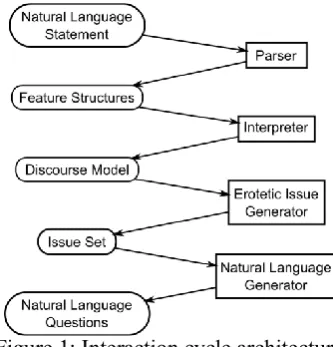
Figure 1: Interaction cycle architecture. Figure 1 presents the simplified architecture for one interaction. Rounded boxes on the left-hand side represent the data structures; the boxes on the right-hand side represent operational mod-ules and the arrows represent input-output data flows. The parser takes natural language text and provides a syntactic and semantic analysis in terms of feature structures which are sets of attribute-value pairs. The content of feature structures is systematized according to SFL theory. The interpreter instantiates the discourse model from the feature structures. The dis-course model serves as the central knowledge repository. Based on it and its instantiation the
erotetic issue generator creates all possible is-sues that can be raised, given a particular in-stance of discourse model. An issue is a formal representation of a question. The issues serve as
mod-[
process type possesi e process catch
g a lion f os tourist
]
Figure 2: Feature structure example. The parser distinguishes among 16 process types (Figure 3) and 29 participant roles where 17 are simple and 12 are compound. In (Fawcett, 2009) are proposed 65 configurations of process types and participant roles. The se-mantics of such configurations is captured by GUM ontology (Bateman, Henschel, & Rinaldi, 1995). However the process type and partici-pant role classifications are different, therefore a structural adaptation is required to provide compatibility. We describe the adaptation in the next section.
4
The Discourse Model
The discourse model proposed here draws mainly on GUM. Generalized Upper Model (Bateman et al., 1995) is a linguistically moti-vated upper level ontology that is domain and task independent. It serves an interface between the linguistic and conceptual forms. This model is compatible with SFL experiential line of meaning which deals with semantic content of text. We further propose a temporal extension and two structural modification of GUM.
Figure 3: The Process Type classification. The first structural modification consists in adaptation of process type and participant role classifications. GUM is build based on Halli-dayan classification (Halliday & Matthiessen, 2004) whereas we propose to use the one de-scribed in (Fawcett, 2009). The main reason for such adaptation is the SFL parser which pro-duces semantic descriptions according to the
latter classification. The top level classification of Fawcett’s process types is presented in Fig-ure 3.
The second structural modification consists in dividing the process types into eventive and
sta-tive processes. This distinction is
metaphysical-ly motivated in DOLCE upper level ontology (Borgo & Masolo, 2009) and linguistically mo-tivated by Bach (1986). This distinction is nec-essary for the temporal extension of the model.
So we propose that attributive, possessive,
loca-tional, emotion and environmental processes to
correspond to states while the action,
direction-al, matching, perception and cognition process-es to be classified as events. This is an intuitive distinction among the process types based on their description and more fine grained division shall be proposed that will, for example, take into consideration the participant roles as well.
In natural language a finite clause is anchored
into the “here and now”, so to speak, bringing
the clause into the context of the speech event.
This is achieved either by reference to the time
of speaking (via tense) or by reference to the
judgment of the speaker (via modality). We hold the view that, in a narrative, each partici-pant can be described via a temporal evolution complemented by atemporal descriptions (e.g. modal, conditional, causal, concessive, etc.) We focus on the former one and the atemporal one is left for future works.
The temporal dimension provides a linear layout for events and states. Each participant
has one or more time-lines. The events are dis-tributed along the timeline(s) of the participants. The events happen in time and are assumed to be bound by start and end time-points. The
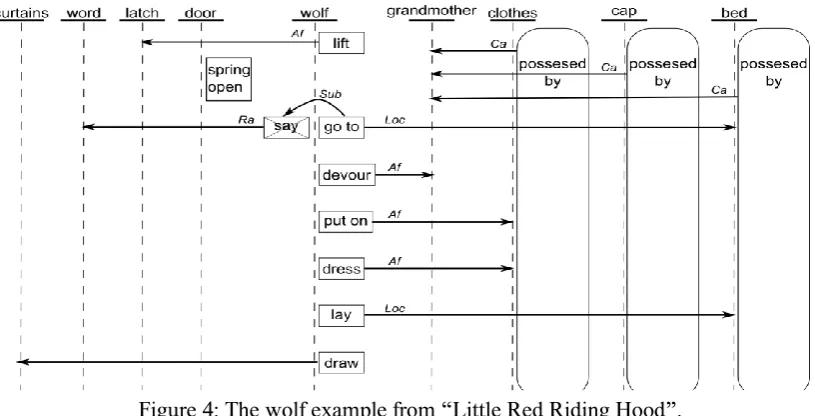
Figure 4: The wolf example from “Little Red Riding Hood”. As mentioned before, not all statements can
be integrated into a timeline for they are
atem-poral. For example some present simple clauses cannot be (easily) located in time when they express facts or generalizations. In this case the events are placed on “atemporal timelines”. In the same manner are treated the conditional or causal relations. The decision to place them on atemporal timelines is merely pragmatic and aims to keep a uniform representation of events and states.
In Figure 4, is provided an example from
“Little Red Riding Hood”. It is a graphical rep-resentation of a paragraph interpreted into the discourse model.
“The wolf lifted the latch, the door sprang open, and without saying a word he went straight to the grandmother's bed, and devoured her. Then he put on her clothes, dressed himself in her cap, laid himself in bed and drew the curtains.”
At the top of the schema are all the partici-pants mentioned in the discourse ordered arbi-trarily. Each of them has a timeline depicted by a dotted vertical line. The events are drawn by squared boxes while the states by rounded box-es. The events are temporally delimited, posi-tioned and ordered as they flow in the dis-course, while the states stretch along the entire duration of the discourse. The temporal interval relations between events are implicit in the graphical representation.
The events are placed on the timeline of the subject participant, e.g. Agent that brings about the event or the possessed thing which is the head noun in possessive nominal phrases. Whether it is a state or event (e.g. wolf lifted the latch) is decided according to the earlier classi-fication. Note that we treat possessive pronouns
in nominal phrases as nominalised possessive
processes. For example “grandmother’s bed” is
semantically equi alent to “grandmother has a bed” where the grandmother is the carrier and the bed is the possessed thing.
The participant roles become orthogonal rela-tions from events or states to other participants (and sometimes to events or states, e.g. phe-nomenon participant role occurring in mental or influential processes). For example in Table 1,
the frame semantic relations are the
agent-carrier, possessed and beneficiary. So the event of giving is placed on the lion’s timeline and from this event there are two orthogonal rela-tions to the teapot and aunt. Another example is in Figure 4 where lift is placed on wolf’s time-line but it has the second participant latch which has the role of affected.
In current model only noun participants are considered. Therefore the pronouns (he, her) have to be anaphorically resolved. We assume that there is already a mechanism to resolve anaphora as correference indexing in order to trace the identity of participants and have a con-cise instance of the model.
This is just a preliminary attempt to charac-terize the discourse model since it is still a work in progress we do not yet provide a formal char-acterisation of it.
5
Axiomatization of Process Types and
Participant Roles
partici-pant roles. Such axiomatization will also serve as foundation in question generation process.
For example action processes are
distin-guished from mental processes as the first one occurs in physical realm while the second one in mental realm. The actions are considered to express quanta of change in the world occurring
over time and they fall under the event
catego-ry. In other words, the world transitions from an initial state si through event e to a final state sf.
Action(e) -> si <before e <before sf
The actions can take a limited number of par-ticipant roles: agent, affected, carrier and creat-ed. For example agent role is given to the partic-ipant that brings about the event. We can say that agent x does the action e. The affected role is given to the participant that receives some change through action e. The created role is given to the participant that did not exist before
the action e and it came about as a result of
ac-tion e. We propose new relations to distinguish
between the linguistic semantic and the com-mon sense axiomatization which is of a concep-tual nature. Below is the formal expression of relations between participants and the event.
Agent(x) -> do(x,e) Affected(y) -> change(e,y)
Created(z) -> create(e,z)
If we put together all the above axioms, we can say that in the world can occur an event which may be a happening (no agent involved) or a doing of an agent. As a consequence there is a state change in the affected participant or creation of a new participant that did not exist before. Also the agent is relevant for pre-event state si while the affected and created are
rele-vant for post-event state sf.
Action(e) -> (do(x,e) OR happen(e)) AND (change(e,y) OR
cre-ate(e,z))
A similar common sense axiomatization is
proposed for relational processes. They stand in
the opposition to both actions and mental pro-cesses and describe the state of affairs. For ex-ample, in an attributive process, the carrier is
ascribed an attribute which can be either
quali-ty, identiquali-ty, class or an abstract role from the domain model. The attributive processes do not denote any change so they fall into state catego-ry. We can say that in a particular state of the world s there is a carrier c that can be character-ized by its attribute a.
Attributive(s) AND Carrier(c) AND Attribute(a) -> is(c,a,s)
Similar reasoning applies to possessive rela-tional processes.
Posessive(s) AND Carrier(c) AND Posessed(p) -> have(c,p,s)
Now we can say that a state of the world s is
characterized by the sum of relations that hold between carriers and their ascribed attributes, possessions, matches etc.
Such axiomatizations fall beyond the dis-course model because they are of conceptual nature even if they are derived from a linguistic model. In the next section we describe how questions can be generated from discourse model based on such common sense axiomati-zations.
6
On Question Raising
We take a situated and context-bound perspec-tive on knowledge and language. SFL, through semantic frames, provides a linguistic support to situated knowledge while formal representation is provided through situation semantics (Barwise & Perry, 1983).
Given a relation rel(p1,p2 … pn) where all
pa-rameters are known we generate an issue by assuming that there exist an alternative value for a parameter pk where 1≤k≤n. We formally
rep-resent a question via lambda notation as fol-lows:
λpk rel(p1, p2…pk…pn)
In the following we illustrate the question ris-ing mechanisms by usris-ing as seeds the below examples.
a. [The wolf]ag [lifted]action [the latch]aff
b. [grandmother’s]car [bed]poss
They can be represented as common sense axiomatization from above, as follows:
a. Action(lift) -> do(wolf,lift) AND change(lift, latch) si <before lift <before sf
b. Posessive(s) AND
Carrier(grandmother) AND Posessed(bed) ->
have(grandmother,bed,s)
Alternative participant questions are ques-tions aiming to elicit alternative participants given the context of a particular event or state.
So we can ask for alternative participants in do
and change relations as follows:
This can be translated into natural language as
“Who else can lift a latch?” “What else can a wolf lift?”
“Who else has a bed?”
Alternative event questions are questions aiming to elicit in what events the current par-ticipants can be in.
λe do(wolf,e); λe change(e,latch)
Correspondingly, the natural language ex-pression is:
“What else a wolf can do?” “What else can happen to a latch?” Stateelicitation questions seek to receive new attributes for a given participant:
λa has(grandmother,a,s)
“What else does the grandmother ha e?”
Now taking into consideration change-based axiomatization for actions we can formulate questions about initial and final states even if they are not mentioned in the discourse. To do so we appeal to temporal relations to specify the position of the targeted state relative to the event.
Consequence elicitation questions seek to identify the affected participants and their corre-sponding post-event attributes. For example if we want to elicit how the latch changed after the event we write it as follows:
λa is(latch,a,sf) AND sf >after lift
“How is the latch after the lift?” or “How did the latch change after the lift?” Temporal elicitation questions aim to elicit new events or states related to a target event. For example, an event e1 is mentioned in the
discourse. Then, for a given an interval relation,
e.g. before, assume there is an unknown state or
event e2 that stands in this relation to e1. In
nat-ural language, this hypothesis can be translated into a question “What happened before e1?”
The satisfiable answer to this question will bring the new event or state statement e2 into
the discourse model. And it will be placed into a before relation with e1.
When decontextualized, the above questions might sound odd or unnatural. Therefore a ques-tion selecques-tion mechanism would need to be build based on questioning sequences found in natural language dialogues that follow a predict-able goal and focus of attention. We do not cov-er such a mechanism hcov-ere, but rathcov-er are intcov-er-
inter-ested to explore means for finding possible question classes. When questions raising meth-ods are clear and the possible classes are known then the selection algorithm can employ them to simulate coherent questioning sequence. So far we have provided some examples of question classes that can be generated from the discourse model, but it is neither an exhaustive nor sys-tematic enumeration of question classes and more work needs to be done in this area. We conclude now on the proposed discourse model and question raising mechanism.
7
Discussion and Conclusions
The current paper is motivated by the idea of an automatic interviewing system. We discuss a preliminary description of a discourse model and question generation mechanism. The dis-course model takes as foundation GUM ontolo-gy and can represent linguistically motivated semantic relations between entities and events and states in which they participate. However those relations are general enough as to enable further transformation into domain ontology. The model is also temporally imbued so the events and states can be ordered along the time-lines of entities. In the last part of the paper we show how questions can be generated for the knowledge elicitation process.
The automatic interviewing system is moti-vated by ontology building process. The in-stances of the presented discourse model can be transformed into the topic/domain ontologies once the elicitation process if over. This chal-lenge shall be addressed in the future work.
There are many unaddressed challenges. A few important ones are: reference tracking of participants and events, accommodation of re-ceived answers and knowledge update, question selection and sequencing along the interview session, dialogue management and turn taking, natural language generation for questions (either by employing a fully-fledged natural language generation system or a template-based approach suffices for this task).
References
James F. Allen. 1983. Maintaining knowledge about temporal intervals. Communications of the ACM,
26, 832–843.
Emmon Bach. 1986. The algebra of events.
Linguistics and Philosophy, 9, 5–16.
Jon Barwise, & John Perry. 1983. Situations and
Attitudes. Semantics A Reader (p. 352). MIT
Press.
John A. Bateman. 2008. Systemic-Functional Linguistics and the Notion of Linguistic Structure: Unanswered Questions, New Possibilities. In Jonathan J. Webster (Ed.), Meaning in Context:
Implementing Intelligent Applications of
Language Studies (pp. 24–58). London, New
York: Continuum.
John A. Bateman, Renate Henschel, & Fabio Rinaldi. 1995. The Generalized Upper Model . Retrieved from http://www.fb10.uni-bremen.de/anglistik/langpro/webspace/jb/gum/gu m-2.pdf
Stefano Borgo, & Claudio Masolo. 2009. Foundational choices in DOLCE. Handbook on
Ontologies, 2, 361–381.
Eugeniu Costetchi. 2013. A method to generate simplified Systemic Functional Parses from Dependency Parses. In Proceedings of
DepLing2013 [forthcoming]. Prague.
Eugeniu Costetchi, Eric Ras, & Thibaud Latour. 2011. Automated Dialogue-Based Ontology Elicitation. Procedia Computer Science, 7, 185– 186.
Robin P. Fawcett. 2009. How to Analyze Process and Participant Roles. In The Functional Semantics Handbook: Analyzing English at the
level of meaning. London: Continuum.
Mariano Ferndndez, Asuncin Gmez-p, & Natalia Juristo. 1997. METHONTOLOGY : From Ontological Art Towards Ontological Engineering. In Assessment (Vol. SS-97–06, pp. 33–40). AAAI Press.
Charles J. Fillmore. 1985. Frames and the semantics of understanding. Quaderni di Semantica, 6, 222– 254.
Paul H. Grice. 1975. Logic and Conversation. In P. Cole & J. L. Morgan (Eds.), Syntax And
Semantics (Vol. 3, pp. 41–58). Academic Press.
Thomas R. Gruber. 1993. Towards Principles for the Design of Ontologies Used for Knowledge Sharing. Formal Ontology in Conceptual Analysis
and Knowledge Representation, 43, 907–928.
Michael A. K. Halliday, & Christian Matthiessen. 2004. An introduction to functional grammar. London: Hodder Education.
Martin Kay. 1985. Parsing In Functional Unification Grammar. In D.Dowty, L. Karttunen, & A. Zwicky (Eds.), Natural Language Parsing. Cambridge University Press.
William C. Mann, & Sandra A. Thompson. 1988. Rhetorical structure theory: Toward a functional theory of text organization. Text, 8, 243–281. Marie-Catherine Marneffe, Bill MacCartney, &
Christopher D. Manning. 2006. Generating Typed Dependency Parses from Phrase Structure Parses.
In LREC 2006 (Vol. 6, pp. 449–454).
Marie-Catherine Marneffe, & Christopher D. Manning. 2008. The Stanford typed dependencies representation. Coling 2008 Proceedings of the workshop on CrossFramework and CrossDomain
Parser Evaluation CrossParser 08, 1, 1–8.
Michael O’Donnell. 2012. Transiti ity Development in Spanish Learners of English. In Proceedings of
39th International Systemic Functional
Linguistics Conference. Sydney, Australia.
Marvin Minsky. 1974. A framework for representing knowledge. In P. Winston (Ed.), The Psychology
of Computer Vision (Vol. 20, pp. 211–277).
McGraw-Hill.
Amy C. Neale. 2002. More Delicate TRANSITIVITY: Extending the PROCESS TYPE
for English to include full semantic classifications.
Cardiff.
Natalya F. Noy, & Deborah L. Mcguinness. 2000. Ontology Development 101 : A Guide to Creating Your First Ontology. Development, 32, 1–25. Robert Kasper. 1988. An Experimental Parser for
Systemic Grammars. In Proceedings of the 12th
Int. Conf. on Computational Linguistics.
Budapest.