The MATE workbench annotation tool, a technical description
Amy Isard
, David McKelvie
, Andreas Mengel
y, Morten Baun Møller
z
HCRC Language Technology Group Division of Informatics, University of Edinburgh
famyi, [email protected]
y
Institut f¨ur Maschinelle Sprachverarbeitung Universit¨at Stuttgart
z
Natural Interactive Systems Laboratory, Odense University [email protected]
Abstract
The MATE workbench is a tool which aims to simplify the tasks of annotating, displaying and querying speech or text corpora. It is designed to help humans create language resources, and to make it easier for different groups to use one another’s data, by providing one tool which can be used with many different annotation schemes. Any annotation scheme which can be converted to XML can be used with the workbench, and display formats optimised for particular annotation tasks are created using a transformation language similar to XSLT. The workbench is written entirely in Java, which means that it is platform-independent.
1.
Introduction
The MATE workbench provides a general framework for defining specialised annotation editors, and makes the writing of an editor tool for a particular annotation scheme and particular annotation task relatively easy. This gen-erality is provided by allowing the use of any annotation schema coded in XML (Bray et al., 1998; Goldfarb and Prescod, 1998) and by allowing the corpus designer to write rule based transformations using a language very similar to Extensible Stylesheet Language Transformations (XSLT) (Clark, 1999) which describe how the corpus is presented to the annotator and what editing actions are available. The workbench provides a number of pre-defined stylesheets for use with particular annotation schemes, but its major strength is that it is possible to write new stylesheets for existing or new schemes. There are many existing tools which offer support for annotation, querying and/or display of speech corpora, and an extensive list of these, with links, can be found at the Linguistic Data Consortium’s Linguis-tic Annotation web site (Bird and Liberman, 2000). These tools have been created for many different and sometimes very specific purposes, and the MATE workbench does not aim to replace them all, but to offer a way of creating specific interfaces more easily in future, and to provide a framework which makes it possible to work with many dif-ferent annotation schemes which are written in a common format.
The MATE workbench draws on several existing strands of work to provide a generic annotation tool which supports non-hierarchical markup (particularly necessary for speech due to overlapping annotation schemes and mul-tiple overlapping speakers). The idea of using XML as a annotation standard for natural language processing goes back to the work of the Text Encoding Initiative (Ide and V´eronis, 1995), and the idea of using a database as a central resource for natural language processing was
de-veloped by the GATE project (Cunningham et al., 1996). Data models related to XML and associated query lan-guages were developed by a number of groups including the Lore project (Goldman et al., 1999) and SgmlQL (LeMaitre et al., 1996), and the idea of document transformation using structurally recursive rules comes originally from the work of the DSSSL (Adler, 1997) standard and XSLT working group. Stylesheet transformation languages have so far largely been used to produce static documents, but in this project we extend this to create active editable displays. The Amaya web editor (Vatton et al., 1999) takes a simi-lar approach.
2.
Workbench Architecture
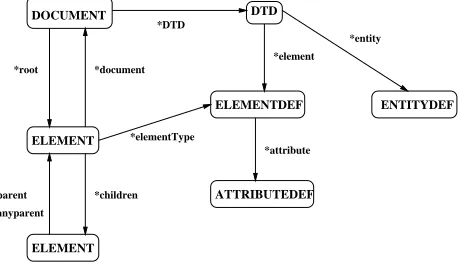
The MATE workbench consists of the following major components, illustrated in figure 1:
an internal database (see section 3.) which is an in-memory representation of a set of hyperlinked XML documents. There are functions for loading and out-putting XML files into and out of the database;
a query language and processor (see section 4.) which are used to select parts of this database for subsequent display or processing;
a stylesheet language and processor (see section 5.1.) which respectively define and implement a lan-guage for describing structural transformations on the database. The output of a transformation applied to a document can either be another document in the database or a set of display objects. These are used to define how the database will be presented to the user;
components used for building a display are panes (used to divide the display into two or more sections), vertical lists, horizontal lists, and text boxes (see figure 6 below for an example display).
5.3. Display Actions
In order to allow the user to interact with displays built from MATE display objects, we have added certain action properties to each object. These specify, for example, the behaviour which will occur if a user clicks on an object in the display, and when one of these display actions occurs, code in one of the attributes of the display object defines what is to happen. For example, if an XML file is associ-ated with a speech file (through the use of start and end time attributes on word elements) then an action can be written which causes the relevant section of speech to be played when a word is clicked on. The code is written in a Lisp-like syntax which allows any Java method to be called. The basic idea is that the code can manipulate the internal rep-resentation and/or the display objects, and thus user actions on the display structure can modify the internal represen-tation. We provide a “redisplay” method, which reruns the stylesheet on the modified part of the database and redis-plays the output. We are not yet entirely satisfied with this action syntax, and in future work we will look at defining a set of common editing paradigms, so that stylesheet writers will be able to use these without having to know about the code that does the modifications of the database.
6.
User Interface
Figure 4: File Chooser Menu
When the workbench is started, a file chooser window (figure 4) appears, and the user can select a project, causing a list of the files referenced by the project file to appear in the right-hand window. The project can then be run to display a particular interface which consists of one or more windows, each contraining a speech player, or a number of panes of text. An example interface is shown in figure 6.
6.1. Tools
Various tools can be called from the file chooser win-dow menus. The querying functions of the workbench can be called in two ways: 1) The project on which the query is to be performed can be chosen from a menu in the startup window, without creating a display and 2) if a display has
already been created, the files which make up the project used to create it will be queried. Both of these methods bring up a query window which interactively guides the user through the process of composing a query. The results of the query are shown as a list, and if a display is already present, clicking on an element in the list repositions the main display on that element.
We currently have two available file format conversion tools. One converts from Entropics Xlabel format (En-tropic, 1996) to a simple XML format, creating an element for each label (by default called “word”) with start and end time attributes and content from the label. The other con-verts from BAS Partitur format (Schiel et al., 1998) into an XML format.
6.1.1. Audio Player
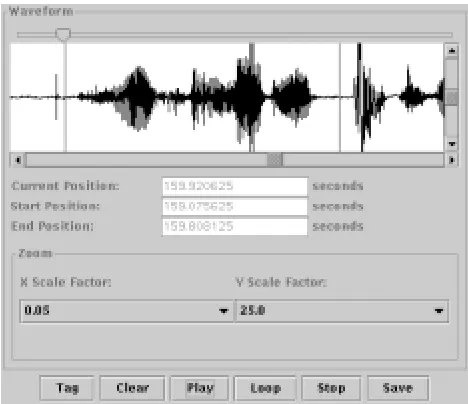
Figure 5: Audio Player Window
An audio player window (figure 5) can be started in two ways: 1) from the main tools menu, in which case the user is prompted for a filename, or 2) by the selection of an audio file in the right-hand side of the file choose menu. This tool provides a scalable waveform display and stan-dard playback functions. When a segment of speech has been selected, it is also possible to use a very simple tran-scription function, which produces an XML element with id, start and end times, and a label, and this can be saved to a file. We do not envisage that users will want to use the MATE workbench for large-scale transcription exercises as there are existing tools well suited to this purpose.
6.1.2. Coding Module Editor
Within the MATE workbench, the coding module and coding files are represented in XML providing an easy and precise parsing of the module and its corresponding coding files. However, using the CME to compose a coding mod-ule will only require a minimal knowledge of XML; the tool itself automatically generates the XML DTD from the ele-ment structure defined by the user. The markup declaration section of the coding module is represented as a tree, and the user adds elements, attributes, entities and comments to the tree to construct the markup declaration. For each node the name, type, etc. is specified. The tree can be parsed to create a coding module text document. The markup decla-ration node and its sub-nodes contain information that can be used to create a DTD which is used internally in the Mate workbench.
6.2. Example Display
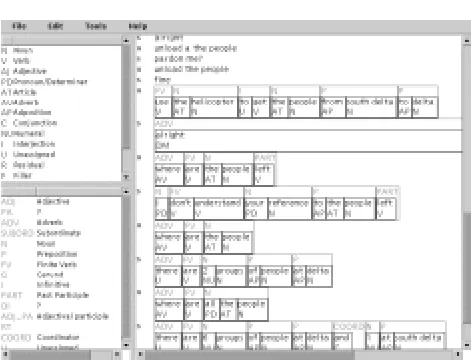
Figure 6: Morphosyntax Display
Figure 6 shows a display of morphosyntactic annota-tion. The display is built of three panes, each of which consists of a vertical list made up of horizontal lists which in turn are made up of text boxes. Figure 7 shows a frag-ment of the stylesheet used to create the display; this tem-plate matches all word elements which are the last child of a chunk element, and creates the top level of boxes in the example. Further templates match words in other contexts, to build up the whole picture.
7.
Evaluation
At the time of writing, the MATE workbench is under-going evaluation by members of the MATE project and its panel of advisors. There is not yet a full-scale evaluation of how well the software works on a large annotation project, which is essential to fully demonstrate the validity of our approach. However, we have developed a number of differ-ent annotation schemes and stylesheets for these schemes and these are available with the workbench.
Information on how to obtain a copy of the MATE workbench can be found at http://mate.nis.sdu.dk
8.
Acknowledgements
The work described here was funded by the European Union (MATE project: Telematics LE4-8370). We wish to
<msl:template match="($w word)($ch ch);($ch 2ˆm $w)"> <MVerticalList Alignment="Left"
FrameVisible="True" FrameColor="Magenta"> <msl:apply-templates
select="($ch ch);($ch 2ˆ $this)"/> <MHorizontalList Alignment="Left">
<msl:for-each
select="($w word)($ch ch)($mw mw);($ch 2ˆm $this) and ($ch 2ˆn $w) and ($mw 1ˆm $w)">
<MVerticalList Alignment="Left"
FrameVisible="True" FrameColor="Blue"> <MHorizontalList Alignment="Left">
<msl:for-each
select="($w word)($mw mw);($mw 1ˆm $this) and ($mw 1ˆ $w)" cache="no">
<MTextEditor FontSize="12"> <msl:apply-templates/> <msl:text> </msl:text> </MTextEditor>
</msl:for-each> </MHorizontalList>
<MHorizontalList Alignment="Left"> <msl:apply-templates
select="($mw mw);($mw 1ˆm $this)" cache="no"/> </MHorizontalList>
</MVerticalList> </msl:for-each> </MHorizontalList> </MVerticalList> </msl:template>
Figure 7: Fragment of an MSL stylesheet
thank our respective institutes for their support.
9.
References
Abiteboul, Serge, Peter Buneman, and Dan Suciu, 2000.
Data on the Web: from relations to semistructured data and XML. San Francisco, California: Morgan
Kauf-mann.
Adler, Sharon C., 1997. The “ABCs” of DSSSL.
Struc-tured Information/Standards for Document Architec-tures, 48(7):597–602. Journal of the American Society
for Information Science, Special Issue.
Bird, Steven and Mark Liberman, 2000. Linguistic annotation resources. Linguistic Data Consortium. www.ldc.upenn.edu/annotation.
Bray, Tim, Jean Paoli, and C. M. Sperberg-McQueen, 1998. Extensible Markup Language. World Wide Web Consor-tium. www.w3.org/TR/REC-xml.
Clark, James, 1999. XSL Transformations (XSLT). World Wide Web Consortium. www.w3.org/TR/xslt.
Cunningham, Hamish, Yorick Wilks, and Robert J. Gaizauskas, 1996. GATE – a general architec-ture for text engineering. In Proceedings of the
16th International Conference on Computational Linguistics. Copenhagen, Denmark. See also www.dcs.shef.ac.uk/research/groups/nlp/gate.
DeRose, Steve, Ron Daniel Jr., and Eve Maler, 1999. XML Pointer Language (XPointer). World Wide Web Consor-tium. www.w3.org/TR/xptr.
DeRose, Steve, Eve Maler, David Orchard, and Ben Traf-ford, 2000. XML Linking Language (XLink). World Wide Web Consortium. www.w3.org/TR/xlink.
Entropic, 1996. Waves+ Manual. Entropic Research Lab-oratory Inc. www.entropic.com.
Goldfarb, Charles F. and Paul Prescod, 1998. The XML
Goldman, Roy, Jason McHugh, and Jennifer Widom, 1999. From semistructured data to XML: Migrating the Lore data model and query language. In Proceedings of the
2nd International Workshop on the Web and Databases (WebDB ’99). Philadelphia, Pennsylvania. See also www-db.stanford.edu/lore.
Heid, Ulrich and Andreas Mengel, 1999. A query language for research in phonetics. In Proceedings of the
Inter-national Congress of Phonetic Sciences (ICPhS99). San
Francisco, California.
Ide, Nancy and Jean V´eronis (eds.), 1995. The Text
En-coding Initiative: Background and Context. Dordrecht:
Kluwer. See also www.tei-c.org.
Isard, Amy, David McKelvie, and Henry S. Thomp-son, 1998. Towards a minimal standard for dia-logue transcripts: A new SGML architecture for the HCRC Map Task corpus. In Proceedings of
the 5th International Conference on Spoken Lan-guage Processing, ICSLP98. Sydney, Australia. www.ltg.ed.ac.uk/Papers/dmck/icslp98.ps.
Klein, Marion, Niels Ole Bernsen, Sarah Davies, Laila Dy-bkjaer, Juanma Garrido, Henrik Kasch, Andreas Mengel, Vito Pirelli, Massimo Poesio, Silvia Quazza, and Claudia Soria, 1998. MATE deliverable 1.1: Supported coding schemes. mate.nis.sdu.dk/about/deliverables.html. LeMaitre, Jacques, Elisabeth Muriasco, and Monique
Rol-bert, 1996. SgmlQL, a language for querying SGML documents. In Proceedings of the 4th European
Confer-ence on Information Systems (ECIS’96). Lisbon,
Portu-gal. See also www.univ-tln.fr/gect/simm/SgmlQL. Marchiori, Massimo, 1998. QL’98 - the Query
Lan-guages Workshop. World Wide Web Consortium. www.w3.org/TandS/QL/QL98.
Mengel, Andreas, 1999a. Manual for Q4M. Institut f¨ur Maschinelle Sprachverarbeitung, Universit¨at Stuttgart. www.ims.uni-stuttgart.de/projekte/mate/q4m.
Mengel, Andreas, 1999b. MATE
deliver-able 2.1: DTDs and notes on schemas.
mate.nis.sdu.dk/about/deliverables.html.
Murata, Makoto and Jonathan Robie, 1998. Obser-vations on structured query languages. In Mas-simo Marchiori (ed.), Proceedings of QL’89 - The
Query Languages Workshop. Boston, Massachussets.
www.w3.org/TandS/QL/QL98/pp/murata-san.html. Schiel, Florian, Susanne Burger, Anja Geumann, and Karl
Weilhammer, 1998. The partitur format at bas. In
Pro-ceedings of the First International Conference on Lan-guage Resources and Evaluation. Granada, Spain.
Vatton, Ir`ene, Ramzi Gu´etari, Jos´e Kahan, and Vincent Quint, 1999. Amaya – W3C’s editor/browser. World Wide Web Consortium. www.w3.org/Amaya.