Methods and Approaches for Characterizing Learning Related Changes Observed in
functional MRI Data — A Review
Raju S. Bapi
*, V. S. Chandrasekhar Pammi, K. P. Miyapuram
Department of Computer and Information Sciences
University of Hyderabad
Gachibowli, Hyderabad – 500 046, India
Email:
*[email protected]
ABSTRACT
Brain imaging data have so far revealed a wealth of information about neuronal circuits involved in higher mental functions like memory, attention, emotion, language etc. Our efforts are toward understanding the learning related effects in brain activity during the acquisition of visuo-motor sequential skills. The aim of this paper is to survey various methods and approaches of analysis that allow the characterization of learning related changes in fMRI data. Traditional imaging analysis using the Statistical Parametric Map (SPM) approach averages out temporal changes and presents overall differences between different stages of learning. We outline other potential approaches for revealing learning effects such as statistical time series analysis, modelling of haemodynamic response function and independent component analysis. We present example case studies from our visuo-motor sequence learning experiments to describe application of SPM and statistical time series analyses. Our review highlights that the problem of characterizing learning induced changes in fMRI data remains an interesting and challenging open research problem.
KEYWORDS:
General Linear Model, Learning, SPM, modelling HRF, time series analysis, ICA1.
INTRODUCTION
learning as it provides a reasonable spatial and temporal resolution (~1–1.5 mm; 3–5 seconds, respectively) compared to other neuroimaging techniques such as positron emission tomography (Volkow et al., 1997 ). After ten years of fMRI research, there is still much to learn about how neuronal activity, haemodynamics and fMRI signals are interrelated (Heeger and Ress, 2002). A recent review of Ugurbil et al. (2003) suggested the possibility of obtaining spatially accurate and quantitative data on brain function from magnetic resonance technologies.
It has long been established that the brain undergoes learning related changes – both short and long term (for example, Karni et al., 1995; Kaas, 1995). Although "learning" is an important cognitive function that the brain is constantly engaged in, most of the current fMRI studies do not explicitly investigate this phenomenon. A possible reason for not undertaking tasks involving learning could be that the image analysis methodology for unraveling time dependent changes is still rudimentary in the fMRI modality. We illustrate possible approaches for characterizing learning related fMRI activity by taking case studies from our experiments in motor skill learning where subjects learned finger movement sequences. The aim of these experiments is to unravel the neural bases for learning visuomotor sequences (Bapi et al., 2000b; Pammi et al., 2003). The goal of the current paper is to review possible methods and approaches for characterizing learning related behaviour from fMRI data.
2.
MATERIALS AND METHODS
Figure 1. fMRI box-car design.
A series of whole brain fMRI scans (functional images) are acquired continuously while the subject performed the task inside the scanner. Functional images were acquired in a 1.5 tesla whole-body scanner. The experiment consisted of four sessions and a session comprised 13 epochs of alternating control (C) and test (T) conditions, each lasting for 18 and 36 seconds, respectively (see Fig. 1). During the experiment, a total of 228 scans were obtained with an inter-scan interval of 6 seconds. Each scan covered the entire brain and consisted of 50 axial continuous slices with 3mm thickness. In addition, a high-resolution anatomical brain image of the subject with slice-thickness of 1 mm was collected.
3.
APPROACHES FOR CHARACTERIZING LEARNING INDUCED CHANGES
3.1. Statistical Parametric Map (SPM)
A popular method for fMRI data analysis is called 'Statistical Parametric Mapping' (SPM). SPM is a method of data reduction and condensing of information (in a statistically meaningful way) from a number of individual brain scans into a single image volume that can be more easily viewed and interpreted. A package by the same name is developed by the Wellcome Department of Cognitive Neurology, London. Most fMRI experiments attempt to infer some general property of brain activation from a particular sample of individuals. Conventionally, this requires a pooled analysis corresponding to a group of subjects. Thus, the images need to be in a standardized space prior to statistical analysis. The preprocessing of fMRI images usually proceeds by setting a common origin for all images and correcting for any head movements during the scanning period. fMRI images are then normalized (Friston et al., 1995a) using non-linear warping techniques. A high-resolution anatomical image for each subject is additionally acquired in order to ensure correct anatomical localization of brain activation, which is used to determine the parameters for normalizing the functional images. The matching
of the brains in the normalization step is only possible on a coarse scale, since there is not necessarily a one-to-one mapping of the cortical structures between different brains. Hence, the normalized functional images are spatially smoothed with a gaussian filter. The smoothing process also validates the underlying gaussian assumption for the BOLD activity that is in turn used in statistical inference. Statistical analysis is performed on the preprocessed image data using the general linear model (Friston et al., 1995b). The general linear model (GLM) is used to specify the covariates of interest, such as the experimental design and the nature of hypothesis testing to be implemented in the form of a design matrix. Brain activity specific to task is obtained by specifying linear contrasts. The end result is a statistical parametric map (SPM) that can be used to display significant activations overlaid on a high-resolution anatomical image.
The main idea behind the General Linear Model (GLM) is that the observed signal (Y) is a linear combination of explanatory variables (x) and gaussian noise (ε), thereby equivalent to linear regression.
Y
j= x
j1β
1+ ··· + x
jkβ
k+ ··· + x
jLβ
L+
ε
jThe βk are unknown parameters to be estimated, corresponding to each of the L explanatory variables (xjk) for the jth observation of Y. This can be expressed in the matrix form as
Y = X
ββ
+
εε
Here, X is called the design matrix that contains the explanatory variables and ββ is the parameter estimate. Each column in the design matrix corresponds to some effect that one has built into the experiment or effects that may confound the results. The rows of the matrix correspond to the number of observations. Commonly used parametric models, such as linear regression, t-tests and analysis of variance (ANOVA) are special cases of the general linear model.
3.1.1. Fixed Effects Model and Conjunction analysis
experimental variable is already known. Further, the statistical assumption in such fixed effects models is that the test epochs are replicated and hence can be averaged and compared to the control epochs. Fixed effects model can also be effectively used to find the typical activation of a group of subjects or compare between subject groups. For example, if among eight subjects, three of them show significant activation then the average activation will also show significant effect.
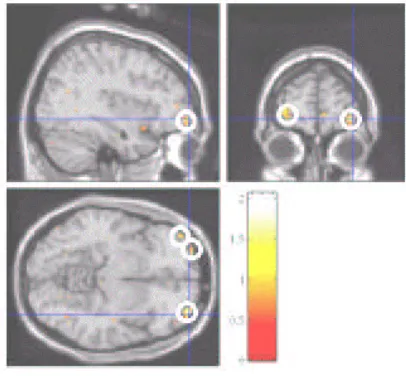
Average result from group analysis considers only the within-subject / session variability. One can perform Conjunction analysis at the second level to fixed effects model to account for variability of activation across the subjects. Fixed effects models along with conjunction analysis are powerful tools to characterize typical and generic aspects of the functional architecture of the human brain (Friston et al., 1999). For the case study that we present in this paper, we performed a fixed effects analysis on a pool of five subjects' data. Corresponding to the trial and error task when compared to the guided task, a typical activation was found in the brain area called Orbitofrontal Cortex (OFC). We further verified this activation using conjunction analysis of subject specific contrasts. As the results shown in Figure 2 indicate, OFC activation remains intact in the conjunction analysis also. In summary, one serious limitation of the fixed effects analysis is that the variability across subjects / sessions is ignored and hence the inference cannot be generalized to population.
Figure 2. Orbitofrontal Cortex activity using 2x6 >1x12 contrast.
3.1.2. Partitioning the Model into Learning Stages
way to incorporate early versus late differences is to partition the overall average into two parts – one corresponding to the average of early epochs and the other corresponding to the late epochs. The comparison of these two averages gives us the typical features of the early stages of learning and that of the late stages. In the current case study, it is interesting that the activation in OFC is observed in late stage but not in the early stage.
3.1.3. Time effects within a session (Parametric Modulation)
In the approach outlined thus far, we ignored any session specific improvements. These can be accounted by using the "parametric modulation" approach in SPM. Parametric modulation is a special case of the approach of using "user specified regressors" in SPM. Regressors are used to study session specific adaptation in brain activity, general effects of time on brain activity and Brain-Behaviour correlations effectively.
3.1.4. Random Effects Analysis (RFX)
All the above methods use fixed effects model where inter-session variance is ignored. Subjects continually adapt to a particular task and both neuronal and cognitive adaptations take place. It can thus be argued that no observation is truly a replicate of a previous one (Vazquez and Noll, 1998). An approach called random effects analysis (RFX) takes inter-session variance also into account and provides generalizability of results to populations and also to make quantitative inferences (Friston et al., 1999). The implementation of RFX in SPM package involves a two-level analysis — in the first level a fixed effects analysis is done and then followed by a second level analysis. In the second level analysis, the contrast images from the first level are analyzed using student's t-test or ANOVA-like methods. Problems with RFX are that it requires large sample and is more complex to implement.
studying learning related effects. As such these methods address the problem only partially. In the next section, we point out alternative approaches.
4.
ALTERNATIVE APPROACHES FOR CHARACTERIZING LEARNING
INDUCED CHANGES
4.1. Statistical Time Series Approaches
As described in the previous section, the SPM framework has special limitations when used for studies that investigate learning and similarly for investigating pharmacological effects. Hence there is an immediate need to explore alternative methods that explicitly characterize the effects of time in fMRI data. One alternative is to augment the current methodology with a second-level analysis where statistical time series techniques are applied on regions selected from the first-level ANOVA based analysis. Explicit modelling of time series can potentially reveal and enable the characterization of learning induced changes in the brain activity. A series of 228 BOLD intensity values are obtained from the activated brain areas. These intensity values are extracted from the local maxima (of voxels) in the volume of interest as revealed by the SPM fixed effects analysis described in section 3.1.1. We used the standard Auto Regressive Integrated Moving Average (ARIMA) statistical time series model (Box and Jenkins, 1976), as it is well known for uncovering hidden patterns in time series data.
4.2. Modelling haemodynamic response function (HRF)
The other possible approach to characterize learning effects is to explicitly model and estimate the haemodynamic response function (for example, Svensen et al., 2000; Marrelec et al., 2002). HRF is the theoretical signal that BOLD fMRI would measure in response to a single, very short stimulus of unit intensity. The local change of BOLD is not immediate but usually has a delay of 2-6 seconds from the onset of stimulus. This change is observed to increase slowly and attains maximum and returns to the baseline. The signal obtained from the fMRI experiments generally consists of noise and BOLD response components. The noise is due to physiological sources such as breathing, heartbeat and system sources like scanner and noise drift.
Estimation of the HRF is of great interest when analyzing fMRI data, since it can give a deep insight into the underlying dynamics of brain activation and relationship between activated areas. There are broadly two categories of techniques for HRF estimation — parametric approaches and non-parametric approaches. In parametric approach HRF is modelled by functions such as Gaussian, Gamma, Poisson etc. These functions give a parsimonious representation of the underlying HRF. With these models the problem simplifies to estimating the parameters of the above functions. In the non-parametric approach the HRF is modelled by an FIR filter. The coefficients of FIR filter are then estimated from the fMRI time series data.
4.3. Independent Component Analysis (ICA)
allows one to design experiments in the absence of fixed effects, which are necessary for conventional ANOVA-type models.
5. SUMMARY AND CONCLUSIONS
In this review, we have presented four different approaches for studying the temporal dynamics of brain activity, especially for learning tasks. The first approach is the traditional analysis using linear methods such as Statistical Parametric Mapping. Fixed effects model together with conjunction analysis in SPM can potentially help in characterizing typical activation in subjects. Random Effects analysis can be used to generalize results to the population. SPM framework is useful but has serious limitations for characterizing learning effects. The second approach is to use statistical time series methods at the second level on the results obtained from the first level fixed effects analysis. We presented example case studies to illustrate these two approaches.
The other two approaches are explicit modelling of HRF and ICA. Modelling HRF is also of interest because HRFs are increasingly suspected to vary from region to region, from task to task, and from subject to subject. ICA appears to be promising, as it does not make any assumptions about the brain response signals other than their statistical independence. These approaches will be investigated on our data in the future.
Learning is an important cognitive function and fMRI studies have not yet started investigating this phenomenon seriously. One possible reason is that there are still many interesting open questions related to the analysis methodology for studying learning induced changes in fMRI data.
ACKNOWLEDGMENTS
REFERENCES
Bapi RS, Doya K, Harner AM (2000a) Evidence for effector independent representations and their differential time course of acquisition during motor sequence learning. Exp Brain Res 132:149–162.
Bapi RS, Graydon FX, Doya K (2000b) Time course of learning of visual and motor sequence representations. Annu meeting of society for Neurosci USA.
Bell AJ, Sejnowski TJ (1995) An information-maximization approach to blind separation and blind deconvolution. Neural Computation 7:1129–1159.
Berns GS, Song AW, Mao H (1999) Continuous functional magnetic resonance imaging reveals dynamic nonlinearities of "dose-response" curves for finger opposition. J Neurosci 19:RC17:1–6.
Box GEP, Jenkins G (1976) Time series analysis: Forecasting and control. 2nd Edition. Holden-Day, San Francisco.
Brahmaiah T, Rao CCS (2002) Time Series Modelling of Learning Induced Changes in Brain Areas as Revealed by Functional MRI Data. Master’s thesis, University of Hyderabad, India.
Friston KJ, Ashburner J, Poline JB, Frith CD, Heather JD, Frackowiak RSJ (1995a) Spatial registration and normalization of images. Hum Brain Mapp 2:165–189.
Friston KJ, Holmes AP, Worsley KJ, Poline JB, Frith CD, Frackowiak RSJ (1995b) Statistical parametric maps in functional imaging: a general linear approach. Hum Brain Mapp 2:189–210.
Friston KJ (1997) Imaging cognitive anatomy. Trends Cogn Sci 1:21–27.
Friston KJ, Holmes AP, Worsley KJ (1999) How many subjects constitute a study? Neuroimage 10:1–5. Heeger DJ, Ress D (2002) What does fMRI tell us about neural activity? Nature Reviews 3:142–150.
Hikosaka O, Rand MK, Miyachi S, Miyashita K (1995) Learning of sequential movements in the monkey: Process of learning and retention of memory. J Neurophysiol 74:1652–1661.
Kaas JH (1995) The reorganization of sensory and motor maps in adult mammals. In: The Cognitive Neurosciences (Gazzaniga M, ed), pp. 51–71. MIT press, Cambridge, MA.
Karni A, Meyer G, Jezzard P, Adams MM, Turner R, Ungerleider LG (1995) Functional MRI evidence for adult motor cortex plasticity during motor skill learning. Nature 377:155–158.
Ogawa S, Lee TM, Kay AR, Tank DW (1990) Brain magnetic resonance imaging with contrast dependent on blood oxygenation. Proc Natl Acad Sci USA 87:9868–9872.
Pammi VSC, Bapi RS, Miyapuram KP, Samejima K, Doya K (2003) The activation of orbitofrontal cortex reflects trial and error processes in a visuomotor sequence learning task. In Networks and Behavior, NCBS Neurobiology Symposium, Bangalore, India.
Svensen M, Kruggel F, von Cramon DY (2000) Probabilistic modeling of single-trial fMRI data. IEEE Trans on Med Imaging 19: 25–35.
Ugurbil K, Toth L, Kim DS (2003) How accurate is magnetic resonance imaging of brain function? Trends in Neurosci 26:108–114.
Vazquez AL, Noll DC (1998) Nonlinear aspects of the BOLD response in functional MRI. Neuroimage 7:108– 118.