FULL PAPER
Anomalous decrease in relatively large
shocks and increase in the
p
and
b
values
preceding the April 16, 2016,
M
7.3 earthquake
in Kumamoto, Japan
K. Z. Nanjo
1*and A. Yoshida
2Abstract
The 2016 Kumamoto earthquakes in Kyushu, Japan, started with a magnitude (M) 6.5 quake on April 14 on the Hinagu fault zone (FZ), followed by active seismicity including an M6.4 quake. Eventually, an M7.3 quake occurred on April 16 on the Futagawa FZ. We investigated if any sign indicative of the M7.3 quake could be found in the space–time changes in seismicity after the M6.5 quake. As a quality control, we determined in advance the threshold magnitude, above which all earthquakes are completely recorded. We then showed that the occurrence rate of relatively large (M≥ 3) earthquakes significantly decreased 1 day before the M7.3 quake. Significance of this decrease was evalu‑ ated by one standard deviation of sampled changes in the rate of occurrence. We next confirmed that seismicity with M≥ 3 was well modeled by the Omori–Utsu law with p ~ 1.5 ± 0.3, which indicates that the temporal decay of seismicity was significantly faster than a typical decay with p= 1. The larger p value was obtained when we used data of the longer time period in the analysis. This significance was confirmed by a bootstrapping approach. Our detailed analysis shows that the large p value was caused by the rapid decay of the seismicity in the northern area around the Futagawa FZ. Application of the slope (the b value) of the Gutenberg–Richter frequency–magnitude distribution to the spatiotemporal change in the seismicity revealed that the b value in the northern area increased significantly, the increase being Δb= 0.3–0.5. Significance was verified by a statistical test of Δb and a test using bootstrapping errors. Based on our findings, combined with the results obtained by a stress inversion analysis performed by the National Research Institute for Earth Science and Disaster Resilience, we suggested that stress near the Futagawa FZ had reduced just prior to the occurrence of the M7.3 quake. We proposed, with some other observations, that a reduction in stress might have been induced by growth of the slow slips on the Futagawa FZ.
Keywords: The 2016 Kumamoto earthquakes, p value of the Omori–Utsu law, b value of the Gutenberg–Richter law, Hinagu fault zone, Futagawa fault zone, Slow slip
© The Author(s) 2017. This article is distributed under the terms of the Creative Commons Attribution 4.0 International License (http://creativecommons.org/licenses/by/4.0/), which permits unrestricted use, distribution, and reproduction in any medium, provided you give appropriate credit to the original author(s) and the source, provide a link to the Creative Commons license, and indicate if changes were made.
Background
Seismicity has become high in almost all parts of Japan
since the 2011 magnitude (M) 9.0 Tohoku-Oki
earth-quake (e.g., Ishibe et al. 2011; Toda et al. 2011). The 2016 Kumamoto earthquakes occurred under these circum-stances, leading to a memorable event that once again
caused devastating damage in Japan. The Kumamoto
earthquakes in the Kyusyu district began with an M6.5
quake on April 14, 2016, at 21:26, on the Hinagu fault zone (FZ), which was followed by numerous shocks
including an M6.4 quake on April 15, at 00:03.
Eventu-ally, on April 16, at 01:25, an M7.3 quake occurred on
the Futagawa FZ. The probability of the occurrence of an
M7.0 or so earthquake on the Futagawa FZ had been
esti-mated by the ERC to be 0–0.9% within 30 years (Earth-quake Research Committee 2016a), which was rather high among the probability at active faults in Japan. In a
Open Access
*Correspondence: nanjo@u‑shizuoka‑ken.ac.jp
1 Global Center for Asian and Regional Research, University of Shizuoka,
3‑6‑1, Takajo, Aoi, Shizuoka 420‑0839, Japan
press conference that was held just after the M6.5 quake, the Japan Meteorological Agency (JMA) warned of the possibility of large aftershocks that should bring fur-ther damages. However, no information on an increased
probability of M7 or larger quakes was announced by
the JMA during the period between the M6.5 quake and
the M7.3 quake. This is because, according to the ERC
(1998) protocol (see also ERC 2016b), the JMA had not considered the occurrence of larger earthquakes after an
M6.5 quake. Moreover, it usually takes more than one
day after a mainshock occurrence for the JMA to issue an announcement of the probability of large aftershocks.
The objective of this study was to investigate if any
indication of the occurrence of the M7.3 quake had not
appeared in the space–time changes in the rate of occur-rence and magnitude-number distribution of shocks after
the M6.5 quake on April 14. We found that M3 or larger
shocks decreased during the period of one day preceding
the M7.3 quake and that the b value (the ratio of small to
large events) became pronouncedly high, corresponding to a decrease in comparatively large shocks, especially in
the area near the hypocenter of the M7.3 quake.
Tremendous efforts have been made to find effective signatures that indicate a large earthquake occurrence
in the near future. A temporal decrease in the b value
may be a candidate (e.g., Suyehiro et al. 1964; Nanjo et al. 2012) while another may be seismic quiescence (e.g., Wiemer and Wyss 1994; Sobolev and Tyupkin 1997). It is known that aftershock activity becomes significantly quiescent preceding large aftershocks (Mtasu’ura 1986). However, any signatures ever proposed do not seem to be universal, since accelerating seismicity (e.g., Bowman
et al. 1998) and an increase in the b value (Smith 1981)
were occasionally reported.
We examined the spatial and temporal trends in
the rate of occurrence of comparatively large (M ≥ 3)
shocks and the b value in the seismic activity following
the M6.5 quake on April 14. We found that the b value
in the activity in the northern area became significantly
high before the M7.3 quake on April 16 and that this
fea-ture corresponded to a decrease in large (M ≥ 3) shocks.
We consider that the high b value and the decrease in
comparatively large shocks were precursors to the M7.3
quake and propose what caused the observed changes in the space–time seismicity.
Methods and data
Activity following the M6.5 quake is well modeled by two
statistical laws: the Gutenberg–Richter (GR) frequency– magnitude law (Gutenberg and Richter 1944) and the Omori–Utsu (OU) aftershock decay law (Utsu 1961).
The GR law is given as log10N = a − bM, where N is the
number of earthquakes per unit time with magnitudes
greater than or equal to M, a describes the productivity
of the regional seismicity, and the b value is the ratio of
small to large events. A high b value indicates a larger
proportion of small earthquakes, and vice versa. In the
laboratory and in the Earth’s crust, the b value is known
to be inversely dependent on differential stress (Scholz 1968, 2015). In this context, measurements of spatial
temporal changes in the b value could be used to discover
highly stressed areas where future ruptures are likely to occur (Schorlemmer and Wiemer 2005; Nanjo et al. 2012). To consistently estimate b values over space and time, we employed the entire-magnitude-range (EMR) technique (Woessner and Wiemer 2005), which also simultaneously calculates the completeness magnitude
Mc, above which all events are considered to be detected
by a seismic network. EMR applies the
maximum-like-lihood method (Aki 1965) in computing the b value to
events with magnitudes above Mc. Uncertainties in b and
Mc were computed by bootstrapping (Schorlemmer et al.
2003, 2004).
Any completeness estimation method is subject to errors, particularly during productive seismicity times such as investigated in this study. To confirm
implica-tions of this study, we compared Mc by the EMR method
with that by other three methods. Results of the compari-son are shown in Appendix 1 and Fig. A1 in Additional file 1.
The OU law is given as λ = k/(c + t)−p, where t is the
time since a mainshock occurrence, λ is the number of
aftershocks per unit time at t with magnitudes greater
than or equal to a cutoff M, and c, k, and p are constants.
p = 1 is generally a good approximation (Omori, 1894). From the view point of the rate- and state-dependent
fric-tion law (Dieterich 1994), variability in p can be observed:
p > 1 and p < 1 for rapidly and slowly decreasing stress,
respectively. When stress increases with time, p = 1 at
t ≫ 0. If this friction law is valid in the Earth’s crust, then
the p values could be used to infer stress history.
Simi-lar to the GR case, we used a maximum-likelihood fit to determine the parameters for this law. Uncertainties in
the p value were computed by bootstrapping.
Our dataset is the earthquake catalog maintained by JMA. From this catalog, we separated events associated with the 2016 Kumamoto earthquakes after the
occur-rence of the M6.5 quake on April 14. Owing to a large
increase in the number of borehole seismic stations (Obara et al. 2005), event delectability has been greatly improved, which lowers the minimum magnitude for catalog homogeneity (Nanjo et al. 2010). Since 2000, the
minimum magnitude is about M = 0–1 in the Kyushu
district.
they are “masked” by the coda of large events and over-lap with each other on seismograms. According to previ-ous cases (e.g., Helmstetter et al. 2006; Nanjo et al. 2007),
Mc depends on time t. In creating Fig. 1, we used a
mov-ing window approach, whereby the window covered 200
events (red). Mc decreased with t from 2.9 and reached
a constant value at around 2.2. Relatively large events occurred early in the sequence, and the mean magnitude of these events evolved to small values over time (gray).
The time-dependent decrease in Mc is consistent with
the data. To examine if the occurrence of the M6.4 quake
affected completeness, events before the M6.4 quake
were excluded from the dataset and Mc was assigned as
a function of t since the M6.4 quake (blue). Immediately
after the M6.4 quake, the estimate of Mc was as high as
2.4. Mc decreased with t and reached a constant value at
around 2.2. We were unable to see any significant
devia-tion of the Mc − t pattern since the M6.4 quake (blue)
from since the M6.5 quake (red). This is interpreted as an
indication that the effect of the M6.4 quake on Mc was
weak.
Results
As a preliminary analysis to modeling the OU law, the
cumulative number of M ≥ 3 earthquakes was
calcu-lated as a function of relative time to the M7.3 quake
over the entire period of activity (Fig. 2a). Taking Mc
in Fig. 1 into consideration, we truncated the catalog
at M = 3 in advance to discard all data that may have
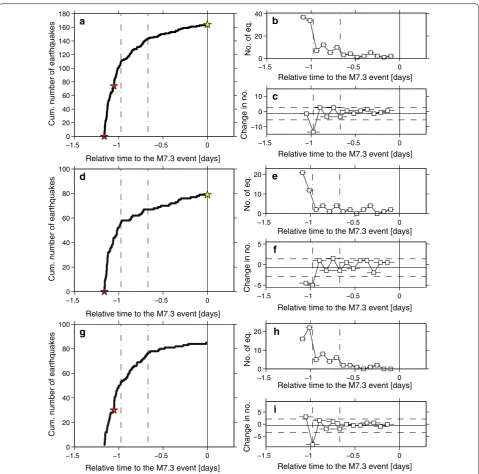
been inhomogeneous. Visual inspection of the cumula-tive curve indicates that there are two kinks at the times
0.98 and 0.67 days before the M7.3 quake, suggesting that
transitions to lower occurrence rates of M ≥ 3 shocks
happened twice. We divided all shocks into two groups: shocks in the northern area (higher than 32.72° in lati-tude) and those in the southern area (lower than 32.72° in latitude). We employed the same plotting procedure as for Fig. 2a to show that there were again two kinks at
0.98 and 0.67 days before the M7.3 quake in both groups
(Fig. 2d, g). Figure 2d, g shows that the timing of the
kinks did not correspond to the occurrence of the M6.4
quake (star at 1.05 days preceding the M7.3 quake),
indi-cating that this quake did not affect the seismic activity as a whole.
We also checked the change in the number (i.e., the
change in the rate of occurrence) of M ≥ 3 shocks. To
do this, we first plotted the number (the rate of
occur-rence) of M ≥ 3 shocks in the entire area as a function
of relative time to the M7.3 quake in Fig. 2b, where we
counted M ≥ 3 shocks in each time window of 0.08 days.
We then plotted the change in the number (the change in the rate of occurrence) of those shocks in the same area
as a function of relative time to the M7.3 quake in Fig. 2c.
Also included in this figure are the mean and standard
deviation of the change in the number of M ≥ 3 shocks.
At 0.98 days relative to the M7.3 quake, the change in
the number was negative and smaller than the standard
deviation, while the change at 0.67 days before the M7.3
quake was also at negative but within the margins of the standard deviation. This shows that the transition to a
lower occurrence rate at 0.98 days relative to the M7.3
quake was significant, but the transition at 0.67 days might not have been. The analysis was performed for the
northern area (Fig. 2e, f) and southern area (Fig. 2h, i)
separately, obtaining the same feature. We confirmed that the above-described result is robust, by sampling differ-ent time windows (0.10 and 0.05 days) and by noting that the general features are the same for all the cases (Fig. A2 in Additional file 1). A preliminary analysis of the change
in the number of M ≥ 3 shocks suggests that the decay of
seismic activity over time was faster than that predicted
by the OU law, typically with p = 1.
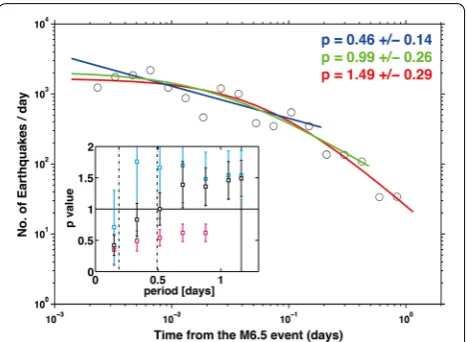
Figure 3 shows a good fit of the OU law with
p = 1.49 ± 0.29 to the activity with M ≥ 3 for the entire
area during the period between the M6.5 and M7.3
quakes (t = 0–1.16 days). Note that this value is
signifi-cantly larger than a typical value (p = 1). For a short time
period (t = 0–0.18 days, equivalent to 1.16–0.98 days
pre-ceding the M7.3 quake), p = 0.46 ± 0.14 is significantly
below 1. For an intermediate period (t = 0–0.49 days,
corresponding to 1.16–0.67 days preceding the M7.3
quake), p = 0.99 ± 0.26 lies between these two p values.
Relative time to the M7.3 event [days]
Fig. 1 Plot of Mc as a function of relative time to the M7.3 quake
The difference in the p value between the short and long periods is statistically significant, showing that decay of seismic activity became faster as period increased, as expected from a preliminary analysis. The influence
of period on p is shown in the inset of Fig. 3 (data in
black). We conducted the same analysis for shocks that occurred in the northern and southern areas. The results
are plotted in the inset of Fig. 3 (data in cyan and pink,
respectively). The difference in the p value between these
areas is significant for periods longer than 0.5 days, where
the p value was not plotted for the southern area for
peri-ods longer than one day because the model-fitting analy-sis did not converge. It can be said that the rapid decrease
in the number of M ≥ 3 shocks in the northern area was
Cum. number of earthquakes
Relative time to the M7.3 event [days]
−1.5 −1 −0.5 0
Relative time to the M7.3 event [days]
−1.5 −1 −0.5 0
Relative time to the M7.3 event [days]
−1.5 −1 −0.5 0
Relative time to the M7.3 event [days]
−1.5 −1 −0.5 0
0 20 40
Change in no.
Relative time to the M7.3 event [days]
−1.5 −1 −0.5 0
−10 0 10
No. of eq.
Relative time to the M7.3 event [days]
−1.5 −1 −0.5 0
0 10 20
Change in no.
Relative time to the M7.3 event [days]
−1.5 −1 −0.5 0
−5 0 5
No. of eq.
Relative time to the M7.3 event [days]
−1.5 −1 −0.5 0
0 10 20
Change in no.
Relative time to the M7.3 event [days]
responsible to the rapid decay in the activity observed over the entire area.
We next examined the spatial distributions in the b
value for two periods, 1.16–0.98 and 0.98–0 days prior
to the M7.3 quake. The results are shown in Fig. 4a, d,
respectively. To create these figures, we calculated b
val-ues for events falling within a cylindrical volume with a 5 km radius, centered at each node on a 0.005° × 0.005°
grid and plotted a b value at the corresponding node if
at least 20 events in the cylinder yielded a good fit to the GR law. We assumed that the characteristic dimen-sion of the node spacing (~500 m) was a larger value than the value of location uncertainty (typically, 275 m) of the JMA catalog (Richards-Dinger et al. 2010).
Dis-tributions in the Mc value that were simultaneously
cal-culated with a b value at each node are shown in Fig. 4b,
e. Overall, the b values increased with time. The
differ-ence Δb = b1.16−0.98 − b0.98−0 is mostly above 0 (cyan to
blue colors in Fig. 4g) and ranges from Δb = −0.05 to
Δb = 0.53. A map view shows a zone of large increase in
the b value (Δb ≥ 0.3, blue colors), but only in the
north-ern area. Observed changes in the b value are not
con-sidered significant if the test proposed by Utsu (1992, 1999) is not passed, as is shown in Fig. 4h. If logPb, the
logarithm of the probability that the b values are not
dif-ferent, is equal to or smaller than −1.3 (logPb ≤ −1.3),
then the change in b is significant (Schorlemmer et al.
2004). A map of logPb (Fig. 4h) revealed a zone of the
low values (logPb ≤ −1.3, green colors) in the northern
area. This observation is further supported by apply-ing a bootstrappapply-ing approach (Schorlemmer et al. 2003, 2004) to the standard deviation of the b values, σ. The
average standard deviation σ of the early period (1.16–
0.98 days prior to the M7.3 quake) is 0.08, and 90% of
the σ values are smaller than 0.10 (Fig. 4c). For the later
period (0.98–0 days prior to the M7.3 quake), σ is 0.12
and 90% of the values are smaller than 0.18. Higher errors of σ ≥ 0.18 (yellow) were obtained only in the north-ern area. The sums between σ in the early period and σ
in the late period are at most 0.3. Comparing Δb with σ,
we can say that the increase in the b value in part of the
northern area is significant. We conducted the same
sta-tistical test as shown in for Fig. 4, but calculated b, Mc,
and σ values, by sampling the nearest 100 earthquakes at
each node (Fig. A3 in Additional file 1). The general
fea-ture remained similar to Fig. 4. Our statistical test
dem-onstrates that the observed changes in the b value were
physically meaningful and not caused by artifacts.
If the b value offers an indicator of stress in the Earth’s
crust, then it is expected to have increased by the time
the M7.3 quake occurred. To examine this possibility, we
compared the b values before the M6.5 quake with the b
values after the M7.3 quake in a polygon that includes
epicenters of the M6.5, M6.4, and M7.3 quakes (Fig.
A4 in Additional file 1). The b value was almost stable
when b was 0.6–0.8 before the M6.5 quake, consistent
with the results obtained by Nanjo et al. (2016). Though
the b value immediately after the M7.3 quake
fluctu-ated due to many aftershocks following the quake, the
b values after this period were significantly larger than
those before the M6.5 quake. This result indicates that
measurement of spatial and temporal changes in the b
value is useful to infer stress in the Earth’s crust, sup-porting our interpretation that the significant increase
in the b value in Fig. 4 shows a decrease in stress before
the M7.3 quake.
Discussion
We found that the rate of occurrence of comparatively
large shocks with M3 or larger in the seismic activity after
the M6.5 quake on April 14, 2016, decreased significantly
preceding the M7.3 quake on April 16. We further
dem-onstrated that the p and b values increased significantly
before the M7.3 quake, a feature that is consistent with
the decrease in comparatively large shocks. Our analysis
of the spatial and temporal changes in the p and b values
indicates that the increase in the p and b values was most
conspicuous in the northern area of the seismic activity
after the M6.5 quake. This finding suggests that stress
around the Futagawa FZ had begun to decrease
declines an increase in stress (Dieterich 1994) and that a
high b value indicates low stress (Scholz 1968, 2015).
The reduction in the normal stress at the Futagawa FZ, i.e., a decrease in compressive stress on the fault, is
suggested by an independent observation from the NIED, the National Research Institute for Earth Science and Disaster Resilience (2016). NIED examined the temporal change in the stress field by performing a stress inversion
Fig. 4 Results from a test of significance of the difference between the periods 1.16–0.98 days and 0.98–0 days prior to the M7.3 quake. ab values,
analysis using focal mechanisms of earthquakes in and around the Kumamoto earthquakes. The minimum
com-pressive stress (σ3) axis lay roughly in a north–south axis
before the M6.5 quake. A comparison between the σ3 axis
after the M6.5 quake and the σ3 axis before this quake
shows that the axis rotated counterclockwise and became nearly perpendicular to the strike of the Futagawa FZ, which indicates the normal force operating to the fault plane reduced.
In the seismic activity after the M6.5 quake, we found
that earthquakes had occurred near the hypocenter of the
M7.3 quake in addition to the majority of the seismicity
around the Hinagu FZ (Fig. 5a). Figure 5b shows a 5-km-wide cross section nearly perpendicular to the strike
of the Futagawa FZ, on which the rupture of the M7.3
quake occurred (ERC 2016a). Note that several events are
recognized close to the hypocenter of the M7.3 quake. In
the magnitude–time diagram (Fig. 5c) where these events are designated by bold squares, they occurred 0.98 days
before the M7.3 event. One possible explanation may
be that they were produced by a nucleation process, as
suggested by Onaka (1993), of the M7.3 quake. Our
find-ing of the occurrence of earthquakes close to the
hypo-center of the M7.3 quake (Fig. 5), combined with the
reduction of normal pressure on the Futagawa FZ (NIED 2016), indicates growth of a quasi-static pre-slips before
the M7.3 quake. The pre-slips might have relaxed stress
around the hypocenter of the M7.3 quake. This stress
relaxation provided feedback to reduce the occurrence
rate of larger (M ≥ 3) shocks (Fig. 2), causing a
signifi-cantly larger p value than p = 1 (Fig. 3) and a significant
increase in the b value (Fig. 4).
Abbreviations
EMR method: entire‑magnitude‑range method; ERC: Earthquake Research Committee; FZ: fault zone; GR law: Gutenberg–Richter law; JMA: Japan Mete‑ orological Agency; NIED: National Research Institute for Earth Science and Disaster Resilience; OU law: Omori–Utsu law.
Authors’ contributions
KZN performed numerical simulations, analyzed data and prepared the figures. KZN and AY helped to draft the manuscript and participated in inter‑ pretation. KZN wrote the final manuscript. Both authors read and approved the final manuscript.
Author details
1 Global Center for Asian and Regional Research, University of Shizuoka,
3‑6‑1, Takajo, Aoi, Shizuoka 420‑0839, Japan. 2 Center for Integrated Research
and Education of Natural Hazards, Shizuoka University, 836, Oya, Suruga, Shizuoka 422‑8529, Japan.
Acknowledgements
We thank the Editor (Matha Savage) and two anonymous reviewers for their constructive review.
Competing interests
The authors declare that they have no competing interests.
Received: 1 August 2016 Accepted: 6 January 2017
References
Aki K (1965) Maximum likelihood estimate of b in the formula log N=a−bM and its confidence limits. Bull Earthq Res Inst Univ Tokyo 43:237–239 Bowman DD, Ouillon G, Sammis CG, Sornette A, Sornette D (1998) An
observational test of the critical earthquake concept. J Geophys Res 103(B10):24359–24372. doi:10.1029/98JB00792
Dieterich J (1994) A constitutive law for rate of earthquake production and its application to earthquake clustering. J Geophys Res 99(B2):2601–2618. doi:10.1029/93JB02581
Earthquake Research Committee (1998) Probabilistic evaluation method of aftershocks. http://www.jishin.go.jp/main/yoshin2/yoshin2.htm. Accessed 26 Dec 2016
Earthquake Research Committee (2016a) Evaluation of the 2016 Kumamoto earthquakes. http://www.jishin.go.jp/main/index‑e.html. Accessed 26 Dec 26 2016
Earthquake Research Committee (2016b) Information on perspective of seismicity after large earthquakes. http://www.jishin.go.jp/reports/ research_report/yosoku_info/. Accessed 26 Dec 2016
Gutenberg B, Richter CF (1944) Frequency of earthquakes in California. Bull Seismol Soc Am 34(4):185–188
Helmstetter A, Kagan K, Jackson DD (2006) Comparison of short‑ term and long‑term earthquake forecast models for southern California. Bull Seis‑ mol Soc Am 76(1):90–106. doi:10.1785/0120050067
Ishibe T, Shimazaki K, Satake K, Tsuruoka H (2011) Change in seismicity beneath the Tokyo metropolitan area due to the 2011 off the Pacific coast of Tohoku earthquake. Earth Planets Space 63(7):731–735. doi:10.5047/eps.2011.06.001
Matsu’ura RS (1986) Precursory quiescence and recovery of aftershock activities before some large aftershocks. Bull Earthq Res Inst Univ Tokyo 61:1–65
Additional file
Additional file 1. Appendix 1, figures A1–A4, and additional references.
Nanjo KZ, Enescu B, Shcherbakov R, Turcotte DL, Iwata T, Ogata Y (2007) Decay of aftershock activity for Japanese earthquakes. J Geophys Res 112:B08309. doi:10.1029/2006JB004754
Nanjo KZ, Ishibe T, Tsuruoka H, Schorlemmer D, Ishigaki Y, Hirata N (2010) Anal‑ ysis of the completeness magnitude and seismic network coverage of Japan. Bull Seismol Soc Am 100(6):3261–3268. doi:10.1785/0120100077
Nanjo KZ, Hirata N, Obara K, Kasahara K (2012) Decade‑scale decrease in b value prior to the M9‑class 2011 Tohoku and 2004 Sumatra quakes. Geophys Res Lett 39:L20304. doi:10.1029/2012GL052997
Nanjo KZ, Izutsu J, Orihara Y, Furuse N, Togo S, Nitta N, Okada T, Tanaka R, Kamogawa M, Nagao T (2016) Seismicity prior to the 2016 Kumamoto earthquakes. Earth Planets Space 68:187. doi:10.1186/s40623‑016‑0558‑2
National Research Institute for Earth Science and Disaster Resilience (2016)
http://cais.gsi.go.jp/YOCHIREN/activity/211/image211/026‑030.pdf. Accessed 26 Dec 2016
Obara K, Kasahara K, Hori S, Okada Y (2005) A densely distributed high‑sensitiv‑ ity seismograph network in Japan: Hi‑net by National Research Institute for Earth Science and Disaster Prevention. Rev Sci Instrum 76:021301. doi:10.1063/1.1854197
Omori F (1894) On the after‑shocks of earthquakes. J Colloid Sci 7:111–200 Onaka M (1993) Critical size of the nucleation zone of earthquake rupture inferred from immediate foreshock activity. J Phys Earth 41(1):45–56 Richards‑Dinger K, Stein RS, Toda S (2010) Decay of aftershock density
with distance does not indicate triggering by dynamic stress. Nature 467:583–586. doi:10.1038/nature09402
Scholz CH (1968) The frequency–magnitude relation of microfracturing in rock and its relation to earthquakes. Bull Seismol Soc Am 58(1):399–415 Scholz CH (2015) On the stress dependence of the earthquake b value. Geo‑
phys Res Lett 42:1399–1402. doi:10.1002/2014GL062863
Schorlemmer D, Wiemer S (2005) Microseismicity data forecast rupture area. Nature 434:1086. doi:10.1038/4341086a
Schorlemmer D, Neri G, Wiemer S, Mostaccio A (2003) Stability and signifi‑ cance tests for b‑value anomalies: example from the Tyrrhenian Sea. Geophys Res Lett 30(16):1835. doi:10.1029/2003GL017335
Schorlemmer D, Wiemer S, Wyss M (2004) Earthquake statistics at Parkfield: 1. Stationarity of b values. J Geophys Res 109:B12307. doi:10.1029/200 4JB003234
Smith WD (1981) The b‑value as an earthquake precursor. Nature 289:136–139. doi:10.1038/289136a0
Sobolev GA, Tyupkin YS (1997) Low‑seismicity precursors of large earthquakes in Kamchatka. Volcanol Seismol 18:433–446
Suyehiro S, Asada T, Ohtake M (1964) Foreshocks and aftershocks accompany‑ ing a perceptible earthquake. Meteorol Geophys 15:71–88
Toda S, Lin J, Stein RS (2011) Using the 2011 Mw 9.0 off the Pacific coast of Tohoku Earthquake to test the Coulomb stress triggering hypothesis and to calculate faults brought closer to failure. Earth Planets Space 63(7):725–730. doi:10.5047/eps.2011.05.010
Utsu T (1961) A statistical study on the occurrence of aftershocks. Geophys 30:521–605
Utsu T (1992) On seismicity. In: Report of the Joint Research Institute for Statis‑ tical Mathematics, Inst Stat Math Tokyo. vol 34, pp 139–157
Utsu T (1999) Representation and analysis of the earthquake size distribution: a historical review and some approaches. Pure Appl Geophys 155(2):509– 535. doi:10.1007/s000240050276
Wiemer S, Wyss M (1994) Seismic quiescence before the Landers (M= 7.5) and Big Bear (M= 6.5) 1992 earthquakes. Bull Seismol Soc Am 84(3):900–916 Woessner J, Wiemer S (2005) Assessing the quality of earthquake catalogues: