
Space-Time Turbo Trellis Coded Modulation
for Wireless Data Communications
Welly Firmanto
School of Electrical and Information Engineering, The University of Sydney, Sydney 2006, Australia Email: [email protected]
Branka Vucetic
School of Electrical and Information Engineering, The University of Sydney, Sydney 2006, Australia Email: [email protected]
Jinhong Yuan
School of Electrical Engineering and Telecommunications, The University of New South Wales, Sydney, NSW 2052, Australia Email: [email protected]
Zhuo Chen
School of Electrical and Information Engineering, The University of Sydney, Sydney 2006, Australia Email: [email protected]
Received 1 June 2001 and in revised form 22 March 2002
This paper presents the design of space-time turbo trellis coded modulation (ST turbo TCM) for improving the bandwidth effi-ciency and the reliability of future wireless data networks. We present new recursive space-time trellis coded modulation (STTC) which outperform feedforward STTC proposed by Tarokh et al. (1998) and Baro et al. (2000) on slow and fast fading channels. A substantial improvement in performance can be obtained by constructing ST turbo TCM which consists of concatenated recursive STTC, decoded by iterative decoding algorithm. The proposed recursive STTC are used as constituent codes in this scheme. They have been designed to satisfy the design criteria for STTC on slow and fast fading channels, derived for systems with the product of transmit and receive antennas larger than 3. The proposed ST turbo TCM significantly outperforms the best known STTC on both slow and fast fading channels. The capacity of this scheme on fast fading channels is less than 3 dB away from the theoretical capacity bound for multi-input multi-output (MIMO) channels.
Keywords and phrases:space-time coding, MIMO fading channels, space-time trellis codes, turbo coded modulation, interative decoding.
1. INTRODUCTION
In the present cellular mobile communication systems, mul-tiple antennas are being considered for applications at base station receivers with the aim to suppress cochannel inter-ference and minimize the fading effects on the uplink. The size of base stations allows the deployment of receive diver-sity on the uplink. On the downlink, however, the limited size and power of the mobile stations make it more practical to consider transmit diversity. Transmit diversity decreases the required processing power of the receivers, resulting in a sim-pler system structure, lower power consumption and lower cost. Furthermore, transmit diversity can be combined with receive diversity to further improve the system performance and increase the spectral efficiency. Channel coding
com-bined with spatial diversity is called space-time (ST) coding. Code design criteria based on the rank and the deter-minant of the codeword distance matrix for trellis based ST codes were derived in [1, 2]. In this approach, multiple trans-mit antennas and error correction coding are combined with higher level modulation schemes. An ST encoder takes as in-put a block ofbbinary data, and maps them intonT
mod-ulation symbols from a signal set of 2bpoints. Each output
modulation symbol feeds a separate transmit antenna. The symbols fromnTantennas are transmitted simultaneously in
one symbol interval. The scheme gives a maximum spectral efficiency ofbbits/s/Hz which is equal to the spectral effi -ciency of the reference uncoded systems.
trellis coded modulation (STTC) can achieve a substantial improvement in performance, benefiting from both diversity and coding gains. However, when the number of transmit antennas gets larger, the complexity of the receiver structure and the code construction becomes prohibitive. In [1], feed-forward STTCs with two transmit antennas were designed. In [3], a set of improved feedforward 4PSK STTCs relative to the codes in [1] were proposed.
Recently, a new set of design criteria for STTCs for slow and fast fading channels were proposed [4, 5]. These criteria are applicable to multiple-input multiple-output (MIMO) channels with a high diversity order. When the diversity or-der, defined as the product of the minimum rank of the dis-tance matrices and the number of receive antennas, is small, the rank and the determinant criteria, proposed in [1], are valid. However, for high diversity orders, (larger than 3), the minimum trace of the codeword distance matrix, or equiva-lently the minimum squared Euclidean distance, dominates the code performance and its minimum value should be maximized in code design. Motivated by this design crite-rion, in this paper we design recursive STTCs and demon-strate that they are superior to feedforward STTCs reported in [1, 3]. Furthermore, we construct an ST turbo trellis mod-ulation (TCM) scheme with the new recursive STTCs as constituent codes. The recursive structure of the constituent codes enables the full benefit of interleaver gain and itera-tive decoding. The proposed ST turbo TCM scheme is based on a parallel concatenation of two constituent STTCs and al-ternate puncturing of parity symbols, analogous to a turbo TCM scheme reported in [6]. The ST turbo trellis encoder consists of two identical recursive STTCs linked by an inter-leaver and followed by anMPSK signal mapper. The iterative decoder operates on the constituent code trellis and gener-ates soft symbol estimgener-ates by a log-MAP algorithm [7, 8].
Independent of the work of this paper, a similar design was done in [9], based on a recursive code obtained by con-verting the feedforward STTC reported in [1] into a recur-sive code. In [10], a turbo code is serially concatenated with a space-time block code. In [11], the concept of recursive STTCs is first suggested and the serial and parallel concate-nation structures with recursive STTCs as component codes are proposed. In [10, 11], full diversity is guaranteed but full rate is not achieved. In [12], a novel serial concatenation of STTC with interleaver and rate 1 simple recursive inner code is proposed.
One of the key issues with turbo codes is decoding algo-rithm convergence. We discuss the decoder convergence of the proposed ST turbo TCM scheme and evaluate the de-coding thresholds, expressed as the minimumEb/N0ratio for which the code can converge. Furthermore, we estimate that the proposed ST turbo TCM codes are less than 3 dB away from the MIMO theoretical channel capacity limit [13].
2. STTC SYSTEM MODEL
The system under consideration employs a recursive STTC withnT transmit andnRreceive antennas. While the
trans-mitter has no knowledge about the channel, it is assumed that the receiver can recover the channel state informa-tion perfectly. Informainforma-tion bits are encoded intonT streams
of MPSK symbols by the ST encoder. A space-time sym-bol xt at timetconsists ofnT MPSK symbols, and can be
written as xt = (x1t, x2t, . . . , xtnT). At any given time t, an
MPSK symbol xi
t is transmitted through the ith antenna,
i=1,2, . . . , nT.
At the receiver, each antenna receives a noisy superposi-tion ofnTtransmitted symbols which have been subjected to
independent fading. After matched filtering, assuming ideal timing information, the received signalrtjat the jth receive
antenna at timetcan be expressed as
rtj=
Es
nT
i=1
hi, j(t)xit+n
j
t, (1)
wherehi, j(t) models the complex fading gain from transmit
antenna i to receive antenna j at time t,i = 1,2, . . . , nT,
j = 1,2, . . . , nR, andEsis the energy per symbol. On a fast
fading channel, we assume that the fading coefficients change independently from symbol to symbol. On a slow fading channel, we assume that the fading coefficients remain the same over a frame and change independently from frame to frame. When the fading coefficients remain the same over more than one symbol but less than a frame, the channel un-dergoes a block fading. Regardless of the fade rate, the fad-ing gains are modelled as independent samples of a complex Gaussian random variable with a zero mean and a variance of 0.5 per dimension. The noise ntj at the jth receive
an-tenna at timet is modeled as an independent sample of a zero mean complex Gaussian random variable with a noise spectral density ofN0.
3. PERFORMANCE ANALYSIS AND CODE DESIGN CRITERIA
A memory ν recursive MPSK STTC can be described in terms of its 2ν-state trellis. At timet= 0 the trellis is at the
zero state. Given a particular input, the state of the trellis at any given time is indicated by the content of theνmemory taps. At time t, there are M branches leaving each statesi
t,
i ∈ {0,1, . . . ,2ν −1}, each of which corresponds to an
in-coming input j, j ∈ {0,1, . . . , M −1}, and is labeled with
nT MPSK symbols. These MPSK symbols are the encoder
output to be transmitted simultaneously throughnT
trans-mit antennas when the previous state issi
t and the input is
j. At the decoder, the received sequence is decoded using a maximum likelihood decoding algorithm based on theM -ary trellis.
Following the derivation in [5], consider an nT × nT
codeword distance matrix A(x,xˆ) = B(x,xˆ)·BH(x,xˆ)
be-tween two codewords x = (x1,x2, . . . ,xt, . . . ,xl) and ˆx =
(ˆx1,xˆ2, . . . ,xˆt, . . . ,xˆl) of lengthl. The matrixBHdenotes the
Bx,xˆ=
For the purpose of our analysis, define r as the minimum rank of the matrixA(x,xˆ) over all possible codeword pairs, andδH, the minimum symbol Hamming distance, is defined
as
3.1. Performance on slow fading channels
The pairwise error probabilityP(x,xˆ) is the probability that the decoder selects as its estimate the sequence ˆxwhen the transmitted sequence was in factx. Whenr·nR≥4, on a slow
fading channel, the pairwise error probability can be upper bounded as [5] signal-to-noise ratios the upper bound in (4) can be further approximated as
From (5), it can be seen that, in order to minimize the er-ror probability, the minimum sum of all eigenvalues of the matrix A(x,xˆ) among all codeword pairs should be maxi-mized. For a square matrix, the sum of the eigenvalues is equal to the sum of all elements on the main diagonal which is called the trace of the matrix. The performance is domi-nated by the minimum trace which is equivalent to the min-imum Euclidean distance over all codewords.
Whenr·nR <4, however, the upper bound on the
pair-wise error probability at high signal-to-noise ratios can be expressed as
which suggests that to achieve the best performance the minimum rank and the minimum product of all nonzero eigenvalues of A(x,xˆ) should be maximized. If full rank is
achievable, it is equivalent to maximizing the minimum de-terminant ofA(x,xˆ), as first proposed in [1].
3.2. Performance on fast fading channels
Provided thatδH·nR ≥4 [5], the pairwise error probability
on fast Rayleigh fading channels can be upper bounded by
Px,xˆ)≤1
Eis the accumulated squared Euclidean distance
be-tween two space-time symbol sequences, given by
d2
By using an approximation of the Q(·) function, at high signal-to-noise ratios the upper bound in (7) can be further approximated as
From (10), we can conclude that the pairwise error prob-ability is dominated by the squared Euclidean distanced2
E.
WhenδH·nR<4, the upper bound on the pairwise error
probability at high signal-to-noise ratios becomes
Px,xˆ≤
p is the product of the squared Euclidean distances
between two space-time symbol sequences, given by
d2
STTC on slow and fast fading channels are identical. The de-sign criteria in this case can be formulated as
• Maximize the minimum Euclidean distance over all codewords.
Therefore, provided thatr ·nR ≥4 andδH ·nR ≥4, we
(a1
Figure1: Feedforward STTC encoder.
4. CONSTRUCTION OF RECURSIVE SPACE-TIME TRELLIS CODES
4.1. Code structure
In this section, the structure of systematic and nonsystematic recursive STTC is explained. A feedforward STTC encoder for 4PSK and two antennas with a memory order ofν=2ν1is shown in Figure 1. If the sequencec1 =(c1
0, c11, c12, . . . , c1t, . . .)
is the binary input stream to the upper row of shift registers, in a polynomial form it can be represented as
c1(D)=c1
0+c11D+c12D2+· · ·+c1tDt+· · ·. (13)
Similarly, the binary input sequence
c2=c2
0, c21, c22, . . . , c2t, . . .
(14)
to the lower row of shift registers can be written as
c2(D)=c02+c21D+c22D2+· · ·+ct2D3+· · ·. (15)
The feedforward generator polynomial for the upper row of shift registers and transmit antennai, wherei ∈ {1,2}, can be written as
Gi
1(D)=ai0+ai1D+· · ·+aiν1D
ν1. (16)
Similarly, the feedforward generator polynomial for the lower row of shift registers and transmit antenna i, where
i∈ {1,2}can be written as
Gi2(D)=bi0+b1iD+· · ·+bνi2D
ν2. (17)
The encoded symbol sequence transmitted from antennaiis given by
si(D)=c1(D)Gi
1(D) +c2(D)Gi2(D) mod 4. (18)
Equivalently, the relationship in (18) can be written in the following form:
Figure2: Recursive STTC encoder.
The feedforward generator matrix from (19),
G(D)=
can be converted into an equivalent recursive matrix by di-viding it by a binary polynomialq(D) of a degree equal to or less thanν1. However, ifq(D) is chosen to be a primitive polynomial, the resulting recursive code should have a high minimum distance. The generator polynomial for antennai
can be represented as
Gi(D)=
A systematic recursive STTC can be obtained by setting
G1(D)=
which means that the output of the first antenna is obtained by directly mapping the input sequences c1 and c2 into a 4PSK sequence. A diagram of a recursive 4PSK STTC encoder with two transmit antennas is shown in Figure 2.
Table1: Recursive 4PSK STTC for slow and fast fading channels, bandwidth efficiency 2 bits/s/Hz.
Table2: Recursive 8PSK STTC for slow and fast fading channels, bandwidth efficiency 3 bits/s/Hz.
ν (a1
0, a20) (a11, a21) (b10, b20) (b11, b21) (b12, b22) (d10, d02) (d11, d12) (d12, d22) dE2 d2E[1]
3 (2,1) (3,4) (4,6) (2,0) — (0,4) (4,0) — 7.172 4.0
4 (2,4) (3,7) (4,0) (6,6) — (7,2) (0,7) (4,4) 8.0 6.0
5 (0,4) (4,4) (0,2) (2,3) (2,2) (3,0) (2,2) (3,7) 8.586 8.0
4.2. Algebraic structure of recursive space-time
trellis codes
For a 4PSK recursive STTC, the output symbols s1
t ands2t
from Figure 2 can be expressed algebraically as
s1
tis defined as
ˆ
The encoder for an 8PSK recursive STTC is implemented as a feedforward shift register with a memory order ofν. The encoder output can be expressed as
s1
4.3. A hybrid design of robust recursive STTC
In this section, we consider design of recursive STTCs which can deliver data transmission with bandwidth efficiency of
2 and 3 bits/s/Hz. Unlike previously reported feedforward STTC in [1, 3], these recursive codes can be used directly as constituent codes in ST turbo TCM schemes to deliver data transmission at the same rates but at much lower sig-nal to noise ratios than the reference uncoded systems with the same spectral efficiency. In a cellular system, a lower transmission power means lower interference to neighbor-ing cells, thus allowneighbor-ing a frequency band to be reused more frequently. Section 3 discusses the design criteria for recur-sive STTCs on slow and fast fading channels. In reality, how-ever, the fade rate falls somewhere between these two ex-tremes. Therefore, it would be desirable to obtain a set of codes which satisfy the design criteria for both extreme con-ditions. It is expected that such codes will perform well in a wide variety of fading conditions. In [1], such codes are termed smart and greedy space-time codes because the encoder does not need to know the channel but can take advantage of the benefits offered by both the multiple trans-mit/receive antennas and the possible temporal channel vari-ations.
We have stated previously that when r ·nR ≥ 4 and
δH ·nR ≥ 4, the design criteria for recursive STTCs on
slow and fast fading channels coincide. Under these condi-tions, the error probability is minimized when the minimum squared Euclidean distance, d2
E, of the code is maximized.
Therefore, with the code structure given in Section 4.1 and assuming that at least two receive antennas, (nR ≥ 2), are
available to the system, we find a set of coefficientsai jk, b
i jk for recursive 4PSK STTCs, andai
jk, b
i jk, d
i
jkfor recursive 8PSK STTCs for a given memory order which maximizesd2
E.
Tables 1 and 2 list recursive 4PSK and 8PSK STTCs, re-spectively, with two transmit antennas which best satisfy the design criterion on slow and fast fading channels, provided thatnR≥2. Each code in both tables have the minimum rank
r =2 and the minimum symbol Hamming distanceδH ≥2,
1E−03 1E−02 1E−01 1E+00
−3 −2 −1 0 1 2 3 4 5
Eb/N0(dB)
Fr
am
e
er
ro
r
ra
te
8-st STTC in [1] 8-st STTC in [2] new recursive 8-st STTC
32-st STTC [1] new recursive 32-st STTC
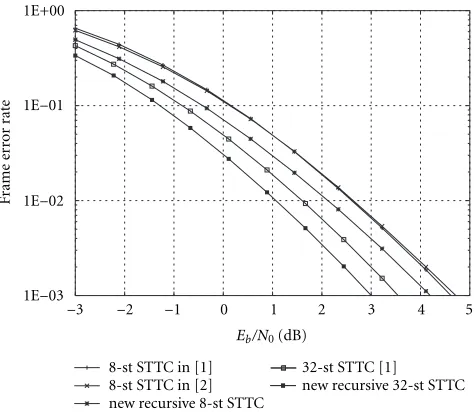
Figure3: Performance comparison of the 8-state and 32-state re-cursive 4PSK STTCs on slow fading channels, bandwidth efficiency 2 bits/s/Hz.
were obtained through an exhaustive computer search. These codes were initially constructed in a feedforward form in [4]. A further investigation shows that these codes maintain their superiority in terms of their squared Euclidean distance, and thus their performance, when they are converted into a feed-back recursive form as discussed in Section 4.1. Both tables list the squared Euclidean distance of each code and that of its counterparts of the same memory order reported in [1, 3]. For any given memory order, the new recursive STTC has the largestd2
E, indicative of a superior performance on slow and
fast fading channels for a large productrnR.
5. PERFORMANCE OF RECURSIVE STTC
In this section, we compare the performance of the new re-cursive STTCs with previously known feedforward STTCs on slow and fast fading channels. The performance is measured in terms of the frame error rate as a function ofEb/N0, the ratio between the energy per information bit to the noise at each receive antenna. Each frame consists of 130MPSK symbol transmissions from each transmit antenna. Figure 3 shows the performance of the new 8-state and 32-state 4PSK recursive STTCs in comparison with feedforward STTCs of the same memory order proposed in [1, 3] with four re-ceive antennas on slow fading channels. The 8-state STTCs in [1, 3] achieve virtually the same performance, while the new 8-state recursive STTC offers a 0.5 dB gain over the other two STTCs at a frame error rate (FER) of 10−3. The new recur-sive 32-state STTC offers a 0.5 dB gain over the feedforward STTC in [1] at the same frame error rate.
Figure 4 shows the performance of the new 16 and 32-state 4PSK recursive STTCs with two receive antennas on fast fading channels. The performance curves show consis-tently lower error rates of the new recursive STTC over the
1E−03 1E−02 1E−01 1E+00
−2 0 2 4 6 8
Eb/N0(dB)
Fr
am
e
er
ro
r
ra
te
16-st STTC in [1] 16-st STTC in [2] new recursive 16-st STTC
32-st STTC [1] new recursive 32-st STTC
Figure 4: Performance comparison of the 16-state and 32-state 4PSK STTCs on a fast fading channel, bandwidth efficiency 2 bits/s/Hz.
feedforward STTC for the same memory order, previously proposed in [1, 3]. When FER =10−3the new recursive 16-state 4PSK STTC offers a 2 dB and a 0.8 dB gain over feedfor-ward STTCs in [1, 3], respectively. The new recursive 32-state 4PSK outperforms feedforward STTC of the same memory order in [1] by 0.5 dB at FER=10−3.
All figures we have shown in this section confirm that the new recursive STTC outperforms feedforward STTC of the same memory order previously proposed in [1, 3], both on slow and fast fading channels. Note however, that the re-cursive structure STTC by itself does not have any advan-tage over feedforward STTC. As stated in Section 4, recur-sive STTCs in Tables 1 and 2 were originally constructed in feedforward form. Figure 5 shows the performance of the 16-state 4PSK STTC in feedforward and recursive forms on quasi-static fading channels. The frame error rate perfor-mance of the code in both forms is identical.
6. SPACE-TIME TURBO TCM
Having designed and constructed a set of recursive STTCs with a superior performance on slow and fast fading chan-nels, we would like to use them in a parallel concatenation to further reduce bit errors by taking advantage of inter-leaver gain and iterative decoding. Figure 6 shows the en-coder structure of a ST turbo TCM with two transmit an-tennas, consisting of two recursive STTC encoders in the up-per and lower branches, and linked by a pairwise interleaver and a symbol deinterleaver [6]. Each encoder operates on a message block ofL groups ofb information bits, where L
is the interleaver size. The message sequence c is given by
c = (c1,c2, . . . ,ct, . . . ,cL), wherect is a group ofb
informa-tion at timet, given byct=(ct,0, ct,1, . . . , ct,b−1).
1E−03
Figure5: FER performance comparison between a recursive and feedforward 4PSK STTC on a slow fading channel.
Inform.
Figure6: ST turbo TCM encoder.
input sequence into two streams of L MPSK symbols,x1 1, x2
1, wherex1i = (xi1,1, x1i,2, . . . , xi1,L),i ∈ {1,2}andM = 2b.
Prior to encoding by the lower encoder, the information bits are interleaved by a pairwise symbol interleaver. The pair-wise symbol interleaver operates on groups of b bits in-stead of on single bits. The interleaver maps even positions to even positions, and odd ones to odd ones. The inter-leaver ensures that the ordering of b information bits ar-riving at the interleaver at any time instantt remains un-changed. The lower encoder also produces two streams of
L MPSK symbols. Each stream is deinterleaved, resulting in x1
2 and x22, where x2i = (x2i,1, xi2,2, . . . , x2i,L), i ∈ {1,2}.
Deinterleaving at this stage ensures that theb information bits determining the output symbols of the upper and lower
encoders at any given time instant are identical. Assum-ing thatLis even, the first stream of symbols generated by the upper and lower encoders, x1
1 and x12, are alternately punctured into x1 = (x1
1,1, x21,2, x11,3, x12,4, . . . , x11,L−1, x12,L) and
transmitted through the first transmit antenna. The sec-ond stream of symbols generated by the upper and lower encoders, x21 and x22, are alternately punctured into x2 = (x2
1,1, x22,2, x21,3, x22,4, . . . , x21,L−1, x22,L) and transmitted through
the second transmit antenna.
7. DECODING ALGORITHM
The decoding process of ST turbo TCM is very similar to that of binary turbo codes except that the symbol probability is used as the extrinsic information instead of the bit proba-bility. The MAP decoding algorithm for nonbinary trellises is called symbol-by-symbol MAP algorithm. Since the ex-trinsic information can become either too large or too small and causes computational overflows, a log-MAP algorithm is used instead of MAP. With a log-MAP decoder, the logarithm of probabilities is computed and passed to the next decoding stage.
The log-MAP decoder computes the log-likelihood ratio of each group of information bits ct = i. The soft output Λ(ct=i) is given by
where i is the set of the information groups, i ∈
{0,1,2, . . . ,2k−1},ris the received sequence, and the
proba-bilitiesαt(l),βt(l), andγt(l) can be computed as in the MAP
algorithm [8]. The symboliwith the largest log-likelihood ratio in (27) is chosen as the hard decision output.
1E−03 1E−02 1E−01 1E+00
−1 0 1 2 3 4 5 6 7 8
Eb/N0(dB)
Fr
am
e
er
ro
r
ra
te
16-st STTC, L=1024
16-st turbo TCM in [9], L=1024, 10 iterations new 16-st ST turbo TCM , L=1024, 10 iterations
Figure7: FER performance comparison between a 16-state 4PSK STTC and a 16-state 4PSK ST turbo TCM with interleaver size of 1024, bandwidth efficiency 2 bits/s/Hz on fast fading channels.
decoding operation proceeds as for the binary turbo codes when the decoder receives the symbol generated by its own encoder. However, for every even received signal, the de-coder receives the punctured symbol which is generated by the other encoder. The decoder in this case ignores this sym-bol by setting the branch transition metric to zero. The only input at this step in the trellis is the a priori component ob-tained from the other decoder.
8. ST TURBO TCM PERFORMANCE
This section evaluates the performance of ST turbo TCM scheme on fast and block fading channels. In each case, it is assumed that the receiver has two receive antennas. Figure 7 shows the (FER) performance comparison between the 16-state recursive 4PSK STTC in Table 1 and a 16-16-state 4PSK ST turbo TCM. The 16-state recursive 4PSK STTC is the con-stituent code in the ST turbo TCM configuration. The per-formance curves show that the ST turbo TCM configuration offers a tremendous improvement. At a frame error rate of 10−3, with ten iterations and an interleaver size of 1024, it achieves a gain of more than 7 dB relative to STTC. At the same frame error rate, it achieves more than 2 dB gain com-pared to ST turbo TCM with the constituent code of the same memory order, proposed in [9]. The bandwidth efficiency in all cases is 2 bits/s/Hz.
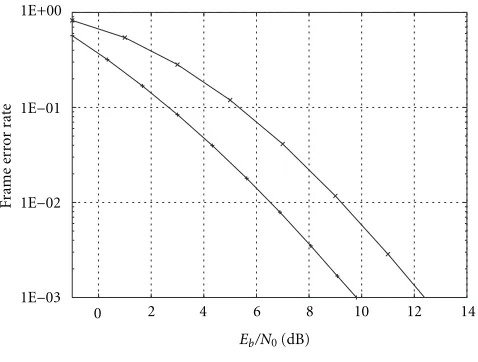
Figure 8 shows the performance of the 4-state 4PSK ST turbo TCM on quasi-static fading channels. The number of iterations is 10 and the interleaver size is 130. The curves show that at FER=10−2the ST turbo TCM offers 8.8 dB and 8.0 dB gain over the recursive STTC for the fading block size of 100 and 200, respectively.
Figure 9 shows the FER performance of the new 32-state 8PSK ST turbo TCM in comparison with that of the 32-state
1E−03 1E−02 1E−01 1E+00
0 2 4 6 8 10 12 14
Eb/N0(dB)
Fr
am
e
er
ro
r
ra
te
4-state 4-PSK ST turbo TCM, 10 iterations 4-state 4-PSK STTC
Figure8: FER performance of a 4-state 4PSK STTC and a 4-state ST Turbo TCM, bandwidth efficiency 2 bits/s/Hz on quasi-static fading channels.
1E−03 1E−02 1E−01 1E+00
1 2 3 4 5 6 7 8 9 10
Eb/N0(dB)
Fr
am
e
er
ro
r
ra
te
32-st 8-PSK STTC, L=1024
new 32-st ST turbo TCM , L=1024, 6 iterations new 32-st ST turbo TCM , L=1024, 10 iterations
Figure9: FER performance comparison between a 32-state 8PSK STTC and a 32-state 8PSK ST Turbo TCM with bandwidth effi-ciency 3 bits/s/Hz on fast fading channels.
8PSK STTC. In this case, with ten iterations the new 32-state 8PSK ST turbo TCM offers more than 7 dB gain at FER=10−3, compared to the 32-state recursive 8PSK STTC in Table 2. When the number of iteration is reduced from ten to six, the performance is degraded by about 0.3 dB.
1E−03 1E−02 1E−01 1E+00
−5 −4 −3 −2 −1 0 1
Eb/N0(dB)
Fr
am
e
er
ro
r
ra
te
2T, 2R 3T, 2R 4T, 2R
2T, 4R 3T, 4R 4T, 4R
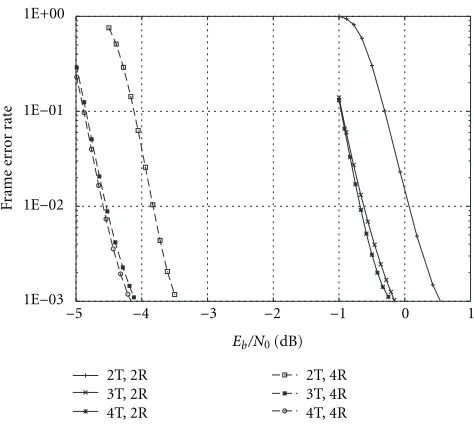
Figure10: Effects of various numbers of transmit and receive an-tennas on the FER performance of the 16-state 4PSK ST turbo TCM, bandwidth efficiency 2 bits/s/Hz on fast fading channels.
three transmit antennas is given as
xt1, xt2, xt3
=(1,2,1)·cˆt0+ (1,3,2)·cˆ0t−1
+ (3,2,1)·cˆ0
t−2+ (2,0,2)·cˆ1t
+ (2,2,0)·cˆ1
t−1+ (2,0,2)·cˆ1t−2 mod 4. (28)
Similarly, the constituent recursive 4PSK STTC with four transmit antennas is given as
x1t, x2t, x3t, x4t
=(1,2,1,1)·cˆ0t + (1,3,2,2)·cˆ0t−1
+ (3,2,1,3)·cˆ0
t−2+ (2,0,2,2)·cˆ1t
+ (2,2,0,0)·cˆ1
t−1+ (2,0,2,2)·cˆ1t−2 mod 4, (29)
where in both cases ˆck
t, k∈ {0,1}is defined in (25). The
per-formance curves show that increasing the number of trans-mit antenna from two to three brings about 0.7 dB gain at FER=10−3, while increasing the number of transmit anten-nas from three to four results in a negligible gain. The incre-mental gain resulting from increasing the number of trans-mit antennas stays relatively the same when the number of receive antennas increases from two to four.
The performance curves of Figures 7, 8, and 9 suggest that the parallel concatenation of STTC outperforms recur-sive STTC scheme. One may argue, however, that the com-parison is less than fair since ST turbo TCM can take ad-vantage of interleaver gain and iterative decoding. Thus, a fairer comparison should consider the performance of ST turbo TCM with other known turbo TCM schemes such as that proposed by Robertson [6, 14]. Figure 11 shows the FER performance comparison between the new 16-state 4PSK ST
1E−03 1E−02 1E−01 1E+00
−1 0 1 2 3 4 5 6 7
Eb/N0(dB)
Fr
am
e
er
ro
r
ra
te
16-st STTC, L=1024
16-st turbo TCM in [5], L=1024, 10 iterations new 16-st ST turbo TCM , L=1024, 10 iterations
Figure 11: FER performance comparison between the 16-state 4PSK ST turbo TCM and a 16-state 8PSK turbo TCM, bandwidth efficiency 2 bits/s/Hz on fast fading channels.
turbo TCM and a 16-state turbo TCM scheme from [6]. Note that although the turbo TCM scheme uses only one transmit antenna while the ST turbo TCM scheme uses two, the to-tal transmit power remains the same. Two receive antennas are used in both cases. With the same interleaver size of 1024 and ten iterations, the ST turbo TCM offers a 2.5 dB gain at a frame error rate of 10−2. The bandwidth efficiency in all cases is 2 bits/s/Hz. Note that to achieve the same bandwidth effi -ciency, the scheme by Robertson et al. has to use 8PSK signal set.
Figure 12 shows the performance of 4-state ST turbo TCM and 4-state STTC on quasi-static fading channels with two transmit and two receive antennas. At FER =10−3, the ST turbo TCM offers more than 1.5 dB improvement. The frame size is 130 symbols.
8.1. System capacity
Telatar investigated and derived the formula for the capac-ity of multiantenna Gaussian channels with or without fad-ing in [13]. Assumfad-ing independent Rayleigh fadfad-ing and in-dependent noise at different receive antennas, the capacity of the channel withnTtransmit andnRreceive antennas under
power constraintPequals [13]
!∞
0 log
1 + P
σ2n
Tλ
m−1
k=0
k!
(k+n−m)!
Lnk−m(λ)2λn−me−λdλ,
(30) where σ2 is the noise variance per dimension, m = min{nR, nT}, n=max{nR, nT}, andLijare the associated
La-guerre polynomials [15].
effi-1E−03 1E−02 1E−01 1E+00
0 2 4 6 8 10 12
Eb/N0(dB)
Fr
am
e
er
ro
r
ra
te
4-state 4-PSK ST turbo TCM, 10 iterations 4-state 4-PSK STTC
Figure12: FER performance of a 4-state 4PSK STTC and a 4-state ST Turbo TCM, bandwidth efficiency 2 bits/s/Hz on quasi-static fading channels.
ciency of STTC and ST turbo TCM with various constituent codes when the bit error rate (BER) is 10−5. They are com-pared with theoretical MIMO channel capacity, expressed in (30). The figure shows that the 16-state 4PSK ST turbo TCM, with an interleaver size of 1024 and 10 decoder itera-tions when (nT, nR)=(2,2) and (2,4), is 2.4 dB away from
the channel capacity. The 32-state 8PSK ST turbo TCM with the same interleaver size and the same number of iterations is 1.65 dB away from the channel capacity. The 16-state 4PSK STTC when (nT, nR)=(2,2), on the other hand, is 8.86 dB
away from the channel capacity, or 6.46 dB worse than the 16-state 4PSK ST turbo TCM. Note that these capacity fig-ures are indicative of the performance on fast fading chan-nels. For slow fading channels, the outage probability calcu-lations should be applied.
In Figure 14, the performance of 16-state ST turbo TCM with four transmit and receive antennas on quasi-static Rayleigh fading channel is presented. For comparison, the outage probability for 2 bits/s/Hz, which is a lower bound for FER on quasi-static fading channels, is also included. The performance curves show that the 16-state ST turbo TCM is 1.5 dB away from the outage capacity at the FER of 10−3.
8.2. Decoder convergence
We analyze the convergence of ST turbo TCM decoder by ap-proximating the density functions of the extrinsic informa-tion message as a Gaussian distribuinforma-tion, and calculating the mean and variance in the Gaussian density evolution. This technique was used to analyze turbo codes [16] and to ob-tain anEb/N0threshold on low density parity check (LDPC) codes[17]. A threshold is the smallestEb/N0 value beyond which an iterative decoder converges and the bit error rate goes to zero as the number of iterations increases.
Assuming perfect interleaving, each extrinsic
informa-0 0.5 1 1.5 2 2.5 3 3.5 4 4.5 5
−6 −4 −2 0 2 4 6 8
Eb/N0(dB)
Capa
cit
y
Capacity with 2T, 2R Capacity with 2T, 4R
(2,4) 4PSK ST turbo TCM
(2,2) 4PSK ST turbo TCM
(2,2) 8PSK ST turbo TCM
(2,2) 4PSK STTC
Figure13: The system capacity when (nT, nR)=(2,4) and (2,2).
10−3 10−2 10−1 100
−2.5 −2 −1.5 −1 −0.5 0 0.5 1 1.5 2 2.5 SNR per receive antenna (dB)
Fr
am
e
er
ro
r
ra
te
16-state ST turbo TCM, 4T, 4R Outage probability, 4T, 4R, 2 bits/s/Hz
Figure14: The outage capacity when (nT, nR)=(4,4).
tion message is independent and identically Gaussian dis-tributed with meanµi and varianceσi2 at end of theith
it-eration. The mean and the variance at each iteration can be determined through simulations. The SNRiof the extrinsic information at theith iteration is defined as
SNRi=µ
2
i
σ2
i
. (31)
0 1 2 3 4 5
0 0.5 1 1.5 2 2.5 3
SNR in
SNR
o
ut
First decoder,Eb/N0=−0.5 dB Second decoder,Eb/N0=−0.5 dB
Figure 15: Convergence and iterative decoding threshold of ST turbo TCM decoder when recursive 16-state STTC in [9] is used as the constituent code.
0 1 2 3 4 5
0 0.5 1 1.5 2 2.5 3
SNR in
SNR
o
ut
First decoder,Eb/N0=−0.5 dB Second decoder,Eb/N0=−0.5 dB
Figure16: Convergence of ST turbo TCM decoder when the new recursive 16-state 4PSK STTC is used as the constituent code.
output SNR of the second decoder. If the two curves intersect with each other, the decoder does not converge. The thresh-old is the value ofEb/N0at which the two curves just touch.
Figure 15 shows the input/output SNR curves of ST turbo TCM scheme with a 16-state 4PSK STTC in [9] as the constituent code. Note thatSNR indenotes the SNR of the extrinsic information at the input of a decoder, andSNR out
denotes the SNR of the extrinsic information at the output of a decoder. The curves were generated whenEb/N0=−0.5 dB. The figure shows the two curves just touch. This implies that the threshold is−0.5 dB.
Figure 16 shows the input/output SNR curves of ST
Table3:Eb/N0thresholds of various 4PSK STTC constituent codes.
ν New recursive STTC Recursive STTC in [9]
3 −0.90 dB −0.65 dB
4 −0.80 dB −0.50 dB
5 0.55 dB 0.40 dB
turbo TCM scheme with the new 16-state 4PSK STTC as the constituent code when Eb/N0 = −0.5 dB. The figure shows a tunnel between the two curves through which the itera-tive decoding progresses. This figure suggests that the thresh-old is less than−0.5 dB. A further investigation shows that the threshold for this code is−0.8 dB. This shows that ST turbo TCM with the new 16-state 4PSK STTC as the con-stituent code is more optimized than that with the 16-state QPSK STTC in [9] as the constituent code, because it con-verges more quickly at a lower operating Eb/N0. Further-more, Table 3 compares the Eb/N0 thresholds between the new recursive 4PSK STTC with that proposed in [9] when being used as constituent codes in a parallel concatenation structure. The entries show that for a given memory order, the new recursive STTC converges more rapidly. The entries of Table 3 suggests that increasing the memory order does not necessarily result in a lower threshold. A similar phe-nomenon has been observed with binary turbo codes, for which a lower memory code has a lower threshold. This can be explained as follows. Firstly, codes with larger memory have longer paths in the trellis and when the noise is large at low operating SNRs the decoder is more likely to diverge as the number of iterations increases. Secondly, codes with larger memory have more nearest neighbor codewords, re-sulting in larger error coefficients. Consequently, at low oper-ating SNRs, it is harder for the decoder to choose the correct codeword.
9. CONCLUSIONS
This paper considers the design of a space-time turbo trel-lis coded modulation scheme. The structure of recursive STTC is presented and new recursive STTCs which best sat-isfy the design criterion on slow and fast fading channels are proposed. These recursive STTCs outperform previously known feedforward STTC. Moreover, they can be used di-rectly as constituent codes in a parallel concatenation struc-ture, benefiting from interleaver gain and iterative decod-ing. This structure offers significant performance improve-ment compared to the traditional STTC scheme on fast and block fading channels. The new ST turbo TCM is less sen-sitive to any change in the fading rate compared to previ-ously known codes, and falls within 3 dB from the theoretical MIMO channel capacity.
ACKNOWLEDGMENT
REFERENCES
[1] V. Tarokh, N. Seshadri, and A. Calderbank, “Space-time codes for high data rate wireless communication: performance cri-terion and code construction,”IEEE Transactions on Informa-tion Theory, vol. 44, no. 2, pp. 744–765, 1998.
[2] J. C. Guey, M. P. Fitz, M. R. Bell, and W.-Y. Kuo, “Signal design for transmitter diversity wireless communication systems over Rayleigh fading channels,” inProc. IEEE Vehicular Technology Conference, pp. 136–140, Atlanta, Ga, USA, April 1996.
[3] S. Baro, G. Bauch, and A. Hansmann, “Improved codes
for space-time trellis-coded modulation,” IEEE Transactions Communications Letters, vol. 4, no. 1, pp. 20–22, 2000. [4] Z. Chen, J. Yuan, and B. Vucetic, “Improved space-time trellis
coded modulation scheme on slow Rayleigh fading channels,”
IEE Electronics Letters, vol. 37, no. 7, pp. 440–441, 2001. [5] J. Yuan, B. Vucetic, Z. Chen, and W. Firmanto, “Performance
of space-time coding on fading channels,” inProc. of Intl. Sym-posium on Inform. Theory, Washington D.C., USA, June 2001. [6] P. Robertson and T. Worz, “Bandwidth-efficient turbo trellis coded modulation using punctured component codes,” IEEE Journal on Selected Areas in Communications, vol. 16, no. 2, pp. 206–218, 1998.
[7] L. R. Bahl, J. Cocke, F. Jelinek, and J. Raviv, “Optimal decod-ing of linear codes for minimizdecod-ing symbol error rate,” IEEE Transactions on Information Theory, vol. 20, no. 2, pp. 284– 287, 1974.
[8] B. Vucetic and J. Yuan, Turbo Codes Principles and Applica-tions, Kluwer Academic, Boston, Mass, USA, 2000.
[9] D. Tujkovic, “Recursive space-time trellis codes for turbo coded modulation,” inProc. IEEE Global Telecommunications Conference, vol. 2, pp. 1010–1015, San Francisco, Calif, USA, 27 November–1 December 2000.
[10] G. Bauch, “Concatenation of space-time block codes and “turbo” TCM,” in Proc. IEEE International Conference on Communications, vol. 2, pp. 1202–1206, Vancouver, British Columbia, Canada, June 1999.
[11] K. R. Narayanan, “Turbo decoding of concatenated space-time codes,” inProc. 37th Annual Allerton Conference on Com-munication, Control, and Computing, pp. 899–900, Allerton, Ill, USA, September 1999.
[12] X. Lin and R. S. Blum, “Improved space-time codes using serial concatenation,” IEEE Communications Letters, vol. 4, no. 7, pp. 221–223, 2000.
[13] E. Telatar, “Capacity of multi-antenna Gaussian channels,”
The European Transactions on Telecommunications, vol. 10, no. 6, pp. 585–595, 1999.
[14] P. Robertson and T. Worz, “Coded modulation scheme em-ploying turbo codes,” IEE Electronics Letters, vol. 31, no. 18, pp. 1546–1547, 1995.
[15] I. S. Gradshteyn and I. M. Ryzhik,Table of Integrals, Series, and Products, Academic Press, San Diego, Calif, USA, 5th edition, 1994.
[16] D. Divsalar, S. Dolinar, and F. Pollara, “Low complexity turbo-like codes,” inProc. 2nd Int. Symp. on Turbo Codes and Related Topics, pp. 73–80, Brest, France, September 2000.
[17] S.-Y. Chung, T. Richardson, and R. Urbanke, “Analysis of sum-product decoding of low-density-parity-check codes us-ing Gaussian approximation,” IEEE Transactions on Informa-tion Theory, vol. 47, no. 2, pp. 657–670, 2001.
Welly Firmantoreceived the B.S. of electri-cal engineering in 1994 from Purdue Uni-versity, West Lafayette, USA and the Mas-ter’s of engineering in 1996 from Carleton University, Ottawa, Canada. Between 1996 and 1999 he was a research engineering at PT. Industri Telekomunikasi Indonesia, Bandung, Indonesia. He is currently work-ing towards the Ph.D. degree at the Uni-versity of Sydney, Sydney, Australia. His
re-search interests include wireless communications, digital commu-nications and error control coding.
Branka Vuceticreceived the B.S. of electri-cal engineering, M.S., and Ph.D. degrees in 1972, 1978, and 1982, respectively, from the University of Belgrade, Belgrade. She is the Director of Telecommunications Labora-tory and Professor of Telecommunications at the University of Sydney, Sydney, Aus-tralia. Her research interests include wire-less communications, digital communica-tion theory, coding, and multiuser detec-tion.
Jinhong Yuanreceived the B.S. and Ph.D. degrees in electrical engineering from the Beijing Institute of Technology, China, in 1991 and 1996, respectively. In 1997, he joined the School of Electrical and Infor-mation Engineering, University of Sydney, Australia, as a Research Fellow. He is cur-rently with the School of Electrical Engi-neering and Telecommunications, Univer-sity of New South Wales, Australia. His
re-search interests include wireless communications, communication theory, error control coding, and digital modulation.
![Figure 15: Convergence and iterative decoding threshold of STturbo TCM decoder when recursive 16-state STTC in [9] is usedas the constituent code.](https://thumb-us.123doks.com/thumbv2/123dok_us/890118.1107064/11.600.60.286.331.521/figure-convergence-iterative-decoding-threshold-stturbo-recursive-constituent.webp)
