Scalable and Efficient Provable Data Possession
Giuseppe Ateniese1, Roberto Di Pietro2, Luigi V. Mancini3, and Gene Tsudik4
Abstract
Storage outsourcing is a rising trend which prompts a number of interesting security issues, many of which have been extensively investigated in the past. However, Provable Data Possession (PDP) is a topic that has only recently appeared in the research literature. The main issue is how to frequently, efficiently and securely ver-ify that a storage server is faithfully storing its client’s (potentially very large) outsourced data. The storage server is assumed to be untrusted in terms of both secu-rity and reliability. (In other words, it might maliciously or accidentally erase hosted data; it might also relegate it to slow or off-line storage.) The problem is exacer-bated by the client being a small computing device with limited resources. Prior work has addressed this prob-lem using either public key cryptography or requiring the client to outsource its data in encrypted form.
In this paper, we construct a highly efficient and provably secure PDP technique based entirely on sym-metric key cryptography, while not requiring any bulk encryption. Also, in contrast with its predecessors, our PDP technique allows outsourcing of dynamic data, i.e, it efficiently supports operations, such as block modifi-cation, deletion and append.
1. Introduction
In recent years, the concept of third-party data ware-housing and, more generally, data outsourcing has be-come quite popular. Outsourcing of data essentially means that the data owner (client) moves its data to a third-party provider (server) which is supposed to – pre-sumably for a fee – faithfully store the data and make it available to the owner (and perhaps others) on de-mand. Appealing features of outsourcing include re-duced costs from savings in storage, maintenance and personnel as well as increased availability and transpar-ent up-keep of data.
A number of security-related research issues in data outsourcing have been studied in the past decade. Early work concentrated on data authentication and integrity,
1The Johns Hopkins University. E-mail: [email protected] 2Universit`a di Roma Tre. E-mail: [email protected] 3Universit`a di Roma “La Sapienza”. E-mail: [email protected]
4University of California, Irvine. E-mail: [email protected]
i.e., how to efficiently and securely ensure that the server returns correct and complete results in response to its clients’ queries [1, 2]. Later research focused on outsourcing encrypted data (placing even less trust in the server) and associated difficult problems mainly having to do with efficient querying over encrypted do-main [3, 4, 5, 6].
More recently, however, the problem of Provable Data Possession(PDP) –is also sometimes referred to as Proof of Data Retrivability(POR)– has popped up in the research literature. The central goal in PDP is to allow a client to efficiently, frequently and securely verify that a server – who purportedly stores client’s po-tentially very large amount of data – is not cheating the client. In this context, cheatingmeans that the server might delete some of the data or it might not store all data in fast storage, e.g., place it on CDs or other ter-tiary off-line media. It is important to note that a storage server might not be malicious; instead, it might be sim-ply unreliable and lose or inadvertently corrupt hosted data. An effective PDP technique must be equally appli-cable to malicious and unreliable servers. The problem is further complicated by the fact that the client might be a small device (e.g., a PDA or a cell-phone) with limited CPU, battery power and communication facili-ties. Hence, the need to minimize bandwidth and local computation overhead for the client in performing each verification.
lim-ited to confidential data. In addition, the number of queries is limited and fixed a priori. This is because sentinels, and their position within the database, must be revealed to the server at each query – a revealed sen-tinel cannot be reused.
Motivation: As pointed out in [9], data generation is currently outpacing storage availability, hence, there will be more and more need to outsource data.
A particularly interesting application for PDP is dis-tributed data store systems. Consider, for example, the Freenet network [10], or the Cooperative Internet Backup Scheme [11]. Such systems rely and thrive on free storage. One reason to misbehave in such systems would be if storage space had real monetary cost at-tached to it. Moreover, in a distributed backup system, a user who grants usage of some of its own space to store other users’ backup data is normally granted usage of a proportional amount of space somewhere else in the network, for his own backup. Hence, a user might try to obtain better redundancy for his own data. Furthermore, users will only place trust in such a system as long as the storage can be consistently relied upon, which is diffi-cult in the event of massive cheating. A PDP scheme could act as a powerful deterrent to cheating, thus in-creasing trust in the system and helping spread its pop-ularity and usage. Finally, note that same considera-tions can be applied to alternative service models, such as peer-to-peer data archiving [12], where new forms of assurance of data integrity and data accessibility are needed. (Though simple replication offers one path to higher-assurance data archiving, it also involves unnec-essary, and sometimes unsustainable, overhead.)
Another application of PDP schemes is in the con-text of censorship-resistance. There are cases where a duly authorized third party (censor) may need to modify a document in some controlled and limited fashion [13]. However, an important problem is to prevent unautho-rized modifications. In this case, there are some well-known solutions, such as [14, 15] and [16]. But, they ei-ther require data replication or on-demand computation of a function (e.g., a hash) over the entire outsourced data. Though the latter might seem doable, it does not scale to petabytes and terabytes of data. In contrast, a well-designed PDP scheme would be, at the same time, secure and scalable/efficient.
A potentially interesting new angle for motivating secure and efficient PDP techniques is the outsourcing ofpersonaldigital content. (For example, consider the rapidly increasing popularity of personal content out-sourcing services, such as.MAC,GMAIL,PICASAand OFOTO.) Consider the following scenario: Alice wants to outsource her life-long collection of digital content (e.g. photos, videos, art) to a third party, giving read access to her friends and family. The combined content is precious to Alice and, whether or not the outsourcing
service is free, Alice wants to make sure that her data is faithfully stored and readily available. To verify data possession, Alice could use a resource-constrained per-sonal device, e.g., a PDA or a cell-phone. In this realis-tic setting, our two design requirements – (1) outsourc-ing data in cleartext and (2) bandiwdth and computation efficiency – are very important.
Contributions: This paper’s contribution is two-fold:
1. Efficiency and Security: the proposed PDP scheme, as [8], relies only on efficient symmetric-key operations in both setup (performed once) and verification phases. However, our scheme is more efficient than POR as it requires no bulk encryp-tion of outsourced data and no data expansion due to additional sentinel blocks —see Section 5 for details. Our scheme provides probabilistic assur-ance of the untampered data being stored on the server with the exact probability fixed at setup, as in [7, 8]. Furthermore, our scheme is provably se-cure in the random oracle model (ROM).
2. Dynamic Data Support: unlike both prior re-sults [7, 8], the new scheme supports secure and efficient dynamic operations on outsourced data blocks, including: modification, deletion and ap-pend.1Supporting such operations is an important step toward practicality, since many envisaged ap-plication are not limited to data warehousing, i.e., dynamic operations need to be provided.
Roadmap: The next section introduces our approach to provable data possession and discusses its effective-ness and security; Section 3 extends and enhances it to support dynamic outsourced data (i.e., operations such as block update, append and delete). Then, Section 4 discusses some features of our proposal, followed by Section 5 which overviews related work. Finally, Sec-tion 6 includes a discussion of our results and outlines avenues for future work.
2. Proposed PDP Scheme
In this section we describe the proposed scheme. It consists of two phases: setupandverification(also calledchallengein the literature).
2.1. Notation
• D – outsourced data. We assume that Dcan be represented as a single contiguous file ofd equal-sized blocks:D[1], . . . ,D[d]. The actual bit-length of a block is not germane to the scheme.
•
OW N
– the owner of the data.•
SR V
– the server, i.e., the entity that stores out-sourced data on owner’s behalf.• H(·)– cryptographic hash function. In practice, we use standard hash functions, such as SHA-1, SHA-2, etc.
• AEkey(·) – an authenticated encryption scheme, that provides both privacy and authenticity. In practice, privacy and authenticity is achieved by encrypting the message first and then computing a Message Authentication Code (MAC) on the re-sult. However, a less expensive alternative is to use a mode of operation for the cipher that provides authenticity in addition to privacy in a single pass, such as OCB, XCBC, IAPM, [17].
• AEkey−1(·)– decryption operation for the scheme in-troduced above.
• fkey(·) – pseudo-random function (PRF) indexed on some (usually secret)key. In practice, a ”good” block cipher acts as a PRF, in particular we could use AES where keys, input blocks, and outputs are all of 128 bits (AES is a good pseudo-random permutation). Other even more practical construc-tions of PRFs deployed in standards use ”good” MAC functions, such as HMAC [18].
• gkey(·) – pseudo-random permutation (PRP) in-dexed under key. AES is assumed to be a good PRP. To restrict the PRP output to sequence num-bers in a certain range, one could use the tech-niques proposed by Black and Rogaway [19].
2.2. General Idea
Our scheme is based entirely on symmetric-key cryptography. The main idea is that, before outsourcing,
OW N
pre-computes a certain number of short posses-sion verification tokens, each token covering some set of data blocks. The actual data is then handed over toSR V
. Subsequently, whenOW N
wants to obtain a proof of data possession, it challengesSR V
with a set of random-looking block indices. In turn,SR V
must compute a short integrity check over the speci-fied blocks (corresponding to the indices) and return it toOW N
. For the proof to hold, the returned in-tegrity check must match the corresponding value pre-computed byOW N
. However, in our schemeOW N
has the choice of either keeping the pre-computed to-kens locally or outsourcing them – in encrypted form – toSR V
. Notably, in the latter case,OW N
’s storage overhead is constant regardless of the size of the out-sourced data. Our scheme is also very efficient in terms of computation and bandwidth.2.3. Setup phase
We start with a databaseDdivided intodblocks. We want to be able to challenge the storage servert times. We use a pseudo-random function, f, and a pseudo-random permutationgdefined as:
f :{0,1}c× {0,1}k−→ {0,1}L
and
g:{0,1}l× {0,1}L−→ {0,1}l.
In our casel=logdsince we usegto permute indices. The output of f is used to generate the key forgand c=logt. We note that both f andgcan be built out of standard block ciphers, such as AES. In this caseL= 128. We use the PRF f with two master secret keysW andZ, both ofkbits. The keyW is used to generate session permutation keys while Z is used to generate challenge nonces.
During the Setup phase, the owner
OW N
generates in advancet possible random challenges and the cor-responding answers. These answers are calledtokens. To produce theithtoken, the owner generates a set ofr indices as follows:1. First, generate a permutation keyki= fW(i)and a challenge nonceci= fZ(i).
2. Then, compute the set of indices:
{Ij∈[1, . . . ,d]|1≤ j≤r}, whereIj=gki(j).
3. Finally, compute the token: vi=H(ci,D[I1], . . . ,D[Ir] ).
Basically, each tokenviis the answer we expect to re-ceive from the storage server whenever we challenge it on the randomly selected data blocks D[I1], . . . , D[Ir]. The challenge nonce ci is needed to prevent potential pre-computations performed by the storage server. No-tice that each token is the output of a cryptographic hash function so its size is small.
Once all tokens are computed, the owner outsources the entire set to the server, along with the file D, by encrypting each token with an authenticated encryption function2. The setup phase is shown in detail in Algo-rithm 1.
2.4. Verification Phase
To perform thei-th proof of possession verification,
OW N
begins by re-generating thei-th token keykias in step 1 of Algorithm 1. Note thatOW N
only needs to store the master keysW,Z,andK, plus the current token index i. It also re-computesci as above. Then,Algorithm 1: Setup phase
begin
Choose parametersc,l,k,Land functions f,g; Choose the numbertof tokens;
Choose the numberrof indices per verification;
Generate randomly master keys W,Z,K∈ {0,1}k.
for(i←1tot)do beginRound i
1 Generateki= fW(i)andci= fZ(i)
2 Compute
vi=H(ci, D[gki(1)], . . . ,D[gki(r)] )
3 Computev0i=AEK(i,vi)
end
Send to
SR V
: (D,{[i,v0i]for 1≤ i≤t}) endOW N
sendsSR V
bothkiandci(step 2 in Algorithm 2). Having received the message fromOW N
,SR V
computes:z=H(ci,D[gki(1)], . . . ,D[gki(r)] )
SR V
then retrievesv0iand returns[z,v0i]toOW N
who, in turn, computes v=AEK−1(v0i) and checks whether v=(i, z). If the check succeeds,OW N
assumes thatSR V
is storing all ofDwith a certain probability.Algorithm 2: Verification phase
beginChallenge i
1
OW N
computeski=fW(i)andci=fZ(i) 2OW N
sends{ki,ci}toSR V
3
SR V
computesz=H(ci,D[gki(1)], . . . ,D[gki(r)] )
4
SR V
sends{z,v0i}toOW N
5
OW N
extractsvfromv0i. If decryption failsorv6= (i,z)then REJECT. end
We point out that there is almost no cost for
OW N
to perform a verification. It only needs to re-generate the appropriate[ki,ci]pair (two PRF-s invocations) and perform one decryption in order to check the reply fromSR V
. Furthermore, the bandwidth consumed by the verification phase is constant (in both step 2 and 4 of Algorithm 2). This represents truly minimal overhead. The computation cost forSR V
, though slightly higher (r PRP-s on short inputs, and one hash), is still very reasonable.2.5. Detection Probability
We now consider the probability Pesc that
OW N
manages to successfully complete one run of our verifi-cation protocol whileSR V
has either deleted, or tam-pered with,mdata blocks. Note thatSR V
avoids de-tection only if none among all the r data blocks in-volved in thei-th token verification process, are deleted or modified. Thus, we have that:Pesc=
1−m
d r
(1)
For example, if the fraction of corrupted blocks (m/d) is 1% andr=512, then the probability of avoiding de-tection is below 0.6%. This is in line with the detection probability expressed in [7].
We stress that, as in [7], we are considering economically-motivated adversaries that are willing to modify or delete a percentage of the file. In this context, deleting or modifying few bits won’t provide any finan-cial benefit. If detection of any modification/deletion of small parts of the file is important then erasure codes could be used. The file is first encoded and then the PDP protocol is run on the encoded file. Erasure codes in the context of checking storage integrity were used, for example, in OceanStore [20], PASIS [21], and by Schwarz and Miller [22] (see also references therein). Erasure codes can help detect small changes to the file and possibly recover the entire file from a subset of its blocks (as in [8]). However, erasure codes (even the near-optimal ones) are very costly and impractical for files with a very large number of blocks (the type of files we are considering here). In addition, encoding will (1) significantly expand the original file and (2) render im-practical any operations on dynamic files, such as up-dating, deleting, and appending file blocks.
Notice that our discussion above concerns erasure codes applied to the file by the client and not by the server. Obviously, the server may (and should) use era-sure codes independently to prevent data corruptions re-sulting from unreliable storage.
Encoding the file via appropriate redundancy codes is a topic orthogonal to PDP and we do not consider it further.
2.6. Security Analysis
We have a challenger that plays a security game (experiment) with the adversary
A
. There is a Setup phase whereA
is allowed to select data blocksD[i]for 1≤i≤d. In the Verification phase the challenger se-lects a nonce andrrandom indices and sends them toA
. Then the adversary generates a proof of possession Pfor the blocks queried by the challenger.IfP passes the verification then the adversary won the game. As in [7], we say that our scheme is a Prov-able Data Possession scheme if for any probabilistic polynomial-time adversary
A
, the probability thatA
wins the PDP security game on a set of blocks is neg-ligibly close to the probability that the challenger can extract those blocks. In this type of proof of knowl-edge, a ”knowledge extractor” can extract the blocks fromA
via several queries, even by rewinding the ad-versary which does not keep state.At first, it may seem that we do not need to model the hash function as a random oracle and that we might just need its collision-resistance property (assuming we are using a ”good” standard hash function and not some contrived hash scheme). However, the security defini-tion for PDP is an extracdefini-tion-type definidefini-tion since we are required to extract the blocks that were challenged. So we need to use the random oracle model but not re-ally in a fundamental way. We just need the ability to see the inputs to the random oracle but we are not using its programmability feature (i.e., we are not ”cooking-up” values as outputs of the random oracle). We need to see the inputs so that we can extract the queried data blocks. Since we are using just a random oracle our proof does not rely on any cryptographic assumption but it is information-theoretic.
We show the following:
Theorem 1 Our scheme is a secure Provable Data Pos-session scheme in the random oracle model.
Proof sketch. We are assuming that AEK(·) is an ideal authenticated encryption. This implies that, given AEK(X), the adversary cannot see or alterX, thus we can assume thatX is stored directly by the challenger (i.e., there is no need for the adversary to sendX to the challenger and we can removeAEK(X)from the pic-ture).
More formally, our game is equivalent to the follow-ing:
• A simulator
S
sets up a PDP system and chooses its security parameters.• The adversary
A
selects valuesx1,. . .,xnand sends them to the simulatorS
• The adversary can query the random oracle at any point in time. For each input to the random ora-cle, the simulator replies with a random value and
stores the input and the corresponding output in a table (to be consistent with his replies).
• At the challenge phase the simulator challenges
A
on thei−thvalue,xiand sends a random valueci toA
.•
A
replies with a stringP.Note that, in our original game, the value xi corre-sponds to the ordered sequence ofrconcatenated blocks which are queried during thei−thchallenge. In addi-tion, the simulator can query anyxionly once.
Clearly if the adversary wins the game (P = H(ci, xi)) with non-negligeable probability then xi is extracted with non-negligeable probability. This is be-cause the best the adversary can do to impede the ex-traction ofxiis to guess the correct output of the random oracle or to find a collision (a random oracle is trivially collision-resistant). Both these events happen with neg-ligible probability.
3. Supporting Dynamic Outsourced Data
Thus far, we assumed that D represents static or warehoused data. Although this is the case for many en-visaged settings, such as libraries, there are many poten-tial scenarios where outsourced data is dynamic. This leads us to consider various data block operations (e.g., update, delete, append and insert) and the implications upon our scheme which stem from supporting each op-eration.
One obvious and trivial solution to all dynamic op-erations, is (for each operation) for
OW N
to down-load fromSR V
the entire outsourced dataDand to re-run the setup phase. This would clearly be secure but highly inefficient. We now show how to amend the ba-sic scheme toefficientlyhandle dynamic operations on outsourced data.3.1. Block Update
We assume that
OW N
needs to modify then-th data block which is currently stored onSR V
, from its cur-rent valueD[n]to a new version, denotedD0[n].is rd∗t. Thus, if this probability is small, a single block update is unlikely to involve any verification token up-date. If
SR V
is allowed to see when a block update causes no changes in verification tokens, it can safely modify/delete the new block since it knows (with ab-solute certainty) that it will not be demanded in future verifications.Based on the above discussion, we require
OW N
to modify allremainingverification tokens. We also need to amend the token structure as follows (refer to line 2 in Alg. 1 and line 3 in Alg. 2):from:
vi = H(ci,D[gki(1)], . . . ,D[gki(r)] )
v0i = AEK(i,vi) to:
vi = H(ci,1, D[gki(1)])⊕. . . ⊕H(ci,r, D[gki(r)]) v0i = AEK(ctr,i,vi)
%wherectris an integer counter
We usectrto keep track of the latest version of the tokenvi (in particular, to avoid replay attacks) and to change the encryption of unmodified tokens. Alterna-tively, we could avoid storingctrby just replacing the keyKof the authenticated encryption with a new fresh key.
The modifications described above are needed to al-low the owner to efficiently perform the token update. The basic scheme does not allow it since, in it, a token is computed by serially hashingrselected blocks. Hence, it is difficult to factor out any given block and replace it by a new version.3
One subtle but important change in the computation ofviabove is that now each block is hashed along with an index. This was not necessary in the original scheme since blocks were ordered before being hashed together. Now, since blocks are hashed individually, we need to take into account the possibility of two identical blocks (with the same content but different indices) that are selected as part of the same verification token. If we computed each block hash as:H(ci, D[gki(j)]), instead of: H(ci, j, D[gki(j)]), then two blocks with identical content would produce the same hash and would cancel each other out due to the exclusive-or operation. In-cluding an unique index in each block hash addresses this issue. We note that our XOR construction is ba-sically the same as the XOR MAC defined by Bellare, et al. [24]. In the random oracle model H(ci, . . .) is a PRF under the key ci. However, we do not need a randomized block as in XMACR [24] or a counter as
3Of course, it can be done trivially by askingSR V to supply all blocks covered by a given token; but, this would leak information and make the scheme insecure.
in XMACC [24] since we use the keyci only once (it changes at each challenge).
The update operation is illustrated in Algorithm 3. As shown at line 7,
OW N
modifies all tokens regard-less of whether they contain the n-th block. Hence,SR V
cannot discern tokens covering the n-th block. However, the crucial part of the algorithm is line 6 whereOW N
simultaneously replaces the hash of the block’s old version H(ci,j, D[n]) with the new one: H(ci,j,D0[n]). This is possible due to the basic proper-ties of theL operator.Algorithm 3: Update
% Assume that blockD[n]is being modified to D0[n]
% and, assume that no tokens have been used up thus far.
begin
1 Send to
SR V
: UPDATE REQUEST 2 Receive fromSR V
: {[i,vi0]|1≤ i≤t}) 3 ctr = ctr +1for (i←1tot)do
4 z0=AEK−1(v0i)
% if decryption fails, exit
% ifz0is not prefixed by(ctr−1),i, exit
5 extractvifromz0
ki=fW(i) ci=fZ(i)
for (j←1tor)do if (gki(j) == n) then
6 vi=vi ⊕ H(ci, j,D[n])⊕ H(ci, j,D0[n])
7 v0i=AEK(ctr,i, vi)
8 Send to
SR V
: {n,D0[n],{[i,v0i]|1≤ i≤t} }end
We now consider the costs. The bandwidth con-sumed is minimal given our security goals: since
OW N
does not store verification tokens, it needs to obtain them in line 2. Consequently, and for the same reason, it also needs to upload new tokens toSR V
at line 8. Computation costs forOW N
are similar to those of the setup phase except that no hashing is in-volved. There is no computation cost forSR V
. As far as storage,OW N
must have enough to accommodate all tokens, as in the setup phase.during the challenge. Indeed, as in [24], we include a unique index in the hash (from 1 tor) that “forces” the adversary to query the random oracle on each single block indicated by the challenge. In addition, the anal-ysis of the collision-resistance property of the XOR-ed hashes comes directly from [24], so we omit it here.
3.2. Block Deletion
After being outsourced, certain data blocks might need to be deleted. We assume that the number of blocks to be deleted is small relatively to the size of the file. This is to avoid affecting the detection proba-bility appreciably. If large portions of the file have to be deleted then the best approach in this case is to re-run the basic PDP scheme on the new file. Supporting block deletion turns out to be very similar to the update operation. Indeed, deleted blocks can be replaced by a predetermined special block in their respective posi-tions via the update procedure. Line 6 of Algorithm 3 can be modified as follows:
from:
vi = vi⊕H(ci, j,D[n])⊕H(ci, j,D0[n]) to:
vi = vi⊕H(ci, j,D[n])⊕H(ci, j,DBlock)
whereDBlock is a fixed special block that represents deleted blocks. This small change results in the deleted block being replaced in all verification tokens where it has occurred. Moreover, as in the update case, all to-kens are modified such that
SR V
remains oblivious as far as the inclusion of the special block. The costs as-sociated to the delete operation are identical to those of the update.3.3. Batching Updates and Deletions
Although the above demonstrates that the proposed technique can accommodate certain operations on out-sourced data, it is clear that the cost of updating all re-maining verification tokens for a single block update or deletion is not negligible for
OW N
. Fortunately, it is both easy and natural to batch multiple operations. Specifically, any number of block updates and deletes can be performed at the cost of a single update or delete. To do this, we need to modify thefor-loopin Algorithm 3 to take care of both deletions and updates at the same time. Since the modifications are straight-forward, we do not illustrate them in a separate algorithm.3.4. Single-Block Append
In some cases, the owner might want to increase the size of the outsourced database. We anticipate that the most common operation is block append, e.g., if the
outsourced data represents a log. Clearly, the cost of re-running the setup phase for each single block append would be prohibitive.
We obviously can not easily increase the range of the PRPgki(·)or other parameters since these are hard-coded into the scheme – we pre-compute all answers to all challenges. However, rather than considering a single contiguous file of d as an array of equal-sized blocks, we could consider a logical bi-dimensional structure of the outsourced data, and append a new block to one of the original blocks D[1], . . . ,D[d] in a round-robin fashion. In other words, assume that
OW N
has the outsourced dataD[1], . . . ,D[d], and that it wants to append the blocks D[d+1], . . . ,D[d+k]. Then a logical matrix is built by column as follows:D0[1] = D[1], D[d+1]
D0[2] = D[2], D[d+2]
. . .
D0[k] = D[k], D[d+k]
. . .
D0[d] = D[d]
For the index jin thei-th challenge, the server will have to include in the computation of the XOR-ed hashesvi any blocks linked toD[gki(j)], i.e., the entire rowgki(j) in the logical matrix above. In particular,
SR V
will include:H(ci, j,D[gki(j)])⊕ H(ci,d+j,D[gki(j) +d])⊕
. . .⊕ H(ci,αd+j,D[gki(j) +αd])
whereα is the length of the row gki(j)of the logical matrix. Clearly,
OW N
will have to update the XOR-ed hashes in a similar fashion by invoking the Update algorithm whenever a certain block must be appended.The advantage of this solution is that we can just run the Update operation to append blocks so we can even batch several appends. Notice also that the prob-ability for any block to be selected during a challenge is still 1/d (this is because intuitively we consider d rows of several blocks combined together). The draw-back is that the storage server will have to access more blocks per query and this may become increasingly ex-pensive for
SR V
as the number of blocks appended to the database increases.described above and requires a substantial number of computations.
3.5. Bulk Append
Another variant of the append operation isbulk ap-pendwhich takes place whenever
OW N
needs to up-load a large number of blocks at one time. There are many practical scenarios where such operations are common. For example, in a typical business environ-ment, a company might accummulate electronic docu-ments (e.g., sales receipts) for a fixed term and might be unable to outsource them immediately for tax and instant availability reasons. However, as the fiscal year rolls over, the accummulated batch would need to be uploaded to the server in bulk.To support the bulk append operation, we sketch out a slightly different protocol version. In this context, we require for
OW N
to anticipate the maximum size (in blocks) for its data. Letdmax denote this value. How-ever, in the beginning,OW N
only outsourcesdblocks whered<dmax.The idea behind bulk append is simple:
OW N
bud-gets for the maximum anticipated data size, including (and later verifying) not r but rmax =dr∗(dmax/d)e blocks per verification token. However, in the begin-ning, when onlydblocks exist,OW N
, as part of setup, computes each tokenvi in a slightly different fashion (the computation ofv0iremains unchanged):vi = rmax
M
j=1
Qj where:
Qj=
H(ci, j,D[gki(j)]) if gki(j)≤ d 0|H(·)| otherwise
The important detail in this formula is that, whenever the block index functiongki(j)>d (i.e., it exceeds the current number of outsourced blocks),
OW N
simply skips it. If we assume thatdmax/dis an integer, we know that, on average,rindices will fall into the range of ex-istingd blocks. Since bothOW N
andSR V
agree on the number of currently outsourced blocks,SR V
will follow exactly the same procedure when re-computing each token uponOW N
’s verification request.Now, when
OW N
is ready to append a number (say, d) of new blocks, it first fetches all unused tokens from the server, as in the block update or delete operations described above. Then,OW N
re-computes each un-used token by updating the counter (as in Equation 2). The only difference is that now,OW N
factors in (does not skip)H(ci, j,D[gki(j)])whenevergki(j)falls in the ]d,2d]interval. (It continues to skip, however, all block indices exceeding 2d.)It is easy to see that this approach works but only with sufficiently large append batches; small batches
would involve high overhead, as each append re-quires
OW N
to fetch all unused tokens, which is a bandwidth-intensive activity.4. Discussion
In this section we discuss some features of the pro-posed scheme.
4.1. Bandwidth-Storage Tradeoff
Our basic scheme, as presented in Section 2, in-volves
OW N
outsourcing toSR V
not only dataD, but also a collection of encrypted verification tokens: {[i,v0i]for 1≤ i≤t}. An important advantage of this method is thatOW N
remains virtually stateless, i.e., it only maintains the “master-key”K. The storage bur-den is shifted entirely toSR V
. The main disadvantage of this approach is that dynamic operations described in Section 3 requireSR V
to send all unused tokens back toOW N
resulting in the bandwidth overhead of (t× r× |AEkey|)bits. Of course,OW N
must subse-quently send all updated tokens back toSR V
; however, as discussed earlier, this is unavoidable in order to pre-serve security.One simple way to reduce bandwidth overhead is for
OW N
to store some (or all) verification tokens locally. Then,OW N
simply checks them against the responses received fromSR V
. We stress that each token is a hash function computed on a set of blocks, thusOW N
will have to store, in the worst case, a single hash per chal-lenge. Another benefit of this variant is that it obviates the need for encryption (i.e.,AEkeyis no longer needed) for tokens stored locally. Also, considering thatSR V
is a busy entity storing data for a multitude of owners, storing tokens atOW N
has a further advantage of sim-plifying update, append, delete and other dynamic op-erations by cutting down on the number of messages.4.2. Limited Number of Verifications
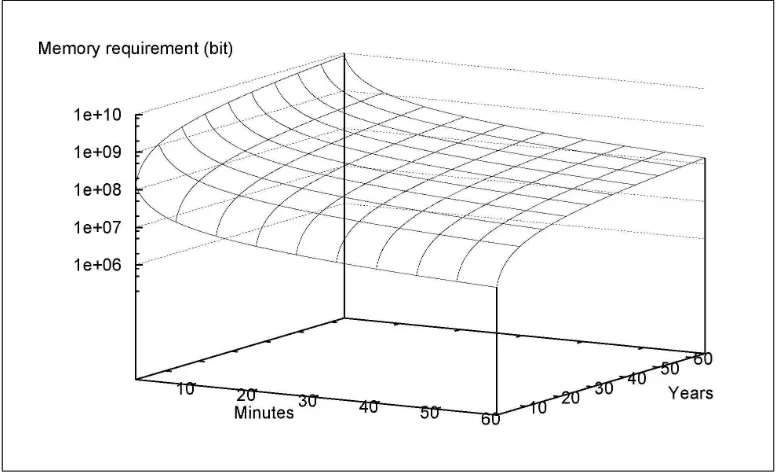
Figure 1. Token Storage Overhead (in bits): X-axis shows verification frequency (in minutes) and Y-axis shows desired longevity (in years).
for 64 years, or, equivalently, every 15 minutes for 16 years.
Furthermore, the number of tokens is independent from the number of data blocks. Thus, whenever out-sourced data is extremely large, extra storage required by our approach is negligible. For instance, the Web Capture project of the Library of Congress has stored, as of May 2007, about 70 Terabytes of data.4As shown above, checking this content every 15 minutes for the next 16 years would require only 1 Mbyte of extra stor-age per year, which arguably can be even stored directly at
OW N
.4.3. Computation Overhead
Another important variable is the computation over-head of the setup phase in the basic scheme. Recall that at setup
OW N
needs to computet hashes, each over a string of sizer∗ |b|size, where |b|is the block size. (In the modified scheme, the overhead is similar:t× r hashes over roughly one block each.)To assess the overhead, we assume that to process a single byte, a hash function (e.g., SHA), requires just 20 machine cycles [25], which is a conservative assump-tion. Furthermore, we assume the following realistic parameters:
•
OW N
outsources 237bytes of data, i.e., the con-tent of a typical hard drive – 128-GB.4Seehttp://www.loc.gov/webcapture/faq.html
• Each data block is 4-KB (|b| =212) and d = 237/212=225.
•
OW N
needs to perform one verification daily for the next 32 years, i.e.,t=32×365=11,680.•
OW N
requires the detection probability of 99% with 1% of the blocks being missing or corrupted; hencer=29(see Equation 1).Based on the above, each hash, computed over roughly 221=212×29bytes, would take – on a low-end comput-ing device with a 1-GHz CPU, less than 0.04 seconds [25]. The total number of hashes is 11,680. Thus, setup time is about 11,680×0.04=467 seconds, which is less than 8 minutes. Note that setup also involvest× r PRP, 2t PRF, as well ast AEK invocations. However, these operations are performed over short inputs (e.g., 128 bits) and their costs are negligible with respect to those of hashing.
5. Related Work
Initial solutions to the PDP problem were provided by Deswarteet al.[26] and Filhoet al.[27]. Both use RSA-based hash functions to hash the entire file at ev-ery challenge. This is clearly prohibitive for the server whenever the file is large.
client is forced to store several bits per file block, so storage at the client is linear with respect to the number of file blocks as opposed to constant.
Schwarz and Miller [22] propose a scheme that al-lows a client to verify storage integrity of data across multiple servers. However, even in this case, the server must access a linear number of file blocks per challenge. Golle et al. [29] first proposed the concept of en-forcement of storage complexityand provided efficient schemes. Unfortunately the guarantee they provide is weaker than the one provided by PDP schemes since it only ensures that the server is storing something at least as large as the original file but not necessarily the file itself.
Provable data possession is a form of memory check-ing [30, 23] and in particular it is related to the concept of sub-linear authentication introduced by Naor and Rothblum [23]. However, schemes that provide sub-linear authentication are quite inefficient.
Compared to the PDP scheme in [7], our scheme is significantly more efficient in both setup and verifica-tion phases since it relies only on symmetric-key cryp-tography. The scheme in [7] allows unlimited verifica-tions and offers public verifiability (which we do not achieve). However, we showed that limiting the num-ber of challenges is not a concern in practice. In ad-dition, our scheme supports dynamic operations, while the PDP scheme in [7] works only for static databases.
Compared to the POR scheme [8], our scheme pro-vides better performance on the client side, requires much less storage space, and uses less bandwidth (sizes of challenges and responses in our scheme is a small constant, less than the size of a single block). To appre-ciate the difference in storage overhead, consider that, POR needs to storessentinels per verification, where each sentinel is one data block in size (hence, a total of s×tsentinels). In contrast, our scheme needs a single encrypted value (256 bits) per verification. Note that, in POR, for a detection probability of around 93%, where at most 1% of the blocks have been corrupted, the sug-gested valuesis on the order of one thousand [8]. Like [7], POR is limited to static data (in fact, [8] considers supporting dynamic data an open problem). In sum-mary, we provide more features than POR by consum-ing considerably less resources5.
To further compare the two schemes we assess their respective tamper detection probabilities. In [8], the outsourced data is composed ofd blocks and there are ssentinels. We compute the probability that,mbeing the number of corrupted blocks, the system consumes all sentinels and corruption is undetected. Similarly, to
5We have recently learned that a MAC-based variant of our first basic scheme was mentioned by Ari Juels during a presentation at CCS ’07 in November 2007 ([31]). This is an independent and con-current discovery. Indeed, an early version of our paper was submitted to NDSS 2008 in September 2007.
evaluate our scheme, for the same amount of data, we assumettokens, each based onrverifiers.
For our scheme, the probability of no corrupted block being detected after allttokens are consumed is:
d−η m
d m
(2)
Note thatηaccounts for the number of different blocks used by at least one token. Indeed, to avoid detec-tion,
SR V
cannot corrupt any block used to compute any token. It can be shown that, for a suitably large d, for everyt, it holds that: η≥min{tr/2,d/2}with overwhelming probability. Hence, the upper bound for Equation 2, whentr/2≤d/2, is given by:d−tr 2 m
d m
(3)
In [8],
SR V
can avoid detection if it does not corrupt any sentinelblock. Since a total ofs×t sentinels are added to the outsourced data, the probability of avoiding detection is:d m
d+(s×t)
m
(4)
The above equations show that, in our scheme, for a givent, increasingralso increases the tamper-detection probability. However,rhas no effect on the total num-ber of tokens, i.e., does not influence storage overhead. As for POR, for a givent, increasing tamper detection probability requires increasing ins, which, in turn, in-creases storage overhead.
6. Conclusions
We developed and presented a step-by-step design of a very light-weight and provably secure PDP scheme. It surpasses prior work on several counts, including stor-age, bandwidth and computation overheads as well as the support for dynamic operations. However, since it is based upon symmetric key cryptography, it is unsuitable for public (third-party) verification. A natural solution to this would be a hybrid scheme combining elements of [7] and our scheme.
To summarize, the work described in this paper rep-resents an important step forward towards practical PDP techniques. We expect that the salient features of our scheme (very low cost and support for dynamic out-sourced data) make it attractive for realistic applica-tions.
References
DB-Sec’03, also in Journal of Computer Security, Vol. 11, No. 3, pages 291-314, 2003, 2003.
[2] E. Mykletun, M. Narasimha, and G. Tsudik, “Authenti-cation and integrity in outsourced databases,” inISOC NDSS’04, 2004.
[3] H. Hacig¨um¨us, B. Iyer, C. Li, and S. Mehrotra, “Exe-cuting sql over encrypted data in the database-service-provider model,” inACM SIGMOD’02, 2002.
[4] D. Song, D. Wagner, and A. Perrig, “Practical tech-niques for searches on encrypted data,” in IEEE S&P’00, 2000.
[5] D. Boneh, G. di Crescenzo, R. Ostrovsky, and G. Per-siano, “Public key encryption with key-word search,” in
EUROCRYPT’04, 2004.
[6] P. Golle, J. Staddon, and B. Waters, “Secure conjunc-tive keyword search over encrypted data,” inACNS’04, 2004.
[7] G. Ateniese, R. Burns, R. Curtmola, J. Herring, L. Kiss-ner, Z. Peterson, and D. Song, “Provable data possession at untrusted stores,” inACM CCS’07, Full paper avail-able on e-print (2007/202), 2007.
[8] A. Juels and B. Kaliski, “PORs: Proofs of retrievability for large files,” inACM CCS’07, Full paper available on e-print (2007/243), 2007.
[9] John F. Gantz, David Reinsel, Christopher Chute, Wolf-gang Schlichting, John McArthur, Stephen Minton, Irida Xheneti, Anna Toncheva, and Alex Man-frediz, “The expanding digital universe: A fore-cast of worldwide information growth through 2010. IDC white paper—sponsored by EMC,” Tech. Rep.,
March 2007, http://www.emc.com/about/
destination/digital_universe/.
[10] Ian Clarke, Oskar Sandberg, Brandon Wiley, and Theodore W. Hong, “Freenet: a distributed anony-mous information storage and retrieval system,” in In-ternational workshop on Designing privacy enhancing technologies, New York, NY, USA, 2001, pp. 46–66, Springer-Verlag New York, Inc.
[11] M. Lillibridge, S. Elnikety, A. Birrell, M. Burrows, and M. Isard, “A cooperative internet backup scheme,” in
USENIX’03, 2003.
[12] B. Cooper and H. Garcia-Molina, “Peer-to-peer data trading to preserve information,” ACM ToIS, vol. 20, no. 2, pp. 133–170, 2002.
[13] G. Ateniese, D. Chou, B. de Medeiros, and G. Tsudik, “Sanitizable signatures,” inESORICS’05, 2005. [14] M. Waldman and D. Mazi`eres, “TANGLER: a
censorship-resistant publishing system based on docu-ment entangledocu-ments,” inACM CCS’01, 2001.
[15] J. Aspnes, J. Feigenbaum, A. Yampolskiy, and S. Zhong, “Towards a theory of data entanglement,” inProc. of Euro. Symp. on Research in Computer Security, 2004. [16] M. Waldman, A. Rubin, and L. Cranor, “PUBLIUS:
a robust, tamper-evident, censorship-resistant web pub-lishing system,” inUSENIX SEC’00, 2000.
[17] P. Rogaway, M. Bellare, and J. Black, “OCB: A
block-cipher mode of operation for efficient authenticated en-cryption,”ACM TISSEC, vol. 6, no. 3, 2003.
[18] M. Bellare, R. Canetti, and H. Krawczyk, “Keying hash functions for message authentication,” inCRYPTO’96, 1996.
[19] J. Black and P. Rogaway, “Ciphers with arbitrary fi-nite domains.,” inProc. of CT-RSA. 2002, vol. 2271 of
LNCS, pp. 114–130, Springer-Verlag.
[20] John Kubiatowicz, David Bindel, Yan Chen, Steven Cz-erwinski, Patrick Eaton, Dennis Geels, Ramakrishan Gummadi, Sean Rhea, Hakim Weatherspoon, Westley Weimer, Chris Wells, and Ben Zhao, “Oceanstore: an architecture for global-scale persistent storage,” SIG-PLAN Not., vol. 35, no. 11, pp. 190–201, 2000. [21] Garth R. Goodson, Jay J. Wylie, Gregory R. Ganger, and
Michael K. Reiter, “Efficient byzantine-tolerant erasure-coded storage,” inDSN ’04: Proceedings of the 2004 International Conference on Dependable Systems and Networks, Washington, DC, USA, 2004, p. 135, IEEE Computer Society.
[22] T. S. J. Schwarz and E. L. Miller, “Store, forget, and check: Using algebraic signatures to check remotely administered storage.,” inProceedings of ICDCS ’06. 2006, IEEE Computer Society.
[23] M. Naor and G. N. Rothblum, “The complexity of on-line memory checking,” inProc. of FOCS, 2005, Full version appears as ePrint Archive Report 2006/091. [24] M. Bellare, R. Gu´erin, and P. Rogaway, “XOR MACs:
New methods for message authentication using finite pseudorandom functions,” inCRYPTO’95, 1995. [25] B. Preneel, et al., “NESSIE D21 - performance of
opti-mized implementations of the nessie primitives,” . [26] Y. Deswarte, J.-J. Quisquater, and A. Saidane, “Remote
integrity checking,” inProc. of Conference on Integrity and Internal Control in Information Systems (IICIS’03), November 2003.
[27] D. L. G. Filho and P. S. L. M. Baretto, “Demon-strating data possession and uncheatable data transfer,” IACR ePrint archive, 2006, Report 2006/150,http: //eprint.iacr.org/2006/150.
[28] F. Sebe, A. Martinez-Balleste, Y. Deswarte, J. Domingo-Ferrer, and J.-J. Quisquater, “Time-bounded remote file integrity checking,” Tech. Rep. 04429, LAAS, July 2004.
[29] P. Golle, S. Jarecki, and I. Mironov, “Cryptographic primitives enforcing communication and storage com-plexity.,” inFinancial Cryptography, 2002, pp. 120– 135.
[30] M. Blum, W. Evans, P. Gemmell, S. Kannan, and M. Naor, “Checking the correctness of memories,” in
Proc. of the FOCS ’95, 1995.
[31] A. Juels and B. S. Kaliski, ,” http: