Available Online atwww.ijcsmc.com
International Journal of Computer Science and Mobile Computing
A Monthly Journal of Computer Science and Information Technology
ISSN 2320–088X
IJCSMC, Vol. 4, Issue. 7, July 2015, pg.128 – 133
Analysis of Different Text
Based Captcha Methods
S.Thangavelu
1; T.Purusothaman
2¹M.S.University, Tirunelveli, India ²Govt. College of Technology, Coimbatore, India
1
Email: [email protected]
Abstract— CAPTCHA stands for completely automated public turing test to tell computers and humans apart. The primary duty of Captcha is to separate humans and bots. Captcha generates a challenge response test and direct the users to perform a simple task. It is easy for the humans to complete the task, whereas it is difficult for the bot programs.Thus Captcha becomes a standard security mechanism in all the websites and web applications to prevent Internet Bots from unauthorised access.
Keywords— Captcha, bots, Security, text, image, audio, video
I. INTRODUCTION
Captcha also called as Human interactive proof engaged in all the websites and web applications which distinguish humans and computer bots automatically. The word Captcha was devised by Luis von Ahn [1], Manuel Blum, Nicholas J. Hopper, and John Langford of Carnegie Mellon University during 2003. The various types [2] of Captcha methods are,
Text based Captcha methods
Image based Captcha methods
Video based Captcha methods
Audio based Captcha methods
II. CAPTCHATYPES
based on the understanding capacity of human to the words and the accent which is a very tough task for bots. The audio based Captcha are difficult for users with hearing impairments. Also, the users need sound knowledge in English.
Video Based Captcha methods: In the Video based Captcha methods a video clipping which contains few key words are presented to the user. Some websites uses a video from the public domain like YouTube as Captcha. The users need to identify the words in the video and submit them for validation. This method provides better security and enhanced usability.
The video files are large in size when compare to text Captcha. Large file size needs extra download time or require high bandwidth. Also the users need more concentration to identify the words.
III.APPLICATIONS OF CAPTCHA
Free E Mail Services: A large number of websites on internet offer free registration to the Social networking sites, Email services, Web blogs etc. These web sites are attacked by the internet bots which signup automatically in huge amount continuously. This intern causes denial of service to the humans on the particular web service. Captcha prevent such attacks.
Web crawler: WebCrawler or Spider is a program used by search engines to explore the Internet and automatically download web content available on web sites. They capture the text of the pages and the links on the pages, thus it enables search engine users to find new pages. The bots acquire specific types of information from the web pages such as mining email addresses which can be used mostly for spam.
Dictionary Attacks: Captcha prevents dictionary attacks on passwords [7]. Bots through iteration method try to break the passwords of the users. Introducing Captcha in the signup page prevents such attacks. Humans need to type the passwords along with Captcha.
Online Games: Captcha prevents web Robots from playing online games
Phishing Attacks: Phishing attack is a novel attack in which the bots are attempting to steal the user credentials such as bank account details, usernames, passwords, credit and debit card details; Captcha prevents any such phishing attacks.
IV.ANALYSIS OF DIFFERENT TEXT BASED CAPTCHA METHODS
Text based Captcha methods are one of the most common and widely accepted forms of Captcha. The Captcha implementation was first developed by Andrei broder in 1997 for AltaVista website; to avoid automatic adding of URLs to the website for indexing. Thereafter many varieties Captcha methods are introduced for web security.
Figure.1. Gimpy Captcha
EzGimpy Captcha: EzGimpy is another version of Gimpy Captcha designed in simple form. EzGimpy randomly picks a single word from a dictionary and presented with distortion and noise. The user needs to identify and enter the text correctly for authentication. The EzGimpy Captcha image is shown in Figure.2.
Figure.2. EzGimpy Captcha images
Baffle Text Captcha: Baffle Text Captcha [8] is a different type of text based Captcha introduced in California University, Berkeley. It is a customized version of Gimpy Captcha. It picks random alphabets or characters to form a pronounceable text. These words are garbage words not available in any dictionary. This is mainly to prevent the drawback of dictionary attacks. Figure.3. shows the Baffle Text Captcha image.
Figure.3. Baffle Text Captcha
Figure.5. Handwritten Captcha image
ReCaptcha: ReCaptcha was introduced into the Google services, to prevent spam and also used to identify the deciphered words which are not recognized by the scanners. Out of the two words, one will be taken from an old book have to be digitized. The users need to identify both the two words for authentication. Figure.6. shows the Google ReCaptcha image.
Figure.6. Google ReCaptcha image
MSN Captcha: MSN Captcha [11] is designed exclusively for Microsoft services. They are popularly known as MSN Passport Captcha. It is designed with a minimum of eight characters and digits, presented in dark blue foreground and grey background. Warping is also used to distort the characters. The ripple effect in the Captcha makes it very difficult for recognition by bots. The figure.7. shows the MSN Captcha images.
Figure.7. MSN Captcha images
3D Captcha: Human’s visual structure is capable to identify 3D objects as well 3D movies. This will be a
Figure.8. 3D Captcha image.
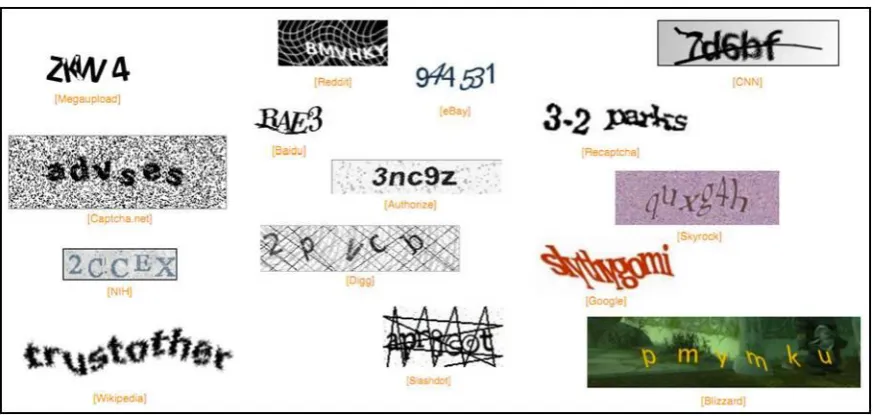
Captcha in popular websites: Based on the different concepts, a large number of popular websites engaged the text based Captcha methods to the security of their websites. The Captcha methods have been implemented with different modification and improvement. This includes lines, waving, overlapping of characters, color characters, noise in the background and degrading the image quality etc. The Figure 9 shows the Captcha images [13] employed in popular websites.
Figure 9. Captcha in Popular websites
Strength and Limitations of Text based Captcha methods: Every Captcha method has its own advantages, strength and limitations [14]. The commonly accepted and most widely used text based Captcha methods has so many advantages but suffers with some disadvantages also.
Advantages and Strength:
Text based Captcha methods are user friendly to all section of users.
It is easy for generation and validation
Text based Captcha is simplest among all other types of Captcha
It may be designed in every language
It is very easy to understand and easy to answer for all humans
Disadvantages and Limitations:
More distortion, different orientation and noise make it difficult for humans also.
Text based Captcha can be cracked by using OCR softwares.
REFERENCES
[1] Luis von Ahn et al, ‘ CAPTCHA: Using Hard AI Problems for Security’, in: Proceedings of the International Conference on the Theory and Applications of Cryptographic Techniques, Poland, 2003
[2] M. Tariq Banday & N. A. Shah, ‘A Study of Captchas for Securing Web Services,’ International Journal of Secure Digital Information Age, 2009,Vol. 1. No.2.,
[3] Henry S.Baird & kris popat, ’ Human interactive proof and document Image analysis’, in: International workshop on document analysis system, 2002,
[4] Luis von Ahn, ‘Labeling Images with a Computer Game’, in: Proceedings of the SIGCHI Conference on Human Factors in Computing Systems, 2004.
[5] Gao et al ,‘An audio CAPTCHA to distinguish humans from computers’, in: 3rd International Symposium on Electronic Commerce and Security, pp 265–269, 2010.
[6] Kiranjot Kaur & Sunny Behal, ‘Captcha and Its Techniques: A Review’, International Journal of Computer Science and Information Technologies, 2014, vol. 5, No.5.
[7] Jeff Yan, Ahmad Salah & El Ahmad, ‘CAPTCHA Security-A Case Study’, IEEE Security & Privacy, 2009, volume: 7, Issue: 4.
[8] Monica Chew & Henry S. Baird, ’ Baffle Text: a Human Interactive Proof’, in: Proceedings of the SPIE/IS&T Document Recognition & Retrieval Conference, 2003.
[9] Coates, A.L, S. Bired & J. Fateman, ‘Pessimal Print: A Reverse Turing Test’, International Journal on Document Analysis and Recognition, 2003, vol.5, no.2, pp 158-163.
[10] Amalia rusu , ‘Handwritten Captcha using the difference in the abilities of human and machines in reading handwritten words’, in : Proceedings of the 9th International Workshop on Frontiers in Handwriting Recognition, IEEE, 2004.
[11] Baljit Singh Saini & Anju Bala, ‘A Review of Bot Protection using CAPTCHA for Web Security’ , Journal of Computer Engineering, 2013, volume 8, Issue 6 , PP 36-42
[12] M. Imsamai &S.Phimoltares, ‘3D CAPTCHA: A Next Generation of the CAPTCHA’, in: IEEE International Conference on Information Science and Applications, Seoul, 2010, PP 1–8.
[13] Elie Bursztein, Matthieu Martin and John C. Mitchell, ‘Text-based CAPTCHA Strengths and Weaknesses’, in: Proceedings of the 18th ACM conference on Computer and communications security, October 2011, PP 125–138.