Available Online atwww.ijcsmc.com
International Journal of Computer Science and Mobile Computing
A Monthly Journal of Computer Science and Information Technology
ISSN 2320–088X
IJCSMC, Vol. 4, Issue. 9, September 2015, pg.36 – 41
RESEARCH ARTICLE
A New Comparative Study of AODV & DSR
Routing Protocols in Mobile Ad-Hoc Networks
Kuldeep Kumar
Computer science Engg Department & IFTM University Moradabad, India [email protected]
Abstract- Mobile Ad-Hoc Networks are those networks which don’t have any fixed infrastructure. Due to mobility of nodes, frequent link breakage takes place. Therefore routing in mobile ad hoc networks is challenging task and this has led to the development of many different routing protocols. This paper analyses the performance of AODV and DSR routing protocols for the metrics Packet Delivery Ratio. This would be a great help for the people conducting research on real world problems in MANET security.
Keywords— MANET’s, routing protocols, reactive, proactive, hybrid, AODV, DSR, NS 2.
I. INTRODUCTION
Ad hoc networks [1] are autonomous, self configuring adaptive which make them applicable in various areas. Ad hoc wireless networks comes up with two variations of wireless network-first is [2] known as Infrastructure or base stations. A mobile unit, which is mobile, communicates to nearest base station. When it moves out of the coverage area of one base station, a process called Handoff and it comes in the coverage area of the other base station. In Infrastructure less or Ad Hoc wireless network [3] the node can move while communicating, there are no fixed base stations and all the nodes in the network act as routers. The mobile node changes their location and establishes their own network „on the fly‟.
II. CHARACTERISTICS OF MANETS
Some of the major characteristics of mobile ad hoc routing protocols are:
Dynamic Network topology: As the nodes move, the topology may change rapidly and the connectivity within the network varies with time.
Limited Bandwidth: The bandwidth [4] available is limited than that of wired networks. The power is limited and the
computation should be energy efficient
Distributed Operation: Nodes collaborate them to implement functions and not a single node is solely responsible for
the overall operation.
Security: The wireless links lack defence against threats. Various attacks such as denial of services, eavesdropping, replay attacks are possible.
MANETs are resource constrained, bandwidth constrained and as the nodes are mobile, the network topology changes dynamically effectively. Therefore routing must be done and hence the need of efficient routing protocols. In MANETs, the protocols for routing are grouped into three categories based on the way how they work.
III. Related Work
As a promising network type for future mobile application, MANETs are attracting more and more researcher. Mobile ad hoc networks are resource constrained and hence Routing in mobile ad hoc networks is more challenging task. Many researchers have done work on analyzing the characteristics of different routing protocols in mobile ad hoc networks. Rachit Jain, Laxmi Shrivastava [10] analyzed the performance of AODV & DSR on the basis of Path Loss Propagation Models based on various performance metrics in order to create a substantial understanding of choosing the correct protocol for any active operating environment. Dhananjay Bisen et al. [11] studied the effect of pause time on AODV, DSR and DYMO routing protocols in mobile ad hoc networks based on parameters like Packet Drop Ratio (PDR), Throughput, Jitter and End to End Delay with variations in Pause Time of network. They concluded that DSR performs better than AODV and DYMO under different situations with variation in pause time and performance of DYMO is better than DSR in some situations. Monika at el. [12] compared AODV, DSDV and DSR Routing Protocols in Vehicular Network Using EstiNet Simulator based on parameters like throughput, number of packets dropped. The performance of AODV found to be better in most situations. M.L Sharma et al. [13] analyzed the performance of MANET routing protocols under CBR and FTP traffic classes under different network scenarios like pause time, offered load (i.e. number of source destination pairs), node speed. The results shows that for CBR traffic, AODV performs better than DSR and WRP in terms of Packet Delivery Ratio(PDR), Throughput and routing overhead and for FTP traffic, DSR performs better than AODV and WRP in terms of packet delivery ratio and throughput. Liang Qin, Thomas Kunz [14] provides a method to increase the packet delivery ratio in DSR by link protection through link breakage prediction algorithm. They also proposed that Enhanced route cache maintenance based on the link status can further reduce the number of dropped packets.
IV. ROUTING PROTOCOLS
Routing protocols tells the way how a message is sent from source to the destination. These protocols are categorized as shown in figure 1Taxonomy of routing protocols
Figure 1: Taxonomy of Ad-Hoc Routing Protocols 1. Reactive Routing Protocols
In Reactive routing protocols or demand routing protocols, nodes are set up when needed Nodes. When a node wants to send a packet to another node, it initiates communication with that node [8], if no node is present earlier. The reactive routing protocols have two major components [4]
Route discovery: When a node or the source [5] wants to send a packet to another node or the destination node, it first scans its cache to find the route to the destination, if route not present, it initiates route discovery process containing through a packet having the destination address and the address of intermediate nodes to the destination.
Route maintenance: Due to mobility of nodes, the nodes change their topology and hence route maintenance is done. Route maintenance is achieved through the use of acknowledgement.
2. Proactive routing protocols
Proactive routing protocols are also knows as table driven protocol. In these protocols, each node maintains a routing table consisting of routing information to every other node in the network [7]. Since the nodes are mobile, they keep on changing their location. So the routing tables maintained by different nodes are periodic or whenever a change occurs, are updated. There are a number of proactive routing protocols. They differ in various areas like number of routing table [6] maintained and how the changes are propagated in the network
3. Hybrid routing protocols
Hybrid routing protocols [7] are both proactive and reactive in nature. There protocols work on the merits of these protocols to increase scalability and to decrease the routing overhead.
V. DYNAMIC SOURCE ROUTING (DSR)
It uses the concept of [5] source routing in which the creates routes only when source requires [6]. It is based on link state algorithm [4]. As it is on demand routing protocol, the routing overhead is less [14] This Protocol is composed of two essential parts of route discovery and route maintenance.
route cache has an expired route, then it initiate the route discovery process. Route cache contains the recently discovered routes. Route discovery requires 7 fields during this process such as source id, destid, ReqIDAddresslist, Hoplimit,NetworkInterf---aceList, Acknowledgment list. Then source node broadcasts the message to its neighbour. Moreover, source node also maintains a replica of messages sent in its send buffer. Packets can be dropped if send buffer is full or the time limit for route discovery is over. When a nodes destination or the intermediate node having route to destination receives the route request message, it generates route reply [6]
Route Maintenance: Route maintenance includes monitoring the routes against failure through route error messages and route cache [5]. There is no need of keeping routing table in DSR [3] protocol. Route cache can further decrease route discovery overhead. DSR reduces overhead of route maintenance. However DSR is not scalable to large networks and packet Size grows with length of the route due to source routing.
VI. AODV (AD HOC ON DEMAND DISTANCE VECTOR)
AODV [3] is based on DSDV and DSR collectively. It keeps Routing tables .Route is between two nodes is discovered as when needed. When a source S node wants to send a packet to the destination node D, it first checks its routing table and if there is no entry, it initiates route discovery process. It broadcasts a route request (RREQ) packet to its neighbours [6]. The RREQ contains IP addresses of source(S) and destination(D) node, current sequence number of source(S) and last known sequence number of D, a broadcast ID from S, which is incremented each time S sends a RREQ message. The broadcast ID, IP address pair of the source S forms a unique identifier for the RREQ. AODV utilizes destination sequence numbers to guarantee the fresh route. When a node broadcast RREQ message, it waits for RREP. If the reply is not received within certain time limit, the source node rebroadcast the RREQ or it assumes that there is no route present. When a node receives a RREQ message, it broadcast the RREQ message to its neighbour if it is not the destination route and creates a temporary reverse route to the source IP address in its routing table with next hope equal to the IP address of neighbouring node that sent the RREQ. Intermediate nodes can reply to the RREQ only if they have a route to the destination whose corresponding destination sequence number is greater than or equal to that contained in the RREQ. Once the RREQ reaches the destination or an intermediate node with a fresher route, it generates RREP and it is unicasted back to the requesting node which eventually reaches the source node. The intermediate node records the route to the destination as the RREP follows from destination to source. The nodes are mobile, so it can move anytime. IF the source node moves to different location, it can rediscover the route the destination node by route discovery process. IF the destination node/the intermediate node moves to different location [6], it informs the upstream node through Route error message which eventually reaches the source node. The source node terminates the ongoing communication and initiate route discovery process. Hello messages are used to maintain the local connectivity. AODV protocol reduces number of routing messages in the network. It handles the dynamic behaviour of the nodes efficiently. However there is possibility of various attacks on AODV. The route discovery latency is high.
VII. SIMULATIONS
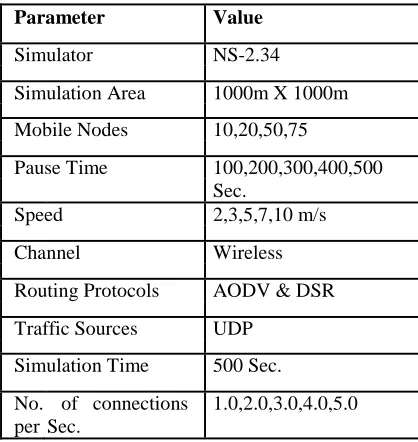
The simulations were performed using Network Simulator 2 (Ns-2.34), particularly popular [9] in the ad hoc networking community. The traffic sources are UDP. The source-destination pairs are spread randomly over the network. During the simulation, each node starts its journey from a random spot to a random chosen destination. Once the destination is reached, the node takes a rest period of time in second and another random destination is chosen after that pause time. This process repeats throughout the simulation, causing continuous changes in the topology of the underlying network. Different network scenario for different number of nodes and pause times are generated. The model parameters that have been used in the following experiments are summarized in Table 1.
Table 1: Simulation Environment
Parameter Value
Simulator NS-2.34
Simulation Area 1000m X 1000m
Mobile Nodes 10,20,50,75
Pause Time 100,200,300,400,500
Sec.
Speed 2,3,5,7,10 m/s
Channel Wireless
Routing Protocols AODV & DSR
Traffic Sources UDP
Simulation Time 500 Sec.
VIII. PERFORMANCE METRICS
1. Packet Delivery Ratio (PDR)
Packet delivery ratio [8] is defined as the ratio of data packets received by the destinations to those generated by the sources. This performance metric gives us an idea of how well the protocol is performing in terms of packet delivery at different speeds and different pause time. The greater value of packet delivery ratio means the better performance of the protocol.
2. Pause Time
Pause time refers to the rest time of the node. A node begins by staying in one location for a certain period of time (i.e. a pause time). Once this time expires, the node chooses a random destination in the simulation area and a speed that uniformly distributed between [min speeds, max speed]. The node then travels towards the newly chosen destination at the selected speed. Upon arrival the node pauses for a specified time period before starting the process again.
X. COMPARATIVE STUDY
A case study has been done using UDP connections. Various cases have been taken and a bias less scenario generation has been done. Scenarios has been created using TCL scripts and a real life situation has been assumed. Various cases have been taken for final results. Nodes taken are 10, 20, 50 and for denser medium as 78. Also two major metrics have been used for calculation of schemes. These are PDR for Pause time and speed. For more realism speed has been increased up to a car moving in a street and pause time has been increased from 100 to 500 to generate bias less patterns for data transmission. It has been observed in all experiments that DSR outperforms AODV in most cases and its PDR is above AODV. The sudden abrupt rise and fall may be due to many reasons some of the important points to highlight in this regards are:
1. Scenario generated
2. Number of connections made 3. Transmission of data at time intervals 4. Motion pattern of various nodes
5. Simulation time and other simulation parameters
6. Lesser Link breaks in generated scenario (which in other case will lead to better performance by AODV)
XI. CONCLUSION & FUTURE WORK
References
[1] Pore Ghee Lay, John C. McEachen “A Comparison of Optimized Link State Routing with Traditional Ad-hoc Routing Protocols” U.S. Navy Research Paper 2.
[2] Umang Singh “Secure Routing Protocols in Mobile Adhoc Network-A Survey and Taxonomy” International Journal of Reviews in Computing 30th September 2011. Vol. 7
[3] Sunil Taneja and Ashwani Kush “A survey of Routing Protocols in Mobile Ad Hoc Networks” , International Journal of Innovation, Management and Technology, Vol. 1, No. 3, August 2010 ISSN: 2010-0248
[4] Robinpreet Kaur & Mritunjay Kumar Rai “A Novel Review on Routing Protocols in MANETs”, Undergraduate Academic Research Journal (UARJ), ISSN : 2278 – 1129, Volume-1, Issue-1, 2012
[5] Dr.D.Siva Kumar “Review: Swarm Intelligent based routing Protocols for Mobile Adhoc Networks” International Journal of Engineering Science and Technology Vol. 2 (12), 2010, 7225-7233
[6] Elizabeth M. Royer, “A Review of current routing protocols for Ad-Hoc Mobile Wireless Networks”, IEEE Personal Communication * April 1999
[7] Mehran Abolhasana, Tadeusz Wysockia, Eryk Dutkiewicz b,* “A review of routing protocols for mobile ad hoc networks”, Telecommunication and Information Research Institute, University of Wollongong, Wollongong, NSW 2522, Australia b Motorola Australia Research Centre, 12 Lord St., Botany, NSW 2525, Australia Received 25 March 2003; accepted 4 June 2003
[8] NS-2 Network Simulator http://www.isi.edu/nsnam/ns
[9] Rachit Jain1, Laxmi Shrivastava “Study and Performance Comparison of AODV & DSR on the basis of Path Loss Propagation Models” International Journal of Advanced Science and Technology Vol. 32, July, 2011
[10] Dhananjay Bisen at el. “Effect of Pause Time on DSR, AODV and DYMO Routing Protocols in MANET” Manuscript received November 20, 2009.
[11] Monika at el. “Comparative Study of AODV, DSDV and DSR Routing Protocols in Vehicular Network Using EstiNet Simulator” International Journal of Scientific & Engineering Research, Volume 3, Issue 6, June-2012 1 ISSN 2229-5518
[12] M.L Sharma at el.“ Performance Evaluation of MANET Routing Protocols under CBR and FTP traffic classes” Int. J. Comp. Tech. Appl., Vol 2 (3), 392-400 ISSN: 2229-6093