Available Online at www.ijcsmc.com
International Journal of Computer Science and Mobile Computing
A Monthly Journal of Computer Science and Information Technology
ISSN 2320–088X
IMPACT FACTOR: 5.258
IJCSMC, Vol. 5, Issue. 8, August 2016, pg.78 – 84
SVM based CBIR Framework by
Combination of Several Features
C. Subha Darathy
Assistant Professor, Arunachala College of Engineering for Women, India
Abstract— A Content Based Image Retrieval (CBIR) system aims at retrieving a similar set of images with respect to the query image, from a vast database. The user can pass any query image of interest and the relevant set of images is returned back to the user. This sort of CBIR systems have found application in many areas such as medicine, education, marketing and so on. A conventional keyword based search was inefficient in retrieving data because of large scale digitization of images, diagrams and paintings. This work presents a CBIR system that extracts features such as LBP, gabor filter and zernike moments. The so extracted features are treated with Discrete Wavelet Transform (DWT). As this approach considers all the features such as texture, shape and color, the performance of the CBIR system is considerably improved. The experimental results prove the efficacy of the work.
Keywords— CBIR, LBP, Gabor filter, Zernike’s moment, SVM
I. INTRODUCTION
Digital images are now the basis of visual information in medical applications. The advent of radiology which employs imaging for diagnosis generates a large number of images. Explosion of World Wide Web (WWW) in the last decade has seen an enormous increase in the usage of digital images and the ease of access to remotely stored databases. This exponential growth in the image stored in databases requires an efficient image indexing and retrieval system. The need to locate the desired image in a large and varied collection has led to design of numerous image retrieval systems.
Traditional methods of image indexing are not adequate as the amount of images to be indexed is huge, which makes it impractical and error prone (Enser 1995). Automatic retrieval of images based on features like color, shape and texture is termed as Content Based Image Retrieval (CBIR). CBIR methodologies are similar to the methods used in image processing and computer vision.
Image processing encompasses image enhancement, compression and interpretation whereas CBIR emphasizes on retrieval of image from a database in response to queries. CBIR automates indexing and analysis of images. Research on CBIR has gained momentum, as application prospective of CBIR for fast and efficient image retrieval is vast.
CBIR is based on the extraction of features from the image; various methods are developed to extract the features. The general features which are extracted from the image are listed below and explained.
Local features - Local features refer to the small pixel blocks obtained by segmenting the image. Finer details are described in local features when compared to global features; thus in various domains local features give good classification results (Shyu et al 1998).
Global features - Global features consider the whole image and most systems use global feature like color histogram, which gives percentage of color present in the whole image. The global features like color or shape provide an overall idea and not the details of image. Global features are advantageous as extraction and matching is done with high speed (Glatard et al 2004).
Low level features - The visual content of the image like color, texture, shape which can be extracted from the image are termed as low level features. Some of the low level features that can be extracted from the images include color, texture and shape.
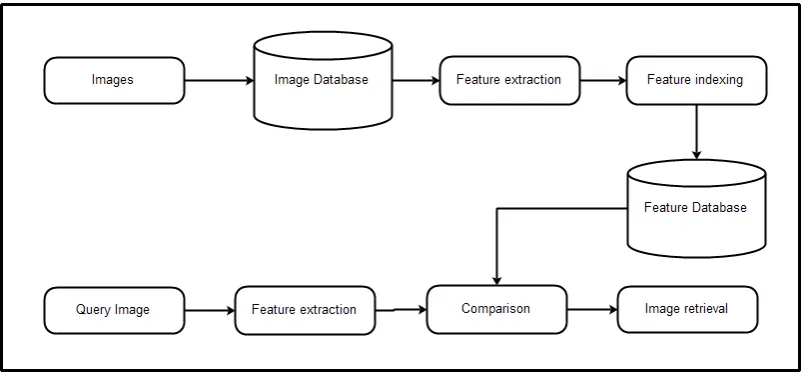
In the generic CBIR process, the process involves three stages. The first stage involves extraction of features from the images in the database. The extracted features are further indexed and compiled into the database. In the second stage, the query image in input is extracted for features. The final stage involves the comparison of the extracted feature from query with the feature database, and the image is retrieved. The block diagram of the CBIR process is shown in Figure 1.
Fig 1: Process of CBIR
Image database - The images are uploaded into database from which the relevant images are to be retrieved.
Feature extraction - All the images in the database are processed to extract features. Generally low level features like color, shape and texture are used as features.
Feature indexing - The features extracted are further indexed for easy comparison.
Feature database - The indexed features are stored in a feature database. Any new image included in the database is processed and its feature is indexed in the feature database.
Query image - When images are to be retrieved from the image database based on the content of image, a query image for which similar images are required is given as input.
Comparison - The features extracted from the query image are compared with the features indexed in the feature database. The similarity is compared using distance metrics, decision tree and Neural Networks.
Image retrieval - The images whose features are most similar to the query image features are retrieved from the image database.
II. REVIEW OF LITERATURE
Several image retrieval systems, which extract the rotation-invariant texture features of images, have been developed recently by Han J. and Ma K.K. (2007), Kokare M. et.al. (2006), Krishnamoorthi R. et.al. (2012), Rallabandi et.al. (2008), Zhang et.al. (2012).
Yang et al. exploited asymmetric loss functions to balance false positives and negatives. These methods, however, require an explicit enumeration of instances in the image. This is usually obtained by breaking images in a small fixed number of segments or applied in settings where detectors perform well, such as the problem of associating faces to captioned names.
On the other hand, to avoid explicitly enumerating the instances, Nguyen et al. coupled constraint generation algorithms with a branch and bound method for fast localization. Yakhnenko and Honavar proposed a MIL algorithm of linear complexity in the number of instances by using a non-convex Noisy-Or model.
Multi-task learning has also been proposed as a way to regularize the MIL problem to avoid local minima due to many available degrees of freedom. In this setting, the MIL optimization is jointly learned with a fully supervised task. It replaces the classifier loss and the non-convex constraints on the positive bags by convex. Lin et al. proposed a color-texture and color-histogram based image retrieval system (CTCHIR). They proposed three image features, based on color, texture and color distribution, as color co-occurrence matrix (CCM), difference between pixels of scan pattern (DBPSP) and color histogram for K-mean (CHKM) respectively and a method for image retrieval by integrating CCM, DBPSP and CHKM to enhance image detection rate and simplify computation of image retrieval. From the experimental results they found that, their proposed method outperforms the Jhanwar et al. and Hung and Dai methods.
Raghupathi et al. have made a comparative study on image retrieval techniques, using different feature extraction methods like color histogram, Gabor Transform, color histogram+gabour transform, Contourlet Transform and color histogram+contourlet transform. Hiremath and Pujari proposed CBIR system based on the color, texture and shape features by partitioning the image into tiles. The features computed on tiles serve as local descriptors of color and texture features.
The color and texture analysis are analyzed by using two level grid frameworks and the shape feature is used by using Gradient Vector Flow. The comparison of experimental result of proposed method with other system found that, their proposed retrieval system gives better performance than the others. Rao et al. proposed CTDCIRS (color-texture and dominant color based image retrieval system), they integrated three features like Motif cooccurrence matrix (MCM) and difference between pixels of scan pattern (DBPSP) which describes the texture features and dynamic dominant color (DDC) to extract color feature. The results are compared with the work of Jhanwar et al. and Hung and Dai and found that their method gives better retrieval results than others
Amore (Advanced Multimedia Oriented Retrieval Engine) provides the facility of selecting a category of images. Using a kind of template matching the system retrieves similar images. Blobworld developed by the computer science division, University of California limits the search space by selecting the image category.
In ImageScape, the user can draw the outline of the desired image. For matching purpose edge mapping methods are used. In iPURE (Perceptual and User friendly Retrieval of Images) initially the images are segmented and then the Individual segments are compared by computing a weighted Euclidean distance. It provides the option of relevance feedback mechanism. MARS (Multimedia Analysis and Retrieval Systems) supports the use of direct queries on low level features. By using queries with Boolean operators, the retrieval accuracy is improved. SQUID (Shape Query Using Image Database) represents the counter of the image using 3 glob shape features.
All the above said works are based on single image queries. J.Tang et al. propose a method that uses multiple images for querying. This method extracts one feature from one image and another feature from the other. The extracted features are combined and used for further similarity comparison. Another approach by B. Moghaddam et.al. allows the user to select the Regions of Interest . Different regions are processed parallelly and the best ones are combined to determine the final similarity. J.R.Smith et.al. propose a method for single/multiple color extraction from multiple regions within an image.
O.Huseyin et al. propose a method that segments the image so that the user can select different Regions of Interest. The features of the regions are used for the efficient retrieval of similar images. The method proposed by C.Zhang et.al retrieves multiple objects based on color and texture features. A CBIR system for human face is developed. The background feature of the image is used for retrieving similar faces. No Multi Query CBIR system for face database is reported yet. The proposed system uses eight face expressions: happiness, sadness, surprise, fear, anger, contempt, neutral and disgust.
localization is known a priori. Several researchers have addressed the problem of classifying an image and providing precise class localization. Motivated by the above works, the proposed work aims to present a novel CBIR system with better accuracy rates.
III.PROPOSED APPROACH
CBIR is at its limelight because of its vast requirement of efficient image retrieval. Every CBIR system comprises four different phases namely data collection, feature database extraction, searching the database and process and ordering the results. The proposed system focuses on three features namely colour, shape and texture.
Discrete wavelet transform is employed because of its degree of directionality, near shift invariance and minimal redundancy. Local Binary Pattern (LBP) and gabor filter are employed for extracting texture features and shape feature is extracted by using Zernike moment.
The LBP, gabor filter and zernike moment are applied over the approximation band of the image. Finally, SVM is employed as the classifier to differentiate between the images. This work retrieves the similar images from the database with the accuracy and sensitivity rate of cent percent.
A. Phases of the work
The proposed work relies on image acquisition, training and testing phases. Image acquisition aims at acquiring images to perform information retrieval. The images can be acquired from the real time photography or from the existing dataset. There are several datasets available for images. The training phase trains the system by taking the extracted features into account. The training phase aims at extracting the LBP, Gabor and Zernike moment features from the images. This is followed by the application of DWT. The feature set is used for learning process.
The testing phase passes a query image and the images from databases are retrieved and ranked with respect to the relevance score. SVM is employed as the classifier for distinguishing between images. Finally, the proposed work is tested for its performance with respect to sensitivity, specificity and accuracy rate. The proposed work is compared with several wavelets and the comparative analysis is performed.
B. Architectural diagram
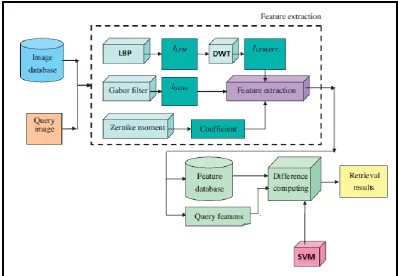
The detailed flow of the proposed work is presented in fig 2. The major components are LBP, Gabor filter and Zernike’s moment. This feature set is distinguishable by the classifier. This work employs SVM as its classifier.
C. Proposed algorithm
The proposed algorithm is presented below. Step 1: Obtain an image dataset.
Step 2: Apply Gabor filter and LBP in order to extract texture features. Step 3: Apply Zernike moment for extracting shape features.
Step 4: Apply discrete wavelet transform over the image.
Step 5: Combine all the features and save them for classification purpose. Step 6: Pass the query image.
Step 7: Repeat steps from 1 to 5.
Step 8: Pass the train and test features to the SVM classifier, in order to retrieve the images by taking the degree of relevancy into account. This is done by the below given equation.
𝑑 𝒒, 𝒙𝒊 = 𝜔𝑓𝛿(𝒒𝑓 𝒇 ∈ 𝑭
, 𝒙𝑖𝑓)
where
(2)
This system is compared with different wavelets such as Haar, DB1, DB3, Bio1.1, Bio1.5, symlets and coiflets. The performance of the proposed work is analysed with metrics such as accuracy, sensitivity and specificity. The proposed system proves better results when compared to all the techniques.
IV.PERFORMANCE ANALYSIS
The performance of this method is tested with measures such as sensitivity, specificity, accuracy. All these measures can be taken into account only if True Positive (TP), True Negative (TN), False Positive (FP) and False Negative (FN) are in hand. The above mentioned parameters are computed in the following way.
A. True Positive (TP)
True Positive (TP) is the proportion of positive cases that were correctly identified, as calculated using the equation (3).
(3)
B. True Negative (TN)
True Negative (TN) is defined as the proportion of negatives cases that were classified correctly, as calculated using the equation (4).
(4)
C. False Positive (FP)
False Positive (FP) is the proportion of negatives cases that were incorrectly classified as positive, as calculated using the equation (5).
(5)
D. False Negative (TN)
False Negative (FN) is the proportion of positives cases that were incorrectly classified as negative, as calculated using the equation.
(6) With the above mentioned parameters, the accuracy, sensitivity and specificity are calculated and the results are shown in graphs. From the experimental results, it is evident that the proposed system works well than the others.
E. Accuracy value
The accuracy of a measurement system is the degree of closeness of measurements of a quantity to that quantity's actual (true) value.
F. Specificity value
Specificity measures the proportion of negatives which are correctly identified such as the percentage of healthy people who are correctly identified as not having the condition, sometimes called the true negative rate.
(8)
G. Sensitivity value
Sensitivity also called the true positive rate or the recall rate in some field’s measures the proportion of actual positives which are correctly identified such as the percentage of sick people who are correctly identified as having the condition.
(9)
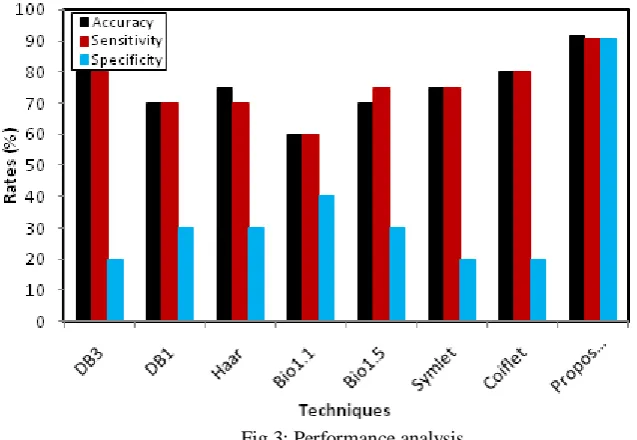
The proposed work is evaluated in terms of the above metrics and the graphical results are presented below.
Fig 3: Performance analysis
Thus, the proposed work proves its efficacy in terms of accuracy, sensitivity and specificity. The reason for the achievement is because of the consideration of all the low level features such as shape, color and texture. Thus, the objective of the work is satisfied.
V. CONCLUSIONS
This paper presents a CBIR system which takes the color, shape and texture features into account. These features are extracted by including Local Binary Pattern (LBP) and gabor filter and zernike moment. LBP and gabor filter are responsible for extracting texture and color features and the shape feature is extracted by using Zernike moment. This is followed by the application of DWT to every resultant image. The approximation band of the image is then extracted. Discrete Wavelet Transform is employed because of its degree of directionality, near shift invariance and minimal redundancy. The LBP, gabor filter and zernike moment are applied over the approximation band of the image. This work retrieves the similar images from the database with the accuracy and sensitivity rate of cent percent.
R
EFERENCES[1] Enser and Orengo, M. “Similarity of color images”, In proc. SPIE storage and retrieval for image and video databases, Vol. 2420, pp. 381-392,1995.
[2] Shyu, C., Brodley, C. and Kak, A. “Local versus global features for content-based image retrieval”, Procs. IEEE Workshop on content based access of image and video libraries, pp. 30-34, 1998.
[4] J. Han, K.K. Ma, Rotation-invariant and scale-invariant Gabor features for texture image retrieval, Image and Vision Computing 25 (2007) 1474–1481.
[5] M. Kokare, P.K. Biswas, B.N. Chatterji, Rotation-invariant texture image retrieval using rotated complex wavelet filters, IEEE Transactions on Systems, Man and Cybernetics-Part B: Cybernetics 36 (6) (2006) 1273–1282.
[6] R. Krishnamoorthi, S. Sathiya Devi, A multiresolution approach for rotation invariant texture image retrieval with orthogonal polynomials model, Journal of Visual Communication and Image Representation 23 (2012) 18–30.
[7] V.R. Rallabandi, V.P.S. Rallabandi, Rotation-invariant texture retrieval using wavelet-based hidden Markov trees, Signal Processing 88 (2008) 2593–2598.
[8] D.G. Sim, H.-K. Kim, R.H. Park, Invariant texture retrieval using modified Zernike moments, Image and Vision Computing 22 (2004) 331–342.
[9] G. Tzagkarakis, B.L. Baltasar, P. Tsakalides, Rotation-invariant texture retrievalwith Gaussianized steerable pyramids, IEEE Transactions on Image Processing15 (9) (2006) 2702–2718.
[10] D. Zhang, M.M. Islam, G. Lu, I.J. Sumana, Rotation invariant curvelet features forregion based image retrieval, International Journal of Computer Vision 98 (2)(2012) 187–201.