
A Hybrid Algorithm for Synthesizing Linear Sparse Arrays
Xiaowen Zhao1, 2, 3, *, Yunhua Zhang1, 2, and Qingshan Yang1, 2
Abstract—A hybrid algorithm based on the invasive weed optimization (IWO) and the convex optimization (CVX) is proposed for minimizing the peak sidelobe level (PSLL) of linear array with focused and/or shaped beam pattern. In this approach, IWO is adopted to produce the array (described by element positions), and CVX is used to determine the excitations for each produced array. Then the corresponding PSLL acts as the fitness function of IWO to find the optimal positions which lead to the minimum PSLL. Numerical experiments are conducted to validate the effectiveness and robustness of the proposed hybrid approach. Compared with other techniques, a lower PSLL can be achieved with a fixed main beam width or with a shaped main beam using this hybrid algorithm. Moreover, this method can easily cope with some constraints on the aperture, such as the minimum element spacing and the total number of elements.
1. INTRODUCTION
Nowadays, the synthesis of aperiodic arrays has attracted growing attentions as a challenging and meaningful problem. Compared with uniform arrays, aperiodic arrays with unequally-spaced elements have many outstanding advantages, such as easy to get rid of grating-lobes while achieving high directivity, the number of elements can be saved, the effect of mutual coupling reduced and the system cost well controlled [1]. As a result, aperiodic arrays have been widely used in the fields of satellite communication, tracking radars, radio astronomy and microwave remote sensing. In the synthesis of aperiodic arrays, the minimization of the peak sidelobe level (PSLL) is usually of major concern to the designer. Generally speaking, aperiodic arrays can be classified into two categories: sparse arrays with optimally spaced elements and thinned arrays that are derived by turning off some elements in an initial equally spaced array [2]. The inter-element spacings of a thinned array is an integer times of the uniform spacing of an initial equally spaced array, thus antenna elements are on originally uniform grids in some sense. However, the elements in sparse array are randomly distributed in the span of array aperture. Therefore, sparse arrays have more freedom degrees of optimization to achieve lower PSLL than thin arrays have. Recently, several approaches, such as analytical methods [3–5], modified genetic algorithm (MGA) [6], differential evolution algorithm (DEA) [7], vector mapping and simultaneous perturbation stochastic approximation [8], and invasive weed optimization (IWO) [9] have been developed for synthesizing sparse arrays. The performances of those techniques on achieving low PSLL are quite limited as a result of position-only optimization. To improve the performance of PSLL, the improved genetic algorithm (IGA) [10] and improved genetic algorithm-extremum disturbed simple particle swarm optimization (IGA-edsPSO) [11] method have been proposed for the synthesis of sparse arrays by simultaneously adjusting element positions and excitations. More recently, the convex optimization has been adopted to solve the nonlinear nonconvex problem of sparse array synthesis [12, 13]. In the approach, the problem was formulated by first finely discretizing an array aperture to get the candidate positions for antenna elements, and then transforming the synthesis
Received 3 March 2016, Accepted 31 March 2016, Scheduled 16 April 2016
* Corresponding author: Xiaowen Zhao ([email protected]).
1 Key Laboratory of Microwave Remote Sensing, Chinese Academy of Sciences, Beijing, China. 2 National Space Science Center,
problem into a convex optimization problem with respect to excitation variables and removing these elements with small excitation coefficients from the supposed positions. This method leads to a solution to the synthesis problem with the active elements positioned on the grids. However, the array may not be sparsely arranged on the aperture oftentimes because the elements may not fall just onto the finite grids defined by the discretization. And, fine discretization with more grids will definitely increase the memory requirement during the calculation process and lead to numerical instability issues as well. In addition, we should point out that these previous research efforts have focused mostly on synthesis of sparse arrays with focused beam patterns, and the methods for shaped beam patterns in [14] and [15] have been developed only for equally spaced array. In view of the drawbacks of the above works and aim to overcome them, a hybrid approach based on the stochastic optimization and the convex optimization is proposed in this paper, which tries to keep a balance between the search capabilities of these two algorithms, at the same time, to achieve a much lower PSLL for any shaped beam pattern with respect to the previous techniques. Compared with other stochastic optimization methods, e.g., GA, particle swarm optimization (PSO), and DEA, IWO is simple, efficient and robust [9]. Here, the IWO is adopted to optimize element positions with the inter-element spacing controllable in the proposed hybrid approach. For each predefined set of locations, the array synthesis is a convex problem related to excitations, which can be solved by a convex solver CVX. At the same time, the corresponding PSLL with both positions and excitations determined is treated as a fitness function of IWO to guide the hybrid method to find the optimal positions and excitations. The hybrid method is named as IWO-CVX algorithm, which can be used for synthesising sparse arrays by simultaneously adjusting the antenna elements’ positions and excitations to minimize the PSLL of the focused and/or shaped beam pattern under the constraints of fixed number of elements, array aperture size and the control of inter-element spacing.
The remainder of this paper is organized as follows. The configuration of the synthesis problem is briefly described in Section 2. The hybrid IWO-CVX method is proposed and formulated to synthesize sparse arrays in Section 3. Then, Section 4 conducts numerical experiments to validate the performance of the proposed algorithm, and finally conclusion is drawn in Section 5.
2. FORMULATION FOR SYNTHESIS PROBLEM
Let us consider an arbitrary N-element linear array positioned in the span of aperture L, the array factor can be characterized as
AF(θ) =
N
∑
n=1
wnejkxnsin(θ) (1)
where k = 2π/λ, λ is the wavelength andwn the excitation coefficient of then-th element located at positionxn. Letx1= 0 and xN =L in order that the aperture is alwaysL, and θ is the steering angle in respect to the broadside. The object is to minimize the PSLL by optimizing both excitation weights and element positions in consideration of the constraints of element number, aperture size as well as minimum element spacing. The synthesis problem is expressed mathematically as
f ind x= [x1, . . . , xN]T andw= [w1, . . . , wN]T
min{PSLL (x,w)}
s.t. xi+1−xi ≥dc>0
i∈Z,1≤i≤N −1
x1 = 0, xN =L
(2)
wheredc is the minimum allowable spacing, and the PSLL is defined as
P SLL(x,w) = max N ∑ n=1
wnejkxnsin(θsl)
AF(θmax) (3)
3. THE HYBRID METHOD AND SYNTHESIS PROCEDURE
The hybrid IWO-CVX method is proposed to solve the synthesis problem in Section 2. The main steps of the procedure are summarized below.
3.1. Initialization of Element Positions
The initialization strategy for element positions in [6] is adopted here for initializing the solution. Let us take the position variable vectorx= [x1, . . . , xN]T as the individual. In order to meet the constraints of minimum element spacing dc and aperture dimensionL, the position vector xis set as follows
x= x1 x2 x3 .. .
xN−1
xN = 0 a1 a2 .. .
aN−2
L + 0 dc 2dc .. . (N−2)dc
0 (4)
The sub-vector a = [a1, . . . , aN−2]T contains N − 2 random real numbers within the range of [0, L−(N −1)dc], where a1 ≤a2 ≤. . .≤aN−2. Obviously, the position vectorxcan be determined as long as the corresponding sub-vectorais generated randomly to meet the requirements. We takeaas a seed for the IWO. By producing sub-vectora M times independently, a starting population containing
M seeds is initialized, thus M sets of position vector are initialized too.
3.2. Excitation Optimization and Fitness Determination
The synthesis problem is convex with respect to the excitation variables as long as the corresponding position variables are predetermined. Convex optimization solver CVX can be used to optimize the excitation variables in order to minimize the PSLL of the array pattern. The mathematical expressions of optimization are described as
{ f ind (w
1, . . . , wN) min{PSLL (w1, . . . , wN)}
s.t. |AF(θmain)−Fred(θmain)| ≤ε
(5)
where θmain is the direction in the main beam region, and Fred(θmain) represents the main beam with any desired shape. Meanwhile, the obtained PSLL of each array is treated as the fitness value of the corresponding seed in the population, and then each initial seed grows to a weed after evaluating the fitness.
3.3. Reproduction
The reproductive capability of each weed depends on the fitness value. The number of reproduced seeds from each weed varies linearly with its own fitness value. For the synthesis problem concerned, the weeds with smaller fitness values are more likely reserved in the population, and consequently produce more seeds. The number of seeds produced by them-th weed is determined as
Sm =
Smax−Smin
fmax−fmin
(fmax−fm) +Smin (6)
where fmax and fmin are the maximum and minimum PSLLs in the current population, respectively;
3.4. Spatial Dispersal
The produced seeds dispread randomly over the searching space and the process obeys to the normal distribution with the mean referring to the parent weed’s location. The standard deviation σ will be reduced after several iterations from the predefined initial value σinitial to the final value σfinal. The current σ of the iter-th iteration is given as
σ = (itermax−iter)
n
(itermax)n
(σinitial−σf inial) +σf inial (7)
where itermax is the maximum number of iterations andn the nonlinear modulation index. Then the
k-th seed produced by them-th weed can be expressed as
an,k=an+N(0, σ) (8)
Meanwhile, the elements of eacha(seed) are limited in the range of [0, L−(N−1)dc] and are reordered
in an increasing sequence, i.e., a1≤a2 ≤. . .≤aN−2. Using Eq. (4), the corresponding position vector x = [x1, . . . , xN]T is subsequently generated, then CVX is used to optimize the excitation vector to minimize the PSLL of the array pattern according to the given position vector. By this way, the fitness of all of the produced seeds and parent weeds can be evaluated.
3.5. Competitive Exclusion
The new seeds will grow to weeds and are later ranked together with their parents based on their fitness values. There should be some kind of competition between weeds for limiting the maximum number of weeds in the colony. Here, the weeds with poor fitness are eliminated from the current colony when the maximum number of weeds Pmax is reached after some iterations. On the contrary, the ones with better fitness should survive and are allowed to reproduce their next generations. The iteration process is repeated from step 3.3 until the termination criterion is met, that is, either the maximum number of iterations itermax is reached or the improvement of the best fitness after successive iterations is smaller than an acceptable level.
4. SIMULATION EXPERIMENTS
In this section, numerical applications of sparse array synthesis with focused or/and shaped beam patterns are considered to evaluate the effectiveness of the proposed hybrid method. The three parameters of the algorithm including the initial standard deviationσinitial, the finial standard deviation
σfinal and the nonlinear modulation index n should be carefully chosen so as to obtain the proper σ for each iteration since they are the major factors affecting the convergence of the algorithm. In the following simulation experiments, σinitial is set around 5% of the dimension of L−(N −1)dc, σfinal is selected as small as possible, e.g., 0.0005, and n = 3 is used (as we know, the best choice of n is suggested to be 3 for IWO in open literatures). In addition, other parameters are selected asM = 20,
Smin= 0, Smax= 5,Pmax= 50,itermax= 100.
4.1. Focused Beam Synthesis Addressed in [12]
Figure 1. PSLLs obtained by the proposed method for 20 independent runs.
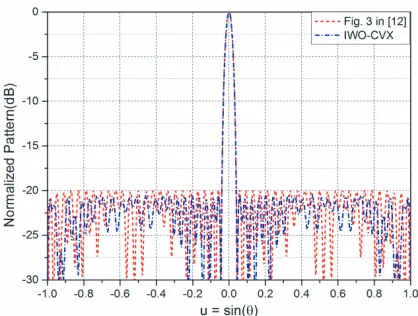
Figure 2. Optimal pattern by the pro-posed method (blue dashed dot line: PSLL =
−20.56 dB) along with the synthesized pattern by the sequential convex optimization in [12] (red dashed line: PSLL =−20 dB).
Table 1. Positions and excitations of the optimal array synthesised by the proposed method.
No. dn/λ wn No. dn/λ wn
1 0 0.7141 14 15.2375 0.8597
2 0.9000 0.6180 15 16.1980 0.8258
3 3.8083 1 16 17.1424 0.7793
4 5.6661 0.9544 17 18.0941 0.6922 5 6.6157 0.6488 18 19.0616 0.6634 6 7.6439 0.7108 19 20.0101 0.6480 7 8.5839 0.8022 20 21.0074 0.7427 8 9.5290 0.6978 21 21.9703 0.6264 9 10.4676 0.9136 22 22.9307 0.6156 10 11.4233 0.9034 23 23.8524 0.6427 11 12.4074 0.9028 24 24.7675 0.6249 12 13.3663 0.7991 25 25.6821 0.4896 13 14.3179 0.7512
to the number of active elements (here is 25), however, for the method in [12], it is proportional to the number of the discretized grids (e.g., 24λ/(λ/200) = 4800, λ/200 is the discretization step), which is far larger than the number of active elements. We should emphasize that with our method, one can conveniently add some other constraints on the linear geometry so as to make the synthesized sparse array well adapted to the requirements of the designer since the inter-element spacing can be controlled flexibly.
4.2. Focused Beam Synthesis Addressed in [11]
(a) (b)
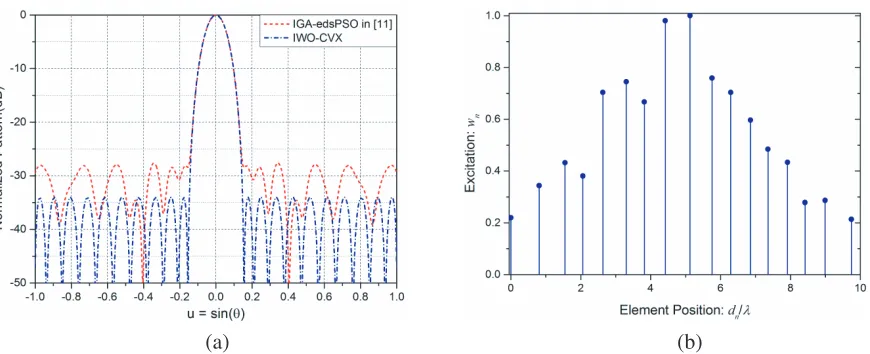
Figure 3. Synthesized array by the proposed method. (a) Beam pattern. (b) Element positions and excitations.
Table 2. PSLL values of 10 independent runs with 17 antenna elements.
No. 1 2 3 4 5 6 7 8 9 10
PSLL (dB) −33.93 -33.92 −33.93 −33.95 −33.90 −33.99 −33.95 −33.91 −33.97 −33.96
we use the proposed IWO-CVX method to solve the same synthesis problem for further reduction on PSLL. An improved PSLL of −33.99 dB is achieved with the same main beamwidth. The synthesized pattern, as compared to the one in [11], is shown in Fig. 3(a). It can be seen that the main beamwidth is not broadened along with the PSLL is decreased, that is just the goal of optimization. In Fig. 3(b), the layout of the corresponding sparse array is also presented. In addition, we run the simulation 10 times independently to verify the robustness of the proposed method. The PSLLs obtained in each run are listed in Table 2, from which one can see that the proposed method is very stable since the PSLLs in those independent runs are almost unchanged and are nearly−33.9 dB.
4.3. Flat-Top Beam Synthesis Addressed in [14]
This example will show the capability of our method to optimize amplitudes, phases and positions simultaneously in order to further reduce the number of elements and the PSLL of a flat-top beam pattern compared with the case of uniformly spaced array. In [14], a 15-element uniformly spaced array with an aperture of 7λhas been synthesized to obtain a flat-top beam pattern with PSLL =−35.45 dB. Using the proposed IWO-CVX method, a sparse array of 12 elements is synthesized with −38.33 dB PSLL for the same shaped main beam of [14]. This means that 3 elements are saved as well as the PSLL is reduced about 3 dB compared with the uniformly spaced array synthesized by [14]. The complex weightings and element positions are given in Table 3. The comparison of the synthesized patterns is shown in Fig. 4.
4.4. Cosecant Beam Synthesis Addressed in [15]
Figure 4. Synthesized flat-top patterns by the proposed method (blue dashed dot line: a 12-element sparse array with PSLL = −38.33 dB) and the method in [14] (red dashed line: a 15-element uniformly spaced array with PSLL =
−35.45 dB).
Figure 5. Synthesized cosecant beam patterns by the proposed IWO-CVX method (blue dashed dot line: PSLL =−26 dB) and the FBMPM method in [16] (red dashed line: PSLL =−25 dB).
Table 3. Element positions and excitations synthesised by the proposed method.
No. dn/λ |wn| ∠wn (rad) No. dn/λ |wn| ∠wn (rad)
1 0 0.1769 0.7873 7 3.805 0.46 0.6310
2 0.612 0.5336 0.7187 8 4.454 0.7758 1.5634 3 1.240 0.7526 0.4785 9 5.103 0.5061 2.1154 4 1.873 0.7661 −0.1957 10 5.752 0.2971 −2.5885 5 2.512 1 −0.7925 11 6.386 0.3256 −1.8901 6 3.157 0.8178 −0.7473 12 7 0.1406 −1.6653
Table 4. Element positions and excitations synthesised by the proposed method.
No. dn/λ |wn| ∠wn (rad) No. dn/λ |wn| ∠wn (rad)
1 0 0.1793 −0.6645 9 5.236 0.9642 2.5299 2 0.679 0.1659 −0.6722 10 5.928 0.6646 1.8142 3 1.466 0.2693 −0.9390 11 6.729 0.4030 1.6570 4 2.159 0.3533 −1.5022 12 7.472 0.3190 1.4393 5 2.865 0.3160 −1.7277 13 8.096 0.2418 0.8942 6 3.379 0.3658 −1.6106 14 8.853 0.1535 0.6583 7 3.944 0.7790 −2.1987 15 9.5 0.1734 0.6654 8 4.589 1 −2.9221
to the FBMPM method in [16]. Fig. 5 shows the comparison of the synthesized shaped beam patterns. Table 4 shows positions and excitations of the elements obtained by the IWO-CVX method.
Table 5. Comparison of PSLLs achieved by the proposed method and other methods for the above simulation experiments.
Simulation 1 Simulation 2
Method IWO-CVX Method in [12] IWO-CVX IGA-edsPSO in [11] PSLL −20.56 dB −20 dB −33.99 dB −27.67 dB
Simulation 3 Simulation 4
Method IWO-CVX Method in [14] IWO-CVX FBMPM in [16] PSLL −38.33 dB −35.45 dB −26 dB −25 dB
5. CONCLUSION
This paper provides a hybrid IWO-CVX approach for synthesis of linear sparse arrays with some constraints imposed. The proposed method aims to minimize the PSLL of a sparse array by optimizing both the positions and the excitations. Simulation experiments are carried out to demonstrate the effectiveness and feasibility of the proposed algorithm. Compared with other methods, the proposed method can achieve lower PSLL while keep the main beam unchanged. In addition, the proposed method can handle the synthesis problem for any shaped beam patterns without any restrictions. Besides, the proposed method is robust and stable. Moreover, the proposed method can easily cope with some constraints on the aperture, e.g., the minimum inter-element spacing and the total number of elements, etc. Therefore, it is more practically applicable to real situations for engineering applications. As expected, the proposed method can guarantee that the minimum inter-element spacing is always larger than λ/2, which means that the mutual coupling of the synthesized sparse array can be controlled to a low level and even can be neglected. Finally, we should point out that the proposed method is also extendable to the synthesis of planar arrays.
REFERENCES
1. Steinberg, B. D.,Principles of Aperture and Array System Design: Including Random and Adaptive Arrays, Wiley, New York, 1976.
2. Kumar, B. P. and G. Branner, “Design of unequally spaced arrays for performance improvement,”
IEEE Trans. Antennas Propag., Vol. 47, No. 3, 511–523, Mar. 1999.
3. Bucci, O. M., T. Isernia, and A. F. Morabito, “An effective deterministic procedure for the synthesis of shaped beams by means of uniform-amplitude linear sparse arrays,” IEEE Trans. Antennas Propag., Vol. 61, No. 1, 169–175, Jan. 2013.
4. Angeletti, P. and G. Toso, “Array antennas with jointly optimized elements positions and dimensions part I: Linear arrays,” IEEE Trans. Antennas Propag., Vol. 62, No. 4, 1619–1626, Apr. 2014.
5. Ishimaru, A., “Unequally spaced arrays based on the poisson sum formula,”IEEE Trans. Antennas Propag., Vol. 62, No. 4, 1549–1554, Apr. 2014.
6. Chen, K., Z. He, and C. Han, “A modified real GA for the sparse linear array synthesis with multiple constraints,”IEEE Trans. Antennas Propag., Vol. 54, No. 7, 2169–2173, Jul. 2006. 7. Zhang, F., W. Jia, and M. Yao, “Linear aperiodic array synthesis using differential evolution
algorithm,”IEEE Antennas Wireless Propag. Lett., Vol. 12, 797–800, 2013.
8. Lin, Z., W. Jia, M. Yao, and L. Hao, “Synthesis of sparse linear arrays using vector mapping and simultaneous perturbation stochastic approximation,”IEEE Antennas Wireless Propag. Lett., Vol. 11, 220–223, 2012.
9. Karimkashi, S. and A. A. Kishk, “Invasive weed optimization and its features in electromagnetics,”
10. Cen, L., Z. L. Yu, W. Ser, and W. Cen, “Linear aperiodic array synthesis using an improved genetic algorithm,”IEEE Trans. Antennas Propag., Vol. 60, No. 2, 895–902, Feb. 2012.
11. Zhang, S., S.-X. Gong, Y. Guan, P.-F. Zhang, and Q. Gong, “A novel IGA-EDSPSO hybrid algorithm for the synthesis of sparse arrays,”Progress In Electromagnetics Research, Vol. 89, 121– 134, 2009.
12. Prisco, G. and M. D’Urso, “Maximally sparse arrays via sequential convex optimizations,” IEEE Antennas Wireless Propag. Lett., Vol. 11, 192–195, 2012,
13. Zhao, X., Q. Yang, and Y. Zhang, “Compressed sensing approach for pattern synthesis of maximally sparse non-uniform linear array,”IET Microwaves, Antennas&Propagation, Vol. 8, 301–307, 2014. 14. Isernia, T., O. M. Bucci, and N. Fiorentino, “Shaped beam antenna synthesis problems: Feasibility criteria and new strategies,” Journal of Electromagnetic Waves and Applications, Vol. 12, No. 1, 103–138, 1998.
15. Akdagli, A. and K. Guney, “Touring ant colony optimization algorithm for shaped-beam pattern synthesis of linear antenna arrays,” Electromagnetics, Vol. 26, 615–628, 2006.
![Figure 5. Synthesized cosecant beam patterns bythe proposed IWO-CVX method (blue dashed dotline: PSLL = −26 dB) and the FBMPM methodin [16] (red dashed line: PSLL = −25 dB).](https://thumb-us.123doks.com/thumbv2/123dok_us/1930801.1253580/7.612.329.537.82.239/figure-synthesized-cosecant-patterns-proposed-dotline-methodin-dashed.webp)
