c e-ISSN: 2348-6848, p- ISSN: 2348-795X Volume 2, Issue 12, December 2015
International Journal of Research (IJR)
Available at http://internationaljournalofresearch.org
A Qualitative Study of Problems of Trained Teachers Teaching
at Pre-Primary Level
Dr. Murlidhar Mishra
& Ritica Sharma
Associate Professor, Faculty of Education, Banasthali Vidyapith, Rajasthan-304022 ([email protected])
M.Ed. Student, Faculty of Education, Banasthali Vidyapith, Rajasthan-304022
Abstract
A Qualitative Study of Problems of Trained Teachers Teaching at Pre-Primary Level was conducted to get idea of
the problems faced by trained teachers teaching at Pre-Primary Level. A sample of 48 teachers was selected as a
cluster from randomly selected 20 pre-primary schools from Meerut district of U.P. Data collected through both
the interview and observation. Result of qualitative analysis revealed problems of trained pre-primary school
teachers related to application of soft technology, lack of command over English Language, lack of resting time,
overcrowded classrooms, low salary, lack of support from Management, negative attitude of Management, less
support of parent, lack of original books and material, the workload of CCE, organizing field trips, lack of
suitable classrooms, lack of Assistant teacher, lack of availability of the hall, Poor utilization of technological
devices, classroom setting and inadequate resources.
Key terms: Problems of Trained Teachers; Pre-Primary Level; Qualitative Study; Interview; Observation
Education is very important for individual success in life. It provides pupils those skills that prepare them physically, mentally and socially for foundation of society which bring a sound economy, social promoting education, but the efficiency and effectiveness of teachers in promoting upon the teacher training. If they are intellectually alive and taken interest in their job, then only success is ensured but if on the other hand, they lack training in education and if they cannot give their profession the system is destined to fail the teachers are the dynamic force of school without a teacher is just like a body without soul. It is widely acknowledge that teacher have a pivotal role in the development of an inclusive educational system availability of qualified trained and highly motivated teachers is an important factor in ensuring meaningful access to education. There are lots of problems for students under the current circumstances untrained teachers were holding the new curriculum in the same manner they used to do old one the new curriculum is based on activities, it requires teachers to use the latest methodologies and techniques which needs training to build up knowledge about the latest methods and techniques.
Sinha (2008) concluded that attitude of trained and untrained teachers at pre-primary level to the teaching profession and the process was similar. Training of teaching had no impact on the attitude of teachers of both the type in this regard. Shah and Masrur (2009) studied the impact of microteaching skills on the performance of primary teachers. The study recommended for continuing in-service
Associate Professor, Faculty of Education, Banasthali Vidyapith, Rajasthan-304022 ([email protected])
c e-ISSN: 2348-6848, p- ISSN: 2348-795X Volume 2, Issue 12, December 2015
International Journal of Research (IJR)
Available at http://internationaljournalofresearch.org
training programs of teaching methodologies and strategies for elementary school teachers by establishing independent cell at district level. Bandopadhyaya (2008) conducted a study to assess the effect of childhood education experience on the academic performance of primary school children. The study revealed that there is a significant difference between pupils who had Pre-Primary education and those without in their academic performance cognitive ability. Social skills and motor skills based on the finding and conclusion recommendations were made. Mwalolo (2011) conducted a study on pre-school teachers' knowledge and attitude towards use of visual media in instructional delivery and found that trained pre-school teachers used instructional visual media more than the untrained pre-school teachers. There was no significant difference between trained and untrained pre-school teachers knowledge and attitude.
There are few studies which have been conducted on Pre-Primary trained teachers like; attitude of trained teachers toward teaching profession at Pre-Primary level, "impact of microteaching skills on the performance of primary teachers" no study has been found yet now in India as well as in abroad which showed that problems of trained teachers in Pre-Primary level. In this context a question arises in the mind of researchers that which kinds of problem are being faced by trained school teachers at Pre-Primary level? Took a view on abstract, dissertations, journals and educational survey to find answers to the above question but could not get the answer completely. Although some studies like this had been conducted earlier in the past, but not resembles purely and also these studies were unable to answer the question that researchers looking for. So, on the basis of conceptual basis and review of related literature, researchers decided to conduct a qualitative study of problems faced by trained teachers at Pre-Primary level.
Assumptions of the Study:
The main objective of the study was to qualitatively ascertain the problems of trained teachers at the pre-primary level. Therefore formulation of any hypothesis was neither possible nor expected. Therefore, to conduct a qualitative research some guiding assumptions are necessary, on the basis of which the researchers had to develop their study so in the present study the researchers have the following assumptions-
Trained teachers of pre-primary school level have specific problems.
These problems can be discerned through observation of the field and interview of concern teachers.
Operational definition of the variables:
The variables used in this study were operationally defined as below.
1. Pre-Primary school teacher- In present study Pre- Primary school Teacher is referred to the teacher who teaches between 3 to 6 years old children in preschool.
2. Trained teacher- In present study trained teacher is referring to the teacher who is trained with nursery teacher training.
Method of study:
To identify problems of pre-primary school teachers' Qualitative data was gathered through unstructured interview and observation techniques were employed. Qualitative analysis has been done to analyze descriptive/qualitative data gathered through aforesaid data collection techniques.
Sample and Sampling:
c e-ISSN: 2348-6848, p- ISSN: 2348-795X Volume 2, Issue 12, December 2015
International Journal of Research (IJR)
Available at http://internationaljournalofresearch.org
20 schools from the list. All the 48 teachers working in these 20 selected schools were taken as a cluster. Thus, the samples of the present study consist of 48 primary school teachers.
Procedure of data collection and analysis:
The researchers have done real time observations and interviews of trained teachers. Reactions or reflections persuaded regarding problems of pre-primary teachers have been noted down and recorded. The data collected through both the interview and observation were qualitative in nature, so qualitative analysis of the data has been done.
Results and Discussion:
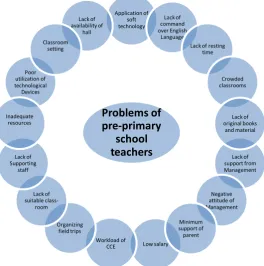
Content analysis of raw data gathered from the interview and observation was done. Problems of trained pre-primary teachers listed and categorized on the basis of content analysis. All identified problems are being exhibited in following
figure-Figure 1: Problems of trained Pre-Primary Teachers at glance
Result of qualitative analysis revealed that trained pre-primary school teachers are facing too many problems. these problems can be classified as problem related to application of soft technology, lack of command over English Language, lack of resting time, overcrowded classrooms, low salary, lack of support from Management, negative attitude of Management, less support of parent, lack of original books and material, the workload of CCE, organizing field trips, lack of suitable classrooms, lack of Assistant teacher, lack of availability of the hall,
Poor utilization of technological devices, classroom setting and inadequate resources.
After analyzing these problems it is quite clear that trained teachers of pre-primary level are facing some common and some specific
problems. Crowded Classrooms causes a
decrease in the overall quality of the education carried out in classroom settings for teachers. First of all this eliminates one to one interaction with children. Teachers have to deal with the overall performance of the children rather than finding a chance to interact with each child
Problems of pre-primary
school teachers
Application of soft technology
Lack of command over English
Language
Lack of resting time
Crowded classrooms
Low salary
Lack of support from Management
Negative attitude of Management Minimum
support of parent
Lack of original books
and material
Workload of CCE Organizing
field trips Lack of suitable
class-room Lack of Supporting
staff
Lack of availability of
hall
Poor utilization of technological Devices
Classroom setting
c e-ISSN: 2348-6848, p- ISSN: 2348-795X Volume 2, Issue 12, December 2015
International Journal of Research (IJR)
Available at http://internationaljournalofresearch.org
individually. In overcrowded classroom pre-school teachers get tired physically and mentally. This affects their classroom performance. Teachers are in opinion that if a class has more than 20 preprimary students, preparation of material for the activities and execution of planed activities get adversely affected.
Unavailability of adequate sized classrooms and halls is found one of the great challenges before teachers. It produces limitations before all kind of activities. Mostly schools have very small classrooms. These are so small and not suitable for the activities which need movements of both teacher and students. Keeping size of the classroom in mind teacher can only plan for activities table activities. Furthermore only teacher directed and guided activities were only chosen to be carried out within the classroom environment due to unavailability of adequate sized halls. Lack of classroom and halls to practice the various activities is also the major problem for pre-primary teachers. It is unrealistic to expect 5-6 year olds to sit on their chair long hours. Children are full of energy and have to move to release their energy however small classroom environment prevents their free movements so this results in aggression among the children in the classroom.
Teachers finding less time for writing detailed evaluation as they are have loaded curriculum, this occupies whole time of teachers. Then no time is left teachers to write and complete the evaluation in three parts; evaluation for the plan, for the each child and for the teacher.
There was an inadequacy of resources for doing different kinds of activities materials exist in the school were just for repeating the same kind of activities rather than doing something original. There is a problem of resources to be able to make good activities she need different resources. Teachers are not assisted by their materials. The materials are not prepared with the level of available teacher expertise in mind.
The teacher need help and help is not being provided.
The pre-school teacher must also prepare creative activities for the children to compare each day. It is important that creativity is a big part of the pre-school experience and pre-school teachers will prepare various activities for the children to engage in things such as arts and craft music and imagination will play a big role in creative learning process but due to lack of resources is the big problem for us. They have to repeat the same kind of activities rather than something doing original there is a problem of resources to be able to make good acclivities she need different resources.
Lack of resting time "is the most overburdening situation for pre-school teachers. In pre-school level primary level or upper level of education; being in the same place for long hours makes them exhausted and decreases the teachers level of tolerance towards children and events that take place in the classroom. Using free play times of children’s is a big problem faced by trained teachers. Lack of resting time is the most overburdening situation for the pre-school teachers. They stressed that this situation makes them overloaded very much. Both physically and psychological they get tired of being in the same environment for long hours; this affects the quality of the teaching for their opinion. "It is a real disaster for pre-school teachers because both physically and psychologically I feel terrible." "I feel as if I am captured in a prison, I even cannot get out for draping coffee and tea.
Lack of good command over the English language both spoken and written. Majority of primary school teachers have an insufficient command of English to be able to teach it effectively.
c e-ISSN: 2348-6848, p- ISSN: 2348-795X Volume 2, Issue 12, December 2015
International Journal of Research (IJR)
Available at http://internationaljournalofresearch.org
problem is that poor utilization of modern technology devices such as computer is not readily available for content presentation. We felt difficulty using instructional aides available at schools.
Parent involvements as the attitudes of parents toward early childhood education. They claimed that parents see the early childhood education as a canters as a playing area rather than a learning environment for parents children do not learn academic skills such as science and math in early childhood education so this leads parents to underestimate the significance of early childhood education and to see parent involvement as an unnecessary activity. "I think parents just perceive early childhood education canters as a caring place". Parents don't see here as a place to learn something rather than see as a playing area. Lack of availability of supporting staff is also a big problem in dealing with the inclusive child. There is a necessity of assistant teacher accompanying to the inclusive child otherwise as teacher they cannot decide whether to focus on normally developed children or the inclusive child. Crowded class room is also a major problem "I have 20 children in my class and I am having difficulty during preparing materials for the activities and while implementing the activities." I do want to deal with each child in my class room during activity times however it is impossible to when. You are in such a crowded classroom.
Teachers consider that they are doing such a hard work with intense dedication but in return to it their salary and incentives is quite low relative to work.
Pre-school teacher having problem in organizing field trips is the difficulty to make necessary permission when a field trip is intended to be done. Long process of permission taking is the prolong factor for organizing field trips teacher added to have less hierarchical process for obtaining the necessary permissions. The process
of permission taking is a kind of torture to me, at least two weeks before you have to start writings as to get it. "Permission taking process is a taking issue for me and it is really overburdening to wait for the consents of parents. "It was really big problem for us to deal with permission taking process.
Unable to get latest information and update related to developments in the field of nursery education. This make teacher uncomfortable and less motivated. Class management is also a big problem for pre-school teacher. We face problems prepare select and uses of different kinds of materials at low cost with a focus on sensory and motor development of children. Teachers are facing problems related to classroom management as they are not prepared for dealing behavior problems. Behavior of students is also one of the major problems faced by pre-school teachers as they are teaching children at such a young age that they are not behaviorally developed. Children have to follow significant body of rules. In fact learning to follow these rules and peacefully interact with peers is one of the primary reasons. Before deciding to teach in pre-school proper exposure and training to deal behavioral problems and ability to handle and cop up the stress due to students behavioral problems is essential.
c e-ISSN: 2348-6848, p- ISSN: 2348-795X Volume 2, Issue 12, December 2015
International Journal of Research (IJR)
Available at http://internationaljournalofresearch.org
Due to large class sizes and children's age limit
not being strictly observed classroom
management was difficult because children used a lot of time transitioning from play to other activities, which distorted their class schedules. "The children are many everyday they fight over toys during a play especially the boys I do not know if the fighting is part of play, because I cannot attend to all of them at the same time, It is difficult. "Having a lot of children in the class I spend a lot of time watching them so that they do not hurt each other. Always the older children run around in the classroom and do not allow the younger children any space to enjoy play." Lack of support from school administration is the major problem for pre-primary teachers when the inclusive child come in to the classroom, all responsibility is on the shoulders of the teacher. Preschool teachers have to organize various competitions weekly, and for this they have to stick notices in every child's daily diary. This creates heavy work load on the teachers. They have to check the copies on daily basis. Apart from checking, they have to write home work and sometimes have to make pictures on every child's copy. If at any time teacher could not able to write home work, notices in the copies/diaries of students then they have to stay for extra time in addition with school timing or have to come early in the morning. it is really a big problem before the teachers and this indirectly turns in anxiety and eventually disturbs the classroom. Few manager are did not understand why the play way method should be used with preprimary students. Even few Head teacher and other teachers also encourage not using play way method by saying that parents do not want to use this here. Trained teachers know importance of using play in their classroom. This type of attitude towards play way method is spreading rapidly. Result of this attitudes pre-primary schools are more emphasizing on academic readiness through concentrated direct teaching of
alphabets, numbers colors and other skills than play.
Educational implications
This study provides an understanding towards problems of trained pre-primary teachers. On the bases of results of the present study it is
recommended that the teacher education
institutes must enrich their nursery teacher training programs by keeping actual problems of trained pre-primary teachers. Drastic change in course content will empower would be teachers at grass root level. The study would also be useful to the teachers working at the pre-primary level. Since they would be able to understand their problems more deeply and by doing this they may be encouraged to have self initiation to
solve them independently. Educational
Administrators can drive basic understanding of problems of these teachers and be able to deal
and help respective teachers efficiently.
c e-ISSN: 2348-6848, p- ISSN: 2348-795X Volume 2, Issue 12, December 2015
International Journal of Research (IJR)
Available at http://internationaljournalofresearch.org
References:
[1] Bandyopadhyaya, Madhumita (2008),
"Effect of children education experience on the academic performance of primary school children" Journal Education for Teaching, 13 (1), 13-17.
[2] Deepali Devee(1990), "Pre-school
children and their problems in rural areas of Kamrup District", Unpublished doctoral thesis, Gauhati University.
[3] Kishor, Awadesh & Rakhi sharma
(2012), "Attitudes of trained and untrained teachers at secondary level towards teaching profession," University news, 24 (12), 4-8.
[4] Moffitt, J. C. (1963),"In service
education for teachers" printed in united states of America,
[5] Mwalolo, J. N. (2011), "Pre-school teacher's knowledge and attitude to word use of visual media in instructional delivery in libwezi district" International Journal of Teacher Education, vol. 7 (1), 93-110.
[6] Shah, Hussain and masrur rehana
(2009), "Impact of microteaching skills on the performance of primary teachers," University News, 35 (14), 6-10.