R E S E A R C H
Open Access
Jointly optimized rate-compatible UEP-LDPC
codes for half-duplex co-operative relay
networks
Rabiullah Khattak
1*and Sara Sandberg
2,3Abstract
This paper addresses the design of low-density parity-check (LDPC) codes for half-duplex co-operative relay networks. Structured rate-compatible codes with unequal error protection (UEP) are designed through joint optimization of the codes for the channels between source and relay and source and destination. The proposed codes clearly outperform simpler LDPC codes which are not optimized for relay channels and puncturing-based rate-compatible LDPC codes, and they show a significant performance improvement over the direct link communication depending on the position of relay. The optimization algorithm for the proposed codes is based on density evolution using the Gaussian approximation and optimal variable node degree distributions are found through iterative linear programming. Interestingly, they anyhow show performance which is almost comparable to the performance of codes optimized through a more complex non-linear optimization algorithm. We analyze the performance of our proposed codes with short, medium and long block lengths, and with low and high rates under realistic assumptions, i.e., imperfect decoding of the codeword at relay and variant signal-to-noise ratio within a single codeword.
Keywords: LDPC code design; Half-duplex relay; Linear programming
1 Introduction
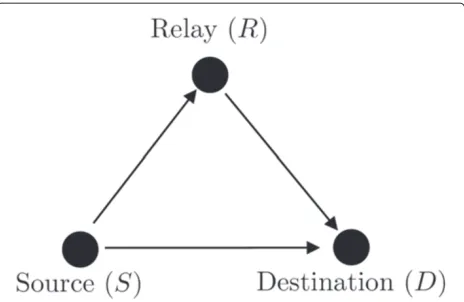
Co-operative relay networks have opened a new research field in wireless communication. They can be used in mobile cellular networks, wirelessad hocnetworks, and wireless sensor networks. They provide spatial diversity because the terminals in a relay network form virtual multiple antenna systems. Like multiple antenna systems, relay networks increase channel capacity under the same bandwidth constraints and with no additional power con-sumption. A simple co-operative relay network is com-posed of three nodes, source (S), relay (R), and destination (D), as shown in Figure 1.Sis transmitting data toDvia a direct link (StoD) and a relay link (StoDthroughR). There are three relay channels in a simple relay network, i.e., the channels betweenSandD, betweenSandR, and betweenRandD. The relay is used to increase the relia-bility and data rate when the channel betweenSandDis bad due to fading and interference.
*Correspondence: [email protected]
1Department of Computer Science, Electrical and Space Engineering, Luleå University of Technology, Luleå 971 87, Sweden
Full list of author information is available at the end of the article
In this paper, we propose low-density parity-check (LDPC) code design for half-duplex relay networks based on rate compatibility and unequal error protection (UEP) capabilities. The code is designed by optimizing the variable node degree distribution using density evolu-tion under Gaussian approximaevolu-tion [1]. We design rate-compatible LDPC codes with UEP using sub-degree distributions both for classes of bits with different pro-tection (denoted by propro-tection classes) and for classes of bits transmitted over different relay channels. Hence-forth, the bits transmitted over one specific relay channel will be referred to as belonging to one channel class. The separation of the variable node degree distribution into sub-degree distributions significantly increases the num-ber of design parameters. Therefore, it is important to note that the code design is solved by iterative linear pro-gramming (LP), which enables an efficient optimization of the sub-degree distributions. Our code design is based on the design method for UEP-LDPC codes with higher order modulations suggested in [2], which employs iterative LP, and the rate-compatible code structure suggested in [3].
Figure 1Layout of the nodes in a relay network.
Higher order modulations cause different bits in the code-word to have different signal-to-noise ratios (SNRs) in the same way as relay channels with different channel gains cause different codeword bits to be received with differ-ent SNRs. In our design, we use the strategy proposed in [2] to optimize the codes for the case where two different codeword segments experience two different SNRs due to different channel gains of theStoDand theRtoDrelay channels. That is, our proposed optimization algorithm considers different SNRs of the relay channels in the code design, like in [3].
The performance of the source to relay channel plays an important role in the overall performance of co-operative relay networks [4,5]. It is pointed out in [3] that code extension techniques provide better performance than code puncturing in the source to relay channel. In code extension techniques, optimal codewords can be trans-mitted over the source to relay channel to get the best performance. In code puncturing techniques, only punc-tured codewords can be transmitted over the source to relay channel, which results in a certain performance loss. Therefore, we design the rate-compatible LDPC codes for relay networks based on the extension technique.
In [3], LDPC codes for relay networks are designed by finding optimal variable and check node degree distri-butions using differential evolution, which is a nonlinear code optimization method. In the design proposed here, linear programming is used to find an optimal variable node degree distribution. Our code optimization algo-rithm requires less computational effort than that of [3] and the performance is anyhow similar to the perfor-mance of the codes proposed in [3]. Like in [3], joint optimization of the codes for the source to relay and the source to destination channels is performed, and vari-ant SNR within a single codeword is considered in the design. In [3], it is assumed that the codeword received at the relay from the source is perfectly decoded at the relay. However, in this paper, it is not assumed that the
codeword is perfectly decoded at the relay, which is a more realistic assumption. In [6], the authors have com-pared two different LDPC coding schemes from [7] and [8] with their proposed puncturing-based rate-compatible LDPC codes. The code design proposed here is differ-ent from the designs proposed in [3] and [6] because it provides UEP properties to the code, i.e., more impor-tant bits are made more protected by allocating them higher variable node degrees. The coding scheme in [6] has simple code design as it requires the design of only one single-user LDPC. In contrast to the coding scheme in [6], our proposed coding scheme requires the joint design of two codes. However, our proposed code shows better performance than the code proposed in [6] because the code in [6] has performance loss due to puncturing in the co-operative relay network.
Most of the papers in the literature on relay networks consider a theoretical approach of code design. However, we focus on code design with realistic assumptions, such as imperfect decoding of the codeword in the relay termi-nal, like in [9] and variant SNR within a single codeword, like in [3].
In [9], quasi-cyclic LDPC (QC-LDPC) codes are used in relay networks through repetition coding schemes. In the code design, the SNR is considered invariant within a single codeword. The fact that [9] uses QC-LDPC codes makes them easier to implement and thereby more real-istic, but on the other hand, they also get worse perfor-mance. Using the same time slots, transmission power, and processing of the codewords in the relay terminal with the decode and forward strategy as in [9], the codes pro-posed here achieve up to 1.9-dB gain over the QC-LDPC codes depending on the location of the relay with respect to the source and the destination. The better perfor-mance is partly due to the rate-compatible coding scheme and partly due to the UEP properties of the code. The rate-compatible coding scheme provides a better trade-off between bit error rate and data rate than the repetition coding scheme. The UEP provides high protection to the codeword bits transmitted over the source to relay chan-nel, which results in a better performance of the important source to relay channel. Also, in contrast to [9], the pro-posed codes are optimized for each position of the relay. Depending on the location of the relay relative to the source and the destination, the proposed low-rate codes with short, medium and long block lengths show a perfor-mance improvement of up to 3.8-dB gain over the direct link communication. The proposed high-rate code with medium block length has a 1.3-dB gain over the direct link communication.
of the optimization algorithm for the design of rate-compatible LDPC codes with UEP properties for half-duplex relay networks. Section 4 describes the selection of a good check node degree distribution and discusses the simulation results of our proposed code design. The results are also compared to the simulation results for QC-LDPC codes [9] as well as the codes proposed in [3] and [6]. Section 5 concludes this paper.
2 Background and system model
2.1 Half-duplex operation of relay and types of relay
In this paper, the relay is assumed to operate in half-duplex mode. Full-half-duplex operation of the relay is hard to implement from a practical system point of view because it is difficult to isolate the several orders of magnitude higher transmitted signal from the received signal in the same frequency band. Half-duplex operation is easy to implement by isolating the transmitted and the received signal in time or frequency. We consider time division multiple access (TDMA) using two time slots. In the first time slott(normalized), known as broadcast mode (BC), S transmits to both R and D. In the second time slot¯t = 1−t, known as multiple access mode (MAC), either only R or bothR and S transmit to Das shown in Figure 2. In this paper, onlyRtransmits toDin MAC mode.
There exist different types of co-operative relay strate-gies based on how the received signal is processed by the relay node. The two most common types of co-operative relay strategies are amplify and forward (AF) and decode and forward (DF). The AF relay [10] amplifies the received signal and then retransmits it to the destination. The DF relay first decodes the signal received from the source and then retransmits the decoded signal after re-encoding, either with the same code as used by the source or with a different code. The drawback of the AF relay is that noise is also amplified along with the desired signal. In power limited communication networks, the AF relay is preferred as it performs no decoding and re-encoding of the received signal. The drawback of the DF relay is the large delay due to decoding and re-encoding as compared to the AF relay. However, the DF relay can also be imple-mented without re-encoding [11]. In this work, the DF relay is considered.
2.2 Relay channel model
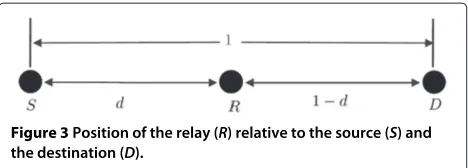
Figure 3 shows the relay system model as suggested in [12]. The distance betweenSandDis normalized to unity.Ris located at a distance ofdfromSand 1−dfromD. The relative distance model in Figure 3 is applied with nor-malized distanced, where 0 < d < 1. Note that all the half-duplex relay channels are AWGN channels with fixed path loss. The signals received atDandRin BC and MAC modes are as follows:
yR1 = hSRxS1+nR1 (1)
yD1 = hSDxS1+nD1 (2)
yD2 = hRDxR2+nD2. (3)
The signals transmitted byS andR are denoted bya x Si andxRi, respectively, wherei ∈ {1, 2}and 1 and 2 stands for BC and MAC modes, respectively. The received signals at RandDare represented by yRi andyDi, respectively. In the above equations,hSR,hSDandhRDare the channel realizations between{S,R},{S,D}and{R,D}, respectively.
nRiandnDiare AWGN at theRandDreceivers with zero means and varianceσ2 = N0/2 in each dimension. The normalized channel gains of the{S,R}, the{S,D}, and the {R,D}channels are given as
γSD= |hSD|2=1
γSR= |hSR|2=1/dτ (4)
γRD= |hRD|2=1/(1−d)τ ,
whereτ is the path loss exponent which normally ranges from 2 to 5 [13]. Furthermore, BPSK modulation and full channel state information (CSI) available at each termi-nal of the relay network are assumed. In order to fairly compare the relay channel with the direct link, we assume that the sum of the R and S transmit powers in the relay channel is equal to the direct link transmit power ofS. Therefore, the following global power constraint is assumed:
tPS1+ ¯tPR≤P. (5)
PS1is the source transmit power in BC mode, PRis the relay transmit power in MAC mode and P is the total system transmit power.
Figure 3Position of the relay (R) relative to the source (S) and the destination (D).
2.3 Coding strategy for half-duplex relays
The proposed relay coding strategy is similar to [3] except that it is assumed thatSis silent in MAC mode and perfect decoding of the codeword atRis not assumed. Accord-ing to this relay codAccord-ing strategy, a codewordw1of length
N1 is transmitted from S to Rand Din BC mode, i.e.,
xS1 = √PS1w1. Rdecodes the codewordw1and gener-ates the extra parity bitsweof lengthN2−N1.Dstoresw˜1 (received version ofw1) until it receivesw˜efromR. Note thatwetransmitted fromRmay contain errors ifw˜1is not decoded correctly atR. In MAC modeSis silent, so only
Rtransmitsweto D, i.e.,xR2 = √PRwe. Dconcatenates
˜
w1withw˜eto get the extended codewordw˜2=[w˜1w˜e] of lengthN2belonging to the extended codeC2.w˜2is then decoded atDto recover the original information. From (2) and (3), it follows that the signals received atDin BC and MAC modes can be expressed respectively as
yD1 = hSD
PS1w1+nD1 (6)
yD2 = hRD
PRwe+nD2. (7)
2.4 Brief introduction to LDPC codes
LDPC are classified as linear block codes. They are described by parity check equations and are represented by a sparse parity-check matrix H. LDPC codes are decoded by a message passing algorithm [14]. The decod-ing complexity increases linearly with codeword length and also depends on the sparseness of H. The parity-check matrix can be represented in graphical form by a bipartite graph, called Tanner graph [15]. The opera-tion of the message passing algorithm is readily explained using a Tanner graph. The two types of nodes in the Tanner graph are variable nodes and check nodes, which correspond to codeword bits and parity-check equations, respectively. The number of variable nodes (codeword bits) is denoted by n and the number of check nodes (parity-check equations) is denoted by (n− k) where k
is the number of the information bits. A variable node is connected to a check node by an edge if the bit corre-sponding to the variable node is included in the parity-check equation corresponding to the parity-check node. Thus, the number of edges in the Tanner graph is equal to the number of 1s in the parity-check matrixH. The code rate of LDPC codes is defined byk/n. LDPC codes are clas-sified as regular or irregular based on the degrees of the
nodes. The degree of a node is the number of edges con-nected to it. The regular codes have variable nodes of fixed degree and their check nodes have another similar fixed degree. The irregular codes have variable and check nodes with varying degrees. The variable and check node degree distributions of irregular codes from an edge per-spective are represented by λ(x) = dvmax
i=2 λixi−1 and ρ(x) = dcmax
i=2 ρixi−1, respectively, where dvmax is the
maximum variable node degree anddcmaxis the maximum
check node degree of the code [16]. The coefficients λi andρidescribe the fraction of edges that are connected to degree-ivariable and check nodes, respectively. The opti-mal degree distribution of irregular codes can be found by density evolution (DE) using the Gaussian approxima-tion [1]. DE tracks mutual informaapproxima-tion exchange between variable and check nodes in the message passing decoding algorithm.
2.5 Rate-compatible UEP-LDPC codes for half-duplex relays
From an implementation point of view, the simplest code design scheme for half-duplex relays is the repetition cod-ing scheme, i.e., transmittcod-ing the same codeword w1 of code C1 in BC and MAC modes[9]. However, the rep-etition coding scheme is not preferred as it provides a poor trade-off between bit error rate and data rate. One alternative is to use coding schemes based on incremen-tal redundancy, i.e., transmitting the codewordw1in BC mode and extra parity bits webeing extracted from w1, in MAC mode [3]. This yields the extended codeword
w2 =[w1we] belonging to the extended codeC2. In this case, a joint design of the mother code C1 and extended code C2 is required. The incremental redundancy could also be achieved using puncturing, i.e., deleting a number of parity bits fromw2to getw1. Code design in this case is the joint design of the mother codeC2and the punctured codeC1.
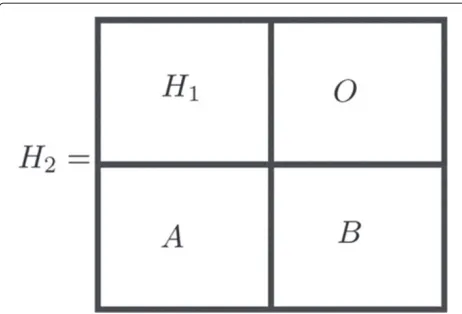
The rate-compatible structure of the parity-check matrix H2 representing the code C2, which follows the structure proposed in [3], is illustrated in Figure 4.H2is composed of a non-zero parity check matrix H1 corre-sponding to the codeC1, a zero sub-matrixOand non-zero sub-matricesAandB. The zero sub-matrix preserves the parity-check equations of the mother codeC1. The rate-compatible design ofC2is different from [17-19] asw1and
weare in general received with different SNRs. Received SNRs for decodingw1andweare given later by (8) and (9), respectively.
Figure 4Structure of the rate-compatible parity-check matrixH2 for the half-duplex relay codeC2.H2is composed ofH1, which is a non-zero parity-check matrix corresponding to the codeC1, a zero matrixOand non-zero matricesAandB.
the source to relay channel performance [4,5]. Through UEP, variable nodes of higher degrees are assigned to thew1segment of the codeC2in order to give it higher protection than itswesegment.
3 Design of RC UEP-LDPC codes for relay networks
3.1 Notations
The codeword bits of codeCzwherez∈ {1, 2}are divided intoNCz
c protection classes in order to give it UEP prop-erties. The proportions αCz =[αCz
1 ,· · ·,αCNzCz c −1
] denote the normalized lengths of each class corresponding to the information bitsui.αCizequals the number of bits belong-ing to protection classCi divided by the total number of information bits k. p =[αCz
1 Rz,· · ·,αCz NcCz−1
Rz,(1 −Rz)] defines proportions of the bits in the codeword belonging to different protection classes andRz is the code rate of
Cz.NsCzis the number of relay channels (channel classes) between source, relay and destination associated withCz. The bit segments of the codeword being received through different relay channels have different SNRs. The bit seg-ment with a distinct SNR will be classified as belonging to one channel classMj,j=1,···,NsCz. The proportions of bit
segments in the codeword belonging to different channel classes are defined byβCz=[βCz
1 ,· · ·,βNCzCz s
].
The vectors λCz and aCz contain the overall variable
node degree distribution from an edge perspective and a node perspective, respectively, both for different protec-tion classes and different channel classes for a codeword corresponding to code Cz. Let λCMzj,,Cik and a
Cz,Ck
Mj,i be the
proportion of edges and nodes, respectively, connected to variable nodes of degreeithat belong to channel classMj, protection classCk, and codeCz. Similarly,bCizis the pro-portion of check nodes of degree i that belong to code
Cz. Define λCMzj,Ck =[λ
Cz,Ck
Mj,2 ,· · ·,λ
Cz,Ck
M
j,dCvmaxz
]T and λCz =
[λCz,C1
M1
T ,· · ·,λ
Cz,C NCcz
M1
T
,· · ·,λCz,C1
M
NsCz
T
,· · ·,λCz,CNcCz
T M
NsCz
]T
where (·)T denotes the transpose. λCz,Ck
Mj is a column
vector of length dCz
vmax − 1 and λCz is a column
vec-tor of length (dCz
vmax − 1)N
Cz
s NcCz. The vectors ρCz = [ρCz
2 ,. . .,ρC
z
dcCmaxz
]TandbCzdescribe the check node degree
distribution from an edge and a node perspective, respec-tively. Note thatdCz
vmax andd
Cz
cmax are the maximum
vari-able and check node degrees respectively in the codeCz. The vector with all-ones is defined by 1 with suitable length.
3.2 Protection and channel classes
Figure 5 shows a diagram of the proposed coding scheme. The RC UEP-LDPC code hasNCz
c protection classes at its output. The information bitsui are divided intoNcCz−1 protection classes C1 · · · CNCz
c −1. The parity bits are
assigned toCNCz
c . The protection classes are ordered with
descending order of protection, i.e., C1 has the highest protection andCNCz
c has the lowest protection. The bits
from the different protection classes are re-multiplexed and assigned to channel classesM1,···,MNCz
s
correspond-ing to the different relay channels. In the half-duplex co-operative relay networks with three terminals, there are two relay channels through which destination receives the signals from the relay and the source, one between
source and destination M1, and the other between relay and destinationM2, see Figure 1.
3.3 SNRs of the relay channels
This subsection describes computation of SNRs of the relay channels in BC and MAC modes. The signals received at D in BC and MAC modes have different received SNRs. The SNRs of the signals received in BC and MAC modes are defined, respectively, as
SNRBC = |
hSD|2PS1
N0
(8)
SNRMAC = |
hRD|2PR
N0
. (9)
In [2], unity signal power is assumed for simplicity, and equivalent noise variances are calculated for the different bits in the higher order constellation. To follow the code design proposed in [2], the equivalent noise variances of the relay channels in BC and MAC modes are required for the optimization of the variable node degree distri-butions. Therefore, the equivalent noise variances of the relay channels in BC and MAC modes are determined from different SNRs by means of an equivalent channel with unit received power, i.e.,
SNR= 1 ˜ N0
⇒ ˜N0= 1
SNR. (10)
The equivalent noise variance is expressed as
˜
σ2= N˜0 2 ⇒ ˜σ
2= 1
2SNR. (11)
The equivalent noise variances of the relay channels in BC and MAC modes are
˜
σBC2 = 1
2SNRBC (12)
˜
σMAC2 = 1
2SNRMAC
. (13)
The noise variances in (12) and (13) are required for den-sity evolution in the proposed optimization algorithm in [2]. For the proposed optimization algorithm in [2], we define the noise vectorσ˜2 =[σ˜12,· · ·,σ˜2
NsCz
] to be a vector that contains the equivalent noise variances of each relay channel in BC and MAC modes, ordered with the highest variance first.
3.4 Optimization algorithm
The optimization algorithm presented here is the adap-tation of the optimization algorithm proposed in [2] for half-duplex co-operative relay networks. We add an additional constraint to the optimization algorithm of [2] for the design of rate-compatible LDPC codes as
described in [3]. In the optimization algorithm, the code
C2 for half-duplex relay network is designed to be rate-compatible with UEP based on the given degree distri-butions of the UEP capable code C1. Code C1 is first designed without the rate-compatible constraint in the optimization algorithm. Then, the rate-compatible code
C2is designed given the variable and check node degree distributions ofC1.
The target of the optimization algorithm proposed in [2] is to find a variable node degree distribution for the whole code that maximizes the average variable node degree of the class being optimized. UEP properties of the code are achieved by sequential execution of the optimization algo-rithm of [2], one protection class at a time and starting with the best protected class for anEb/N0slightly higher than the threshold. In every sequential execution step, the optimization algorithm keeps the degree distributions of lower protection classes fixed and may change only the degree distributions of higher protection classes [2]. The objective function for protection classCkcan be expressed as
max λCz
NsCz
j=1 dCz
vmax
i=2 λCz,Ck
Mj,i . (14)
The optimization algorithm with objective function (14) maximizes the average variable node degree. For max-imization of the minimum variable node degree, the optimization is initiated with a high minimum variable node degree and decreased to a lower value until a vari-able node degree distribution for which density evolution convergence is found, see [2] for details.
3.4.1 Rate-compatible constraints
The optimization algorithm in [3] designs the codeC2 cor-responding toH2, by considering the rate-compatible con-straints for variable and check node degree distributions given the degree distributions of the codeC1. However, the optimization algorithm in this paper designs the code
C2by considering only the rate-compatible constraint for the variable node degree distribution [3] (expressed by (19)) given the degree distributions of the code C1. The check node degree distribution of C2 is assumed to be given and must satisfy the rate-compatible constraints for the check node degree distribution [3] (expressed by (17)) before using it in the optimization algorithm to deter-mine an optimal variable node degree distribution for
C2. The rate-compatible constraints for the variable node degree distribution from [3] have been adapted to cover the UEP properties of our proposed code. ForC2, the over-all edge distributions λC2 and ρC2 and the overall node
distributionsaC2 andbC2 must satisfy the following
⎧
The check node degree distributions of C1 from edge and node perspective{ρC1,bC1}become part of the check
node degree distributions ofC2from edge and node per-spective{ρC2,bC2}, see Figure 4. The check node degree
distributions from node perspective ofC1andC2should satisfy the following constraints:
bC2 whereWzis the number of rows in parity-check matrixHz and = (1−R1)N1 constraint (16) into edge perspective using (15) gives
Similarly, the variable node degree distributions from the node perspective ofC1andC2should satisfy the following constraints:
Converting the node perspective constraint (18) into edge perspective using (15) gives
3.4.2 Convergence constraint
The optimal variable node degree distributions are found through density evolution using the Gaussian approxima-tion [1]. The mutual informaapproxima-tion messages from a check node to a variable node (xcv) and from a variable node to a
respectively. Here,J(·)is the mutual information, given by
J(m)=1−E{log2(1+e−q)},
mand variance 2m. The mutual information evolution can be written as a combination of (20) and (21)
x(l)vc =F(λCz,ρCz,σ2,x(l−1)
vc ). (23)
TheλCz andρCz describe the degree distributions of the
code for a givenσ2when the conditionx(l)vc > x(lvc−1)for anyx(lvc−1)is satisfied.
3.4.3 Proportion distribution constraints
The variable node degree distribution is constrained to have the total sum of the fractions equal to one, i.e.,
NsCz
λCzis also constrained by the proportion vectorsαCzand
βCz. The total number of variable nodes n
Ck and nMj
belonging to protection classCkand to channel classMjis
nCk =α
respectively. The code rate can be expressed as
Rz=1−
Furthermore,λCzcan be related ton
CkandnMjby
The optimal degree distribution must satisfy the stability condition [16]. For the direct link channel with BPSK, all the codeword bits experience the same noise varianceσ2. The stability condition for the direct link channel is
1
tions. The stability condition gives an upper bound on the number of degree-2 variable nodes. In case of co-operative relay networks, the codeword bits experience different noise variancesσj2due to different SNRs of the relay channels and there are different densities P0,j(x).
The derivatives are λCz(0) = N the co-operative relay network can be expressed as
e−r=
Similar to [2], the optimization is performed atEb/N0= δ+ in dB, whereδ is the lowest possible threshold for the givenρCz anddCz
vmax, and is an offset from the
low-est threshold that offers more freedom in the selection of λCz. The optimization algorithm is decomposed into
an inner and an outer loop. For a fixedEb/N0, the outer loop finds an optimal variable node degree distribution for each protection class and thus finds an optimal variable node degree distribution for the whole code. The inner loop performs the maximization of the minimum variable node degree of a protection class. The optimalλCzis found
by executing the optimization algorithm for a given check node degree distributionρCz,E
b/N0=δ+, a maximum variable node degreedCz
vmax, a code rateRz, and proportion
The operation of the optimization algorithm is summa-rized as follows.
1. For any givenEb/N0=δ+computeσ˜2. 2. FindλCzby executing the iterative linear
programming optimization algorithm.
The structure of the optimization algorithm with its constraints is defined as follows.
1. Initialization:d(k)Cz
vmin =d Cz
vmax
2. While optimization failure:
(a) Optimize
[C2]Proportion distribution constraints
i. from[2] (see (24))
[C3]Convergence constraint, from[2] (see (23))
F(λCz,ρCz,σ2,x) >x (37)
[C4]Stability condition, from[2] (see (30) and (31))
[C5]Rate-compatible constraint, from[3] (see (19))
[C6]Minimum variable node degree constraint from [2]
∀i<d(k)Cz
vmin ,∀j:λ Cz,Ck
Mj,i =0 (40)
[C7]Previous optimization constraints from [2]
When optimal variable node degree distributions for codeC1andC2are found, we construct the parity check matricesH1andH2, as shown in Figure 4, using the ACE algorithm[20]. The ACE algorithm is modified to first constructH1and thenH2, while keepingH1fixed.
4 Simulation results
PS1 = P/2 andPR = P/2. The channel gainsγSD,γSR, and γRD from (4) are dependent upon path loss prop-agation only and we consider τ = 2. Using the relay system model shown in Figure 3, simulations have been performed for different positionsdof the relay relative to the source. Note that in the simulations for relay network, 20 decoding iterations at the relay and 20 decoding iter-ations at the destination are considered. In all the direct link simulations, 40 decoding iterations at the destination are considered.
4.1 Low-rate medium block length codes
This subsection describes the simulation results of the proposed codes of low-rate and medium block length for cooperative relay networks. The results are also compared to the results for quasi-cyclic LDPC codes (QC-LDPC) from [9]. The code C1 for BC mode, described by the parity-check matrix H1, is designed by optimizing the variable node degree distributions forR1=1/2,NcC1 =2,
NC1
s =1,αC1 =1,βC1=1,dCvmax1 =11, andρC1=x6. The
codeC2for the half-duplex relay network is extended from the codeC1 by appending extra parity bits to the code-words of the codeC1. Variable node degree distributions ofC2 are optimized forR2 = 1/4,NcC2 = 3,NsC2 = 2, αC2=[0.5 0.5],βC2 =[0.5 0.5],dC2
vmax =15 and check node
degree distribution ρC2. Suitable ρC2 for C
2 are chosen by evaluating the performance of C2 for different check node degree distributions for different positions of relay as explained in the following subsection.
Like in [3], the code C1 in this paper is designed by considering the SNR of the source to destination chan-nel, therefore there is only one channel classNC1
s = 1. Note that the SNR of the source to relay channel is always higher than the SNR of the source to destination chan-nel as|hSR|2 > |hSD|2, therefore the successful decoding of the codewordw1of the codeC1is possible at the relay even when it fails at the destination. The codewordw1is composed of equally protected information bits and less protected parity bits, by choosing NC1
c = 2. The code
C2 is designed by taking into account the SNRs of the source to destination and the relay to destination chan-nels, i.e., NC2
s = 2. The codeword w2 of C2, which is decoded at the destination, is composed of w1 and we. We let NC2
c = 3 for w2 assuming that it is composed of equally important information bits and less important parity bits ofw1and least important extra parity bitswe.
w1is received at the destination from the source, whilewe is received at the destination from the relay. In relay net-works, the source to destination channel is worse than the relay to destination channel. Therefore, the equally impor-tant information bits and less imporimpor-tant parity bits ofw1 inw2are assigned to protection classesC1andC2, respec-tively, in order to give them good protection against the channel conditions of the source to destination channel
and the least important bitsweinw2are assigned to pro-tection classC3, as the relay to destination channel has a better SNR than the source to destination channel.
We compare the performance of the proposed codes for relay networks with an LDPC code designed for the direct link. The design of the code for the direct link is the same as forC1except that the code is designed with code rate 1/4 the same as forC2, a suitable check node degree distributionρ=0.1350x2+0.3695x3+0.0684x4+
0.2812x5+0.1459x6(from LOPT [21]), full transmission powerPanddvmax=15. In the simulations, the lengths of
the codewordsw1andw2areN1=1296 andN2=2592, respectively. In the simulations of the direct link, an LDPC codeword of lengthN2is used.
4.1.1 Selection of good check node degree distributions In this subsection, we analyze the performance of the pro-posed codes for different check node degree distributions and for different positionsdof the relay. Optimization of the check node degree distributions is outside the scope of this paper. The aim of this analysis is to select a good check node degree distribution for eachd.
Code C1 is designed with a concentrated check node degree distributionρC1 = x6, since concentrated check
node degree distributions have been shown to perform well[16]. The codeC2is designed with a non-concentrated check node degree distribution because it is shown in [3] that co-operative relay networks show better perfor-mance with LDPC codes designed with non-concentrated check node degree distributions. The maximum check node degrees are chosen asdC1
cmax = d
C2
cmax =7 in order to
keep the same maximum check node degree as the code in [9] to simplify the comparison.
For the design of codeC2, optimal variable node degree distributions are found by choosing a check node degree distribution for which codeC2gives good performance in terms of bit error rate for a specific position d of relay. The performance of code C2 is analyzed for four differ-ent check node degree distributions for differdiffer-ent positions
degree distributions still satisfy (17). The optimal variable node degree distribution at eachdis found for each one of the four check node degree distributions.
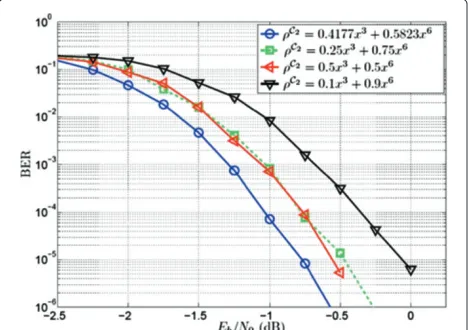
We observe that ford<0.6, the code designed with the check node degree distributions, which have the lowest fraction of edges of the minimum degree, has its water-fall region at high SNR as compared to the codes with check node degree distributions with a higher fraction of edges of the minimum degree. Figure 6 shows the per-formance of the proposed code with four different check node degree distributions for d = 0.2. It is noticed in Figure 6 that the proposed code design gives good per-formance with ρC2 = 0.4177x3+ 0.5823x6. This holds
also ford = 0.3 and 0.5, but simulation results are omit-ted here. Figure 7 shows the performance of the proposed codes with four different check node degree distributions for d = 0.4 and good performance is observed with ρC2 =0.5x3+0.5x6. This holds also ford=0.1 but
sim-ulation results are omitted here. Ford = 0.6, 0.7, 0.8, 0.9 it is observed in Figure 8 that the choice of check node degree distribution does not have a large impact on the performance.
4.1.2 Results for low-rate medium block length codes This subsection describes the simulation results of the proposed codes with low-rate and medium block length in a relay network and compares their performance with a standard LDPC code for the direct link. The proposed codes at eachdare designed with the suitable check node degree distributions found in the previous subsection. The simulation results for the proposed codes are shown in Figure 9 for different positions of the relay. The results show that the relay network achieves better performance with the proposed codes than the direct link with a LDPC
Figure 6Comparison between different check node degree distributions for the code with code rate 0.25 andd=0.2.The check node degree distributionρC2=0.4177x3+0.5823x6gives
good performance ford=0.2.
Figure 7Comparison between different check node degree distributions for the code with code rate 0.25 andd=0.4.The check node degree distributionρC2=0.5x3+0.5x6gives good
performance ford=0.4.
code optimized for this link. At a BER of 10−5, the relay network has best performance ford = 0.4. At a BER of 10−4, the proposed code achieves 3.8-dB gain over the direct link transmission for the position of relayd =0.4, as shown in Figure 9. A degradation in the performance of the proposed codes in the waterfall region can be observed when the relay is located closer to the destination than the source, i.e., for relay positionsd > 0.5, as shown in Figure 9. Note that for alld, both the source and the relay have fixed transmit power, i.e., the total powerPis divided in half for the source and the relay for alld. The perfor-mance of the co-operative relay network depends mostly on the performance of the source to relay channel. Atd> 0.5, the signal received at the relay has higher path loss
Figure 9Performance of the proposed codes for different positionsdof the relay.All codes have code rate 0.25 and a codeword length of 2, 592 bits.
than atd≤0.5, so the probability of erroneous decoding ofw˜1in the relay increases with increasingd. The erro-neously decodedw˜1is then used to calculatewe, which in turn is transmitted to the destination and increases the probability of erroneous decoding of the entire codeword
w2. This causes the performance degradation of the pro-posed codes atd>0.5. Atd≥0.7, the relay network has worse performance than the direct link, at least for some SNRs.
4.2 High-rate medium block length codes
The performance of the proposed code design has also been analyzed for a high-rate code of medium block length. The codeC1is designed by optimizing the variable node degree distributions forR1=0.9,NcC1 =2,NsC1 =1, αC1 =1,βC1 =1,dC1
vmax =7, andρC1 =x29. Variable node
degree distributions of C2 are optimized for R2 = 0.6,
NC2
c = 3,NsC2 = 2, αC2 =[0.9 0.1],βC2 =[2/3 1/3],
dC2
vmax = 50 and check node degree distributionρC2. The
lengths of the codewordsw1andw2areN1= 1, 730 and
N2=2, 592, respectively.
Good ρC2 forC2 at each d has been chosen by using
the procedure adopted in Section 4.1.1 for finding good ρC2 for medium block length codes of low rate. We have
analyzed the performance ofC2with four different non-concentrated check node degree distributions ρC2 =
0.25x10+0.75x29,ρC2 =0.5x10+0.5x29,ρC2 =0.4177x10+
0.5823x29, andρC2 =0.1x10+0.9x29for different positions
d. All the check node degree distributions forC2 satisfy the rate-compatible constraint for the check node degree distribution as defined by (17). In the same way as for the code with low rate in Section 4.1.1, the codeC2with high rate is also designed such that it has the error floor at lower bit error rates and the waterfall region at a lower
SNR by keeping the minimum check node degree in all the check node degree distributions equal to 11. Note that 11 is the highest possible minimum degree with which the four check node degree distributions satisfy (17). The good check node degree distributions being found for
d = 0.1, 0.2, 0.4 and 0.5 areρC2 = 0.25x10 +0.75x29,
ρC2 = 0.25x10 + 0.75x29, ρC2 = 0.5x10 + 0.5x29, and
ρC2 = 0.25x10 + 0.75x29, respectively. As for the
low-rate code proposed in Section 4.1.1, the choice of check node degree distribution does not have a large impact on the performance for d = 0.6, 0.7, 0.8 and 0.9. The per-formance of the proposed code has been evaluated for
d = 0.1, 0.2, 0.4, 0.5, 0.7 and 0.9 as shown in Figure 10. It is shown that the relay network has the best perfor-mance ford=0.4, like the low-rate code in Section 4.1.2. It is reported in [9] that codes with different code rates have similar sensitivity to the relay position for a given transmit power distribution of the source and the relay; hence, for both cases of low- and high-rate codes, the optimal position where the proposed code achieves best performance is d = 0.4. The performance of the pro-posed high-rate code is compared to the performance of an LDPC code designed for the direct link. The design of the code for the direct link is the same as forC1 except that the code is designed with code rate 0.6, a suitable ρ = 0.5143x10 +0.0986x18 +0.0717x24 +0.2339x26 +
0.0816x29 (from LOPT [22]), full transmission power P
anddvmax = 50. In the simulations of the direct link, the
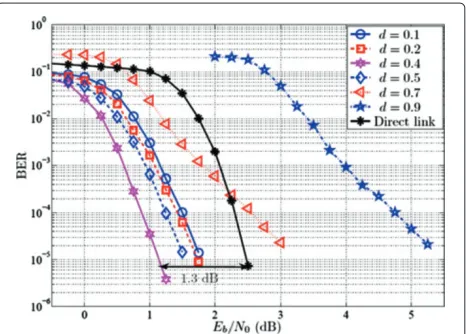
codeword length is 2, 592 bits. At a BER of 10−5, the pro-posed high-rate code shows 1.3-dB gain over the direct link transmission ford=0.4, as shown in Figure 10.
4.3 Short and long block length codes
In this subsection, the performance of the proposed code design has been analyzed for short and long block lengths.
The codeword lengths for the short block length areN1= 512 andN2 = 1, 024 bits, and for the long block length, we considerN1=5, 344 andN2=10, 688 bits. Note that the proposed code optimization algorithm is independent of the code length. The parameters used for the design of the proposed code with short and long block lengths are the same as those used for medium block length in Section 4.1. For comparison, codes for the direct link with codeword lengths of 1, 024 and 10, 688 bits have been con-structed, according to the degree distributions found for the medium length code in Section 4.1.
It is shown in [9] that the optimal position of the relay depends on the power distribution of the source and the relay in the relay network. For the proposed code with medium block length, it has been shown in the previous subsections that the optimal position isd=0.4. We have analyzed the performance of the proposed code with short and long block lengths at the optimal position of the relay, i.e., atd=0.4. At a BER of 10−4, the proposed code with short and long block lengths have 3.8-dB gain over the direct link transmission ford=0.4, as shown in Figure 11.
4.4 Comparison
This subsection provides a performance comparison of the codes proposed in this paper to QC-LDPC codes [9], extension-based RC LDPC codes [3] and puncturing-based RC LDPC codes [6].
4.4.1 Comparison to QC-LDPC codes
In this subsection, we compare the performance of the RC UEP-LDPC codes to the QC-LDPC codes proposed in [9], which are implemented through a repetition cod-ing scheme in a half-duplex co-operative relay network.
Figure 11Performance comparison between the proposed codes with short and long block lengths atd=0.4 and direct link communication.The codeword lengths of the short and long block lengths are 1, 024 and 10, 688 bits, respectively. The code rate is 0.25 for all codes.
The simulation results for the QC-LDPC codes of [9] are reproduced in this paper, as shown in Figure 12. The pro-posed RC UEP-LDPC codes, like the QC-LDPC codes, are structured and irregular. They are however implemented in the half-duplex co-operative relay network through a rate-compatible coding scheme. We assume, like in [9], that the source is silent in MAC mode and use the same codeword length. In contrast to [9], the relay terminal in our case transmits the extra parity bits instead of retrans-mitting the decoded codeword in MAC mode. The RC UEP-LDPC codes are more complex from a practical implementation point of view compared to the QC-LDPC codes in [9], but they require a lowerEb/N0to achieve the same bit error probability.
Equal time slots are assumed in BC and MAC modes as well as equal transmit powers at the source and the relay, i.e.,PS1 = P/2 andPR = P/2. In [9], the length of each codeword being transmitted in BC and MAC modes is 1, 296 bits and the rate is 1/2. For the RC UEP-LDPC codes, the length ofw1is equal to 1, 296 with rate 1/2. Additional parity bitsweof length 1, 296 are transmitted in MAC mode. Hence, the total number of bits received at the destination, both for the QC-LDPC codes and for the RC UEP-LDPC codes, is equal to 2, 592 bits.
In [9], the LDPC code is decoded by the layered belief propagation (LBP) algorithm as defined in [23]. LBP is a variation of the standard belief propagation [1] which is designed for architecture aware (AA) LDPC codes with quasi-cyclic properties. It is shown that with LBP, the decoding of AA LDPC codes is improved by two times in
the number of iterations required for a given error rate [24]. However, we have used standard belief propagation decoding to reproduce the results of [9] and to analyze the performance of the proposed LDPC codes in co-operative relay networks. To get the equivalent performance of LBP using standard belief propagation decoding, the number of decoding iterations is set to twice the number of itera-tions defined in [9]. In [9], ten decoding iteraitera-tions at the relay and ten decoding iterations at the destination are used. We use 20 decoding iterations at both the relay and the destination.
From the comparison of Figures 9 and 12, the RC UEP-LDPC codes give better performance than the QC-LDPC codes in [9]. The QC-QC-LDPC codes also show best performance for d = 0.4. Under the same time slots, transmission power and using the DF strategy for the relay, the proposed codes outperform the codes in [9] with a gain of 1.9 dB at a BER of 10−4ford=0.4, as shown in Figure 12. For the positions of the relay other thand=0.4, the proposed codes have different gains over the codes in [9], which can be observed by comparing the results for eachdin Figures 9 and 12. The improved performance of the proposed codes over the QC-LDPC codes in [9] is due to separate optimization of the proposed codes for each relay position. Furthermore, the proposed code design is based on the rate-compatible coding scheme, which pro-vides a better trade-off between bit error rate and data rate than the repetition coding scheme.
4.4.2 Comparison to extension-based RC LDPC Codes It is observed from Figure 9 that the performance of the proposed codes is close to the performance of the code proposed in [3] for the range of d between 0.2 and 0.3 (see the simulation of the optimized code of length 20, 000 in [3] for a comparison). We perform the optimization of the code through an iterative linear pro-gramming algorithm in contrast to the code design in [3], which is achieved through differential evolution, a complex non-linear constrained optimization algorithm. There are three reasons why the RC UEP-LDPC codes are not exactly approaching the performance of the codes in [3]. First, the codeword length considered in [3] is almost ten times higher than the codeword length considered for the RC UEP-LDPC codes. Second, in [3], it is assumed that each codeword is perfectly decoded at the relay. Third, in [3], it is assumed that the source is active also in MAC mode.
4.4.3 Comparison to puncturing-based RC LDPC codes The performance of the proposed codes is also compared to puncturing-based RC LDPC codes proposed in [6] for half-duplex co-operative relay networks. The puncturing-based rate-compatible coding scheme proposed in [6] requires the design of only one single-user LDPC code as
a mother codeC. The mother code C with code rateRc is first designed either by linear programming or by using an optimized LDPC degree distribution from [25]. Then, a proportion of the parity bits is punctured randomly, which raises the code rate of C to Rp. In BC mode, the punc-tured codeword ofCis transmitted to the destination and the relay. The destination stores the punctured codeword until it receives the punctured parity bits from the relay. The punctured parity bits are recovered at the relay and are sent as extra parity bits to the destination in MAC mode. Thus, the destination receives the entire codeword corresponding to the mother codeCwith different SNRs for the punctured codeword and the extra parity bits as expressed by (8) and (9). The coding scheme proposed in [6] only requires the design of a mother codeC and the code design proposed in [6] is therefore simpler than the code design proposed here, which requires joint design of two codes.
We use the linear programming optimization algorithm defined in this paper without the constraints for UEP and rate-compatibility to find an optimized variable node degree distribution for the code C with a suitable ρ = 0.2465x3+0.2990x5+0.1307x6+0.1774x7+0.1464x8(from LOPT [25]),Rc=1/4 anddvmax=33. The codeCis
punc-tured at the source and the code rate is raised toRp=0.5. The performance of the coding scheme proposed in [6] is shown in Figure 13 for a codeword length of 2, 048 bits andd = 0.4. It is assumed in [6], as in the coding strat-egy proposed here, that the source is silent in MAC mode, the codeword is imperfectly decoded at the relay and that extra parity bits from the relay are sent without encoding to the destination.
To compare the performance of the RC UEP-LDPC code proposed here to the coding scheme proposed in [6],
Figure 13Performance comparison between the proposed RC UEP-LDPC code and puncturing-based RC LDPC codes for
the simulations of the RC UEP-LDPC codes are set with codeword lengthsN1=1, 024 andN2=2, 048 forw1and
w2, respectively, code ratesR1 = 0.5 andR2 = 0.25 and
d = 0.4. Other parameters that are specific to the code design proposed here are as follows. CodeC1is designed by optimizing the variable node degree distributions for
NC1
c = 2,NsC1 = 1,αC1 = 1,βC1 = 1,dCvmax1 = 30, and
ρC1 = x8. Code C2 is designed by optimizing the
vari-able node degree distributions forNC2
c = 3,NsC2 = 2, αC2 =[0.5 0.5], βC
2 =[0.5 0.5], d
C2
vmax = 33, and check
node degree distributionρC2. The performance ofC
2has been analyzed for four different check node degree distri-butionsρC2 =0.5x4+0.5x8,ρC2 =0.25x4+0.75x8,ρC2=
0.4177x4+0.5823x8, andρC2 =0.1x4+0.9x8atd= 0.4
by using the procedure adopted in Section 4.1.1 to find a goodρC2forC2. The good check node degree distribution
forC2atd=0.4 isρC2=0.5x4+0.5x8. The code proposed in [6] shows worse performance than the code proposed here, as shown in Figure 13. The reason for this may be that the code proposed in [6] uses punctured codewords in BC mode, which results in a certain performance loss in the source to relay channel. Note that the overall perfor-mance of the co-operative relay network depends largely on the performance of the source to relay channel [4,5]. Our proposed coding scheme uses an optimized code in BC mode to achieve the best performance in the source to relay channel.
5 Conclusions
Using a relay node increases the reliability and the data rate when the direct link between the source and the des-tination is bad due to fading and interference. This paper proposes an LDPC code design algorithm for half-duplex co-operative relay networks, which is based on density evolution using linear programming. The proposed codes are rate-compatible with unequal error protection and the codes are designed through optimization of the vari-able node degree distribution. The proposed codes are jointly optimized for the source to relay and the source to destination channels.
The performance of the proposed codes is evaluated with short, medium and long block lengths, and with low and high rates under realistic assumptions cover-ing imperfect decodcover-ing at the relay and variation of SNR within a single codeword. The proposed codes of rate 0.25 outperform the direct link communication for short, medium and long block lengths with 3.8-dB gain at a BER of 10−4, when the relay is located at position
d = 0.4. The proposed code of medium block length and high-rate outperforms the direct link communica-tion with 1.3-dB gain at a BER of 10−5 for d = 0.4. In contrast to the QC-LDPC codes proposed in [9], the proposed codes are optimized for each position of the relay relative to the source by considering the variation
of SNR within a codeword due to the transmission over different relay channels. Under the same time slots, trans-mission power and processing of the codewords at the relay terminal with the decode and forward strategy, the proposed codes achieve a 1.9-dB gain over the repeti-tion coding scheme-based QC-LDPC codes in [9] for the position of the relayd = 0.4 at a BER of 10−4. In con-trast to the puncturing-based RC-LDPC codes proposed in [6], the proposed code uses an optimized LDPC code in BC mode to achieve the best performance in the source to relay channel. Although the proposed code design is based on a low-complexity linear programming algorithm, its performance is close to the performance of codes proposed in [3] being optimized by the more complex differential evolution algorithm and using much longer codewords.
Endnote
aIn this paper, vectors are represented by bold letters.
Competing interests
The authors declare that they have no competing interests.
Acknowledgements
This study was supported by the Department of Computer Science, Electrical and Space Engineering, Luleå University of Technology, Sweden.
Author details
1Department of Computer Science, Electrical and Space Engineering, Luleå
University of Technology, Luleå 971 87, Sweden.2Formerly with the
Department of Computer Science, Electrical and Space Engineering, Luleå University of Technology, Luleå 971 87, Sweden.3Ericsson Research, Wireless
Access Networks, Luleå 977 53, Sweden.
Received: 5 March 2013 Accepted: 17 January 2014 Published: 2 February 2014
References
1. SY Chung, T Richardson, R Urbanke, Analysis of sum-product decoding of low-density parity-check codes using a Gaussian approximation. Inf. Theory IEEE Trans.47(2), 657–670 (2001)
2. S Sandberg, N Von Deetzen, Design of bandwidth-efficient unequal error protection LDPC codes. Commun. IEEE Trans.58(3), 802–811 (2010) 3. C Li, G Yue, X Wang, M Khojastepour, LDPC code design for half-duplex
cooperative relay. Wireless Commun. IEEE Trans.7(11), 4558–4567 (2008) 4. C Li, M Khojastepour, G Yue, X Wang, M Madihian, Performance analysis
and code design for cooperative relay channels, inInformation Sciences and Systems, 2006 40th Annual Conference(Princeton, NJ, 22–24 March 2006), pp. 1032–1037
5. C Li, G Yue, M Khojastepour, X Wang, M Madihian, LDPC-coded cooperative relay systems: performance analysis and code design. Commun. IEEE Trans.56(3), 485–496 (2008)
6. M Wu, P Weitkemper, D Wubben, KD Kammeyer, Comparison of distributed LDPC coding schemes for decode-and-forward relay channels, inSmart Antennas (WSA), 2010 International ITG Workshop
(Bremen, 23–24 Feb 2010), pp. 127–134
7. A Chakrabarti, A de Baynast, A Sabharwal, B Aazhang, Low density parity check codes for the relay channel. Selected Areas Commun. IEEE J. 25(2), 280–291 (2007)
8. P Razaghi, W Yu, Bilayer low-density parity-check codes for decode-and-forward in relay channels. Inf. Theory IEEE Trans. 53(10), 3723–3739 (2007)
10. J Laneman, D Tse, G Wornell, Cooperative diversity in wireless networks: Efficient protocols and outage behavior. Inf. Theory IEEE Trans. 50(12), 3062–3080 (2004)
11. HV Khuong, HY Kong, Performance analysis of cooperative
communications protocol using sum-product algorithm for wireless relay networks, inAdvanced Communication Technology, 2006. ICACT 2006. The 8th International Conference, Volume 3(Phoenix Park, 20–22 Feb 2006, 6), pp. -2173
12. M Khojastepour, N Ahmed, B Aazhang, Code design for the relay channel and factor graph decoding, inSignals, Systems and Computers, 2004. Conference Record of the Thirty-Eighth Asilomar Conference on, Volume 2
(Pacific Grove, CA, 7–10 Nov 2004), pp. 2000–2004
13. TS Rappaport,Wireless Communications, Principles and Practice, 2nd edition (Prentice Hall PTR, Upper Saddle River, 1996)
14. F Kschischang, B Frey, HA Loeliger, Factor graphs and the sum-product algorithm. Inf. Theory IEEE Trans.47(2), 498–519 (2001)
15. R Tanner, A recursive approach to low complexity codes. Inf. Theory IEEE Trans.27(5), 533–547 (1981)
16. T Richardson, M Shokrollahi, R Urbanke, Design of capacity-approaching irregular low-density parity-check codes. Inf. Theory IEEE Trans. 47(2), 619–637 (2001)
17. D Bi, L Perez, Rate-compatible low-density parity-check codes with rate-compatible degree profiles. Electron. Lett.42, 41–43 (2006) 18. J Li, KR Narayanan, Rate-compatible low density parity check codes for
capacity-approaching ARQ schemes in packet data communications, in
Proceeding of the 2002 Int. Conf. Commun., Int.rnet, and Inform. Tech.Tech. (CIIT)(St. Thomas, 18–20 November 2002), pp. 201–206
19. M Yazdani, A Banihashemi, On construction of rate-compatible low-density parity-check codes. Commun. Lett. IEEE.8(3), 159–161 (2004) 20. T Tian, C Jones, J Villasenor, R Wesel, Selective avoidance of cycles in
irregular LDPC code construction. Commun. IEEE Trans.52(8), 1242–1247 (2004)
21. LOPT - Online Optimization of LDPC Degree Distributions.
[http://sonic.newcastle.edu.au/ldpc/lopt/results/a7e98878c] Accessed 27 September 2012
22. LOPT - Online Optimization of LDPC Degree Distributions .
[http://sonic.newcastle.edu.au/ldpc/lopt/results/a9bbcb2c1] Accessed 8 November 2013
23. M Mansour, N Shanbhag, High-throughput LDPC decoders. Very Large Scale Integration (VLSI) Syst. IEEE Trans.11(6), 976–996 (2003) 24. D Hocevar, A reduced complexity decoder architecture via layered
decoding of LDPC codes, inIEEE Workshop on Signal Processing Systems 2004(Austin, TX, 13–15 Oct 2004), pp. 107–112
25. LOPT - Online Optimization of LDPC Degree Distributions.
[http://sonic.newcastle.edu.au/ldpc/lopt/results/af562fb8c] Accessed 19 November 2013
doi:10.1186/1687-1499-2014-22
Cite this article as: Khattak and Sandberg: Jointly optimized rate-compatible UEP-LDPC codes for half-duplex co-operative relay networks.
EURASIP Journal on Wireless Communications and Networking20142014:22.
Submit your manuscript to a
journal and benefi t from:
7 Convenient online submission
7 Rigorous peer review
7 Immediate publication on acceptance
7 Open access: articles freely available online
7 High visibility within the fi eld
7 Retaining the copyright to your article

![Figure 12 BER performance of the QC-LDPC code proposed in[9]. With the decode and forward strategy of the relay terminal andwithout re-encoding](https://thumb-us.123doks.com/thumbv2/123dok_us/961309.1117846/13.595.58.294.504.674/figure-performance-proposed-forward-strategy-terminal-andwithout-encoding.webp)