R E S E A R C H
Open Access
Dynamics of a two-dimensional competitive
system of rational difference equations with
quadratic terms
Vahidin Hadžiabdi´c
1, Mustafa RS Kulenovi´c
2*and Esmir Pilav
3*Correspondence:
[email protected] 2Department of Mathematics,
University of Rhode Island, Kingston, Rhode Island 02881-0816, USA Full list of author information is available at the end of the article
Abstract
We investigate global dynamics of the following systems of difference equations: ⎧
⎨ ⎩
xn+1= b1x
2
n A1+y2n, yn+1=a2+c2y2n
x2n ,
n= 0, 1, 2,. . .,
where the parametersb1,a2,A1,c2are positive numbers and the initial conditiony0is an arbitrary nonnegative number andx0is a positive number. We show that this system has rich dynamics which depends on the part of a parametric space. We find precisely the basins of attraction of all attractors including the points at∞.
MSC: Primary 39A10; 39A30; secondary 37E99; 37D10
Keywords: basin of attraction; competitive map; global stable manifold; monotonicity; period-two solution
1 Introduction
In this paper we study the global dynamics of the following rational system of difference equations:
⎧ ⎨ ⎩
xn+= bx
n
A+yn,
yn+=a+cy
n
xn ,
n= , , , . . . , ()
where the parametersb,a,A,care positive numbers and the initial conditionyis an arbitrary nonnegative number andxis a positive number.
The related system of difference equations
xn+=
βxn
A+yn
, yn+=
α+γyn
xn
, n= , , . . . , ()
where the parametersA,β,αandγare positive numbers and the initial conditionsx> ,y≥, was considered in [], where it was shown that this system has simple dynamics. Precisely, it was shown that system () has no equilibrium points ifβ≤A and that it has a unique equilibrium point ifβ>A, in which case this equilibrium point is a saddle point. Furthermore, the following result describes the global dynamics of system ().
Theorem Consider system().
()Assume thatβ>AandγA=α.Then there exist a setC⊂Rwhich is invariant and a subset of the basin of attraction of E.The setC is a graph of a strictly increasing continuous function of the first variable on an interval(and so is a manifold)and separates
Rinto two connected and invariant components,namely
W–:={x∈R\C:∃y∈Cwith x sey} and W+:={x∈R\C:∃y∈Cwith y sex},
which satisfy:
lim
n→∞(xn,yn) = (,∞) for every(x,y)∈W–,
and
lim
n→∞(xn,yn) = (∞, ) for every(x,y)∈W+.
()Assume thatγA=α.Then system()can be decoupled as follows:
xn+=
βxn
Axn+βγ
, yn+=
β
yn(A+yn), n= , , . . . ,
and every solution of this system(depending of the choice of the initial condition(x,y)) is either bounded and converges to an equilibrium point, or increases monotonically to infinity.
()Assume thatβ≤AandγA=α.Every solution{(xn,yn)}of system(),with x> , y≥,satisfies
lim
n→∞xn= and nlim→∞yn=∞.
Thus every solution of system () either converges to the unique equilibrium point or is asymptotic to one of the points at infinity, precisely to either (,∞) or to (∞, ). In all cases, either solution is eventually monotonic or the subsequences of even indexed and odd indexed terms are eventually monotonic. Introduction of quadratic terms into the system will substantially change the dynamics by introducing new equilibrium points (up to three) with different local character and minimal period-two solutions (up to ). Again, most of the solutions of system () will be asymptotic to (∞, ) or (,∞), but the separatrix between the two basins of attraction may consist of several global stable manifolds of either saddle point equilibrium points or non-hyperbolic equilibrium points or minimal period-two solutions. In one case, when there exists a unique non-hyperbolic equilibrium point, it is possible that this point will have a basin of attraction of positive Lebesgue measure.
System () is a competitive system, and our results are based on recent results about competitive systems in the plane, see [, ]. System () can be used as a mathematical model for competition in population dynamics. The first systematic study of a specific competitive system with quadratic terms was performed in [] where system of the form
xn+= xn
a+y
n
, yn+= yn
b+x
n
where the parametersa,b> and the initial conditionsx,y≥, was considered. It was shown that the dynamics of system () is very similar to the dynamics of the corresponding linear fractional system
xn+= xn
a+yn
, yn+= yn
b+xn
, n= , , . . . ,
with the same conditions on parameters and initial conditions. Both systems have nine parametric regions with different dynamical behavior.
As noted, the introduction of quadratic terms in system () dramatically changes the dy-namics. The techniques used to study system () were straightforward calculations, while the techniques which will be used to study system () are a combination of techniques for studying real algebraic curves and implicit function theorem as neither equilibrium points nor period-two solutions are explicitly computable. Some of our calculations are performed by usingMathematicaand outputs are included in the Appendix.
The paper is organized as follows. Section contains some necessary results on com-petitive systems in the plane. Section provides some basic facts about the equilibrium points and injectivity of the map associated with system (). Section contains local sta-bility analysis of both equilibrium solutions and minimal period-two solutions. Section gives global dynamics in different cases.
2 Preliminaries
A first-order system of difference equations
xn+=f(xn,yn),
yn+=g(xn,yn),
n= , , , . . . , ()
where S ⊂R, (f,g) :S →S,f, g are continuous functions, is competitiveif f(x,y) is non-decreasing inxand non-increasing iny, andg(x,y) is non-increasing inxand non-decreasing iny. If bothf andgare non-decreasing inxandy, system () iscooperative. Competitive and cooperative maps are defined similarly.Strongly competitivesystems of difference equations or strongly competitive maps are those for which the functionsf and gare coordinate-wise strictly monotone. Competitive and cooperative systems have been investigated by many authors, see [, , –]. Special attention to discrete competitive and cooperative systems in the plane was given in [, , , , , , –]. One of the rea-sons for paying special attention to two-dimensional discrete competitive and cooperative systems is their applicability to mathematical models in biology and economics, the for-mer involves competition or cooperation between two species. Another reason is that the theory of two-dimensional discrete competitive and cooperative systems is very well de-veloped, unlike such theory for three and higher dimensional systems. Part of the reason for this situation is de Mottoni-Schiaffino theorem given below, which provides relatively simple scenarios for possible behavior of many two-dimensional discrete competitive and cooperative systems. However, this does not mean that one cannot encounter chaos in such systems as has been shown by Smith, see [].
Ifv= (u,v)∈R, we denote byQ
Similarly, we define thenorth-eastpartial order neonRby (x,y) ne(s,t) if and only if
x≤sandy≤t. ForA⊂Rand x∈R, define thedistance fromxtoAasdist(x,A) := inf{x – y: y∈A}. ByintAwe denote the interior of a setA.
It is easy to show that a mapFis competitive if it is non-decreasing with respect to the south-east partial order, that is, if the following holds:
x y
se
x y
⇒ F
x y
seF
x y
.
For standard definitions of attracting fixed point, saddle point, stable manifold, and re-lated notions, see [, ].
We now state three results for competitive maps in the plane. The following definition is from [].
Definition LetSbe a nonempty subset ofR. A competitive mapT:S→Sis said to satisfy condition (O+) if for everyx,yinS,T(x) neT(y) impliesx ney, andT is said to
satisfy condition (O–) if for everyx,yinS,T(x) neT(y) impliesy nex.
The following theorem was proved by de Mottoni and Schiaffino [] for the Poincaré map of a periodic competitive Lotka-Volterra system of differential equations. Smith gen-eralized the proof to competitive and cooperative maps [].
Theorem LetSbe a nonempty subset ofR.If T is a competitive map for which(O+) holds,then,for all x∈S,{Tn(x)}is eventually component-wise monotone.If the orbit of x
has compact closure,then it converges to a fixed point of T.If instead(O–)holds,then,for all x∈S,{Tn(x)}is eventually component-wise monotone.If the orbit of x has compact
closure inS,then its omega limit set is either a period-two orbit or a fixed point.
The following result is from [], with the domain of the map specialized to be the carte-sian product of intervals of real numbers. It gives a sufficient condition for conditions (O+) and (O–).
Theorem LetR⊂Rbe the cartesian product of two intervals inR.Let T:R→Rbe a Ccompetitive map.If T is injective anddetJ
T(x) > for all x∈R,then T satisfies(O+).
If T is injective anddetJT(x) < for all x∈R,then T satisfies(O–).
The following result is a direct consequence of the trichotomy theorem of Dancer and Hess, see [] and [], and is helpful for determining the basins of attraction of the equi-librium points.
Corollary If the nonnegative cone of is a generalized quadrant inRn,and if T has no
fixed points inJu,uKother than uand u,then the interior ofJu,uKis either a subset of the basin of attraction of uor a subset of the basin of attraction of u.
Theorem Let T be a monotone map on a closed and bounded rectangular region
R⊂R.Suppose that T has a unique fixed pointe¯inR.Thene¯ is a global attractor of T onR.
The following theorems were proved by Kulenović and Merino [] for competitive sys-tems in the plane, when one of the eigenvalues of the linearized system at an equilibrium (hyperbolic or non-hyperbolic) is by an absolute value smaller than , while the other has an arbitrary value. These results are useful for determining basins of attraction of fixed points of competitive maps.
Theorem Let T be a competitive map on a rectangular regionR⊂R.Letx∈Rbe a fixed point of T such that:=R∩int(Q(x¯)∪Q(x))is nonempty(i.e., xis not the NW or SE vertex ofR),and T is strongly competitive on.Suppose that the following statements are true.
(a) The mapThas aCextension to a neighborhood ofx.
(b) The JacobianJT(x)ofTatxhas real eigenvaluesλ,μsuch that <|λ|<μ,where |λ|< ,and the eigenspaceEλassociated withλis not a coordinate axis.
Then there exists a curveC⊂Rthroughxthat is invariant and a subset of the basin of attraction ofxsuch thatCis tangential to the eigenspace Eλatx,andCis the graph of a strictly increasing continuous function of the first coordinate on an interval.Any endpoints ofCin the interior ofRare either fixed points or minimal period-two points.In the latter case,the set of endpoints ofCis a minimal period-two orbit of T.
The situation where the endpoints of Care boundary points of Ris of interest. The following result gives a sufficient condition for this case.
Theorem For the curveCof Theoremto have endpoints in∂R,it is sufficient that at
least one of the following conditions is satisfied.
(i) The mapThas no fixed points nor periodic points of minimal period two in. (ii) The mapThas no fixed points in,detJT(x) > ,andT(x) = xhas no solutions
x∈.
(iii) The mapThas no points of minimal period two in,detJT(x) < ,andT(x) = x
has no solutionsx∈.
The next result is useful for determining basins of attraction of fixed points of compet-itive maps.
Theorem (A)Assume the hypotheses of Theorem,and letCbe the curve whose existence is guaranteed by Theorem.If the endpoints ofCbelong to∂R,thenCseparatesRinto two connected components,namely
W–:={x∈R\C:∃y∈Cwithx sey} and W+:={x∈R\C:∃y∈Cwithy sex},
such that the following statements are true.
(i) W–is invariant,anddist(Tn(x),Q(x))→asn→ ∞for everyx∈W–.
(B)If,in addition to the hypotheses of part(A), xis an interior point ofRand T is Cand strongly competitive in a neighborhood ofx,then T has no periodic points in the boundary ofQ(x)∪Q(x)except forx,and the following statements are true.
(iii) For everyx∈W–,there existsn∈Nsuch thatTn(x)∈intQ(x)forn≥n.
(iv) For everyx∈W+,there existsn∈Nsuch thatTn(x)∈intQ(x)forn≥n.
IfT is a map on a setRand if x is a fixed point ofT, thestable setWs(x) of x is the set
{x∈R:Tn(x)→x}andunstable setWu(x) of x is the set
x∈R: there exists{xn}n=–∞⊂Rs.t.T(xn) = xn+, x= x, and lim
n→–∞xn= x .
WhenTis non-invertible, the setWs(x) may not be connected and made up of infinitely
many curves, orWu(x) may not be a manifold. The following result gives a description of the stable and unstable sets of a saddle point of a competitive map. If the map is a diffeomorphism onR, the setsWs(x) andWu(x) are the stable and unstable manifolds ofx.
Theorem In addition to the hypotheses of part(B)of Theorem,suppose thatμ> and
that the eigenspace Eμassociated withμis not a coordinate axis.If the curveCof Theorem has endpoints in∂R,thenCis the stable setWs(x)ofx,and the unstable setWu(x)of x is a
curve inRthat is tangential to Eμatxand such that it is the graph of a strictly decreasing function of the first coordinate on an interval.Any endpoints ofWu(x)inRare fixed points
of T.
The following result gives information onlocaldynamics near a fixed point of a map when there exists a characteristic vector whose coordinates have negative product and such that the associated eigenvalue is hyperbolic. This is a well-known result, valid in a much more general setting: we include it here for completeness. A point (x,y) is a subso-lutionifT(x,y) se(x,y), and (x,y) is asupersolutionif (x,y) seT(x,y). Anorder interval
J(a,b), (c,d)Kis the cartesian product of the two compact intervals [a,c] and [b,d].
Theorem Let T be a competitive map on a rectangular setR⊂R with an isolated fixed pointx∈Rsuch thatR∩int(Q(x)∪Q(x))=∅.Suppose that T has a Cextension to a neighborhood ofx.Letv = (v(), v())∈Rbe an eigenvector of the Jacobian of T atx, with associated eigenvalueμ∈R.Ifv()v()< ,then there exists an order intervalIwhich is also a relative neighborhood ofxsuch that for every relative neighborhoodU⊂Iofxthe following statements are true.
(i) Ifμ> ,thenU∩intQ(x)contains a subsolution andU∩intQ(x)contains a supersolution.In this case,for everyx∈I∩int(Q(x)∪Q(x)),there existsNsuch thatTn(x) /∈Iforn≥N.
3 Some basic facts
In this section we give some basic facts which will be used later. The mapTassociated to system () is given by
T(x,y) =f(x,y),g(x,y)=
bx A+y
,a+cy
x
. ()
Let
R=R+\(,y) :y≥.
3.1 Equilibrium points
The equilibrium points (x¯,y¯) of system () satisfy the equations
bx¯
¯
y+A
=x¯, cy¯ +a
¯
x =y¯. ()
By eliminatingx¯= from (), we get
¯
y+ Ay¯–bcy¯+Ay¯–ab= . ()
Similarly, we can eliminate variabley¯from system () to obtain
bx¯–Ax¯–bcx¯– bc(a–Ac)x¯– (a–Ac)= . ()
Lemma Let
= –,aAbc+a
,Abc+ A
– a
Abc+ Ac– bc
+ ,ab– Abc+ Ac
and
= –aAc+ aA+ Ac– bc.
Then the following statements hold:
(a) Consider equation().Then all its real roots are positive numbers.Furthermore,
equation()has one,two,or three real roots.
(b) If> ,then equation()has one real root and two pairs of distinct conjugate imaginary roots.
(c) If< ,then equation()has three distinct real roots and one pair of conjugate imaginary roots.
(d) If= and= ,then equation()has one pair of conjugate imaginary roots and two real roots,one real root of multiplicity one and other one of multiplicity two. (e) If= and= ,then equation()has one pair of conjugate imaginary roots
Proof The proof of (a) follows from Descartes’ rule of signs.
from which it follows that the number of sign changes of the revised sign list of list () is two. Now, statement (b) follows in view of Theorem []. Assume thatD< . IfD≥, then we obtain thatf˜(y) has three pairs of conjugate imaginary roots, which is a contra-diction. Hence,D< . The sign list of the sequence{D,D,D,D,D}is given by
[, –, –, –, –], ()
which implies that the number of sign changes of the revised sign list of () is one. Now, statement (c) follows in view of Theorem []. Similarly, one can prove statements (d)
3.2 Injectivity, (O+) and (O–)
is invariant under the mapT.Furthermore,the following holds:
T
By substituting this into equation (), we obtain
and
y . By substituting this into () we get
(x¯y¯–bc)(b(cy¯+x¯) +x¯¯y)
¯
y = ,
which impliesx¯¯y–bc= , from which the proof follows. () The Jacobian matrix of the mapThas the form
JT=
The determinant of () at any point is equal to
JT(x,y) =
The determinant of () at the equilibrium point is given by
detJT(x¯,y¯) =
The trace of () at the equilibrium point is given by
trJT(x¯,y¯) =
given explicitly as functions ofy:
Lemma Let T= (f,g)be the map defined by().Then fx(x,y) > ,and the following is
The characteristic equation associated with the Jacobian matrix ofTat (x¯,y¯) is given by
p(λ) =λ–fx(x¯,y¯) +gy(x¯,y¯)λ+fx(x¯,y¯)gy(x¯,y¯) –fy(x¯,y¯)gx(x¯,¯y)
=λ– (a+d)λ+ (ad–bc).
From trJT(x¯,y¯) =λ +λ> we get λ > . The mapT is competitive, which implies c=gx(x¯,¯y) < . In view of Lemma , we geta=fx(x¯,¯y) > , from which it follows that
sign(x˜(y¯)) =sign( –λ).
Theorem Assume that> andλ andλ are eigenvalues of JT(x¯,y¯).Then there
exists the unique equilibrium point E= (x¯,y¯)and the following hold:
(a) Ifa<Ac,thenEis a saddle point and <λ< ,λ> .
(b) Assume thata>Ac.Let
(y¯) = c¯y+y¯(Ac–a) + aA.
(b) If (y¯) > ,thenEis a saddle point.Furthermore,the following hold:
– <λ< ,λ> .
(b) If (¯y) < ,thenEis a repeller.Furthermore,the following hold:λ< –,λ> ;
|λ|<λ.
(b) If (y¯) = ,thenEis a non-hyperbolic equilibrium point.Furthermore,the following hold:λ= –,λ> .
Proof In view of () and Lemma , we have that the function
˜
f(y) =y+ Ay–bcy+Ay–ab
has one zeroy¯of multiplicity one. In view of Lemma , the mapThas a unique equilibrium point. Sincef˜() = –ab< andlimy→+∞f˜(y) = +∞, we havef˜(y) < fory<y¯andf˜(y) >
for y>¯y. By Lemmas and from [], the equilibrium curvesCf andCg intersect
transversally at (x¯,y¯),i.e.,x˜(¯y)= . In view of Lemma and by the continuity of function
˜
x(y), there exists a neighborhoodUy¯ofy¯such thatx˜(y) > fory∈Uy¯, which implies
˜
x(¯y) =xf(y¯) –xg(y¯) > . ()
From () and Lemma we obtainλ< andλ> .
Ifa<Ac, thendetJT(x¯,y¯) =λλ> , which implies thatλ∈(, ). Now, assume thata>Ac. By using
b=
¯
y+A
¯
x , x¯=
cy¯+a
¯
y ,
one can see that
p(–) = +detJT(x¯,y¯) +trJT(x¯,¯y) =
c¯y+y¯(Ac–a) + aA (¯y+A
)(cy¯+a)
= (¯y)
(y¯+A
)(cy¯+a)
and
detJT(x¯,y¯) =λλ=
b¯y(Ac–a)
¯
x(¯y+A )
wherep(λ) = (λ–λ)(λ–λ). In view of () andp(–) = (λ+ )(λ+ ), we obtain
state-ment (b) of the theorem.
Lemma Suppose that all the assumptions of Theoremare satisfied.Let
y±=
a– Ac±
–aAc+a+ Ac c
.
Then the following statements are true.
(a) (¯y) > if and only if one of the following inequalities holds:
Ac–a≥,
Ac–a< and –aAc+a+ Ac< ,
Ac–a< and –aAc+a+ Ac≥ and
˜
f(y–) > orf˜(y+) <
;
(b) (y¯) < if and only if the following hold:
Ac–a< and –aAc+a+Ac≥ and
˜
f(y–) < andf˜(y+) >
;
(c) (¯y) = if and only if
Ac–a< and – aAc+a+ Ac≥ and
˜
f(y–) = orf˜(y+) =
.
Proof The functionf˜(y) has one simple zeroy¯, which impliesf˜(y) < for ≤y<y¯and
˜
f(y) > fory>y¯. Then
¯
y>α if and only if f˜(α) < ,
while
¯
y<β if and only if ˜f(β) >
for someα,β∈[,∞). Now the proof follows from the fact thatf˜(y) = has real roots
a– Ac±
–aAc+a+ Ac c
,
–
a– Ac±
–aAc+a+ Ac c
if and only if
Theorem Assume that< .Then there exist three distinct equilibrium points in the positive quadrant:E= (x¯,y¯),E= (x¯,y¯)and E= (x¯,y¯)such that EneEneE and the following hold:
(a) EandEare saddle points.Ifλ(i)andλ (i)
are the eigenvalues ofJT(Ei),i= , ,then
<λ(i)< ,λ(i)> .
(b) The equilibrium pointEis a repeller.Ifλ() andλ ()
are the eigenvalues ofJT(E), then <λ() <λ() .
Proof In view of Lemma , equation () has three positive roots of multiplicity one. Since
¯
x=A+y¯
b > ,
then by (a) of Lemma we obtain that the mapT has three equilibrium points that we denote byE,EandE. Given points lie on the increasing curve
xf(y) =
A+y b
,
which implies that the points are in the north-east ordering. Descartes’ rule of signs and () imply thatdetJT(x,y) > whena<Ac. In view of () and Lemma , we have that the polynomial
˜
f(y) =y+ Ay–bcy+Ay–ab
has three zerosy¯i,i= , , , of multiplicity one. Sincef˜() = –ab< andlimy→+∞f˜(y) =
+∞, we havef˜(y) < fory∈(,y¯)∪(y¯,y¯) andf˜(y) > fory∈(y¯,¯y)∪(y¯, +∞). By Lemmas and from [], the equilibrium curvesCf andCgintersect transversally
atE,E andE,i.e.,x˜(y¯i)= ,i= , , . By this and Lemma and by the continuity of
function x˜(y), there exists a neighborhoodUy¯(ii) ofy¯i such thatx˜(y) > for y∈U¯y(ii) for
i= , andx˜(y) < fory∈U¯y()i . Using this we get
˜
x(¯yi) > fori= , and x˜(y¯i) < fori= .
Let
JT(Ei) =
ai bi
ci di
, i= , , .
In view of (), we havedetJT(Ei) =λ(i)λ (i)
> ,i= , , . By Lemma we obtain <λ (i) < andλ(i)> fori= , . Sincex˜(y¯) < , by Lemma we have <λ() <λ
()
. This completes
the proof.
Theorem Assume that= and= Then there exist two distinct equilibrium points in the positive quadrant E= (x¯,y¯)and E= (x¯,y¯)such that EneE.Letλ(i) andλ(i)be the eigenvalues of JT(Ei),i= , .Then the following hold:
(b) Ify¯is a root of ()of multiplicity two,then the equilibrium pointEis non-hyperbolic andEis a saddle point.Furthermore,λ() = ,λ
() > and <λ() < ,λ() > .
(c) Ify¯is a root of ()of multiplicity two,then the equilibrium pointEis non-hyperbolic andEis a saddle point.Furthermore,λ() = ,λ
() > and <λ() < ,λ() > .
Proof In view of Lemma , equation () has two positive zeros, one of multiplicity one and another one of multiplicity two, which implies statement (a). Sincex¯= (A+y¯)/b> , we obtain that the mapThas two equilibrium points that we denote byEandE. Descartes’ rule of signs and () imply thata<Ac⇒detJT(x,y) > . Now, we prove statement (b).
Similarly as in the proof of Theorem , one can see thatEis a saddle point. In view of Lemmas and , from [] we have thatx˜(y¯) = , since¯yis the root of () of multiplicity two. By Lemma we obtainλ() = ,λ() > . The proof of statement (c) is similar and we
will skip it.
Theorem Assume that= and= .Then there exists one equilibrium point in the positive quadrant E= (x¯,y¯)which is non-hyperbolic.Ifλ() andλ
()
are eigenvalues of JT(E),thenλ() = ,λ
() > .
Proof In view of Lemma ,y¯is zero of () of multiplicity three. In view of Lemmas and , from [] we have thatx˜(y¯) = . The rest of the proof is similar to that in Theorem
and we skip it.
4.1 Period-two solution
Let
T(x,y) =TT(x,y)=F(x,y),G(x,y),
where
F(x,y) = b
x
(A+y)(acy+a+Ax+cy)
and
G(x,y) =(A+y )(a
cy+ac+ax+cy)
bx .
Period-two solution{(,),T(,)}satisfies the system
F(,) =, G(,) =,
which is equivalent to
b–A
A+
–A+
a+c
= ,
b–a
A+
–c
A+
a+c
= .
The Jacobian matrix of the mapTat (x,y) has the form
curves,that is,the curves the intersection of which is a period-two solution.Then,for all y> ,there exist exactly one xF(y) > and exactly one xG(y) > such that F(xF(y),y) =x
respectively, in view of Descartes’ rule of signs, we have that for ally> there exist exactly onexF(y) > and exactly onexG(y) > such thatF(xF(y),y) =xandG(xG(y),y) =y. Taking
Proof Ifa≤Ac, the statement follows from Lemma . Ifa>Ac, then from the first equation of () we have that
A+
= b
(a+c)+A
.
By substituting this into () we obtain
trJT(,) =
(A+)(a(c(A+ ) +) +ac+c(A+ )) b
+ – A
(a+c)+A > .
The rest of the proof follows from the fact thattrJT(,) =μ+μ> ,detJT(,) =
μμ> and Lemma .
Theorem If the map T has a minimal period-two solution{(,),T(,)},which is non-hyperbolic,then D(p) = ,where D(p)is the discriminant of the polynomial
p(y) :=py+py+· · ·+py+p,
where the coefficients pi, i= , . . . , ,are in the Appendix. If {(,),T(,)} and
{(,),T(,)}are two minimal period-two solutions such that T has no other min-imal period-two solutions inJ(,), (,)K={(x,y) : (,) ne(x,y) ne(,)} and D(p)= ,then one of them is a saddle point and the other is a repeller.
Proof Period-two solution curves CF ={(x,y)∈R:F˜(x,y) = } and CG ={(x,y)∈R: ˜
G(x,y) = }, where
˜
F(x,y) =bx–Ax
A+y
–A+y
a+cy
and
˜
G(x,y) =byx–ax
A+y
–c
A+y
a+cy
,
are algebraic curves. By using softwareMathematica, one can see that the resultant of the polynomialsF˜(x,y) andG˜(x,y) in variablexis given by
R(F˜,G˜) = –bA+y
a+cy
–ab+ Ay+Ay–bcy+y
p(y)
= –bA+y
a+cy
˜ f(y)p(y).
as in Lemma , one can see that
wherep(μ) is the characteristic equation of the matrix
JT(,) = multiplicity greater than one if and only if the discriminantD(p) of the polynomialp(y) is equal to zero, which proves the first statement of the lemma.
Theorem If a>Acand (y¯) < ,then T has one equilibrium point E(x¯,y¯),which is a repeller,and there exists at least one minimal period-two solution{(ψ,φ),T(ψ,φ)}which is non-hyperbolic or a saddle point.If T has no minimal period-two solutions which are non-hyperbolic,then(ψ,φ)neEneT(ψ,φ).
Proof By Theorem we have thatT has one equilibrium pointE(x¯,y¯), which is a re-peller. This and Lemma imply thatTn(x
,y) is asymptotic to either (,∞) or (∞, ), or a minimal period-two solution, for all (x,y)∈R. LetB(,∞) be the basin of attraction of (,∞), and letB(∞, ) be the basin of attraction of (∞, ). By using Theorem one can prove thatint(Q(E))⊂B(,∞) andint(Q(E))⊂B(∞, ). LetSdenote the boundary of
B(∞, ) considered as a subset ofQ(E), and letSdenote the boundary ofB(∞, ) con-sidered as a subset ofQ(E). It is easy to see thatE∈S,E∈SandT(R)⊂int(R). Now we prove the following claim.
Claim LetSandSbe the sets defined as above.Then
(a) If(x,y)∈B(∞, ),then(x,y)∈B(∞, )for all(x,y) se(x,y).
(b) If(x,y)∈S∪S,then(x,y)∈int(B)(∞, )for all(x,y)se(x,y).
(c) S∩int(Q(E))=∅andS∩int(Q(E))=∅.
(d) T(S∪S)⊆S∪S.
(e) (x,y), (x,y)∈S∪S⇒(x,y)ne(x,y)or(x,y)ne(x,y).
Proof (a) The statement follows fromTn(x
,y) seTn(x,y) se(∞, ) andTn(x,y)→ (∞, ) asn→ ∞.
(b) The claim (b) follows from the observation that there exists a ball centered at (x,y) with the property that all its points (x,y) satisfy (x,y)se(x,y). But one of these points necessarily lies inB(∞, ), so by (a) there exists (x,y)∈B(∞, ). Furthermore, there exists a ball centered at (x,y) with the property that all its points (x,y) satisfy (x,y)∈B(∞, ), which implies (x,y)∈int(B)(∞, ).
(c) Takey>¯yarbitrary (but fixed). SinceTis strongly competitive, we haveT(x¯,y)se
T(x¯,y¯), which impliesT(x¯,y)∈int(Q(E)). This implies that there exists a ballBε(T(x¯,y)) with the property Bε(T(x¯,y))⊂int(Q(E)). SinceT is a continuous map on a setR+\
{(,y) :y≥}, then there exists a ballBδ(x¯,y) such that T(Bδ(x¯,y))⊂Bε(T(x¯,y))⊂ int(Q(E)), which impliesTn(x,y)→(,∞) asn→ ∞for all (x,y)∈Bδ(x¯,y). Similarly,
one can prove that then there exists a ballBδ(x¯+δ/,y¯) such thatTn(x,y)→(∞, ) as
n→ ∞for all (x,y)∈Bδ(x¯+δ/,y¯). Lety=sup{y:limn→∞T
n(x¯+δ
/,y) = (∞, )}. It is easy to see that (x¯+δ/,y)∈S∩int(Q(E)). The assertion concerningSis proved in a similar fashion.
(d) Take (x,y)∈S∪S. Assume thatT(x,y) /∈S∪S. SinceS ∪S =∂B(∞, ) =
B(∞, )\int(B(∞, )), then eitherT(x,y)∈int(B(∞, )) orT(x,y) /∈B(∞, ). Assume that T(x,y)∈int(B(∞, )). This implies that there exists a ballBε(T(x,y)) with the property Bε(T(x,y))⊂int(B(∞, )). SinceTis a continuous map on the setR+\ {(,y) :y≥}, then there exists a ballBδ(x,y),δ> such thatT(Bδ(x,y))⊂Bε(T(x,y)), which impliesBδ(x,y)⊂
(e) Assume that (x,y), (x,y)∈S∪S⇒(x,y) se(x,y) and (x,y)= (x,y). Since Tis strongly competitive, we getT(x,y)neT(x,y). This contradicts (e) and (b), which
completes the proof.
In view of Claim , we have that (S∪S,ne) is a totally ordered set which is invariant
underT. If (x,y)∈S∪S, then{T(n)(x,y)}is eventually component-wise monotone. Then there exists a minimal period-two solution{(,),T(,)} ∈S∪S⊂Q(E)∪ Q(E) such thatT(n)(x,y)→(,) asn→ ∞. By Theorem ,{(,),T(,)}is a non-hyperbolic or a saddle point. Assume that T has no minimal period-two solu-tions which are non-hyperbolic points and, for example, that (,),T(,)∈S such that E ne (,)ne T(,). Since {(,),T(,)} is a saddle point, in view of
Theorems , and , we have that the global stable manifolds Ws({(,),T(,)}) are the union of two curves Ws(,) andWs(T(,)) whose endpoints are repeller
points such thatT(Ws(,)) =Ws(T(,)) andE
neWs(,)neWs(T(,)). If
P andP (P neP) are endpoints ofWs(,), thenT(P) andT(P) are endpoints of T(Ws(,)) and either T(P
) neT(P) or T(P) neT(P). Assume, for example, thatPneWs(,)nePneT(P)neWs(T(,))neT(P). By Theorem be-tween two repellersPandT(P), there exists a saddle pointSwhere its stable manifold is the union of two invariant curvesWs(S
) andWs(T(S)) whose endpoints are repellers such thatPneWs(S)neT(P). Continuing in this way, we obtain thatThas infinitely many minimal period-two solutions{Pi,T(Pi)}, which is in contradiction with the fact that
T has at most eleven minimal period-two solutions. Hence (,)neEneT(,).
Corollary Assume that a>Ac, (y¯) < and D(p)= .Then there exists one equi-librium point E which is a repeller.Further, the set int(Q(E))∪int(Q(E))contains an odd number of minimal period-two solutions {(i,i), (˜i,˜i)}, i = , . . . , n+ , such
that(i+,i+)ne(i,i)neE and Ene(˜i,˜i)ne(˜i+,˜i+),where(˜i,˜i) =
T(i,i). Furthermore, odd indexed period-two points are saddles and even indexed
period-two points are repellers.
Proof By Theorem we have thatT has one equilibrium pointE(x¯,y¯), which is a re-peller. By Theorem all minimal period-two solutions are hyperbolic and the number of minimal period-two solutions is finite. In view of Claim ,T has at least one min-imal period-two solution which is a saddle point. Let {P,T(P)} be a minimal period-two solution which is a saddle point such thatPneEneT(P) andThas no minimal period-two solutions inJE,T(P)KandJP,EK. Such a minimal period-two solution exists in view of Theorem . The mapTsatisfies all conditions of Theorems , and , which yields the existence of the global stable manifoldsWs({P
,P˜}) which are the union of two curvesWs(P
is a saddle point. Since the number of minimal period-two solutions is finite, continuing in this way, we will end with a minimal period-two solution which is a saddle point, from
which the proof follows.
Corollary If a>Acand (y¯) > ,then there exists one equilibrium point E which is a saddle point.If D(p)= ,thenint(Q(E))∪int(Q(E))contains an even number of minimal period-two solutions{(i,i), (˜i,˜i)},i= , . . . , n,such that(i+,i+)ne(i,i)ne
E and Ene(˜i,˜i)ne(˜i+,˜i+)and(˜i,˜i) =T(i,i).Furthermore,even indexed
period-two points are saddles and odd indexed period-two points are repellers.
Proof The proof is similar as the proof of Corollary and it will be omitted.
Based on a series of numerical simulations, we propose the following conjecture.
Conjecture System()has at most one minimal period-two solution.
5 Global behavior
In this section we present global dynamics of system () in different parametric regions. We have five parametric regions with different dynamics which will be characterized by the following five theorems.
5.1 The case where the equilibrium points and period-two solutions are hyperbolic points (
1= 0 andD(p)= 0)
Theorem Assume that< .Then system()has three equilibrium solutions Ene
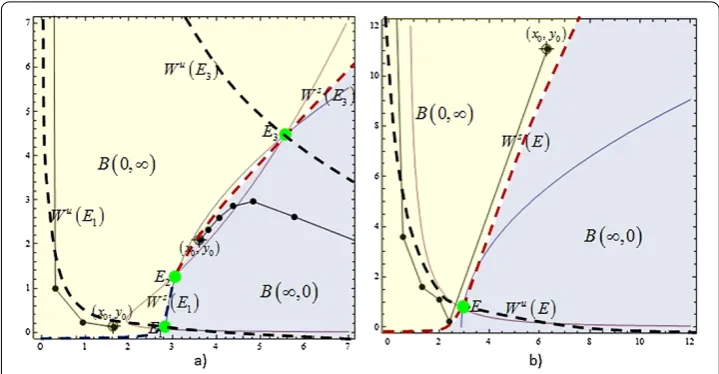
EneE,where Eand E are saddle points and Eis a repeller.In this case there exist four invariant continuous curvesWs(E),Ws(E),Wu(E),Wu(E),whereWs(E),Ws(E) have end points at E,and are graphs of increasing functions.The curvesWu(E),Wu(E) are the graphs of decreasing functions.Every solution{(xn,yn)}which starts belowWs(E)∪
Ws(E
)in the south-east ordering is asymptotic to(,∞),and every solution{(xn,yn)}which
starts aboveWs(E)∪Ws(E)in the south-east ordering is asymptotic to(∞, ).The first quadrant of initial condition Q={(x,y) :x> ,y≥}is the union of five disjoint basins of attraction,i.e.,
Q=B(,∞)∪B(∞, )∪B(E)∪B(E)∪B(E),
whereB(E) ={E},B(E) =Ws(E),B(E) =Ws(E)and
B(,∞) =(x,y)|(x,y) se(x˜,y˜)for some(x˜,y˜)∈Ws(E)∪Ws(E)
,
B(∞, ) =(x,y)|(x˜,y˜) se(x,y)for some(x˜,˜y)∈Ws(E)∪Ws(E)
.
chosen to point in the direction of the second and first quadrant, respectively. Also, one can show that if the map is strongly competitive, then no eigenvector is aligned with a coordinate axis.
Since< impliesa<Ac, we have thatdetJT(Ei) > ,i= , . Hence, all
condi-tions of Theorems , and are satisfied, which yields the existence of the global sta-ble manifoldsWs(E
),Ws(E) and the global unstable manifoldsWu(E),Wu(E), where
Ws(E
),Ws(E) are passing through the pointEand are graphs of increasing functions. The curvesWu(E
),Wu(E) are the graphs of decreasing functions. Let
W–=(x,y)|(x,y)
se(x˜,˜y)for some(x˜,y˜)∈Ws(E)∪Ws(E)
,
W+=(x,y)|(x˜
,y˜) se(x,y)for some(x˜,y˜)∈Ws(E)∪Ws(E)
.
Take (x,y)∈ W– ∩R. By Theorem we have that there exists n > such that Tn(x,y)∈int((Q(E)∪Q(E))∩R),n>n. In view of Theorem , sinceEandEare saddle points, we obtain that for all (x,y)∈int((Q(E)∪Q(E))∩R), there exists a sub-solution (u,v) such that (x,y) se(u,v). By monotonicity we have that (,∞) se
Tn(x
,y) se Tn(u,v)Eif (x,y)∈int(Q(E)∩R) and (,∞) seTn(x,y) se
Tn(u
,v)Eif (x,y)∈int(Q(E)∩R). For the sequence (un,vn) =Tn(u,v), we have (un+,vn+) se(un,vn) se(u,v). The sequence{un}is monotone decreasing and
bounded from below and{vn}is monotone increasing. SinceT has no other equilibrium
point exceptE,EandE, this implies that the sequence{un}has finite limit andvn→+∞
asn→ ∞. Fromun+= (bun)/(A+vn) we obtain thatun→ asn→ ∞. This implies
Tn(x
,y)→(,∞) asn→ ∞. If (x,y)∈W+∩R, the proof is similar and we skip it.
Another way of completing the proof is by using () of Lemma .
Theorem Assume that> .If
a≤Ac
or
a>Acand (y¯) > and T has no minimal period-two solution,
then system()has one equilibrium solution E(x¯,y¯),which is a saddle point.There exists the global stable manifoldWs(E)which is the graph of a continuous increasing function and the
global unstable manifoldWu(E),which is the graph of a continuous decreasing function.
Every solution{(xn,yn)}which starts belowWs(E)in the south-east ordering is asymptotic
to(,∞),and every solution{(xn,yn)}which starts aboveWs(E)in the south-east ordering
is asymptotic to(∞, ).The first quadrant of initial condition Q={(x,y) :x> ,y≥} is the union of three disjoint basins of attraction,Q=B(,∞)∪B(∞, )∪B(E),where
B(E) =Ws(E)and
B(,∞) =(x,y)|(x,y) se(x˜,y˜)for some(x˜,y˜)∈Ws(E)
;
B(∞, ) =(x,y)|(x˜,y˜) se(x,y)for some(x˜,˜y)∈Ws(E)
Figure 1 (a) Visual illustration of Theorem 17. (b)Visual illustration of Theorem 18.
Proof The conditions of this theorem anda=Acimply all assumptions of Theorems , and forR. The proof of this theorem in this case is similar to the proof of Theorem and will be skipped.
Now, we assume thata=Ac. In view of Lemma , the set
I=
x,
bx–Ax¯
¯
x
:x≥
Ax¯ b
is invariant and contains equilibriumE, andT(x,y) =Efor (x,y)∈I. In view of the unique-ness of the global stable manifold, we conclude thatWs(E) =I. Let
W–=(x,y)|(x,y)
se(x˜,˜y)for some(x˜,y˜)∈Ws(E)
;
W+=(x,y)|(x˜
,y˜) se(x,y)for some(x˜,y˜)∈Ws(E)
.
Take any point (x,y)∈ W+(E). Then there exists the point (xl,yl)∈I such that
(xl,yl)se(x,y). Since the mapTis strongly competitive, thenE=T(xl,yl)seT(x,y). This impliesT(x,y)∈int(Q(E)∩R). If (x,y)∈W–(E), then there exists the point (xr,yr)∈I such that (x,y)se(xr,yr). Since the mapT is strongly competitive, then
T(x,y)seE=T(xr,yr). This impliesT(x,y)∈int(Q(E)∩R). Similarly as in Theo-rem , one can prove thatTn(x
,y)→(,∞) asn→ ∞if (x,y)∈int(Q(E)∩R) and Tn(x,y)→(∞, ) asn→ ∞if (x,y)∈int(Q(E)∩R), from which the proof follows in
this case.
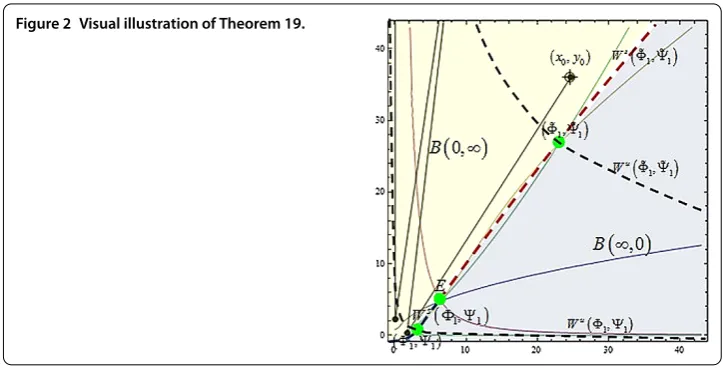
See Figure for visual illustration of Theorems and .
Theorem If a>Acand (y¯) < ,then there exists one equilibrium point E which is a repeller.If D(p)= ,thenint(Q(E))∪int(Q(E))contains an odd number of minimal period-two solutions{(i,i), (˜i,˜i)},i= , . . . , n+ ,such that(i+,i+)ne(i,i)neE
and Ene(˜i,˜i)ne(˜i+,˜i+)and(˜i,˜i) =T(i,i).Furthermore,the odd indexed
global stable manifolds are given by
Ws(
k+,k+), (˜k+,˜k+)
=Ws(k+,k+)∪Ws(˜k+,˜k+),
k= , . . . ,n,
whereWs(
k+,k+)andWs(˜k+,˜k+)are the graphs of a continuous strictly in-creasing function such that Ws(˜
k+,˜k+) =T(Ws(k+,k+)) with endpoints at (˜k,˜k), (˜k+,˜k+)and(k+,k+), (k,k),k= , . . . ,n– ,respectively,where
(˜,˜) = (,) =E.The curve
C=
n
k=
Ws(
k+,k+)∪Ws(˜k+,˜k+)∪
(k,k), (˜k,˜k)
separatesRinto two componentsW–andW+,which are basins of attraction of(,∞)and (∞, ),respectively,where
W–=(x,y)|(x,y)
se(x˜,˜y)for some(x˜,y˜)∈C
;
W+=(x,y)|(x˜
,y˜) se(x,y)for some(x˜,y˜)∈C
.
Further,for k= , . . . ,n,we have
B(k+,k+), (˜k+,˜k+)
=Ws(k+,k+)∪Ws(˜k+,˜k+);
B(k,k), (˜k,˜k)
=(k,k), (˜k,˜k)
.
The global unstable manifolds are given by
Wu(
k+,k+), (˜k+,˜k+)
=Wu(k+,k+)∪Wu(˜k+,˜k+),
k= , . . . ,n,
whereWu(k+,k+)andWu(˜k+,˜k+)are the graphs of continuous strictly decreas-ing functions such thatWu(˜
k+,˜k+) =T(Wu(k+,k+))with endpoints at(,∞) and(∞, ).
Proof In view of Corollary , the setint(Q(E))∪int(Q(E)) contains an odd number of minimal period-two solutions{(i,i), (˜i,˜i)},i= , . . . , n+ , such that (i+,i+)ne
(i,i)neEandEne(˜i,˜i)ne(˜i+,˜i+) and (˜i,˜i) =T(i,i). Furthermore,
the odd indexed period-two points are saddles and the even indexed period-two points are repellers. The mapTsatisfies all conditions of Theorems , and , which yields the existence of the global stable and unstable manifolds with the above properties. In view of Theorem , for (x,y)∈W–∩R, there existsn> such that
Tn(x,y)∈
n
k=
intQ(k+,k+)
∪intQ(˜k+,˜k+)