Volume 2010, Article ID 843745,12pages doi:10.1155/2010/843745
Research Article
A Precoded OFDMA System with User Cooperation
Yao Yu,
1Sarod Yatawatta,
2and Athina P. Petropulu
11Electrical and Computer Engineering Department, Drexel University, Philadelphia, PA 19104, USA 2Kapteyn Astronomical Institute (RUG), Postbus 800, 9700 AV Groningen, The Netherlands Correspondence should be addressed to Yao Yu,[email protected]
Received 1 November 2009; Accepted 30 March 2010
Academic Editor: Xinbing Wang
Copyright © 2010 Yao Yu et al. This is an open access article distributed under the Creative Commons Attribution License, which permits unrestricted use, distribution, and reproduction in any medium, provided the original work is properly cited.
A new cooperative scheme for a two-user orthogonal frequency division multiple access (OFDMA) uplink communication scenario is proposed. Each user is equipped with one transmit/receive antenna. Before transmission, inter-block linear precoding is introduced to pairs of blocks. The cooperative transmission is implemented in cycles of three time slots. During each slot, a user transmits either his data, or a weighted mixture of his data and the data that he received in previous slots of the same cycle. The weights are obtained in an optimum fashion, so that a user that faces deep fading on certain subcarriers can benefit from the other user’s channel, without taxing significantly the resources of that user. It is shown that the proposed scheme achieves the maximum available diversity for both users (full cooperation), or for the weak user (half cooperation) without increasing the number of antennas needed as compared to an energy-equivalent noncooperative OFDMA system that also uses inter-block precoding. Further, the proposed use of inter-block precoding allows one to exploit the cooperation induced diversity in 1.5 slots on the average; 2 slots would be needed if intra-block precoding was used instead.
1. Introduction
Multiuser Cooperation is a promising technology for improving the performance of wireless communication systems, as it has the potential to increase the data rate [1,2], and achieve diversity order equal to the number of cooperating users [3]. Three types of cooperation have been used in the past, decode-and-forward (DF) [1,4], amplify-and-forward (AF) [5], and coded cooperation [6]. In [4], a two-user cooperative system was considered and in that context it was shown that the AF approach performs better than the DF, with the performance gap closing as the SNR increases. Also in [4], it was shown that coded cooperation based on channel coding can in general outperform both AF and DF schemes at all SNR levels, while it is comparable to the noncooperative system at low SNR.
OFDM systems have gained popularity due to their ability to handle frequency selective fading. Various forms of cooperation in the context of OFDM systems have been considered. In [5], a hybrid forwarding scheme was proposed for cooperative relaying in OFDM-based networks that adaptively decides between AF, DF, or no relaying at all, based
two-user OFDMA systems was proposed in [10] and was shown to achieve the capacity region upper bound of two-user OFDMA systems.
It is well known that OFDM systems loose multipath diversity as each symbol is transmitted on one subcarrier only. Several ways have been proposed in the literature for introducing path diversity in OFDM systems. Suppose that the multipath channel is finite impulse response (FIR) withL taps. Maximum diversity gain,L, was achieved in [11,12] via a linear receiver using redundant precoding, or oversampling at the receiver. In [13] it was shown that a single user OFDM system with nonredundant block precoding can achieve diversity gain up to L. The performance gain is exploitable using a Maximum Likelihood (ML) decoder. Reduced complexity decoding at the receiver is possible via subcarrier grouping [13], which may result in smaller than Ldiversity gains. Other nonredundant precoding techniques were also considered in [14–16]. A multirelay cooperative OFDM system with nonredundant precoding and AF relay-ing was investigated in [17]. Based on the expression of pairwise error probability (PEP), it was demonstrated that the maximum diversity order is the sum of the source-to-destination channel length and the length of the shortest channel among the relay links.
In this paper we propose a cooperative approach for a two-user OFDMA system that combines linear interblock precoding and user cooperation. The transmission occurs in cycles of three time slots each; two new precoded data blocks for each user are transmitted in each cycle. In the first slot, both users transmit their own data. In the two subsequent slots, each user transmits a weighted combination of the user’s own precoded data and also data from the other user that were received in the previous slot. The weights are obtained as the solution of a constrained optimization problem that allows the user that faces a bad channel on certain subcarriers to benefit from the user that has a better channel, without taxing significantly the resources of that user. Two methods are proposed to implement this scheme: the full cooperation and the half cooperation. In the full-cooperation scheme, both users are involved in the cooperation. The base station (BS) recovers the transmitted symbols after it has collected data from both users in the three slots. In the half-cooperation scheme, only the strong user transmits cooperative information. We show that the proposed cooperative schemes combined with interblock precoding can achieve the maximum available diversity, that is, twice the length of the multipath channel. To achieve the same diversity order, a noncooperative OFDMA system that uses the same transmission energy per block pair and the same interblock precoding scheme would require at least two transmit antennas. Further, the proposed use of interblock precoding allows one to exploit the diversity induced by cooperation in 1.5 slots on the average; 2 slots would be needed if intrablock precoding was used instead.
1.1. Relation of Contribution to the Literature. For most existing cooperative OFDM techniques [5, 7–10, 17], the users serving as relays transmit only the data of other users
during the cooperation phase. The main difference between the proposed approach and these techniques lies in the fact that each cooperating user transmits a linear combination of the user’s own data and also data from the other user. Superposing user’s own data and data from the other user can double the maximum diversity gain of each user.
In this paper, we propose to use interblock precoding for our proposed cooperation scheme. Inter-block precoding was previously applied to channel estimation for OFDM systems in [16] to exploit time diversity introduced by time varying channels. However, here, even if the channel is completely static, interblock precoding allows one to exploit the spatial diversity that is introduced by cooperation. In [17], intrablock precoding [13] was employed to achieve multipath diversity for multirelay cooperative OFDM sys-tem. The proposed use of interblock precoding allows one to exploit the diversity induced by cooperation in 1.5 slots on the average; 2 slots would be needed if intrablock precoding was used instead.
1.2. Paper Organization. The paper is organized as follows. In Section 2 we describe the signal model of a multiuser OFDM system. InSection 3, we propose a full-cooperation scheme and a half-cooperation scheme for a two-user OFDMA system and provide diversity analysis. Further, we describe a modified ML decoder based on subcarrier grouping. We provide simulation results of two cooperative schemes in Section 4, and finally make some concluding remarks inSection 5.
1.3. Notation. The small and capital letters in bold denote vectors and matrices. We denote theN×Nidentity matrix asINand all-zero matrix as0N. The statistical expectation of
a random variable is denoted byE{·}. The superscripts (·)∗ and (·)Hdenote the conjugation and Hermitian respectively. We useto denote element-wise multiplication.
2. Signal Model and Assumptions
Let us consider a two-user OFDMA system where users com-municate with a BS. The users are assigned disjoint carriers. User 1 transmits over subcarriers in setI1and receives over
subcarriers in setI2, whereI1
I2= {0, 1,. . .,N−1}and
I1
I2= { }. User 2 transmits over subcarriers in setI2and
receives over subcarriers in setI1.|I|denotes the cardinality
of setI. We assume that|I1| = |I2| = N/2. Letsij denote
theith OFDM block of user j with the lengthN/2, that is transmitted over the subcarriers in Ij, and rip denote the
corresponding signal received by userp in theith time slot over the carriers in setIp.
The time-domain multipath channel between user jand user p is denoted byhp j(n),n ∈ [0,L−1]; each channel
tap is assumed to be zero-mean i.i.d. Gaussian with unit variance. The tapshp j(n) are assumed to be uncorrelated for
channel. Let the frequency-domain channel be Hp j(k) =
L−1
n=0hp j(n)e−j(2π/N)kn, k ∈ [0,N −1]. Then the received
signal by userpfrom userjin theith slot is given by
rip=Hp jsij+nip j, (1)
where
Hp j =diag
Hp j
Ij(1)
,. . .,Hp j
Ij Ij
(2)
withIj(k) denoting thekth element of the setIjaccording
to some predefined ordering; nip j denotes noise at user p
during the transmission of theith block from userjwith the variance of its entries beingσip j. We assume that the noise is
circularly complex Gaussian with zero mean, temporally and spatially white, that is,
E
ni p j
ni pj
H
= ⎧ ⎨ ⎩
σi
p jIN/2, i=i, p=p, j=j,
0N/2, otherwise.
(3)
For simplicity we assume that for the noise variance it holds: (σip j)2=(σp ji+1)2=σ2p j.
The signal-to-noise ratio (SNR) throughout this paper is defined as the ratio of the power of transmitted signal to the power of additive noise as
SNRip j=
Esij
H
sij
Enip jHnip j
. (4)
It is well known that a good interuser channel is a pre-requisite for cooperation. In a multiuser system, the partners are selected to have a good channel between them. Therefore, throughout this paper we assume that the interuser channels are sufficiently good.
We will next discuss a scenario where both users transmit and receive simultaneously using the same antenna, that is, in full duplex mode. Since there could be practical difficulties in such scenario, we will later discuss an approach where time division multiplexing is used to achieve full duplex operation. As that approach does not change the following analysis nor the conclusions drawn in this paper, for simplicity, we continue to present our methods assuming full duplex operation.
3. The Precoded Cooperation Scheme
First, the users perform interblock precoding on pairs of successive data blocks before they enter the OFDM system. As it will be shown in a subsequent subsection, the purpose of the precoding is to exploit the multipath diversity and spatial diversity that is introduced by the cooperative retransmissions.
Let us expressWj be the unitary precoding matrix for
userjas
Wj=
⎡ ⎣Wj1
Wj2 ⎤
⎦, (5)
whereWj1(N/2×N) contains the first half of the rows ofWj
whileWj2(N/2×N) contains the other half. On denoting
the uncoded blocks of user j bydj =[(dij)T, (dij+1)T]T, the
precoded blocks are
si
j=Wj1dj, sij+1=Wj2dj, j=1, 2. (6)
Second, each user transmits two precoded data blocks in a cycle of 3 slots. Two cooperative transmission schemes are considered for a three-slot cycle, namely, the full-cooperation scheme and the half-cooperation scheme.
3.1. The Full-Cooperation Scheme. In this scheme, the two users superimpose their own data to the data received from the other user. Two blocks from each user, that is,si1 and
si1+1, i=1, 2 are transmitted and recovered in three time slots
as follows.
Slot i. Both users transmit their own data, si1 and si2,
respectively. These are received asH21si1+ni21andH12si2+
ni
12, respectively, by the other user.
Slot i+ 1. The users transmit a weighted combination of their own datasi1+1 (si2+1) and the signal that they received
during the previous slot after it has been scaled byα(β) and mapped from the incoming carriers to outgoing carriers. The amount of power allocated for cooperation by users 1 and 2 is proportional to α2 andβ2, respectively. The selection of
those weights is formulated as an optimization problem in Section 3.5. The transmitted signals of both users, that is,ti+1 1
andti+1
2 are given by
ti+1
1 =si1+1+α
H12si2+ni12
,
ti2+1=si2+1+β
H21si1+ni21
.
(7)
Sloti+ 2. Both users again transmitR1si1andR2si2 as their
own data, plus the signal that they received during sloti+ 1. Note that there is a component ofsi
1(si2) in the received
signals by users 1 (2). In order to eliminate that component, the precoding for that block is modified as
R1=R2=IN/2−αβH12H21, (8)
αβH12H21 can be obtained at each user by correlating the
signal that was received in the (i+ 1)th slot with the signal that was transmitted in the ith time slot. Therefore, the transmitted signalsti+2
1 andti2+2can be expressed as
ti+2
1 =si1+αH12si2+1+αβH12ni21+αni12+1,
ti+2
2 =si2+βH21si1+1+αβH21ni12+βni21+1.
(9)
The signals received at the BS during slotsi,i+ 1,i+ 2
Similarly, the received signals over carriers inI2during slots i,i+ 1,i+ 2 are:
one can see that cooperation has effectively created two transmission paths for the information blocks. This effect is analogous to employing two transmitters. We should note that interblock precoding was used in [16] to exploit time diversity introduced by time varying channels. Here, even if the channel is completely static, interblock precoding allows us to exploit spatial diversity introduced by cooperation. The proposed scheme with interblock precoding requires on the average 1.5 slots for each data block to achieve the double diversity induced by cooperation. Without interblock precoding, two slots would be required.
Combining (16) and (18), the following MIMO problem can be formulated at the receiver:
y=
Assuming knowledge of H, recovery of d based on y is discussed inSection 3.4.
3.1.1. Transmission Energy Adjustment. Let σ2
i,σi2 be the
power of one data block transmitted by useriwithout and with cooperation, respectively. For simplicity let us takeσ1=
σ2 = σ and σ1 = σ2 = σ. In the cooperative OFDM
scheme, the transmission ofsij andsi+1
j requires three slots,
as opposed to the two slots required in the no-cooperation scheme. To maintain the energy used by the two schemes for the transmission of a block pair at the same level, we need to adjust the transmission power. In the noncooperative case, the transmission of 2 blocks requires energy equal to Pnoco =2σ12|I1|+ 2σ22|I2| =2σ2N. Under cooperation, the
energy spent by user 1 and user 2 to transmit 3 blocks is
Γ1=3σ2|I1|+ 2α2
Since the channel taps are assumed to be zero-mean unit-variance Gaussian random variables, the magnitudes
|Hi j(k)| are i.i.d. Rayleigh distributed, that is, |Hi j(k)| ∼
Rayleigh(1/2). Letσ2 be the averageσ2 over the interuser
channel coefficients. It holds
4σ2=σ26 + 2α2+ 2β2+ 2α2σ2
3.1.2. Diversity Analysis. It is shown in [13] that for a single user OFDM system, the maximum diversity gain achievable with one transmit antenna is equal to the number of independent fading paths of the channel. Diversity is related to the bit error rate performance [18] and is usually increased by adding more transmitters and receivers. In this section, we follow a similar procedure as in [13] to study the diversity gain achieved by (20) and show that (20) achieves the full spatial diversity available, that is, 2Lwithout adding more transmitters.
The probability ofdbeing detected whendis transmitted is
nis the noise variance. Then we have
d2y,y=y−y2=R−n1/2H[e1T,eT2]T
(25) can be further rewritten as
d2y,y=hHR1/2
andF1andF2are submatrices of theN-point DFT matrix
corresponding toI1andI2.
Because Rn is generally invertible, it is reasonable to
assume thatG has full rank. Conditioned on the interuser channelsH12andH21, the pairwise error probability is [19]
Pd−→d|H12,H21
where
point DFT matrix corresponding to thekth subcarrier inIj.
Since the rank ofFkis two, the maximum rank ofZkj is two.
Thus, without interblock precoding, the maximum diversity gain that the cooperation scheme could achieve would be two.
To achieve the full diversity for both users we need α,β /=0. If we choose α /=0,β = 0 as an example, user 1 cannot achieve the maximum diversity 2L. However, if the channel of one user is very bad, this user should terminate cooperation to maintain its own signal power at a certain level, that is, setαorβto zero. Unlike pure transmit diversity, where we always have a good (wired) channel between the transmitters, cooperation can exhibit the same performance only when the interuser channel is good. In OFDM, where we have multiple carriers, some carriers will enjoy the full diversity gain by cooperation while some carriers will not.
3.2. The Half-Cooperation Scheme. In the full cooperation scheme, both users are involved in the cooperation. In order to keep the total energy consumed by the full-cooperation scheme equal to that of the no-cooperation scheme, we have to reduce the power assigned to each data block. Therefore, the maximum diversity gain is doubled at the price of SNR. It is expected that, at low SNR, the full-cooperation scheme will yield worse performance in terms of BER than the no-cooperation scheme. One might wonder whether the performance at low SNR can be improved by sacrificing diversity to some extent. Next, we investigate another scheme in which only the strongest of the two users cooperates. In particular, user 1 serves as a relay for user 2, while user 2 does not help user 1. Unlike the full-cooperation scheme, users send their information separately to the BS. Again, three slots are required for two users to transmit two blocks of data as follows.
Slot i. Both users transmit their own data si1 and si2,
respectively. User 1 receivesH12si2+ni12from user 2.
Sloti+ 1. Both users transmit their own datasi+1
1 andsi2+1,
respectively. At the time of transmission, user 1 receives H12si2+1+ni12+1from user 2.
Sloti+ 2. User 2 terminates transmission. User 1 transmits the signal that he received in the previous two slots overI1
andI2.
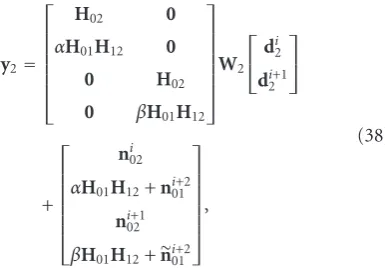
y2=
01 represents the addictive Gaussian noise on the
user-to-BS channel for user 1 in the (i+ 2)th slot overI2.
3.2.1. Transmission Energy Adjustment. Under cooperation, the energy spent by user 1 and user 2 to transmit 3 blocks is:
Γ1=2σ2|I1|+
Similar to the full-cooperation scheme, the average signal power over the interuser channel coefficientsσ2is given by
4σ2=σ24 +α2+β2+α2+β2σ2
the half-cooperation scheme can save more transmission power for each data block. It is expected that when SNR is relatively low, the half-cooperation scheme can yield better performance than the full-cooperation scheme.
3.2.2. Diversity Analysis. Similar to the scenarios discussed in [13], the maximum diversity gain of user 1 in (37) isL. From the analysis ofSection 3.1.2, the maximum diversity gain of user 2 in (38) is 2L. This indicates that user 1 has to sacrifice its performances for the sake of user 2. On the other hand, the full-cooperation scheme is a win-win situation for both users when the SNR is relatively high.
Table 1summarizes the maximum diversity gain of the full-cooperation scheme (FC), the full-cooperation scheme without precoding (FC-no precoding), the half-cooperation scheme (HC), the no-cooperation scheme with precoding (NC) and the no-cooperation scheme without precoding (NC-no precoding).
3.3. Time Division Duplexing. The cooperation scheme described above is strongly dependent on the users being able to both receive and transmit simultaneously. However, in a practical situation this might be difficult. Nevertheless it is possible to effectively achieve full duplex operation by time division duplexing.
In the original scheme both users transmit during the entire duration of time slot i (N symbols plus the cyclic prefix). However, we can allocate half a time slot for each user to the data vectorssi1 andsi2. During time sloti, user 1 will
first transmitN/2 data symbols plus the cyclic prefix. Next, user 2 will transmit his ownN/2 data symbols plus the cyclic prefix. During each transmission, all the other users will be in receive mode. Therefore, there is no difference between this time division approach (half duplex) and the full duplex one, and the analysis and conclusions hold in this case too.
3.4. Symbol Recovery. The maximum diversity can be best exploited using ML decoding. In general, ML decoding has prohibitively high complexity especially when the number of subcarriers N is large. Here, following the main idea of [13], we implement ML by optimal subcarrier grouping. The set of all subcarriers is divided intoK equally spaced groups. Each group containsJ =N/Ksubcarriers. In order to achieve the maximum multipath diversity, it should hold thatJ ≥ 2L(seeSection 4for diversity analysis). To reduce the complexity further, we let two users exchange their subcarriers to transmit data in the second slot, that is, in slot i+ 1, user 1 transmits overI2 and receives over I1, while
user 2 transmits overI1and receives overI2. By this way, the
minimumJ can be reduced toLto achieve diversity of the order of 2L. For simplicity, we assume thatK = N/Lis an integer. The sets of subcarriers for two usersI1 andI2are
divided intoKgroups, each group containingJ=Lequally spaced subcarriers. Let us define
pk=
wherepk denotes the subcarrier pattern for thekth group;
dij,k represents the transmitted signal of the jth user in the
ith slot over thekth group of subcarriers;yij,k denotes the
received signal at BS in theith slot over the kth group of subcarriers inIj;nip,kj denotes the noise at user p over the
kth group of subcarriers during the transmission of the data block from user j in theith slot (The 0th user represents the BS); Hkp j and Hk
p j are the fading coefficients of the
Table1: Maximum diversity gain for the various schemes.
FC FC-no precoding HC NC NC-no precoding
Maximum diversity gain of user 1 2L 2 L L 1
Maximum diversity gain of user 2 2L 2 2L L 1
Table2: Transmitted signal for the full-cooperation scheme.
User 1 User 2
Table3: Transmit Signal for the half-cooperation scheme.
User 1 User 2
the full-cooperation scheme as an example, the model for the received signal by grouping subcarriers can be reduced to
yk=
By optimal subcarrier grouping, we only perform the precoding on a group of subcarriers.
LetULbe anL×Lunitary Vandermonde matrix defined
as in [13]. The precoding matrixesW1andW2in (6) can be
simplified asW=ULIN/L.
3.5. Optimal Allocation of Power during Allocation. In this section, we discuss the optimization of power allocation parameterαandβbased on the model of (42). We assume that user 1 is the strong user, that is, user 1 has less subcarriers in deep fade as compared to user 2 (weak user). During the cooperation, user 1 will assist user 2, while at the same time, will also receive some help.
Let us define x = [α2,β2]T
to be the vector of the parameters to be determined. The objective function is defined in terms of the SINR of user 1 and user 2. In order to derive the SINR for the users, we need to separate the data of each user in the model of (42) as
whereH1kandH2kcontain the first half and the second half of the columns ofHk, respectively. On lettingsj(k) denote the
SINR of the jth user at thekth subcarrier, we have
s1(k)=
Thekth inequality of constraint (d)
Hk
β2
The minimumykobtained from thekth inequality
Constraint (a) P1
Constraints (a)–(c) P
Constraints (b),(c) P2
α2
1
1
Figure1: Geometric interpretation of the solution of the optimiza-tion problem of (48).
subcarriers of the strong user is above some threshold η, that is,
max
x=[α2,β2]Tmink s2(k)
s.t. (a)s1(k)≥η, k=0,. . .,K−1;
(b) [0, 0]T≤x≤[1, 1]T; (c) [−1, 1]x≤0,
(46)
where the last constraint means that user 2 never spends more energy than user 1 when helping user 1. The threshold depends on the applications that user 1 needs to transmit, and is here assumed given. The lower the threshold, the more help user 1 will provide. The advantage for user 1 is that if the user has subcarriers on which the SINR is less thanη, the situation on those subcarriers will improve.
A more standard form of the above problem is
min x=[α2,β2]Tmaxk
1 s2(k)
s.t. (a)s1(k)≥η, k=0,. . .,K−1;
(b) [0, 0]T ≤x≤[1, 1]T; (c) [−1, 1]x≤0.
(47)
or equivalently,
min x,y y
s.t. (a) s1(k)≥η, k=0,. . .,K−1;
(b) 0≤x≤1;
(c) [−1, 1]x≤0;
(d) 1 s2(k)≤y
, k=0,. . .,K−1.
(48)
Since the denominators of sj(k), j = 1, 2 are
poly-nomials ofx, finding the solution of the problem of (48)
is not easy. We will proceed by making some simplifying assumptions. Let us assume that the interuser channels are quite good and that the noise at the user end is very small so that σ2
12 and σ212 are negligible as compared toσ012 and σ2
02. Since the coefficients of the high orders ofxare linear
combinations of σ2
12 and σ212, the high orders of x can be
ignored. Therefore, the denominators ofsj(k), j =1, 2 can
be approximated as a linear function in x. Let 1/s2(k) be
represented by (akα2+bkβ2+ck)/(akα2+bkβ2+ck). Finding
the solution of (48) is based on the following observations.
(1) The constraints (a)–(c) are linear so they give rise to the feasible set shown by a polyhedronP inFigure 1. The irregular pentagon P1 and a triangle P2 are
formed by constraints (a) and (b)-(c), respectively.
(2) With a fixedy, thekth inequality in the constraint (d) yields a halfspaceHk:
akα2+bkβ2+ck
akα2+bkβ2+ck
≤y
bk−bky
β2≤a
ky−ak
α2+c
ky−ck
, (49)
whereak,bk,ak,bk>0.
(3) When y takes the minimum value 0, β2 ≤ −(ak/bk)α2−(ck/bk), k =0,. . .,K−1 and thus the
feasible set is empty. Asyincreases, the dimension of the feasible set increases. There are several different scenarios.
(a) If 0< y <(bk/bk),
β2≤ ⎛ ⎝−ak
bk
+
ak/bk
bk−ak
bk−bky
⎞ ⎠
!
u(y)
α2
+
⎛ ⎝−ck
bk
+
ck/bk
bk−ck
bk−bky
⎞ ⎠
!
.
v(y)
(50)
(i) If ((ak/bk)bk−ak≥0 & (ck/bk)bk−ck>0) or
((ak/bk)bk−ak>0 & (ck/bk)bk−ck=0), the
halfspaceHk approachesP as y is increasing
in (0,bk/bk), and finallyHkintersects withP.
Let yk denote the minimum y that the kth
inequality of the constraint (d) yields. Then this ykis achieved whenHktouches a vertex ofP.
(ii) If (ak/bk)bk −ak ≤ 0 &(ck/bk)bk−ck ≤ 0,
v(y) and u(y) are decreasing functions of y. Therefore, the halfspace Hk and P do not
intersect within (0,bk/bk).
(iii) If ((ak/bk)bk−ak<0 &(ck/bk)bk−ck>0), or
((ak/bk)bk−ak>0 & (ck/bk)bk−ck<0),ykis
(b) Ifyk does not exist when 0< y < bk/bk, we have to
consider the scenario in which y ≥ bk/bk. First, we
considery=bk/bkand so 0≤((ak/bk)bk−ak)α2+
((ck/bk)bk−ck).
(i) If (ak/bk)bk −ak ≥ 0 & (ck/bk)bk−ck ≥ 0,
the intersection ofHkwithP isP itself. Thus,
yk=bk/bk.
(ii) If ((ak/bk)bk−ak<0 & (ck/bk)bk−ck>0) or
((ak/bk)bk−ak >0 & (ck/bk)bk−ck <0), we
have
yk=
⎧ ⎪ ⎪ ⎪ ⎪ ⎪ ⎪ ⎪ ⎪ ⎨ ⎪ ⎪ ⎪ ⎪ ⎪ ⎪ ⎪ ⎪ ⎩
bk
bk
, if∃α∈P s.t.
0≤
ak
bk
bk−ak
α+
ck
bk
bk−ck
>bk bk
and refer to (c), otherwise.
(51)
(iii) If ((ak/bk)bk−ak ≤ 0 & (ck/bk)bk−ck < 0)
or (ak/bk)bk −ak < 0 & (ck/bk)bk−ck ≤ 0,
yk>(bk/bk) then refer to (c).
(c) If ykdoes not exist when 0< y ≤bk/bk, we have to
consider the scenarios in whichy > bk/bkand soβ≥
u(y) +v(y). When (ak/bk)bk−ak≤0 & (ck/bk)bk−
ck≤0, we can always find a feasibleyk.
In conclusion, we know
(i) If (ak/bk)bk −ak = 0 & (ck/bk)bk −ck = 0, any
elements in the setPcan give rise to the minimumy, yk=(bk/bk). However, this case happens with small
probability.
(ii) Otherwise,ykalways falls on a vertex ofP.
SinceKinequalities of constraint (d) need to be satisfied simultaneously, the optimalx = [α2,β2]T
is a vertex ofP satisfying
bj−bjyj
β2=a
jyj−aj
α2+c
jyj−cj
, (52)
where yj is the maximum value of the set {yk,k =
0,. . .,K −1}obtained from the K inequalities. Therefore, we can determine the optimal power allocation parameters xwith the aid of the geometric interpretation of (48). The minimumyis the maximum value of{zk |(bk−bkzk)β2=
(akzk−ak)α2+ (ckzk−ck),k=0,. . .,K−1}.
4. Simulation Results
In this section, we provide simulation result to illustrate the performance of the proposed full-cooperation (FC) and half-cooperation (HC) schemes. To illustrate the advantages of cooperation in addition to precoding, we compare the two
5 10 15 20 25
10−4
10−3
10−2
10−1
SNR (dB)
BER
User 1: FC with optimalαandβ User 2: FC with optimalαandβ
User 1: NC User 2: NC
Figure2: BER performance of each user with FC and NC, where user 1 hasN1=1 and user 2 hasN2=2 subcarriers in deep fade.
proposed approaches to a noncooperative scheme (NC) that uses the same interblock precoding strategy and is equivalent in terms of power consumption.
We consider an OFDM system withN =16 subcarriers and 4QAM signals. We use the model of [20] to generate channels consisting of two equal power taps with normalized Doppler shift equal to 0.001. The channel is virtually static in order to eliminate temporal diversity due to by channel variation and thus highlight diversity due to cooperation and multipath. The SNR of the interuser channel is fixed at 30 dB. For the interblock precoding, we use 2×2 unitary matrices and group carriers into blocks of two. Two users exchange their subcarriers as described inSection 3.4.
In our simulations, we assign unit power to each OFDM symbol for the noncooperative scheme. The power of each OFDM block in the proposed cooperative schemes is deter-mined by (23) and (40). This guarantees that cooperative and noncooperative schemes consume the same energy during a cycle of three slots. In the following figures and discussion the term SNR refers to the SNR for the noncooperative scheme, that is, the reciprocal of the noise power. We assumeσ2
01 =
σ2
02. We force user 1 and user 2 to haveN1 andN2
deep-fading subcarriers, respectively. The variance of nondeep-fading subcarriers is set to 1 while the variance of subcarriers in deep fade is set to 0.001. We consider three cases where
{(N1=1,N2=2), (N1=1,N2=3), (N1=2,N2=3)}. Figures 2,3, and 4 compare the BER performances of each user for FC and NC in three cases described above for SNR01=SNR02. Since our proposed approach of optimizing α andβ holds only whenσ012,σ012 σ212,σ212, we consider
5 10 15 20 25 10−4
10−3
10−2
10−1
100
SNR (dB)
BER
User 1: FC with optimalαandβ User 2: FC with optimalαandβ
User 1: NC User 2: NC
Figure3: BER performance of each user with FC and NC, where user 1 hasN1=1 and user 2 hasN2=3 subcarriers in deep fade.
5 10 15 20 25
10−4
10−3
10−2
10−1
100
SNR (dB)
BER
User 1: FC with optimalαandβ User 2: FC with optimalαandβ
User 1: NC User 2: NC
Figure4: BER performance of each user with FC and NC, where user 1 hasN1=2 and user 2 hasN2=3 subcarriers in deep fade.
5 10 15 20 25 30 35 10−5
10−4
10−3
10−2
10−1
SNR (dB)
BER
User 1: FC User 2: FC User 1: NC
User 2: NC User 1: HC User 2: HC
Figure5: BER performance of each user with FC, HC and NC, where user 1 hasN1 = 1 and user 2 hasN2 = 2 subcarriers in deep fade.
5 10 15 20 25 30 35 10−4
10−3
10−2
10−1
SNR (dB)
BER
User 1: FC User 2: FC User 1: NC
User 2: NC User 1: HC User 2: HC
Figure6: BER performance of each user with FC, HC and NC, where user 1 hasN1 =1 and user 2 has N2 = 3 subcarriers in deep fade.
5 10 15 20 25 30 35 10−4
10−3
10−2
10−1
SNR (dB)
BER
User 1: FC User 2: FC User 1: NC
User 2: NC User 1: HC User 2: HC
Figure7: BER performance of each user with FC, HC and NC, where user 1 hasN1 =2 and user 2 has N2 = 3 subcarriers in deep fade.
(1) We first find the vertices of the feasible sets ofα2and β2satisfying the constraints (a)–(c) of (48);
(2) We determine the vertex that gives rise to the the minimumykfor thekth constraint of (d) in (48), and
record the value ofyk;
(3) The optimal solution y of (48) is the maximum element of the set{yk,k = 0,. . .,K −1}. Based on
that maximum value for ythe optimalαandβare found via (52).
Figures 2–4show that FC can significantly improve the performances of both users at higher SNR.
Figures 5,6, and7 show the BER performance of each user for the FC, HC and NC for SNR01=SNR02=5 dB∼
a negligible penalty on the other user’s performance as compared to NC. At low SNR, HC performs slightly better than FC with regards to user 2’s performances. When the two users encounter relatively high SNR, the FC scheme can improve the performance of both users. When the antennas are not able to switch from one scheme to another, the FC scheme is always a wise choice regardless of the environment.
5. Conclusion
In this paper, we have proposed and compared two pre-coded schemes with user cooperation for two-user OFDMA systems. By analyzing the pairwise error probability of the proposed system, we have shown that the full-cooperation scheme can double the diversity available to both users without requiring additional transmitters. Therefore, the full-cooperation scheme can improve the BER performance of both users when the SNR of the users towards the receiver is relatively high so that the fading dominates the performance. On the other hand, when the SNR of two users is low, the half-cooperation scheme can achieve slightly better performance than the full-cooperation scheme. Fur-thermore, the use of interblock precoding, as compared to intrablock precoding, reduces the number of time slots required by the cooperative OFDM system to achieve the maximum diversity induced by cooperation. The extension of the proposed scheme to the multiuser case is not trivial; it involves selecting the users to cooperate with each other, or modifying the proposed scheme to render the cooperation of more than two users feasible. Such extension will be part of future work.
Acknowledgments
This work was supported by the Office of Naval Research under Grant ONR-N-00014-07-1-0500 and the National Science Foundation under Grant CNS-0905425. Preliminary results of this work were presented at the 2004 Asilomar Conference on Signals, Systems, and Computers [21].
References
[1] A. Sendonaris, E. Erkip, and B. Aazhang, “User cooperation diversity—part I: system description,”IEEE Transactions on Communications, vol. 51, no. 11, pp. 1927–1938, 2003. [2] A. Sendonaris, E. Erkip, and B. Aazhang, “User cooperation
diversity—part II: implementation aspects and performance analysis,”IEEE Transactions on Communications, vol. 51, no. 11, pp. 1939–1948, 2003.
[3] J. N. Laneman and G. W. Wornell, “Distributed space-time-coded protocols for exploiting cooperative diversity in wireless networks,”IEEE Transactions on Information Theory, vol. 49, no. 10, pp. 2415–2425, 2003.
[4] A. Nosratinia, T. E. Hunter, and A. Hedayat, “Cooperative communication in wireless networks,”IEEE Communications Magazine, vol. 42, no. 10, pp. 74–80, 2004.
[5] B. Can, H. Yomo, and E. de Carvalho, “Hybrid forwarding scheme for cooperative relaying in OFDM based networks,” inProceedings of IEEE International Conference on Communi-cations (ICC ’06), vol. 10, pp. 4520–4525, June 2006.
[6] T. E. Hunter and A. Nosratinia, “Diversity through coded cooperation,”IEEE Transaction on Wireless Communications, vol. 5, pp. 283–289, 2006.
[7] L. Dai, B. Gui, and L. J. Cimini, “Selective relaying in OFDM multihop cooperative networks,” in Proceedings of IEEE Wireless Communications and Networking Conference (WCNC ’07), pp. 963–968, March 2007.
[8] K. J. R. Liu, A. K. Sadek, W. Su, and A. Kwasinski,Cooperative Communications and Networking, Cambridge Univeristy Press, Cambridge, UK, 2009.
[9] Z. Han, T. Himsoon, W. P. Siriwongpairat, and K. J. R. Liu, “Resource allocation for multiuser cooperative OFDM networks: who helps whom and how to cooperate,” IEEE Transactions on Vehicular Technology, vol. 58, no. 5, pp. 2378– 2391, 2009.
[10] L. Weng and R. D. Murch, “Cooperation strategies and resource allocations in multiuser OFDMA systems,” IEEE Transactions on Vehicular Technology, vol. 58, no. 5, pp. 2331– 2342, 2009.
[11] C. Tepedelenlioglu and R. Challagulla, “Low-complexity mul-tipath diversity through fractional sampling in OFDM,”IEEE Transactions on Signal Processing, vol. 52, no. 11, pp. 3104– 3116, 2004.
[12] C. Tepedelenlioglu, “Maximum multipath diversity with lin-ear equalization in precoded OFDM systems,”IEEE Transac-tions on Information Theory, vol. 50, no. 1, pp. 232–235, 2004. [13] Z. Liu, Y. Xin, and G. B. Giannakis, “Linear constellation precoding for OFDM with maximum multipath diversity and coding gains,”IEEE Transactions on Communications, vol. 51, no. 3, pp. 416–427, 2003.
[14] A. Petropulu, R. Zhang, and R. Lin, “Blind OFDM channel estimation through simple linear preceding,”IEEE Transac-tions on Wireless CommunicaTransac-tions, vol. 3, no. 2, pp. 647–655, 2004.
[15] F. Gao and A. Nallanathan, “Blind channel estimation for OFDM systems via a generalized precoding,”IEEE Transac-tions on Vehicular Technology, vol. 56, no. 3, pp. 1155–1164, 2007.
[16] R. Lin and A. P. Petropulu, “Linear precoding assisted blind channel estimation for OFDM systems,”IEEE Transactions on Vehicular Technology, vol. 54, no. 3, pp. 983–995, 2005. [17] Y. Ding and M. Uysal, “Multi-relay cooperative OFDM with
amplify-and-forward relaying invited paper,” inProceedings of IEEE Radio and Wireless Symposium (RWS ’09), pp. 614–617, San Diego, Calif, USA, January 2009.
[18] L. Zheng and D. N. C. Tse, “Diversity and multiplexing: a fundamental tradeoffin multiple-antenna channels,”IEEE Transactions on Information Theory, vol. 49, no. 5, pp. 1073– 1096, 2003.
[19] V. Tarokh, N. Seshadri, and A. R. Calderbank, “Space-time codes for high data rate wireless communication: performance criterion and code construction,”IEEE Transactions on Infor-mation Theory, vol. 44, no. 2, pp. 744–765, 1998.
[20] Y. R. Zheng and C. Xiao, “Improved models for the generation of multiple uncorrelated Rayleigh fading waveforms,” IEEE Communications Letters, vol. 6, no. 6, pp. 256–258, 2002. [21] S. Yatawatta and A. P. Petropulu, “A multiuser OFDM system