VOLUME 4
May 1951
Number 3
In this Issue
Message to the Members .. ... ... Don Fulton
137
A Challenge to Stockmen and Range Officials
D.A. Savage
139
Replacing Wyethia with Desirable Forage Species
Walter F. Mueggler and James P. Blaisdell
143
Grazing Habits of Cattle in a Mixed-Prairie Pasture
James G. Moorefield and Harold H. Hopkins
151
Controlling Big Sagebrush with 2,4-D and Other Chemicals
A.C. Hull, JR. and W.T. Vaughn
158
Condition Classes on Mountain Range in Southwestern
Alberta... ... ... ... W.R. Hanson
165
Paille Fine... ... ... Robert E. Williams
171
Bluestem Range in the Piney Woods of Louisiana and
East Texas... ... ... .. John T. Cassady
173
The Echo-Chalk Creek Range Owners’ Protective
Association ... ... Lawrence Wright
178
Brushland Management in California... D.W. Hedrick
181
Book Reviews:
Practical Grassland Management (Allred)
Vernon A. Young
184
Water, Land, and People (Fank and Netboy)
Lewis M. Turner
185
Current Literature... ... ... Grant A. Harris
187
News and Notes . ... ... ... ... 192
With the Sections... ... ... ... 199
Fourth Annual Meeting.... ... ... ... 202
Published Quarterly by
JOURNAL OF RANGE MANAGEMENT
TO FOSTER ADVANCEMENT
IN
GRAZING LAND MANAGEMENT
The Jouraal of Range LManagement is published bimonthly by the American Society of Range Management at Mount Royal and Guilford Avenues, Balti- more 2, Maryland. Subscription, $5.00 per year; students $3.00. Single copies $1.50. Changes of address and communications on business matters should be addressed to the publishers at Baltimore, Maryland, or preferably to the Treasurer, C. Kenneth Pearse, P. 0. Box 951, Tucson, Arizona.
Address communications on editorial matters to the Editor.
Entered as second-class matter at the Post Office at Baltimore, Maryland. Copyright, 1951, by the American Society of Range Management.
EDITOR: R. S. Campbell, Southern Forest Experiment Station, 704 Lowich Bldg., 2026 St, Charles Ave., New Orleans 13, Louisiana
THE EDITORIAL BOARD
1949-1951
B. W. Allred, U. S. Soil Conservation Service, Fort Worth 1, Texas David F. Costello, Rocky Mt. For. & Range Exp. Sta., Fort Collins, Colorado
1950-1952
Kenneth B. Plat t, Bureau of Land Management, Washington 25, D. C. E. W. Tisdale, University of Idaho, Moscow, Idaho
1951-1953
Advertising Rates
JOURNAL
OF
RANGE
MANAGEMENT
Published Bimonthly by The American Society of Range Management
1. Rates 1 TIME 4 TIMES 6 TIMES DIMENSIONS
Size Amount per time w. D.
1 page $85.00 $70.00 $65.00 5+” x 83”
3 page 50.00 40.00 35.00 22” x 83” or
5i” x 4$”
t page 35.00 25.00 20.00 23 1’ x 4;”
Per col. inch 5.50 5.00 4.50 29” x l$”
2. Mechanical Requirements
Trim Size: 6%” x 10”. Full page ads up to 5$” x 8;” can be accommodated. For other dimensions, see above.
Dates of Issue
First week of January, March, May, July, September, November. Closing Dates
Six weeks ahead of date of issue. Billing and Discounts
Accounts rendered bimonthly. Cash discount 2% if paid 15 days from date of invoice. Inquiries-Address inquiries to:
Editor, Journal of Range Management
Journal of
Volume4, Number 3,
9 m/lay, 1951RANGE
MANAGEMENT
Message to the Members
DAN FULTON
President, American Society of Range Management
I
HAVE been reading a History of the American Society of Range Manage- ment, 1946 to 1949, prepared during1950 by the Historical Committee of the Society. It gives me the greatest possible gratification to be connected with an organization that has made so much progress from such humble beginnings in such a short time.
At the Billings meeting, one of the highlights was the report of our able Secretary, Pat McIlvain, indicating our situation at that time. He portrayed ,an analogy between our Society and a steer, both three year olds, boogery, snorty and full of spirit. Then he commented, “His hide is still’ loose, and there is room for lots more beef .”
In a way, our Society is also somewhat comparable to a boy in his early “teens”. We are at the “awkward” age. We are almost too big to continue to operate without a paid secretary, and not quite big enough to adequately finance a paid executive secretary and an office such as he would require to fill the duties we would expect from him.
Your Directors in session at Billings considered several angles of this financial problem. The opinion was that an increase in annual dues per member should be delayed just as long as it is possible to do so. There was fear that such an increase in dues might restrict our membership, and the members that we might lose by such a course would be just that,
portion of our membership which is of greatest value and assistance to us t80 achieve our objectives. Another angle that was discussed at some length was the possibility of making the Journal at least partly self-supporting by advertising. Steps are being taken to more fully ex- plore this possibility, and we have much hope that we will be able to do something along this line.
The thing that will best “fill out our hide”, help along our finances and help us generally along the road to our objec- tive, “To foster Advancement in the Science and Art of Range Management” is more members, and I think we can get them.
DAN FULTON
Another thing that makes me tremen- dously interested in and proud to belong to our Society I have trouble expressing. The largest part of our membership, and much (not all) of our interest, is in an area of low precipitation. A large part of our interest is in natural vegetation.
Perhaps we are “Western”, not in a
narrow, provincial sense, but in a broad world-wide sense, trying to see and under- stand a particular sort of environment,
not from the standpoint of a diflerent environment, but from the standpoint of that environment in which we live. Hbw
any “Westerner”, either technician or
rancher, can fail to get a thrill out of belonging to and supporting this organiza- tion, I just cannot understand.
Many of the young men working at the ground level ,which I mentioned above are going into the Armed Services. Many are in the Reserves, many will be drafted. In a sense, this is their organization be- cause they operate at the focal point of much of our work. The least we can do is
to keep their organization strong and active while they are away. I have great .personal hope that many ranchers will
help to do so.
Your officers are now organizing this membership drive with a Society Mem- bership Chairman and Section Member- ship Chairmen to spearhead the effort. Perhaps by the time you read this, the organization will have been set up. But it takes individual effort to get a new mem- ber and every present member can work at it. It is only by this individual effort
by our present members that we can
succeed.
During 1950, one individual member of our Society personally enrolled 64 new members. If he enrolled 64, aren’t you a good enough man to enroll one or two or three during 1951? If every member will get one new member during 1951, our problems of the moment will be solved, and we will be ready to get along to the important ones. It is up to you.
CALL FOR NOMINATIONS
The Nominating Committee calls for nominations for 1952. To be elected are Presi- dent, Vice-president, and two members of the Board of Directors. Petitions must be signed by at least ten members of the Society in good standing. Consult Articles II and III of the Bylaws for eligibility, conditions and procedures (See March 1951 Journal, 4; 131-132).
Petitions should be accompanied by a letter from the petitioners stating that their nominee or nominees will accept the office if elected, and a brief biographical sketch of each person nominated. So that t)he list of nominees can be completed in time for the ballot to be sent by the Secretary to the members before October 1, it is essential that petitions be in the hands of the nominating committee by August 1.
Joseph F. Pechanec
Chairman, Nominations Committee 523 U. S. Court House
A CHALLENGE TO STOCKMEN AND
RANGE OFFICIALS
Presidential
Addres+Fourth
Annual Meeting
American Society of Range Management
Billings, Montana, January 23-25,
1951
D. A. S.1VAGE
M.
UCH as I eqoyed my recent range..’
study ~~SSKXI to the splendid pro- gressive, democratic little country of Uruguay, it is a distinct pleasure to re- t,urn to old IJSA. It is also a rare privilege and signal honor to preside at the Fourth Annuel Meeting of the American Society of Range Management here at Billings in my home county of Yellowstone and home state of Montana. It is altogether fitting and proper that our Society should meet, here. Montana leads all states in Societ,y membership. Two of the first three prcsi- dents of the Society and the next elected one are Montanans. Active interest in range improvement displayed by expan- sion of Range Society interests in Mon- tana is highly commendable and repre- sents a laudable goal to which other states and areas should strive.
Our Society is composed of leading range officials and stockmen t,hroughout the United States, Canada, Alaska, and several foreign countries. It was founded three years ago as a medium by which its members could work effectively and har- moniously together in improving all phases of the range livestock industry. Our Society fills a crit,ical need not pro- vided hy any other splendid organization to which officials and stockmen belong.
Our Society has increased from 1,400 members a year ago to about 2,000 at the
present time. The high ideals, prartiral aims, and feasible accomplishments of an organization of t,his kind demand ex;tm- six expansion, with incwased pnrticipa- tion at the working level of stockmm and stock farmers. Every atockman and range official in the Americas would gain much by active participation in our Society work and ohject,ives. It is imperative thar current memhcrs make this fact known to non-members.
140 D. A. SAVAGE
worked diligently on 31 committees in advancing Society objectives. The Journal of Range Management has made notable strides. It has limited its publication to articles, editorials, and news items of im- mense interest and practical value to range officials and stockmen everywhere. Plans have been perfected to increase this valuable service from four to six issues in 1951.
Local sections have increased from seven to thirteen during the year, with additional groups now in process of for- mation. These local organizations, com- posed of leading stockmen and officials within a given area, constitute the most important single segment of our Society. They, the backbone of our organization, represent the most effective means by which our highly commendable objectives may be translated into positive, realistic local action.
Many of the local sections have been extremely act.ive during the year. Others are just getting under way. Considerable progress has been made in accomplishing
range improvement through frequent
local meetings, range trips, and exchange of information among stockmen and offi- cials. Proper consideration of scientific facts and practical experience provide sound bases for local range improvement.
Much has been accomplished in respect to range and pasture improvement and increased production of better livestock throughout America. I strongly commend you stockmen and range officials for this indicated progress. However, our accom- plishments to date have only scratched the surface. There is very much more that can be done through individual and collective effort. I challenge and charge every one of you to give this all-important problem your immediate and continuous attention.
We are now faced with the gravest emergency in the history of the World. Mobilization for defense, preparation for the possibility of a glob&l war, and rapid recovery thereafter demand the produc- tion of more and better. livestock prod- ucts.
Complete application of currently
available information on range and pas- ture management and improvement could easily double grazing returns in America. Increases of even greater magnitude would be possible through further and
more comprehensive research on all
phases of range and pasture improvement and plant development. The importance of the range livestock industry to the
economy and stability of America de-
mands a complete program of research, demonstration, and extension on range forage plants comparable with that no\f applied to cultivated crops.
In the meantime let us take full ad- vantage of existing information and ac- complish the maximum of possible im-
provement necessary in mobilizing for
continental defense and security. I
strongly urge the Local Sections to take the lead in this major effort, giving due consideration to all of the following list of range improvement practices that may apply to a given set of local conditions:
-1. Proper stocking as to kind and number of livestock
2. Distribution and season of grazing 3. Subdivision and deferred grazing 4. Herding
5. Water supply 6. Salt and minerals 7. Seeding
8. Fertilizing 9. Mowing
10. Spraying for weed and brush
control 11. Burning
CHALLENGE TO STOCKMEN
13. Supplemental feeds (concentrates, hay, silage, bundle feed)
14. Renovation and other mechanical t’reatment
15. Shade and shelter
10. Control of diseases and parasites 17. Livestock breeding and improve- ment
The American Society of Range Man- agement fully endorses a program for improvement of the Nation’s grasslands recently adopted by the United States Tjepartment of Agriculture and the Association of Land-Grant Colleges and IJniversities. This is right down the,alley of our organization. It represents a highly constructive movement long overdue in America. It constitutes the bases for balanced livestock farming, sustained abundance, and good nutrition. A con- certed program for grassland better- ment in America represents an ideal opportunity to serve and support the Natlion’s mobilization.
The ten-point program adopted by the Department of Agriculture arid the Land- Grant Colleges and Universities is timely and worthy of quotation here:
1. Cooperate with farmers in fitting grasses, legumes, and livestock in their plans for balanced, profitable farming.
2. Encourage the wise use of lime, fertilizers, and farm manures in line with local soil requirements, future cropping needs, and ascertained re- search results.
3. Grow more high quality forage by renovating pastures, reseeding pas- tures, hay land, and range with legumes and grasses in proper mixture, adopting improved rotations based on desirable legumes and grasses, planting cover crops, and converting suitable idle land to grass of good character.
4. Employ modern and scientific
practices of proven quality in development and management of stock herds and the pastures ranges on which they graze.
141
the live- and
5. Provide and conserve water for livestock and forage production by installing stockwater ponds, wells, waterspreaders, contour furrows, ter- races, irrigation systems, and similar improvements.
6. Control weeds, brush, insect pests, and livestock parasites and diseases.
7. Furnish farmers the best scientific information on harvesting and storing forage, as hay or silage, so as to con- serve maximum feed and maintain nutritional quality.
8. Assure adequate stocks of adapted legume and grass seeds and encourage their best utilization through efficient methods of production, harvesting, storing, distributing, and planting them in good seedbeds.
9. Reduce farm costs and raise net income by employing suitable com- binations of grasslands and livestock improvement practices in balanced farm plans.
10. Make available to farmers and ranchers the appropriate financial aid in the form of credit and conservation payments and encourage leasing ar- rangements which will make improve- ments profitable for both tenants and landlords.
These steps towards grassland im- provement are clearly in line with the major objectives of our Society. They and the main purposes of our organization are highly commendable and eminently worthwhile. However, none of these broad objectives can be accomplished without the wholehearted coopera,tion, support, and concerted action of stock- men and officials throughout America.
142 D. A. SAVAGE
can be fostered, encouraged, and de- veloped through concrete and tangible action by Local Sections of the American Society of Range Management. It be- hooves every unit of our organization to develop and carry out a positive program for accelerated improvement of local range and pasture conditions. This re- quires more sectional meetings, field trips, publicity, demonstrations, exten-
must be taken to guide local, regional, and national policies, developments, and legislation for the continued improve- ment of agriculture. Greatly increased expansion of Society membership will unquestionably occur as a natural out- growth of these developments.
Other retiring officers join with me in pledging our continued support to the future development of the American sion, research, child and adult education, Society of Range Management
and related activities. Aggressive steps highly commendable objectives.
and it)s
Blessed are they who have -James Russell Lowell.
4b
LISTENING
nothing to say, and who cannot be persuaded to say it.
It is a great misfortune neither to be silent .-Jean de 1:~ BruyCre.
to have enough wit to talk well nor enough judgment
Replacing Wyethia with Desirable Forage Species
WALTER F. MUEGGLER AND JAMES P. RLAISDELL
Range Conservationists, Intermountain Forest and Range Experiment Station,
CJ. S. Forest Service, Ogden, Utah
D
ENSE stands of wyethia (Wyethia amplexicaulis and W. helianthoides) now occur on extensive areas of western mountain range lands (Fig. 1A). These plants prefer moist, heavy soils, and consequently are found on some of the most productive sites. An air-dry herbage production of more than 1.5 tons per acre is possible on many of these sites, but when most of this is made up of the relat)ively unpalatable wyethia, there is only a small amount of usable forage.Such stands of wyethia may be native on some areas, but on many others it is thought that wyethia has increased as more palatable plants have been reduced by heavy grazing. Wyethia appears to be long lived and a strong competitor, so that its elimination by nattiral means, if possible at all, is slow. In order to deter- mine what methods might be successful in converting dense stands of wyethia to more desirable plants quickly, studies were begun in 1947 on the Spencer Dis- trict of the Targhee National Forest in eastern Idaho.
The authors wish to acknowledge the assistance of Lyman Richwine, District Forest Ranger, in establishing and main- taining these studies, and the work of C. E. Holscher, now with the Pacific Northwest Forest and Range Experiment Station, who planned the Dry Creek study. They also wish to thank George Whornham of the American Chemical Paint Company for furnishing the chemi- cals used in the West Camas Creek study and for his advice in the selection of these chemicals.
DRY CREEK STUDY
Methods
A 14-acre area on Dry Creek, approxi- mately 6,500 feet in elevation and sloping gently to the southeast, was selected in 1947. The annual precipitation is prob- ably between 20 and 25 inches, and the soil is a heavy, black loam. Prior to treatment, the area supported a dense stand of wyethia (mostly W. amplexi- caulis but some W. helianthoides) with a small amount of geranium (Geranium viscosissimum), cinquefoil (Potentilla sp.), dock (Rumex sp.), mountain brome (Bromus carinatus), slender wheatgrass (Agropyron trachycaulum), bluegrasses (Poa spp.), oniongrass (Mel&a sp.), and several other grasses and forbs.
Five methods of cultivation were used on duplicated l-acre plots in September, 1947: moldboard plowing to 10 inches, wheatland plowing to 3 and 6 inches, and offset (2-way) disking to 3 and 5 inches. Two plots were reserved as un- treated checks.
144 WALTER F. MUEGGLER AND JAMES P. BLAISDELL
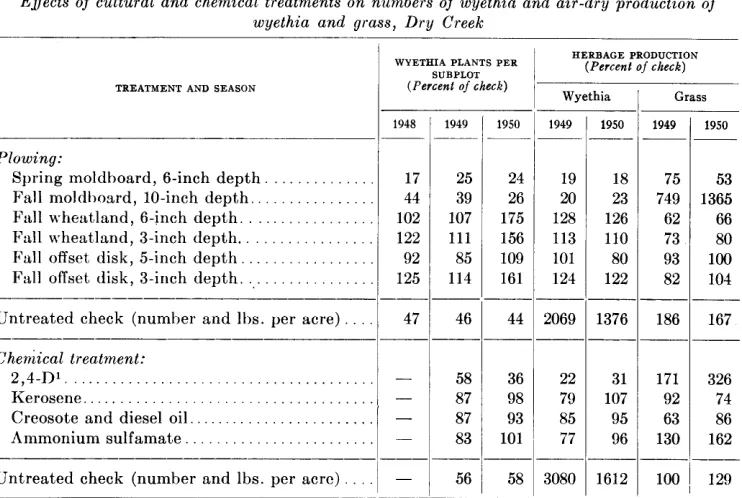
Plots cultivated in the fall of 1947, as 1). In 1948 it appeared that plowing in well as the untreated check plots, were the spring was considerably more effec- broadcast to a mixture of smooth brome tive than in the fall, but these initial (Rromus inermis) , slender wheatgrass, differences had mostly disappeared by timothy (Phleum pratense), and orchard- 1950. Although there was only a slight, grass (Dactylis glomerata) at the rate of difference in favor of spring plowing in 10 pounds per acre immediately after 1950, cultivation at t)his season may actu- cultivation. The spring-plowed plot and ally be more effective as these results t’he chemically treated sections were were accomplished by plowing at’ a 6-inch drilled to the same mixture in the fall of depth, whereas the fall plowing was at 10
1948. inches. Disking with a wheatland plow
TABLE 1
E$ects of cultural and chemical treatments on numbers of wyethia and air-dry production of wyethia and grass, Dry Creek
TREATMENT AND SEASON
I-
Yawing:
Sprir& moldhoard, g-inch depth. Fall moldboard, lo-inch depth.. .
Fall wheatland, 6-inch depth. .
Fall wheatland, 3-inch depth.. Fall offset disk, 5-inch depth.. .
Fall offset disk, 3-inch depth. . . . .
-~---~~ ---
Untreated check (number and Ibs. per acre). . _~___--_-_-~~
Chetiical treatment:
2,4-D’... . . . Kerosene... . . . . . . . Creosote and diesel oil. . . . . . . .
Ammonium sulfamate. . . . .
Untreated check (number and lbs. per acre). l Ammonium 2,4-dichlorophenoxyacetate.
Wyethia plants were counted on cir- cular 4%square-foot subplots within each acre plot during late summer of 1948, 1949, and 1950. Weight estimates were made of both wyethia and reseeded grasses in 1949 and 1950.
Results
Moldboard plowing was the only method of cultivation which caused an appreciable reduction in wyethia (Table
WYETHIA PLANTS PER SUBPLOT
(Percefit of check)
1948 17 44 102 122 92 125 --- 47 -- - - - - --- - 1949 25 39 107 111 85 114 46 58 87 87 83 --- 56
1950 1949 1950
24 26 175 156 109 161 --- 44 -__
19 18 20 23 128 126 113 110 101 80 124 122
2069 ---
--- 1376 ---
36 22 31 98 79 107 93 85 95 101 77 96 __-
58
--- -__ 3080 1612
HERBAGE PRODUCTION
(Percent of check)
Wyethia -/- _- _- _- Grass 75 749 62 73 93 82 -- 186 --- 171 92 63 130 __- 100 53 1365 66 80 100 104 --- 167 --- 326 74 86 162
disking wits further subntantint~d hy hers were essentially the same as on the poor results obtained from disking a untreated checkrj.
5-acre area on West Camas Creek in the Of t,he grasses broadcast in the fall of
spring of 1949. 1947, s successful stand was obt,ained
A critical examination of data in Table only on t,he fall moldboard-plowed plots, 1 shovs certain variations h&wren years ix., only &here wyethis had
hren greatly
for \vhivh no explanation
is readily ap-
reduced. Grass production on these plots parent. It, is thought that these minor WRS over seven times that of t,he un- variations arc attrihutahle to sampling treated plots in I919 and over thirteen error resulting from use of different times, in 1950. Total grass productionsample subplots rach yciu. \~as decreased on all other plots, but
Wyethia herbage production ras
greatly reduced the year following treat- ment with 2,4-D (Table l), and numbers of plants continued to decrease the second year after spraying. Both herbsge pro- duction of wyethia and numbers of plants were slightly decreased by the other chemical treatments, but these decreases were only temporary, for in 1950 both wyethia herbage yield and plant num-
146 WALTER F. MUEGGLER AND JAMES P. BLAISDELL
completely sheared and turned. In con- trast to this, other fall cultivated plots were producing between 1,000 and 2,000 pounds of wyethia and less than 200 pounds of grass. These differences are well illustrated in Figure 1B.
Although a good kill of wyethia was obtained on the spring moldboard-plowed area, the establishment of grass was un- successful. This grass failure was prob- ably not related to season of plowing but perhaps to less favorable weather follow- ing the 1948 planting or too deep seed covering through drilling.
Grass production was greatly increased on the sections treated with 2,4-D, and to a lesser extent, on those treated with ammonium sulfamate. This increase, in contrast to that on the fall moldboard- plowed plots, was mostly due to an in- crease in natjive grasses, rather than to establishment of reseeded species. Ap- parently the hard, uncultivated ground was such a poor seedbed that reseeded grasses were unable to become established even where competition of wyethia was greatly reduced. Grass yield on plots treated with kerosene and creosote- diesel oil was slightly decreased.
WEST CAMAS CREEK STUDY
Methods
The study area selected on West Camas Creek is very similar to the one on Dry Creek, having about the same elevation, annual precipitation, soil type, and vegetation. The land slopes gently northeast, however, and the dense stand of wyethia prior to treatment was chiefly W. helianthoides. In addition to wyethia, the area supported bluegrasses, Idaho fescue (Festuca idahoensis), alpine tim- othy (Phleum alpinum), meadow barley (Hordeurn nodosum), needlegrass (Stipa sp.), slender wheatgrass, mountain brome, sedges (Carex spp.), redtop (Agrostis
sp.), dock, geranium, cinquefoil, dan- delion (Taraxacum oficinale), yarrow (Achilles lanulosa) , yampa (Perideridia gairdneri) , and others.
Effectiveness of three herbicides for wyethia eradication were tested at two rates of application at two dates (growth stages). In order that regular field meth- ods of spraying could be employed, 0.5- acre plots, each 1 by 5 chains, were used. All treatments were duplicated and there were four untreated check plots. Treatments were assigned at random to the plots within each replication.
Commercial formulations were used throughout. These consisted of a 2,4-D ethyl ester, a 2,4,5-T butoxy ethanol ester, and a mixture of two parts 2,4-D and one part 2,4,5-T in butoxy ethanol ester form. Rates of application were 1 and 2 pounds acid equivalent per acre, and application was made at two growth stages, when the wyethia was about half way through blooming (June 7) and when blooming was over (June 20, 1949). Chemicals were applied in a water solu- tion with a boom sprayer mounted on a pick-up truck. The sprayer was so regu- lat’ed that approximately 25 gallons of water were required per acre.
Prior to any treatment (May 28, 1949) and approximately 1 year afterwards (July 7, 1950), wyethia counts and weight estimates were made of the vege- tation on five circular 96-square-foot subplots within each 0.5-acre plot.
Results per acre. In most cases reductions in Wyethia on all of the sprayed plots numbers and in yield were statistically began to show effects of the herbicides significant. The 2,4-D and mixture ap- within a few hours. Herbage of wyethia plied at the 2-pound rate when wyethia treated early (half bloom) was completely was in half bloom, were the most effective dry in approximately 1 month, but that treatments, and were fairly comparable treated later (blooming over) retained in degree of wyethia kill (Fig. 1C; note some life most of the summer. Differ- wyethia on untreated plot in left back- ences resulting from chemicals or rates ground). The former reduced wyethia to of application were not readily apparent 54 pounds per acre and 28 plants per
in 1949. subplot, while the latter reduced wyethia
It was obvious the year after spraying to 56 pounds per acre and 10 plants per that all herbicides had caused consider- subplot.
able reduction in wyethia (Table 2). Comparison of the various treatments
REPLACING WYETHIA 147
TABLE 2
Efects of chemical treatments on numbers of wyethia and on air-dry herbage weight of wyethia, grasses, and forbs, together with estimated costs, West Camas Creek, 1960’
CHEMICAL
2,4-D 2 Half bloom 19 Mixture 2 Half bloom 7 2,4-D 2 Blooming over 33 Mixture 2 Blooming .over 21 2,4-D 1 Half bloom 40 Mixture 1 Half bloom 21 2,4-D 1 Blooming over 41 Mixture 1 Blooming over 55 2,4,5-T 2 Half bloom 47 2,4,5-T 2 Blooming over 58 2,4,5-T 1 Half bloom 52 2,4,5-T 1 Blooming over 75
GROWTH STAGE
Untreated check (number and lbs. per acre) . . . . . . . . .
WYETHIA PLANTS PER SUBPLOT
(Percent of check)’
150
_-
HERBAGE PRODUCTION
(Percent of check)
Wyethia Grass Forbs
5 5 7 10 13 10 20 28 32 30. 36 73 --__
136 235 145 102 142 197 98 146 201 166 162 136
.- --
149
29 2.90 146 4.70 88 2.90 59 4.70 68 1.70 107 2.60 44 1.70 99 2.60 93 6.50 96 6.50 76 3.50 96 3.50 -- ---
1083 82 -
COST
(Dollars per acre, approx.)
.
1 Production figures adjusted to original production by covariance analysis. 2 Acid equivalent in pounds per acre.
plication at the rate of 2 pounds per acre was far more effective than 1 pound, and tlrat spraying at the half bloom
growth stage ws much more effective
than at, the blooming orer s&go.
All of the herbicides used had a defi- nite physiological effect upon wyethia plants not killed. Scarcely any flower stalks were produced on sprayed i~reits,
whcrcns wycthia flowered profusely on
untreated check plots. Evrn the least effective twatment, 2,4,3-T applied late at 1 pound per acw, prerented flowering (Fig. lD), though the wnaining plants wre vigorous and showd no deformity like that, raused by 2,4-D.
Dry Creek study \\-hcrc wyethia num- bers dropped from 58 percent of the chrck in 1919, 1 year after treatment with 2,4-D, to but 3F percent of the rherk in 1050 (TahlP 1). Erickson, PL al. (1948) noted that 2,4-D usually acts much more slovly than other wedkillers.
Grass production incrcasrd on nearly all treated plots, hut these increases came from rwovery of niltive grasses rather than from growth of artificially seeded species. 2Zs n mat,ter of fact, aver- age grass production ras higher on the replication which was not, seeded. Al- though grass yields from several of t,he treatments wxe significantly higher than
There was little difference in effective- ness of 2,4-D and the mixture in reduc- ing wyet,hia hrrhege yield, hut the mix- ture caused a more immediate reduction in plant numbers. Most of the plants
remaining on the areas treated with
2,4-D were small and deformed, however,
and many of these will probably die
(Fig. 2). This actually happened in the
REPLACING WYETHIA 149
acre was increased to 235 percent of the untreated check, whereas yield on plots sprayed with 2,4-D at the same rate and date was only 136 percent of the check. In most cases increase of grasses sprayed with 2,4-D was less marked than with the other chemicals, which suggests that 2,4-D may have injured the grasses to some extent.
Forb production after spraying was generally lower than on the unsprayed plots, although so much variation exists between plots that it is difficult to assess significance. Again, there is a suggestion that forbs were more greatly reduced on the plots sprayed with 2,4-D than with the other chemicals. Had the stand of wyethia been less dense, sheltering other species less effectively, it seems likely that harmful effects of the chemicals would have been more evident. For the most part, reductions in forb yield in these tests were not pronounced and were offset by increases in grass. Although records were not kept of individual forb species, inspection of treated and un- treated plots indicated that the more desirable species were not disproportion- ately reduced.
DISCUSSION
Jt is evident that competition from wyethia must be reduced in order to obtain a heavy stand of either native or reseeded grasses. Moldboard plowing was the only cultivation method that satisfactorily reduced this competition. This means of eradication, however, is not only expensive but is also limited to areas of deep soil without numerous rock outcrops which would cause excessive breakage in equipment. Moldboard plow- ing must be followed with reseeding as all perennial vegetation is destroyed. Because of these limitations and its high cost, this method cannot be widely used as a means of eradicating wyethia.
The mixture of 2,4-D and 2,4,5-T and the 2,4-D alone were both successful in eradicating wyethia when applied at 2 pounds per acre at the half bloom growth stage. These chemical treatments have certain advantages over moldboard plowing in that they do not destroy the natural understory of grasses and other forbs, nor are they limited to specific types of terrain. The tests indicate the importance of applying the weedkillers in sufficient concentration and at an early date. It is thought that even better wyethia kill might be secured from ear- lier spraying while the plants are more actively growing-perhaps when they first begin to bloom. In similar studies with herbicides on other species (Egler, 1949; McIlvain, 1949; Offord, 1949), in- creased effectiveness of application dur- ing the vigorous growth period before plant maturity has been observed.
Although the mixture and 2,4-D were almost equally effective in reducing wyethia, the cost of the chemicals differed greatly. The cost of treatment with 2,4-D at 2 pounds was approximately $2.90 per acre, whereas the mixture at 2 pounds cost approximately $4.70 (Table 2). Expenses can undoubtedly be re- duced if the operation is on a large scale, especially if spraying is done by airplane. The 2,4-D may be more in- jurious to forbs and grasses than the mixture, but this disadvantage does not appear to offset the advantage of its lower cost. Spraying with 2,4-D ethyl ester at 2 pounds per acre appears to be the most economical means of eradicat- ing wyethia.
150 WALTER F. MUEGGLER AND JAMES P. BLAISDELL
prevent reinvasion by wyethia. In such cases, seedbed preparation may be neces- sary on some areas to assure successful reseeding.
CoNcLusIoNs
1. Moldboard plowing is an effective, though expensive, means of eradicat’ing wyethia. This method is limited to ac- cessible areas with deep, rock-free soils that will not cause excessive breakage in equipment.
2. 2,4-D ethyl ester applied at 2 pounds acid equivalent per acre between first and half bloom is a comparatively economical and thorough means of eradi- cating wyethia. With adequate facilities it can be used on any site.
3. Reseeding of moldboard plowed areas is necessary to obtain desirable forage species. Plowing destroys all peren- nial vegetation; unless an adequate stand of desirable perennials is produced the
area will be subject to immediate re- invasion by wyethia.
4. The suggested application of 2,4-D does not greatly injure the native grasses; reduced competition from wyethia after treatment will allow a rapid increase in yield of other species. Reseeding, therefore, is necessary only on areas that lack a fairly abundant and well-distrib- uted understory of other species.
LITERATURE CITED
EGLER, FRANK E. 1949. Herbicide effect in Connecticut vegetation. Ecology 30: 24% 256.
ERICKSON, L. C. 1948. Using 2,4-D for selec- tive and non-selective weed control. Uni- versity of Idaho Ext. Bull. 172.
MCILVAIN, E. H. AND D. A. SAVAGE. 1949.
Spraying 2,4-D by airplane on sand sage- brush and other plants of the southern Great Plains. Jour. Range Management 2: 43-52.
Grazing Habits of Cattle in a Mixed-Prairie
Pasture
JAMES G. MOOREFIELD
Work Unit Conservationist, Soil Conservation Service, Eurelca, Kansas
AND
HAROLD H. HOPKINS
Assistant Professor of Botany, Fort Hays Kansas State College, Hays, Kansas
P
ROPER utilization of forage plants by livestock is one of the problems which confront range men today. The number of acres to allow per animal unit, t,ime to begin and cease grazing, and methods of determining degree of utilization are only a few aspects. The problem is further complicated when the ranges are of diversified topography and include several types of vegetation, since some areas may be over-utilized while others are scarcely touched. It would be of value to have more information on specific activities of cattle on the range. The purpose of this study was to find the amount of time cattle spend at various activities, the time of day at which they occur, and the area in which they are carried on. These data are correlated with season, weather, and condition of the vegetation. The study was made by the senior author while a student at Fort Hays Kansas State College.Grazing habits have been studied in various parts of the country, but little information is available for the mixed- prairie region. Cory (1927), in Texas, made one of the earliest studies and pre- sented considerable detail as to the time spent at various activities. Stanley (1938), working in Arizona, concluded that graz- ing habits are dependent upon factors that influence the condition of various
plant species. In eastern Kansas the time spent grazing has been correlated with the condition of the pasture (Atke- son et al., 1942). More time was used in grazing on poor pastures than on good pastures. Hein (1935), in Maryland, likewise found that grazing time was directly proportional to the abundance and palatability of the forage. In New York it has been reported that cattle may graze as much at night as in the daytime (Johnstone-Wallace, 1938).
DESCRIPTION OF PASTURE The study was conducted in the 82% acre college pasture near Hays, Kansas. The short-grass type of vegetation, which is characteristic of the uplands, includes about 143 acres. Dominants are buffalo grass (Buchloe dactvloides) and blue grama (Bouteloua gracilis). The hillsides support a mixed-grass type of vegetation, which comprises 536 acres. The chief grasses are sideoats grama (Bouteloua curtipendula), big bluestem (Andropogon ,furcatus), blue grama, and little bluestem
populated by buffalo grass and sand
dropseed (Sporobohs cryptmdrlrs). Ob-
servations in thiv area vxe included x&h those in the short-grass type.
The topography is rolling, although many of the hillsides are steep and rocky
(Fig. 1). The pasture is divided by a fence into two nearly eyual parts. Watrr is located only in the loxland. The south pasture contains 4 large ponds in one ravine; the north pasture has 3 ponds in 3 ravines and a well with v-a&r tanks in one of these ravines.
ties of the cattle. A record was made of the number grazing, standing idle, lying down, ruminating, drinking, and licking salt. In addition, on tno occasions the herd as a group and certain individual animals UWP closely observed for a 24- hour period.
RESULTS
The pastures were moderately grazed, and there was always an abundance of forage. Consequently the use of certain plant,s indirated a preference for those
bsckground.
The study WLB started April 1, 1948,
and continued through September 20.
Continuous records were kept of tcmpcra- ture and relative humidity on a self-
recording hygro-thermograph. Rainfall
and soil moist,ure data WYY also ob- tained. These data are not presented as such but are used in an effort to interpret certain activities of the cattle.
Studies vw-e generally restricted to the herd rather than to individual animals:. At least one day of each week every hour from 8 a.m. to 8 p.m. notes and counts were made as to the location and activi-
plants or for the site in lvhioh they were grolring and not> a lack of forage else- r-here. Each pasture ,,.a~ completely protected during alt,ernate months so that there \\.a8 n good growth of grass at the first of the month when the cattle were turned in.
April
Grazing started in the south p&ore on the first, of April with 124 cows, heifers, and steers. .4vailable green forage during the early portion of this month consisted most,ly of western wheat, grass on the lox-land and little barley (Hordeurn pusil-
GRAZING HABITS OF CATTLE 153
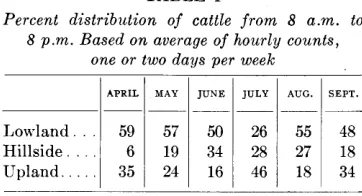
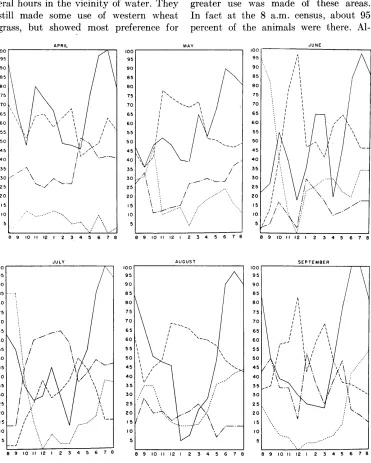
grasses on the hillsides had not started to grow. Grazing was largely restricted to areas where vegetation was most succulent. The cattle spent an average of 59 percent of their time from 8 a.m. to 8 p.m. on the lowland, 35 percent on the upland, and only 6 percent on the hill- sides (Table 1). From 52 to 70 percent of the herd was on the lowland all day except for a short period in late after- noon when about half the cattle were on the upland (Fig. 2).
TABLE 1
Percent distribution of cattle from 8 a.m. to 8 p.m. Based on average of hourly counts,
one or two days per week
APRIL MAY JUNE JULY AUG. SEPT. ___~ ____
Lowland. 59 57 50 26 55 48 Hillside. 6 19 34 28 27 18 Upland.. 35 24 16 46 18 34
There were 3 periods during the day when the cattle were most actively graz- ing. The first of these was prior to 8 a.m. Nearly half the animals then rested for 2 or 3 hours and resumed grazing at about 11 o’clock. During the middle of the after- noon there was another resting period of about the same length. In these resting periods often as many as half the cattle were feeding. However, their activities were somewhat listless lacking the en- thusiasm displayed during the active grazing periods. Nearly all the cattle grazed vigorously from 5 until after 7 o’clock p.m. Bedding down occurred between 7 and 8 o’clock.
May
Precipitation was low in May as it. was in April and the vegetation grew slowly. However, green forage became available in all of the habitats as the mid grasses on the hillsides began to grow. Little barley on the upland had become somewhat un-
* palatable, but the short grasses in the same area had grown enough to be avail- able for grazing. Nevertheless, a large portion of the herd remained on the lowland except during the early morning and late evening hours. During the warmer part of the day they tended to remain in the vicinity of water, where there was also plenty of succulent forage. Early morning grazing, which had been at a peak at 8 o’clock in April, began earlier during May, and less than half the animals were still grazing at 8 o’clock. Another grazing peak occurred in the late morning although only about 50 percent of the cattle were involved (Fig. 2). There was no distinct idle period during t.he afternoon, but grazing gradually increased beginning about 4 o’clock. During the evening, when grazing was most vigorous, about half the herd was on the lowland. This indicated a prefer- ence of the livestock for the more succu- lent lowland grasses. At nearly all times the hillside seemed to be the least pre- ferred of the 3 habitats, although it was used considerably more than during April.
June
The herd was increased by 76 animals to a total of 200 head. This increased the difficulty of making a census. The ab- normally dry weather during the spring ceased with the advent of 6.6 inches of rain in June. As a result’ the soil moisture was replenished and the vegetation grew vigorously.
154 JAMES G. MOOREFIELD AND HAROLD H. HOPKINS
era1 hours in the vicinity of water. They greater use was made of these areas. still made some use of western wheat In fact at the 8 a.m. census, about 95 grass, but showed most preference for percent of the animals were there. Al-
100 95 90 85 80 75 70 65 60 55 50 45 40 35 30 25 20 I5 IO 5 100 95 90 85 80 75 70 65 60 55 50 45 40 35 30 25 20 I5 IO 5 APRIL
..____.-1 _..---._.
L. .
~.._/-.\ ,’ ,#’ :. i . . . ,,’ :,
8 9 IO II 12 I 2345676 8 9 IO II I2 I 2 3 4 5 6 7 8 8 9 IO II 12 I 2345678
100 95 90 85 80 75 70 65 60 55 50 45 40 35 30 25 20 I5 IO 5 100 95 90 85 80 75 70 65 60 55 50 45 40 35 30 25 20 I5 IO 5
9 IO II I2 I 234567
AUGUST 100 95 90 85 80 75 70 65 60 55 50 45 40 35 30 25 20 I5 IO 5 JUNE SEPTEMBER
FIGURE 2. Percent of total herd present in the short-grass type (alternate long and short lines), hillside mixed-grass type (short broken lines), and lowland mixed-grass type (long broken lines) at each hour of the day from 8 a.m. to 8 p.m. from April to September. Percent of cattle grazing when observed is also shown (unbroken line).
big bluestem, sideoats grama, and the though only 22 percent were grazing at
short grasses. the time, it was evident they had been
GRAZING HABITS OF CATTLE 155
habitat. Furthermore it received less use than at any other time during the season. This may have been due to the dry little barley, which made the short grasses less accessible.
As the days became longer the first grazing period occurred earlier so that by 8 o’clock the animals were compara- tively idle. There was another grazing period about 10 a.m., another in mid- afternoon, and another in the evening. Between each of these periods many of t)hc cattle were idle, although some grazing occurred at all times. Greatest activity was in late evening prior to bedding down.
July
The high precipitation during .June continued in July. Total rainfall was 6.3 inches, which is well above normal. Vegetation of the entire pasture con- tinued rapid growth and was consequently highly succulent.
The cattle spent 46 percent of their time in the short-grass areas of the up- land which received its greatest use of the season. This is especially significant in view of the fact that no water was available in the immediate vicinity. The hillside was utilized mostly in early morning and some in the evening, but hardly at all during the day. The low- land was visited to the greatest extent between noon and 4 p.m. The cattle went into this area primarily for water and spent the grazing periods in the other habitat,s.
At the 8 a.m. census the cattle were tapering off from their early morning grazing period. Except for some listless feeding around noon, most of the ani- mals rested or grazed only intermittently until the beginning of the evening period
(Fig. 2).
August
Precipitation of 3.3 inches of moisture was adequate to maintain growth, and t!here was still an abundance of good for- age. This was especially true in the low- land where big bluestem had grown rapidly while it was protected during July. The cattle again showed a preference for bhis area, especially during the morn- ing grazing period. A large part of the herd remained in the vicinit)y of water throughout much of the day. Then as the lat#e afternoon grazing period started, many of them moved out’ of the lowland and up on the hillsides.
During t,his month more than half the herd continued grazing until almost noon. Then there was a lapse in feeding activi- ties during the early afternoon when sel- dom more than a dozen animals were grazing. This was the only month during the summer when the idle period involved nearly all the herd. After 4 o’clock there was a sharp increase in the number of animals feeding, and the peak of grazing activities was reached about 7 p.m. This pattern of activities differed considerably from the usual alternate grazing and rest- ing periods of earlier summer. This may have been due, to some extent, to higher mid-day temperatures causing the ani- mals to prefer to rest or remain near water.
September
156 JAMES G. MOOREFIELD AND HAROLD H. HOPKINS
and the hillsides were used more than any other area in the evening. Maximum concentrations of cattle in the lowland were during the middle of the day when grazing was at a minimum (Fig. 2).
Observations of Individual Animals In order to supplement data concerning the entire herd, a cow, heifer, and steer were observed closely for two 24-hour periods during the first and second weeks of August. Observations were made with field glasses whenever possible so that the animals were not likely to be dis- turbed. Routes were mapped and later followed with an automobile to ascertain distances travelled.
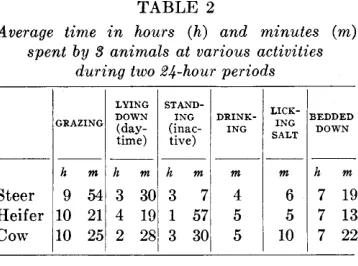
There were not enough animals ob- served to know whether the activities of each were individual characteristics or true of that particular type of animal. Periods of grazing corresponded well to those of the maiority of the herd. As shown by Table 2, there was little dif- ference in the time spent grazing and bedded down by the different .animals.
TABLE 2
Average time in hours (h) and minutes (m) spent by 3 animals at various activities
during two R&hour periods I
-~ ~~
h mhmhm m m h m
Steer 9543303 7 4 6 7 19 Heifer 10 21 4 19 1 57 5 5 7 13 cow 10 25, 2 28, 3 30/ 5 10 7 22
The distance travelled by each of the 3 animals was from 2.5 to 3 miles per day. Most of the travelling was done while grazing. They drank 2 or 3 times per day and took salt from 1 to 3 times. There was little if any correlation between drinking and taking salt. Unfortunately
salt was placed near the water, but never- theless several hours often elapsed be- tween these activities.
DISCUSSION
It is apparent that with the uneven distribution of cattle, the grass was not properly utilized. Some areas were too heavily grazed to maintain good yield and compositon. Others were under utilized, thus wasting forage and causing the accumulation of a large amount of mulch, which tends to cause a decrease in cover.
The beef producing capacity of the pasture could be increased considerably by nothing more than better distribution of the animals while grazing. Such man- agement would result in an increase in the most valuable species, an overall increase in yield, and more complete use of available forage. Additional fencing or a change in watering places would not be feasible in this particula,r pasture, but a change in location of salt from the low- land to the lightly used hilltops should stimulate use of the latter areas (Chapline
& Talbot, 1926). Furthermore the salt can be moved from place to place pre- venting localized trampling and over utilization.
GRAZING HABITS OF CATTLE 157
in that it yields from 3 to 4 times as much mediately while others ruminated a short per acre as the other habitats (Weaver time, either standing or lying down. The & Albertson, 1944). middle part of the day was marked by alternate periods of resting and feeding SUMMARY
Activities of cattle on the range have certain relationships with proper range management. The purpose of this study was to find when and how much time cattle spend at various activities in a mixed-prairie pasture.
During April, green forage was mainly limited to western wheat grass on the
during the first part of the summer, but by a distinct resting period in late sum- mer. The evening grazing period was well under way by 5 p.m. and lasted until 8 p.m. or later when the cattle bedded down. During the active grazing periods, the herd tended to become scattered in small groups, which joined into one or two herds during the idle periods. lowland and little barley on the upland. LITERATURE CITED
CoBseWentlY, the cattle spent most of ALBERTSON, F. W. 1937. Ecology of mixed
the time in these areas. The little barley prairie in west central Kansas. Ecol.
approached maturity in May and became Monog. 7: 481-547.
less desirable. The warm-season grasses on ATKESON, F. W., A. 0. SHAW, AND H. W. CAVE. the hillsides had started to grow, but 1942. Grazing habits of dairy cattle. Jour. the cattle still preferred the succulent CHAPLINE. W. R. of Dairy Sci. 25: 779-784. AND M. W. TALBOT. 1926.
grasses of the lowland. During June use of the hillsides became more extensive, and in July greatest use was made of the upland. In August preference was again for the lowland both for grazing and for resting. The greatest amount of time was also spent in the lowland during September but this was mostly during the middle of the day when grazing was at a minimum.
Grazing began between 5 and 6 a.m. depending on the time of sunrise and continued unabated for about 3 hours. The cattle then started moving toward water doing some grazing along the way. After reaching water, some drank im-
I
The use of salt in range management. U.S.D.A. Dept. Circ. 379. 32 pp.
CORY, V. L. 1927. Activities of livestock on the range. Tex. Agr. Exp. Sta. Bul. 367. 47 PP.
HEIN, M. A. 1935. Grazing time of beef steers on permanent pastures. Jour. Amer. Sot. Agron. 27: 675-679.
JOHNSTONE-WALLACE, D. B. 1938. Pasture improvement and management. Cornell Univ. Ext. Bul. 393. 42 pp.
STANLEY, E. B. 1938. Nutritional studies with cattle on a grassland type range in Arizona. Univ. of Ariz. Tech. Bul. 79: 129-164.
Controlling Big Sagebrush with 2,4-D and
Other Chemicals
A. C. HULL, JR.
Range Conservationist, 120&y Mouniain Forest and Range Experiment Station,’ For1 rollins, ~‘olorado
AXD
C
HE;\IICALS s~wh as 2,4-D,: 2,4,5-T, and others haIre been widely and sucvxsfully used to control undesirable weetls and brush. ;‘ju~ws~ with 2,4-D incontrolling sand sagebrush (rlrtemisia
Jlil~folia) nt the Southern Great Plains
Field Station and other IocaGons led
n-orkw~ to belie\ve that control of big
sagebrush (Art~nukh trider~tata) n-ould
be easy. The first sprayings on big snge-
brush were disappointing, but as more
became known about’ different types and rates of chemicals and carriers, chemical control began to show some promise.
To find which chemicals and carriers, and methods and dates of application, might be used for large-scale control of sagebrush this present study was under-
taken near Lander, Wy6ming. In size
and number of plots it is one of the largest’ studies reported for chemical control of big sagebrush. Sprayings are being con- tinued, but as the first-year (1949) spray- ings show trends which might, help other workers in t,he same field, t,hese results
are presented at this time. Smaller
chemical spraying studies in Moffat
County, Colorado, by Colorado A Cy: XI
College, and in Delta County, Colorado,
by the Rocky Mountain Forest, and
‘Maintained by the Forest Service, C. S. Department of Agriculture, in cooperation with Colorado A & >I College, Fort Collins, Colorado.
Range Esperimcnt Station, were designed to be coordinated \vith this study and, although there are some exceptions, they
show similar trends. Dewing the spring
and summer of 1930 more dates and
treatments than w~rc in the 1949 study
were applied nwr 1,ander. Final data
from these sprayings are not yet avail-
able, but 1950 defoliation show that
treatments common to both years give
similar results.
LOC.YTIOS _UD DESCRIPTION 0~ STUDY AREA
The chemical spraying was conduct,ed 35 miles southeast of Lander, Wyoming,
on the Sweetwater drainage. Elevation
is 6,800 feet and precipitation is approx-
imately 14 inches annually. The area
slopes about 5 percent southeast. Sage- brush formed an uneven-aged stand w&h about 35 plants per 100 square feet- about I4 of these plants were mature and brittle, 10 were young and flexible,
and 11 were seedlings not, producing
flowerstalks. There was an average of
one-half small rabbit brush plant (C’hrpo- th.umnw spp.) per 100 square feet lvith an occasional small plant of spineless horsebush (Trtmclymiu cancscens inrrmis).
The understory vegetation was mostly
western, thickspike, and streambank
wheatgrass (Agropyron smithii, il. dusys- tachyum, and A. riparium) with consider-
able prairie junegrass (K&tia cristata), cusick bluegrass (Pea cusickii), nwdle- and-thread (Sf+z comata), Indian rice- grass (Oryzopsis hymrnoides), plains reed- grass azlnmngrostis ??wntanensi8), and
bluebunch ah&grass (Agropyron spicn- tzcm). There KS considerable phlox (Phlox spp.) and some small rild clover
sprayer mounted on a Caterpillar tractor. One round trip completed a plot. There was a 30-foot strip h&ween plots. The other six plots, 6.6 acres in size (100 x 2,640 feet), wre sprayed by airplane. The plant made two trips over each plot. A ZOO-foot strip KS left between plots. Figures 1 and 2 shov the ground
(Trifolium spp.), with an occssiontll plant of lupine (Lupines spp.).
A total of 69 plots n~re sprayed either from the ground or from the air on one of t,wo dates in 1949 vith different, types and rates of chemicals and carriers. Sixtythree l-acre plots (60 x 72(; feet) were sprayed with n 30.foot ground
TABLE 1
Sagebrush plant mortality on July 12, 1960, after spraying on May 65 and June 16, 1949, near Lander, Wyoming
TREATMENT AND CHEMICAL
Airplane spraying
Weed-i-tide-(6.4 pounds butyl ester acid of 2,4-D per gallon)
Ground spraying
Weed-i-tide-(see above)
Weed-no-more-(2.64 pounds butyl ester acid of 2,4-D per gallon)
Sherwillkill-(1.26 pounds butyl ester acid per gallon [0.63 pounds 2,4,5-T and 0.63 pounds 2,4-D])
Brushkiller 32-(2 pound: butoxy ethanol ester acid per gal. [3 lbs. 2,4,5-T; 15 lbs. 2,4-D])
0.75 0.50
0.25 0.12
0.08
2.00
Brushkiller 102-(6.4 pounds 2,4-D acid per gal. [2.1 Ibs. methyl ester and 4.3 lbs. ethyl ester])
Penta Weedkiller-(Approxi- mately 1.2 lbs. pentacloro- phenol per gal.)
I
’also 2 lbs. 2,4-D per acre also 1 lb. 2,4-D per acre
Vintox-(4.0 pounds arsenic trioxide per gallon)
Diesel oil alone
2.20
4.0
4.0 2.0
1.5 I.5
-
I :
0 1
Xo treatment-(Check plots) 3 percent of plants dead
ACID PER ACRE
lbs.
1.0 1.4
1.5
3.0 2.0
1.5 1.0
0.5
1.5 1.0
MAY 25 June 15
78 68
63
79
58 58
4
2
/
97
31
38 48
85 64
77
42
63
9
12
14
30 39 24 15
28 27
43
15
17
1 46
12
0
64 61
66
43
0.5
6
0