375 | P a g e
A NOVEL APPROACH FOR DATA HIDING IN THE
VIDEO MOTION USING CRYPT ANALYTICAL
ALGORITHM
S.Kumari
1, D.Karunkuzhali
2 1Department of Information Technology, Panimalar Engineering College, Chennai, (India)
2Department of Information Technology,Panimalar Engineering College, Chennai, (India)
ABSTRACT
Video information covering up is still a critical exploration point because of the configuration complexities
included. We propose another video information concealing strategy that makes utilization of deletion revision
ability of Repeat Accumulate codes and prevalence of Forbidden Zone Data Hiding. Particular inserting is used
in the proposed strategy to decide host signal specimens suitable for information stowing away. This strategy
additionally contains a fleeting synchronization plan keeping in mind the end goal to withstand outline drop and
embed assaults. The proposed structure is tried by regular telecast material against MPEG-2, H.264 pressure,
outline rate change assaults, and additionally other surely understood video information concealing techniques.
The translating mistake qualities are accounted for run of the mill framework parameters. The re-enactment
results demonstrate that the structure can be effectively used in video information concealing applications.
Keywords
:Steganography, Data concealing, Least Significant Bit Method (LSB), Motion Vector.
I
INTRODUCTION
Steganography is the craftsmanship and study of undercover com-munication, which inserts mystery messages in like manner spread media so as not to stimulate a meddler's suspicion.as computerized video has gotten to be a standout amongst the most compelling media today, video transmission can be utilized as a perfect shroud of mystery message conveyance.
376 | P a g e
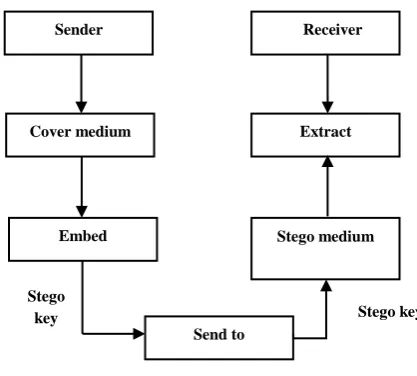
Fig. 1.
Basic Diagram of steganography.
The target of steganography is to conceal a mystery message inside of a spread media in a manner that unapproved persons can't perceive the vicinity of the shrouded message [1]. In fact in basic words “steganography implies concealing one bit of information inside another". Concealing data into a media requires
taking after components.
The spread picture (C), which will be utilized to conceal information
The mystery message (M), might be plain content, figure content or any kind of information
The stego capacity ( ) and its reverse ( )
An optional stego-key (K) or mystery key may be used to stow away and unhide the message [3].
Concealing the data into the front of computerized questions, for example, advanced picture, video, computerized sound and so on., is known as Digital Steganography [3]. Spread protests that are utilized as a part of computerized steganography can fluctuate, for instance in the picture document. Steganography calculations in the picture chronicle have been generally created. In the mean time, steganography calculations in sound chronicle are generally few. As of late there are such a large number of calculation have been produced to give more security, upgraded quality with simple execution and quicker computations. Among all of them of the methods have their own disadvantages like computational many-sided quality, time utilization and recreation of mystery data and so forth., Here, in this proposition we actualized pixel mapping based video steganography, which is an exceptionally straightforward and simple figuring furthermore give more security.
II
RELATED
WORK
For typical person the capacity to see the movements of other enliven edges or video has been broadly concentrated on and it is demonstrated that for the developments made in the running video just the little measure of the pixels are modified and rest every one of the pixels stay static on the off chance that we think about the pixels of any back to back casings in a video [8-12]. So by the progressions made in the littler number
Stego key
Sender Receiver
Cover medium Extract
Embed Stego medium
377 | P a g e
of pixels in an arrangement of pictures every one of the developments are portrayed impeccably in a video file. This is exceptionally straightforward and simple technique for envisioning any procedure under study. Research demonstrates that among the sequential pictures having million quantities of pixels just couple of hundred pixels are modified for showcasing the developments happening in the specific video. Any video is fundamentally a mix of various casings and every one of the edges constituting a video has a fixed outline rate. By and large the casing rate is 25 so we can say that 25 edges are caught inside of one second time. For the efficient and fruitful execution of this specific calculation there is a necessity that the video should be sectioned. For a specific case on the off chance that we assume that the video is of 5 minutes length of time than this video significantly contains 7500 casings in it. These casings are essential building obstruct for the video and also for video encryption process. We can embed and send the content alongside the edge by utilizing different accessible watermarking methods. There are different diverse watermarking procedures accessible like visual watermarking, discrete cosine change, discrete Fourier change and lossless watermarking strategy [8]. All the watermarking strategies as of late accessible have certain disadvantages furthermore these techniques are a tiny bit tedious. Likewise the watermarking procedures can be modified utilizing more propelled systems for picture handling [10], [12]. To get over the downsides of the watermarking systems stenography strategy can be utilized for the encryption of the video files. Stenography is fundamentally valuable as far as efficient and precise information handling for the instance of the continuous applications. In the proposed work additionally the stenography system can be created by utilizing a pixel mapping calculation. Likewise the stenography method is quicker and efficient as far as time required for denoting the specific arrangement of pictures.A. Cryptography
Cryptography is a craft of transforming so as to secure the data it into an incoherent and untraceable arrangement known as figure content [7]. Just the individual who have the mystery key can decode or we can say unscramble the message into the first shape. Cryptography is the method by which the data can be send and share in a mystery way. Due the cryptography the data is by all accounts seeming like a waste quality and it is dependably verging on difficult to find the data content lying under the picture or a video file. The data looks like covered up inside the picture or the video file.
B. Steganography
Figure describes the simplified process of steganography. Above all else, the video document in changed over into succession of edges of equivalent size. The data content which is to be transmitted by mapping onto the video file is dispersed into little parcel contingent upon the measure of the edges in the video file. From every casing a littler locale is modified relying on the private key. Because of this the chose bunches looks extremely arbitrary to the outsider who does not have the private key with them.
378 | P a g e
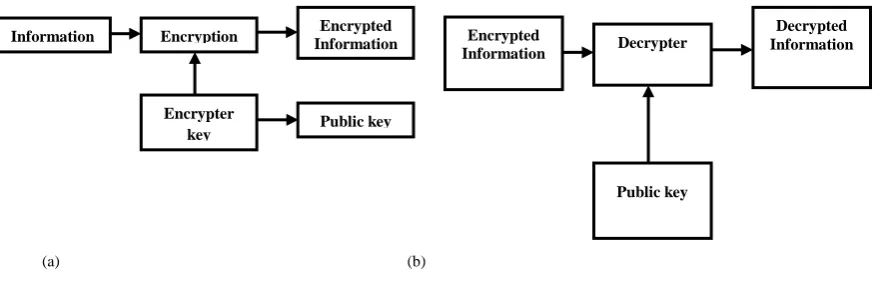
(a) (b)
Fig 2 : (a) and (b) Block diagram of Encryptor and Decryptor
Above all else, the video document in changed over into succession of edges of equivalent size. The data content which is to be transmitted by mapping onto the video file is dispersed into little parcel contingent upon the measure of the edges in the video file. From every casing a littler locale is modified relying on the private key. Because of this the chose bunches looks extremely arbitrary to the outsider who does not have the private key with them.
Fig 3: Process of Steganography
C. Existing system
In unique space, the concealing process, for example, slightest critical bit(LSB) substitution, is done in exceptional area, while change space techniques; shroud information in another space, for example, wavelet domain. Least huge piece (LSB) is the easiest type of Steganography. LSB depends on embeddings information at all critical piece of pixels, which prompt a slight change on the spread picture that is not perceptible to human eye. Since this technique can be effortlessly broken, it is more helpless against attacks. LSB strategy has exceptional effects on the factual data of picture like histogram. Assailants could know about a shrouded correspondence by simply checking the Histogram of a picture. A decent answer for wipe out this imperfection was LSB coordinating. LSB-Matching was an awesome stride forward in Steganography strategies and numerous others get thoughts from it.
Information Encryption Information Encrypted
Encrypter key Generator
Public key
Encrypted
Information Decrypter
Decrypted Information
Public key
Cover - image
Stego - image
EMBEDDING PROCESS EXTRACTING PROCESS Embedded Message Embedded Message
379 | P a g e
D. Proposed System
Information stowing away in video successions is performed in two noteworthy ways: bit stream-level and information level. In this paper, we propose another square based specific installing sort information concealing system that typifies Forbidden Zone Data Hiding (FZDH) By method for basic guidelines connected to the casing markers, we present certain level of vigor against casing drop, rehash and embed assaults.
Favourable circumstances
User can't locate the first information. It is not effortlessly broke.
To expand the Security.
To expand the extent of put away information. We can shroud more than one piece
LSB Approach
Least Significant Bit (LSB) insertion is a typical, basic way to deal with implanting data in a spread
video.
Video is changed over into various casings, and afterward change over every edge into a picture. After that, the Least Significant Bit (as such the 8 bit) of a few or the greater part of the bytes inside a
picture is changed to a touch of each of the Red, Green and Blue shading segments can be utilized, since they are each spoken to by a byte.
In different words one can store 3 bit in every pixel.
We actualized our venture such that it can acknowledge and video of any size.
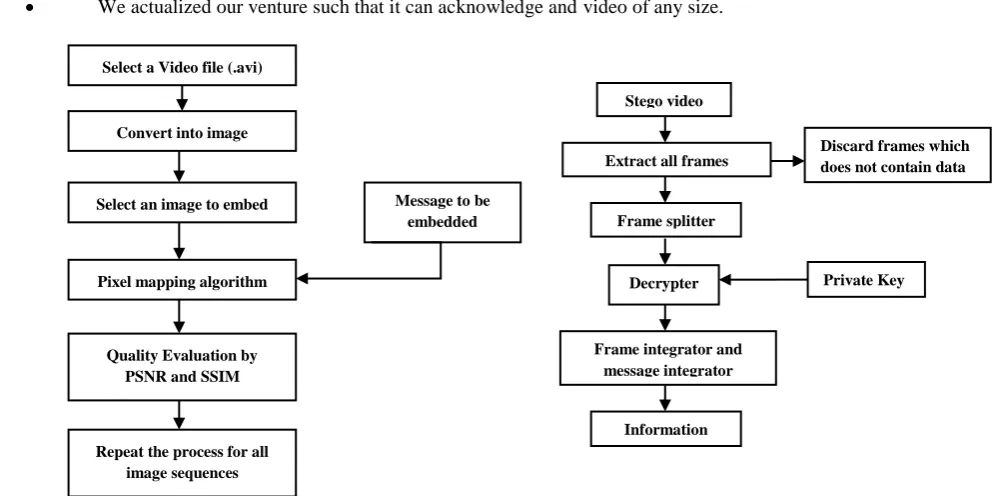
Fig 4. Proposed Embedding algorithm Fig 5. Proposed Extraction process
Select a Video file (.avi)
Convert into image sequences
Select an image to embed
Pixel mapping algorithm
Quality Evaluation by PSNR and SSIM
Repeat the process for all image sequences
Message to be embedded
Stego video
Extract all frames
Frame splitter
Decrypter
Frame integrator and message integrator
Information
Discard frames which does not contain data
380 | P a g e
III.ALGORITHM
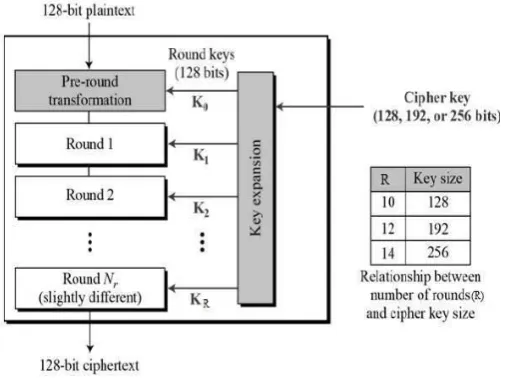
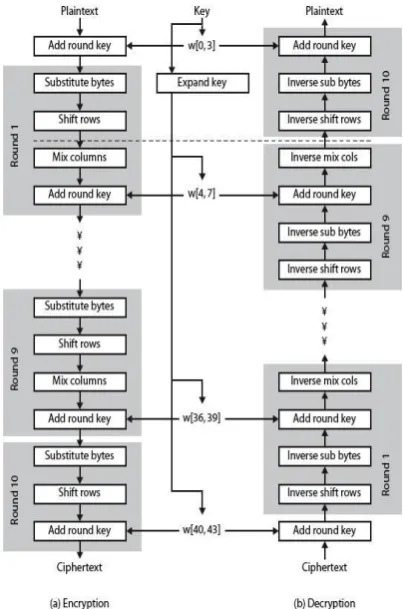
AES depends on a configuration rule known as a Substitution stage system. It is quick in both programming and hardware. Not at all like its antecedent, DES, AES does not utilize a Feistel network. AES has a settled piece size of 128 bits and a key size of 128, 192, or 256 bits, though Rijndael can be indicated with square and key sizes in any numerous of 32 bits, with at least 128 bits. The blocksize has a most extreme of 256 bits, yet the key size has no hypothetical maximum. AES works on a 4×4 section significant request framework of bytes, termed the state (adaptations of Rijndael with a bigger square size have extra segments in the state). Most AES estimations are done in an exceptional limited field.
Fig 6. Process of AES algorithm
A.
AES Structure:
1.data square of 4 segments of 4 bytes is state 2.key is extended to exhibit of words
3.has 9/11/13 rounds in which state experiences:
byte substitution (1 S-box utilized on each byte) shift lines (permute bytes between gatherings/segments) mix sections (subs utilizing network increase of gatherings) add round key (XOR state with key material)
view as substituting XOR key and scramble information bytes
381 | P a g e
Fig 7. Process of AES algorithm
B.
Encryption Process
382 | P a g e
C.Decryption process
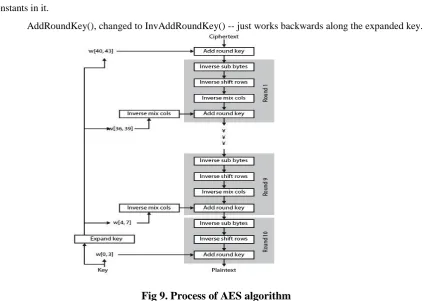
AES decryption is not identical to encryption since steps done in reverse but can define an equivalent inverse cipher with steps as for encryption
1. but using inverses of each step 2. with a different key schedule
works since result is unchanged when 1. swap byte substitution & shift rows
2. swap mix columns & add (tweaked) round key
The following functions need minor (or more major) revision for decryption:
Cipher(), changed to InvCipher(), which is the main decryption outline. It is very similar to the
Cipher() function, except that many of the subfunctions are themselves inverses, and the order of functions within a round is different.
ShiftRows(), changed to InvShiftRows() -- just minor changes.
MixColumns(), changed to InvMixColumns() -- the inverse function, similar but with different
constants in it.
AddRoundKey(), changed to InvAddRoundKey() -- just works backwards along the expanded key.
Fig 9. Process of AES algorithm
IV
EXPERIMENTAL
RESULT
383 | P a g e
A.
Input Module
The Input Module is designed in such a way that the proposed system must capable of handling any type of data formats, such as if the user wishes to hide any image format then the proposed system must be compatible with all usual image formats such as jpg, gif, bmp, it must be also compatible with video formats such as .avi, .flv, .wmf etc.. And also the proposed system must be compatible with various document formats, so that the user can use any formats to hide the secret data.
B.
Encryption Module:
384 | P a g e
C. Decryption Module:
385 | P a g e
D.
RSA:
This RSA implementation module consists of same as Encryption and Decryption part using RSA algorithm. RSA is the first algorithm which is more suitable for signing as well as encryption, and it was one of the first great advancement in the public key cryptography. RSA is widely used in electronic commerce protocols, and is believed to be sufficiently secure given sufficiently long keys and the use of up-to-date implementations.
V
CONCLUSION
One of the critical elements of the proposed work is it assumes an imperative part in transmitting the data mapped on an either a picture or a video file viably and productively. The basic data is a picture or a video is not unmistakable to the stripped eye when we implant the message data into LSB. The individual user is having the private key and the user can recognize and decipher the first data from its unique structure. This technique simplified the assignment of securing the basic data from the abuse and protects it from the undesirable client. With the utilization of the cryptography and steganography blend together, the data security can be expanded.
REFERENCES
[1] S. Zhu and K. Ma, “A new diamond search algorithm fast block matching motion estimation,” IEEE Trans Image Process, vol.9, no.2, pp.287–290, Feb.2000.
[2] C. Zhu, X. Lin, and L. Chau, “Hexagon-based search pattern for fast block motion estimation,” IEEE Trans. Circuits System Video Technology, vol.12, no.5, pp.349–355, May 2002.
[3] T. Wiegand, G. J. Sullivan, G. Bjøntegaard, and A. Luthra, “Overview of the H.264/AVC video coding standard,” IEEE Trans. Circuits Syst. Video Technol., vol.13, no.7, pp.560–576, Jul. 2003.
[4] C. Cachin, “An information-theoretic model for steganography,” Inf. Comput., vol. 192, no. 1, pp. 41–56, Jul. 2004.
[5] J. Fridrich, M. Goljan, P. Lisonek, and D. Soukal, “Writing on wet paper,” IEEE Trans. Signal Process., vol. 53, no. 10, pp. 3923-3935, Oct. 2005.
386 | P a g e
[7] D. Fang and L. Chang, “Data hiding for digital video with phase of motion vector,” in Proc. IEEE Int.Symp. Circuits Syst., 2006, pp. 1422–1425.
[8] Z. Chen, J. Xu, Y. He, and J. Zheng, “Fast integer-pel and fractional-pel motion estimation for H.264/AVC,” J. Vis. Commun. Image Represent. vol.17, no. 2, pp.264–290, Apr. 2006.
[9] Aly, Hussein A. "Data hiding in motion vectors of compressed video based on their associated prediction error." IEEE Transactions on Information Forensics and Security 6.1 (2011): 14-18.
[10] T. Filler, J. Judas, and J. Fridrich, “Minimizing additive distortion in steganography using syndrome-trellis codes,”IEEE Trans.Inf. Forensics Security, vol. 6, no.3, pp.920 – 935, Sep. 2011.
[11] Cao Y, Zhao X, Feng D, Sheng R. “Video steganography with perturbed motion estimation” Proc. Of International Workshop on Information Hiding, 2011 May 18 (pp. 193-207), Springer Berlin Heidelberg. [12] Cao, Yun, Xianfeng Zhao, and Dengguo Feng. "Video steganalysis exploiting motion vector
reversion-based features." IEEE signal processing letters, Vol: 19.1 (2012): 35-38.
[13] D. Ker et al., “Moving steganography and steganalysis from the laboratory into the real world,” in Proc.
IHMMSec, 2013, pp. 45–58.
[14] K. Wang, H. Zhao, and H. Wang, “Video steganalysis against motion vector-based steganography by adding or subtracting one motion vector value,” IEEE Trans. Inf. Forensics Security, vol. 9, no. 5, pp.
741–751, May 2014.