ALICE Overview
AlessandroGrelli (the ALICE Collaboration)1,?
1Utrecht University, Princetonplein 1, 3584CC, The Netherlands
Abstract.An overview of the recent results obtained by the ALICE Collaboration from
the analysis of the pp, p-Pb and Pb-Pb data samples collected during LHC run I and the first half of run II is presented.
1 Introduction
The study of Pb-Pb collisions in the LHC energy regime provides insight on the properties of nuclear matter at extreme conditions of temperature and energy density, where lattice QCD predicts the mat-ter to be in a Quark Gluon Plasma (QGP) state [1]. Properties of the QGP medium, such as shear viscosity to entropy ratio, electromagnetic radiation and energy loss are the focus of past, present and future proposed measurements. In addition, in recent years, the investigation of the properties of small systems (i.e. pp and p-A collisions) has taken up an important role. Since the first experimental evidence of long-range near-side angular correlations in high multiplicity pp [2] and p-Pb [3] interac-tions a large e↵ort has been made to measure the small system properties as a function of the event
multiplicity in order to understand the possible onset of collectivity and its implications.
ALICE [4] is the dedicated heavy ion experiment at the LHC. It is equipped with excellent particle identification (PID) and tracking capabilities down to very low transverse momentum (pT). The afore-mentioned properties make ALICE unique in measuring identified particles spectra, (anti-)(hyper-) nuclei production and in reconstructing decays of heavy-flavour hadrons by resolving their secondary decay vertices both in small systems and in heavy-ion collisions.
In the next sections, an overview of recent ALICE results from LHC run I and II data is presented with particular focus on strangeness, hard probes, nuclei production and collectivity. It has to be noted that, at the moment this manuscript was written, the LHC run II is still ongoing. At present ALICE collected an integrated Pb-Pb luminosity of⇠250µb−1during the 2015 data taking while an additional⇠750µb−1is expected by the end of 2018 for a total run II Pb-Pb integrated luminosity of
Lint⇠1nb−1.
Finally, the ALICE Collaboration is preparing the upgrade of the detector, which will take place dur-ing LHC long shutdown 2 in 2019, when, among other upgrades, the inner trackdur-ing system and the readout chambers of the Time Projection Chamber will be fully replaced [5].
2 Highlights on strangeness production
Strangeness enhancement (i.e. higher abundance of strangeness per participating nucleon in A-A collisions with respect to pp collisions at the same energy) was one of the first proposed signatures
of the formation of the QGP, suggested by Rafelski and Muller in 1982 [6]. The e↵ect was indeed
observed for the first time at the SPS [7] and then at RHIC [9, 10]. The investigation of strangeness production at RHIC and LHC, revealed several features, such as the baryon to meson anomaly and the enhancement decreasing with the increase in collision energy, which triggered further theoretical investigations [8]. Quark coalescence has been used to explain the intermediate-pTbaryon to meson enhancement [11], while statistical hadronization models succeeded in describing hadron yields using a grand-canonical approach [12]. In the statistical model, the lower production of strangeness in small systems (pp collisions) is understood as the consequence of the small phase-space volume available, and it is referred to as canonical suppression [13] . The ALICE experiment detectsK0
S,⇤,⌅±and⌦±
ALI-PREL-132336 ALI-PREL-134110
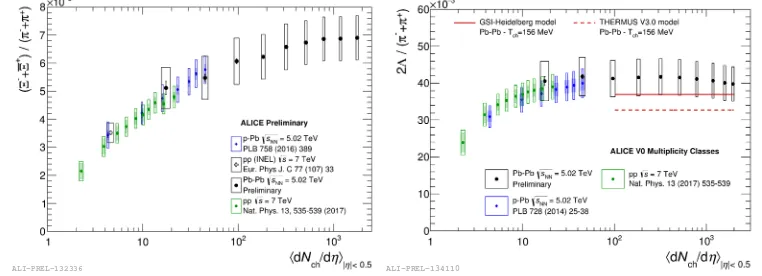
Figure 1. Left: Integrated production yield of ⌅− + ⌅+ normalized to charged pions is shown versus
hdNch/d⌘i|y|<0.5. Right: same plot for the⇤compared with Thermal Model predictions [14, 15].
through the reconstruction of the daughter tracks coming from their weak decay in the rapidity region
|y|<0.5. The Inner Tracking System and the Time Projection Chamber are used for secondary vertex determination, tracking and PID through specific energy loss measurements. Recent measurements by the ALICE experiment [16] show that strangeness enhancement is also present in high-multiplicity pp and p-Pb events. Moreover, the⇤/K0s ratio shows a qualitatively similar behavior in p-Pb and Pb-Pb
collisions [17]. Therefore, the study of strangeness production in small and large systems acquires a fundamental importance in the investigation of the origin of the heavy-ion-like e↵ects found in small
systems [18].
The preliminary measurement of the production yield of strange and multi-strange hadrons in Pb-Pb at psNN =5.02 TeV was shown for the first time at this conference. As example, in the left panel of figure 1 the integrated production yield of⌅−+ ⌅+normalized to charged pions is shown as a function of the charged-particle multiplicityhdNch/d⌘i|y|<0.5for the three di↵erent collision systems. The right panel shows the same ratio for the⇤baryon. The results provide clear evidence that in high
multiplicity pp interactions strangeness enhancement is comparable with p-Pb and peripheral Pb-Pb. While the general behavior of the finding can be understood using the grand canonical approach, all the generators and models fail to reproduce the shape and/or the magnitude of the e↵ect [16, 19].
3 Highlights on heavy-flavour production
Heavy-flavour hadrons, which are produced in large-virtuality parton scatterings in the early stages of the collision [20], are sensitive probes of the medium formed in heavy-ion collisions. They are
expected to be sensitive to the energy density through the in-medium energy loss of their heavy quark constituents [21, 22]. Furthermore, the in-medium thermal production is expected to be negligi-ble [23]. In addition, if in-medium hadronization contributes to charm hadron formation at low-pT, then strange charm hadrons (i.e. D+
s ) should be enhanced relative to non-strange charm hadrons [24]. Recently ALICE released the first measurement of two charmed baryon to meson ratios in pp and p-Pb collisions at central rapidity at ps = 7 TeV and psNN = 5.02 TeV respectively (⇤c/D0 and
⌅c/D0) [38]. Both results challenge models and point toward something not well understood in the
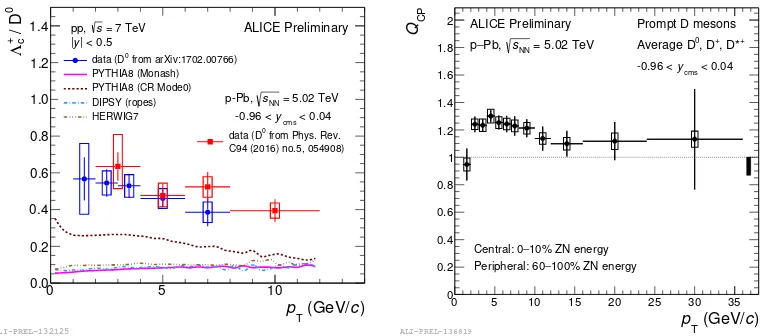
fragmentation of charm quark into baryons. The measured⇤c/D0 ratio shown in the left panel of
figure 2 is a factor 2-5 higher than all the models considered. In this regard it is interesting to note that only PYTHIA8 with color reconnection can qualitatively reproduce the shape of the measured ratio. The right panel of figure 2 reports the ratio of the average D meson (D0, D⇤+, D+) production in central to peripheral p-Pb collisions (QCP) obtained at psNN =5.02 TeV. The shape of the ratio
shows a hint of deviation from unity at intermediate pT (at⇠ 1.5σlevel). This deviation could be caused by nuclear modification of the PDFs or by final state e↵ects on D meson production.
) c (GeV/ T p
0 5 10
0
/ D
+ c
Λ
0.0 0.2 0.4 0.6 0.8 1.0 1.2
1.4 pp, s = 7 TeV | < 0.5
y
|
from arXiv:1702.00766)
0
data (D PYTHIA8 (Monash) PYTHIA8 (CR Mode0) DIPSY (ropes) HERWIG7
= 5.02 TeV
NN s
p-Pb,
< 0.04
cms y
-0.96 <
ALICE Preliminary
C94 (2016) no.5, 054908) from Phys. Rev.
0
data (D
ALI−PREL−132125 pT (GeV/c)
0 5 10 15 20 25 30 35
CP
Q
0 0.2 0.4 0.6 0.8 1 1.2 1.4 1.6 1.8
2 ALICE Preliminary
= 5.02 TeV
NN
s
Pb,
−
p Average D0, D+, D*+ < 0.04
cms
y -0.96 <
Prompt D mesons
10% ZN energy
−
Central: 0
100% ZN energy
−
Peripheral: 60
ALI−PREL−136819
Figure 2. Left panel: ⇤c/D0ratios at central rapidity (|y|<0.5) as measured in pp and p-Pb interactions using
LHC run I data at ps=7 TeV and psNN=5.02 TeV respectively. Right panel: AverageQCPof non-strange D
mesons (D0, D+and D⇤+) as measured in p-Pb LHC run II data at ps
NN=5.02 TeV.
In Pb-Pb collisions the interactions with the produced medium can be studied via the nuclear modification factor,RAA, defined as the ratio between the yields measured in Pb-Pb and pp collisions after normalizing the Pb-Pb yield to the average number of nucleon-nucleon collisions in the consid-ered centrality class. It is expected that the medium created in the collision a↵ects the momentum
spectra of the originally produced hard probes, resulting in a value ofRAA di↵erent from unity. It
has however to be considered that other e↵ects related to the presence of nuclei in the initial state
can break the expected binary scaling due to the cold-nuclear matter e↵ects (CNM) (e.g. nuclear
expected to be sensitive to the energy density through the in-medium energy loss of their heavy quark constituents [21, 22]. Furthermore, the in-medium thermal production is expected to be negligi-ble [23]. In addition, if in-medium hadronization contributes to charm hadron formation at low-pT, then strange charm hadrons (i.e. D+
s ) should be enhanced relative to non-strange charm hadrons [24]. Recently ALICE released the first measurement of two charmed baryon to meson ratios in pp and p-Pb collisions at central rapidity at ps = 7 TeV and psNN = 5.02 TeV respectively (⇤c/D0 and
⌅c/D0) [38]. Both results challenge models and point toward something not well understood in the
fragmentation of charm quark into baryons. The measured⇤c/D0 ratio shown in the left panel of
figure 2 is a factor 2-5 higher than all the models considered. In this regard it is interesting to note that only PYTHIA8 with color reconnection can qualitatively reproduce the shape of the measured ratio. The right panel of figure 2 reports the ratio of the average D meson (D0, D⇤+, D+) production in central to peripheral p-Pb collisions (QCP) obtained at psNN=5.02 TeV. The shape of the ratio
shows a hint of deviation from unity at intermediate pT (at⇠ 1.5σlevel). This deviation could be caused by nuclear modification of the PDFs or by final state e↵ects on D meson production.
) c (GeV/ T p
0 5 10
0
/ D
+ c
Λ
0.0 0.2 0.4 0.6 0.8 1.0 1.2
1.4 pp, s = 7 TeV | < 0.5
y
|
from arXiv:1702.00766)
0
data (D PYTHIA8 (Monash) PYTHIA8 (CR Mode0) DIPSY (ropes) HERWIG7
= 5.02 TeV
NN s
p-Pb,
< 0.04
cms y
-0.96 <
ALICE Preliminary
C94 (2016) no.5, 054908) from Phys. Rev.
0
data (D
ALI−PREL−132125 pT (GeV/c)
0 5 10 15 20 25 30 35
CP
Q
0 0.2 0.4 0.6 0.8 1 1.2 1.4 1.6 1.8
2 ALICE Preliminary
= 5.02 TeV
NN
s
Pb,
−
p Average D0, D+, D*+ < 0.04
cms
y -0.96 <
Prompt D mesons
10% ZN energy
−
Central: 0
100% ZN energy
−
Peripheral: 60
ALI−PREL−136819
Figure 2. Left panel: ⇤c/D0ratios at central rapidity (|y|<0.5) as measured in pp and p-Pb interactions using
LHC run I data at ps=7 TeV and psNN=5.02 TeV respectively. Right panel: AverageQCPof non-strange D
mesons (D0, D+and D⇤+) as measured in p-Pb LHC run II data atps
NN=5.02 TeV.
In Pb-Pb collisions the interactions with the produced medium can be studied via the nuclear modification factor,RAA, defined as the ratio between the yields measured in Pb-Pb and pp collisions after normalizing the Pb-Pb yield to the average number of nucleon-nucleon collisions in the consid-ered centrality class. It is expected that the medium created in the collision a↵ects the momentum
spectra of the originally produced hard probes, resulting in a value ofRAA di↵erent from unity. It
has however to be considered that other e↵ects related to the presence of nuclei in the initial state
can break the expected binary scaling due to the cold-nuclear matter e↵ects (CNM) (e.g. nuclear
) c (GeV/ T p
0 5 10 15 20 25 30 35 40 45 50
AA R 0 0.2 0.4 0.6 0.8 1 1.2 1.4 1.6 1.8 2 ALICE Preliminary = 5.02 TeV NN s 0-10% Pb-Pb, |<0.5 y |
Filled markers: pp rescaled reference -extrapolated reference
T p
Open markers: pp + , D* + , D 0 Average D + s D
ALI−PREL−133564 pT (GeV/c)
0 2 4 6 8 10 12
AA R 0 0.2 0.4 0.6 0.8 1 1.2 1.4 1.6 1.8 2
= 5.02 TeV, 0-20%
NN
s
Pb − ALICE, Pb
2.5 < y < 4, (PLB 766 (2017), 212)
-µ + µ → ψ J/
|y| < 0.9 (Preliminary)
-e + e → ψ J/ ALI-PREL-132236
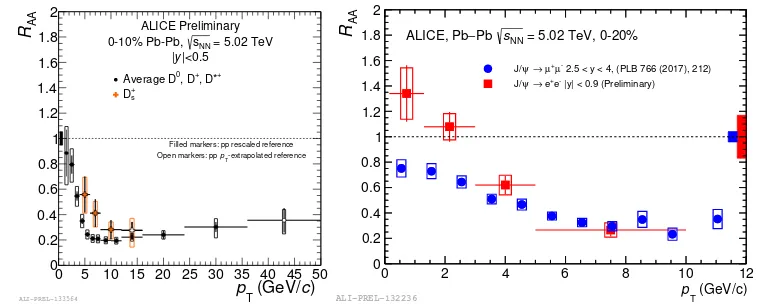
Figure 3. Left panel:RAAof non-strange D mesons (D0, D+and D⇤+) in black compared with the D+s RAAin
orange as obtained from the most central 10% Pb-Pb collisions. Right panel:RAAof J/ at central and forward
rapidity in the 20% most central collisions.
hint of relative enhancement of the D+
s in the low-pT region. However, this observation is not yet significant due to the large uncertainties.
Quarkonium states are also expected to be suppressed (RAA < 1) in the QGP, due to the color screening of the force which binds thecc(orbb) state. Quarkonium suppression is expected to occur sequentially according to the binding energy of each meson: strongly bound states like J/ and⌥(1S)
should melt at higher temperatures with respect to more loosely bound states [27, 28]. At LHC en-ergies, it is predicted that the more abundant production of charm quarks would lead to charmonium regeneration from recombination of c andcquarks at the hadronization level, resulting in an enhance-ment in the number of observed J/ [29]. The right panel of figure 3 shows theRAAof J/ measured at central rapidity (|y|<0.9) via the decay channel J/ ! e+e−compared with the same observable measured at forward rapidity (2.5<y<4) via the decay channel J/ !µ+µ−. The measurement at cen-tral rapidity suggests a di↵erent behavior at low-pTwith respect to the forward rapidity measurement.
This is consistent with the possibility of a stronger regeneration of central rapidity [30]. However, the large uncertainties of the central-rapidity measurement prevent a clear conclusion on this point.
4 Highlights on collectivity
The collective motions arising from the large pressure gradients generated by compressing and heating the nuclear matter is a typical feature of the medium produced in heavy-ion collisions. The radial flow, generated by the collective expansion of the fireball, is studied by measuring the transverse momentum spectra of identified hadrons [32]. The radial flow velocity at the thermal freeze-out, is estimated via a blast-wave fit. In the Blast Wave model [41], radial flow breaks the mT-scaling present in the non-flowing case. Heavier particles gain more momentum from the common collective flow field and this leads to a mass ordering of elliptic flow at low-pT. Indeed a mass ordering in the measurement of elliptic flow of⇡±, K±,p+p, φ,⌦±and⌅± was found by ALICE with data from the first LHC Pb-Pb run at psNN=2.76 TeV [31]. The study also provided evidence for constituent quark scaling [33–35] to be violated in the intermediatepTregion at the level of±20%. Profiting from the larger sample collected during the second LHC Pb-Pb run at psNN=5.02 TeV, ALICE released
)
c
(GeV/
T p
0 0.5 1 1.5 2 2.5 3 3.5
|>0.9}
η
∆
{2, |2
v 0 0.1 0.2 0.3 10-20% ) c (GeV/ T p
0 0.5 1 1.5 2 2.5 3 3.5
0 0.1 0.2 0.3 40-50% ± π ± K +p p φ
ALICE Preliminary IP-Glasma+
= 5.02 TeV MUSIC+UrQMD
NN s
Pb-Pb
|y| < 0.5 arXiv:1609.02958
± π ± K +p p φ ALI-PREL-124995
Figure 4. v2 for pions, protons, kaons, andφmesons for various centrality classes, measured with the scalar
product method in Pb-Pb atpsNN=5.02 TeV. Comparison with hydrodynamics simulations is added.
a new, more precise, measurement of the elliptic flow of⇡±, K±,p+p, andφ(see Fig. 4) as well as measurement of the higher order harmonicsv3andv4. Hydrodynamical simulations [25] based on IP-Glasma+MUSIC+UrQMD can reproduce the measured ordering qualitatively rather well in the pT region below 1-2 GeV/cfor all thevnconsidered. In figure 5 on the left panel, the elliptic flow of
)
c
(GeV/ T
p
5 10 15 20 25
2 v 0.1 − 0.05 − 0 0.05 0.1 0.15 0.2 0.25 0.3 |<0.8 y average, | + , D 0 Prompt D , 30-50% |>0.9} η ∆ {EP, | 2 v |<0.5 y , | ± π , 30-40% |>0.9} η ∆ {2, | 2 v
Syst. from data Syst. from B feed-down
= 5.02 TeV NN
s
Pb-Pb,
ALICE Preliminary
ALI−PREL−121597
)
c
(GeV/
T p
0 2 4 6 8 10 12
{EP}2 v 0.1 − 0.05 − 0 0.05 0.1 0.15 0.2 0.25
= 5.02 TeV
NN
s
ALICE 20 - 40% Pb-Pb,
ψ
Inclusive J/
X. Du et al. K. Zhou et al. (2.5 < y < 4)
= 0} η ∆ {EP, 2 v | < 0.9, y , | -e + e = 1.1} η ∆ {EP, 2 v < 4, y , 2.5 <
-µ
+
µ
- global syst : 1%
| < 0.9
y | , ψ Inclusive J/ < 4 y 2.5 < , ψ Inclusive J/ < 4 y 2.5 < , ψ Primordial J/ w non-collective ψ Inclusive J/ w/o non-collective ψ Inclusive J/ ψ Primordial J/
ALI−PUB−138833
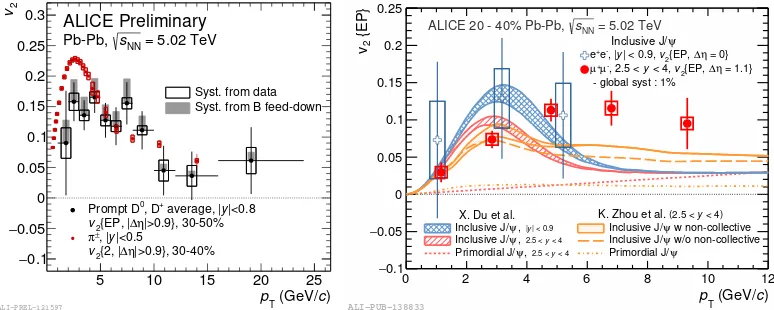
Figure 5. Left panel: Average non-strange D-mesonsv2measured in the centrality class 30−50% compared
with pionv2measured in the centrality class 30−40%. Right panel: J/ v2measured at central (|y|<0.9) and
forward (2.5<y<4) rapidity.
D-mesons in the centrality range 30−50% , measured with event plane method [36], is compared to charged pionv2. The measurement [37] shows that D-mesons have a positivev2in range 2<pT<10 GeV/cindicating that charm quark takes part in the collective motion of the system. At higherpT,v2 is compatible with 0 within uncertainties.
) c (GeV/ T p
0 5 10 15 20 25 30 35 40 45 50
AA R 0 0.2 0.4 0.6 0.8 1 1.2 1.4 1.6 1.8 2 ALICE Preliminary = 5.02 TeV NN s 0-10% Pb-Pb, |<0.5 y |
Filled markers: pp rescaled reference -extrapolated reference
T p
Open markers: pp + , D* + , D 0 Average D + s D
ALI−PREL−133564 pT (GeV/c)
0 2 4 6 8 10 12
AA R 0 0.2 0.4 0.6 0.8 1 1.2 1.4 1.6 1.8 2
= 5.02 TeV, 0-20%
NN
s
Pb − ALICE, Pb
2.5 < y < 4, (PLB 766 (2017), 212)
-µ + µ → ψ J/
|y| < 0.9 (Preliminary)
-e + e → ψ J/ ALI-PREL-132236
Figure 3. Left panel: RAAof non-strange D mesons (D0, D+and D⇤+) in black compared with the D+s RAAin
orange as obtained from the most central 10% Pb-Pb collisions. Right panel:RAAof J/ at central and forward
rapidity in the 20% most central collisions.
hint of relative enhancement of the D+
s in the low-pT region. However, this observation is not yet significant due to the large uncertainties.
Quarkonium states are also expected to be suppressed (RAA < 1) in the QGP, due to the color screening of the force which binds thecc(orbb) state. Quarkonium suppression is expected to occur sequentially according to the binding energy of each meson: strongly bound states like J/ and⌥(1S)
should melt at higher temperatures with respect to more loosely bound states [27, 28]. At LHC en-ergies, it is predicted that the more abundant production of charm quarks would lead to charmonium regeneration from recombination of c andcquarks at the hadronization level, resulting in an enhance-ment in the number of observed J/ [29]. The right panel of figure 3 shows theRAAof J/ measured at central rapidity (|y|<0.9) via the decay channel J/ ! e+e−compared with the same observable measured at forward rapidity (2.5<y<4) via the decay channel J/ !µ+µ−. The measurement at cen-tral rapidity suggests a di↵erent behavior at low-pTwith respect to the forward rapidity measurement.
This is consistent with the possibility of a stronger regeneration of central rapidity [30]. However, the large uncertainties of the central-rapidity measurement prevent a clear conclusion on this point.
4 Highlights on collectivity
The collective motions arising from the large pressure gradients generated by compressing and heating the nuclear matter is a typical feature of the medium produced in heavy-ion collisions. The radial flow, generated by the collective expansion of the fireball, is studied by measuring the transverse momentum spectra of identified hadrons [32]. The radial flow velocity at the thermal freeze-out, is estimated via a blast-wave fit. In the Blast Wave model [41], radial flow breaks the mT-scaling present in the non-flowing case. Heavier particles gain more momentum from the common collective flow field and this leads to a mass ordering of elliptic flow at low-pT. Indeed a mass ordering in the measurement of elliptic flow of⇡±, K±,p+p, φ,⌦± and⌅±was found by ALICE with data from the first LHC Pb-Pb run at psNN=2.76 TeV [31]. The study also provided evidence for constituent quark scaling [33–35] to be violated in the intermediatepTregion at the level of±20%. Profiting from the larger sample collected during the second LHC Pb-Pb run at psNN=5.02 TeV, ALICE released
)
c
(GeV/
T p
0 0.5 1 1.5 2 2.5 3 3.5
|>0.9}
η
∆
{2, |2
v 0 0.1 0.2 0.3 10-20% ) c (GeV/ T p
0 0.5 1 1.5 2 2.5 3 3.5
0 0.1 0.2 0.3 40-50% ± π ± K +p p φ
ALICE Preliminary IP-Glasma+
= 5.02 TeV MUSIC+UrQMD
NN s
Pb-Pb
|y| < 0.5 arXiv:1609.02958
± π ± K +p p φ ALI-PREL-124995
Figure 4. v2for pions, protons, kaons, andφmesons for various centrality classes, measured with the scalar
product method in Pb-Pb at psNN=5.02 TeV. Comparison with hydrodynamics simulations is added.
a new, more precise, measurement of the elliptic flow of⇡±,K±,p+p, andφ(see Fig. 4) as well as measurement of the higher order harmonicsv3andv4. Hydrodynamical simulations [25] based on IP-Glasma+MUSIC+UrQMD can reproduce the measured ordering qualitatively rather well in the pTregion below 1-2 GeV/cfor all thevnconsidered. In figure 5 on the left panel, the elliptic flow of
)
c
(GeV/ T
p
5 10 15 20 25
2 v 0.1 − 0.05 − 0 0.05 0.1 0.15 0.2 0.25 0.3 |<0.8 y average, | + , D 0 Prompt D , 30-50% |>0.9} η ∆ {EP, | 2 v |<0.5 y , | ± π , 30-40% |>0.9} η ∆ {2, | 2 v
Syst. from data Syst. from B feed-down
= 5.02 TeV NN
s
Pb-Pb,
ALICE Preliminary
ALI−PREL−121597
)
c
(GeV/
T p
0 2 4 6 8 10 12
{EP}2 v 0.1 − 0.05 − 0 0.05 0.1 0.15 0.2 0.25
= 5.02 TeV
NN
s
ALICE 20 - 40% Pb-Pb,
ψ
Inclusive J/
X. Du et al. K. Zhou et al. (2.5 < y < 4)
= 0} η ∆ {EP, 2 v | < 0.9, y , | -e + e = 1.1} η ∆ {EP, 2 v < 4, y , 2.5 <
-µ
+
µ
- global syst : 1%
| < 0.9
y | , ψ Inclusive J/ < 4 y 2.5 < , ψ Inclusive J/ < 4 y 2.5 < , ψ Primordial J/ w non-collective ψ Inclusive J/ w/o non-collective ψ Inclusive J/ ψ Primordial J/
ALI−PUB−138833
Figure 5. Left panel: Average non-strange D-mesonsv2measured in the centrality class 30−50% compared
with pionv2measured in the centrality class 30−40%. Right panel: J/ v2measured at central (|y|<0.9) and
forward (2.5<y<4) rapidity.
D-mesons in the centrality range 30−50% , measured with event plane method [36], is compared to charged pionv2. The measurement [37] shows that D-mesons have a positivev2in range 2<pT<10 GeV/cindicating that charm quark takes part in the collective motion of the system. At higherpT,v2 is compatible with 0 within uncertainties.
5 Highlights on (Anti-)(Hyper-) nuclei production
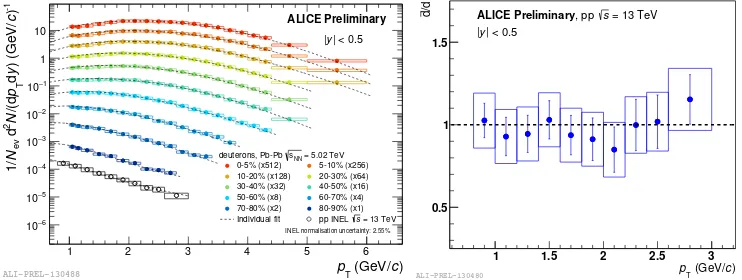
The production of (anti-)(hyper-)nuclei [46] was measured in all the available collision systems at LHC at central rapidity (|y|<0.5). The production spectra of deuterons in Pb-Pb collisions at psNN
=5.02 TeV and in pp collisions at ps=13 TeV are shown in the left panel of figure 6. The typical
)
c
(GeV/
T p
1 2 3 4 5 6
-1)
c
) (GeV/
y
dT
p
/(d
N
2
d
ev
N
1/
6
− 10
5
− 10
4
− 10
3
− 10
2
− 10
1
− 10
1 10
= 5.02 TeV
NN
s deuterons, Pb-Pb
0-5% (x512) 5-10% (x256) 10-20% (x128) 20-30% (x64) 30-40% (x32) 40-50% (x16) 50-60% (x8) 60-70% (x4) 70-80% (x2) 80-90% (x1) Individual fit pp INEL s = 13 TeV
ALICE Preliminary
INEL normalisation uncertainty: 2.55%
| < 0.5
y
|
ALI−PREL−130488 pT (GeV/c)
1 1.5 2 2.5 3
/d
d
0.5 1 1.5
= 13 TeV s , pp ALICE Preliminary
| < 0.5 y |
ALI−PREL−130480
Figure 6.Left panel: deuteron production in pp atps=13 TeV and in Pb-Pb atpsNN=5.02 TeV. Right panel:
d/d ratio in pp at ps=13 TeV.
hardening of the spectra with increasing centrality, already observed for lighter particles [42] and for deuterons [43] at lower energies, is visible. The observation suggests an increasing radial flow with increasing centrality. Moreover, in the right panel of the same figure, the ratio between the produc-tion spectra of deuteron and anti-deuteron is shown to be compatible with unity. This observaproduc-tion is compatible with expectations from the statistical hadronisation [44] and the hadron coalescence mod-els [45].
Finally, ALICE presented one of the most precise measurements of the 3
⇤H lifetime using the Pb-Pb data sample at psNN = 5.02 TeV collected in 2015. The preliminary measured value of ⌧ = 237+33
−36(stat.)±17(syst.) ps is compatible with both the previously computed world average of ⌧=216+18
−16ps [47] and with the free⇤lifetime.
6 Conclusions
ALICE is the dedicated heavy ion experiment at the CERN LHC and it is equipped with excellent tracking and particle identification capabilities. The large sample collected during the second Pb-Pb run at LHC allowed ALICE to enter a precision hera for many observables (e.g. strangeness production and collectivity in Pb-Pb). In terms of azimuthal anisotropy, measurements of thev3and v4of identified particles set additional tight constraints to models. In the heavy-flavour sector ALICE released the first measurement of the charmed baryon to meson ratio in pp and p-Pb interactions at central rapidity at LHC. Such a measurement constitutes, at present, a challenge for models of charm fragmentation. There are interesting hints for collective behavior in high-multiplicity pp and p-Pb collision, one of them being the measurement of theQCPof non-strange D mesons. However, the low significance and the fact that the e↵ect of a Color Glass Condensate or other cold matter
5 Highlights on (Anti-)(Hyper-) nuclei production
The production of (anti-)(hyper-)nuclei [46] was measured in all the available collision systems at LHC at central rapidity (|y|<0.5). The production spectra of deuterons in Pb-Pb collisions at psNN
=5.02 TeV and in pp collisions at ps=13 TeV are shown in the left panel of figure 6. The typical
)
c
(GeV/
T p
1 2 3 4 5 6
-1)
c
) (GeV/
y
dT
p
/(d
N
2
d
ev
N
1/
6
− 10
5
− 10
4
− 10
3
− 10
2
− 10
1
− 10
1 10
= 5.02 TeV
NN
s deuterons, Pb-Pb
0-5% (x512) 5-10% (x256) 10-20% (x128) 20-30% (x64) 30-40% (x32) 40-50% (x16) 50-60% (x8) 60-70% (x4) 70-80% (x2) 80-90% (x1) Individual fit pp INEL s = 13 TeV
ALICE Preliminary
INEL normalisation uncertainty: 2.55%
| < 0.5
y
|
ALI−PREL−130488 pT (GeV/c)
1 1.5 2 2.5 3
/d
d
0.5 1 1.5
= 13 TeV s , pp ALICE Preliminary
| < 0.5 y |
ALI−PREL−130480
Figure 6.Left panel: deuteron production in pp atps=13 TeV and in Pb-Pb atpsNN=5.02 TeV. Right panel:
d/d ratio in pp at ps=13 TeV.
hardening of the spectra with increasing centrality, already observed for lighter particles [42] and for deuterons [43] at lower energies, is visible. The observation suggests an increasing radial flow with increasing centrality. Moreover, in the right panel of the same figure, the ratio between the produc-tion spectra of deuteron and anti-deuteron is shown to be compatible with unity. This observaproduc-tion is compatible with expectations from the statistical hadronisation [44] and the hadron coalescence mod-els [45].
Finally, ALICE presented one of the most precise measurements of the 3
⇤H lifetime using the Pb-Pb data sample at psNN = 5.02 TeV collected in 2015. The preliminary measured value of ⌧ =237+33
−36(stat.)±17(syst.) ps is compatible with both the previously computed world average of ⌧=216+18
−16ps [47] and with the free⇤lifetime.
6 Conclusions
ALICE is the dedicated heavy ion experiment at the CERN LHC and it is equipped with excellent tracking and particle identification capabilities. The large sample collected during the second Pb-Pb run at LHC allowed ALICE to enter a precision hera for many observables (e.g. strangeness production and collectivity in Pb-Pb). In terms of azimuthal anisotropy, measurements of thev3and v4of identified particles set additional tight constraints to models. In the heavy-flavour sector ALICE released the first measurement of the charmed baryon to meson ratio in pp and p-Pb interactions at central rapidity at LHC. Such a measurement constitutes, at present, a challenge for models of charm fragmentation. There are interesting hints for collective behavior in high-multiplicity pp and p-Pb collision, one of them being the measurement of theQCPof non-strange D mesons. However, the low significance and the fact that the e↵ect of a Color Glass Condensate or other cold matter
e↵ects may yet provide an alternative explanation for the observed behavior make the measurement
not yet conclusive. The excellent PID capabilities enable ALICE to perform high precision nuclei measurements. At this conference ALICE presented precision measurements of deuteron and anti-deuteuteron production in pp and Pb-Pb as well as one of the most precise measurements so far of the hyper-triton lifetime.
References
[1] D. J. Gross and F. Wilczek, Phys. Rev. Lett.30, 1343, H.D. Politzer, Phys. Rev. Lett.30, 1346 (1973).
[2] V. Khachatryanet al., (CMS), JHEP1009(2010) 091. [3] B. Abelevet al., (ALICE), Phys.Lett. B719(2013) 29-41. [4] K. Aamodt et al. (ALICE), JINST3, S08002 (2008). [5] G. Martinez (ALICE), These proceedings (2017).
[6] J. Rafelski, B. Muller, Phys. Rev. Lett.48(1982) 1066-1069.
[7] Andersen, E.et al., (WA97), Physics Letters B449(3-4) (1999) 401-406.
[8] C. Blume, C. Markert, Progress in Particle and Nuclear Physics66(4) (2011) 834-879. [9] Abelev B.et al., (STAR), Phys. Rev. C77, 044908 (2008).
[10] D. Tlusty, These proceedings (2017).
[11] R. Fries, V. Greco, P. Sorensen, Annual Review of Nuclear and Particle Science58(1) (2008) 177-205.
[12] P. Braun-Munzinger, D. Magestro, K. Redlich, J. Stachel, Physics Letters B518 (12) (2001) 41-46.
[13] Hamieh S., Redlich K. and Tounsi A., Phys. Lett. B486, 61-66 (2000).
[14] A. Andronic, P. Braun-Munzinger, and J. Stachel, Physics Letters B673(2009) 142-145. [15] S. Wheaton, J. Cleymans, and M. Hauer, Computer Physics Communications180(2009)
84-106.
[16] K. Aamodtet al.(ALICE), Nature Physics13, 535-539 (2017). [17] K. Aamodtet al.(ALICE), Physics Letters B728(2014) 25-38. [18] L. Bianchi, (ALICE), These proceedings (2017).
[19] M. Sefcik, (ALICE), These proceedings (2017).
[20] F.-M. Liu and S.-X. Liu, Phys. Rev.C 89no. 3, (2014) 034906. [21] R. Baier, Y. L. Dokshitzer, et al, Nucl.Phys.B 484(1997) 265282. [22] M. Gyulassy and M. Plumer, Phys. Lett.B 243(1990) 432438. [23] P. Lvai and R. Vogt, Phys. Rev. C56, 2707.
[24] V. Greco, C. M. Ko, and R. Rapp, Phys. Lett. B 595(2004) 202208. A. Andronic, P. Braun-Munzinger, K. Redlich, and J. Stachel,Phys. Lett. B571(2003) 3644.
[25] S. McDonaldet al.Phys. Rev. C95, 064913 (2017). [26] F. Grosa, (ALICE), These proceedings (2017).
[27] S. Chatrchyanet al.(CMS), Phys. Rev. Lett.109(2012) 222301. [28] A. Abelevet al.(ALICE), Phys. Lett. B738(2014) 361-372. [29] P. da Costa. (ALICE), Nucl.Phys. A956(2016) 705-708. [30] D. Weiser (ALICE), These proceedings (2017).
[31] B. Abelevet al., (ALICE), JHEP06190 (2015). [32] R. A. Bertens. (ALICE), These proceedings (2017).
[34] A. Adareet al., (PHENIX), Phys. Rev. Lett.98, 162301 (2007). [35] B. Abelevet al., (STAR), Phys. Rev. C75, 054906 (2007). [36] A. M. Poskanzer, S.A. Voloshin, Phys. Rev.C58, 1671 (1998). [37] S. Acharyaet al., (ALICE), ALICE-PUBLIC-2017-003, (2017). [38] J. Normal, (ALICE), These proceedings (2017).
[39] X. Du and R. Rapp, Nucl. Phys. A943(2015) 147-158.
[40] K. Zhou, N. Xu, Z. Xu, and P. Zhuang, Phys. Rev. C89no. 5, (2014) 054911. [41] E. Schnedermann, J. Sollfrank, U.W. Heinz, Phys. Rev.C48, 2462 (1993). [42] J. Adamet al., (ALICE), Phys. Rev. C93, 034913 (2016), 1506.07287. [43] J. Adamet al., (ALICE), Phys. Rev. C93, 024917 (2016), 1506.08951.
[44] A. Andronic, P. Braun-Munzinger, J. Stachel, H. Stocker, Phys. Lett. B697, 203 (2011). [45] J. I. Kapusta, Phys. Rev. C21, 1301 (1980).