386
Evaluation and Optimization of Abu Tartur Egyptian
Phosphate
Ore Dissolution
M.A.El-BadryP
a
P
, T.A. ElbarbaryP
b
P
, I.A. IbrahimP
b
P
, Y. M. Abdel-FatahP
b
a: Botany and Microbiology Department, Faculty of Science, Al-Azher University, Egypt b:Central Metallurgical Research and Development Institute, Egypt
ABSTRACT:
Phosphorus is the most required nutrient of plants, but its availability in Egypt is relatively low. The use of phosphate solubilizing microorganism to dissolve phosphate content of phosphate ore instead of conventionally methods is an ecologically safe and economically reasonable. In this study dissolution of phosphorus from Abu Tarture Egyptian ore which has low solubility level was applied by two different fungal isolates
penicillium chrysogenum and Aspergillus niger to increase availability of phosphorous.
The results of this study indicated that p. chrysogenum gave the highest value with 95% maximum dissolution of 0.5 % phosphate ore. The objective of the present work, study all factors affecting on phosphate dissolution of Abu Tartur phosphate ore. The optimum conditions for dissolution of phosphate ore by p. chrysogenum were 0.25 g ore per 50 ml of broth PVK medium, inoculated with spore suspension 5.1x10P
6
P
cfu/ml incubated for 4 days at 30° C, glucose and yeast were the most effective carbon and nitrogen source. By apply this optimum conditions, maximum dissolution of phosphate content of ore reaches to 95%. Whereas, A. niger isolate optimum dissolution conditions were 0.25 g ore for 50
ml of PVK broth medium inoculated with spore suspension 5.2x10P
6
P
cfu/ml and incubated for 4 days at 30 ° C, sucrose and tryptone were the most effective carbon and
nitrogen source. By applying this optimum conditions maximum dissolution of
phosphate content of ore reaches to 85.5%.
Key words:
Abu Tartur phosphate ore, penicillium chrysogenum, Aspergillus niger, Phosphate dissolution
INTRODUCTION:
387
To overcome the specific phosphorous deficiency, different forms of phosphate, varying from processed rock phosphates (phosphate -fertilizers) to ground phosphate rocks are applied. The use of commercial Phosphate fertilizers is not cost effective. Among the alternative phosphate sources, the most important are locally available Rock Phosphate resources (Rajan et al., 1996)
Filamentous fungi are widely used as producers of organic acids and in particular
Aspergillus niger and some species of Penicillium have been tested in fermentation
system or inoculated directly into soil in order to solubilize rock phosphate (Vassilev et al., 1996)
Reddy et al., 2002 found that all the isolates of A. niger isolated from rhizospheric soils were found to be capable of solubilizing all the natural forms of rock phosphates. Showed that this fungus might serve as an excellent rock phosphate solubilizer when inoculated into soils whererock phosphate is used as Phosphate fertilizer.
One problem of intensive agriculture is that the fertilizers are expensive and their efficiency is very low (Vassilev & Vassileva, 2006), making it unsustainable. Because of this, there is a pressing need to identify sustainable alternatives that may allow for a more efficient use of P for cultivated plants (Consensus Statement Declaration, 2011).
Rock phosphate is a locally available and cheap alternative, but its reactivity is low due to its slow dissolution and release of Phosphorous (Yusdar et al., 2007; Hamdali et al., 2010). On the other hand, it is known that the dissolution of rock phosphate improves when microorganisms capable of dissolving it are added to the system. This is the case with phosphate solubilizing microorganisms (Galindo et al., 2011; Paiva-Coutinho et al., 2012).
There have been various reports on the dissolution of Rock Phosphate with individual inoculates of just one species, but little is known about the effectiveness of microbial consortia (Singh and Reddy, 2011). Additionally, existing reports on the subject have focused on one particular type of rock phosphate, which has limited the results to very specific effects (Xuan Yu et al., 2012).
Roos and Luckner 1984 observed that an isolate of 15TPenicillium cyclopium15T employed
an NH4+ /HP
+
P
exchange mechanism in presence of NHR
4RCl and glucose in the medium
resulting in the generation of inorganic acid which caused reduction of medium pH.
Phosphate rock is the major source of phosphorus in nature and is being used as the
raw-material for manufacturing commercial phosphate fertilizers (90%) and elemental phosphorus (10%) used in the chemical and food industries. The rock phosphate consists of insoluble calcium phosphate, generally known as apatite. The general formula of
apatite is CaR5 R(POR4R)R3R (OH, F, Cl) and depending on the end member, apatite can be
388
The dissolution of rock phosphate can be increased through microbial mediation.
Penicillium bilaii produces citric and oxalic acids to solubilize calcium phosphate
(Cuuingham & Kuiack, 1992), others Penicillium sp, also produces gluconic acid (Vassilev et al., 1996).
In this work, the factors affecting on phosphate dissolution of Abu Tartur phosphate ore by using two different fungal isolates were approved for maximum dissolution of PR2ROR5R.
MATERIAL AND METHODS:
Egyptian Phosphate Ore Collection:
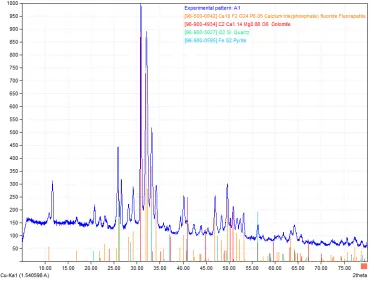
Abu Tartur phosphate deposit is one of the largest phosphates mining area (1000 million tons and 200 million tons proved) in the Middle East Rock phosphate sample is collected in plastic bags from phosphate mine present in Safaga and Elkosir on the red sea coast in Egyptian eastern desert. Chemical composition of the studied phosphate sample is determined by using XRD analysis.
Isolation of Phosphate Solubilizing Fungi:
Two fungal isolates were isolated and characterized from post infection of dry meat. phosphate solubilizing activity were done on Pikovskaya agar Composition: Ingredients
g/ l Yeast extract 0.5, Dextrose 10, Calcium phosphate 5, Ammonium sulphate 0.5,
Potassium chloride 0.2, Magnesium sulphate 0.1, Ferrous sulphate 0.0001 Agar 15. Formula adjusted, standardized to suit performance parameters.
Different culture media used in optimization of phosphate dissolution by two fungal isolates
Different types of culture media are used in the practical study of this work, which are:
Czapek's Dox medium (Thom C. and Church M.B., 1926):
It contains (g\l): NaNOR
3R, 2; CaR
3 R(POR
4R)R
2R, 1; MgSOR
4R.7HR
2RO, 0.5; KCl, 0.5; FeSOR
4R. 5HR
2RO
traces; sucrose, 30 and 1 liter distilled water.
Glucose-yeast extract medium( Wickerham, J. 1939):
It contains (g\l): Glucose, 10 g; Peptone, 5.0 g; Yeast extract, 3.0g; Agar, 20.0 g, Distilled water, 1.0 l and adjust pH to 6.8 before autoclaving, autoclave at 121P
°
P
C for 15 min.
389
It contains (g/l): 0.5 g/l Yeast extract, 10 g/l Dextrose, 5 g/l Tri calcium phosphate, 0.5 g/l Ammonium sulphate, 0.2 g/l Potassium chloride, 0.1 g/l Magnesium sulphate, 0.0001 g/l Manganese sulphate and 0.0001 g/l Ferrous sulphate. Suspend 16.3 grams in 1000 ml distilled water. Heat if necessary to dissolve the medium completely and sterilize by autoclaving at 15 lbs pressure (121°C) for 15 minutes. Dispense as desired.
The above media are solidified by adding 15g agar per liter. They are autoclaved for 20 min at 1.5 Atm. Pressure.
Characterization of phosphate solubilizing fungal isolates:
DNA isolation and PCR condition:
DNA extraction was done by use protocol of Gene Jet Plant genomic DNA
purification Kit (Thermo). PCR by using Maxima Hot Start PCR Master Mix (Thermo) #K0221and Primer of ITS1 TCCGTAGGTGAACCTGCGG-3 and ITS4
5-TCCTCCGCTTATTGATATGC-3 (White et al. 1990). Initial denaturation. 95P
0
P
C for 10 min Denaturation. 95P
0
P
C for 30 sec. annealing 55P
0
P
C for 1 min Extension 72P
0
P
C for 1min Final extension 72P
0
P
C for 15min Number of cycles 35. PCR clean up for the PCR product using GeneJET™ PCR Purification Kit (Thermo)
Sequencing is done to the PCR product on GATC Company by use ABI 3730xl DNA sequence by using forward and reverse primers.
Optimization of phosphate dissolution:
Different types of media, ore amount, inoculum size, incubation period, different carbon and nitrogen source and different incubation temperature were evaluated for increase phosphate dissolution by two different fungal isolates
Organic acid production screening:
Two fungal speciesisolated is subjected for organic acid production. One disk of fungal isolate is inoculated on petri plates containing mineral agar organic acid indicator (Sunstornsuk et al., 1994) and incubated for five days for the formation of yellow zone around the mycelial growth. The medium used is Czapek’s agar medium with 1% bromocresol green as organic acid indicator.
The HPLC analysis
The HPLC analysis is performed on clarity chromatography data system, the HPLC system consisted of two pressure pumps (Sykam S1122 delivery system), the injection port with a 2ml loop (Sykam S 5111 Injector valve bracket), a UV detector (Jasko – UV – 2070 Plus, Intelkigent UV/Visible detector, Japan). For chromatographic separation,
390
dihydrogen phosphate buffer (pH 2.8) was used as mobile phase and flow rate was adjusted to 1 ml /min. Sample volume (20 µl) was injected with the help of a micro syringe, the run time was adjusted to 10 min and UV absorbance was determined at 214 nm. Autochrom 3000 software was the data acquisition system. Authentic sample of oxalic and fumaric acids are used (Sigma). The results obtained from HPLC analysis of the samples are monitored using the above mentioned authentic samples.
RESULTS AND DISCUSSION:
Chemical Composition of Abu Tartur Phosphate Ore:
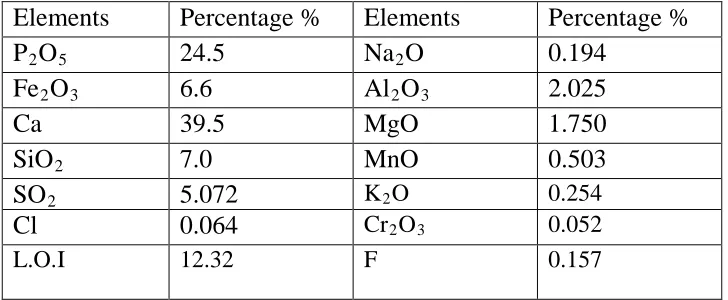
Abu Tartur phosphate ore is characterized by XRD (Figure1) which shows the presence of insoluble PR
2ROR
5R is 24.5 % and the other element presence in this ore is Ca
39.5 %, L.O.I. 12.32 %, SiOR2R with 7%, SO 5.07%, FeR2ROR3R with 6.6%, AlR2ROR3R 2.02%and
other traces elements (Table 1).
391
Table (1): Components of Abu Tartur Phosphate ore
Elements Percentage % Elements Percentage %
PR2ROR5R 24.5 NaR2RO 0.194
FeR
2ROR
3R 6.6 AlR
2ROR
3R 2.025
Ca 39.5 MgO 1.750 SiOR2R 7.0 MnO 0.503
SOR2 5.072 KR2RO 0.254
Cl 0.064 CrR2ROR3 0.052
L.O.I 12.32 F 0.157
Molecular identification of two fungal isolates:
Molecular identification of the selected isolate ITS1 and ITS 2 sequencing is a powerful tool for rapid identification and phylogenetic analysis of fungal species. Nucleotide sequence was compared with available nucleotides ribosomal sequences in the NCBI database using BLASTN.. The first isolate has been enrolled into a cluster containing Penicillin sp. and was found to be closely related to penicillium chrysogenum. The second isolate has been enrolled into a cluster containing Aspergillus sp. and was found to be closely related to Aspergillus niger, Figure(2).
Figure (2): Phylogenetic Tree of Penicillium and Aspergillus Isolate Respectively.
Optimization of phosphate dissolution by penicillium chrysogenum isolate: Effect of different growth factors on phosphate ore dissolution:
P. chrysogenum and A. niger isolates were grown in Erlenmeyer Flask 100 ml contains
50 ml of Pikovskaya broth at 28P
°
P
392
pikovskaya broth media are studied with different culture media, incubation period, ore amount, inoculums size, carbon and nitrogen sources.
Effect of different incubation period on phosphate dissolution by penicillium
chrysogenum :
Whereas, Using PVK medium in presence 0. 5 g Abu Tartur phosphate ore for 50 ml
of medium and inoculated with spore suspension 5.2x10P
6
P
CFU/ml of penicillium
chrysogenum and incubated at 28°C, 150 rpm and measuring PR2ROR5 Reach 2 days and also
pH and redox potential.
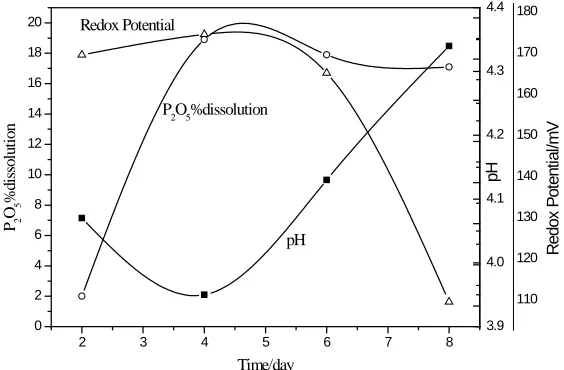
As the results obtained from above conditions, the effect of different incubation period was studied to evaluate phosphate ore dissolution by penicillium chrysogenum. The results show that phosphate dissolution markedly affected by incubation period as it regularly increased till a maximum value reached after 4 day with 18.9 % phosphate dissolution, Figure(3). In addition the final pH sharply decreased and highly increased in redox potential after 4 day of incubation and then increases in pH and decreases in redox potential have occurred till 8 day of incubation period. This correlated with growth curve
of penicillium chrysogenum that begins the log phase from second day until fourth day
from growth then enter in stationary phase up to 13P
th
P
day of growth that produce all acids in these phase which may be in agreement with results obtained by Pradhan and Sukla, (2005) who proved that pencillium were found to be the best phosphate solublizer among several tested fungi and bacteria. This agrees with Maisa, 2013 who found that Increasing of the incubation period was accompanied by gradual increase in the uranium leaching efficiency which reached its maximum value with the fourth day.
Figure (3): Effect of Different Incubation Time Period on Phosphate Dissolution by Penicillium chrysogenum
2 3 4 5 6 7 8
0 2 4 6 8 10 12 14 16 18 20
P2O5%dissolution
393
Effect of different incubation period on phosphate dissolution by A. niger isolate:
Using PVK medium in presence 0.25 g Abu Tartur phosphate ore for 50 ml of medium and inoculated with spore suspension 5.2x10P
6
P
CFU/ml spores and measuring PR2ROR5 Reach 2
days and also pH and redox potential.
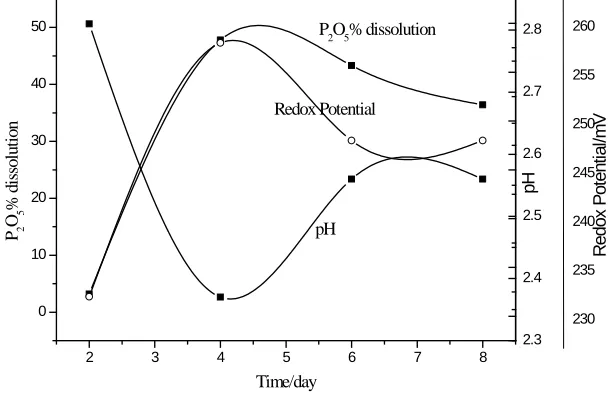
As the results obtained from above conditions, the effect of different incubation period was studied to evaluate phosphate ore dissolution by A. niger isolated. The results show that phosphate dissolution markedly affected by incubation period as it regularly increased till a maximum value reached after 4 day with 47.8 % phosphate dissolution, Figure(4). In addition the final pH sharply decreased and highly increased in redox potential after 4 day of incubation and then slightly changes in pH and redox potential have occurred till 8 day of incubation period. This correlated with growth curve of
A.niger isolated that begins the log phase from third day until fifth day from growth then
enter in stationary phase up to 12P
th
P
day of growth that produce all acids in these phase which may be in agreement with results obtained by Pradhan and Sukla 2005 who proved that A. niger was found to be the best phosphate solublizer among several tested
fungi Aspergillus niger solubilized 480g/ml of phosphorus, from 0.5% tricalcium
phosphate after 4 days of growth respectively.
Figure (4): Effect of Different Incubation Time Period on Phosphate Dissolution by A. Niger
Isolated.
Effect of different media on phosphate dissolution by penicillium chrysogenum:
Three different types of liquid media are used, Pikovskaya with initial pH 6, CzapexP
,
P
s Dox with initial pH 6 and glucose yeast extract medium with initial pH 6, each contained
2 3 4 5 6 7 8
0 10 20 30 40 50 P2 O5 % di ss ol ut ion Time/day 2.3 2.4 2.5 2.6 2.7 2.8 pH 230 235 240 245 250 255 260 R edox P ot ent ial /m V pH
P2O5% dissolution
394
0.5 g Abu Tartur phosphate ore for 50 ml of medium and inoculated with spore suspension 5.1x10P
6
P
CFU/ml of penicillium chrysogenum isolate and incubated at 28 °C and 160 rpm and measuring PR2ROR5 Reach 2day and also pH and redox potential.
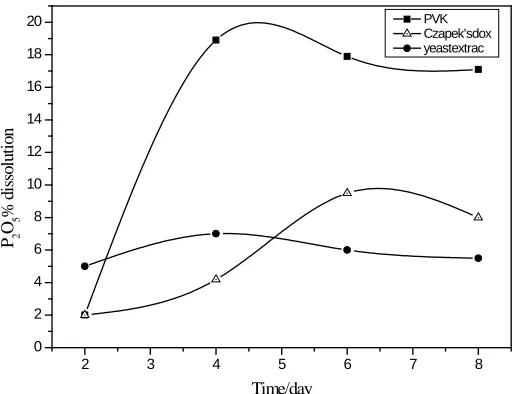
The results reveal that Pikovskaya broth media gave maximum insoluble phosphate ore
dissolution 18.9% after 4 day whereas CzapexP
'
P
s Dox broth media with penicillium
chrysogenum isolate gave 9.4 % phosphate ore dissolution after 6 day. On the other hand
glucose yeast extract medium gave very low phosphate dissolution with 7 % (Figure 5) and this refers to best growth of penicillium chrysogenum isolate on components of PVK medium and produces acids to leach the phosphate content of ore.
This agrees with Pradhan and Sukla (2005) who evaluated two P solubilizing fungi isolated from rice filed soil, using different media to select P solubilizing. They confirmed the impact of media type on phospherous solubilization ability. Similarly, Son
et al. (2006) affirmed the effect of the concentrations of some elements of the media as
salts and nitrogen source on solubilization of the inorganic phosphates.
Figure (5): The Effect Of Type Of Medium On Dissolution Of PR2ROR5R Content of Ore by
penicillium chrysogenum isolate .
Effect of different media on phosphate dissolution by A. niger isolated:
Three different types of media are used in this study Pikovskaya with initial pH 6, CzapexP
,
P
s Dox with initial pH 6 and glucose yeast extract with initial pH 6. each contained 0.25 g Abu Tartur phosphate ore for 50 ml of medium and inoculated with 5.2x10P
6
P
spores
of A. niger isolated and incubated at 30°c and 160 rpm and measuring PR2ROR5 Reach 2day
and also pH and redox potential.
2 3 4 5 6 7 8
0 2 4 6 8 10 12 14 16 18 20
P2 O5
%
di
ss
ol
ut
ion
Time/day
395
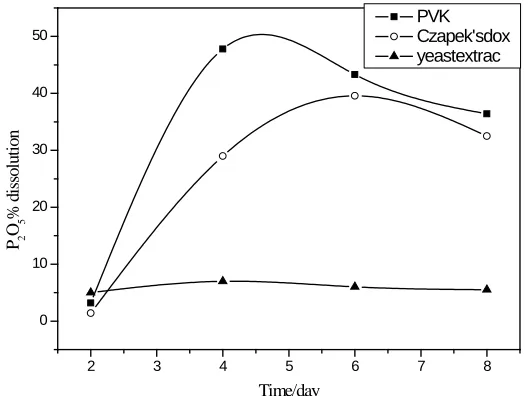
The results reveal that Pikovskaya broth media gave maximum insoluble phosphate ore dissolution 47.8% after 4 day with final pH 2 whereas CzapexP
'
P
s Dox broth media with A.
niger isolated gave 39 % phosphate ore dissolution after 6 day with final pH 2. On the
other hand yeast dextrose gave very low phosphate dissolution with 5 % with no change in pH value (Figure 6) and this refers to best growth of A. niger isolated on components of PVK medium and produces acids to leach the phosphate content of ore.
2 3 4 5 6 7 8
0 10 20 30 40 50
P2 O5
%
di
ss
ol
ut
ion
Time/day
PVK Czapek'sdox yeastextrac
Figure (6): The Effect of Type of Medium on Dissolution of PR2ROR5R Content of Ore.
Effect of different ore amount on phosphate dissolution by penicillium chrysogenum isolate:
Different phosphate ore amount per 50 ml of broth Pikovskaya medium as ( 0.25, 0.5, 1, 1.5, 2) gm are used to determine the ability of penicillium chrysogenum isolate to dissolve large amount of Abu Tartur phosphate ore incubation for 4 day at 28°PPC and 155
rpm. The results show that maximum phosphate solubilization reaches to 39.5% phosphate dissolution for 0.25 g ore with highest redox potential and lowest pH value then dissolution of phosphate content of ore begins to decreases with increasing concentration of ore (Figure 7).
The dissolution of phosphate decreases with increasing phosphate ore concentration in the growth medium, that may be attributed to toxic effect of some metal ions which may be released into the culture medium such as MnP
+2
P
and NaP
+1
P
, Ca P
+2
P
396
(Narsian et al., 1995), the negative effect of soluble P on microbial acid productivity (Rohr et al., 1983) might also be responsible for final soluble P concentration Another explanation for this might be formation of an organo-P compound induced by organic metabolites released, which in turn, reduces the amount of available P (Illmer and Schinner, 1992).
Figure(7): Effect of Different Ore Amount on Phosphate Dissolution by Penicillium
Chrysogenum Isolate.
Effect of different ore amount on phosphate dissolution by A. niger isolated:
Different phosphate ore amount per 50 ml of broth Pikovskaya medium as ( 0.25, 0.5, 1, 1.5, 2) g are used to determine the ability of A. niger isolated to dissolve large amount
of Abu Tartur phosphate ore which inoculated with 2x10P
6
P
spore forming unit and incubation for 4 day at 30°PPC and 155 rpm. The results show that maximum phosphate
solubilization reaches to 48 % phosphate dissolution for 0.25 g ore and begins to decreases with increasing concentration of ore (Figure 8).
The dissolution of phosphate decreases with increasing phosphate ore concentration in the growth medium, that may be attributed to toxic effect of some metal ions which may be released into the culture medium such as MnP
+2
P
and NaP
+1
P
, Ca P
+2
P
ions and these ions can react with soluble phosphate and form insoluble phosphate so decrease total soluble phosphate, these results found to be almost similar to that obtained by (Hefnawy et al., 2002). Also, it may be due to inhibitory effect on further phosphate solubilization
0.2 0.4 0.6 0.8 1.0 1.2 1.4 1.6 1.8 2.0 2.2
0 5 10 15 20 25 30 35 40 45 P2 O5 % di ss ol ut ion Ore Amount/gm 2.0 2.5 3.0 3.5 4.0 4.5 5.0 pH 120 140 160 180 200 220 240 260 R edox P ot ent ai l Redox potential
P2O5% dissolution
397
(Narsian et al., 1995), the negative effect of soluble P on microbial acid productivity (Rohr et al., 1983) might also be responsible for final soluble P concentration Another explanation for this might be formation of an organo-P compound induced by organic metabolites released, which in turn, reduces the amount of available P (Illmer and Schinner, 1992).
Figure(8): Effect Of Different Ore Amount on Phosphate Dissolution by A. niger
Isolated.
Effect of different inoculums size on phosphate dissolution by penicillium
chrysogenum isolate:
Different inoculums size are used from penicillium chrysogenum isolate (5.1x10P
6 P , 10 .2x10P 6 P
, 15.3 x10P
6
P
and 20.4 x10P
6
P
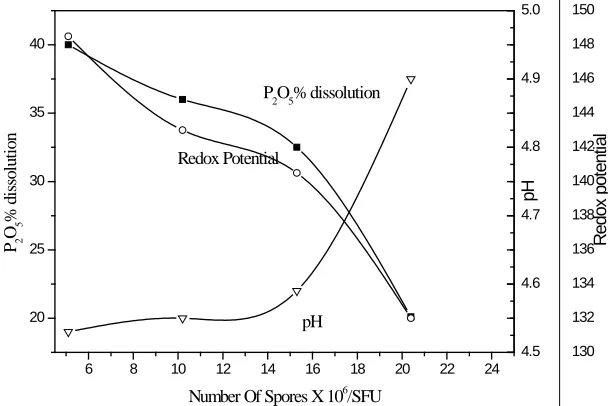
) SFU of fungal growth supplied with 0.25 g phosphate ore in 50 ml PVK medium then incubated for 4 days at 28°C and 155 rpm. The results reveal that at a concentration of 5.1x10P
6
P
spores, penicillium chrysogenum isolate can solublize approximately 39.5% of phosphate content of the ore after 4 days of incubation (Figure 9).
Concentration of fungus affects on dissolution of phosphate content of the ore. The best phosphate solublization occurs at a concentration of 5.1x10P
6
P
spores of fungus and decreases at high concentration of fungus with increase pH value and decrease redox potential and this may be due to competition factor between spores themselves, decreases the aeration and also high growth which may consume phosphate.
0.2 0.4 0.6 0.8 1.0 1.2 1.4 1.6
10 15 20 25 30 35 40 45 50 P2 O5 % di ss ol ut ion Ore Amount/gm 2.0 2.5 3.0 3.5 4.0 4.5 5.0 pH pH
P2O5% dissolution
398
This agrees with Laura Osorno (2014) who found that maximum capacity of
Mortierella sp. was detected with lowest population level (1x10P
7
P
CFU) suggested that this fungus is effective using nutrients and producing the required acidity to dissolve rock phosphate and by increasing the population density of Mortierella sp. their effectiveness decreases, which may be due to intraspecific competition.
Figure (9): The Effect of Penicillium Chrysogenum Isolate Amount on Dissolution of PR2ROR5R Content of Ore.
Effect of different inoculums size on phosphate dissolution by A. niger isolated:
Different inoculums size are used from A. niger isolated (2x10P
6
P
, 4 x10P
6
P
, 6 x10P
6
P
and 8 x10P
6
P
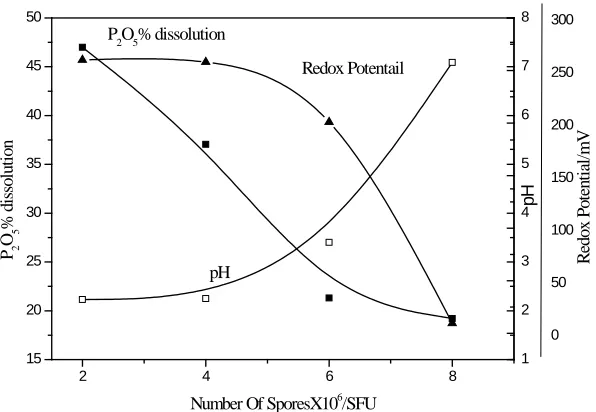
) SFU of fungal growth supplied with 0.25 g phosphate ore for 4 days of incubation. The results reveal that at a concentration of 2x10P
6
P
spores, A. niger can solublize approximately 47% of phosphate content of the ore after 4 days of incubation (Figure 10).
Concentration of fungus affects on dissolution of phosphate content of the ore. The best phosphate solublization occurs at a concentration of 2 x10P
6
P
spores of A. niger isolated and decreases at high concentration of fungus with increase pH value and decrease redox potential and this may be due to competition factor between spores themselves, decreases the aeration and also high growth which may consume phosphate.
6 8 10 12 14 16 18 20 22 24
20 25 30 35 40 P2 O5 % di ss ol ut ion
Number Of Spores X 106/SFU
4.5 4.6 4.7 4.8 4.9 5.0 pH
P2O5% dissolution
399
2 4 6 8
15 20 25 30 35 40 45 50
Redox Potentail
pH P2O5% dissolution
P2 O5
%
di
ss
ol
ut
ion
Number Of SporesX106/SFU
1 2 3 4 5 6 7 8
pH
0 50 100 150 200 250 300
R
edox P
ot
ent
ia
l/
m
V
Figure (10): The Effect of A.Niger Isolated Amount on Dissolution of PR2ROR5R Content of
Ore.
Effect of different incubation temperature on phosphate dissolution by Penicillium
Chrysogenum Isolate:
It is studied by using three different temperature(20, 30, 40 °c) in presence 0.25 g Abu Tartur phosphate ore for 50 ml of PVK medium and inoculated with 5.1x10P
6
P
spores of
penicillium chrysogenum isolate and incubated for four days then measuring PR2ROR5, RpH
and redox potential. The growth and rock phosphate solublization by penicillium
chrysogenum isolate is increased with increasing incubation temperature up to 30°C and
then decreased above this temperature. Phosphate solublization by penicillium
chrysogenum isolate reaches to approximately 45 % at 30°C after 4 days of incubation
(Figure 11).
400
Figure (11): The effect of Temperature on Dissolution of PR2ROR5R Content of Ore.
Effect of different incubation temperature on phosphate dissolution by A. niger isolated:
It is studied by using three different temperature(20, 30, 40 °c) in presence 0.25 g Abu Tartur phosphate ore for 50 ml of PVK medium and inoculated with 2x10P
6
P
spores of A.
niger isolated and incubated at 30 °c and 160 rpm and measuring PR2ROR5 R. The growth and
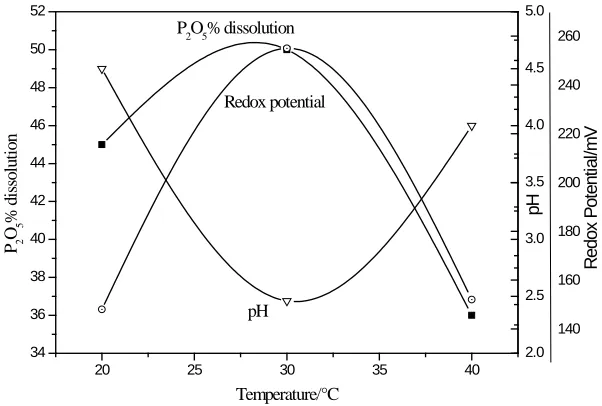
rock phosphate solublization by A. niger isolated is increased with increasing incubation temperature up to 30°C and then decreased above this temperature. Phosphate solublization by A. niger isolated reaches to approximately 50 % at 30°C after 4 days of incubation (Figure 12). The optimum growth of A. niger isolated occurs at 30ºC which refers to high production of organic acids lead to increase phosphate content solublization in the ore at this incubation temperature. It is also observed that the final pH is the lowest one at this temperature and increase redox potential and this associated with organic acids production. Quite Similar results were obtained by Hefnawy et al., (2002) who reported that A.terrus was able to solublize 75% of uranium content of the ore at 30°C.
20 25 30 35 40
30 32 34 36 38 40 42 44 46
P2O5% dissolution
P2 O5
%
di
ss
ol
ut
ion
Temperature/°C
4.2 4.4 4.6 4.8 5.0
pH
pH
140 142 144 146 148 150
R
edox
P
ot
ent
ial
/m
V
401
20 25 30 35 40
34 36 38 40 42 44 46 48 50 52 P2 O5 % di ss ol ut ion Temperature/°C 2.0 2.5 3.0 3.5 4.0 4.5 5.0 pH 140 160 180 200 220 240 260 R edox P ot ent ial /m V Redox potential P2O5% dissolution
pH
Figure (12): The Effect of Temperature on Dissolution of PR2ROR5R Content of Ore
Effect of different carbon source on phosphate dissolution by Penicillium
Chrysogenum Isolate:
It is studied by using five different carbon sources of (glucose, sucrose, dextrose, lactose, starch) for 50 ml of PVK medium in presence 0.25 g Abu Tartur phosphate ore, inoculated with 5.1x10P
6
P
spores of penicillium chrysogenum isolate, incubated at 30 °c and 160 rpm and measuring PR2ROR5R.
Nutritional constituent of the culture medium plays an important role in phosphate solublization from its ores.The resultsreveal that penicillium chrysogenum isolate grows well on PVK medium containing different carbon sources. Whereas, the maximum amount of soluble phosphate is detected only in the culture filtrate of penicillium
chrysogenum isolate with glucose that reaches approximately to 80% and starch followed
by sucrose and dextrose, while lactose exhibits low amount of soluble phosphate (Figure 13). glucose is represented the best carbon source utilized by penicillium chrysogenum isolate during phosphate solublization process which may be used in the production of certain organic acids that involved in solublization process. According to Cerezine et al. (1988), glucose is the most frequent and abundant sugar detected in plant exudates that possibly affect the microbial population which solubilizes insoluble phosphates. This finding may be related to the complexity of sucrose and the preference of glucose.
402
Figure (13): The Effect of Carbon Source on Dissolution of PR
2ROR
5R Content of Ore by
Penicillium Chrysogenum Isolate.
Effect of different carbon source on phosphate dissolution by A. niger isolated:
It is studied by using five different carbon sources of (glucose, dextrose, lactose, sucrose, starch and mannitol) for 50 ml of PVK medium in presence 0.25 g Abu Tartur phosphate ore, inoculated with 2x10P
6
P
spores of A. niger isolated, incubated at 30 °c and 160 rpm and measuring PR2ROR5R.
Nutritional constituent of the culture medium plays an important role in phosphate solublization from its ores. The results reveal that A. niger isolated grows well on PVK medium containing different carbon sources. Whereas, the maximum amount of soluble phosphate is detected only in the culture filtrate of A. niger isolated with sucrose and starch followed by mannitol, glucose and dextrose, while lactose exhibits low amount of soluble phosphate (Figure 14). sucrose is represented the best carbon source utilized by
A. niger isolated during phosphate solublization process which may be used in the
production of certain organic acids that involved in solublization process and this agrees with Gilberto de Oliveira Mendes et al (2015) and also agrees with Oktay Bayat et al (2011) which Sucrose was provided as the sole carbon source for A. niger and was hydrolysed to glucose and fructose and metabolized to organic acids used in leaching of phosphate content of ore.
Glucose Sucrose Starch Dextrose Lactose
0 10 20 30 40 50 60 70 80
P2 O5
%
di
ss
ol
ut
ion
403
Glucose Sucrose Starch Dextrose Manittol Lactose
0 10 20 30 40 50 60 70
P2 O5
%
di
ss
ol
ut
ion
Carbon Source
Figure (14): The Effect of Carbon Source on Dissolution of PR2ROR5R Content of Ore.
Effect of different nitrogen source on phosphate dissolution by Penicillium
Chrysogenum Isolate:
It is studied by using five different nitrogen sources of (asparagine, peptone, yeast extract, tryptone, ammonium sulfate, ammonium oxalate) for 50 ml of PVK medium containing glucose as carbon source in presence 0.25 g Abu Tartur phosphate ore, inoculated with 5.1x10P
6
P
spores of penicillium chrysogenum isolate, incubated at 30 °c and 160 rpm for four days then measuring PR2ROR5Rdissolution from ore.
penicillium chrysogenum isolate can solublize high amount of phosphorus from rock
404
Figure (15): The Effect of Nitrogen Source on Dissolution of PR
2ROR
5R Content of Ore by
Penicillium Chrysogenum Isolate:
Effect of different nitrogen source on phosphate dissolution by A. niger isolated:
It is studied by using five different nitrogen sources of (asparagine, peptone, yeast extract and tryptone) for 50 ml of PVK medium containing sucrose as carbon source in presence 0.25 g Abu Tartur phosphate ore, inoculated with 2x10P
6
P
spores of A. niger isolated, incubated at 30 °c and 160 rpm then measuring PR2ROR5Rdissolution from ore.
A.niger isolated can solublize high amount of phosphorus from rock phosphate ore
with all tested nitrogen sources. tryptone is found to be the best nitrogen source utilized
by A.niger isolated for maximum phosphate solublization which reaches to 85.8% after 4
days of incubation followed by asparagine and the lowest dissolution of phosphate content of the ore at using ammonium sulphate as nitrogen source, Figure (16). Variation of medium composition markedly altered the phosphate mobilization by phosphate solublizing microbes (Illmer and Schinner, 1992).
Asparagines Peptone Yeast tryptone ammonium sulphate 0
20 40 60 80
P2 O5
%
di
ss
ol
ut
ion
Nitrogen Source
Figure (16): The Effect of Nitrogen Source on Dissolution of PR
2ROR
5R Content of Ore.
Asparagines Peptone Yeast tryptone amm. sulphateAmm.chloride 0
20 40 60 80 100
P2
O5
%
di
ss
ol
ut
ion
405
Organic acids production:
1- In case of Penicillium chrysogenum isolate
penicillium chrysogenum isolate is able to produce organic acids such as oxalic and
fumaric acids in the growth medium as secondary metabolites resulting from utilization of glucose. Utilization of insoluble phosphate as main phosphorus source highly increased the production of some organic acids by organism. Detection of acids present in filterate of bioleaching experiment by HPLC which found that presence of higher amount of oxalic acid and fumeric acids in flasks containing of penicillium chrysogenum isolate and 0.25gm Abu Tartur phosphate ore in 50 ml of glucose-yeast extract medium( Figure 18) than control flask without ore(Figure 17)that containing fumaric acid only and this lead to decrease of pH of medium and increase of redox potential and improve the dissolution of phosphate content in Abu Tartur ore to reach to 90%, these organic acids are produced from utilization of glucose by penicillium chrysogenum isolate.
Many studies have investigated mechanisms in which P-solubilizing fungi enhance the mobility of P to plants (reviewed by Whitelaw (2000)). Most accepted P-solubilization mechanisms used by these fungi are: 1) acidification by exuded HP
+
P
and organic acids, and through the production of carbon dioxide (COR2R), 2) complexation of cation partners of P
by the exuded organic acids, and 3) ligand exchange (i.e., exchange of P) by the exuded organic acids (reviewed by Gulden and Vessey (2000)).
Previous studies have shown consistent pH reduction in the solid and liquid culture of
P. bilaiae (Asea et al., 1988; Cunningham and Kuiack, 1992). The larger pH reduction
was related to assimilation of ammonium by P. bilaiae
rather than nitrate. Also, citrate and oxalate were detected as the major acidic metabolites
of P. bilaiae(Cunningham and Kuiack, 1992).
Figure (17): HPLC Analysis of Filterate of Control Flask Containing Medium with
406
Figure (18): HPLC Analysis of Filterate of Sample Flask Containing Medium with
Penicillium and Ore.
2- In case of A.niger isolate
A.niger isolated is able to produce organic acids such as oxalic and fumaric acids in
407
Figure (19): HPLC Analysis of Filterate of Control Flask Containing Medium with A.Nger
Isolated and without Ore.
Figure (20): HPLC Analysis of Filterate of Sample Flask Containing Medium with A.Niger
Isolated and Ore.
408
REFERENCES:
Asea, P.E.A., R.M.N. Kucey, and J.W.B. Stewart. 1988. Inorganic phosphate solubilization by two Penicillium species in solution culture and soil. Soil Biol. Biochem. 20: 459-464.
Bojinova D. Y., Velkova R. G., Gruncharov I. and Zhelev S. (1997). The bioconversion of Tunisian
phosphorite using Aspergillus niger. Nutr. Cycl. Agroecosys. 47: 227–232.
Cerezine, P.C., E. Nahas and D.A. Banzatto, 1988. Soluble phosphate accumulation by
Aspergillus niger from fluorapatite. Applied Microbiol. Biotechnol., 29: 50l-505.
Consensus Statement Declaration. Sustainable phosphorus summit. Tempe, Arizona, USA: ASU School of Life Sciences; 2011. 9 p.
Cramer MD, (2010). Phosphate as a limiting resource: introduction.
Plant Soil.334:1-10.
Cunningham J. E. and Kuiack C.(1992). Production of citric and oxalic acids and solubilization of calcium phosphate by Penicillium billaii. Appl. envir. Microbiol. 58 (2): 1451–1458.
Dutton V. M. and Evans C. S.(1996). Oxalate production by fungi: its role in pathogenicity and ecology in the soil environment. Canadian J. Microbiol. 42: 881– 895.
Galindo T, Sánchez J, Polanía J., (2011). Capacidad solubilizadora de fosfatos de microorganismos rizosféricos asociados a dos manglares del Caribe colombiano. Acta biol. Colomb. 11(1):153-154.
Gilberto de Oliveira Mendes, Nina Morena Rêgo Muniz da Silva,Thalita Cardoso Anastácio, Nikolay Bojkov Vassilev, José Ivo Ribeiro Jr., Ivo Ribeiro da Silva, Maurício Dutra Costa, (2015). Optimization of Aspergillus niger rock phosphate solubilization in solid-state fermentation and use of the resulting product as a P fertilizer. Fungal Biotechnology, Thematic Issue, Volume 8: Pages 930–939.
Gulden, R.H. and J.K. Vessey, 2000.Penicillium bilaii inoculation increases root-hair production in field pea. Can. J. Plant Sci. 80: 801-804.
Hamdali H, Smirnov A, Esnault C, Ouhdouch Y, Virolle MJ., (2010). Physiological studies and comparative analysis of rock phosphate solubilization abilities of actinomycetales originating from Moroccan phosphate mines and of Streptomyces lividans. Appl Soil Ecol. 44:24-31.
Illmer P, Barbato A, Schinner F. (1995). Solubilization of hardly-soluble AlPOR4R with
P-solubilizing microorganisms. Soil Biol. Biochem. 27:265-270.
P-409
solubilizing microorganisms. Soil Biol. Biochem. 27:265-270.
Johnson LF, Curl EA, Bono JH, Fribouring HA. 1959. Methods for studying soil
microflora plant disease relationships. Minneapolis publishing Co. USA, 178.
Kpomblekou K. and Tabatabai M. A.(1994). Effect of organic acids on release of phosphate rocks. Soil
Sci. 158(6): 442–432.
Laura Osorno, (2014). Effect of carbon and nitrogen source and concentration on rock phosphate dissolution induced by fungi. Journal of Applied Biotechnology, ISSN 2327-0640 , Vol. 2, No. 2 .
M. Rohr, C.P. Kubicek, J. Kominek, HJ. Rehm, G. Reed, (1983.), Biotechnology III, Verlag Chemie, Wienheim , pp. 456–465.
M. Rohr, C.P. Kubicek, J. Kominek, HJ. Rehm, G. Reed, (1983.), Biotechnology III, Verlag Chemie, Wienheim , pp. 456–465.
Magnuson J. K. and Lasure, L. (2004). Organic acidproduction by filamentous fungi. Advances in Fungal Biotechnology for Industry, Agriculture and Medicine. (J. L. Lange, ed.) Kluwer Academic/ Plenum Publishing
Maisa Mohamed Amin, 2013. Factors controlling uranium bioleaching from different Egyptian phosphates using Penicillium Simplicissimum. Journal of Environmental Sciences, 2013; Vol. 42, No. 3 : 405-415.
Mohamed A. Hefnawy, Mohamed M. Gharieb , Omima A. Eissa , Asmaa M. Ammar, 2009. Evaluation and Optimization of Rock Phosphate and Tri-Calcium Phosphate Solublization by soil fungi. Egypt. J. Exp. Biol. (Bot.), 5: 75 – 84.
Mohamed A. Hefnawy, Mohamed M. Gharieb , Omima A. Eissa , Asmaa M. Ammar, (2009). Evaluation and Optimization of Rock Phosphate and Tri-Calcium Phosphate Solublization by soil fungi. Egypt. J. Exp. Biol. (Bot.), 5: 75 – 84.
N Pradhan, and LB Sukla, (2005). Solubilization of inorganic phosphates by fungi isolated from agriculture soil. African Journal of Biotechnology Vol. 5(10), pp. 850-854.
N Pradhan, and LB Sukla, (2005). Solubilization of inorganic phosphates by fungi isolated from agriculture soil. African Journal of Biotechnology Vol. 5(10), pp. 850-854.
Nahas E. (1996). Factors determining rock phosphate solubilization by microorganisms isolated from soil. W. J. Microbiol. Biotechnol. 12: 567–72.
410
isolated from acidic soils. Afr. J. Microbiol. Res. 7(34): 4310–4316.
Narsian V. & Patel H.H., (2000). Aspergillus aculeatus as rock phosphate solubilizers. Soil Biology and Biochemistry 32, 559-565.
Narsian, V., Thakkar,J., Patel, H.H., (1995). Mineral phosphate solubilization by A.
aculeatus. Indian Journal of Experimental Biology 33, 91-93.
Narsian, V., Thakkar,J., Patel, H.H., 1995. Mineral phosphate solubilization by A.
aculeatus. Indian Journal of Experimental Biology 33, 91-93.
Oberson A, Bunemann EK, Friesen DK, Rao IM, Smithson PC, (2006). Improving phosphorus fertility in tropical soils through biological interventions. In: Uphoff N, editor. Biological approaches to sustainable soil systems. Taylor and Francis Group. Boca Raton, Florida: CRC Press. p. 531-546.
Oktay Bayat,Volkan Arslan, Belgin Bayat (2011). Use of Aspergillus niger in the
bioleaching of colemanite for the production of boric acid. Electronic journal of Biotechnology, vol.14 No. 3.
Oliveira C. A., Alves V. M. C., Marriel I. E., Gomes E. A., Scotti M. R., Carneiro N. P.,Guirmaraers C. T., Schaffert R. E. and Sa’ N.M. H.(2009). Phosphate solubilizing micro-organisms isolated from rhizosphere of maize cultivated in an oxisol of the Brazillian Cerrado Biome. Soil Biol. Biochem.41: 1782–1787.
Paiva-Coutinho F, Wagner-Pereira F, Mayumi A, Yano-Melo., (2012) Solubilization of phosphates in vitro by Aspergillus spp. and Penicillium spp. Ecol Eng. 42:85-89.
Phukan R., Samanta R. and Barthakur,B. K.(2011). Phosphatase activity of Aspergillus
niger: A native tea rhizosphere isolate. Sci. Cult. 77(9–10): 403–405.
Pradhan N, Sukla LB. 2005. Solubilization of inorganic phosphate by fungi isolated from agriculture soil. African Journal of Biotechnology 5, 850–854.
Reddy M., Kumar S., Babita K. and Reddy M. S.(2002). Biosolubilization of poorly soluble rock phosphates by Aspergillus tubingenesis and Aspergillus niger. Bioresour. Technol. 84: 187–189.
Reddy, M., Kumar, S., Khosla, B., (2002). Biosolubilization of poorly soluble rock phosphates by Aspergillus tubingensis and Aspergillus niger. Bioresource Technology 84:187-189.
411
Roos, W. (1981). Kinetik und Regulation des Amino- saure-Transports in Penicillium cyclopium. Thesis Dr sc., Martin-Luther-University, Halle, GDR.
Sagervanshi A, Kumari P, Nagee A, Kumar A., 2012. Media optimization for inorganic phosphate solubilizing bacteria isolated from anand argiculture soil. International Journal of Life science and Pharma Research 2(3),245–255.
Sagoe C. I., Ando T., Kound K. and Nagaota T.(1998). Residual effects of organic acid-treated phosphate rocks on some soil properties and phosphate availability. Soil Sci. Pl. Nutr. 44: 627–634.
Sahu SN, Jana BB., (2000) Enhancement of the fertilizer value of rock phosphate engineered through phosphate solubilizing bacteria. Ecol Eng. 15:27-39.
Seshadri S., Ignacimuthu S. and Lakshminarasimhan C. (2004). Effect of nitrogenand carbon sources on the inorganic phosphate solubilization by different Asperglu57”illus niger strains. Chem. Engng. Commun. 191: 1–10.
Goenadi D. H., Siswanto Y. and Sugiarto C. (2000). Bioactivation of poorly soluble phosphate rocks with a phosphorus solubilizing fungus. Soil Sci. Soc. Am. J.64: 927– 932.
Singh, C.P. and A. Amberger, (1991). Solubilization and availability of phosphorus during decomposition of rock phosphate reached straw and urine. Biol. Agric. Hortic., 7: 261-269.
Singh, C.P. and A. Amberger, (1998). Organic acids and phosphorus solubilization in straw composed with rock phosphate. Bioresour. Technol., 63: 13-16
Son HJ, Park GT, Cha MS, Heo MS., 2006. Solubilization of insoluble inorganic phosphates by a novel salt and pH tolerant Pantoea agglomerans R-42 isolated from soybean rhizosphere. Bioresource Technology 97, 204–210.
Song OR, Lee SJ, Lee YS, Lee SC, Kim KK, Choi YL., 2008. Solubilization of insoluble inorganic phosphate by Burkholderia cepaciaDA23 isolated from cultivated soil. Brazilian Journal of Microbiology 39,151–156.
Sperber JI., (1958) Solution of apatite by soil microorganisms producing organic acids. Aust J Agr Res. 9:778-781.
Sundara Rao W.V.B. and Sinha M.K., 1963, Ind. J., Agric. Sci., 33:272.
Suntornsuk, W., and Hang,Y.D., (1994).Strain improvement of Rhizopus oryzae for production of L(+)lactic acid and glucoamylase, Lett. Appl. Microbiol. 19:249-252.
Thom C. and Church M. B., (1926). The Aspergilli, Williams and Wilkins Co.,
412
Tilak, K.V.B.R., N. Ranganayaki1, K. K. Pal, R. De, A. K. Saxena, C. S. Nautiyal, S. Mittal, A. K. Tripathi and B. N. Johri, (2005). Diversity of plant growth and soil health supporting bacteria. Current Science. 89: 136.
Vassilev N, Medina A, Azcon R, Vassilev A M, (2006). Microbial solubilization of rock phosphate on media containing agro-industrial wastes and effect of the resulting products on plant growth and P uptake [J]. Plant Soil, 287: 77-84.
Vassilev N., Fenice M. and Federici F.(1996).Rock phosphate solubilization with gluconic acid produced by immobilized Penicillium variableP16.Biotechnol. Techniq. 10: 585–588.
White TJ, Bruns T, Lee S, Taylor J (1990). Amplification and direct sequencing of fungal ribosomal RNA genes for phylogenetics. In: PCR Protocols: a guide to methods and applications. (Innis MA, Gelfand DH, Sninsky JJ, White TJ, eds). Academic Press, New York, USA: 315–322.
Whitelaw, M.A., 2000. Growth promotion of plants inoculated with phosphate-solubilizing fungi. Advances in Agronomy 69: 99-151.
Wickerham L.J. and Rettger L.F (1939) 15TJ. Tropical Med. Hyg15T. 42. 174-179.
Xiao CQ, Chi RA, Huang XH, Zhang WX, Qiu GZ, Wang DZ., (2008). Optimization for rock phosphate solubilization by phosphate solubilizing fungi isolated from phosphate mines. Ecol Eng. 33:187-193.
Xuan Y, Xu L, Tian-Hui Z, Guang-Hai L, Cui M., (2012) Co-inoculation with phosphate-solubilizing and nitrogen fixing bacteria on solubilization of rock phosphate and their effect on growth promotion and nutrient uptake by walnut. Eur J Soil Biol. 50:112-117.