ISSN(Online): 2320-9801
ISSN (Print): 2320-9798
I
nternational
J
ournal of
I
nnovative
R
esearch in
C
omputer
and
C
ommunication
E
ngineering
(An ISO 3297: 2007 Certified Organization)
Vol. 3, Issue 5, May 2015
Base Station Switching Using Transfer
Actor-Critic Learning Algorithm for Energy Saving
In Heterogeneous Networks
1Ramya.R,
2Pratheba.M
PG Scholar, Department of EEE, SNS College of Engineering, Coimbatore, India. Assistant Professor, Department of EEE, SNS College of Engineering, Coimbatore, India
ABSTRACT: The explosive popularity of smart phones and tablets has ignited a surging traffic load demand for radio access and there has been massive energy consumption. .The reason behind is this largely due to that the present BS deployment on the basis of peak traffic loads and generally stays active irrespective of the heavily dynamic traffic load variations. There is a need to reduce energy consumption at BS. In this project using TACT (Transfer Actor-Critic Learning Algorithm), developed base station switching operations to match up with traffic load variations. This scheme is designed to minimize the energy consumption of Radio Access Networks (RAN). Ultimate aim is to reduce the energy consumption with traffic load variations in radio access networks. Markov decision process and testing results are presented in this project.
KEYWORDS: Markov Decision Process, cellular networks, Transfer Critic learning algorithm.
I.INTRODUCTION
Mobile Adhoc Networks:
An ad-hoc network is a collection of wireless mobile hosts forming a temporary network without any stand-alone infrastructure and centralized administration. Mobile Ad-hoc networks are self-organizing and self-re-configuring multichip wireless networks where, the structure of the network changes dynamically. This is mainly due to the mobility of the nodes. Nodes in these networks utilize the same random access wireless channel, cooperating in a friendly manner to engaging themselves in multichip forwarding. The nodes in the network not only act as hosts but also as routers that route data to/from other nodes in network.In mobile ad-hoc networks where there is no infrastructure support as is the case with wireless networks, and since a destination node might be out of range of a source node transmitting packets, a routing procedure is always needed to find a path so as to forward the packets appropriately between the source and the destination. Within a cell, a base station can reach all mobile nodes without routing via broadcast in common wireless networks. In the case of ad-hoc networks, each node must be able to forward data for other nodes.
II.RELATED WORKS
[1]The author explains about the development of ICT information and communication technology industry.it has emerged as one one of the major sources of energy consumption.Therefore this paper concerns about the BS energy saving issue , for most energy consumption of the communication network comes from the BS and the core network.Particularly,consider dynamically turning or certain BS when the network traffic is low.Centralized and decentralized implementations are investigated.[2]The autrhor describes about the energy efficiency and resource management of cellular networks.Traffic modeling and prediction has been focused in recent years.In this paper the advantage of entropy theory to explore the limits of predictability of cellular network traffic based on large amount of traffic data set gathered from real cellular network in china.
A.BASE STATION DEPLOYMENT:
ISSN(Online): 2320-9801
ISSN (Print): 2320-9798
I
nternational
J
ournal of
I
nnovative
R
esearch in
C
omputer
and
C
ommunication
E
ngineering
(An ISO 3297: 2007 Certified Organization)
Vol. 3, Issue 5, May 2015
which they can communicate.
Figure 1.BS at rural area with high coverage
radio frequencies to be reused in other cells without interference and which then increases the overall number of calls that the network can handle at any one time. Base stations have two limiting factors one is the capacity of calls that they can handle, and the other is the geographical area that they can cover. In areas with fewer users, base stations can be quite far apart, but in areas where there are many users, the base stations need to be located much closer to each other.
In areas where there are many users, more base stations will be needed to handle the call traffic, and as such, are located much closer to each other to increase overall capacity. Where base stations are located closer to each other, their output power must be lower to avoid interference with other base stations. Our work proposes a reinforcement learning framework for energy saving in RANs. An RAN usually consists of multiple BSs while the traffic loads of BSs are usually fluctuating, thus often BSs under-utilization. Switching operation is conducted based on one learned strategy and the energy saving in the whole system tends to be optimized in the long run. By this proposed system, the system might come into the same state in two different tasks, whereas the traffic loads in the source task (e.g., Period 1) might be usually higher than that in the target one (e.g., Period 2).
Figure 2. Base station at rural area & urban area Traffic Prediction
In this first module, analyze the traffic usage per day manner. By predicting the traffic, get the detail when the base station has to be in sleep and awake.User Localization,By this second module, the MSC can know the information, the user location and distance from second base station. By this knowledge, MSC can desire the base station switching.
B.Dynamic Source Routing: DSR is a reactive routing protocol which is able to manage a MANET without using periodic table-update messages like table-driven routing protocols. DSR was specifically designed for use in multi-hop wireless ad hoc networks.
Rural
area
less
user
with
large
cover
age
Num
ber
of
BS
incre
ased
to
man
age
num
ber
of
user
ISSN(Online): 2320-9801
ISSN (Print): 2320-9798
I
nternational
J
ournal of
I
nnovative
R
esearch in
C
omputer
and
C
ommunication
E
ngineering
(An ISO 3297: 2007 Certified Organization)
Vol. 3, Issue 5, May 2015
Ad-hoc protocol allows the network to be completely self-organizing and self-configuring which means that there is no need for an existing network infrastructure or administration.
Fig 3.Route Discovery
ROUTE DISCOVERY:
In Figure3, Node A has in his Route Cache a route to the destination E, this route is immediately used. If not, the Route Discovery protocol is started: Node A (initiator) sends a Route Request packet by flooding the network .If node B has recently seen another Route Request from the same target or if the address of node B is already listed in the Route Record, Then node B discards the request.If node B is the target of the Route Discovery, it returns a Route Reply to the initiator. The Route Reply contains a list of the “best” path from the initiator to the target. When the initiator receives this Route Reply, it caches this route in its Route Cache for use in sending subsequent packets to this destination. Otherwise node B isn’t the target and it forwards the Route Request to neighbors (except to the initiator).
II.NS2 SIMULATOR
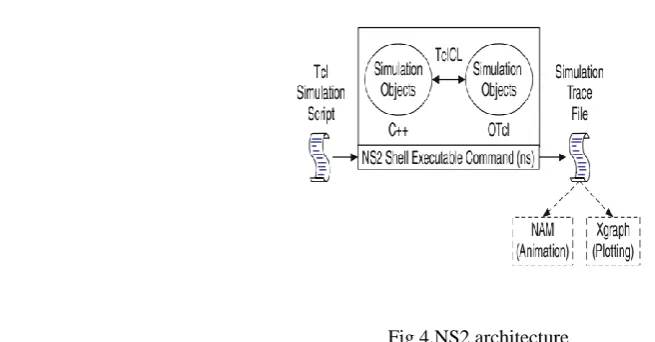
Network Simulator (Version 2), widely known as NS2, is simply an event driven simulation tool that has proved useful in studying the dynamic nature of communication networks. Simulation of wired as well as wireless network functions and protocols (e.g., routing algorithms, TCP, UDP) can be done using NS2. In general, NS2 provides users with a way of specifying such network protocols and simulating their corresponding behaviors.
Fig 4.NS2 architecture
Network design
ISSN(Online): 2320-9801
ISSN (Print): 2320-9798
I
nternational
J
ournal of
I
nnovative
R
esearch in
C
omputer
and
C
ommunication
E
ngineering
(An ISO 3297: 2007 Certified Organization)
Vol. 3, Issue 5, May 2015
Route selection
In this method, user can select any type of broadcasting like as requesting and replying is the main process going to be done and so on. In this project taking three item spectrum availability, network resources, and licensed users. In our project, we included route selection module for setting the specific route with some fixed properties preferences.
Fig 5.Network Design
Wireless network evolution
Design the network which is capable of selecting various network paths. The proposed network broadcasting algorithm works on the choice of the user specified QoS parameters. A discovery and selection mechanism to find a new Base Station must be done.
Customizing parameters
In this module, after getting the network detail and separating the different parameters. After separating the parameters for each network, comparing that parameter to select best network. After comparison we are providing the Rank list for each parameter.
Network selection
Multi-parameter blind information is required to meet user needs in terms of automatic network selection during handover. All the parameter values are normalized so that they take on values in the range of zero and one and also in negative. After getting the rank for finding the path, the device going to select the best network automatically.
System Modeling
System modeling refers to an act of representing an actual system in a simply way. System modeling is extremely important in system design and development, since it gives an idea of how the system would perform if actually implemented. Traditionally, there are two modeling approaches: analytical approach and simulation approach.
Simulation Approach
ISSN(Online): 2320-9801
ISSN (Print): 2320-9798
I
nternational
J
ournal of
I
nnovative
R
esearch in
C
omputer
and
C
ommunication
E
ngineering
(An ISO 3297: 2007 Certified Organization)
Vol. 3, Issue 5, May 2015
Fig 6.Packet Arrival Event
Fig 7.Successful Packet Transmission BLOCK DIAGRAM
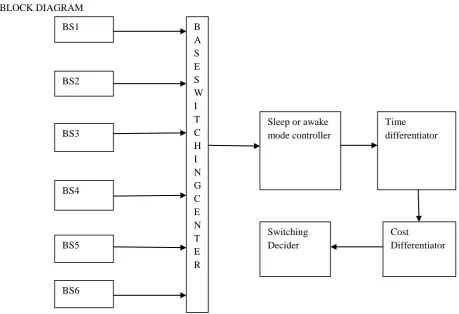
Fig 8.Block Diagram BS1
BS2
BS3
BS4
B A S E S W I T C H I N G C E N T E R BS5
BS6
Sleep or awake mode controller
Time differentiator
Cost
Differentiator Switching
ISSN(Online): 2320-9801
ISSN (Print): 2320-9798
I
nternational
J
ournal of
I
nnovative
R
esearch in
C
omputer
and
C
ommunication
E
ngineering
(An ISO 3297: 2007 Certified Organization)
Vol. 3, Issue 5, May 2015
The Block diagram shows that switching mechanisms of base station Flow Chart:
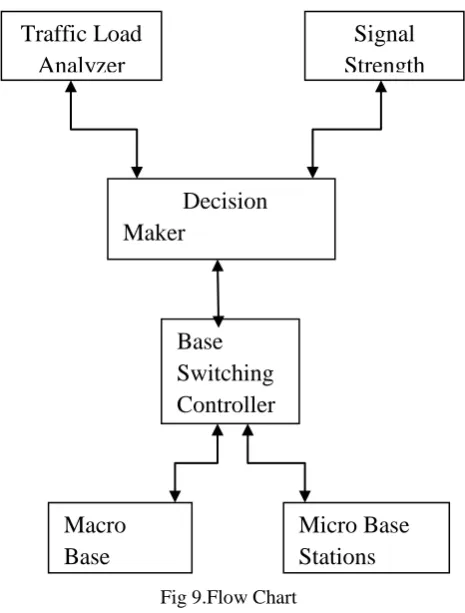
Fig 9.Flow Chart
Decision making is done to select the type of base station whether to chose macro or micro base station.
III.SIMULATION RESULTS
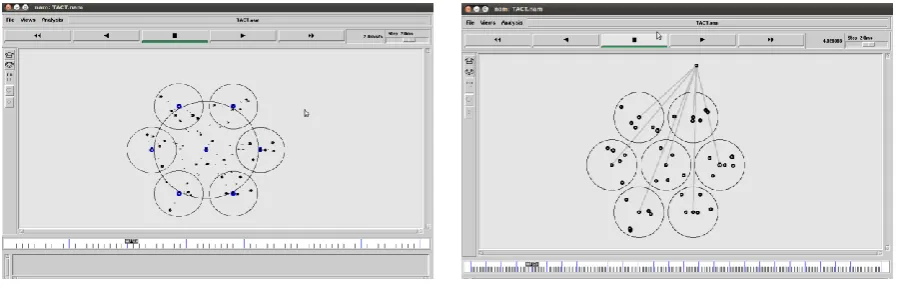
Fig 10 shows the base station switched to one single station with low traffic and the data is transmitted within the single circle. The nodes under the all the cluster heads receives information and becomes black in colour.Data transmission is done with single base station and its cluster head in case of less traffic. Traffic load is reduced as well as more energy consumed by the nodes is also reduced.
Fig 10.Data transmission in single BS
Base
Switching
Controller
Macro
Base
Stations
Micro Base
Stations
Traffic Load
Analyzer
Decision
Maker
ISSN(Online): 2320-9801
ISSN (Print): 2320-9798
I
nternational
J
ournal of
I
nnovative
R
esearch in
C
omputer
and
C
ommunication
E
ngineering
(An ISO 3297: 2007 Certified Organization)
Vol. 3, Issue 5, May 2015
Fig 11.Group of Base station Fig 12.Data transmission in centralcluster head Fig.11 shows that all the base stations are working in less traffic and data is transmitted through the cluster heads in concentric circles.If data transmission is active in single cluster head, other base stations and its clusters head which are not transmitting the data or in inactive stage .It is turned off. From this energy consumption and also power is reduced. If heavy traffic occurs in any particular base station, it shares with others.
Fig 12 shows the data transmission from the central cluster head to all other nodes without any traffic. The cluster head distributes the information to all the end nodes properly with the help of central cluster head.
Fig 13.Data transmission in End nodes Fig 14.Base station selection
Fig13 shows that from the central base station data are transmitted effectively to all other base station and its cluster heads. All the end nodes also able to receive the information correctly.Fig 14 shows that base station is selected based on handoff procedure.Decision is done by Markov Decision Process.
IV. CONCLUSION
In this Existing work, developed a learning framework for BS energy saving. Specifically formulated the BS switching operations under varying traffic loads as a Markov decision process. Besides, adopt the actor-critic method, a reinforcement learning algorithm, to give the BS switching solution to decrease the overall energy consumption. Afterwards, to fully exploit the temporal relevancy in traffic loads, propose a transfer actor-critic algorithm to improve the strategies by taking advantage of learned knowledge from historical periods.
V. FUTURE WORK
ISSN(Online): 2320-9801
ISSN (Print): 2320-9798
I
nternational
J
ournal of
I
nnovative
R
esearch in
C
omputer
and
C
ommunication
E
ngineering
(An ISO 3297: 2007 Certified Organization)
Vol. 3, Issue 5, May 2015
Winner process: consider the number of base stations connected to the MSC, in that if there is some of the base stations have to go to sleep, but at the same time any BS can go for sleep and other should be in active with increase in coverage. If both the base station intimated at same time, any base station will be selected randomly by the MSC to sleep and cell zooming.
REFERENCES
1.G.P.Fettweis and E.Zimmermann, “ICT energy consumption-trends and challenges,” in Proc. 2008 WPMC, vol.no.4,April 2008.
2. Rongpeng Li, Zhifeng Zhao, Xianfu Chen, Jacques Palicot, and Honggang Zhang, “TACT: A Transfer Actor-Critic Learning Framework for Energy Saving in Cellular Radio Access Networks”, IEEE Transactions on wireless communications, vol.13, no.4, April 2014.
3.J. Wu, S. Rangan, and H. Zhang, Eds., “Green Communications: Theoretical Fundamentals, Algorithms and Applications”, 1st ed. CRC Press, 2012.
4. H.Zhang, A.Gladisch, M. Pickavet, Z. Tao, and W. Mohr, “Energy efficiency in communications”,IEEE Communication. Mag., vol. 48, no. 11, pp. 48–49, Nov.2010.
5. M. Marsan, L. Chiaraviglio, D. Ciullo, and M.Meo, “Optimal energy savings in cellular networks”, in Proc. 2009 IEEE ICC Workshops. 6.China Mobile Research Institute, “C-RAN: road towards green radio access network”, Tech. Rep., 2010.
7. G.P.Fettweis and E.Zimmermann, “ICT energy consumption-trends and challenges,” in Proc. 2008 WPMC, vol.no.4,April 2008.
8. K. Son, H. Kim, Y.Yi, and B. Krishnamachari, “Base station operation and user association mechanisms for energy-delay tradeoffs in green cellular networks”, IEEE J. Sel. Areas Commun., vol.29, no.8, pp. 1525–1536, Sept. 2011.
9. C. Peng, S.-B. Lee, S. Lu, H. Luo, and H. Li, “Traffic-driven power savings in operational 3G cellular networks”, in Proc. 2011 ACM Mobicom. 10. Z.Niu,“TANGO: traffic-aware network planning and green operation” IEEE Wireless Commun., vol. 18, no. 5, pp. 25–29, Oct. 2011. 11. L.Chiaraviglio, D.Ciullo, M. Meo, M. Marsan, and I.Torino, “Energyaware UMTS access networks,” in Proc. 2008 WPMC.