PRÉSENTÉE À
L´ UNIVERSITÉ DE BORDEAUX
ÉCOLE DOCTORALE EN MATHÉMATIQUES ET INFORMATIQUE par
Wafa Ben Jaballah
Pour obtenir le grade de
DOCTEUR
Université de Bordeaux, France SPÉCIALITÉ : INFORMATIQUESECURING WIRELESS SENSOR
AND VEHICULAR NETWORKS
SOUTENUE LE : 08 Janvier 2014
Devant le Jury de Thèse :
Mauro Conti Frederic Cuppens Francine Krief Maryline Laurent Mohamed Mosbah Habib Youssef
Président du jury,Université dePadoue
Rapporteur, TelecomBretagne
Examinateur, Institut Polytechniquede Bordeaux Rapporteur, TelecomSudParis
Directeur de thèse,Institut Polytechnique deBordeaux Directeur de thèse,Université de Sousse
To the memory of my beloved mother, to the love of my family,
© Copyright by Wafa Ben Jaballah
“We must have perseverence and above all confidence in ourselves. We must believe that we are gifted for something and that this thing must be attained.”
TABLE OF CONTENTS
Page
List of Tables . . . . xii
List of Figures . . . . xiii
ABSTRACT . . . . xvii
1 Introduction . . . . 1
1.1 Wireless Sensor Networks and Vehicular Communications . . . . 1
1.1.1 Wireless Sensor Networks . . . . 2
1.1.2 Vehicular Communications . . . . 3
1.2 Security Requirements and Related Issues . . . . 5
1.3 Attacks . . . . 7
1.4 Defensive Measures . . . . 9
1.5 Main Contributions. . . . 13
1.6 Dissertation Outline . . . . 14
2 Key Disclosure based Source Authentication . . . . 16
2.1 Notation and Preliminaries . . . . 16
2.1.1 Notation. . . . 16
2.1.2 Preliminaries . . . . 18
2.2 Related Work . . . . 19
2.2.1 Overview ofµTESLA . . . . 22
2.2.2 Overview of Multi-levelµTESLA: ML-µTESLA. . . . 24
2.2.3 Staggered Authentication . . . . 27
Page
2.3.1 Architectural System. . . . 28
2.3.2 Adversary Model . . . . 28
2.3.3 Design Goals . . . . 28
2.4 Our Advanced Schemes . . . . 29
2.4.1 Staggered Multi-level-µTESLA . . . . 29
2.4.2 Bloom Filter Multi-level-µTESLA . . . . 31
2.5 Formal Validation . . . . 33
2.5.1 Overview of AVISPA. . . . 33
2.5.2 Multi-level-µTESLA . . . . 34
2.5.3 Staggered Multi-level-µTESLA . . . . 39
2.5.4 Bloom Filter Multi-level-µTESLA . . . . 40
2.5.5 Security Analysis . . . . 41 2.6 Performance Evaluation . . . . 43 2.6.1 Prototype Implementation. . . . 43 2.6.2 Simulation Setup . . . . 45 2.6.3 Results . . . . 46 2.7 Summary . . . . 51
3 Delayed Authentication Compromise . . . . 53
3.1 Related Work . . . . 54
3.2 Notation and Background . . . . 55
3.2.1 Notation. . . . 55
3.2.2 Background . . . . 56
3.3 Limitations and Attacks for the State of the Art . . . . 60
3.4 Our proposal: MASS . . . . 61
3.4.1 Overview . . . . 61
3.4.2 Description . . . . 61
3.5 Security Analysis . . . . 63
3.6 Performance Comparison . . . . 65
3.7 Conclusion . . . . 68
Page 4.1 System Model . . . . 71 4.1.1 Architectural System. . . . 71 4.1.2 Design Goal . . . . 71 4.1.3 Reputation Model . . . . 72 4.2 Related Work . . . . 74
4.3 Proposed Source Authentication Protocols . . . . 75
4.3.1 Key Tree based Source Authentication Scheme: TSA. . . . 76
4.3.2 Bloom Filter based Source Authentication Scheme: BTSA . . . . 79
4.4 Security Analysis . . . . 80
4.4.1 Bit Random Attack Scenario . . . . 80
4.4.2 Random Attack Scenario . . . . 80
4.5 Performance Analysis . . . . 81
4.5.1 Average Number of MACs . . . . 81
4.5.2 Communication Overhead . . . . 82
4.5.3 Lifetime of a Key . . . . 83
4.6 Summary . . . . 84
5 Fast and Secure Multi-hop Broadcast for Inter-Vehicular Communication . . . . 86
5.1 Background on Fast Multi-hop Broadcast Solutions for IVC . . . . 87
5.1.1 Medium Access Control in Vehicular Communication. . . . 87
5.1.2 Routing in Vehicular Networks . . . . 89
5.1.3 Fast Broadcast in Safety Applications . . . . 89
5.1.4 Fast and Secure IVC in Future Trends of Vehicular Networks . . . . 91
5.2 Preliminaries and Notation . . . . 92
5.2.1 Model assumptions . . . . 92
5.2.2 Fast Multi-Hop Broadcast Algorithm (FMBA) . . . . 93
5.2.3 Example of FMBA . . . . 95
5.3 Attack #1: Position-Cheating Attack . . . . 97
5.3.1 Overview . . . . 98
5.3.2 Description . . . . 98
Page
5.4.1 Overview . . . . 99
5.4.2 Description . . . . 100
5.5 Attack #3: Interrupting Forwarding Attack . . . . 100
5.5.1 Overview . . . . 101
5.5.2 Description . . . . 102
5.6 Solution to Attack #1: False Position Detection . . . . 102
5.6.1 State of the Art Solutions for False Position Detection . . . . 102
5.6.2 Overview of the Proposed Cheating Position Detection. . . . 104
5.6.3 Description of the Proposed Cheating Position Detection . . . . . 109
5.7 Solution to Attack #2: Anti-Replay Protection . . . . 115
5.7.1 State of the Art Solutions of Anti-Replay Protection . . . . 116
5.7.2 Overview of our Proposed Solution . . . . 116
5.7.3 Description . . . . 117
5.8 Solution to Attack #3: Interrupting Forwarding Attack Detection . . . . 119
5.8.1 State of the Art Solutions of Detecting Misbehaving Forwarders . 119 5.8.2 Overview . . . . 120 5.8.3 Description . . . . 121 5.9 FS-MBA. . . . 123 5.9.1 Security Overhead . . . . 124 5.10 Performance Evaluation . . . . 125 5.10.1 Simulation Environment . . . . 126 5.10.2 Simulations Outcomes . . . . 127 5.11 Summary . . . . 138 6 Conclusion. . . . 142 6.1 Contributions . . . . 142 6.2 Future Direction . . . . 143 Bibliography . . . . 146
List of Tables
2.1 Overview of some state of the art key disclosure schemes in WSNs. . . . . 22
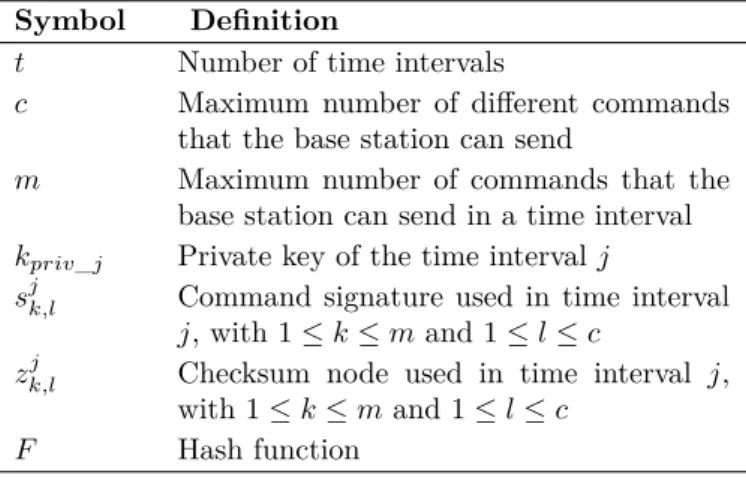
3.1 Delayed Authentication Compromise: Notation . . . . 55
3.2 Overheads of TASS, PTASS, and MASS . . . . 66
5.1 Fast and Secure Multi-hop Broadcast for IVC: Notation . . . . 92
5.2 FS-MBA Overhead . . . . 125
List of Figures
2.1 A Bloom Filter withn= 4, m= 16 and k = 3 . . . . 19
2.2 An example of a One Way Key Chain . . . . 19
2.3 µTESLA Scheme . . . . 23
2.4 An example of two level key chain mechanism (n0 = 3, andn1 = 3) . . . . 26
2.5 SML-µTESLA: An example of execution . . . . 31
2.6 MappingdMACs into a Bloom filter Vector. . . . 33
2.7 A scheme of state machine interpretation . . . . 37
2.8 Role receiver: Arrival of a data packet . . . . 39
2.9 Loss of Packets . . . . 39
2.10 Transmission of a data packet (SML-µTESLA) . . . . 41
2.11 Our Application Architecture . . . . 44
2.12 Authentication Probability . . . . 47
2.13 Authentication Probability versus attack rate and duration using TelosB motes 47 2.14 Authentication Delay. . . . 48
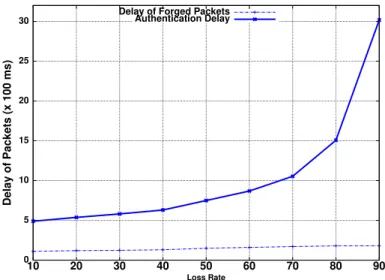
2.15 Average Number of Forged Packets in Multi-level-µTESLA using TelosB motes 48 2.16 Delay of Forged Packets in the Buffer . . . . 49
2.17 Delay of Forged and Authenticated Packets in Staggered Multi-Level µTESLA 50 2.18 Delay of Forged and Authenticated Packets in Multi-level µTESLA. . . . 50
3.1 Merkle Winternitz signature scheme to signm bits . . . . 57
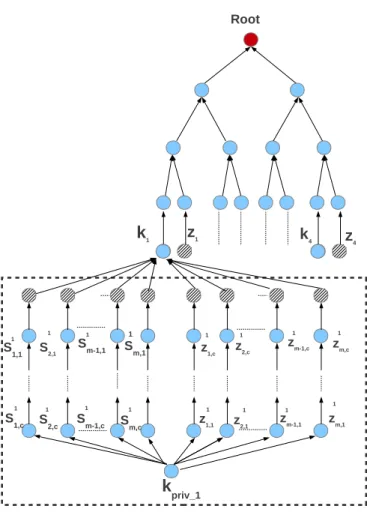
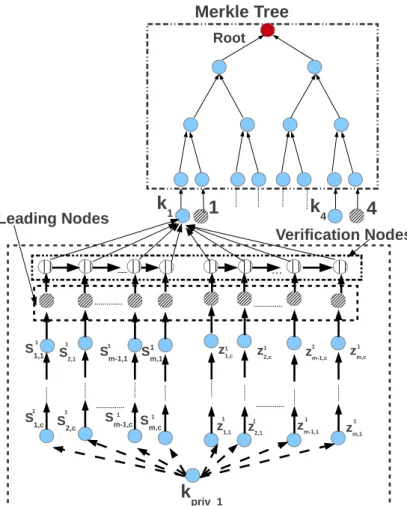
3.3 MASS Direct Acyclic Graph (t= 4) . . . . 62
3.4 MASS: Drop and Switch Command Attack Detection . . . . 64
3.5 Average Transmission Overhead for an Authenticated Message . . . . 67
3.6 Average Authentication Overhead for a Message . . . . 67
4.1 Architectural Model . . . . 72
4.2 Key Tree Generation by a sourceS . . . . 77
4.3 Energy Consumption in Communication . . . . 83
5.1 Contention window versus distance . . . . 95
5.2 Example of a fast broadcast algorithm . . . . 97
5.3 Impact of distance cheating on the waiting time. . . . 98
5.4 Example of enforcing non cooperation attack . . . . 100
5.5 Impact of a malicious forwarder node . . . . 101
5.6 Degrading performance attack executed bynmalicious vehicles . . . . 102
5.7 Scenario 1 - Case 1 . . . . 105
5.8 Scenario 1 - Case 2 . . . . 106
5.9 Scenario 1 - Case 3 . . . . 106
5.10 Scenario 1: Verifier waiting time versus distance . . . . 107
5.11 Scenario 2: Verifier waiting time versus distance . . . . 108
5.12 Scenario 3: Verifier waiting time versus distance . . . . 109
5.13 Verifier waiting time versus distance . . . . 109
5.14 Neighbor structure . . . . 110
5.15 Indirect neighbors structure . . . . 110
5.16 A modified structure ofHellomessage . . . . 111
5.17 Falsing list neighbors . . . . 115
5.18 Modified broadcast message . . . . 117
5.19 Stored Table . . . . 117
5.20 Example of non propagation of broadcast message . . . . 122
5.22 FMBA and FS-MBA under attacks: Average Number of Slots . . . . 131
5.23 FMBA: Retransmissions/Collisions . . . . 131
5.24 FMBA under Attack #1: Estimated transmission range . . . . 133
5.25 FS-MBA under Attack #1: Estimated transmission range . . . . 133
5.26 FMBA under Attack #1: Average of declared distance by the attacker . . . . 134
5.27 FMBA under Attack #1: Average Number of Hops. . . . 135
5.28 FMBA under Attack #2: Average Number of slots . . . . 136
5.29 FMBA under Attack #2: Percentage of Message Propagation to the end of the platoon . . . . 137
5.30 FMBA under Attack#3 with a Random Position of Malicious node: Percentage of Message Propagation . . . . 138
5.31 FMBA under Attack #3 with Malicious Node at the End of the Transmission Range of the First Sender: Percentage of Message Propagation . . . . 138
ABSTRACT
Wireless sensor and vehicular networks play an important role in critical military and civil applications, and pervade our daily life. However, security concerns constitute a po-tential stumbling block to the impeding wide deployment of sensor networks and vehicu-lar communications. This dissertation studies communication security for Wireless Sensor Networks (WSNs), and vehicular communication. To this aim, we address four important aspects. The first study addresses broadcast authentication in WSNs. We focus on key disclosure based schemes. We demonstrate that key disclosure delay induces an authenti-cation delay, which could lead to a memory DoS attack. We then propose two broadcast authentication protocols for WSNs, which overcome the security vulnerability of existing solutions. The proposed schemes guarantee the efficient management of receiver’s buffer, by employing a staggered authentication mechanism, and a Bloom filter data structure to reduce the communication overhead. We also validate our protocols under the AVISPA model checking tool, and we evaluate them with experiments under TinyOS. Our findings are that these protocols provide source authentication service while respecting the WSN constraints.
The second study addresses the storage issue in WSNs, in particular the Delayed Authen-tication Compromise attack (DAC). We first demonstrate that recently proposed schemes, which also address the DAC issue are vulnerable to two kinds of attacks: switch com-mand attack (where an adversary pretends to “switch” two messages over time), and drop command attack (where an adversary just pretends to “hide” a message sent from the broadcaster). As a countermeasure against these attacks, we propose a new solution for broadcast authentication. Our analysis shows that our solution is effective in detecting both switch command and drop command attack, and—at the same time—is more efficient (in terms of both communication and computation) than the state of the art solutions.
In the third study, we address key management security in WSNs. We present novel symmetric-key-based authentication schemes which exhibit low computation and communi-cation authenticommuni-cation overhead. Our schemes are built upon the integration of a reputation mechanism, a Bloom filter, and a key binary tree for the distribution and updating of the
au-thentication keys. Our schemes are lightweight and efficient with respect to communication and energy overhead.
The fourth study addresses security in vehicular communications. We focus on fast multi hop broadcast applications. We analyze the security threats of state of the art vehicular based safety applications. We demonstrate that these schemes are vulnerable to the posi-tion cheating attack, the replay broadcast message attack, and the interrupting forwarding attack. Then, we propose countermeasures for these threats. We hence propose a complete solution which is both fast and secure in broadcasting safety related messages: Fast and Secure Multi-hop Broadcast Algorithm (FS-MBA). Finally, we confirm the efficiency and feasibility of our proposals using an extensive set of simulations under NS-2 Simulator.
Keywords: Source Authentication in WSNs, Security, Secure Vehicular Communica-tions, Key management, Attacks.
RESUME
Les Réseaux de Capteurs Sans Fils (RCSFs) et les réseaux véhiculaires sont de plus en plus répandus, et déployés dans des domaines d’applications variés tels que la santé, la surveillance environmentale, les applications d’alerte d’accident, et les applications mili-taires. Cependant, ces réseaux peuvent être sujets à des attaques, ce qui empêche leur util-isation à grande échelle. Cette thèse étudie la sécurité des communications pour les réseaux de capteurs sans fils, et les communications inter-véhiculaires. Dans ce but, nous abordons quatre aspects importants. La première étude porte sur l’authentification des messages diffusés dans les réseaux de capteurs. Nous nous concentrons sur les principaux schémas à base de divulgation de clés d’authentification. Nous démontrons que le délai de divulgation de clé induit un délai d’authentification, ce qui pourrait conduire à une attaque de mémoire de déni de service. Nous proposons ensuite deux protocoles d’authentification de la source dans les RCSFs, pour surmonter la vulnérabilité des solutions existantes. Les schémas pro-posés garantissent la gestion efficace de la mémoire tampon du récepteur, en utilisant un mécanisme d’authentification par niveau, et une structure de Filtre de Bloom afin de ré-duire le coût de communication. Ensuite, nous validons nos protocoles en utilisant l’outil de vérification AVISPA, et nous les évaluons avec des expérimentations dans l’environment TinyOS. Nous confirmons que ces protocoles fournissent un service d’authentification de la source tout en respectant les contraintes de RCSFs.
La seconde étude porte sur le problème de stockage au niveau des capteurs. Nous con-sidérons en particulier l’attaque d’authentification différée “Delayed Authentication Com-promise” (DAC) dans les RCSFs, qui permet à un attaquant d’utiliser une clé déjà divulguée pour signer d’autres messages. Nous montrons d’abord que les systèmes récemment pro-posés qui sont résistants également à l’attaque DAC sont vulnérables aussi à deux types d’attaques: attaque de permutation de commandes (où un adversaire prétend “permuter” deux messages au fil du temps), et l’attaque de rejet de commandes (où un adversaire semble “cacher” un message envoyé par la station de base). Nous proposons ensuite une nouvelle solution d’authentification. Notre analyse montre que notre solution est efficace pour dé-tecter à la fois l’attaque de permutation de commandes et l’attaque de rejet de commandes, — et en même temps — est plus efficace (en termes de communication et de calcul) que les solutions existantes.
Dans la troisième étude, nous considérons le problème de la sécurité de la gestion des clés dans les réseaux de capteurs. Nous présentons de nouveaux schémas d’authentification à base de clés symétriques qui présentent un faible coût d’authentification et de commu-nication. Nos systèmes sont construits en intégrant un mécanisme de réputation, un fil-tre de Bloom, et un arbre binaire de clés pour la distribution et la mise à jour des clés d’authentification. Nos schémas d’authentification sont efficaces en matière de communica-tion et de consommacommunica-tion de l’énergie.
La quatrième étude porte sur la sécurité des communications véhiculaires. Nous nous concentrons sur les applications d’alerte d’accident. Nous analysons les menaces pour un ensemble d’algorithmes. Nous démontrons que ces systèmes sont vulnérables à l’attaque d’injection d’une fausse position, à l’attaque de rejeu de message d’alerte, et à l’attaque d’interruption de message d’alerte. Ensuite, nous proposons des contre-mesures à ces men-aces. Nous avons donc proposé une solution qui est à la fois rapide et sécurisée pour les applications d’alerte d’accident : Un algorithme rapide et sécurisé pour la diffusion des messages en multi-saut (FS-MBA). Enfin, nous confirmons l’efficacité et la faisabilité des différents protocoles en effectuant un ensemble de simulations sous le simulateur NS-2.
Mots-Clés : Authentification de la Source dans les RCSFs, Sécurité, Sécurisation des Communications Véhiculaires, Gestion des Clés, Attaques.
RESUME DETAILLE
Au cours des dernières décennies, il y a eu une croissance importante dans le domaine de l’informatique ubiquitaire et omniprésente. En particulier, l’informatique ubiquitaire vise à rendre “plusieurs ordinateurs disponibles dans l’environnement physique, mais aussi transparents pour l’utilisateur” [1]. Pendant cette période, les récents progrès des systèmes électro-mécaniques, de la communication sans fil et de l’électronique numérique ont facilité la production de petits appareils performants et pas chers, tels que les téléphones intel-ligents, les PDA, les systèmes d’identification par radiofréquence (RFID), les Réseaux de Capteurs Sans Fils (RCSFs), et de nombreuses autres technologies. Ces appareils mobiles sont capables d’effectuer diverses opérations complexes sans perdre de vue les besoins des utilisateurs. Les appareils sont utilisés dans de grandes variétés d’applications telles que la surveillance de la santé, les systèmes de diagnositc, les alarmes de sécurité, la communication véhiculaire et la surveillance de l’environnement.
Dans de nombreux scénarios d’application, la sécurité est un besoin essentiel. Dans cette thèse, on se focalise sur la sécurité des communications dans les réseaux de capteurs sans fils (RCSFs), et les communications inter-véhiculaires. Nous allons mettre l’accent sur les exigences en sécurité pour ces deux types de technologies, et par la suite nous allons aborder les différentes motivations qui permettent de sécuriser les RCSFs et les communications inter-véhiculaires.
Authentification de la source L’authentification de la source des messages de diffusion d’une station de base à des capteurs est le paradigme le plus commun dans les réseaux de capteurs sans fil. Cette authentification est trés importante, car elle permet à la station de base de diffuser des requêtes et des messages aux capteurs et d’exploiter ainsi efficacement le réseau de capteurs sans fil. L’authentification permet aux récepteurs de vérifier que les messages reçus proviennent de la source prétendue, et n’ont pas été modifiés en cours de route. Le problème devient plus complexe dans le cas où d’autres récepteurs de données sont non fiables, et où les paquets perdus ne sont pas retransmis. L’authentification de la source des messages diffusés est donc l’un des services de sécurité les plus importants dans ces réseaux [2–8].
Un réseau de capteurs peut être déployé dans des environnements hostiles où il y a des attaques malveillantes. Dans une telle situation, la sécurité devient une des
préoc-cupations majeures. En tant que service de sécurité fondamental, l’authentification de la source des messages diffusés permet à un expéditeur de diffuser des données critiques et/ou des commandes de noeuds de capteurs d’une manière authentifiée. Par exemple un at-taquant est incapable d’intercepter un message de l’expéditeur [9–15]. Toutefois, en raison des contraintes de ressources sur les noeuds de capteurs, les techniques d’authentification traditionnelles telles que les signatures numériques basées sur des clés publiques ne sont pas souhaitables. Dans [16], les auteurs ont développé µTESLA pour l’authentification de la source des messages diffusés dans les réseaux de capteurs basée sur la cryptographie symétrique, ce qui élimine la dépendance à la cryptographie à clé publique. Plusieurs sché-mas à base du protocole µTESLA ont été proposés pour étendre la capacité de protocole
µTESLA [4–7, 17]. Malgré ces progrès récents, plusieurs questions ne sont toujours pas correctement traitées.
• Authentification Immédiate des Messages. Les schémas à base de µTESLA souffrent d’un retard d’authentification, en raison du retard de divulgation de la clé d’authentification. Ce processus se réfère à une asymétrie temporelle, où la clé est secrète au niveau de la station de base, et elle sera divulguée après certains intervalles de temps (délai de divulgation), rendant ainsi la clé publique. Dans ce scénario, les travaux dans [7, 18] prouvent que ces mécanismes sont vulnérables contre certaines attaques comme celles de déni de service.
• Résistance aux Attaques de Déni de Service (DoS). Un attaquant peut lancer les attaques DoS sur les messages pour surcharger la mémoire tampon, et il ex-ploite le délai d’authentification des messages pour intercepter des paquets de don-nées. Bien que plusieurs solutions aient été proposées dans [7], celles-ci utilisent une bande passante importante ou bien nécessitent d’importantes ressources au niveau de l’expéditeur (en utilisant par exemple les énigmes cryptographiques) [19].
• Coût de Communication. Comme les capteurs ont des ressources limitées, le coût de communication est crucial. Ainsi, pour concevoir un système d’authentification efficace dans ces réseaux, le coût de communication doit être réduit.
L’Attaque de Délai d’Authentification Les schémas d’authentification qui se basent sur les mécanismes deµTESLA entraînent une vulnérabilité qui peut conduire à une attaque appelée ”Delayed Authentication Compromise”(DAC). Considérons le scénario suivant: le récepteur doit identifier les messages reçus, de telle sorte que l’attaquant ne puisse pas modifier successivement les messages. Les mécanismes à base de divulgation de clé, ou bien à base de µTESLA ne sont pas candidats à être utilisés dans un tel scénario. En effet, dès que la clé est divulguée, l’attaquant peut utiliser cette clé pour modifier les messages enregistrés. Dans [18], ce processus d’attaque désigne l’attaque DAC. L’adversaire peut utiliser une clé déjà divulguée pour signer par exemple la commande “ouvrir une porte”, et l’enregistrer dans la mémoire d’un actionneur compromis. Une fois que la porte est ouverte, il sera difficile de prouver avec certitude ce qui a été compromis. Si la station de base est déclarée honnête, alors nous pouvons affirmer que le noeud est malveillant, mais si la station
de base elle-même peut être compromise, alors il n’est pas possible de déterminer qui est le malveillant, le noeud ou la station de base. Afin de contrer ces attaques du DAC, les auteurs dans [18] proposent trois algorithmes appelés PASS, TASS et PTASS. Cependant, plusieurs questions ne sont toujours pas correctement traitées.
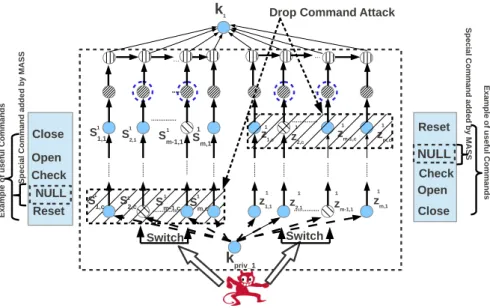
• Attaque de Suppression de Commande. Un noeud malveillant peut facilement supprimer/rejeter une commande transmise par la station de base. Un noeud récep-teur ne pourra pas détecter si la station de base n’a pas envoyé une commande, ou bien si la commande a été supprimée par un noeud malveillant.
• Attaque de Permutation de Commande. Les protocoles (TASS et PTASS) sont également vulnérables à l’attaque de permutation de commande qui vise à changer l’ordre des messages envoyés par la station de base. Prenons le scénario où la station de base doit envoyer la commande “initialiser” suivie par la commande “fermer la porte”, tandis que l’attaquant souhaite ouvrir la porte. En utilisant TASS et PTASS, le noeud malveillant est capable de changer l’ordre des commandes, poussant le récepteur à exécuter la commande “fermer la porte”, puis d’exécuter la commande “initialiser”, ce qui va rouvrir la porte.
• Authentification Immédiate des Messages. En utilisant le protocole TASS, le récepteur doit attendre la fin d’un intervalle de temps afin d’authentifier les mes-sages reçus. Cela peut conduire également à des attaques DoS. PTASS propose un moyen d’envoyer des messages de haute priorité qui sont immédiatement authentifiés. Toutefois, cette fonctionnalité engendre une augmentation de la communication et de la transmission.
Dans de nombreuses applications, il est important de protéger les communications entre les noeuds de capteurs pour maintenir l’authentification, la confidentialité et l’intégrité.
En particulier, les efforts de recherche pertinents ont abordé la technique de clé de groupe afin de localiser le calcul, et aussi pour diminuer les coûts de communication dans les réseaux de capteurs sans fil [20]. La technique à base d’un arbre de clés est utilisée pour sécuriser les communications de groupe. Plusieurs techniques de gestion sécurisée de clé de groupe ont été proposées pour sécuriser les communications multicast [21, 22]. Dans un système de gestion de clé de groupe typique [23], il y a un tiers de confiance, dit centre de distribution de clés (KDC). Cette entité unique et fiable est responsable de la génération et de la distribution de clés aux membres de groupe. Dans [21], les auteurs proposent un système de gestion de clés de groupe se basant sur une hiérarchie des clés topologiques. Il génère un arbre de clés en se référant à la topologie de réseau de capteurs. Dans [24, 25], les auteurs proposent un polynôme de degré t avec le terme constant du polynôme étant la clé secrète, en calculant t termes distincts du polynôme et les stockant. Dans [26], les auteurs ont conçu un système utilisant un arbre de clé pour gérer les membres du groupe. Par ailleurs, dans [26], la technique de clé de groupe repose sur une refonte de système de groupe centralisé basé sur l’arbre logique de clés dans les réseaux de capteurs. Cette technique n’est pas pratique pour les réseaux de capteurs, puisqu’elle utilise des opérations complexes.
Bien que de nombreux travaux dans [9,11] aient proposé des mécanismes d’authentification de la source dans les réseaux de capteurs sans fil, le problème est toujours difficile puisqu’il faut réaliser un compromis entre la sécurité et les ressources de calcul limitées.
Sécurité des communications inter-véhiculaires On s’intéresse dans cette thèse à la sécurité des communications entre véhicules. En effet, la communication entre véhicules est parmi les applications les plus prometteuses [27, 28]. De nombreuses applications sont possibles, en particulier, les systèmes d’alerte de dangers.
En résumé, plusieurs algorithmes de diffusion multi-sauts ont été proposés. Ces algo-rithmes partagent généralement un ensemble de propriétés, se situant dans une même classe de solutions. Malheureusement, ils ont tous été développés sans tenir compte des aspects de sécurité. La sécurité est un problème fondamental, qui ne devrait pas être négligé [29]. En effet, les attaquants pourraient exécuter des actions malveillantes pour injecter des fausses informations ou de fausses alarmes.
Contributions Les principales contributions de cette thèse se résument comme suit. • Contribution 1 : Authentification de la source des messages diffusés dans
les RCSFs. Nous identifions le problème de l’authentification de la source des mes-sages diffusés dans les RCSFs. Nous détectons une vulnérabilité de sécurité pour les protocoles à base de clé symétrique qui se basent sur µTESLA. Cette vulnérabilité pourrait conduire à une attaque de déni de service affectant la mémoire des capteurs. Nous proposons ensuite plusieurs schémas à clé symétrique permettant de limiter les impacts de cette attaque. Nous atteignons notre objectif en intégrant plusieurs tech-niques telles que le mécanisme d’authentification par niveau afin de réduire le nombre de paquets forgés dans le tampon de récepteur. Nous concevons un système basé sur un filtre de Bloom qui permet de concevoir un protocole avec un coût de communi-cation faible. Nous validons formellement nos solutions de sécurité, et nous évaluons leurs performances sous le simulateur TOSSIM. Cette contribution est présentée dans le Chapitre 2.
• Contribution 2 : Authentification différée dans les RCSFs. Tout d’abord, nous montrons que les protocoles existants qui sont résistants à l’attaque DAC sont soumis à deux attaques possibles : l’attaque de rejet/suppression de commandes, et l’attaque de permutation de commandes. Deuxièmement, nous proposons une nouvelle solution qui est résistante à l’attaque DAC, à l’attaque de rejet/suppression et à l’attaque de permutation de commandes. En plus, notre solution est plus efficace par rapport à l’état de l’art, ce qui permet également l’authentification immédiate des messages. Cette contribution est bien détaillée dans le Chapitre 3.
• Contribution 3 : Communications du Groupe dans les RCSFs. Le problème de la fourniture de l’authentification de la source dans les RCSFs a été un obstacle pour leur déploiement à grande échelle. Nous présentons un schéma basé sur une clé
symétrique ayant un faible coût de calcul et de communication. Nos systèmes sont construits en intégrant un mécanisme de réputation, un filtre de Bloom, et un arbre binaire de clés pour la distribution et la mise à jour des clés d’authentification. Nos schémas sont efficaces en matière de communication et de consommation d’énergie. Cette contribution est décrite dans le Chapitre 4.
• Contribution 4 : Sécurité des communications entre véhicules. Nous analysons la sécurité d’un algorithme représentant la diffusion rapide multi-saut (FMBA) [30,31] comme un état de l’art des applications de sécurité basées sur les communications en-tre véhicules. Nous proposons des conen-tre-mesures pour gérer les menaces de sécurité. En particulier, nous nous concentrons sur l’une des principales menaces: la possibilité d’attaquer le protocole pour entraver son fonctionnement. Nous identifions les prob-lèmes et proposons des contre-mesures possibles. Les solutions proposées et identifiées pour FMBA peuvent être également adaptées à d’autres protocoles/algorithmes, ap-partenant à la même catégorie générale d’applications. Cette contribution est bien détaillée dans le Chapitre 5.
Introduction
Over the last few decades there have been tremendous developments in the area of per-vasive and ubiquitous computing. In particular, the ubiquitous computing aims to make “many computers available throughout the physical environment, but making them effec-tively invisible to the user” [1]. During this era, recent advances in Micro Electro Mechanical Systems (MEMS), in wireless communication and in digital electronic made it possible to produce small, cheap and “smart” devices such as smart-phones, PDAs, Radio Frequency IDentification systems (RFID), Wireless Sensor Networks (WSNs), and many other tech-nologies. These portable devices are capable of performing various complex operations while keeping in view the needs of users. These devices are being used in wide varieties of applications such as health monitoring, diagnostic systems, safety alarms, vehicular com-munication, and environment monitoring.
Moreover, annually, road crashes result in almost 120000 fatalities and 2.4 million in-juries in the European Region [32]. Road traffic inin-juries represent the leading cause of death among adolescents and young adults [33], and the economic burden of road crashes is as much as 3% of gross domestic product. Nevertheless, many effective preventive strategies exist [32]. Therefore there is potential to take up the challenge and reduce the burden of road traffic injuries. The basic approach consists of using advanced technologies that can prevent vehicles from being involved in accidents. In this direction, one of the most promis-ing techniques is based on the use of inter vehicular communication (IVC) [27,28,34]. Many applications are possible in this context, yet local danger warning systems remain the most prominent ones. Secure communication is a crucial aspect that must not be overlooked. Indeed, attackers might run malicious actions to inject false information or alarm, thus rendering ineffective the safety application [35–41].
In this thesis, we focus on the security issues of Wireless Sensor Networks and vehicular communications [42–44], introduced in the following section.
1.1 Wireless Sensor Networks and Vehicular Communications
1.1.1 Wireless Sensor Networks
In this thesis, a sensor device is a small device that is able to sense environmental data (sound, light, temperature, etc.). The device is also able to communicate with other sensor nodes in its communication range and compute the sensed/received data. A set of these sensor devices deployed in a given area constitutes a network with no pre-established archi-tecture, also called Wireless Sensor Network (WSN). The usefulness of this type of network comes from the collaboration of a big amount of nodes. In a WSN hundreds or thousands of nodes are usually deployed in a large area where they can sense data, compute and communicate the collected data in a very efficient and distributed way. Sensor nodes are different compared to other traditional wireless devices, they do not communicate directly with a Base Station (BS)- a device that does not have the limitations of a sensor node-but mainly with other sensor nodes. The sensed data are locally computed and forwarded to the BS. WSN applications are in different fields: building surveillance, battlefield moni-toring, fire prevention, and so on. Most WSN applications require security (confidentiality, integrity, authenticity, and availability) as a fundamental building block. If we consider a WSN deployed in order to detect an area, e.g, for the detection of poisonous gas that could potentially be released during a concert or a big sport event. In this scenario, if the network is not secure we could have worse damages. In order to develop useful security mechanisms, it is necessary to know and understand the constraints of WSNs first. In the following, we present the challenges specific to WSNs.
Challenges The following features (resource constraints, unreliable communication, net-work constraints, and vulnerability to novel attacks) make it particularly challenging to protect communication security in WSNs.
• Resource Constraints. In WSNs, the nodes are battery-powered, thus they only have a limited energy supply. This again requires the security design to be efficient re-garding both communication and computation overheads. In most cases, sensors only have very limited memory, which further narrows down the security design choices. All these resource constraints require that the security design can only be efficient and lightweight; otherwise it will not be practical for WSNs.
• Unreliable Communication. Unreliable communication is another threat to sensor security. The security of the network relies heavily on a defined protocol, which in turn depends on communication.
– Unreliable Transfer. Normally the packet-based routing of the sensor network is connection less and thus inherently unreliable. Packets may get damaged due to channel errors or dropped at highly congested nodes. The result is lost or missing packets. Furthermore, the unreliable wireless communication channel also results in damaged packets. A higher channel error rate also forces the software developer to devote resources to error handling. More importantly, if
the protocol lacks the appropriate error handling it is possible to lose critical security packets. This may include, for example, a cryptographic key.
– Conflicts. Even if the channel is reliable, the communication may still be un-reliable. This is due to the broadcast nature of the wireless sensor network. If packets meet in the middle of transfer, conflicts will occur and the transfer itself will fail. In a high density sensor network, this can be a major problem. More details about the effect of wireless communication can be found at [45].
– Latency. Multi-hop routing, network congestion, and node processing can lead to greater latency in the network, thus making it difficult to achieve synchroniza-tion among sensor nodes. The synchronizasynchroniza-tion issues can be critical to sensor security where the security mechanism relies on critical event reports and cryp-tographic key distribution. Real-time communication issues in wireless sensor networks are discussed in [46].
• Network Constraints. Wireless networks use wireless open channels, therefore an adversary can easily eavesdrop on all the network communications, as well as arbi-trarily injecting messages and launching jamming attacks at different network layers. This means that the security design has to take into account both passive and active attacks. Wireless Sensor Networks are distributed in nature, therefore centralized security solutions cannot be an option. This also means that these environments are vulnerable to various DoS attacks. WSNs in particular are often very large in scale, which in turn imposes scalability requirements on the security design of WSN applications.
• Malicious attacks. WSNs are prone to several kinds of novel attacks as stated in Section 1.3. For instance, an adversary could inject some bogus information in the network and let the honest nodes believe that it is an authentic participant in the network, thereby acquiring all the information traversed in the network.
In the following, we present vehicular communications systems and some major challenges specific to this technology.
1.1.2 Vehicular Communications
Vehicles will be equipped with novel computing, communications, and sensing capabili-ties. These will increase and support a number of applications that enhance the transporta-tion safety and efficiency. A key aspect of vehicular communicatransporta-tions systems is to expand the time horizon of information relevant to driving safety. Based on their own sensing and on information received from nearby peers and Road-Side-Units (RSUs), vehicles can an-ticipate, detect, and avoid dangerous situations. For example, messages about accidents, timely notifications about upcoming lane changes, and alerts about unsafely approaching vehicles, can be highly beneficial. Interconnected vehicles not only collect information about themselves and their environment, but they also exchange this information in real time with
other vehicles. Security is a fundamental problem in this context which should not be over-looked [29]. Indeed, attackers might run malicious actions to inject false information or alarm, thus rendering ineffective the safety application [35–41]. In the following, we discuss some major constraints of vehicular communications that could affect security.
Challenges The user requirements, the operational conditions, and constraints on ve-hicular communication systems make security a hard problem [47]. The most significant challenges specific to the vehicular communications range from network volatility, to liability and privacy, delay-sensitive applications, and heterogeneity.
• Network Volatility. Let us consider two vehicles traveling on the highway that may remain for a limited period of time, within a few wireless hops, or within their transceiver range. This means that vehicular networks lack the relatively long-lived context. As a result, password-based establishment of secure channels, gradual de-velopment of trust by using a circle of trust, or secure communication only with a handful of endpoints, may be not practical for securing vehicular communication. • Heterogeneity. Security solutions should retain flexibility, efficiency, and
operabil-ity. Vehicular communication technologies as well as their supported applications are various and heterogeneous. Nodes are possibly equipped with external devices as Ge-ographical Positioning Service (GPS), digital audio, or cellular transceivers. A secure solution should be inter operable.
• Delay-Sensitive Applications. Safety applications impose strict deadlines for mes-sage delivery and are time-sensitive. Security design must take these constraints into consideration. Protocols should be lightweight and robust to denial of service (DoS) attacks. An adversary can generate a high volume of bogus information and consumes resources, which could result in message delay.
• Liability vs. Privacy. Vehicular communication is envisioned as an excellent op-portunity to obtain hard-to-refute data that can assist legal investigation, (e.g., in car accidents). The identification of the vehicles as sources of messages should be possible and without ambiguity. Moreover, informations related to coordinates, time intervals, and associated vehicles, should be possible to extract.
• Scalability. An important challenge is the scale of the network, which is roughly a billion of vehicles around the world. This makes the design to provide cryptographic keys a challenge, taking into account that there are also various authorities governing transportation systems. Moreover, the security scheme should take into account the existence of collisions or retransmissions when the vehicle density increases.
All the malicious attacks, and the specific features interleaved together, impose many challenging requirements for the security design in WSNs and vehicular communications. Sophisticated techniques and careful design are demanded to balance among all these com-peting and sometimes even conflicting requirements as desired by the WSN applications or vehicular applications.
In the following, we report an overview of security issues in Wireless Sensor Networks and vehicular communications [42–44]. In particular, Section 1.2 presents the typical secu-rity requirements under the context of WSNs and vehicular communications. Section 1.3 describes the main attacks in WSNs and vehicular communications. Section 1.4 presents some of the main defensive measures. Section 1.5 presents the contributions of our work. The following chapters of this thesis provide a deeper discussion of some aspects presented in these sections.
1.2 Security Requirements and Related Issues
In the following, we report the major security requirements and related issues for WSNs and vehicular communications [42–44, 48].
Confidentiality Data confidentiality is an important issue in network security. Con-fidentiality ensures that the content of the message being transferred is never disclosed to unauthorized entities. Network transmission of sensitive information, such as military information, requires confidentiality.
When we focus on sensor networks, the confidentiality relates to the following:
• In many applications nodes communicate highly sensitive data, e.g., key distribution, therefore it is important to build a secure channel in a wireless sensor network. • A sensor network should not leak sensor readings to its neighbors.
• To protect against traffic analysis, public sensor information such as sensor identities and public keys, should be encrypted.
To achieve confidentiality, a standard approach is to encrypt the data with a secret key that is only intended for a receiver to possess.
Authenticity Authenticity enables a node to make sure the identities of its communi-cating entities. Thus, an adversary could not masquerade another entity, and disseminate forged messages [44]. An adversary can inject additional packets. So the receiver needs to ensure that the data originates from the correct source. Moreover, the authentication ser-vice is necessary for many administrative tasks (e.g., network reprogramming or controlling sensor node duty cycle). Message authentication is crucial for many applications in sensor networks and vehicular communications. Data authentication can be achieved through a purely symmetric mechanism in case of two-party communication. In this case, the sender and the receiver share a common secret key to compute the Message Authentication Code (MAC) of all communicated data. In a multicast scenario, this approach is not feasible. Thus some approaches have been proposed in WSNs. Adrian Perrig et al. propose a key chain distribution system calledµTESLA [13,49]. The basic idea ofµTESLA is to use a key chain to generate and disclose authentication keys. Moreover, in µTESLA, initially before the authentication of broadcast messages, some initial information must be unicast to each
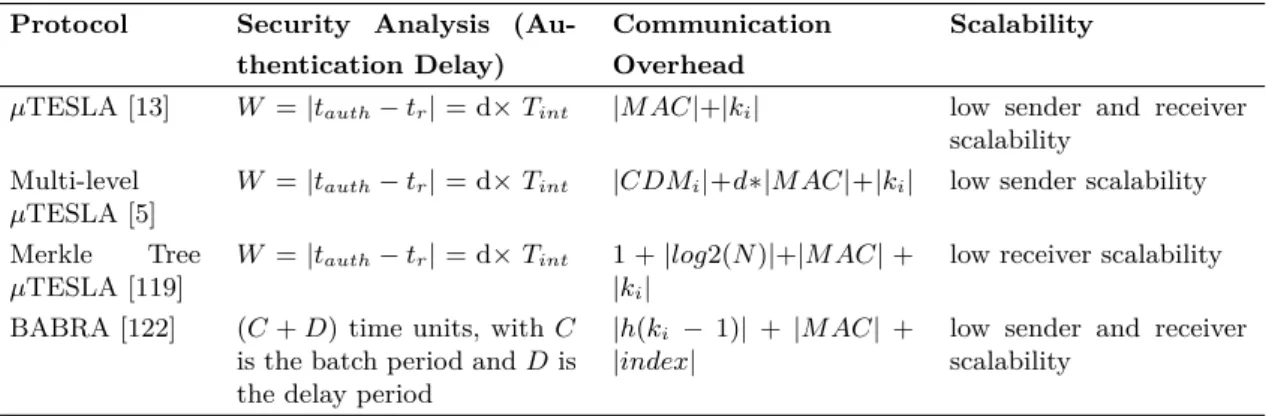
sensor node. Liu and Ning [5] propose Multi-level-µTESLA that broadcasts the key chain commitments rather than using µTESLA’s unicasting technique.
Integrity Integrity ensures that a message being transferred is never corrupted or mod-ified by an adversary without being detected. An adversary may be unable to steal infor-mation with the implementation of confidentiality. However, this does not mean the data is safe. In fact, the adversary can change the data. For instance, a malicious node may add some fragments or manipulate the data within a packet, and this new packet can then be transmitted to the original receiver. Data loss or damage can even occur also due to harsh communication environment, and without the presence of a malicious node. Thus, integrity ensures that any received data has not been altered in transit.
Data Freshness Data freshness means that the data is recent, and that it ensures that no old messages have been replayed. Even when confidentiality and integrity services are provided, we need to ensure the freshness of each message. For instance, shared-key ap-proaches need data freshness, and the keys should be changed over time. As it takes time for the new shared keys to be propagated to the entire network, an adversary can use a replay attack. Thus, it is easy to disrupt the normal behavior of the node, when the node is not aware of the new key change time. A standard approach to solve this problem is to add a nonce, or another time-related counter, to ensure data freshness.
Availability Availability ensures the survivability of network services despite denial of service (DoS) attacks [7]. A DoS attack could be launched at any layer of the network and could be of various forms. At the network layer, an adversary could disrupt the routing protocol and disconnect the network. At the application layer, an adversary may bring down high-level services such as network broadcast and multicast. Despite the importance and the spread of WSNs and vehicular communications, providing satisfactory security protection has never been an easy task. This is because WSNs not only suffer from various malicious attacks; but also are subject to many resource and network constraints as compared to traditional wireless networks.
In a WSN environment, adjusting traditional encryption algorithms to fit within the network will introduce some extra costs [7]. To this aim, some approaches modify the code to reuse as much code as possible. Other approaches make use of additional communication to achieve the same goal. Some approaches force strict limitations on the data access, or propose a central point scheme to simplify the algorithm. However, these approaches are not feasible in WSNs and weaken the availability of a sensor network. The first reason is that additional computation consumes additional energy, and the data will be no longer available when the battery of the sensor is depleted. The second reason is that additional communication also consumes more energy. A third reason is that a single point of failure will be introduced if using the centralized scheme. This threatens the availability of the network and motivates the research on security.
Time Synchronization Most wireless network applications, often require a scalable time synchronization service enabling data consistency and coordination [50]. In sensor network applications, in order to conserve power, an individual sensor’s radio may be turned off for periods of time. In [51], the authors propose a flooding time synchronization proto-col (FTSP), especially tailored for applications, requiring stringent precision on resource limited wireless platforms. The FTSP protocol uses periodic flooding of synchronization messages. It is based on using MAC-layer time-stamping and comprehensive error compen-sation including clock skew estimation. The first version of the protocol FTSP was first implemented on the Berkley Mica2 platform, and then on TelosB motes [52].
Self Organization Self Organizing a network with specific assignment of roles and tasks to the devices based on their wireless connectivity or sensing characteristics is an impor-tant problem [53]. Self organization involves abstracting the communicating entities into an easily controllable network infrastructure. Cluster or connected dominating set, tree, grid, or mesh based organizations are typical. For example, in a sensor network, the dynamics of the whole network inhibits the idea of pre-installation of a shared key between the base station and all sensor nodes [54]. Thus, the nodes must self-organize to conduct key man-agement and build a trust relation among them. In the context of symmetric encryption techniques [54, 55], several random key pre-distribution schemes have been devised. More-over, in the context of public-key distribution, several public-key cryptography techniques have been proposed. Self organization is very necessary since when this service is lacking in a network, the damage resulting from an attack may be devastating.
1.3 Attacks
In this section, we give an overview of some attacks on wireless sensor networks, and vehicular communications.
Attacks on Wireless Sensor Networks Sensor networks are particularly vulnerable to several types of attacks. Attacks can be performed in a variety of ways ranging from denial of service to delayed authentication compromise, physical attacks, sybil attacks, wormhole attacks, and so on. In the following, we present some major attacks on WSNs, that could also be applied to vehicular communications.
• Denial of Service Attacks.
A standard attack is simply to jam a node or a set of nodes. Jamming consists in this case to the transmission of a radio signal that interferes with the radio frequencies being used by the network [56]. There are two forms of jamming a network: Constant jamming and Intermittent jamming. The former (Constant jamming) involves the complete jamming of the entire network. No messages are able to be sent or received. In Intermittent jamming, nodes are able to exchange periodically but not consistently.
This can have an impact on the sensor network when exchanged messages between nodes are time sensitive [56].
Denial of service attacks assume a particular importance in wireless sensor networks, where it is not possible to afford the computational overhead necessary in implement-ing many of the typical defensive strategies of traditional computimplement-ing. Attacks can be made on the link layer itself. For instance, an attacker may simply intentionally vio-late the communication protocol, e.g., ZigBee [57], or IEEE 801.11b (Wi-Fi) protocol, and then transmit messages continually in an attempt to generate collisions. Thus, the collisions would require the retransmission of any packet affected by the collision. Using this technique, an attacker can easily deplete a node’s power supply by doing many retransmissions.
The routing layer is also susceptible to DoS attacks. A node can take advantage of a multi hop network by simply refusing to route messages constantly or intermittently. In the transport layer, the malicious node can opt to flooding. Flooding can be as simple as sending many connection requests to a susceptible node. In this case, resources must be allocated to handle the connection request. As a result, the node’s resources will be exhausted. Finally, a denial of service attack can be performed against the specific application level protocol.
We address the DoS attack in Chapter 2, and we demonstrate that authentication delay inµTESLA based schemes could lead to a memory DoS attack. In Chapter 5, we address also this kind of attack when analyzing the security threats to a state of the art multi-hop broadcast algorithm for vehicular communications.
• Delayed Authentication Compromise Attack. In order to present the delayed authentication compromise attack, let us consider the scenario when the receiver needs to log the received messages, in such a way that an attacker cannot successively modify the messages. Key disclosure based schemes (µTESLA based schemes) are not candidates to be used in such scenario. Indeed, as soon as the key is disclosed, the attacker may use that key to modify the logged messages. In [18], this attack process refers to Delayed Authentication Compromise (DAC) attack. The adversary may use an already disclosed key to sign for instance the command “open the valve”, and save it in the memory of a compromised actuator. Once noticed that the valve has been opened, it will be difficult to prove with certainty who has been compromised. If the base station is trusted, we can state that the node is cheating; however if the base station itself can be compromised, then it is not possible to determine who is cheating, the node or the base station. We present the DAC attack in Chapter 3, and we demonstrate that several issues are still not properly addressed.
Attacks on Vehicular Communications The major attacks on vehicular communi-cations could be classified into Bogus Information, Cheating Positioning information, ID disclosure of other vehicles, Denial of Service, and Masquerade [39]. In the following we present a brief overview of these attacks.
• Bogus information. One or several legitimate members of the network send out false information to misguide other vehicles about traffic conditions. In order to cope with such misbehavior, the received data from a given source should be verified by correlating and comparing them with those received from other sources.
• Cheating on positioning information. Injection of a false position by a malicious vehicle pretending to be at a claimed position.
• ID disclosure of other vehicles. This is to track their location. A global entity can monitor trajectories of targeted vehicles and use this data for many purposes, we could take the example of some car rental companies that track their own cars. • Denial of Service. Wood and Stankovic define the denial of service attack as “any
event that diminishes or eliminates a network’s capacity to perform its expected func-tion” [56]. The attacker may want to bring down the Inter-Vehicular Communication (IVC) or even cause an accident. Example of attacks include channel jamming and aggressive injection of dummy messages.
• Masquerade. The attacker claims to be another vehicle by using false identities. In Chapter 5, we study a state of the art algorithm for vehicular safety, and we demonstrate its vulnerability to different attacks.
1.4 Defensive Measures
A set of security primitives should be included to solve the security problems, and im-prove the robustness and reliability of the network. In order to create secure communication channels, a set of cryptographic primitives is needed; and the security credentials used by those primitives must be distributed using key management systems [62]. Moreover, addi-tional services such as trust management and self-healing should exist [63, 64]. They can help to protect the core protocols of the network: routing, time synchronization, and aggre-gation. Finally other aspects such as distributed computing, secure location, secure mobile base station location need to be protected, if included inside a sensor network.
In this section, we describe some of the main security defensive measures ranging from key establishment, which lays the foundation for different security aspects, to more specific measures.
Key Establishment One security aspect that deserves an important attention in net-works is the area of key management [65–69]. In traditional netnet-works, key establishment is done using public-key protocols such as the Diffie-Helman protocol [70]. Most of the tradi-tional techniques, however, are unsuitable in low power devices. Wireless sensor networks are unique in this aspect due to their size, mobility, and computational/power constraints. This, coupled with the typical operational constraints of WSNs, makes secure key man-agement an absolute necessity in most wireless sensor network designs. The problem with
asymmetric cryptography in WSNs, is that it is typically too computationally intensive for the individual nodes in a sensor network. Different researchers show that it is feasible to implement asymmetric cryptography, with the right selection of algorithms [44,71–73]. Two of the most used techniques to implement public-key cryptosystems are RSA and Elliptic Curve Cryptography (ECC) [74]. In [73], Malan et al. demonstrate a working implementa-tion of Diffie-Hellman based on the Elliptic Curve Discrete Logarithm Problem.
Despite the actual use of implementation of asymmetric cryptography on sensor devices, symmetric cryptography induces low computational complexity compared to asymmetric cryptography. Symmetric cryptography based schemes use a single shared key known only between the two communicating parties. One major shortcoming of symmetric cryptography is the key exchange problem: Two communicating hosts must somehow know the shared key before they can communicate securely. One case is that all nodes share the same master key, thus when a node is compromised, all the communications are also compromised. A second case, when all the pair of nodes share a different symmetric key. As a result, each node has to store a huge amount of keys. Different approaches of random key pre-distribution schemes have also been proposed to resolve the problems related to these two cases [23,54,69,75,76]. Relevant research efforts addressed the group key technique in order to localize compu-tation, and also to decrease communication overhead in wireless sensor networks [20], for example in situational awareness, border protection, asset tracking, and digital battlefield. Key tree structure is considered in previous literature to secure group communications. Several secure group key management techniques have been proposed to support secure multicast [21, 22]. In a typical group key management scheme [23], there is a trusted third party, known as Key Distribution Center (KDC). This single trusted entity is responsible for generating and distributing keys securely to the group members. In [21], authors propose a group key management scheme called Topological Key Hierarchy (TKH). It generates a key tree by using the sensor network topology with consideration of subtree-based key tree separation and wireless multicast advantage. In [26], the authors conceived a scheme using a key tree to manage group members. Their technique reposes on a centralized group rekeying scheme, and it is based on logical key tree. Their scheme is based on a group key management, that is not practical in sensor networks since it uses complex operations. Although many works in [9, 11] discussed source authentication in wireless sensor networks, and especially group key for secure group communications, the problem is still challenging because we have to manage the trade-off between acceptable levels of security and, con-serving scarce resources, in particular energy needed for network operations. We focus on Chapter 2 on key disclosure based schemes for source authentication service. In Chapter 4, we present security protocols based on group key management.
Defending Against DoS Attacks One strategy in defending against the classic jamming attack is to identify the jammed part of the network and effectively route around the unavailable portion. Wood and Stankovic [56] describe a two-phase approach where the nodes along the perimeter of the jammed region report their status to their neighbors who then collaboratively define the jammed region and simply route around it. At the MAC
layer, nodes might use a MAC admission control that is rate limiting to handle jamming. The network will ignore those requests designed to exhaust the power supply of a node. However, this is not fool-proof as the network must be able to handle any legitimately large traffic volume. A sending node can send the message along multiple paths to increase the likelihood that the message will eventually arrive at its destination. This has the advantage of effectively dealing with nodes that may not be malicious, but rather may have simply failed as it does not rely on a single node to route its messages.
In the transport layer, in order to resolve the flooding denial of service attack, authors in [77] propose a mechanism that uses client puzzles. The aim is to discern a node’s commitment to make the connection by using some of their own resources. Aura et al. [77] suggest that a server should force a client to commit its own resources first. This strategy would likely be effective as long as the client has computational resources comparable to those of the server.
In Chapter 2, we address the memory DoS attack in WSNs. Then, we propose a new and secure broadcast authentication scheme. Our proposal uses a staggered authentication mechanism applied to WSNs. We address also three types of attacks in vehicular commu-nications in Chapter 5, that could be classified as a Denial of Service attacks. We propose efficient countermeasures to mitigate the impact of these three attacks in Chapter 5.
Defending Against the Delayed Authentication Compromise Attack In order to be resilient against DAC attacks, the authors in [18] propose three algorithms called Partially Accountable Signature Scheme (PASS), Totally Accountable Signature Scheme (TASS), and Prioritized Totally Accountable Signature Scheme (PTASS). PASS works only in particular cases, while TASS and PTASS are more widely applicable. In fact, the main idea behind these two protocols is as follows. The time is divided in intervals. Moreover, the protocols associate the authentication key both to the time interval and to the message content. The base station builds a Direct Acyclic Graph (DAG) composed by a Merkle Tree and several Merkle-Winternitz Signatures [78]. When the base station wants to send a command, it sends several nodes of this DAG, in such a way to create a one time signature of the command. The receivers can authenticate the signature, but an attacker cannot use this signature to authenticate other messages. We address the problem of DAC attack in Chapter 3, and propose an efficient and secure scheme that is also resistant to this kind of attack.
Defending Against the Position Cheating Attack in Vehicular Communications
Accurate information on position is crucial for IVC based vehicular safety applications. To this aim, detection mechanisms have been proposed in this context to recognize nodes cheat-ing about their location [79–84]. Position verification approaches can be grouped into two main categories [79,85]: infrastructure based and infrastructure-less based approaches. The approaches using infrastructure based solutions use special hardware dedicated infrastruc-ture to verify the position of other vehicles. In the infrastrucinfrastruc-ture-less approaches, solutions use parameter based and model based approaches.
We address position cheating detection in vehicular communications in Chapter 5. We propose a new cheating position detection mechanism based on collaboration of vehicles.
Secure Broadcast Authentication Broadcast authentication from a sink or base sta-tion to sensors is the most common paradigm in Wireless Sensor Networks and of great im-portance, as it enables the base station to disseminate queries and messages to the sensors and thus efficiently operate the wireless sensor network. Broadcast authentication enables receivers to verify that received messages originated with the claimed source, and were not modified en-route. The problem becomes more complex in common settings, where other receivers of the data are untrusted, and where lost packets are not retransmitted. Broadcast authentication is hence one of the most important security services in such networks [2–8]. As a fundamental security service, broadcast authentication enables a sender to broad-cast critical data and/or commands to sensor nodes in an authenticated way such that an attacker is unable to forge any message from the sender [9–15]. However, due to the re-source constraints on sensor nodes, traditional broadcast authentication techniques such as public key based digital signatures are not desirable. Perrig et al. developed µTESLA for broadcast authentication in sensor networks based on symmetric cryptography [16], which removes the dependence on public key cryptography. Several multi-levelµTESLA schemes have been proposed to extend the capability of the original µTESLA protocol [4–7]. In Chapter 2, we detail secure broadcast authentication service in Wireless Sensor Networks, and especially based onµTESLA schemes. Despite the recent advances, we show in Chapter 2, that several issues are still not properly addressed in WSNs.
• Immediate message authentication. µTESLA based schemes suffer from authen-tication delay, due to the delay of the disclosure of the authenauthen-tication key. This process refers to temporal asymmetry, where the key is secret at the base station, and it will be disclosed after some time intervals (disclosure delay), and thus the key will be public. In this scenario, researches in [7, 18] prove that this kind of schemes are vulnerable against some attacks as DoS attacks [7], and Delay Authentication Compromise attack [18].
• Resistance to DoS attacks. An attacker may launch DoS attacks by flooding a target node with messages to overload its buffers, and to exploit the message au-thentication delay to forge data packets. Though several solutions have been proposed in [7], they either use substantial bandwidth or require significant resources at senders (cryptographic puzzles) [19].
• Low communication overhead. As devices are resource constrained, the commu-nication overhead is of great importance. Thus, to devise an efficient secure broadcast authentication scheme in these networks, this overhead should be minimized.
1.5 Main Contributions
The main contributions of this thesis are summarized as follows.
• Contribution 1: Broadcast Authentication in WSNs. We identify the problem of broadcast authentication in WSNs and point out a serious security vulnerability to the symmetric-key basedµTESLA-like schemes, that could lead to a memory DoS attack. We then propose several symmetric key based schemes to address the proposed problem with minimized computational and communication costs. We achieve our goal by integrating several buildings blocks such as the staggered authentication mechanism in order to reduce the number of forged packets in the receiver’s buffer, and to allow the scheme to be more resistant. We devise a Bloom filter based scheme that allows a low communication overhead. We also analyze the performance and security resiliency of the proposed schemes. This contribution is discussed in Chapter 2.
• Contribution 2: Delayed Authentication Compromise in WSNs. First, we show that existing protocols that are resilient to DAC attack (TASS and PTASS) are subject to two possible attacks that we refer to as the drop command attack and the switch command attack. Second, we propose a new solution that is resilient against the DAC, the drop command attack and the switch command attack, and when compared to the state of the art solution is even more efficient, allowing also immediate message authentication. This contribution is discussed in Chapter 3. • Contribution 3: Secure Group Communications in WSNs. The problem
of providing source authentication in Wireless Sensor Networks (WSNs) has been a roadblock to their large scale deployment, and is still in its infancy. We present novel symmetric-key-based authentication schemes which exhibit low computation and communication authentication overhead. Our schemes are built upon the integration of a reputation mechanism, a Bloom filter, and a key binary tree for the distribution and updating of the authentication keys. Our schemes are lightweight and efficient with respect to communication and energy overhead. This contribution is discussed in Chapter 4.
• Contribution 4: Securing Vehicular Safety Application. We analyze the se-curity of a representative algorithm Fast Multi-hop Broadcast Algorithm (FMBA) [30, 31] for state of the art IVC based safety applications, and propose countermea-sures to handle the security threats. In particular, we focus on one of the main threats to safety application: the possibility to attack the protocol to impede its useful ser-vice. We focus especially on FMBA as it embodies both a state of the art solution and is a representative example of the IVC based vehicular safety applications class. In-deed, we identify the problems and propose possible countermeasures. The proposed solutions identified for FMBA can be adapted also to other protocols/algorithms, be-longing to the same general class of applications. This contribution is discussed in Chapter 5.