UNIVERSITI TEKNIKAL MALAYSIA MELAKA
Faculty of Electronic and Computer Engineering
DEVELOPMENT OF ALGORITHMS FOR VEHICLE
CLASSIFICATION AND SPEED ESTIMATION FROM DYNAMIC
SCENES BY ON-BOARD CAMERA USING IMAGE PROCESSING
TECHNIQUES
Nur Shazwani binti Aminuddin
Master of Science in Electronic Engineering
DEVELOPMENT OF ALGORITHMS FOR VEHICLE CLASSIFICATION AND SPEED ESTIMATION FROM DYNAMIC SCENES BY ON-BOARD CAMERA
USING IMAGE PROCESSING TECHNIQUES
NVR SHAZW ANI BINTI AMINUDDIN
A thesis submitted
in fulfillment of the requirements for the degree of Master of Science in Electronic Engineering
Faculty of Electronic and Computer Engineering
UNIVERSITI TEKNIKAL MALAYSIA MELAKA
DECLARATION
I declare that this thesis entitle "Development of Algorithms for Vehicle Classification and Speed Estimation from Dynamic Scenes by On-Board Camera Using Image Processing Techniques" is the result of my own research except as cited in the references. The thesis has not been accepted for any degree and is not concurrently submitted in candidature of any other degree.
Signature Name Date
NUR SHAZW ANI BINTI AMINUDDIN
···
'?1
·
~~
.
1
.
~~i
...
.
APPROVAL
I hereby declare that I have read this thesis and in my opinion this thesis is sufficient in terms of scope and quality for the award of Master of Science in Electronic Engineering.
Signature
Supervisor Name DR. MA ULLIZAM BIN MAT IBRAHIM
...
1.::i. Y/:lll1.t.
..
..
...
.
...
.
DateDEDICATION
To my dear self,
my parents Adibah and Aminuddin, my siblings Mimi, Na, Den, and Nish
ABSTRACT
Vehicle assistance system applications benefit the drivers and passengers to promote better and safer driving situations. In terms of usability of dash camera, most vehicle owners pre -installed the camera as a personal safety purpose to record the path they went through. The wide availability of various models of the dash cameras on the market, however, lacks in
intelligence to process the information that can be obtained from the camera technology system itself. Moreover, in most studies for Intelligence Transport System (ITS) the
implementation of static camera, for example CCTV, is popular thus, it is an encouragement for improvement to develop a vehicle assistance system using dynamic camera scenes. The main purpose of this research was to develop a vehicle detection, vehicle classification, and vehicle speed estimation system in dynamic scenes fully by image processing technique. The scope of this research covered Malaysia highway in Skudai, Johor; Ayer Keroh, Melaka and
Kajang, Selangor. Video database of these highway areas was recorded by the on-board
camera unit placed on the front dashboard area of the host vehicle. Image dataset was
collected with positive image sets containing four vehicle classes namely car, lorry, bus, and
motorcycle. It was decided that the technique for vehicle detection were Haar-Like and Cascade Classifier while vehicle classification was based on the ratio characteristics of the
vehicle detected. The use of ratio value was an added advantage for the classification process since the prepared image dataset were based on each vehicle class dimension and the ratio
value are the uniqueness property for each vehicle class. Speed estimation of the vehicle started with host vehicle speed estimation by lane detection technique since the road lane
was the most consistence moving object inside the video region. The Host vehicle distance measurement used the broken lane detection and for a scale factor calculation, the width of
the highway lanes was calculated by measuring the lane width inside the image and
calibrated with real value in meter of the lanes stated by (Jabatan Kerja Raya, 1997). Detected vehicle speed measurements were based on its centroid tracking measurements. Result analysis on accuracy measurement in vehicle detection system obtained 0.93 true
positive rates from 300 vehicles presented in the video data. Further analysis in vehicle
classification was proved to obtain true positive rate of 0.98 for car class, 0.89 for lorry class, 0.89 for bus class, and 0. 75 for motorcycle class. For analysis of speed estimation achieved
with the average percentage 6.42% for speed error of host vehicle tested on 10 different
videos. In detected vehicle, its speed estimations were based on the host vehicle speed calculation by observation its position and motion behavior in comparison with the host vehicle speed value. Overall, these development indicated that image processing has the ability to visualize the surrounding area for drivers and passengers that was near to real
ABSTRAK
Aplika.si sistem bantuan kenderaan memberi manfaat kepada pemandu dan penumpang untuk menggalakkan gaya pemanduan yang lebih selamat. Dari segi penggunaan kamera papan pemuka, kebanyaka.n pemilik kenderaan melengka.pi kenderaan mereka. dengan
ka.mera tersebut bertujuan untuk merakam laluan yang mereka. lalui sebagai langka.h keselamatan. Pelbagai variasi model kamera papan pemuka boleh didapati di pasaran,
namun, kekurangan teknologi pada spesifika.si kamera tersebut perlu ditingka.tkan. Selain itu, kebanyakka.n ka.jian yang terlibat dalam pembinaan aplika.si sistem pengangkutan,
menggunaka.n teknologi ka.mera statik seperti CCTV Oleh itu, penambahbaikan amat perlu dengan membangunkan sistem bantuan kenderaan dengan menggunakan kamera dinamik. Tujuan utama ka.jian ini dijalanka.n adalah untuk membangunkan sistem aplikasi
pengesanan kenderaan, pengklasifikasi kenderaan, dan menganggar kelajuan kenderaan bagi teknik pemprosesan imej menggunakan babak dinamik lebuh raya. Skop ka.jian ini
meliputi lebuh raya Malaysia sekitar Skudai, Johar, Ayer Keroh, Melaka dan Kajang,
Selangor. Pangkalan data video mengandungi raka.man video sekitar lebuh raya Malaysia direkod oleh ka.mera papan pemuka yang diletakkan di bahagian cermin papan pemuka. kenderaan utama. Tambahan lagi, koleksi dataset imej positif mengandungi empat kelas kenderaan iaitu kereta, Lori, bas dan motosika.l. Teknik digunakan untuk mengesan
kenderaan adalah ciri-ciri Haar-like dan Pengelas Cascade manaka.la teknik pengklasifika.si kenderaan adalah berdasarka.n pengiraan nisbah kenderaan yang dikesan. Penggunaan nisbah sebagai pengklasifikasi adalah satu kelebihan kerana dataset imej positif kenderaan yang disediaka.n adalah berdasarkan dimensi bagi setiap jenis kenderaan dan nisbahnya sebagai faktor unik untuk mengelas kenderaan. Bagi teknik anggaran kelajuan kenderaan, teknik pengesanan penanda lorong lebuh raya digunaka.n. Hal ini kerana, penanda lorong
lebuh raya bergerak dengan konsisten di dalam video, menjadikannya sebagai pengukur nilai jarak pengiraan kelajuan kenderaan utama. Pengiraan ska.la faktor digunaka.n untuk mengira penuka.ran nilai dari nilai piksel lebar lebuh raya didalam imej kepada nilai dunia
sebenar lebar lebuh raya berdasarka.n (Jabatan Kerja Raya, 1997). Bagi pengiraan kelajuan
kenderaan yang dikesan, nilai centroid adalah komponen utama untuk mengira jarak yang
dilalui kenderan yang dikesan. Analisis keputusan adalah berdasarkan ka.dar positif pengesanan sistem dimana ka.dar positif benar adalah 0.93 daripada 300 kenderaan yang
terdapat di dalam video. Analisis selanjutnya adalah prestasi pengklasifikasi kenderaan
yang dibina, keputusan menunjukkan ka.dar posit if benar ialah 0. 98 bagi kelas kereta, 0. 89
bagi kelas Lori, 0.89 bagi kelas bas dan 0. 75 bagi kelas motosikal. Bagi analisis
penganggaran kelajuan, 10 video telah digunakan dan dari analisis kelajuan, purata kesilapan anggaran kelajuan memperoleh sebanyak 6.42%. Keputusan analisis bagi kelajuan untuk kereta yang dikes an adalah berdasarkan perbandingan perubahan jarak dan
gerakan kenderaan tersebut dengan kenderaan utama. Secara keseluruhan, pembangunan menggunaka.n teknik imej pemprosesan adalah hampir sama dengan visi sebenar manusia,
oleh itu, ianya menyumbang kepada kemudahan interaksi antara manusia dan mesin.
ACKNOWLEDGEMENTS
I am grateful to Allah for good health throughout this research. I am very blessed with the completion of this thesis. Hereby, I would like to express my sense of gratitude to one and all, who directly or indirectly have lent their hand in completing this project and thesis. I wish to express my gratitude to my research supervisor, Dr. Masrullizam Bin Mat Ibrahim. I am very much thankful to him for valuable guidance and keen interest with encouragement during my research period despite with busy schedules. Also, a great thank you to my second supervisor Madam Nursabillilah binti Mohd Ali from Faculty of Electric (FKE). The supervisors have been such a good guider with appropriate tips and knowledge during my research progress. Special thanks to all my family members who tried their best to give a lot of encouragement and support. I am also grateful to my friends and lab mates who supported and helped me through this research period until its end. Finally, I would like to thank Universiti Teknik:al Malaysia Melaka (UTeM) and Ministry of Higher Education for supporting this research under RAGS/1/2015/TKO/FKEKK/02/BOOlOl and MyBrain UTeM.
TABLE OF CONTENTS DECLARATION APPROVAL DEDICATION ABSTRACT ABSTRAK ACKNOWLEDGEMENTS TABLE OF CONTENTS LIST OF TABLES LIST OF FIGURES LIST OF ABBREVIATIONS LIST OF PUBLICATIONS CHAPTER 1. INTRODUCTION 1.1 Project Background 1.2 Problem Statement 1.3 Objectives of Research 1.4 Scope of Research 1.4.1 Data Preparations 1.4.2 Algoritlun Development 1.5 Research Contribution 1.6 Thesis Organization 2. LITERATURE REVIEW 2.1 Introduction
2.2 Techniques for Vehicle Detection
2.3 Computer Vision Technique
2.3. l Camera Placement
2.3.2 Related Work on Vehicle Detection
2.3.2.1 Appearance Based Method
2.3.2.2 Motion Based Method 2.4 Vehicle Classification
2.4.1 Related Work on Vehicle Classification
2.5 Speed Estimation
2.5.1 Related Work on Speed Estimation
2.6 Summary
3. RESEARCH METHODOLOGY
3.1 Introduction
3.2 Data Preparations
3.2. l Road Scene Video Collections
3.2.2 Vehicle Images Dataset
3.3 Feature Extractions
3.3. l Haar-like Features
3.3.2 Histogram of Oriented Gradients (HOG)
3.4 Classifier for Vehicle Detection and Classification
PAGE i ii iii iv vi viii xi xiii 1 1 4 5 5 6 6 7 8 10 10 11 14 16 19 20 26 33 34 38 39 43 45 45 47 48 50 52 53 55 57
3.5 3.6 3.7 3.8 3.9 3.10
3.4.1 Support Vector Machine (SVM) 3.4.2 Cascade Classifier
Perfonnance Comparison between SVM and Cascade Classifier Performance Comparison of Haar-Like and HOG Feature Extraction 3.6.1 Region of Interest (ROI) for Reducing Time
Consuming Computation 3.6.2 Sliding Window Technique 3.6.3 Multi-scaling
Vehicle Tracking Technique 3.7. l Kalman Filtering Vehicle Classification Speed Estimation
3 .9 .1 Highways Lane Detection
3.9.2 Road Width Calculation for Scale Factor Calculations 3.9.3 Host Vehicle and Forward Detected Vehicle Speed
Measurement Summary 58 60 61 62 64 65 66
67
67
69 71 7276
78
80 4. RES UL TS AND DISCUSSIONS 824.1 Introduction 82
4.2 Performance Evaluation between Cascade and SVM Classifier 83 4.3 Performance Evaluation between Haar-like Features and
HOG Features in Cascade Classifier Training 86
4.4 Vehicle Detection 94
4.4.1 Vehicle Tracking 94
4.5 Vehicle Classification 97
4.6 Vehicle Speed Estimation 104
4.6.1 Scale Factor 105
4.6.2 Host Vehicle Speed I 06
4.6.3 Detected Vehicle Speed 108
4.7 Summary 110
5. CONCLUSION AND RECOMMENDATIONS 112
5 .1 Conclusion 112
5.2 Recommendations 115
REFERENCES 117
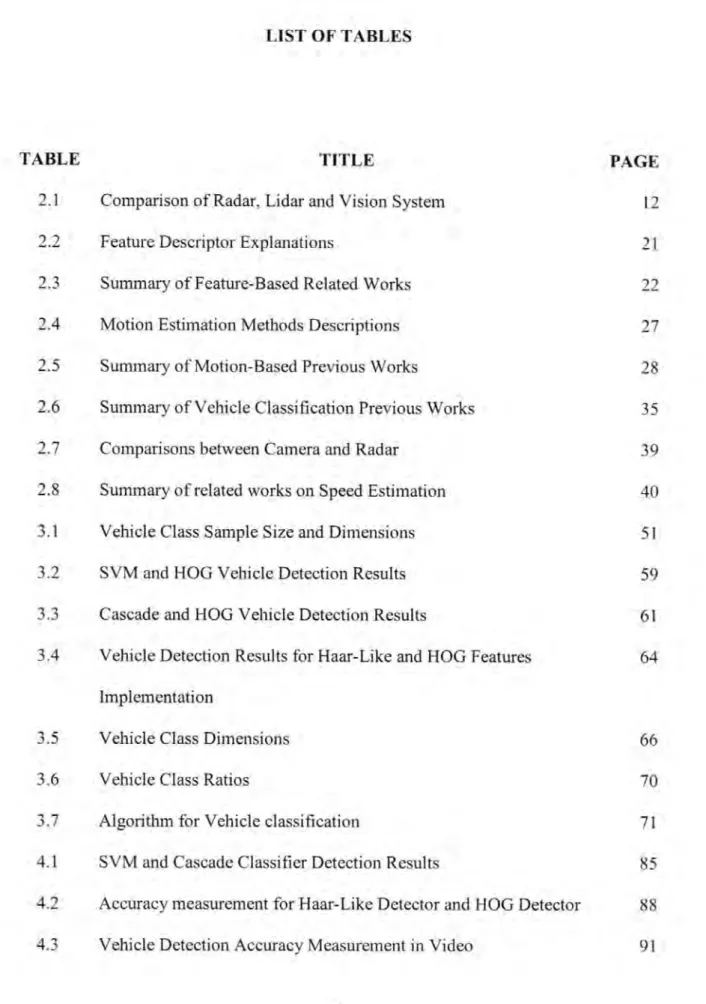
LIST OF TABLES
TABLE TITLE PAGE
2.1 Comparison of Radar, Lidar and Vision System 12
2.2 Feature Descriptor Explanations 21
2.3 Summary of Feature-Based Related Works 22
2.4 Motion Estimation Methods Descriptions 27
2.5 Summary of Motion-Based Previous Works 28
2.6 Summary of Vehicle Classification Previous Works 35
2.7 Comparisons between Camera and Radar 39
2.8 Summary of related works on Speed Estimation 40
3.1 Vehicle Class Sample Size and Dimensions 51
3.2 SVM and HOG Vehicle Detection Results 59
3.3 Cascade and HOG Vehicle Detection Results 61
3.4 Vehicle Detection Results for Haar-Like and HOG Features 64
Implementation
3.5 Vehicle Class Dimensions 66
3.6 Vehicle Class Ratios 70
3.7 Algorithm for Vehicle classification 71
4.1 SVM and Cascade Classifier Detection Results 85
4.2 Accuracy measurement for Haar-Like Detector and HOG Detector 88
4.3 Vehicle Detection Accuracy Measurement in Video 91
4.4
Execution time results92
4.5
Final Vehicle Detection Accuracy94
4.6
Accuracy measurement for Car99
4.7
Accuracy measurement for Lorry101
4.8
Accuracy measurement for Bus102
4.9
Accuracy measurement for Motorcycle102
4.10
Scale Factor Value Calculated106
4.11
Host Vehicle Speed Measurement Results107
4.12
Vehicle Speed Conditions108
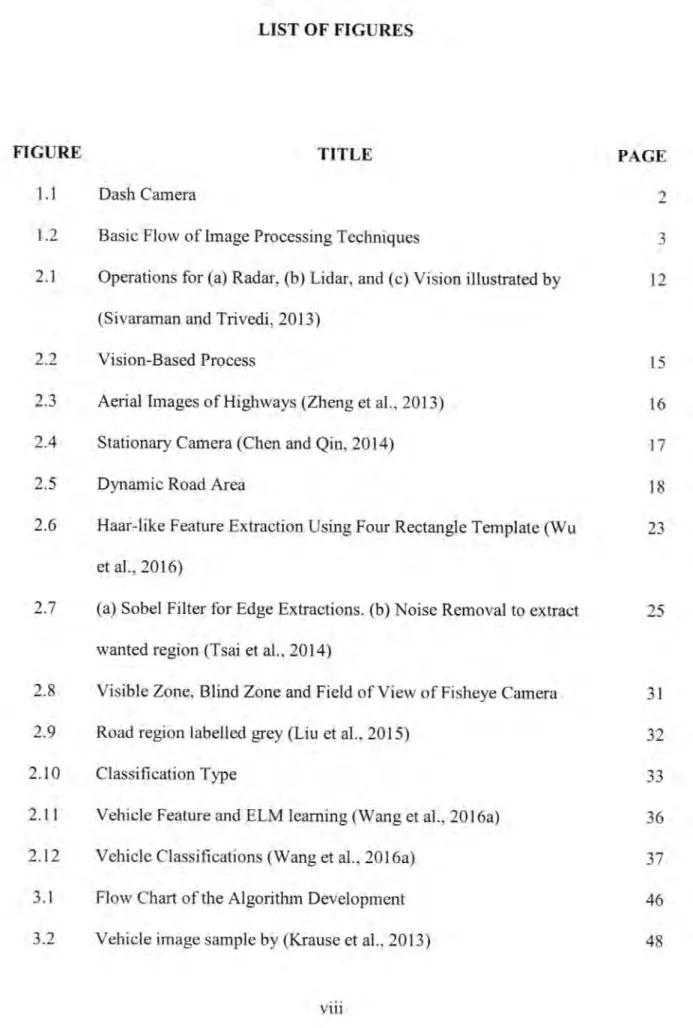
LIST OF FIGURES
FIGURE TITLE PAGE
1.1 Dash Camera 2
1.2 Basic Flow of Image Processing Techniques 3
2.1 Operations for (a) Radar, (b) Lidar, and (c) Vision illustrated by 12 (Sivaraman and Trivedi, 2013)
2.2 Vision-Based Process 15
2.3 Aerial Images of Highways (Zheng et al., 2013) 16
2.4 Stationary Camera (Chen and Qin, 2014) 17
2.5 Dynamic Road Area 18
2.6 Haar-like Feature Extraction Using Four Rectangle Template (Wu 23 et al., 2016)
2.7 (a) Sobel Filter for Edge Extractions. (b) Noise Removal to extract 25 wanted region (Tsai et al., 2014)
2.8 Visible Zone, Blind Zone and Field of View of Fisheye Camera 31 2.9 Road region labelled grey (Liu et al., 2015) 32
2.10 Classification Type 33
2.11 Vehicle Feature and ELM learning (Wang et al., 2016a) 36
2.12 Vehicle Classifications (Wang et al., 2016a) 37
3.1 Flow Chart of the Algorithm Development 46
3.2 Vehicle image sample by (Krause et al., 2013) 48
3.3 Two Lane Highway Route 49
3.4 Three Lane Highway Route 49
3.5 Sample Image Dataset of Rear Area Profile for (a) Cars, (b) Bus, 50 (c) Lorry, and (d) Motorcycle
3.6 Positive Image Dataset Preparations and Enhancement 52
3.7 Negative Image Sample 52
3.8 Rectangular Wavelet 53
3.9 Detection Window 54
3.10 Haar-Like Feature Extraction Process 55
3.11 HOG Vector Outline on Vehicle Image 56
3.12 Vehicle Outline of HOG vector 57
3.13 SVM Hyperplane 58
3.14 Cascade Stage (A et al., 2017) 60
3.15 Vehicle Detection Development 62
3.16 Cascade and HOG Vehicle Detection System 63 3.17 Cascade and Haar-Like Vehicle Detection System 63 3.18 ROI for Highway Road Lane Detection 65
3.19 Sliding Window Process 65
3.20 Multi-Scale Technique over an Image 67
3.21 Discrete Kalman Filter Cycle 68
3.22 Lane Detection Algorithm Development flow 73
3.23 Road Lane edge Extractions 75
3.24 Solid Road Lane Marker Detections 76
3.25 Width Calculation Algorithm Development Flow 76
3.27
Broken Lane Marker Detection 784.1
Cascade Classifier+ HOG features vehicle detection83
4.2
SVM Classifier+ HOG features vehicle detection84
4.3
Accuracy measurement Comparison between SVM and Cascade86
Classifier
4.4
ROC curve for Haar-Like Detector and HOG detector89
4.5
Haar-Like Vehicle Detection90
4.6
HOG Vehicle Detection90
4.7
Accuracy Measurement comparison of both feature detector92
4.8
Detector Execution Time Graph93
4
.
9
Motion Trajectory of Detected Vehicle95
4.10
Motion Trajectory of Vehicle with Addition of Kalman Filter96
4
.
11
Car and Motorcycle Class detection97
4
.
12
Bus Class detection98
4.13
Lorry Class detection98
4
.
14
ROC curve for Car Class100
4.15
ROC curve for Lorry Class 1014
.
16
ROC curve for Bus Class103
4
.
17
ROC curve for Motorcycle Class104
4
.
1
8
Overpassing Detected Vehicle Speed109
4.19
Slow Speed Detected Vehicle110
ADAS CCTV
CNN
ELM GDSM GDVM HDBN HOG ITSKLT
LIDAR LNMS MMR RADAR RBF ROB ROC ROI SC SIFT LIST OF ABBREVIATIONSAdvanced Driver Assistance System Closed-Circuit Television
Convolutional Neural Network Extreme Learning Machine
Genetic Dynamic Saliency Map
Grey Differential Value Method
Hybrid Dynamic Bayesian Network
Histogram of Oriented Gradient
Intelligence Transport System
Kanade-Lucas-Tomasi
Laser Identification Detection and Ranging
Linear Normalization with Mean Shift
Make and Model Recognition
Radio Detection and Ranging
Radial Basis Function
Red-Green-Blue
Receiver Operating Characteristic
Region of Interest Sparse Coding
Scale Invariant Feature Transformation
SURF SVM
Speeded up Robust Features
Support Vector Machine
LIST OF PUBLICATIONS
1. A, N.S., Ibrahim, M.M., Ali, N.M., and Y, N.F.I., 2016. Vehicle Detection Based o n Underneath Vehicle Shadow Using Edge Features. IEEE International Conference on Control System, Computing and Engineering (ICCSCE2016), pp.25-27.
2. A, N.S., Ibrahim, M.M., Ali, N.M., Radzi, S.A., Darsono, A.M., and Chiew, W.Y. 2017. Road Triangle Detection for Non-Road Area Elimination Using Lane Detection and Image Multiplication. Journal of Telecommunication Electronic and Computer Engineering, 9 (2), pp.73-77.
3. Aminuddin, N.S., Ibrahim, M.M., Ali, M., Radzi, S.A., Hidayat, W., and Saad, M.,
2017. A New Approach to Highway Lane Detection by Using Hough Transfonn Technique. Journal of Information and Communication Technology (JICT), 2 (2),
pp.244-260.
4. A, N.S., Ibrahim, M.M., and Ali, N.M., 2017. Comparison of Forward Vehicle
Detection Using Haar-like features and Histograms of Oriented Gradients (HOG) Technique for Feature Extraction ill Cascade Classifier. Journal of Telecommunication Electronic and Computer Engineering, 9 (2) pp.101-105.
CHAPTER 1
INTRODUCTION
1.1 Project Background
Intelligence Transport System (ITS) for vehicular system in various applications has emerged as a demanding project in a recent development of vehicular area. It can be focused on many categories and applications such as vehicle detection, road lane marks detection, and road obstacle detection. The advantages provided from the existence of intelligence system for drivers that they are aware of their driving environments thus, promote safe driving habits and environments. One example of ITS is an obstacle detection system, in which the system functioning with the vehicular on-board units that detect the surroundings.
The system will notify vehicles' motion status to update the driver and give warning for assisting driver on the obstacle ahead that needs to be avoided (Wu et al., 2014). Therefore,
naturally the adding features of driving assistance by an intelligence system for driver are a great improvement.
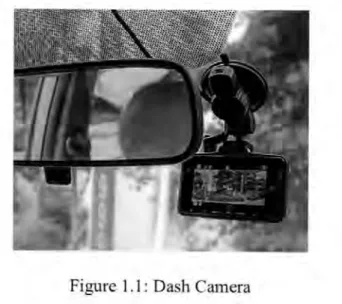
On the contrary, one of the rising demands of on-board units that drivers often use is the dash camera. Dash camera is simply a camera mounted at the dash board area of the car. It is designed to record sounds and images from the drivers' point of view while driving as shown in Figure 1.1. The purpose of having the camera installed in vehicles is to record every detailed information from scenes that take place on the road. Various types and
resolution up to 2560 x 1440 (4K) of the camera specification are available in the market with affordable prices. Notable reason from the drivers to have this in their vehicle is simply for personal safety measures.
Figure 1.1: Dash Camera
Owing to the innovation of the dash camera, algorithms can be developed by the
implementation of video footages of Malaysia road highways recorded by the on-board dash
camera. Since the camera captures and records the images of the road scenes, the use of image processing technique on the video can be applied to analyse the road area. From the analysis, many parameters can be obtained from the video sequences such as a number of vehicles, turning traffic flows at intersections, speed measurements and many more (Chong et al., 2013). Generally, this research aimed to develop an algorithm system that consisted of a combination of systems in vehicle detection, vehicle classification and vehicle speed estimations.
Basically, image processing techniques consist of flow steps that need to be followed by each of its sequence to achieve the best results. Through this flow, a full system
combination of vehicle detection, vehicle classification and vehicle speed estimation can be
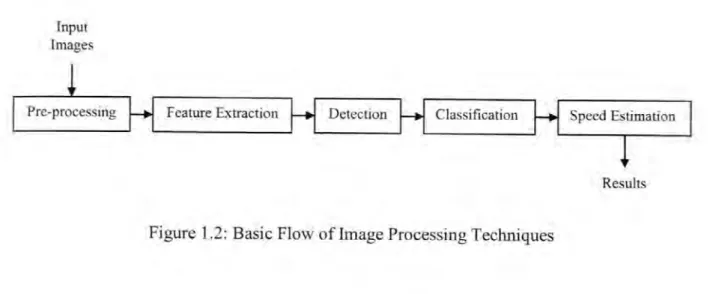
achieved. Figure 1.2 shows a basic flow of the algorithm development by using image processing technique followed by this research. The choices made for the technique depend on the reliability of each component of the system to each other based on characteristics needed by each component.
Input Images
Pre-processing Feature Extraction Detection Classification
Figure 1.2: Basic Flow of Image Processing Techniques
Speed Estimation
Results
From the flow, image pre-processing is the first stage of the system. The image data input undergoes this stage to enhance the main feature of the vehicle by improving its
appearance. Next stage is the feature extraction where the unique features that best describe
each vehicle type are extracted. The aim for feature extraction is to group the vehicle type
with the same and different categories in its class based on its feature property. Extracted features are then passed into stages that work by classifying the vector and train them to produce a final vehicle detector system.
In recent time, a technique of image processing for vehicle detection development is
commonly adapted by the use of static camera, for example CCTV, placed on the road side
to monitor traffic conditions (Battiato et al., n.d.; Leon and Hirata Jr, 2012). For that purpose,
the backgrounds captured in the camera are almost static. This approach basically uses a
background subtraction method based on the difference of motion of the target object and
the almost static background (Brutzer et al., 2011) (Sirikuntarnat and Algorithm, 2015). In
contrast to the dynamic background approach, the background subtraction is not applicable.
In order to distinguish the background and foreground in a dynamic scene, motion flow
classification by (Chen and Wu, 2015) can be applied. Optical flow feature points on an edge
of image are produced by applying canny edge operator and Lucas-Kanade Pyramid Model,
used to calculate the optical flow information for distinguishing the motion between the background and the vehicle.
Furthermore, current study for vehicle speed estimation applied the use of RADAR
(Radio Detection and Ranging) methods (Jeng et al., 2014). The RADAR is placed at the
roadside to cover multiple lanes of the road instead of install it in parallel to the direction of traffic. Unfortunately, it is only able to detect a forward single lane which only detects the speed of single forward vehicle in the radar range. On the contrary, image processing
techniques in vehicle speed estimation, by (Gupta, Pratishtha, G. N. Purohit, 2014) estimated
the vehicle speed by using a centroid method. Vehicles detected were tagged with centroid that followed the movement of vehicles. The distances travelled by the centroid were calculated representing the distance of the vehicles. Distances calculated were included with a specific amount of time to obtain the speed values. As a comparison to RADAR method,
the image processing approach undoubtedly covers more, in terms of distance and angle that radar has been able.
1.2 Problem Statement
Prior to the existence of dash cameras in the market, there is a major slack in the established technology. Most road users nowadays installed an on-board camera in their vehicles for their own personal safety measures of road monitoring. Apparently, with high resolutions of camera that achieve up to 2560 x 1440 ( 4K) in certain model, lack of intelligent system is a major loss. Intelligent system such as vehicle detection, vehicle classification and vehicle speed estimations are underappreciated to be taken advantage to be part on the dash camera feature specifications.
Nevertheless, image processing techniques implemented on the development on either the three systems; vehicle detection, classification and speed estimation, exist in a
contribution for road monitoring purposes. However, the development only focuses on the
implementation using static surveillance cameras (CCTVs) as the main input. Disadvantage point from using static cameras is that it limits the location and area for monitoring a large scale data information extraction (Wang, 2013).
Speed estimation system often integrated with the use of Radar technology. On the contrary, the use of Radar associates with high cost equipment sensor (Peng et al., 2015) while in image processing, the availability of cameras with high resolutions can be obtained easily at a cheaper cost. Other than that, the disadvantage of using Radar is that it only covers and measures a single vehicle speed at a time in contrast with the image processing technique that can track more than one vehicle at the same time.
1.3 Objectives of Research
Throughout this research, the main focus was to utilize dynamic road scenes recorded by the on-board camera installed in host vehicles. Hence the overall goal was to develop algorithms that can analyse the information available on the video sequences. Therefore, this research embarked on the following objectives:
1. To develop an algorithm of vehicle detection and classification based on dynamic video footages using Haar-Like features with Cascade classifier and ratio property vehicle classification.
11. To develop an algorithm of speed estimation classification based on dynamic video footages using scale factor and centroid measurement.
111. To analyse and validate the developed algorithms using video database
recorded by the host vehicles using on-board cameras.
1.4 Scope of Research
The research focused on developing an algorithm for vehicle field related course of
vehicle detection, vehicle classification and vehicle speed estimation using image processing 5
techniques. Details on the scope of work were categorised into two sections namely data preparations and algorithm development.
1.4.1 Data Preparations
For this research, there were no standard databases available to contribute in the algorithm development. Despite of the limitations a new image dataset and video database for this research were created with the criteria as described below:
t. The video sequences were recorded using on-board cameras installed in vehicles and located at the dashboard area of the host vehicles producing road scenes in dynamic where the foreground (vehicle) and background were in motions.
11. The highway scenes were recorded from Ayer Keroh, Melaka to Skudai,
Johor for two-lane highways, and from Ayer Keroh, Melaka to Kajang,
Selangor for three-lane highways.
m. The back-view profile of the vehicles has been set as the main feature since the videos were recorded in a forward motion based on drivers' point of view of the host cars on the road.
iv. The collection of positive image dataset comprised four types of vehicles; car, lorry, bus, and motorcycle.
1.4.2 Algorithm Development
Details on the software tools, performance measurement and algorithm method focus,
used in this research development were as described below:
1. Matlab Software was the main platform for algorithm development started from the preparations of data until the performance measurements.