Ex-post Evaluation
Joint Research Centre
Direct Actions in the
6
th
Framework Programmes 2002-2006
Final Report
1
Ex-post Evaluation
Joint Research Centre
Direct Actions in the
6
thFramework Programmes 2002-2006
Final Report
3 TABLE OF CONTENTS
CHAIRMAN’S INTRODUCTION . . . .07
EXECUTIVE SUMMARY . . . .09
1 OVERVIEW OF THE EVALUATION . . . .15
1.1 The Panel’s approach . . . .15
1.2 Evaluation of the JRC in the context of the 6th Framework Programmes . . . .15
1.3 Scientific output and policy support . . . .17
1.4 Meeting the needs of users . . . .18
1.5 Response of the JRC to the five-year assessment in 2003 . . . .19
2 DETAILED COMMENTARY . . . .21
2.1 Core area 1: Food, chemical products and health . . . .21
2.1.1 Priority 1 - The Food Chain . . . .21
2.1.2 Priority 2 - Biotechnology . . . .23
2.1.3 Priority 3 - Safety of Chemicals . . . .24
2.1.4 Priority 4 - Contributions to Health . . . .26
2.2 Core area 2: Environment and sustainability . . . .27
2.2.1 Priority 5 - Protection of the European Environment . . . .27
2.2.2 Priority 6 - Global Change . . . .30
2.2.3 Priority 7 - Energy . . . .31
2.3 Core area 3: Euratom . . . .33
2.3.1 Priority 8 - Nuclear Safety and Security . . . .33
2.4 Core area 4: Horizontal priorities . . . .35
2.4.1 Priority 9 - Technology Foresight . . . .35
2.4.2 Priority 10 - Reference Materials and Measurements . . . .36
2.4.3 Priority 11 - Public Security and Anti-Fraud . . . .37
2.5 Support to EU enlargement policy and integration of new Member States . . . .39
2.6 Promotion of the European Research Area . . . .39
3 CHALLENGES FOR THE FUTURE . . . .41
3.1 Strategic positioning . . . .41
3.1.1 Arrangements for the Development of a Corporate Strategy . . . .41
3.1.2 Combining Scientific Work and Policy Support . . . .44
3.1.3 From (reactive) Policy Support to (proactive) Policy Advice . . . .45
3.2 Human capital . . . .46
3.2.1 Emphasis on Human Resources . . . .46
3.2.2 Training European Scientists: Revitalising the JRC . . . .48
3.3 Modernising the organisation . . . .49
3.3.1 Integration and Synergy . . . .49
3.3.2 Improving Knowledge Management . . . .51
3.3.3 Maintaining a Modern Infrastructure . . . .52
4 CONCLUDING REMARKS . . . .55
Glossary
ANNEX 1 Terms of Reference
ANNEX 2 Main Reference Documents
ANNEX 3 Facts and Figures of the Joint Research Centre
5
The Ex-post Evaluation Panel
Sir David KING Chairman Jussi HUTTUNEN Vice Chairman Jacques BOUCHARD Jan DEKKER Nada LAVRAČ Heino NITSCHE Klaus PAULUS František PAZDERA Lisa SENNERBY FORSSE Ján SZOLGAY
Klaus THOMA Lena TSIPOURI
Christine VAN BROECKHOVEN Wolfhard WEGSCHEIDER Alexander ZEHNDER
7
CHAIRMAN’S INTRODUCTION
This final report forms the Ex-post Evaluation of the Joint Research Centre (JRC) Direct Actions of the 6th Framework Programmes for the period
2002-2006. The evaluation was carried out between February and June 2008 by a Panel with international experts from different disciplines. The report presents general observations from the evaluation (Chapter 1), detailed commentary on the JRC’s achievements in the 11 Priorities in the JRC Work Programme (Chapter 2) and the JRC’s challenges for the future (Chapter 3). As Chair of the Panel, I summarised the findings and recommendations of our evaluation in the executive summary of this report.
It was an honour to chair this Evaluation Panel and a privilege to work with such distinguished and committed colleagues. Their objective and perceptive judgments form the basis of this report and it was satisfying to see that we all agreed on the conclusions and recommendations contained in it.
The Panel was clear in its appreciation of the JRC’s achievements in realising its mission, and acknowledged its place as a service within the Commission, which is crucial for this purpose.
It became evident during the Panel’s work that the JRC today is not only instru-mental in supporting the policy development in the Commission but also in responding to crisis situations threatening the security of European citizens. The JRC has undergone a major transformation over the last 10 years, consoli-dating its position as an indispensable source of knowledge and expertise in support of the political agenda of the EU. The Panel generally believe that the organisation can only advance now by introducing some step changes in its strategic positioning and its operation.
Our observations throughout the report are designed to help the JRC in preparing such changes. They are aimed at strengthening JRC’s capability to deliver a service to the Commission, but without compromise to the JRC’s future scientific vitality or integrity. A clear position within the Commission and an overall corporate strategy with a five-year time horizon are important prerequisites for this next step.
On behalf of the Panel I wish to record our gratitude to the staff of the JRC and particularly to Dr Pieter van Nes and Ms Sarah Morgan, for their support and assistance throughout. We also wish to express our appreciation for the substantial amount of work that was undertaken so willingly by Dr Roland Schenkel, the Director General of the JRC, and his colleagues who provided us with the information necessary for the evaluation. I wish to place on record my personal gratitude to Professor Jussi Huttunen for his willingness to undertake a very substantial amount of work as my Vice Chairman, and for dispensing this so effectively and efficiently.
9
EXECUTIVE SUMMARY
This report presents the Ex-post Evaluation of Joint Research Centre (JRC) Direct Actions of the 6th Framework Programmes (FP6) for the period
2002-2006. It is divided into a backward-looking section with the achievements of the JRC in FP6 and a forward-looking section with an analysis of challenges for the JRC in the future. The recommendations have been drawn up with the objective to strengthen the capability of the JRC to deliver a service to the Commission without compromising scientific vitality or integrity.
The Multi-Annual Work Programme of the Joint Research Centre during FP6 was based on customer needs and on a push for integration of its Institutes’ competencies and facilities, around thematic priorities. Simultaneously, the JRC strived to increase its networking activities across Europe and interna-tionally, to enhance the training of European researchers and to help Candidate Countries in the last steps of the EU accession process.
ACHIEVEMENTS UNDER THE 6TH FRAMEWORK PROGRAMMES
In ten years of working with its new mission the JRC evolved into a reliable source for scientific and technical support to EU policies. It successfully achieved the main goals set for its work under the 6th Framework Programmes
through a clear customer-orientation, robust policy support and underpinning research. The standing of the JRC inside the Commission is of crucial importance for these achievements.
The JRC has accepted and implemented the recommendations of the Five-Year Assessment in 2003. During the review period the JRC has shown the capacity to set priorities by reorienting small parts of its work and discontinuing certain activities that have become less relevant. Nevertheless, within areas like food, health, foresight, environment, public security, the Panel indicated topics during the Institute visits and in the detailed commentary of the final report where the JRC needs to analyse its position seriously and make sure that it can generate the critical mass needed to be effective in those fields.
The Panel observed that the JRC has reinforced its networking activities across Europe and internationally, that it has enhanced the training of European researchers, that it has assisted the New Member States with the transfer of the total body of EU legislation, regulations, directives and standards
(the acquis communautaire) and that it delivers well-respected international services in several areas of competence.
A detailed assessment of the work carried out during the 6th Framework
Programme convinced the Panel of the good, very good and sometimes excellent quality of the delivered science and policy support. The full report of the evaluation presents a “detailed commentary” on the various priority areas. An important observation, however, is that it is difficult to make a thorough evaluation of all the different themes and competences in one single exercise.
So far the JRC has significantly changed the structure of its Work Programme with every new Framework Programme, whereas the basic elements of its
10
work broadly stayed the same. The Panel was unable to find a convincing explanation for this practice.
For the benefit of the JRC and notably for its corporate positioning, planning and evaluation activities, it is recommended to develop a Work Programme structure that reflects the core activities of the JRC. Adaptations to changing political priorities have to be accommodated in substructures.
CHALLENGES FOR THE JOINT RESEARCH CENTRE IN THE FUTURE
Strategic Positioning
Since the introduction of its new customer-oriented mission the JRC has shown continuous improvement thanks to internal control on the mission alignment of the work. This has produced a step change in the performance of the JRC which is today certainly satisfactory. In this regard, however, the Panel felt that the organisation is reaching a performance ceiling and that it needs another step change to advance to a higher level.
For this next step change the JRC needs a fully fledged corporate strategy, building on an assessment of its current tasks and competencies and an analysis of the needs with a five-year time horizon. Such a strategy would provide the necessary reference for making the difficult choices in setting priorities in the Work Programme.
The Panel recommends that the JRC and its Institutes should establish a rolling five-year strategy, formulate a vision with clear goals, analyse its assets making a proper representation of policy support areas and compe-tencies, and adopt criteria for accepting or not accepting tasks and apply them rigorously.
The vision needs to distinguish three distinct types of activity in the JRC (i) The largest element: a collection of S&T policy support activities driven
by a few big and several small and more irregular policy customers. (ii) The Euratom commitment: a stable element within the JRC. It is, however,
more dedicated to Treaty implementation than to policy support. It is arranged through a Euratom Framework Programme and a dedicated Work Programme Unit in the organisational structure.
(iii) Reference Materials and Measurements: also a stable element in the programme based on the JRC’s expertise in this field.
It should bring the science and policy-support dimensions inseparably together and for this purpose the role of exploratory research in the JRC would be clarified.
The Panel recommends that the JRC should thoroughly re-evaluate the position and management of exploratory research and revisit the functions and the roles of the JRC Scientific Committee and Institute Scientific Committees so as to produce uniform procedures for the Institute Committees.
11
The Panel was somewhat surprised to see that the JRC mainly operates in a reactive “policy support” mode. It has the position, the knowledge base and the human resources to play a proactive “policy advice” role, in which it should, in a timely manner, draw the attention of policy makers to upcoming issues and indeed to become more involved in the early, agenda-setting part of the policy-making process.
In the Panel’s view the European Commission would benefit from receiving proactive unbiased scientific advice from the JRC, identifying future problems, opportunities and needs of our societies, picking up signals from the scientific community and using horizon scanning procedures based on the current state of knowledge from science, technology and the social sciences.
The Panel urges the President and the Commission to enable the JRC, with its links to university knowledge generation in the EU and worldwide, to exercise a proactive policy advice function. To function properly this would need, for example, the creation of an “Office for the Chief Scientific Adviser to the Commission” within the Commission Services, with a high-profile Chief Scientific Adviser responsible directly to the President and the Commission. Human Resources
Given the vital role that human resources play in the JRC’s ability to achieve its mission, strategic importance must be given to the recruitment of the best possible candidates and to their continued career development once recruited. Strategic resource management must reach beyond the recruitment phase of the new staff members and follow them throughout their career as permanent members of staff or during their stay as a member of the visiting staff.
The Panel is fully aware of the Staff Regulations for Officials of the European Communities and the Conditions of Employment of other Servants of the European Communities; but the Panel believes that the following improve-ments are feasible and necessary for the JRC in this field:
• More competitions for staff with an S&T profile that give the highest priority to specific competence. Currently the Commission still places too much emphasis on administrative knowledge even in these S&T competi-tions.
• Enough posts for the JRC to recruit top talent on six-year temporary contracts for which the selection is made by the JRC.
• An increased use and selection of grant holders (PhD, post docs and visiting scientists) for the JRC.
• The creation of possibilities for the JRC to develop a career path for scientists within the constraints of the Commission rules, e.g. by creating Senior Scientist positions parallel to the system for administrative managers.
The Panel recommends that the Commission should grant improvements allowing the JRC to adapt hiring procedures and career management schemes in keeping with the skills required.
12
PhD students have a revitalising effect on an organisation. The JRC provides a training ground for PhD students and in areas where there are demands for skills in Europe not met elsewhere (e.g. nuclear, reference materials, environment) the opportunities offered are very good. Some parts of the research programme are critically dependent on the work and availability of graduate students. This training policy has to be continued, but its implemen-tation can be improved.
The Panel recommends that the JRC should develop a quality assurance system for graduate training with the aim of continually attracting talented students.
Modernising the Organisation
Modernisation is key in a constant strive towards efficiency and effectiveness. The JRC needs a structured approach towards constantly modernising the organisation, paying attention in particular to infrastructure, management, organisation, and knowledge management.
In the wake of the Five-Year Assessment the JRC started building up mechanisms for coordination of the activities within the organisation. Further integration of the thematic and methodological competencies of the JRC is possible. The principal role of the vertical, “hierarchical” structures is to maintain these competencies. However, much of the actual work should occur in horizontal actions and programmes put together in a flexible way, backed by adequate financial resources according to the needs of the customers and research questions.
The Panel recommends that the JRC should continue building up efficient mechanisms for the coordination of the activities within the organisation. The mechanisms should be need and competence driven, and correspond to the trends adopted by the most successful research-based policy-support organisations in the world.
While much of the work over the past four years has already resulted in measurable improvements in the ICT system of the JRC, several strategic goals have not yet been fully achieved. JRC publications hold a wealth of knowledge that should be easily accessible to the external public; the only acceptable exception to open publication is an issue of EU or national security. In view of the large number of JRC researchers and the fluctuation of the temporary staff the organisation needs to use the most advanced Knowledge Management facilities.
The Panel recommends that all information exchange functions in the JRC, including the publications database PUBSY, should be upgraded. Contem-porary knowledge management tools and methods to improve awareness should be used. These should include knowledge mapping tools.
The owner of large research facilities and infrastructure has to commit financial and human resources to something that may not necessarily be useful in the longer run. It also reduces the owner’s flexibility. In the long run simpler laboratories bring a higher cost-benefit ratio.
13
The Panel recommends that the JRC should start a continuous process for making a detailed short, medium and long-term assessment of the status of its research facilities and infrastructure with the aim to further enhance its efficiency and effectiveness. This should be part of an overall strategy.
CLOSING REMARKS
The current evaluation allowed a high-level assessment of the JRC activities, but an assessment of the detailed policy support and the quality of scientific work would require more study of the JRC products and real interaction with its customers and stakeholders. More specialised evaluations would provide a better feed back to analyse the key competence areas and benchmark their success in research and policy support.
The Panel recommends that, in addition to the legally obligated high-level FP evaluations, the JRC should organise smaller, competence or sector-oriented external evaluations of its work. This will improve the positioning of the JRC in the relevant field.
These more specialised evaluations should also be used to assess the internal administrative and reporting processes in the JRC and to validate the “quality assurance framework for scientific and technical documents” and its imple-mentation mechanism adopted by the JRC after the Five-Year Assessment of 2003.
15
1 OVERVIEW OF THE EVALUATION
1.1 The Panel’s Approach
The objective of the Ex-post Evaluation of Joint Research Centre (JRC) Direct Actions of the 6th Framework Programmes (FP6) is to provide an independent
assessment of the JRC activities in FP6 to the European Commission, the Council and the European Parliament, Member States, other stakeholders and the general public. The Panel’s terms of reference and working method are described in detail in Annex 1.
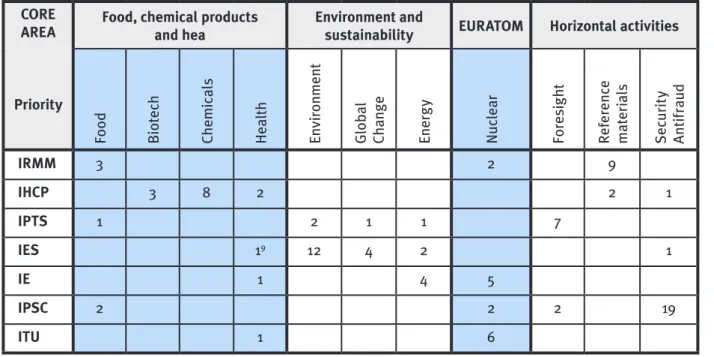
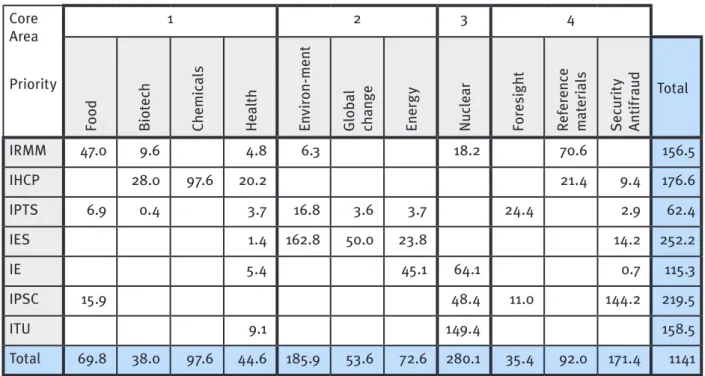
The evaluation assessed the JRC’s work according to the structure of the Multi-Annual Work Programme (MAWP) for FP6 categorizing the activities by 11 Priorities in four Core Areas of Research. The approach was similar to that used in the Five-Year Assessment in 2003 chaired by Professor David Fisk and emphasised an integrated approach to the JRC as an organisation rather than assessing the performance of individual Institutes.
Special attention was paid to the quality of research activities, as well as to the quality of implementation and management, and achievement of the objectives set. These results are related to the budget spent, the impact of the JRC activities and to customer satisfaction.
Expert groups, selected from the Panel, met with the Director and staff of every Institute on site. The membership of these expert groups purpose-fully overlapped. The Vice Chairman of the Panel participated in all visits to ensure a consistent approach across the different Institutes and across the 11 Priorities of the JRC’s Work Programme. On the basis of the site visits and parallel desk studies of the background material provided by the JRC, one or two Panel Members prepared a thematic summary report for the activities in each of the 11 Priorities.
The Panel first met in Brussels on 26 February 2008 to agree on a distribution of tasks and the visiting schemes. It had its final plenary meeting on 22-23 June 2008 in Brussels, where it discussed the findings for each of the 11 Priorities, scrutinised the italicised text of the report that contains the conclusions and agreed on the recommendations.
1.2 Evaluation of the JRC in the Context of the 6th Framework Programmes
The Multi-Annual Work Programme (MAWP) of the JRC was developed on the basis of the 6th Framework Programme of the European Community for
Research, Technological Development and Demonstration Activities and of the 6th Framework Programme of the European Atomic Energy Community for
Research and Training Activities.
The MAWP was elaborated through extensive consultations with the JRC High-Level Users Group, the JRC Board of Governors and the Commission and was organised into four Core Areas: Food, chemical products and health; Environment and sustainability; Nuclear activities and Horizontal activities. The Core Areas were further divided into a total of eight thematic and three horizontal Priorities.
16
The MAWP was detailed into annual Work Programmes which specified Actions undertaken by the JRC for each year and allocated their resources. All Actions were reviewed annually in order to monitor progress against the objectives described in the MAWP and to determine needs for resources in the following year. The adjustments thus proposed were discussed with the High-Level User Group and the Board of Governors before implementation.
The Panel’s evaluation was at the level of the MAWP. The 11 Priorities formed the basis for the Panel’s work. Occasionally, the Panel gave its opinion on the results of individual JRC Actions. The Panel’s detailed findings on the 11 Priorities are described in Chapter 2.
The Panel was impressed by the quality and volume of the work produced by the JRC during the period under evaluation. In general the objectives that were set in the MAWP 2003-2006 have been achieved. The Panel was also pleased to note that the planning of the work has shown a certain dynamics. In some cases when an Action did not fulfil its objectives or when they turned out to be obsolete, the resources were reallocated for the benefit of other activities with different objectives.
It is inevitable that the scientific impact of the JRC varies across the Priorities depending on the availability of appropriate facilities, infrastructure and expertise. The Panel noted with satisfaction that the JRC was able to produce important new information even in areas outside its core competence. In such cases the success was often based on collaboration and networking with universities and research institutes within the EU and beyond.
The JRC has in many ways succeeded in achieving the goals set in the 6th Framework Programmes 2002-2006. Much of the research that the Panel
reviewed in the JRC is of good quality and has been used for the Commission and for customers outside the Commission. The international standing of the JRC reflects the contributions that have been made by competent staff using the unique position of the JRC.
The Panel acknowledges the success of the Director General and his staff in building a JRC that on the whole delivers robust scientific-technical support to policy makers in the European Commission and in the Member States.
The Panel noticed that during FP6 and now in FP7 the JRC has shown the capacity to reorient small parts of its work by sun setting activities that became of less relevance. Nevertheless, within areas like food, health, foresight, environment, public security, the Panel indicated topics during the Institute visits and in the detailed commentary of the final report where the JRC needs to analyse its position seriously and make sure that it can generate the critical mass needed to be effective in those fields.
The effectiveness of the JRC will be further increased if attention is paid to bringing down “silo walls” in the organisation for instance through internal seminars or thematic workshops.
17 1.3 Scientific Output and Policy Support
The scientific output and the relevance of the work in different Priority Areas are reviewed in Chapter 2. Overall, the Panel’s impression of the scientific performance of the JRC during the MAWP 2003-2006 is good and its work plays a role in policy development in the European Union. The Panel was pleased to observe that the number of publications in peer-reviewed journals has continuously increased and several JRC reports have been published in leading general and specialty periodicals.
Although the primary objective of this evaluation has been to assess Direct Actions of the JRC under FP6, the Panel has seen other work carried out by the JRC for the Directorates General (DGs) of the Commission and as a participant in Indirect Actions of the Framework Programmes. The JRC target is that the volume of this work is around 15% of the total workload, but the percentage varies from one Institute to the other. The overall impression of the Panel is that the balance between the various activities is reasonable, and that the JRC has been able to fulfil the needs of different customers in a satisfactory way. The ultimate goal of the JRC is to deliver robust scientific and technical support to policy makers based on a strategic dialogue with customers and stake-holders and an appropriate research basis. The support activities of the JRC are manifold and range from the implementation of EU legislation via monitoring and verification services, performing prospective studies and modelling, to scenario building and a broad variety of analyses. The JRC may also provide operational support, for example in anticipating environmental disasters and providing assistance in crisis management.
The main customers of the JRC are the other Directorates General of the Commission. They use the scientific support and advice in the preparation, implementation and monitoring of various EU policies. The JRC also carries out studies for and provides information to the European Parliament and the EU Council Secretariat thus providing scientific and technical support also to other EU institutions. The JRC provides support to authorities in the Member States in areas where it has a special competence or is mandated to do so by EU policies.
The Panel noted that the JRC has a good record in supporting EU policies. The JRC’s activities cover the complete policy cycle, from the anticipation of policy needs, via the assessment of policy options and their impacts, through to the monitoring and implementation of policies with in practice a stronger presence in the latter part of the cycle.
In addition to the direct support, the JRC also has strong links with regulatory and advisory bodies both within and outside the EU. It cooperates with relevant EU agencies, for example through exchanging data and information and the development of informatics tools, and carries out work for, or in cooperation with, international organisations, such as the International Atomic Energy Agency (IAEA), the Organisation for Economic Co-operation and Development (OECD), the United Nations (UN) and the European Space Agency (ESA). The Panel has seen good networking of the JRC not only with its main customers in the Commission but also with EU agencies and other European organisations as well as with universities and research institutes in the Member States. The
18
JRC has an outstanding role in establishing, leading and participating in a wide range of collaborative projects and expert networks in Europe and beyond. The JRC has also been successful in delivering an international service in areas of its expertise.
The work of the JRC plays a role in policy development in the European Union and has a scientific standing that is appropriate to fulfil its mission. Quality assurance systems are in place to assist in generating good quality performance of the JRC in knowledge production and knowledge synthesis. The JRC has a good record in supporting European policies. Its activities cover much of the policy cycle: assessment of policy options and their impacts, and monitoring and contributing to the implementation of policies, but there is an emphasis on the latter part of the cycle. The JRC understands the policy process and the type of support required. Nevertheless, the Panel is in favour of a stronger role for the JRC in the early, anticipatory part of the policy cycle and formulates relevant recommendations later on in the report (section 3.1.3).
The JRC has succeeded in establishing and leading (and participating in) a wide range of collaborative research projects and expert networks in Europe and elsewhere. The JRC has also been successful in delivering an interna-tional service in areas of its expertise.
1.4 Meeting the Needs of Users
The JRC meets the demands of its policy customers either from its own resources or, where its in-house knowledge is not sufficient, by hiring external experts or subcontracting certain elements of the work. The knowledge synthesis activities rely on external knowledge and the collating of work from other individuals or organisations. This enables the JRC to operate with excellence and authority also in areas where it is not necessarily at the forefront of research.
The major users of the research output of the JRC are the Commission and its Directorates General (DGs). The Panel noted close ties and an active collab-oration between the customer DGs and the JRC. The demand for JRC policy support and advice has been rising as shown for instance by additional work commissioned by the other DGs. It also became obvious that the value and impact of the JRC’s policy support increased substantially during the review period. The positive development is the result of a number of factors, like the quality and relevance of the research and policy support and the active work of the Director General of the JRC and his staff in creating close, flexible and productive collaboration with the DGs.
Since the start of FP6 the JRC has developed a formal typology to monitor the output and quality of different categories of services and products for planning, monitoring and evaluation purposes. A first step in counting deliver-ables was made in 2006 and was used to underpin budgetary planning in 2007. The data shows a wide range of deliverables in support of European policies. They range from policy support documents, validated methods, reference materials, scientific papers and training courses, to test and measurements as well as databases used by the scientific community and policy makers.
1 Further on in this report referred to as the “Fisk Report”
19
The JRC implements Total Quality Management following the model of the European Foundation for Quality Management (EFQM). Within this framework a “customer satisfaction survey” is carried out regularly in order to assess the quality of the support provided to its customers and their degree of satis-faction. The main conclusion of the 2005 and the 2008 report was that the strengths and the added value of the JRC were in the scientific quality of its products and services. The relevance of its products and results also appears highly satisfactory. However, the ability of the JRC to manage a project does not always live up to the user’s expectations. The overall performance of a project, which combines these three aspects, is assessed positively.
The Panel noted the good results of the JRC customer surveys, but this does not exclude less satisfactory performance in the service. Careful attention should, therefore, be paid to feed-back from individual customers, and any problem should be reported and analysed immediately. The relevant level of the analysis of potential problems is that of projects, rather than the level of the JRC Institute, and even less the level of the JRC as a whole.
The Panel was particularly pleased to note that the requirement of delivering consistent and high-quality results has led the JRC to pursue a quality management approach, where needed backed up by external certification and accreditation.
The JRC has over the recent past substantially reinforced its ability to provide scientific and technical policy support to the EU institutions. The JRC is credible as a competent and independent service and research body that understands the policy process and the type of support required. The demand for JRC policy support and advice has been rising as shown for instance by additional work commissioned by the other DGs.
From the bi-annual customer surveys, the Panel concludes that the JRC should pay special attention to management abilities in coordinating and operating projects. The relevant level of the analysis of potential problems is that of projects, rather than the Institute or the JRC corporate level.
1.5 Response of the JRC to the Five-Year Assessment1 in 2003
A Panel of experts under the chairmanship of Professor David Fisk carried out in 2003 an independent external evaluation of the direct research activities of the JRC, a formal requirement both under the Framework Programmes and as part of the Commission’s evaluation practice.
The Panel presented in a comprehensive Five-Year Assessment report a focussed set of recommendations to strengthen the JRC’s ability to deliver services to the Commission. There were 11 general recommendations to reinforce the organisation of the JRC, its functioning, quality management and its infrastructure (laboratory and informatics environment) and 11 recom-mendations for the JRC Work Programme under FP6 (one for each Priority area with as a bottom line to seek integration in the Work Programme and across Institutes).
The JRC accepted all recommendations and has elaborated a number of actions to implement a follow-up to the various recommendations. The Panel noted
20
with satisfaction that the JRC has enacted all recommendations, while the implementation of two recommendations requiring long-term commitments is still ongoing. The main effects of the achieved follow-up actions are specified in the relevant paragraphs of this document and further recommendations are presented if deemed necessary.
The JRC has accepted and implemented the recommendations presented in the final report of the Five-Year Assessment of the JRC 2003. These actions have resulted in an improved ability of the JRC to deliver its services to its customers.
21
2 Detailed commentary
The subsections of this chapter deal with the 11 Priorities under the four Core Areas in the JRC’s Multi-Annual Work Programme. It gives a mixture of the Panel experts’ impressions during the Institute visits and their analysis of the achievements based on Action reporting.
In assessing the achievements in the different Priority areas, the Panel often felt that the specific Priority did not include all relevant Actions or that some of the Actions covered would have been better placed under a different Priority. Therefore a certain inhomogeneity in the level of observations for the different themes was unavoidable and the findings are presented as a “detailed commentary” rather than as a full assessment.
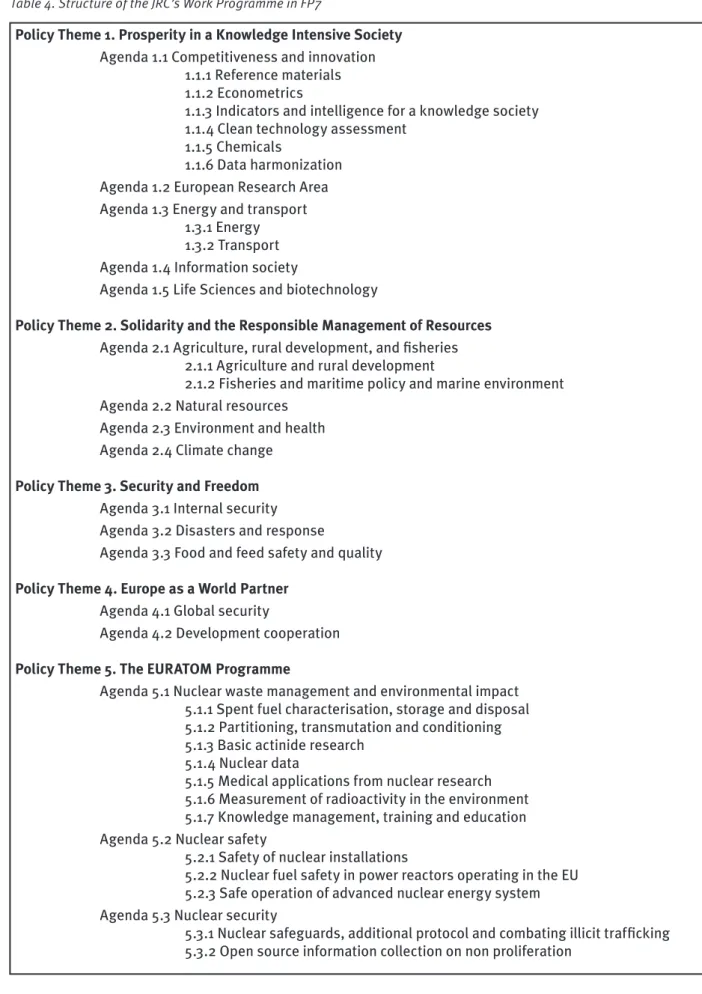
The Panel noticed that the current Work Programme structure with Policy Themes and Agendas under FP7 differs significantly from the one with Core Areas and Priorities under FP6. Indeed, so far the JRC has significantly changed the structure of its Work Programme with every new Framework Programme, whereas the basic elements of its work broadly stayed the same. The Panel was unable to find a convincing explanation for this practice. A more stable structure would give the JRC a more recognisable work portfolio.
Whereas Chapter 3 will address the challenges ahead and thus contains the main recommendations of this evaluation report, the analysis of the development of the Work Programme over the years led the Panel to the following statement about the work programme structure.
For the benefit of the JRC and notably for its corporate positioning, planning and evaluation activities, it is recommended to develop a Work Programme structure that reflects the core activities of the JRC. Adaptations to changing political priorities have to be accommodated in substructures.
2.1 Core Area 1: Food, Chemical Products and Health
2.1.1 Priority 1 - The Food Chain
This Priority supports policies for consumer protection with regard to the food chain including safety, quality, authenticity, health, and nutritional and socio-economic aspects. The JRC Work Programme during FP6 grouped six Actions under the “Food Chain” Priority. They are carried out in the IRMM, IPSC and IPTS. Food-related activities in IHCP were not part of this Priority.
The Actions in this Priority show a clear identification the customer: for most of them it is the Commission, in particular its Health and Consumers DG, Agriculture and Rural Development DG and Eurostat, the Statistical Office of the European Communities. International standardisation bodies2 are also
significant beneficiaries of the JRC’s work in food and feed.
As regards the implementation of one specific recommendation3 of the “Fisk
Report”, the Panel acknowledges that the IRMM is developing a new microbi-ology (Level 3) laboratory and that it has produced certified microbiological reference materials and developed immunological methods.
Detailed commentary
2 Like the International Organisation for Standardisation (ISO), the European Committee for
Stand-ardisation (CEN), the Codex Alimentarius Commission for food standards )
3 ”While endorsing the chemical science underpinning the Priority Area for Food, future expertise
22
The Panel believes the JRC should analyse the international situation and open the door for more leadership, based on competence in reference materials and measurements. In this respect the position of IRMM has been discussed in relation to CEN.
The JRC’s food-and-feed related Actions are spread over five different Priorities and four Institutes (IRMM, IPSC, IHCP, and IPTS); several activities under Priority 1.2 “Biotechnology” or under Priority 1.3 “Safety of Chemicals” could as well have been arranged under “Food Chain”, and at least five “horizontal” Actions (Core Area 4) partially support or complement the work done for the Food Chain.
Although it would have been meaningful to bring more coherence in the food-related activities from a programmatic point of view, the fact is that the various Actions in the “Food Chain” Priority have been carried out in an effective manner and with success giving the JRC a strong position.
Until now almost the whole of the Work Programme has been related to analytical methods relevant for food legislation. However, horizontal activities are important where no unique scientific research areas can be formed (e.g. in the case of nanotechnology). For IHCP horizontal thinking and working is particularly important. More research than routine work and introduction of horizontal topics such as “nutrition and health” could sharpen the picture in this area. Nanotechnology and biotechnology should lead these activities within JRC and use their knowledge for further inter-national competence building. Biomedical testing methods have a high political priority, but future political and public thinking has to be observed continuously.
The Panel believes that the JRC should consider the following targets:
• Complete the actual system of analytical work considering hygienic and immunological issues as well as future developments in genetically modified organisms (GMOs) and safety aspects of nanotechnology. • Define positive criteria for foods relating to quality as a whole including
nutritional, sensorial and ecological aspects. They already play a certain role in food legislation now.
• Evaluate agricultural, feed, and food production systems (e.g. functional foods) based on techno-economic models to establish clear pictures on safety, quality, and health aspects. IHCP could take over the leading role in this integrated area.
More programmatic coherence in the food related activities would be good, but the various Actions in the “Food Chain” Priority have been carried out effectively which has put the JRC in a strong position.
The Panel supports a stronger role for the JRC in international actions (standardisation bodies) commensurate with the scientific importance and competence of the work in this field. The Panel recommends paying additional attention to food quality in horizon scanning and proactive thinking.
23
2.1.2 Priority 2 - Biotechnology
This Priority is based on the EU strategy recognising that biotechnology is a major contributor to the competitive and dynamic knowledge based economy in the EU. The Community intends to ensure that legislation concerning biotech-nology, in particular concerning GMOs, is enforced uniformly and effectively across the EU. In addition, future policy developments will rely on high-quality assessments of the impact of technological developments on our economies and societies, and on early identification of newly emerging issues requiring policy responses. The main aim is to support implementation of GM legislation and to develop methods to assess risks as well as evaluate long-term impact of GMOs and other uses of biotechnology. Main customers of services in this area are the Health and Consumers DG and the Environment DG.
The JRC is recognised as the world leader in the GMO field of setting standards for GMO detection and in GMO certified reference materials (CRMs) which are essential tools for GMO quantification (bio-metrology) in the context of GM labelling of feed and food.
The JRC has close relations with the European Food Safety Authority (EFSA) and with the European Network of GMO Laboratories (ENGL). It also partici-pates in multiple EU projects, contributing control samples and CRMs, reference detection methods and expertise with designing new protocols for standardisation and reference measurements. Through the ENGL, there is a very active distribution of materials and methodologies as well as a provision of training on site or within the JRC for national laboratories. Training material is distributed free through the respective websites. Furthermore, the ENGL acts as an interface for interaction with the USA, Japan, and others, with the EU serving as the world leader on GMO standards.
A consortium led by the JRC has developed a tool to estimate levels of adventitious admixture of GM and conventional crops in a given landscape. The methodology allows an analysis of the cost-effectiveness of agronomic measures to ensure coexistence.
While the focus of IHCP activities is on the core function as Community Reference Laboratory for GMOs (CRL-GMO), IRMM is largely concerned with the large scale production and distribution of GMO certified reference materials for GMO quantification for which they received international accreditations. While these activities are essentially complementary, there seems to be some overlap in objectives and deliverables such as for example the development of methods for quantitative GMO analysis and provision of controls. There is visibly an exchange of materials (e.g. CRMs and methodology) between the two units in the JRC working on GMOs, but both would benefit from a more systematic communication and exchange of information.
IPTS made a contribution to biotechnology foresight, concerning model simulations and expert opinions on the co-existence of GM and non-GM crops in European agriculture. IHCP supported this work by monitoring GMOs in the field.
The Biotechnology Priority is providing solid reference materials and detection methods for GMOs needed for the uniform and effective
24
tation of the EU legislation, and as such has achieved most of the objectives set in the Work Programme.
GMOs are perceived negatively by the public worldwide irrespective of the guaranteed quality control of GM food and feed. The JRC is advised to use its expert leadership in this field to actively contribute to engaging with the general public and politicians.
2.1.3 Priority 3 - Safety of Chemicals
The chemical industry forms a large and highly important economic sector of the European Union. For the tens of thousands of chemicals in commerce, a harmonised EU legislation must be in place ensuring a high level of protection for workers, consumers, and the environment against dangerous chemicals whilst allowing less regulated markets for the other chemical compounds. Safety of chemicals has been a core activity of JRC for over 15 years. Without the solid and thorough work of the JRC scientists now grouped together at IHCP, there would not be a sound European policy on the effect of chemicals on humans and the environment. Since its inception, the European Chemical Bureau (ECB) has been seen as the key partner for policy development and for R&D. It has been at the forefront for classification and labelling, and paved the way for an unbiased discussion on risk assessment and toxicology of chemicals and consumer goods.
Recently, the new regulation with the Registration, Evaluation, Authorisation and Restriction of Chemical substances (REACH) entered into force and legislation became fully operational on 1 June 2008. It will have far reaching implications on the chemical industry and the way in which the EU deals with the question of safety of chemicals. Together with the chemical industry and the Organisation for Economic Co-operation and Development (OECD) the JRC had a leading role in the development of the informatics tools for REACH, the so-called REACH-IT system that will be at the heart of the operations of the European Chemicals Agency (ECHA). This concerned scientific aspects, such as data structure and the content of the web portal as well as technical issues such as how to put databases together worldwide and how to achieve global access free of charge. The JRC’s website for the implementation of REACH has become one of the most visited sites of chemical information, both in Europe and abroad.
With the successful launch of REACH and the transfer of a number of activities to the European Chemicals Agency, the JRC has reached a most important objective within FP6. It has to be complimented for all the preparatory work which finally allowed a relatively smooth start for REACH. The Panel is convinced that without the science-based integrated approach used by the JRC such a major piece of work could not have been achieved in the restricted time window budgeted. The set-up and the launching of REACH could be used as a showcase of how scientific information, technical and economic feasibil-ities, business interests, and the needs and concerns of all stakeholders can be woven successfully into a legal framework.
The assessment of risks and hazards is at the core of identifying chemicals that are potentially not safe for humans and the environment. The outcome
25
from this topic will allow the IHCP to base its judgments on scientifically sound data and methods harmonised between Member States and different regulatory frameworks. In the integrated exposure assessment and modelling (EXPO-model) special emphasis is given to chemicals in consumer products from food packaging, via appliances to furniture under conditions of daily use. Work under this topic is clearly a task of JRC. The advances in risk and hazard assessment, in computational toxicology, and exposure modelling are good and here the JRC fills a gap which no other organisation can or would do. As regards the analytical possibilities in risk assessment, the JRC would benefit from IHCP and IES joining forces. The “Indoortron” is one of the research facilities that triggered the Panel’s general recommendation in section 3.3.3 to regularly analyse the status of big infrastructures in the JRC. Several of these infrastructures give the impression of being under-used and their maintenance ties up resources. Individual experiments may be better out-sourced to other European institutes.
The European Centre for the Validation of Alternative Methods (ECVAM) has been active for over 15 years. It is supported by computational toxicology which makes advances in the field of quantitative structure-activity relation-ships (QSARs). A QSAR database is now available containing estimates for the properties of over 160.000 chemicals. This database and ECVAM are the basis for making in silico assessments and reducing the need for animal testing. The design, construction, and maintenance of such a database need major scientific input. Its validation service, and the maintenance and management of the database are extremely important for the EU. The JRC is well equipped and staffed to do this work which is of utmost benefit to all Member States, the chemical and pharmaceutical industry, as well as NGOs and the academic world. The JRC shows leadership in this all so important but often neglected field.
Testing of the safety and the effects of chemicals is still done independ-ently in each scientific and application sector. Interpretation of test results from different approaches is difficult if not entirely impossible. Therefore, it is timely that the IHCP has started an effort to integrate the different testing targets and the appropriate methods into one toolbox in order to obtain a truly (molecular) mechanistic understanding of the effects of stressors on individuals and populations. To reach this goal it is pertinent to integrate physicochemical (e.g. membrane permeability), chemical (e.g. QSARs), and biological methods. The results of such an integrated approach will allow sound policy support through its comprehensive information.
The Panel welcomes this effort towards integrated testing strategies for risk assessments and stresses that a special effort is needed to bring the different expertise and disciplines together; the total will be more than the sum of the individual components. Time must be allowed for the creation of a leading team from members of different Institutes. To avoid pitfalls, proven parameters of success from past experience of integrated projects, particu-larly also from outside of the JRC, must be incorporated into the project design and management.
With REACH and the European Chemicals Agency in place, the JRC should focus more on integrated approaches in the assessment of risks and hazards by chemicals to humans and the environment.
26
To keep up with the newest knowledge developments, particularly in the molecular biology field, the JRC must connect even more strongly with leading institutions worldwide. The JRC Institutes should take this window of opportunity to optimise their respective roles, fuse activities where opportune, and create a sharper profile in complementary areas.
2.1.4 Priority 4 - Contributions to Health
This Priority is based on the Community health strategy and intends to underpin and support policy development at Community level by focusing on improving health information and knowledge, responding rapidly to health threats and addressing health determinants. The Actions in this area are diverse and based on specific competencies existing in several Institutes. They range from health effects of environmental exposure to treatment of cancer.
The general impression is that the Priority has achieved many of the objectives set in the MAWP, but at the same time, that the impact on European policies or on the work of the Commission Services seems to be small. However, several Actions included in other Priorities (food chain, biotechnology, safety of chemicals, protection of the European environment) have directly or indirectly contributed to the health of European citizens. Therefore, the overall impact of the JRC on issues related to the health of European citizens has been significant.
Two Actions in this Priority aimed at the development of new approaches to cancer treatment based on nuclear methodology. The Neutron Capture Therapy is used mainly for treatment of brain tumours and can only be performed at nuclear research reactors. The clinical significance of the therapy is still uncertain, but it is obvious that even if the treatment turns out to be effective, the number of patients that can undergo this treatment will remain small. The Panel encourages the JRC to carry out its intentions to phase out the project as the methodology seems to be fully developed and other institutions may continue the clinical studies.
The JRC has, in close collaboration with the university hospitals worldwide, made its facilities and expertise in handling highly radioactive alpha-nuclides available to develop and test suitable alpha-emitting immune-conjugates for cancer treatment. The initial results are promising and the method could be applied to the treatment of several cancer types and infectious diseases. The technical expertise of the JRC is critical for the development of the therapy, a reason to continue providing support to the work on alpha-immunotherapy, cell toxicity and cancer therapy.
The volume of health technology assessment has decreased during the transition from FP6 to FP7 along with a changing focus from technology assessment to modelling and policy analysis. The remaining work focuses on the impact of new technologies, particularly genetic technologies, on health and health systems. The Panel believes that the research groups for this work are below a critical mass, making contributions to the European policies that are not very significant. The Panel noted that there are other sectors in health research where the JRC could support the Commission Services and the health policy of the Member States. An area with growing importance which might benefit from improved European networking and collaboration is health technology assessment.
27
The majority of the inputs of the IHCP have contributed to health in Europe but only two of the Actions have formally been included in the Health Priority (Cyclotron Applications in Health and Environment; Human Exposure to Environmental Stressors and Health Effects). Although the Institute has generally been successful in achieving its objectives, it is clearly at a crossroad. Potential “future topics” were put forward, but building up new expertise for instance in “nutrition and health” would require significant resources, and should be dealt with in the context of a corporate strategy.
The Panel noted that there has not been enough collaboration within the JRC in this area of health research, and there appeared to be only a little cross fertili-zation between the Institutes and between the individual Actions working on health issues. One obvious explanation is the heterogeneity of the thematic area.
Some of the Actions in the Health Priority have operated below the critical mass during FP6. Much of the work has not been in the main stream of the parent Institutes, or in fact, in the main stream of the JRC. On the positive side, the scientists working in this Priority have been strong in networking with academia, i.e. universities, research institutes and hospitals in Member States and elsewhere.
The Fisk Report noted that there is an absolute need to coordinate the topics to be addressed with a more realistic and pragmatic overall health strategy for the JRC. In FP7 the position of health research has become a crosscutting discipline across several Policy Themes of the Work Programme without visible structure. Therefore, the JRC should start to establish a clear vision of what position it wants to give to health research in its Work Programme.
The Health Priority has achieved many of the objectives set in the Work Programme, but the impact on European policies and on the work of the Commission Services has not been large. On the other hand, the Actions included in several other Priorities are directly or indirectly related to the health of European citizens. Hence, the overall impact of the JRC on issues related to the health of European citizens has been significant.
The JRC should now start to establish a clear vision of what position it wants to give to health research in its Work Programme.
2.2 Core Area 2: Environment and Sustainability
2.2.1 Priority 5 - Protection of the European Environment
This Priority focused on air, soil and water quality, the sustainable management of land and water resources, the environmental aspects of products throughout their life cycle and impacts associated with the management of waste. The activities support a broad range of policies laid down in the Sixth Environment Action Programme and fit the EC Strategy on Sustainable Development. For this purpose the JRC develops and tests advice and scenarios for regional, EU and global policies and data sets. The Commission is the biggest customer of the JRC’s work, but the Member States are also beneficiaries. New Member States have been direct customers and
28
the networking of the JRC with their Institutes has been especially effective during the accession process.
The availability of massive environmental data with global coverage has become more common today; environmental data sets covering the whole of Europe have a clear added value for the EU. The JRC plays a key role in the collection and management of this kind of data for the region.
The JRC connects operational activities such as warning of forest fires, flood and droughts forecasting, or calibration exercises for the water framework directive, with quality in science and logistics. This has proved to be beneficial to the Commission and other customers of the JRC in the Member States. It is important that the JRC continues to integrate and harmonise all environmental data available in the various JRC Institutes.
The JRC has been building on results achieved on global change monitoring and research in large national and European institutes by inter-comparing and integrating these into services for its customers. This role has become increasingly organised and institutionalised. In this respect the Panel would encourage the JRC to investigate the possibility of creating for the EU and its institutions a focal point on global issues as a European counterpart to regional or global initiatives. The focal point should reside within the JRC and could serve as an integrating body for European trans-boundary issues that are handled by international initiatives, projects and programmes, like for example the Global Environment Facility (GEF) of the United Nations Development Programme (UNDP).
With the Commission’s mandate to represent the European Union in the United Nations (UN), the JRC participates in several of the environment-related UN committees successfully achieving the integration of various issues across the different committees.
The JRC gradually developed tools for integrative assessment of scenario impacts. Customer response is positive and a few of these tools have already been integrated in the Global Monitoring for Environment and Security (GMES) initiative.
External collaboration is good and the Panel recognised improvements in the JRC’s internal communications, but these seem not to be efficient. Establishing dedicated task forces was signalled as a possible solution to strengthen corporate identity and to react to new policy needs in a timely way; a temporary instrument, which could avoid calls for major reorganisations and which could be supported by small organisational readjustments.
There is a joint work programme with the European Environment Agency (EEA) covering task distribution and exchange of personnel, which avoids duplication of work. The Panel welcomes and encourages the continuation of this development which could be used as a JRC model for cooperation with other EU agencies.
The Panel acknowledged the flexibility and pragmatism regarding decisions about Actions in this area. Environment Actions that fall below the critical mass are phased out and a new Action is only initiated if there is a good chance of success. The latter is usually linked with the existence of sufficient
29
interest in Member States, or to becoming part or being part of an EU Regulation.
The JRC’s role in the field of environment may not be correctly or fully perceived within the scientific community of Europe. It is not well known that the JRC often serves as a lens, focusing activities in Member States incorporating work of many cooperating organisations. It would be worthwhile to seek improve-ments including building stronger links to universities.
The laboratory facilities for this Priority have improved since earlier assessments. The Panel’s opinion is unanimously positive with regard to keeping and developing these laboratories in the future to avoid loss of expertise. The Panel would also stimulate an internal discussion on the right balance between competitive and institutional funding for this area and perhaps for other areas too.
The level of interest from external users for using JRC databases is very high. At the level of resource allocation meeting this growing demand should not compromise maintaining scientific competence. Although the JRC has the knowledge and the capacity to meet this demand, there is a need to establish more dedicated capacities in this field and to harness them into a coherent framework. At the same time the JRC should strengthen efforts to integrate the available databases, knowledge and software into the development of impact assessment and scenario models and reinforce the socio-economic components in these.
Despite JRC’s policies for open access to its environmental databases and requests for data and some models, these are sometimes restrictive for users due to the fact that Member States do not allow the JRC to give third-party access to data that concern their territory. This problem would need to be solved at EU level.
The Panel acknowledges the progress made in the quality and the orientation of the work in this Priority Area since the Fisk Report. The JRC plays an important role in the collection and management of global and European environmental data. The level of interest from external users for using the various JRC databases is very high.
There is scope to strengthen efforts to integrate the available databases, knowledge and software into the development of impact assessment and scenario models and reinforce the socio-economic components. At the same time the JRC should work on a structured integration and harmonisation of all environmental data available in the various JRC Institutes.
The Panel encourages the JRC to investigate the possibility of creating within the JRC a European focal point on global issues as a European counterpart to regional or global initiatives. The focal point could also serve as an integrating body for European trans-boundary issues handled by international initiatives, projects and programmes for the EU and its Institutions.
The Panel believes that the JRC should strengthen research for its general knowledge base and the available databases in the areas of information for ecological security and durable development, monitoring and understanding
30
of nature and extent of disasters, the impact of global warming, desertifi-cation, erosion and deforestation.
2.2.2 Priority 6 - Global Change
It is clear that the title Global Change covers a very large number of fields and that the JRC cannot possibly make an impact in all of them. The JRC’s most valuable role is that of coordinator collecting, harmonising and integrating regional, EU and global data sets related to levels and emissions of greenhouse gases and conventional air pollution such as aerosols and tropospheric ozone. The role might also be looked upon as a focal point and a useful player because of the data collections covering regions and climatic zones in large parts of Europe. The JRC is well-positioned to fulfil these roles in a regional and global context. The main customers are found within EU institutions, but there is also a host of important international users of JRC results and reports in this field. Amongst them are a series of UN bodies like the Food and Agriculture Organisation (FAO), the World Meteorological Organisation (WMO), the World Health Organisation (WHO), and the Intergovernmental Panel on Climate Change (IPCC), but also international bodies like the International Geosphere-Biosphere Programme (IGBP), or the US National Aeronautics and Space Administration (NASA). The JRC has developed unique competence in the area of greenhouse gas emission and sinks in the forestry and agriculture sector. It has refocused much of its environmental studies and work on natural hazards, and integrated expertise already available in areas of land resources and water quality management which are closely linked to global change and therefore important areas for the JRC to cover.
The work done is quite effective and the planning and progress of the different activities have resulted in a large quantity of deliverables in terms of case studies, risk maps, analysis of climate-change scenarios. The quality of the output is in general satisfactory, but the impact of many of the products is more difficult to assess. Top quality products are to be found in peer-review scientific publications, reporting results from the JRC’s own research.
There is cooperation, contact and networking with the major players worldwide and the JRC has close collaborations regarding climate change and related ongoing and/or expected effects on the environment and society with some of the most outstanding institutions. The links with the 12 New Member States are good and experts and young scientists from these countries have been hired into the ongoing work at the Institutes.
Some “Global Change” Actions have been closed since they came below the critical mass. This capacity to reorient work programmes and staff when necessary has a positive effect on the work in this area.
There seems to be a need for more and improved links with global initiatives for data collection. JRC results are disseminated on a regular basis and are to some extent available also for users outside of the formal customer list. Most of the work in this Priority is reactive. The Panel is inclined to promote a change of attitude in terms of allocating more time and funding to do more