Service-Oriented Architecture Adoption Patterns
Marc N. HainesInnograte LLC [email protected]
William (Dave) Haseman Sheldon B. Lubar School of Business
University of Wisconsin-Milwaukee [email protected]
Abstract
As many organizations are recognizing that their current IT architecture does not provide the business with the needed agility to compete in an ever faster changing business environment, many CIOs and enterprise architects are seeking to improve their overall IT architecture by moving towards a service-oriented architecture (SOA). While the technology around SOA is maturing, the adoption of a service-oriented IT paradigm and its organizational consequences are not without challenges. Organizations start their SOA initiatives from diverse baselines, are at different stages in the process, and take varying approaches to accomplish the expected IT and business goals. This research has the objective to identify adoption patterns of SOA and paths of SOA adoption observed in a field study of eight organizations with SOA initiatives.
1. Introduction
SOA has become one of the most visible trends in the IT industry and current publications by research groups indicate that the adoption of an SOA is both growing and maturing [4, 12]. The interesting question at this point is not, whether organizations should adopt SOA but rather how organizations can effectively leverage SOA. This includes understanding patterns of adoption along with other insights that can be used to inform planned or ongoing SOA efforts. This study relies on the observations made in eight different organizations from varying industries. The observations provide information about the expected goals of the SOA initiatives, the organizational circumstances and drivers that led to the projects, the steps taken towards an SOA, and the benefits and challenges experienced on the journey to SOA. To help explain the adoption process in the different organizations, the SOA adoption is viewed through the lens of technology innovation theory [13], which
provides a framework of different innovation levels that entail varying organizational consequences.
In the following sections we start out with briefly establishing our conceptual framework by discussing SOA, technology innovation, and the methodology used in this research. We then present the evidence collected in the cases, which is followed by a discussion of patterns for SOA adoption based on the empirical evidence. At the end we provide a conclusion in which we highlight the key findings of this research.
2. Service-Oriented Architecture
A service-oriented architecture (SOA) is a paradigm for organizing and utilizing distributed capabilities that may be under the control of different ownership domains [7], or it can be viewed as an architectural style for building software applications that uses available services in a network [9]. There are several design principles and best practices associated with service-oriented computing or SOA [3, 8]. A number of standards-based technologies have been established to help realize an SOA, most prominently XML Web services.
2.1. The Role of Web Services
From a conceptual standpoint, an SOA can be built on a variety of underlying technologies. However, Web services play a particularly important role as a technology to realize an SOA [1, 3]. Prior to the availability of mature Web services standards (i.e., SOAP), some companies and vendors in fact developed their own proprietary protocols to establish IT architectures based on SOA principles. However, the lack of standardization posed a major obstacle to adoption across organizational boundaries and to improvements in productivity through automation of software development tasks. However, our own experience and a review of the trade press suggest that companies are moving away from proprietary
solutions to open-standards based solutions. A number of alternative open-standards based solutions for an SOA exist (e.g., REST-based Web-oriented Architectures [1]). However, Web services as defined below arguably have the widest support in the industry as far as development and management tools and enterprise applications are concerned. Analogous to the World Wide Web Consortium (W3C) [5], we define Web services as a software system designed to support interoperable machine-to-machine interaction over a network with an interface described in a machine-processable format (specifically WSDL). Other systems interact with Web services in a manner prescribed by its description using SOAP messages, typically conveyed using HTTP with an XML serialization in conjunction with other Web-related standards. A service registry based on the UDDI standard can be employed to publish and discover Web services. For industry strength services, further standards related to security, reliability, and other relevant aspects of application development have been established (i.e., WS-Security), and further standards for more advanced features are being developed (i.e., standards related to semantic Web services).
The main contribution of Web services is the level of standardization they provide in conjunction with the broad acceptance of these standards in the industry. This is also important from a business innovation perspective, as standardization of technology is a necessary ingredient for innovation at a higher level. In this case the standardization of interfaces and the messaging protocol drives innovation at the application level, business process level, as well as innovation related to software development.
3. Innovation
To understand the value of an open-standards based SOA, it is helpful to have a framework that can describe the impact of technology innovation on the organization. Technology Innovation Theory [12] provides a useful framework in this context.
IS innovation broadly defined as innovation in the organizational application of digital computer and communications technologies (now commonly known as information technology, or IT). [12] IS innovation theory is concerned with how IS innovation spreads within organizations and differentiates different types of innovation. Typing of innovations is significant in part because facilitation factors, adoption sequences, and timing vary systematically between different types
of innovation. Swanson proposes three major types and several subtypes of IS innovation, based on the Tri-Core representation of IS innovation in organizations. The Tri-Core model is an extension of the Dual-Core model of innovation in organizations [2]. According to IS Innovation Theory IS innovation may involve a new IS product or service, a new IS work technology, or a new IS administrative arrangement. [11] Type I innovations are restricted to the functional IS core, other business areas are affected mostly indirectly (e.g., through gains in IS efficiency). Type II innovation applies IS products and services to the administrative core without directly affecting the organizations produced goods and services. Type III innovation integrates IS products and services with core business technology and potentially affects the whole business, including its competitive strategy and position. A purpose of innovation theory is to develop the understanding of the relationship of IS to the larger business.
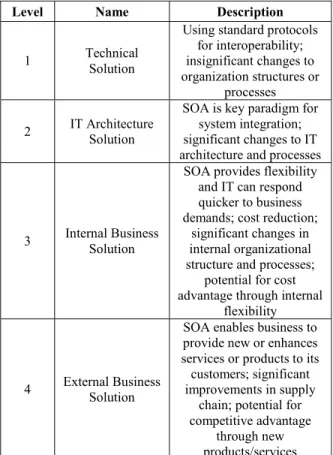
Table 1: SOA Enabled Innovation
Level Name Description
1 Technical Solution
Using standard protocols for interoperability; insignificant changes to organization structures or
processes 2 IT Architecture Solution
SOA is key paradigm for system integration; significant changes to IT architecture and processes
3 Internal Business Solution
SOA provides flexibility and IT can respond quicker to business demands; cost reduction;
significant changes in internal organizational structure and processes;
potential for cost advantage through internal
flexibility
4 External Business Solution
SOA enables business to provide new or enhances services or products to its customers; significant improvements in supply
chain; potential for competitive advantage
through new products/services Innovation theory has previously been used to describe the relationship between Web services adoption and organizations [6] by defining four levels of Web services adoption based on the Tri-Core model
of innovation: technical solution, IT solution, internal business solution, and external business solution. Here this framework is adapted and used in the more generic context of SOA, for which Web services are a key enabling technology (see Table 1).
4. Methodology
This paper employs a multiple case research strategy to capture the actual adoption patterns of SOA in the industry. This strategy was chosen because the adoption of SOA is a contemporary event that can be observed in a real-life context, for which little prior academic research has been published.
4.1. Research Design
In this study it was important to gain an understanding of the different approaches to SOA adoption. Thus, we chose a multiple case design rather than focusing on one case.
The key data source for this research are interviews with IT professionals, including project managers and IT architects, with the requirement that the participants had knowledge of the organizational IT strategy and current SOA related initiatives. The interviews were conducted in 2006. In total 11 participants from eight organizations participated in the interviews. The organizations belong to a range of different industry, including automotive, manufacturing, health care, financial, and government.
Each interview lasted approximately 30 minutes. All interviews were conducted via phone and were guided by a semi-structured interview guide. This interview guide contained open-ended questions and was used to ensure that all relevant areas of interest were consistently addressed in the interviews. The questions elicited the firms demographics (industry, size, etc.) and the role of the participant within the firm, the history and goals of SOA initiatives, key business drivers, the scope and technologies applied in the SOA efforts, key challenges, and the currently observable outcomes. This type of data collection was deemed sufficient in this exploratory study for a high level identification and assessment of technology innovation and adoption patterns across organizations. It was not intended to provide in-depth information for each case, or confirm causal relationships between adoption patterns.
With one exception, all interviews were recorded and transcribed. The researchers then created summaries of the transcripts and provided participants
with an opportunity to make corrections, such as adding important details or removing sensitive information.
The qualitative data analysis focused on identifying evidence of innovation, using a coding strategy with some preconceived constructs, similar to axial coding [11]. The transcripts and other documents were coded and summarized individually, with the goal to identify text passages associated with innovation and different types of SOA outcomes (e.g., interoperability, business process change, etc.). All text passages associated with innovation were then validated by the researchers and linked to a level of innovation according to the framework presented in [6]. This process is the basis for associating a level of innovation to each organization. However, the qualitative analysis also allowed for an open coding of additional relevant constructs that were discovered in the process (e.g., SOA backplane, standards, etc.).
5. Case Evidence
The following is a brief summary of each organization that participated in this study and its major SOA initiative.
5.1. Automotive
The organizations IT landscape consist of a majority of custom developed legacy applications, SAP applications, and a few other commercial applications. Automotive started in 1999 to connect legacy applications with XML-based messaging, before starting to use SOAP in 2001. But it was not until 2005 that SOA was applied to business critical applications. The organization leverages two main integration backplanes, an Enterprise Service Bus (ESB) product and the SAP Exchange Infrastructure. The key motivating factors driving the SOA efforts were flexibility, the ability to faster align with the business needs, and improved manageability of IT resources. The organization has implemented an ESB as a key building block of the overall architecture and plans to leverage its business process management capability.
5.2. Liquids
This manufacturer of liquids runs a large SAP implementation, along with a number of mainframe and .NET applications. Liquids started with their first pilot implementations of SOA in 2004 and plans to
expand the use of SOA in the future. The SOA is largely based on SOAP Web services and leverages two integration backbones, the SAP Exchange Infrastructure to integrate SAP applications and Microsoft Biztalk to integrate all other applications. Key motivating factors were faster delivery of solutions to the business and costs reduction. At the time of the interview, the focus of the SOA was to provide interoperability, and business process management features were not leveraged at that point.
5.3. Medical Center
The medical center runs legacy mainframe systems and a very heterogeneous set of other smaller systems (including medical devices) throughout the organization. The SOA efforts began in 2003, originating from interoperability issues in the operating room where multiple devices recorded vital signs that needed to be accessed outside of the operating room using a common protocol. New services provided new capabilities to, for instance, anesthesiologists and improved data accuracy and prevented an estimated loss of 2 million dollars in revenues.
5.4. Hospital
The hospital has a heterogeneous IT environment, consisting of a PeopleSoft ERP system, and more than 140 mission critical systems running on Linux or Windows servers, including applications from a diverse set of health care system vendors such as General Electric and Siemens. The SOA effort was started in 2003 with a focus on cost reduction and improving the efficiency of workflow, as well as complying with HIPPA regulations. With respect to cost reduction, for example, the cost for a claim was reduced from $5 to $0.25. The hospital also played a key role in leading a state wide effort to improve medical records processing. Due to SOA it was possible to implement a new system related to bioterrorism in less than 2 months, compared to previous efforts that had been going on for over 2 years. The hospital has leveraged SOA to develop new composite applications but was at the time of the interview just experimenting with a BPM tool.
5.5. Health Care Information
This organization delivers healthcare information among different entities, such as health care providers, insurance companies, hospitals, labs, physicians and emergency centers. The organization is working on
delivering more medical information in digital format using mostly custom developed legacy applications in conjunction with the HL7 standard. Health Care Information has only recently looked at SOA and expects its first SOA initiative developed on a Java platform to be completed in 2006. A key goal is to move away from fax and courier-based exchange of information to an electronic format. While this should result in faster system deployment and cost savings, the larger goal is to improve health care services. Health Care Information is using SOA to improve interoperability and create new composite applications on services, but has no apparent plans to leverage BPM for its information processing.
5.6. Insurance
Insurance uses mostly custom applications on mainframes written in COBOL, but also has a number Java applications running on Unix systems and applications running on Windows servers. At the corporate level, a PeopleSoft system supports the HR function. The organization began exploring SOA in 2003 and went live with its first SOA-based solution in 2005. A key goal is to improve the ability to access that functionality from disparate applications in a manner that would maximize the overall business agility of the organization. There are increasing time-to-market pressures and more requests to build composite applications based on functionality in the existing systems. The SOA solution is realized using the Sun Java Integration Server. The organization leverages the integration capabilities of the tool, as well as its ability to manage workflow and business processes.
5.7. State Government
The operations of the state government are supported by custom applications running on IBM mainframes, as well as Windows and Linux servers. The state government is currently not using an ERP but is in the process of procuring one.
The SOA initiative started in 2003 and led to the purchase of a Cape Clear Enterprise Service Bus. The current implementation is expected to grow to a statewide effort and eventually also include federal agencies and corporate entities. Key goals were cost savings by the elimination of duplication of effort and streamlined access to data for making better decisions through standardized integration of the data and applications. Business process management is an
important element in this effort, besides providing better interoperability.
5.8 Financial Advisor
This company provides financial advisor services for middle income people. The organization uses packages (e.g., CRM) as well as custom applications developed on the Microsoft .NET platform. The SOA initiative started in 2003 as a data integration project and became officially an SOA project 2005. Now SOA is viewed as the foundation for key applications in the organization. It was initially an IT driven initiative with the goal to serve the business better and more efficiently. SOA helped IT to become more real-time and move away from batch processing. SOA also provided a common ground for the integration of acquired companies. Financial Advisor uses TIBCO for service orchestration and BPM. BPM and abstraction are viewed as key parts of the SOA effort. Service management is supported with an AmberPoint product. However, at the time of the interview a UDDI registry was used only for experimentation.
6. Results
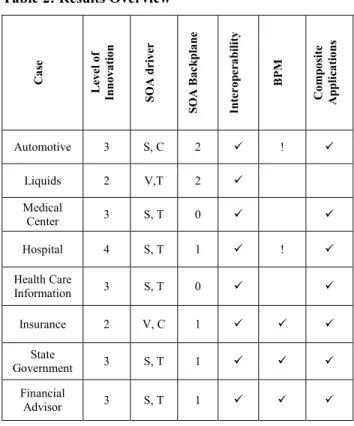
The eight cases revealed several insights into how the organizations are approaching SOA adoption and its expected outcomes in terms of organizational innovation. Table 2 below shows for each case the level of innovation associated with SOA, whether or not the SOA adoption was driven by a system vendor, and the type of utilization of SOA.
All organizations leveraged SOA to improve interoperability. Except for Automotive and Liquids, participants from all other organizations explicitly noted the development of composite applications based on their SOA.
Based on the case evidence we identified the following characteristics in which the adoption of SOA differed significantly:
• the level of innovation enabled through the SOA initiative;
• whether the adoption of specific tools and technology was guided by open standards or followed a vendors offering of SOA related products;
• whether the initial adoption of SOA was concept driven or driven by the availability of technology;
• the number of SOA backplanes that are involved in the organizations SOA initiative;
• and the use of business process management (BPM) capabilities.
We also address some of the key impacts and challenges that the organizations observed in the process of adopting SOA in the organization.
Table 2: Results Overview
Ca se Le vel of Inno va tio n SOA dr iv er SOA B ac kpla ne In terop er ab ilit y BPM Co m po si te Appl ic at io ns Automotive 3 S, C 2 9 ! 9 Liquids 2 V,T 2 9 Medical Center 3 S, T 0 9 9 Hospital 4 S, T 1 9 ! 9 Health Care Information 3 S, T 0 9 9 Insurance 2 V, C 1 9 9 9 State Government 3 S, T 1 9 9 9 Financial Advisor 3 S, T 1 9 9 9 S standards-driven; V vendor-driven C concept-driven; T Technology-driven
9 explicit statement referring to either leveraging SOA for better interoperability, use of BPM, or development of composite applications.
! BPM capability, but not used yet.
6.1. Levels of Innovation
All organizations clearly went beyond just a technical solution, or level 1 innovation, which would mean the SOA-related mechanisms and protocols (i.e., Web services) would just have been used as an alternate way of connecting systems. All organizations reported significant changes to the IT architecture and processes within IT. Key benefits mentioned by all participants were improved interoperability, reduced software development cycle times, and IT cost
reduction. However, Liquids and Insurance did not report any innovative changes beyond the confines of IT related issues at the time of the interviews. Thus, the level of innovation for these two cases is considered to be at level 2, where SOA provides an IT solution but no direct benefits to the business. The IT related benefits include reuse of existing applications, shorter software development life cycles, improved interoperability, and application deployment, and the flexibility to change elements of the system with minimal impact on the business. The IT related benefits did lead to IT cost savings but not necessarily to business related innovations. The project manager at Medical Center, for instance, stated that
One of the biggest advantages that we have seen is a clear separation between our business logic and all the infrastructure details. For example, the security aspect has been completely separated from the code. And that has really made the code much more containable because the code is now basically just business logic.
For all other cases, some direct business innovations were identified by the participants. These included the implementation of new business processes to support changing customer and compliance requirements, enabling real time electronic processing, and improving the quality of work. Also, important was the ability to improve business processes across organizational units. The participant from State Government pointed out that
[ ] if we had three agencies that collaborated on producing some desired results in the past, they would each have divvied up the problem [...]. Now what were seeing with SOA, is a rise in our ability to implement the enterprise component of the work flow that transcended any particular agency [...].
However, only for the Hospital case an obvious level 4, external business innovation, was clearly identified. In the Hospital case, SOA enabled the development of new services to customers who were previously unattainable. In the other cases there was no direct evidence for changes in the business model, or providing previously unavailable services or products to customers. In fact, there was little expectation by the participants that SOA would lead to significant level 4 innovations, including new business models or new services.
6.2. Following Vendor vs. Standards
A notable difference in SOA philosophy was the approach to determine appropriate SOA tools and
runtime environments. While some participants emphasized openness and vendor independence, other participants favored following the lead of a major vendor, such as the main enterprise system vendor or infrastructure vendor.
A key reason to follow a vendor was the lack of maturity of relevant SOA-related standards and the effort to track the development of standards to make the right decision. These organizations favored relying on a major vendor and let the vendor take the risk. The trade-off is an effective vendor lock-in, even if the vendors products are largely based on open standards. Other organizations valued vendor independence and interoperability higher and were willing to make the effort to identify and track relevant standards. This requires high awareness of or even participation in standards development.
It is also interesting to note that both vendor-driven cases had the lowest level of innovation (level 2). While this may be pure coincidence in our study, it could also indicate that perhaps the vendor-driven approach focuses too much on technology and not enough on the specific business context - to provide higher level business innovation.
6.3. Concept-driven vs. Technology-driven
Adoption of SOA
Many of the participants were proponents of SOA and believed that using a service-oriented paradigm to develop distributed information system provides substantial benefits to the organization. However, it also became clear that in some instances organizations were pushed into SOA or using an integration tool that supports SOA. As all major enterprise system vendors have moved to an SOA model, including SAP, many organizations using these systems now are bound to architect their solutions within an SOA framework.
Other organizations went through a more organic adoption of SOA that is based on its principles rather than the availability of technologies associated with SOA. A typical progression appears to be
1. starting with a form of messaging and interface descriptions, typically based on custom developed XML formats;
2. adopt standard Web services based messaging, using SOAP and WSDL; 3. adopt a service registry and other tools to
4. develop or purchase an Enterprise Service Bus tool that allows for further
abstraction, multi-channel communication, and business process
management.
Most organizations included in this study started their SOA efforts after Web services and other SOA related standards were established. However, both Automotive and Insurance bought into the idea of service-orientation prior to the availability of these standards and developed their own proprietary messaging based on SOA principles. Thus, they are considered concept-driven SOA leaders. All other organizations are considered technology-driven followers, as they only started SOA after key standards and technology were established. The evidence suggests that changing the paradigm to SOA is a greater challenge than adopting new SOA standards and technologies. Thus, the move to an SOA based on open standards was easier for companies already using a service-oriented approach.
6.4. Business Process Management
Capabilities
In the interviews we asked our participants if they are leveraging SOA to provide interoperability between existing systems, if business process management and abstraction are key parts of the SOA effort, and if they are building new composite applications from the services.
For all participants, enhancing interoperability between existing systems was a key aspect of the SOA effort. All organizations, except Liquids, are using the services within the SOA to build new composite applications. However, Business Process Management (BPM) and service orchestration play major roles in only half of the SOA initiatives of the organizations participating in this study.
As illustrated in some of our cases, BPM and service orchestration can play an important role in the capability to quickly react to changes in the business environment and is an important ingredient enabling internal business innovation, as well as new business models or products.
6.5. Choosing a SOA Backplane
An SOA backplane is software that provides an environment to manage and orchestrate services, track messages, and provide security and other common
features needed for SOA [10]. A typical backplane associated with SOA is an Enterprise Service Bus.
It is common in large organizations to have more than one SOA backplane (i.e., Enterprise Service Bus) [10]. Two of our cases revealed a scenario where an SOA backplane associated with the major Enterprise System of organization (e.g., SAP Exchange Infrastructure) is being used in parallel with another backplane from a different Vendor (e.g., IBM WebSphere Business Integration server).
In the case of Automotive, a combination of two main factors led to having multiple SOA backplanes. According to a participant, Automotive was forced to adopt the enterprise system vendors SOA product. However, the SOA product provided by the enterprise system vendor has not been used for the integration of other third-party systems. This was partially due to technical concerns regarding the integration solution provided by the enterprise system vendor, based on experiences made in the banking branch of Automotive. Second, the reluctance to replace an existing integration server that was already in place for connecting legacy systems and other systems not associated with the major enterprise system.
In the case of Liquids, in addition to technical concerns, cost played a role. The use of the integration solution provided by the enterprise system vendor was free for integration scenarios involving enterprise system components. However, when third-party systems are involved, charges were incurred based on the message volume. In both cases, the organizations had to implement the integration solution provided by the enterprise system vendor, as it became a required component with the new release of the enterprise system.
6.6. SOA Impact
All participants viewed cost reduction as a key driver for their SOA initiative. Some cases provided compelling evidence that this was achieved. For instance, Hospital reported the reduction of average claims processing cost from $5 to $0.25., Financial Advisor avoided licensing fees of $2,000,000, and Health Care Information reduced cost for courier services from $200,000 to $2,000.
SOA was also associated with a substantial shortening of the software development lifecycle and the ability to better respond to changing requirements. Changing business rules at Financial Advisor used to take two months, now it happens in a few days.
But also improvements in the business processes were linked to SOA, such as the reduced wait time for lab results (Health Care Information) and more accurate information and better compliance with regulations (Hospital).
Another important facet of the SOA initiatives is that in some cases it appeared to have improved the relationship with the business units. While the service-oriented paradigm required a new mindset from developers, that is, looking at services as an enterprise asset rather than a project deliverable, it also served as a good communication tool with the business units.
7. Limitations and Future Research
As in most case studies, the ability to generalize the results is limited. Since this study is mostly relying on interviews with participants who had a stake in the SOA efforts, there is also the possibility of a favorable bias towards the outcomes of the SOA initiatives. The dynamic development around SOA related standards and technology is not captured beyond 2006 and may need to be re-assessed. For instance, SOA tools and related technologies have matured substantially and major enterprise system vendors are now seeing their SOA related products being installed in their client organizations. However, non-technical aspects, such as governance, are still issues that require a better understanding and best practices in the context of SOA. This study, which is based on a fairly small set of qualitative data, should only be viewed as a starting point and further research into the adoption patterns and their relationship to innovation is needed to validate the conclusions put forward in this article. It is also important to realize that SOA is only a possible foundation, with the potential to enable business innovation. Important high level innovations, such as new information services or business models, are not likely to be seen immediately after the adoption of SOA. Future studies need to be conducted to confirm the value of the patterns for understanding SOA adoption presented here.
8. Conclusion
This research contributes to the understanding of how organizations approach the adoption of SOA and how SOA is enabling innovation in the organization. We identified a number of key characteristics in which the adoption can differ:
1. Single vendor vs. best-of-bread, guided by vendor offering or guided by open standards
2. Concept first or technology first, motivated by SOA principles or being driven by presence of tool that happens to support SOA
3. Type and number of different SOA backplanes
4. Use of BPM capabilities
Based on the experiences reported in our study, SOA has a significant impact on how organizations operate internally and the ability of IT to support these operations efficiently. However, most of the innovation attributed to SOA has not yet changed the products and services offered by the organizations to its customers or suppliers. The results also suggest that BPM plays an important role in the context of SOA to enable innovation that goes beyond the IT realm. Even the more advanced organizations in our study were still using a limited set of mostly internal services and just started to leverage BPM.
With growing service ecosystems and improved BPM, we propose that higher levels of innovation will be observed in those organizations that effectively leverage BPM in combination with their SOA. In terms of the approach to SOA, organizations that embraced SOA conceptually first, rather than being SOA-enabled through new technology, are expected to realize higher levels of innovation.
10. References
[1] Bradley A., Gall N., Schulte R. W., Understanding and Applying the Design Differences Between WS-* Based Architecture and Web-Oriented Architecture, G00147780, 25 April, 2007.
[2] Daft R. L., A Dual-Core Model of Organizational Innovation, Academy of Management Journal, 21, 1978, pp. 193-210.
[3] Erl T., Service-Oriented Architecture, Prentice Hall, New York, 2006.
[4] Fenn J., Raskino M., Basso M., Phifer G., Lundy J., Gilbert M. R., Basiliere P., Morrison S., Costello R., Jopling E., Schulte R. W., Natis Y. V., Drakos N., Tully J., Ball R. J. G., Smith D. M., Valdes R., Andrews W., Knox R. E., Cain M. W., Arevolo De Azevedo Filho W., Prentice S., Fiering L., MacDonald
N., Davison J., Jones N., Smith D. M., Bradley A., Reynolds M., McGuckin P, Cearley E. W., Rozwell C., Hype Cycle for Emerging Technologies, 2007, G00149712, Gartner, 2007.
[5] Haas H., Brown A., Web Service Glossary, http://www.w3c.org/TR/2004/NOTE-ws-gloss-20040211 (accessed 2008, June 10), 2004. [6] Haines, M. N., Web Services as Information Systems Innovation: A Theoretical Framework for Web Service Technology Adoption,Proceedings of the IEEE International Conference on Web Services, San Diego, September 2004.
[7] MacKenzie, C. M., Laskey, K., McCabe, F., Brown, P. F., and Metz, R., Reference Model for Service Oriented Architecture 1.0, OASIS Standard, 12 October, 2006.
[8] Papazoglou, M. P. & Georgakopoulos, D., Service-Oriented Computing,Communications of the ACM, 46(10), 2003, pp. 24-28.
[9] Papazoglou, M. P., van den Heuvel, W.-J., Service-Oriented Design and Development
Methodology,International Journal of Web
Engineering and Technology, 2, 4, 2006, pp. 412-442. [10] Schulte, R. W., Succeeding with Multiple SOA Service Domains and Disparate ESBs, G00143293, 3 May, 2007.
[11] Strauss, A. and Corbin, J., Basics of Qualitative Research, SAGE Publications Inc., 30 Thousand Oaks, CA, 1998.
[12] Swanson, E. B., Information Systems Innovation Among Organizations,Management Science, vol. 40, 1994, pp. 1069-1092.
[13] Taft, D. K., ‘‘Enterprise SOA Adoption to Double in Next Two Years,eWeek, April 4, 2007.