Classification and Comparison of Architecture Evolution-Reuse Knowledge –
A Systematic Review
Aakash Ahmad, Pooyan Jamshidi, Claus Pahl School of Computing, Dublin City University, Ireland Lero – the Irish Software Engineering Research Centre [ahmad.aakash || pooyan.jamshidi || claus.pahl]@computing.dcu.ie
ABSTRACT –– Context: Architecture-centric software evolution (ACSE) enables changes in system’s structure and behaviour while maintaining a global view of the software to address evolution-centric trade-offs. The existing research and practices for ACSE primarily focus on design-time evolution and runtime adaptations to accommodate changing requirements in existing architectures.
Objectives: We aimto identify, taxonomically classify and systematically compare the existing research focused on enabling or enhancing change reuse to support ACSE.
Method: We conducted a systematic literature review (SLR) of 32 qualitatively selected studies, and taxonomically classified these studies based on solutions that enable i) empirical acquisition and ii) systematic application of architecture evolution-reuse knowledge to guide ACSE.
Results: We identified six distinct research themes that support acquisition and application of architecture evolution-reuse knowledge. We investigated: a) how evolution-reuse knowledge is defined, classified and represented in the existing research to support ACSE,b) what are the existing methods, techniques, and solutions to support: b) empirical acquisition and c) systematic application of architecture evolution-reuse knowledge.
Conclusions: Change patterns (34% of selected studies) represent a predominant solution, followed by evolution styles (25%) and adaptation strategies and policies (22%) to enable application of reuse knowledge. Empirical methods for acquisition of reuse knowledge represent 19% including pattern discovery, configuration analysis,
evolution and maintenance prediction techniques (approximately 6% each). A lack of focus on empirical acquisition of reuse knowledge suggests the need of solutions with architecture change mining as a complementary and integrated phase for architecture change execution.
KEYWORDS: Software Architecture, Architecture-Centric Software Evolution, Architecture Evolution-Reuse Knowledge, Systematic Literature Review, Evidence-Based Study in Software Evolution, Research Synthesis.
1.
INTRODUCTION
Modern software systems operate in a dynamic environment with frequent changes in stakeholder needs, business and technical requirements and operating environments [1, 2]. These changing requirements trigger a continuous evolution in existing software to prolong its productive life and economic value over time [1, 3]. During the design, development, and evolution of software systems; the role of an architecture as a blueprint of software is central to map the changes in requirements [33] and their implementations in source code [4]. Architecture abstracts the implementation specific details of a software by modelling lines-of-code as architectural components and their interconnections. As a result, an architecture model enables planning, modelling and executing both design-time evolution [3, 8] and runtime adaptation [21, 27] – at higher abstraction levels such as software components and connectors [3, 7, 16, 21].
Lehman’s law of continuing change[2]poses a challenge to research and practices that aim to support long-living and continuously evolving architectures [6, 21, 34] under frequently varying requirements [16, 33]. The law states, “systems must be continually adapted or they become progressively less satisfactory”. To support a continuous
change [2], existing solutions focused on exploiting reusable knowledge and expertise to address recurring evolution [35] and adaptation [34] of software architectures. However, there has been no attempt to analyse the existing research with a systematic study of active trends, limitations and future dimensions for evolution reuse in software architectures [7, 13]. Furthermore, considering the growing demand for autonomic computing [5, 12] or specifically self-adaptive architectures [6, 8, 34], we must distinguish the effects of reuse on design-time [3] (also static or off-line) as well as on run-time (also dynamic adaptation or online) evolution [21].
Recently, we conducted a systematic review [7] to classify and compare state-of-the-research and practices that enable architecture-centric software evolution (ACSE). An evaluation of this review suggested, “given the increasing importance of reuse in ACSE, a dedicated effort is required to systematically classify and compare available evidences that support reuse in evolution and adaptation to address architecture-based change management”. Existing studies of architecture evolution research are focused on analysing [13], characterising
[16] and comparing [7, 8] ACSE approaches. In contrast to the existing reviews on architectural evolution [7, 8, 13, 16], our focus in this review is to classify and compare research that enables acquisition and application of reuse knowledge to support ACSE.
In recent years, interest in the area of Architecture Knowledge (AK) research [29] has grown – in books [9], research conferences [10], workshops [18] and dedicated body-of-knowledge [22]. Although Architecture Evolution-Reuse Knowledge (AERK)1 could be classified as a sub-domain of architecture knowledge (AK), a survey of architecture knowledge research [29] identifies architectural maintenance and evolution as an independent concern. This allows us to conclude that in the general context of AK, there is a need to explicitly classify and compare research on evolution knowledge to address recurring evolution in architectures [34, 35, 36]. Thus, we shift architectural knowledge application focus from the reuse of design-time artefacts to the reuse of evolution-centric artefacts. Although, the progress of architecture evolution reuse research [35, 36, 37] is reflected over more than a decade starting in 2001 [37]. However, we did not find any evidence to systematically synthesise the collective impact of existing research focused on architecture evolution-reuse knowledge.
To carry out this review, we followed the guidelines in [17] to conduct a systematic literature review (SLR) of evolution reuse in architectures. SLRs helps to identify, classify and synthesise a comparative overview of state-of-the-art research and enable knowledge transfer among the research community. The objective of this research is to systematically identify and classify the available evidence about evolution reuse in software architectures, and provide a comparison of existing research to highlight its potential, limitations and future dimensions.
This SLR includes 32 qualitatively selected studies that are classified as research that supports acquisition or
application of reuse knowledge to support ACSE. To assess the contribution of each study, we provide a comparison among all the studies and synthesise our results using 12 comparison attributes. The comparison attributes are derived and refined by following the guidelines in [11, 13, 16], our experience with SLRs [7, 52], a qualitative assessment of the studies and an external validation of the review protocol.
In Figure 1, a classification of existing literature highlights primary contributions of this paper, focussing on:
How architecture evolution-reuse knowledge is defined, classified and expressed in existing research to support ACSE. The contribution is a taxonomic classification scheme to identify and categorise research with overlapping and disjoint themes on evolution reuse.
What existing methods and techniques enable or enhance evolution reuse in software architectures. We classify and compare the state-of-research and analyse the research impact based on 26 (81%) of qualitatively assessed studies.
What existing methods and techniques enable an empirical acquisition of evolution-reuse knowledge. We analyse the role of existing methodologies to discover and share evolution reuse based on 6 (19%) selected studies.
Figure 1. An Overview of the Contribution of Systematic Review.
We identified three distinct research themes that enable reuse in architecture evolution. Change patterns [33, 38], as the most prominent solution address corrective, perfective and adaptive changes [16] for design-time evolution [3, 35] as well as runtime adaptations [21, 34]. In contrast, evolution styles [35, 36] only support design-time evolution as corrective and perfective type changes [16], while adaptation strategies and policies [34, 39] enable self-adaptation in running architectures. In general, we observed non-complementary and solution-specific representation and expression of architecture evolution-reuse knowledge. In the knowledge acquisition context, we identified three research themes – pattern discovery [40, 41], configuration analysis [37, 42] and evolution and maintenance prediction [43, 44]. We observed a lack of research on empirical approaches to analyse and discover knowledge [41, 43, 44] that can be shared and reused to guide ACSE.
Based on a taxonomic classification of studies, we provide a definition of architecture evolution-reuse knowledge. We propose a framework, REVOLVE, that supports architecture change mining (for reuse knowledge acquisition) as a complementary and integrated phase to architecture change execution (for reuse knowledge application).
1 Please note that we use the terms “Architecture-Evolution Reuse Knowledge” and “Evolution-Reuse Knowledge” and “Reuse Knowledge” interchangeably – all referring to the same concept.
This framework guides the systematic review. The literature base we provide in [25] is itself subject to a continuous evolution (adding newly published studies over time) and helps in knowledge sharing with ACSE community [26, 31]. In particular, the results of this SLR are beneficial for:
Researchers in software engineering and software architecture in particular, who require an identification of relevant studies. A systematic presentation of research provides a foundational body of knowledge to develop theory and solutions, analyse research implications and to establish future dimensions.
Practitioners interested in understanding the methods and solutions with formalism and tool support to model, analyse, and implement evolution reuse in software architectures.
In general, this SLR provides a literature base to identify emerging trends or formulating hypotheses as a complement to existing studies [7, 8, 13, 16, 29]. The collected data in [25] – as an online literature base – provides a detailed insight and objective interpretation of the results.
The remainder of this paper is organised as follows. Section 2 presents background details and related research. Section 3 describes details about the research methodology we followed to plan, conduct and document the SLR. Section 4 highlights the results based on a taxonomical classification of the literature. Sections 5 and 6 present two separate concerns – application and acquisition of reuse knowledge respectively. Research implications and validity threats are discussed in Section 7 with conclusions in Section 8.
2.
BACKGROUND
Architectural maintenance [43], evolution [3, 36] and adaptation [34] represent different views of change implementation determined by the types, means, times and frequency of changes in software architectures. We highlight existing secondary studies in the context of ACSE that justifies the needs and scope of this review. In contrast to the existing systematic reviews on ACSE [7, 8, 13, 16, 29], this SLR specifically focuses on a taxonomical classification and comparison of research that supports evolution reuse in architectures.
2.1 Architecture-Centric Software Maintenance and Evolution
The implications of software maintenance and evolution in the context of system life cycle became obvious with the emergence of Lehman’s laws of software evolution [2] and the ISO/IEC 14764 standard for software maintenance [51]. Since then, maintenance and evolution represent a critical activity in system life cycle to prolong the productive life, economic value and operational reliability of existing software[1, 2, 11]. However, beyond these abstract laws and theoretical standardisations, a critical decision is to select an appropriate abstraction to implement changes in software [3, 35, 36]. In contrast to source-code refactoring [4], architecture models – as topological configurations of components and their connectors – represent an appropriate abstraction of software to enable maintenance and evolution in a controllable fashion [3, 7, 13]. The software engineering literature in general and theory of software architectures in particular treated maintenance and evolution as virtually synonymous, interchangeable concepts [1, 27]. However, in this review; we must maintain a distinction between the two based on the time of change implementation. More specifically, architectural maintenance refers to post-deployment changes implemented as static or off-line modifications of architecture. In contrast,
architectural evolution refers to consequential changes in architectures usually implemented as dynamic or online modifications of architecture. Furthermore, in order to consider the needs for autonomic computing [5] and self-adaptive architectures [6, 8, 21], we must distinguish between design-time maintenance [43, 44] and run-time evolution or adaptations [34, 39]. In the taxonomy of software change [11], the factors influencing evolution are:
Time of Evolution: To operate in a dynamic and open world [12], modern software systems need to evolve their architecture while maintaining system execution. This highlights a critical factor as a change (either design-time or run-time evolution) that must be implemented in a timely and consistent fashion [34].
Frequency of Change: It determines the rate at which software must evolve in order to keep its utility [2]. Therefore, evolution-reuse knowledge could provide assistance to effectively address frequent (business and technical) change cycles in architecture of software systems.
Evolution Reuse: To support a frequent evolution and adaptation in a timely fashion, solutions must follow ‘build-once, use-often’ philosophy to support reuse of recurring architectural changes [33, 42]. In recent years, solution for architectural evolution promoted evolution styles [35, 36] to enable change reuse. However, systematic reviews in ACSE [7, 13, 16, 29] suggest the needs for solutions that enable a continuous empirical discovery of reuse knowledge that can be shared and reused to enable or enhance ACSE.2.2 Secondary Studies on Software Architecture Evolution
In recent years, the SLRs on ACSE have focused on architecture evolution analysis [13], characterisation of architectural changes [16], and classification and comparison of architecture evolution research [7, 8]. We
summarise the existing SLRs [13, 16, 7] (in Section 2.2.1) and survey-based studies [8] (in Section 2.2.2) to justify the needs and scope for this review (in Section 2.2.3).
2.2.1 Systematic Literature Reviews of Software Architecture Evolution
A. Review of Architecture Change Characterisation – A systematic review (Williams et al. [16] in Table 1) investigated a total of 130 peer-reviewed studies – published from 1976 to 2008 – to characterise design-time and runtime evolution as corrective, perfective, adaptive and preventive type changes in architectures. The SLR [16] proposed a comprehensive change characterisation scheme to systematically classify different approaches on how to distinguish and characterise software architecture changes and change impact analysis. The scheme works as a decision tree to provide support for system developers to assess the impact and feasibility of desired changes.
B. Review of Architecture Evolution Analysis – A systematic review (Breivold et al. [13] in Table 1) investigates 82 peer-reviewed studies – published from 1992 to 2012 – focused on design-time evolution of software architectures. The SLR in [13] is focused on analysing the evolvability of a software architecture. The primary objective of this review is to provide an overview of existing approaches for analysing and improving software architecture evolution and to identify critical factors influencing software architecture evolvability.
C. Classification and Comparison of ACSE Research –We conducted a systematic review (Jamshidi et al. [7] in
Table 1) of 60 peer-reviewed studies – published from 1995 to 2011– focused on design-time and runtime evolution of software architectures. In the SLR [7], we qualitatively investigated the state-of-the-art to classify and compare of formalisms and tool support that enable or enhance software architecture evolution.
Table 1. A Summary of secondary studies on ACSE. Study Type Study Reference Study Focus Year of Publication Time Constraints Total Reviewed Years of Studies Systematic Literature Review(s)
Williams et al. [16] Change Characterisation. 2010 Design-time, Runtime 130 1976-2008
Breivold et al. [13] Evolvability Analysis. 2011 Design-time 82 1992-2010
Jamshidi et al. [7] Classification and Comparison 2013 Design-time, Runtime 60 1995-2011
Ahmad et al. [25] Reuse-Driven Evolution N/A Design-time, Runtime 32 1999-2012
Surveys Bradbury et al. [8] Dynamic Evolution 2004 Runtime 14 1992-2002
Mapping Studies
Li et al. [29] Architecture Knowledge 2013 N/A 55 2000-2011
2.2.2 Survey-based and Taxonomic Studies on Software Architecture Evolution
A. Survey of Self-Management in Dynamic Software – A survey-based study (Bradbury et al. [8] in Table 1)
reviewed 14 studies – published from 1992 to 2002 – focused on runtime evolution of software architectures. The survey [8] synthesises formal specifications for dynamic adaptation of software architectures. The authors present a set of classification criteria for the comparison of dynamic software architectures based on the types, processes and infrastructure for dynamic adaptation of architectures.
B. Mapping Study on Knowledge-based Approaches in Software Architectures – A mapping study (Li et al. [29]
in Table 1) provides a systematic mapping of research on knowledge-based approaches in software architecture according to 55 peer reviewed studies – published from 2000 to 2011. The mapping study [29] identifies gaps in the application of knowledge-based approaches to five architecting activities that include architectural analysis,
synthesis, evaluation, implementation, along with maintenance and evolution. The study shows an increasing interest in the application of knowledge-based approaches in software architecture with only 5/55 studies on architectural knowledge for maintenance and evolution.
C. Industrial Survey and Taxonomic Study on Architecture Evolution – Stammel et al. [26] provide an overview
of various approaches evaluated based on real-world industrial scenarios on the evolution of sustainable systems. The study targets practitioners because it is a general and live document based on a growing number of industrial experience reports. Slyngstad et al. [28] perform a survey among software architects from software industry in order to capture a more complete picture of risk and management issues in software architecture evolution. Although not directly related to the ACSE, some taxonomies of software change [11, 27] try to answer the questions like why, how, what, when and where aspects of software evolution that have also acted as a guideline for us to define the comparison attributes (detailed in Section 3).
2.3 A Systematic Review of Architecture Evolution-Reuse Knowledge
The review in this paper (Ahmad et al. [25] in Table 1) is focused on a systematic identification, classification
and comparison of the existing research that supports application and acquisition of reuse knowledge to support ACSE. In contrast to the mapping study on AK [26] that identifies only 5 studies on design-time maintenance and
evolution, our SLR is comprised of 32 studies published from 1999 to 2011 and is focused on both design-time and runtime evolution. As presented in Table 1, the proposed SLR complements the existing body of secondary studies on ACSE [8, 13, 16] and extends our previous review [7]. Given the importance of reuse in ACSE [13], it exclusively focuses on classification and comparison of evolution-reuse knowledge.
In order to ensure that a similar review or any study has not already been performed, we searched the Compendex, IEEE Xplore, ACM and Google Scholar digital libraries (on 23/10/2012). None of the retrieved publications was related to any of our research questions detailed in Section 3. Considering the importance of reuse in ACSE [7, 13] and the relative maturity of architecture knowledge (AK) approaches [9, 22], a consolidation of existing evidence about application and acquisition of reuse knowledge to support ACSE is timely.
3. RESEARCH METHODOLOGY
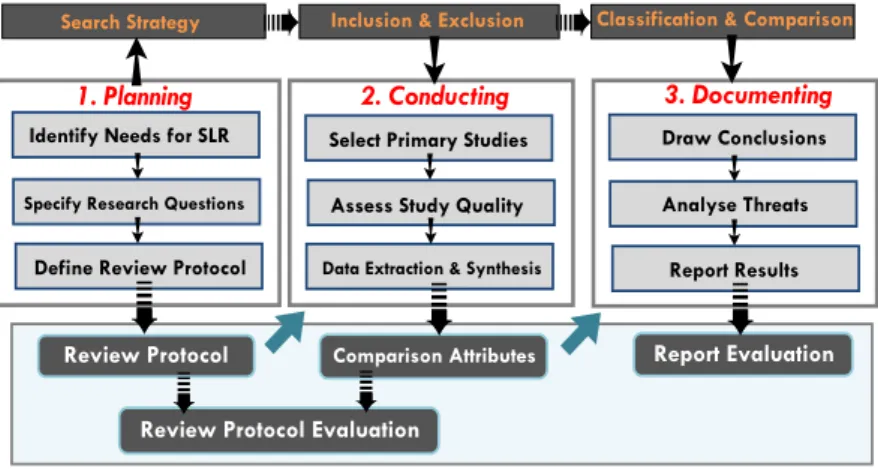
In contrast to a non-structured review process, a systematic literature review [15, 17] reduces bias by following a precise and rigorous sequence of methodological steps to investigate the state-of-research. More specifically, an SLR relies on a well-defined and evaluated review protocol to extract, analyse and document the results as illustrated in Figure 2. We adopted the guidelines in [17] with a three-step review process that includes: Planning,
Conducting and Documenting the SLR. The review is complemented by evaluation of the outcome of each step, as illustrated in Figure 2. We also provide a taxonomical classification and comparison of the reviewed studies. A taxonomical classification is the foundation for comparative analysis of studies based on our defined comparison attributes (Section 3.5) that are subject to external evaluation prior to results reporting in [25].
Figure 2. Systematic Review Process for Classification and Comparison of Reuse Knowledge in ACSE.
3.1 Definition and Evaluation of the Protocol for Systematic Review
According to the guidelines in [17], the review protocol drives the planning, conducting and documenting
phases of the systematic review as illustrated in Figure 2. The protocol definition is provided in the reminder of Section 3. More specifically, protocol for SLR includes: i) identification of the needs and objectives for SLR (Section 3.2), ii) definition of search strategies to identify, include and exclude and qualitatively analyse the relevant literature (Section 3.3, Section 3.4), iii) data extraction and results synthesis (Section 3.5), and iv) results classification (Section 3.6). We developed the review protocol by following the guidelines in [14, 15, 17] and our experience with conducting the systematic review [7, 52]. Additional details about the review protocol are provided in [25].
As suggested by [7] and [17], we externally evaluated the protocol before its execution. Weaskedtwo external experts for feedback, who had experience in conducting SLRs in an area that overlaps with software architecture research (see acknowledgement section). The feedback made by the expert resulted in a refined protocol. We also performed a pilot study of the systematic review with 15 (approximately 50%) of the included studies. The objective for conducting a pilot study was to first reduce the bias for a) identification of primary studies b) extraction of data from these studies and c) synthesising the results of review. Based on the external review of the protocol, we expanded the review scope, improved search strategies and refined the inclusion/exclusion criteria during the pilot studies (see Section 3.3 for details).
3.2 Planning the Review
The review plan consists of three steps as i) identifying the needs for SLR, ii) specifying the research questions and iii) defining and evaluating the review protocol, as illustrated in Figure 2.
3.2.1 Identify the needs for SLR
The needs for SLR have been identified in [7] and its contribution already justified in Section 2. This SLR complements the existing reviews on ACSE [7, 8, 13, 16, 29] to investigate the state-of-research for application and acquisition of architecture evolution-reuse knowledge (cf. Table 1). Although the progress of research on architecture evolution reuse [35, 36, 37] is reflected over more than a decade [37], we did not find any evidence to systematically synthesise the collective impact of existing research on reuse knowledge (Section 2.3). Therefore, in this SLR, we aim to classify and compare existing research, identify the research potential, its limitations and outline future dimensions for methods, techniques and solution that enable evolution reuse in software architectures. In addition, the research questions help us to a) outline the scope and contributions of SLR and b) defining and evaluating the review protocol to conduct the SLR.
3.2.2 Specify the Research Questions
The research questions are based on our motivation to conduct the SLR, i.e. the answers provide us with an evidence-based overview of the definition, application and acquisition of reuse knowledge to support ACSE methods and techniques. We define three research questions that represent the foundation for deriving the search strategy for literature extraction. The objective outlines the primary intent of investigation for each question. In addition, a comparative analysis allows us to analyse the collective impact of research, represented in terms of comparison attributes (in Section 3.5, Table 5).
Research Question 1 – How evolution-reuse knowledge is defined, classified and expressed in existing literature to enable architecture-based software change management?
Objective – To understand the existing classification and representation of architecture evolution-reuse knowledge that provides a foundation for a detailed comparison of solutions to enable ACSE.
Research Question 2 – What are the existing methodologies and techniques that support application of reuse knowledge to evolve software architectures?
Objective – To identify and compare existing solutions that support an explicit reuse of change implementation mechanisms to enable design-time evolution and run-time adaptations in architectures.
Research Question 3 – What empirical approaches are employed to discover evolution-reuse knowledge?
Objective – To investigate and compare the available support for empirical acquisition/discovery of reuse knowledge and expertise that can be shared to guide architecture evolution.
3.3 Conducting the Review
To conduct the review, we follow a three step process as i) searching the studies for review, ii) selection and qualitative assessment of studies, and iii) extraction and synthesis of data from studies, as illustrated in Figure 2.
3.3.1 Selection of Primary Studies for Review
The search terms used to identify primary studies were developed using suggestions in [15] and guided by the research questions (cf. Section 3.2). Our search process comprises of primary and secondary search.
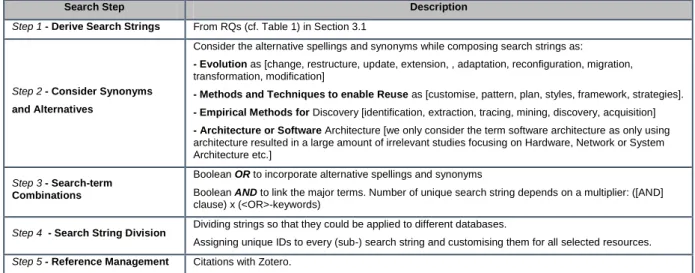
Primary Search is a five-step process to identify and retrieve the relevant literature. The summary of each step involved in primary search is presented in Table 2.
Secondary Search includes a) review of references/bibliography section in the selected primary studies to find other relevant articles, b) review of citations to the selected primary studies to find any relevant articles, also known as a backward pass [15, 17] and c) identify and contact authors of selected primary studies for extended versions of the research, if required. The secondary search did not lead to identification of any relevant studies. The secondary search and study selection was performed iteratively until no new studies were found.
The research question resulted in a composition of search string applied to six databases as illustrated in Figure 3. We extracted published peer-reviewed literature from years 1999 to 2012 (inclusive). The year 1999 was chosen as the preliminary search found no earlier results related to any of the research questions with 1550 manuscripts extracted. Because we used our primary search criteria on title and abstract, the results provided a relatively high number of irrelevant studies, which were further refined with secondary search.
Table 2. A Summary of the Steps in the Literature Search.
Search Step Description
Step 1 - Derive Search Strings From RQs (cf. Table 1) in Section 3.1
Step 2 - Consider Synonyms and Alternatives
Consider the alternative spellings and synonyms while composing search strings as:
- Evolution as [change, restructure, update, extension, , adaptation, reconfiguration, migration, transformation, modification]
- Methods and Techniques to enable Reuse as [customise, pattern, plan, styles, framework, strategies].
- Empirical Methods for Discovery [identification, extraction, tracing, mining, discovery, acquisition]
- Architecture or Software Architecture [we only consider the term software architecture as only using architecture resulted in a large amount of irrelevant studies focusing on Hardware, Network or System Architecture etc.]
Step 3 - Search-term Combinations
Boolean OR to incorporate alternative spellings and synonyms
Boolean AND to link the major terms. Number of unique search string depends on a multiplier: ([AND] clause) x (<OR>-keywords)
Step 4 - Search String Division Dividing strings so that they could be applied to different databases.
Assigning unique IDs to every (sub-) search string and customising them for all selected resources. Step 5 - Reference Management Citations with Zotero.
Note that we have decomposed the search string for illustrative reasons in Figure 3. To search the primary studies the sub-strings in Figure 3 were combined and represented as a single search string.
Figure 3. Summary of the Primary Search Process.
3.4 Selection and Qualitative Assessment of Primary Studies
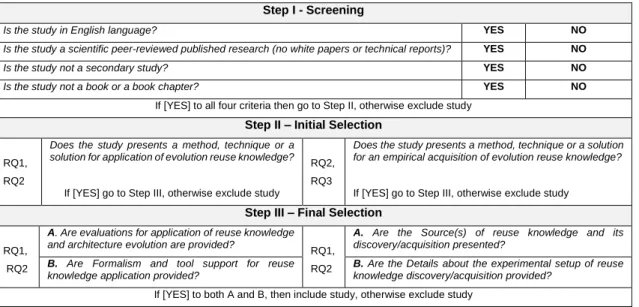
The study selection comprises of a four-step process that includes, screening, initial selection, final selection and qualitative assessment as presentedin Table 3 and Table 4. In Table 4, the qualitative assessment helps us to include/exclude studies and rank the selected studies based on their quality score in the Appendix.
3.4.1 Screening of Identified Literature
An initial screening is performed for all the studies based on four criteria as presented in Table 3. The screening ensures that each of the selected study represents a i) peer-reviewed research and is ii) written in English language
and is iii) not a secondary study and iv) not a book. If the answer to all of these four criteria is [YES], the study is included for initial selection. Otherwise, if the answer to any of the four criteria is [NO], the study is excluded.
3.4.2 Initial Selection
This process comprises screening of titles and abstracts of the potential primary studies. For almost 35% of studies, no decision could be made just on title and abstract, as these papers did not make a clear distinction between an explicit representation and application (RQ1 and RQ2) or acquisition (RQ1 and RQ3) of reuse
knowledge. During initial selection, the decision to exclude [NO] or proceeding to the final selection [YES] was based on an examination of the full text for each study.
3.4.3 Final Selection
This process is based on a brief validation of the studies, the use of formalisms and tool support and details of the experimental setup. After performing this step, 34 studies were selected. During the secondary search process, references and citations for the 34 selected studies were also reviewed, but this did not lead to the inclusion of any other relevant studies. As a result, 34 studies were included for qualitative assessment.
Table 3. Summary of the Study Selection Process (without qualitative assessment).
Step I - Screening
Is the study in English language? YES NO
Is the study a scientific peer-reviewed published research (no white papers or technical reports)? YES NO
Is the study not a secondary study? YES NO
Is the study not a book or a book chapter? YES NO
If [YES] to all four criteria then go to Step II, otherwise exclude study Step II – Initial Selection
RQ1, RQ2
Does the study presents a method, technique or a solution for application of evolution reuse knowledge?
If [YES] go to Step III, otherwise exclude study
RQ2, RQ3
Does the study presents a method, technique or a solution for an empirical acquisition of evolution reuse knowledge?
If [YES] go to Step III, otherwise exclude study Step III – Final Selection
RQ1, RQ2
A. Are evaluations for application of reuse knowledge and architecture evolution are provided?
RQ1, RQ2
A. Are the Source(s) of reuse knowledge and its discovery/acquisition presented?
B. Are Formalism and tool support for reuse knowledge application provided?
B. Are the Details about the experimental setup of reuse knowledge discovery/acquisition provided?
If [YES] to both A and B, then include study, otherwise exclude study
3.4.4 Qualitative Assessment of Included Studies
For the 34 included studies, we primarily focused on the technical rigor of content presented in the study. We based our qualitative assessment on two factors as General Assessment (G) and Specific Assessment (S), as summarised in Table 4. Additional details about the quality checklist are provided in [25]. Quality scores provided us with a numerical quantification to rank the selected studies in the Appendix.
Table 4. Summary of Quality Assessment Checklist.
General Items for Quality Assessment (G) Score for General Items ∑𝟓
𝑮=𝟏 = Yes = 1 Partially = 0.5 No = 0
G1 Are problem definition and motivation of the study clearly presented?
G2 Is the research environment in which the study was carried out properly explained? G3 Are research methodology and its organisation clearly stated?
G4 Are the contributions of the in-line with presented results?
G5 Are the insights and lessons learnt from the study explicitly mentioned?
Specific Items for Quality Assessment (S)
Score for Specific Items ∑𝟓𝐒=𝟏 = Yes = 1 Partially = 0.5 No = 0 S1 Is the research clearly focused on application or acquisition of evolution reuse?
S2 Are the details about related research clearly addressing evolution reuse in architectures? S3 Is the research validation clearly illustrates application or acquisition of evolution reuse? S4 Are the results clearly validated in a real (industrial case study) evaluation context? S5 Are limitations and future implications for architecture evolution reuse clearly positioned?
Based on the quality assessment checklist in Table 4, the quality ranking formula is given as follows. G represents 5 factors as general assessment criteria from Table 4, providing a maximum score of 1 (25% weight), S represents a total of 5 factors as specific items providing a maximum score of 3. S is weighted as 3 times more than G (75% weight) as specific contributions of a study are more important than general factors for assessment. Based on a consensus among the researchers and suggestions from the external reviewers, the criteria for qualitative assessment maximum score was G + S = 4, where a 3-4 score represented quality papers, a score less than 3 and greater than or equal to 1.5 was acceptable and a score less than 1.5 resulted in study exclusion.
𝑄𝑢𝑎𝑙𝑖𝑡𝑦 𝑆𝑐𝑜𝑟𝑒 = [ ∑ 5 𝐺=1 5 + ( ∑5 𝑆=1 5 × 3 ) ]
Based on the qualitative assessment of 34 studies, we excluded two studies to finally select 32studies for the review. Two studies were excluded because their quality scored was less than 1.5 according to the criteria in Table 4. The selected studies are listed with title, authors, quality score and citation count in the Appendix. Please note that quality ranking is an internal metric only that helps us to choose most related studies and does not reflect any comparison or objective interpretation of selected studies.
3.5 Data Extraction and Synthesis
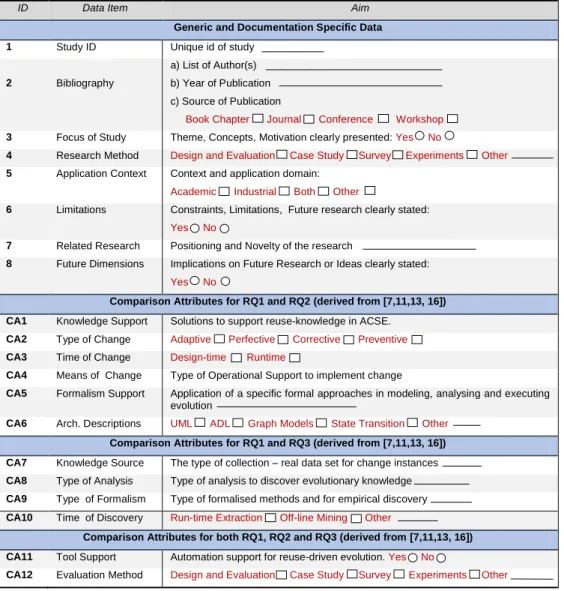
In order to record the extracted data from the selected studies, we followed [15, 17] and designed a structured format as presented in Table 5. The format in Table 5 records the data as generic and documentation specific items
and comparison attributes for a collective and comparative analysis of research to answer RQ1 – RQ3. The data was extracted by locating evidence for each item in the selected studies. Self-explanatory comparison attributes (CA1 – CA12 in Table 5) are the smallest unit of data that we extracted from the literature for comparison purposes and provided for external evaluation. These attributes provide the base for follow-up syntheses, i.e., mainly classification and comparison of claims and supporting evidence of evolution reuse detailed in the paper. Instead of reading through detailed results (Section 4, 5, 6), external reviewers examined a summary of results provided in [25] to evaluate the protocol and suggestions about documentation of SLR results.
Table 5. Extracted Data and Comparison Attributes.
ID Data Item Aim
Generic and Documentation Specific Data
1 Study ID Unique id of study
2 Bibliography
a) List of Author(s) b) Year of Publication c) Source of Publication
Book Chapter Journal Conference Workshop
3 Focus of Study Theme, Concepts, Motivation clearly presented: Yes No
4 Research Method Design and Evaluation Case Study Survey Experiments Other
5 Application Context Context and application domain: Academic Industrial Both Other
6 Limitations Constraints, Limitations, Future research clearly stated: Yes No
7 Related Research Positioning and Novelty of the research
8 Future Dimensions Implications on Future Research or Ideas clearly stated: Yes No
Comparison Attributes for RQ1 and RQ2 (derived from [7,11,13, 16]) CA1 Knowledge Support Solutions to support reuse-knowledge in ACSE.
CA2 Type of Change Adaptive Perfective Corrective Preventive
CA3 Time of Change Design-time Runtime
CA4 Means of Change Type of Operational Support to implement change
CA5 Formalism Support Application of a specific formal approaches in modeling, analysing and executing evolution
CA6 Arch. Descriptions UML ADL Graph Models State Transition Other
Comparison Attributes for RQ1 and RQ3 (derived from [7,11,13, 16]) CA7 Knowledge Source The type of collection – real data set for change instances
CA8 Type of Analysis Type of analysis to discover evolutionary knowledge
CA9 Type of Formalism Type of formalised methods and for empirical discovery
CA10 Time of Discovery Run-time Extraction Off-line Mining Other
Comparison Attributes for both RQ1, RQ2 and RQ3 (derived from [7,11,13, 16]) CA11 Tool Support Automation support for reuse-driven evolution. Yes No
CA12 Evaluation Method Design and Evaluation Case Study Survey Experiments Other
3.3 Classifying the Results
To discuss the results, first we need to provide a conceptual framework to systematically present the existing literature and to identify the required steps that enable ACSE. With the help of a framework we can organise the reviewed studies in terms of framework processes and activities that (a process-centric view to) support application and acquisition of evolution-reuse knowledge. Section 3.3.1 highlights some established models and frameworks for architectural evolution and adaptation, while Section 3.3.2 presents the proposed framework to consolidate the existing research on application and acquisition of architecture evolution-reuse knowledge.
3.3.1 Models and Frameworks for Architectural Migration and Evolution
We introduce some established reference models and frameworks based on their impact and relevance for design-time evolution [3] and rundesign-time adaptations of software architectures [21]. The selected models and frameworks are acknowledged through high citations in the research community, provide a detailed documentation and cover a process-based view for design-time evolution as well runtime adaptations detailed as:
Horseshoe Model for Architectural Extraction and Transformation
The horseshoe model [45] (proposed by Software Engineering Institute in 1999) represents one of the classical approaches for architecture-based reverse and forward engineering. The Horseshoe model follows a three-step process including architectural extraction, architectural transformation and
architecture-based development. In recent years, a number of solutions have extended the classical horseshoe model that include i) SOA Migration Horseshoe [46], ii) SOA Migration Framework (SOA-MF) [47], and iii) Architecture Driven Modernisation model [32]. The SOA Migration Horseshoe [46] and SOA Migration Framework [47] support migration of a legacy software to service-oriented architectures. In contrast, the Architecture Driven Modernisation (ADM) [32] model is a more generic model that supports a process-based approach to architecture-based evolution. In Section 3.3.2, we further explain how ADM model helps us to develop the proposed framework to support reuse in ACSE.
IBM Autonomic Framework
The IBM autonomic framework provides a number of solutions to support autonomic computing [5, 12] by means of dynamic and self-adaptive architectures [6, 8]. Two of the well-established autonomic frameworks are i) Software Tuning Panels for Autonomic Control (STAC) [48] and Monitor, Analyse, Plan, Execute Knowledge (MAPE-K) framework [5]. STAC aims to automatically re-architecture the (system source code) to facilitate autonomic adaptation of a software. In contrast, the MAPE-K model supports application of adaptation knowledge to execute dynamic adaptation of a software and ultimately its underlying architecture. In Section 3.3.2, we further explain how MAPE-K framework helps us to identify and develop the framework to highlight research on runtime adaptations of architectures.
3.3.2 A Framework to Classify Research on Acquisition and Application of Evolution Reuse Knowledge
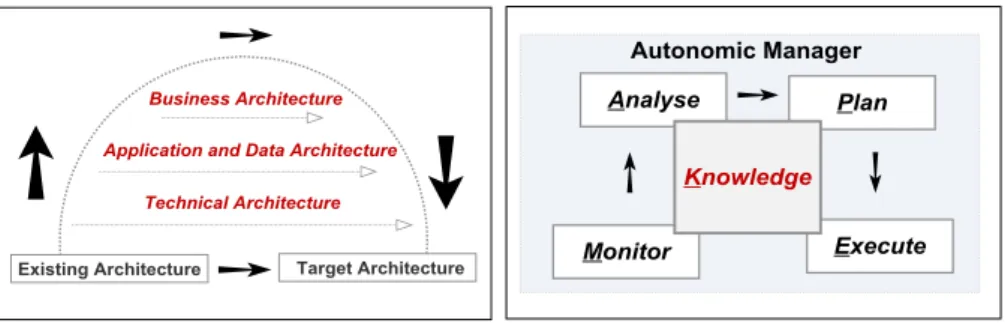
We derive our proposed framework from two well-known reference models: the OMG ADM method [32] and the IBM MAPE-K reference model [5], presented in Figure 4. ADM represents architectural modernisation and evolution at design-time [35, 36], while MAPE-K loop supports runtime adaptations [34, 39]. Using established reference models and practices validates the adequacy of our classification and comparison framework. In the following, we briefly present the details for the ADM and MAPE-K models as a basis for our proposed framework to organise research on reuse knowledge. Additional details about the proposed framework provided in [49]. The ADM horseshoe model consists of three architectural views: business architecture, application and data architecture, and technical architecture, see Figure 4A. The existing system with a three-layer architecture is on left, while the target system with evolved architectural view on right. The transformation from legacy to target represents the path of evolution.
Therefore, the ADM method involves transformation of the existing legacy architectures in an incremental fashion to the target architectures. The evolution involves the transformation of legacy (procedural) code to new (object-oriented) code. In summary, transformation at any architectural layer relies on three elements:
Knowledge discovery of the legacy system,
Definition of target architecture, and
Transformation steps for source to target evolution.
The MAPE-K reference framework describes dynamic adaptation process of software. The MAPE-K reference model in Figure 4B is used to communicate the architectural aspects of autonomic systems. Although MAPE-K does not entirely focus on architecture of dynamic software, it provides a reference model to monitor, analyse, plan and execute run-time adaptation of architectures [8, 34, 39]. The MAPE-K reference model relies on:
Monitoring monitors the system and measure attributes related to architectural configurations and properties for possible run-time reconfigurations of architecture.
Analysing analyses the measured run-time data and detects violations of the requirements.
Planning generates a change plan for architectural reconfigurations.
Execute enacts structural and behavioural changes to the running system based on the actions recommended by the plan function
Knowledge includes shared data such as topology information, metrics and policies for dynamic adaptation. After discussing the ADM and MAPE-K reference frameworks, we propose an integrated framework called
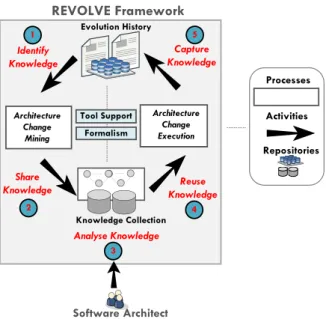
REVOLVE presented in Figure 5. The reviewed studies are organised (in Section 4) according to the methods and techniques for evolution history analysis (i.e. change mining for reuse knowledge acquisition) and change implementation (i.e. change execution for reuse knowledge application), which form the two core activities of REVOLVE in Figure 5, each covered by ADM and MAPE-K separately. Additional technical details about the proposed REVOLVE framework in terms of framework activities and framework process are provided in [49].
Figure 5. REVOLVE – An Integrated View of Architecture Change Mining and Change Execution. The concepts and methods used in ADM and MAPE-K reference models can be reused or possibly extended to develop the processes and activities in REVOLVEframework. Method engineering [50] enables us to reuse the existing concepts from existing methods (frameworks, models or solutions) to develop new methods by reusing existing methodologies with reduced efforts and time to derive or develop new solutions. More specifically, during architecture change mining process in the REVOLVE framework, we exploit the knowledge discovery concepts from ADM [32] model for acquisition of evolutionary knowledge from architecture evolution histories. Moreover, the discovered knowledge can be shared and reused as in the MAPE-K framework [5] to analyse, plan and execute architectural adaptation.
The REVOLVE framework in Figure 5 along with the presentation of its processes, activities and their corresponding studies in Table 6 is beneficial for ACSE researchers and practitioners. The framework assist ACSE researchers with quick identification of relevant studies. A systematic presentation of state-of-the-research provides a foundational body of knowledge to develop theory and solutions, analyse research implications and to establish future dimensions. In addition, the framework can be beneficial for practitioners interested in understanding the methods and solutions with formalism and tool support to model, analyse, and implement
evolution reuse in software architectures. The framework provides a process-centric view of a collection of existing solutions for acquisition and application of reuse knowledge to evolve software architectures.
We conceptualised the logical relationship between individual research elements as a framework in Figure 5. It defines an iterative mechanism to continuously discover reuse knowledge that can be shared and reused to guide ACSE in a semi-automated way. The framework provides an aggregated representation of existing literature. In Section 4, we further discuss the framework processes and activities from Figure 5. The results highlight a lack of solutions that integrate the concept of empirical acquisition of reuse knowledge to guide ACSE with reuse knowledge application. Beyond this review, this framework can assist researchers and practitioners to objectively identify and interpret potential and limitations in state-of-the-art research [25].
4. RESULTS CATEGORISATION AND REUSE KNOWLEDGE TAXONOMY
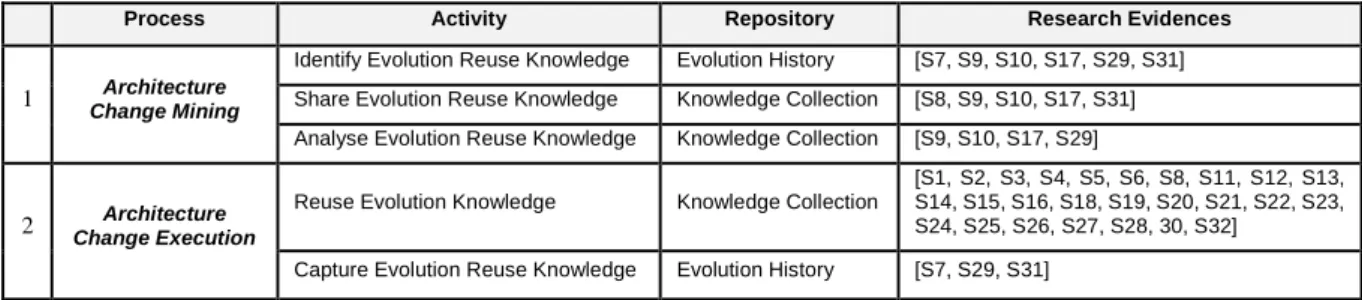
Our discussion of results uses the REVOLVE framework for reuse knowledge from Section 3.3. Central to this framework are a set of processes, activities and repositories (in Table 6, which complements Figure 6). The processes encompass architecture change mining as a complementary and integrated phase to change execution – a concept partially realised in only one of the reviewed studies [S7]2. We also present the relative distribution of the five activities of the REVOLVE framework. Figure 6 highlights a significant portion (53%) of studies focussing on methods and techniques for application of evolution-reuse knowledge. On the other hand, only 9% of studies focus on analysing reuse knowledge. Please note that some of the studies cover different activities of the REVOLVE framework. For example, studies [S9, S10, S17, S13] both represent research on identifying andsharing reuse knowledge. Similarly, studies [S7, S29, S31] represent capturing and identifying reuse knowledge. Table 6. Processes, Activities and Repositories of Framework to Represent Reviewed Studies.
Process Activity Repository Research Evidences
1 Architecture
Change Mining
Identify Evolution Reuse Knowledge Evolution History [S7, S9, S10, S17, S29, S31] Share Evolution Reuse Knowledge Knowledge Collection [S8, S9, S10, S17, S31] Analyse Evolution Reuse Knowledge Knowledge Collection [S9, S10, S17, S29]
2 Architecture
Change Execution
Reuse Evolution Knowledge Knowledge Collection
[S1, S2, S3, S4, S5, S6, S8, S11, S12, S13, S14, S15, S16, S18, S19, S20, S21, S22, S23, S24, S25, S26, S27, S28, 30, S32]
Capture Evolution Reuse Knowledge Evolution History [S7, S29, S31]
Table 6 summarises the involved processes, their corresponding activities and associated repositories as well as identified studies - concrete research evidence of the claims. In Figure 5, it is vital to highlight the complementary role of tool support and formalism to support reuse in ACSE. In recent years, there is a growing need for tool and automation support to model and execute architecture evolution in a (semi-) automated way [30, 35].
Figure 6. Percentage Distribution of Studies based on REVOLVE Framework Activities.
For example, in Figure 5, to support automation of the activity for reuse knowledge identification, the solution must provide a tool or a prototype to analyse architecture evolution histories that contain evolutionary data of significant size and complexity [S29, S31]. A lack of tool support results in an increase in the complexity of architecture evolution process, process scalability (changes from small to large systems), and error proneness in change implementation.
2
The notation [S
n] (n is a number) represents a reference to studies included in the SLR which are listed in the
Appendix. The notation also maintains a distinction between the bibliography and list of selected for SLR. 21%
11% 9% 53%
6%
Capture Evolution Reuse Knowledge Identify Evolution Reuse Knowledge
Share Evolution Reuse Knowledge
Analyse Evolution Reuse Knowledge
4.1
A Taxonomical Classification of Architecture Evolution-Reuse Knowledge
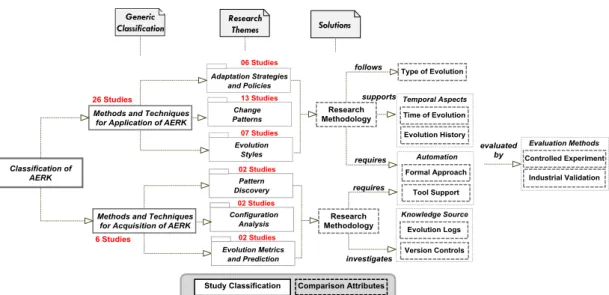
The taxonomy defines a systematic identification, naming and organisation of reuse approaches into groups that share, overlap or are distinguished by various attributes. A taxonomical classification provides an insight into the commonality or distinction of research themes as denoted in Figure 7. We explicitly discuss three distinct classification types of reuse knowledge research as generic and thematic. A solution-specific classification is introduced in Sections 5 and 6 when we provide a comparison of existing research.
A. Generic Classification is derived based on a review of studies and our experience with previous SLRs [7, 52] that helped us to refine classification attributes based on studies for analysing the role of reuse knowledge in ACSE. In Figure 7, the literature is classified into methods and techniques that enable change reuse in architectural evolution (26 studies, i.e., 81%) and empirical acquisition or discovery (6 studies, i.e., 19%) of reuse knowledge and expertise by exploiting evolution histories. Dotted rectangles in Figure 7 represent the comparison attributes extracted by full-text investigation of the selected studies, as explained in Table 5 – data extraction and synthesis.
B. Thematic Classification provides details about the predominant research themes based on time and type of evolution. In the following, we focus on taxonomy of identified research themes based on a mapping of activities in REVOLVE framework to identified research themes in Figure 7.
Figure 7. A Taxonomical Classification of Architecture Evolution Reuse Knowledge.
1. Evolution Styles [S1, S5, S8, S11, S13, S21, S23] are inspired by a conventional concept of architecture styles that represent a reusable vocabulary of architectural elements (component or connectors) and a set of constraints on them to express a style [20]. Evolution styles focus on defining, classifying, representing and reusing frequent evolution plans [S1, S11] and architecture change expertise [S5, S8, S13, S21]. Style-based
approaches represent 22% of the reviewed studies addressing corrective and perfective changes implemented as design-time evolution. In the style-driven approaches, we observed a trend towards structural evolution-off-the-shelf [S13, S21] and evolution planning [S1, S8] with time, cost and risk analysis to derive evolution plans.
2. Change Patterns [S2, S6, S12, S14, S15, S16, S17, S20, S21, S27, S29, S30, S24]exploit the same idea as
design patterns [19] that aim at providing a generic, repeatable solution to recurring design problems. In contrast, change patterns follow reuse-driven methods and techniques to offer a generic solution to frequent evolution problems. Pattern-based solutions accounted for 41% of total reviewed literature, focusing on
corrective, adaptive and perfective changes supporting both design-time as well as run-time evolution.
Adaptation and reconfiguration patterns [S16, S19] are the run-time evolution solutions. The solutions also address the co-evolution of processes [S30], requirements [S2] and underlying architecture models. In addition, a number of studies propose language-based formalism [S6, S12, S14, S15] to enable reuse in architectural migration and integration. Unlike styles that only use model-driven evolution, pattern-based changes are expressed as different techniques using model transformations [S2, S30], state transitions [S16, S19] and change operationalisation [S27].
3. Adaptation Strategies and Policies [S3, S4, S25, S26, S28, S32] focus on reuse and customisation of
adaptation policies [S3, S4], reusable and knowledge-driven strategies [S25, S26, S32] and aspects [S28] to support the reuse of policies in self-adaptive architectures.With a recent emphasis on autonomic computing,
and growing demand for highly available architectures, reuse-driven strategies aim to support knowledge-driven reuse at runtime. These accounted for 19% of reviewed literature with a focus on adaptive change.Run-time
reconfigurations of architectures are also highlighted in the MAPE-K reference model [5, S4].
4. Pattern Discovery [S19, S29] represent methods and techniques for post-mortem analysis of evolution history (change logs [S29] and version control [S19]) to discover recurring changes as pattern instances. Pattern-based knowledge acquisition/discovery mechanisms represented a 6% of the total study population.
5. Architecture Configuration Analysis [S7, S31] exploits configuration management techniques to analyse architectural configurations [S7]. It focuses on mining architecture revision histories tocapture evolution and
variability in order to represent crosscutting relationships among evolving architecture elements. This is particularly beneficial to classify changes as atomic and composite types and allows determining the extent to which architectural change can be parallelised (commutative and dependent changes) [S31]. Architecture configuration analysis represented 6% of total study population.
6. Evolution and Maintenance Prediction [S9, S10] focuses on prediction of maintenance and evolution efforts for software architectures. We included two studies in which [S9] representsa set of change scenarios for predicting perfective and adaptive evolution tasks in architectures. In [S10], based on an architectural evaluation and maintenance prediction, the required maintenance and evolution effort for a software system can be estimated [S10].
4.2 A Mapping of Identified Research Themes to Activities in REVOLVE Framework
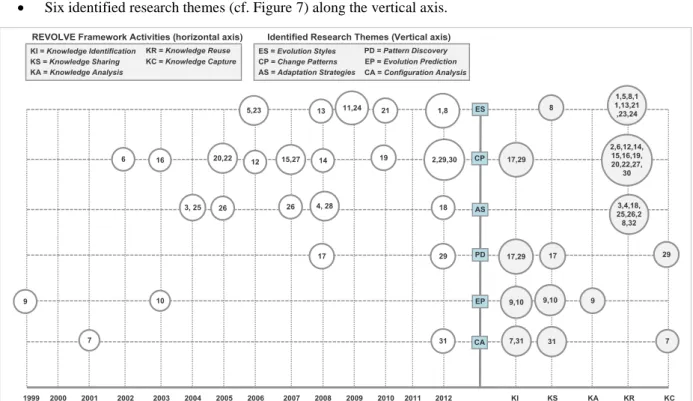
While the REVOLVE framework has provided a broader categorisation of research, some observations and interpretation of the results suggested an explicit mapping among the identified research themes and the activities of REVOLVE framework. Figure 8 provides a mapping of the framework’s activities (cf. Figure 6) and the identified research themes (cf. Figure 7) to classify and compare application (Section 5) and acquisition (Section 6) of architecture evolution-reuse knowledge. The circles on right axis in Figure 8 represents mapping between framework activities and identified research themes for a study reference (e.g., ‘8’ represents ‘S8’ in the Appendix list of selected studies). Alternatively, the circles on left axis represents publication map (providing a temporal distribution, 1999 to 2012) for framework activities and identified research themes.
In this section, an iterative mapping process has been employed to present the identified research themes and to provide an answer to the first research question (RQ1). The map as bubble plot is depicted in Figure 8 to enable a mapping of research themes to activities of REVOLVE based on:
Five activities of the REVOLVE framework (cf. Figure 6) along the horizontal axis.
Six identified research themes (cf. Figure 7) along the vertical axis.
For example in Figure 8, the bubble at right-axis and at the intersection of “research theme” change pattern (CP) and “framework activity” knowledge reuse (KR) represents the studies [S2, S6, S12, S14, S15, S16, S19, 20, 22, 27, 30] that support change patterns to apply reuse knowledge in ACSE. Alternatively, the bubble at left-axis that intersects “CP” and 2012 represents the studies [2, 29, 30] published in 2012 and focus on change patterns. The relative size of the bubble indicates the total number of studies (bigger the size, more studies a theme represents).
4.3
Definition of Architecture Evolution-Reuse Knowledge
Research Question RQ1 addresses how architecture evolution-reuse knowledge is defined and expressed in the context of ACSE and is answered in this section. After we have defined architecture evolution-reuse knowledge here, we answer RQ 2 (application of reuse knowledge in Section 5) and RQ3 (acquisition of reuse knowledge in Section 6).
In the reviewed studies, we observed that interpreting and assessing individual studies as isolated solutions to a specific research problem lacks consistency in representing what exactly defines architecture evolution-reuse knowledge and how it is classified and expressed in literature. This could be a direct consequence of the respective author views on how to achieve reuse in a solution-specific context. For example, the concept of evolution style
has distinct and diverse interpretations as Garlan et al. who define evolutionary plans [S1, S11] following a style, while Tamzalit et al. exploit styles as evolution patterns [S13, S21, S23]. Moreover, Cuesta et al. express evolution
styles as an integrated part of architectural knowledge [S8] that drives architecture evolution. In addition, Yskout et al. utilised change patterns for architecture co-evolution [S2], Côté et al. for pattern-to-pattern integration
[S27], Gomma et al. for run-time adaptations [S16, S19] and Zdun et al. exploited language based formalism for
evolution and integration patterns [S6, S12, S15]. This reflects a lack of consideration of what existing methods could be leveraged, extended or refined to achieve reuse that drives ACSE [3, 6, 7].
Evolutionin the reviewed literature refers to design-time changes [S1, S2, S6, S13, S20] or run-time adaptations [S3, S4, S16, S25] as perfections, reconfigurations or corrections in architectural structure and behaviour [16]. We observed that the term evolution (also including evolving, evolve, co-evolution) has six variations as change
(also including changing), Reconfiguration, Adaptation, Restructuring, Update, Transformation and Migration. The reasons for distinctive terminologies are:
Type of architecture changerefers to Corrective, Adaptive (also Reconfigurative [S16, S19]), Perfective
(also Updative [S23], Restructurive [S21], Transformative [S5], Migrative [S6]). With a more conventional interpretation of ISO/IEC 14764 and architectural change characterisation [16], we did not find any study to support preventive changes. This indicates that existing work lacks support for reuse in pre-emptive and pro-active evolution of architectures [5, 6].
Time Constraint of Change refers to Evolution, Change, Update and Restructure for design-time evolution
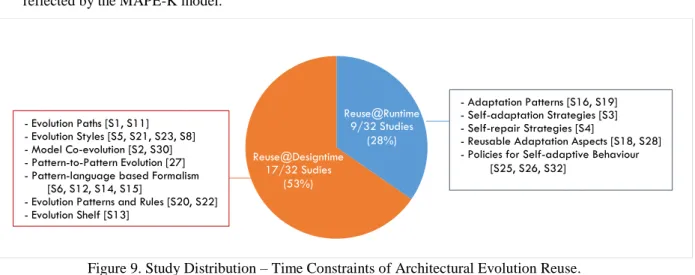
[3], while Reconfiguration and Adaptation refer to run-time evolution [S3, 6]. In Figure 9, there is a clear inclination (53% of total studies) towards style-driven approaches, evolutionary plans and model co-evolution for design-time (a.k.a. static evolution). In contrast, run-time (a.k.a. dynamic evolution) comprises of 28% of studies focussing on self-adaptation and runtime reconfigurations reflected by studies published in 2004 and 2009. However, with a growing importance of autonomic computing [5] and the context of high-availability architectures [S3, S4, S16, S19, S25, S26, S32], there is a need to realise the potential ofreuse at runtime
reflected by the MAPE-K model.
Figure 9. Study Distribution – Time Constraints of Architectural Evolution Reuse.
This suggests that evolution is an unclear term in the context of types and time of architectural changes making it hard to implicitly derive a unified or aggregated definition for evolution reuse knowledge. In the study titles, the keyword “evolution” occurs 10 times, “change” 5 times and “adaptation” 6 times (i.e., approx. 34% , 15% and
Reuse@Runtime 9/32 Studies (28%) Reuse@Designtime 17/32 Sudies (53%) - Evolution Paths [S1, S11] - Evolution Styles [S5, S21, S23, S8] - Model Co-evolution [S2, S30] - Pattern-to-Pattern Evolution [27] - Pattern-language based Formalism [S6, S12, S14, S15]
- Evolution Patterns and Rules [S20, S22] - Evolution Shelf [S13]
- Adaptation Patterns [S16, S19] - Self-adaptation Strategies [S3] - Self-repair Strategies [S4]
- Reusable Adaptation Aspects [S18, S28] - Policies for Self-adaptive Behaviour [S25, S26, S32]
19% respectively). Due to a characterisation of architectural change types [16] and times of evolution [11], a clear consensus or unified definition is not possible. In fact, it would only limit the acceptance of the concept with a narrow view based on available evidence. However, an aggregated definition of evolution-reuse knowledge is important to classify and compare the existing research. We further discuss the types and time or architectural changes in Section 5, while answering RQ2 – a comparison of method for application of reuse knowledge.
Reusein the reviewed studies is expressed as evolution styles (7 studies, 22%), change patterns (13 studies, 40%), ii) adaptation strategies and policies (6 studies, 19%) in Figure 7. An interesting observation is that although they are novel as methodical approaches, both evolution styles and change patterns conceptually extend the more conventional concepts of architecture styles [20] and design patterns [19] to represent evolution expertise.
Evolution styles [S1, S13, S21] primarily aims at defining, classifying, representing and reusing frequent corrective and perfective changes as a design-time activity. In contrast, change patterns [S2, S16, S19] promote the ‘build-once, use often’ philosophy to offer a generic, repeatable solution to frequent adaptive, corrective and perfective changes as design-time and run-time-time evolution. The concept of reusable adaptation strategies and policies is only represented in the context of reuse plans [S3, S4, S25] and aspects [S28] for self-adaptive architectures.
Once we have identified the relative representation and expression of architecture evolution and evolution reuse, we can provide a consolidated view of architecture evolution-reuse knowledge in the context of ACSE. We provide an aggregated definition of Architecture Evolution-Reuse knowledge (AERK) as
“A collection and integrated representation (problem-solution mapping) of empirically discovered generic and repeatable change implementation expertise that can be shared and reused as a solution to frequent (architecture) evolution problems.”
In the existing literature, the generic and repetitive solutions are predominantly expressed as evolution styles and patterns. In addition, frequent evolution operations represent addition, removal or modification of architecture elements as design-time change or runtime adaptation. Some studies [S1, S11, S13, S20] implicitly denoted reuse as a first-class abstraction – by operationalising and parameterising changes – to resolve recurring evolution tasks. In summary, to answer RQ1, we provided a definition of a generic and thematic classification scheme and organised research about reuse knowledge in ACSE along this scheme. A classification, definition and
representation of reuse knowledge is missing in the existing literature to reflect a consolidated impact of research that has progressed for more than a decade (1999 - 2012). This classification is not meant to be exhaustive and might need to be adapted to consider future developments. Figure 7 and Figure 8, however, provide a foundation for a more fine-granular classification and comparison of studies as discussed in Section 5 below.
5. APPLICATION OF ARCHITECTURE EVOLUTION-REUSE KNOWLEDGE
Based on the generic and thematic classification in Section 4, to answer to RQ2 we classify and compare the existing methods and techniques that support application of evolution-reuse knowledge based on the generic and thematic classification in Section 4. A systematic identification and comparison of existing research is particularly beneficial to gain an insight into aspects of problem-solution mapping, architecture evolution characterisation, or to assess formalisms and tool support. The comparative analysis is presented as a number of structured tables (Table 7, Table 8). Additional details of synthesised data are available in [25]. In this section, a thematic coding process has been employed to identify the comparison attributes (cf. Table 5) and to provide an answer to the RQ2. More specifically, what are the existing methods and techniques that enable application of reuse knowledge to support architecture evolution is answered in Section 5.1 and how to compare the existing techniques to analyse a collective impact of existing research that enhance evolution reuse is answered in Section 5.2.5.1 Methods and Techniques for Application of Evolution Reuse Knowledge
Based on the classification of research themes, we focus on answering RQ2 with Table 7. It has three columns associated with the following aspects:
Problem View– Why there is a need for reuse knowledge to address recurring evolution problems?
Solution View – How dosolutions provide methods and techniques to address these research problems?
Comparison View – What are the trends, type, means and time of evolution, formalism and tool support, architectural description notations and evaluation methods? See Table 8 for details.
For each reviewed study, the problem and solution views are captured in Table 5 (with ID 5, 6 in generic and documentation specific items) and represented in Table 7. While the comparison view is represented with a set of comparison attributes in Table 5. Note that, due to the classification scheme(styles vs. patterns vs. strategies and policies),we denote adaptation patterns [S16, S19] as a sub-theme of change patterns [S2, S17]. For example, Table 7 highlights change patterns as a solution to address the problems of continuous runtime adaptations of