Distributed Moderation systems - an
exploration of their utility and the social
implications of their widespread adoption.
by
Richard A. Mills
MRes (Applied Social Statistics), Lancaster University (2009) MSc (Advanced Psychological Research Methods), Dundee University (2007)
BSc (Psychology), University of Abertay (2006)
Thesis submitted for the degree of Ph.D at the University of Lancaster
Distributed Moderation systems - an exploration of
their utility and the social implications of their
widespread adoption.
by
Richard A. Mills
MRes (Applied Social Statistics), Lancaster University (2009) MSc (Advanced Psychological Research Methods), Dundee University (2007)
BSc (Psychology), University of Abertay (2006)
Abstract
The present research introduces and investigates Distributed Moderation systems - in particular, sites where the votes of users are aggregated in order to rank or grade items of content. The primary subject of this research is reddit.com - a ‘social news’ website where users vote to collectively determine the level of visibility which will be afforded to submitted items of content.
This research is investigative in nature - at its inception there was little published research on Dis-tributed Moderation (DM) systems. The question which has guided the research is “what can we learn about these systems through observation and the interrogation of data which they naturally produce and store in their day-to-day operation?”. There are Chapters of the thesis which inves-tigate how DM works in practice (Chapter 5) and how/why individual users participate (Chapter 6). The research also devotes considerable attention to the social implications of producing infor-mation resources in this fashion (Chapter 7) - how do the resources which are produced using DM systems differ to those produced in a more conventional manner?
At the outset of this researchredditwas a relatively little-known website - over the course of the research it has become much more widely recognised and in the process it has changed considerably. Chapter 8 considersredditfrom a longitudinal perspective; observing its development has offered insight into both the potential and the limitations of this particular application of DM. The final Chapter re-visits research questions and considers how one might go about adapting DM to other domains, with an emphasis on the political.
Declaration
This thesis results entirely from my own work and has not been offered previously for any other degree or diploma.
-Acknowledgements
I would like to thank Brian Francis and Roger Penn for their supervision and guidance - particularly for allowing me the freedom to research a topic like this, and for affording me the time to find my feet with regard to appropriate methods of research.
I would also like to thank Dr. Derek Carson and Dr. Martin Fischer - who have previously supervised my earliest psychological research projects and in the process showed me that conducting social science research can be an interesting and fun pursuit.
I also wish to thank Chris Slowe, for providing me with theredditdata-set that set me off down the particular path I have followed in this research.
I would also like to thank the friends I have shared an office with, for the many interesting dis-cussions we have had and the problems they have helped me with - Stu, Gareth, Jude, James and Phillip.
Finally, I wish to thank my family for their support over the years - and especially Yang Wei Jing, whose support and encouragement has been of immeasurable importance both in this research and in life more generally.
Contents
1 Introduction 13
2 A review of relevant literature from the Social Sciences 21
2.1 A brief history of the Internet - and the birth of the Web . . . 21
2.2 Sociological perspectives on the Internet . . . 22
2.3 Political perspectives on the Internet . . . 24
2.4 The changeable nature of Internet use . . . 25
2.5 Attention distribution on the World Wide Web . . . 28
2.5.1 Links on the World Wide Web . . . 28
2.5.2 Social significance of the web’s attention distribution . . . 32
2.5.3 Social implications of the highly skewed distribution of attention on the web 34 2.5.4 Social Media and the channeling of their users’ attention . . . 37
2.6 Distributed Moderation as Peer Production . . . 39
2.7 The convergence of ‘old’ and ‘new’ media systems . . . 43
2.8 Distributed Moderation, the Commons, and non-zero-sum games . . . 46
2.9 The Democratisation of the Public Sphere . . . 48
2.9.1 Distributed Moderation and Politics - beyond the Public Sphere . . . 53
2.10 The Democratisation of Culture . . . 56
2.11 Is ‘Democratisation’ a good thing? . . . 57
2.12 Research Questions . . . 61
3 A review of the literature on Distributed Moderation Systems 64 3.1 Social News websites . . . 65
3.1.1 Reddit.com- description and terminology . . . 67
3.1.2 Redditusers are influential in the website’s development . . . 70
3.1.3 Reddit.com- communication modalities and content types . . . 72
3.1.4 Digg.com . . . 73
3.1.5 Slashdot.org . . . 74
3.2.1 The spread of Distributed Moderation principles . . . 76
3.3 Social News-makers . . . 78
3.3.1 Motivation to participate . . . 78
3.3.2 Learning to participate effectively . . . 85
3.3.3 Superparticipants . . . 85
3.4 How do the Distributed Moderation systems of Social News websites work? . . . . 87
3.4.1 Social Networks and Social News . . . 88
3.4.2 Modeling the ‘popularisation’ process . . . 90
3.4.3 Do Distributed Moderation systems produce good collective decisions? . . . 93
3.4.4 How can Distributed Moderation platforms be improved? . . . 94
3.5 The differences between Social News websites - structural or social? . . . 96
3.6 Q&A or Knowledge Exchange websites -Stack Exchange . . . 97
3.6.1 History . . . 97
3.6.2 The purpose of Stack Exchange . . . 98
3.6.3 Stack Exchange’s structure . . . 99
3.6.4 Literature concerning Q & A or Knowledge Exchange Websites . . . 100
3.7 Guiding Questions . . . 102
4 Methods of research and data collection 105 4.1 Obtaining data directly from websites of interest by request . . . 105
4.1.1 Handling and transforming back-end procedural data . . . 106
4.1.2 Collecting front-end data through APIs . . . 108
4.2 Surveys and experiments conducted with the users of Social News . . . 113
5 How does Distributed Moderation work? 115 5.1 Social News -reddit.com . . . 115
5.1.1 A highly skewed distribution of votes between posts . . . 118
5.1.2 Reddit’s ‘hot’ post ranking algorithm . . . 122
5.1.3 Voting activity by page type . . . 123
5.1.4 How much attention do posts receive onreddit’s pages? . . . 135
5.1.5 Reaching the Front page . . . 138
5.1.6 Summary - Post voting onreddit . . . 145
5.1.7 Comment ranking . . . 147
5.1.8 Comment threading . . . 153
5.1.9 The comments page for a high-activity post (redd.it/x8kra) . . . 154
5.1.10 Comments which criticise their parent Post . . . 157
5.1.11 The comments page for a moderately active post (redd.it/x6pb4) . . . 160 5.1.12 Using the comment voting system to conduct ‘Ask Me Anything’ interviews 162
5.1.13 Comments - a short summary . . . 171
5.1.14 Re-visitingredditResearch Questions . . . 172
5.2 Stack Exchange . . . 175
5.2.1 Answering Questions, Voting, and Accepting Answers . . . 177
5.2.2 Which questions receive answers? . . . 178
5.2.3 What makes a good (high-scoring) answer? . . . 182
5.2.4 Voting onStackoverflow . . . 184
5.3 Your Freedom. . . 185
5.4 Chapter discussion . . . 196
6 Users of Distributed Moderation systems 198 6.1 Reddit. . . 199
6.1.1 Who arereddit’s users? . . . 199
6.1.2 User activity levels . . . 211
6.1.3 User activity types . . . 214
6.1.4 Users who vote . . . 215
6.1.5 Users who submit Posts . . . 221
6.1.6 Posting superparticipants . . . 231
6.1.7 Questionnaires regardingreddituse . . . 234
6.1.8 RedditUsers Discussion . . . 239
6.2 Users of Stackoverflow.com . . . 244
6.2.1 Users’ level of activity . . . 245
6.2.2 Users’ types of activity . . . 245
6.3 Chapter Summary . . . 251
7 The Social Significance of Social News 253 7.1 Reddit’s coverage of a story -Wikileaks’ release of United States’ diplomatic cables in November/December 2010 . . . 257
7.2 Redditand the Stop Online Piracy Act . . . 266
7.2.1 Media coverage and public awareness of SOPA . . . 269
7.2.2 Early Posts about SOPA - October 27th to November 25th . . . 272
7.2.3 Information about SOPA . . . 279
7.2.4 Corporate Allies and Enemies . . . 280
7.2.5 Political Allies and Enemies . . . 286
7.2.6 Taking action . . . 293
7.2.7 Maintaining momentum . . . 296
7.2.8 SOPA coverage and subreddits . . . 297
7.3 Doesreddit’s up/down voting system put the ‘best’ content in the most prominent
locations? An experimental approach. . . 305
7.3.1 Do ratings obtained through the experiment reflect the performance of the items onreddit? . . . 311
7.3.2 Does the score which an item was presented with influence users’ perception of its quality? . . . 313
7.3.3 Experiment Summary . . . 315
7.4 ‘Hive Mind’ or ‘Collective Consciousness’ ? . . . 316
7.4.1 Don’t link to Fox News! . . . 318
7.5 Chapter summary . . . 321
8 A longitudinal perspective on reddit 326 8.1 Analysing the Front page . . . 327
8.2 Reddit’s Front page from 10th June 2010 until 18th October 2011 . . . 328
8.2.1 Which subreddits do posts appearing on the Front page come from? . . . . 330
8.2.2 What does it take to reach the default Front page? . . . 332
8.3 Reddit’s Front page from 18th October 2011 until 20th August 2012 . . . 338
8.4 A shift away from a shared Front page? . . . 343
8.5 A shift away from a shared Front page - part 2 . . . 346
8.6 The effect of being on the list of default Front page subreddits . . . 348
8.7 Meta Subreddits . . . 357
8.7.1 TheoryOfReddit . . . 358
8.7.2 BestOf . . . 361
8.8 Subreddit invasions and voting brigades . . . 364
8.9 Reddit’s murky and dubious depths . . . 366
8.10 Eternal September . . . 372
8.11 Chapter conclusions . . . 375
9 Discussion and Conclusions 380 9.1 Discussion of Research Questions . . . 382
9.2 Adapting Distributed Moderation to Political discourse . . . 414
List of Figures
2.1 The share of global Internet users’ time spent on five major websites 2006-2010 . . 26
5.1 Excerpt from theredditFAQ and Reddiquette pages concerning the voting system 116 5.2 The raw distribution of votes between posts for two sub-sets of posts . . . 119 5.3 Plots of the frequency distribution of votes across posts. The top-left pane shows
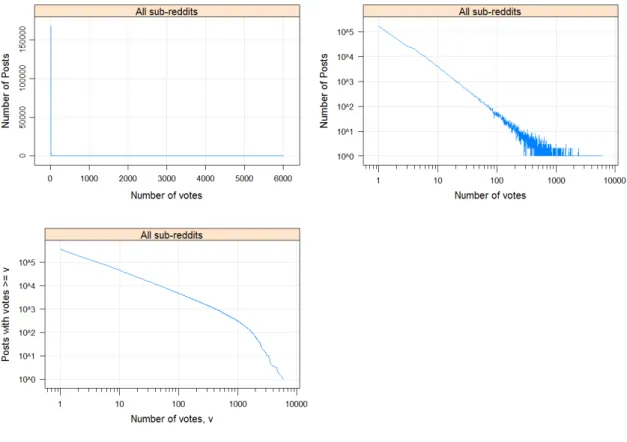
the data on untransformed axes, the top-right pane shows the data on logarithmic axes, the bottom-left pane shows the inverse cumulative distribution on logarithmic axes. . . 120 5.4 Reddit’s ‘hot’ ranking algorithm - from Dover (2008) . . . 122 5.5 Showing cumulative Hits, Votes and Comments for a single /r/pics Front page Post
- redd.it/cy6aw . . . 137 5.6 Showing the number of unique posts which appeared on the four observed page
types for a number of subreddits - August 20th to September 27th 2012 . . . 139 5.7 Final scores for posts which appeared on the Main page of their subreddit . . . 141 5.8 A kernel density plot showing comments’ submission order against final observed rank149 5.9 A kernel density plot showing comments’ first observed rank against final observed
rank . . . 150 5.10 Showing new votes by comment level over time for post redd.it/x8kra . . . 154 5.11 Showing number of comments displayed by level over time for post redd.it/x8kra . 156 5.12 Showing the ranks over time for the top-level comments on post redd.it/x8kra . . . 157 5.13 Showing the score over time for the post redd.it/x8kra . . . 159 5.14 Showing new votes by comment level over time for post redd.it/x6pb4. Comment
voting is more evenly distributed between comments of different levels in comparison to a highly active post. It should also be noted that the level of comment voting on this post is in general much lower. Observations were recorded at 30-minute intervals.160 5.15 Showing the ranks over time for the top-level comments on post redd.it/x6pb4 . . 161 5.16 Showing the level of comments submitted to Front page IAmA posts . . . 164 5.17 Showing the final ranks of comments submitted to Front page IAmA posts by level 165
5.18 Showing the maximum ranks of level 1 comments and whether they received a
response from the OP . . . 165
5.19 Showing the maximum ranks of level 1 comments which appeared at some stage in the top 50 comments - and whether they received a response from the OP . . . 166
5.20 Showing the ranks of level 1 comments at the observation point before they had a response from the OP . . . 166
5.21 Showing the level of comments submitted to Main page IAmA posts - for comments by the OP and by other users. . . 170
5.22 Showing the final ranks of comments submitted to Main page IAmA posts by level. 170 5.23 Showing the maximum ranks of level 1 comments which appeared at some stage in the top 50 comments - and whether they received a response from the OP . . . 170
5.24 A screen capture from redditmetrics.com taken on 14th December 2012 - showing the number of new subscribers for subreddits in descending order . . . 174
5.25 Excerpt from theStackoverflow‘About’ page . . . 176
5.26 [Showing the time between the submission of questions and the submission of the answer which is ultimately accepted.]Showing the time between the submission of questions and the submission of the answer which is ultimately accepted. The green line shows the median time until accepted answer is submitted. . . 177
5.27 Showing Answer acceptance rate as a function of submission order for the first 10 answers submitted for questions which received at least 10 answers. . . 178
5.28 Showing the distribution of ratings between posts for Your Freedom . . . 186
5.29 Showing the distribution of comments between posts forYour Freedom. . . 187
5.30 A histogram showing the average ratings achieved by posts toYour Freedom. . . . 187
5.31 A histogram showing the average ratings achieved by posts to Your Freedom with panes representing posts which received a certain number of ratings in total. . . 188
5.32 A histogram showing the average ratings achieved by posts toYour Freedomwhich received 100 or more ratings . . . 189
5.33 Showing the creation dates of Your Freedomposts . . . 190
5.34 Showing the average scores for posts with certain key terms in their title. Posts which received less than 30 ratings in total have been excluded. . . 192
6.1 Gender of respondents to the JavaLSU survey . . . 201
6.2 Age of respondents to the JavaLSU survey . . . 201
6.3 Country selected by respondents to the JavaLSU survey . . . 202
6.4 Ethnicity of respondents to the JavaLSU survey . . . 202
6.5 Religion of respondents to the JavaLSU survey . . . 203
6.7 State selected by respondents who chose United States as their country . . . 204
6.8 Operating System of respondents to the JavaLSU survey . . . 204
6.9 Web Browser of respondents to the JavaLSU survey . . . 204
6.10 Gender of respondents to the redditsurvey . . . 207
6.11 Age of respondents to the redditsurvey . . . 208
6.12 Country selected by respondents to the redditsurvey . . . 208
6.13 State selected by respondents who chose United States as their country . . . 209
6.14 Household Income of respondents to the redditsurvey . . . 209
6.15 Education level selected by respondents to theredditsurvey . . . 210
6.16 Favourite subreddit chosen by respondents to the redditsurvey . . . 210
6.17 The distribution of activity betweenredditusers . . . 212
6.18 The distribution of votes betweenredditusers . . . 212
6.19 The distribution of post submissions betweenredditusers . . . 213
6.20 Showing the percentage of all Users who fall into each activity bin, the percentage of exclusive users within a bin who engaged in either voting or submitting but not both, and the average proportion of actions which are submissions for users within a bin. . . 214
6.21 Showing the percentage of global votes and submissions which originate with users in each activity bin. . . 215
6.22 Showing the percentage of voting Users in each bin who cast Up or Down votes exclusively, and the percentage of votes cast by voting users in each bin which are Down-votes. . . 216
6.23 Showing the proportion of votes which are negative (down-votes) as a function of post voting order . . . 217
6.24 Showing the proportion of ‘quick’ votes and ‘early’ votes cast by users in each activity bin. . . 219
6.25 Showing probabilities predicted by the multi-level model for four hypothetical users. 227 6.26 Showing the number of different subreddits which users reached the Front page through - panels show users with a specified number of Front Page posts . . . 234
6.27 Showing the number of redditaccounts respondents had created . . . 235
6.28 Showing the length of time respondents spent on redditand the Internet daily . . 236
6.29 Showing responses to the item asking ‘How much of your ‘News’ do you get from reddit?’ . . . 237
6.30 Showing the frequency with which respondents participated by voting, commenting and posting onreddit . . . 237
6.31 Showing responses to question: ‘How important are the following when you browse reddit.com?’ Bars represent the percentage of respondents who selected each re-sponse option - coloured to indicate the item which was being responded to. . . 238 6.32 Showing responses to question: ‘How often do you do the following when
brows-ing reddit.com?’ Bars represent the percentage of respondents who selected each response option - coloured to indicate the item which was being responded to. . . . 239 6.33 An image created by areddituser about ‘karma bombs’ . . . 243 6.34 Showing the distribution of answer submissions between users on Stackoverflow . 245 6.35 Showing the proportion of users’ Question/Answer submissions which are Answers 247 6.36 Showing the pattern of question/answer submissions for users with between 11 and
50 posts . . . 248 6.37 Showing the pattern of question/answer submissions for users with between 51 and
100 posts . . . 249 6.38 Showing the percentage of ‘exclusive’ users in each of the activity bins, and the mean
proportion of question and answer submissions for users in each bin . . . 250 6.39 Showing the percentage of questions, answers and accepted answers which originate
with users in each of the activity bins, and also the percentage of users who fall into each bin. . . 250 6.40 Showing the percentage of answers, comments, votes, edits and reversions which
originate with users in each of the activity bins . . . 250
7.1 Showing the number of ‘Wikileaks’ posts per day which appeared onreddit’s Front page and the total number of stories per day in the four selected newspapers. . . . 259 7.2 Showing the sources linked to by Front page posts onreddit . . . 260 7.3 Showing the subject of Front page posts and the tone of the item being linked to
with regard to this subject. . . 262 7.4 Showing the subject of text posts submitted to the ’politics’ subreddit and the tone
of these posts with regard to their subject. . . 263 7.5 Showing the subjects and tones of the politics text posts which reached the Front
page. . . 264 7.6 Showing the final scores of a sample of posts submitted to the politics subreddit . 266 7.7 Showing the number of posts about this story appearing onreddit’s default Front
page per day . . . 268 7.8 Prevalence of key words on google, retrieved from ‘Google Trends’ . . . 270 7.9 Prevalence of key words onTwitter- percentage of tweets which included them . 270 7.10 Showing the instructions screen for the content-rating experiment. . . 307
7.11 Showing a sample item from the ‘false information’ condition of the experiment, the
participant clicks the title to proceed. . . 308
7.12 Showing a sample item from the experiment after the participant has clicked the title. Once the participant selects their rating and clicks ‘vote’ the next trial begins. 309 7.13 Showing Scores generated by the experiment (positive ratings less negative ratings) for the set of 50 core items. . . 311
7.14 Showing the distance of ratings in the ‘false information’ condition from the mean in the ‘true information’ condition multiplied by the direction of the ‘mislead’ and displayed according to order of presentation. . . 316
7.15 A histogram showing the number /r/politics posts submitted per day which linked to a Fox News domain. The ‘meta’ posts were submitted on day 0. . . 319
7.16 Showing the final scores of /r/politics posts which linked to a Fox News domain . . 320
8.1 Prevalence of subreddits on the default Front page - 10/06/10 - 18/10/11 . . . 331
8.2 Number of Posts from each considered subreddit on the Front page per hour of the 24-hour cycle . . . 332
8.3 Score of posts at first ovservation on Front page - 10/06/10 - 18/10/11 . . . 333
8.4 Time taken for posts to reach the Front page - 10/06/10 - 18/10/11 . . . 334
8.5 Number of minutes spent on the Front page - 10/06/10 - 18/10/11 . . . 335
8.6 Hourly score change before reaching the Front page - 10/06/10 - 18/10/11 . . . 336
8.7 Hourly score change while appearing on Front page - 10/06/10 - 18/10/11 . . . 337
8.8 Prevalence of subreddits on the default Front page - 18/10/11 - 20/08/12 - p1 . . . 339
8.9 Prevalence of subreddits on the default Front page - 18/10/11 - 20/08/12 - p2 . . . 340
8.10 Hourly change in score before reaching the Front page - 18/10/11 - 20/08/12 - p1 . 340 8.11 Hourly change in score before reaching the Front page - 18/10/11 - 20/08/12 - p2 . 341 8.12 Hourly change in score while appearing on the Front page - 18/10/11 - 20/08/12 - p1341 8.13 Hourly change in score while appearing on the Front page - 18/10/11 - 20/08/12 - p2342 8.14 Showing the percentage of posts on /r/all (leaf 1 only) which come from non-default subreddits per week . . . 345
8.15 Showing the percentage of posts on /r/all which come from non-default subreddits per week. . . 347
8.16 Showing the percentage of posts on /r/all (first 4 leafs) which come from non-default subreddits per week. . . 347
8.17 Showing the number of new posts observed on /r/askscience per week . . . 349
8.18 Showing the average up-votes per hour rate for the Main, New and Rising pages of /r/askscience . . . 350
8.19 Showing whether the last observed scores for posts which appeared on the /r/askscience Main page were positive or negative . . . 352 8.20 Showing the number of /r/askscience comments per week which were deleted . . . 353 8.21 Showing the reading level of comments onredditover time. Taken from redd.it/l8id4
post by user LinuxFreeOrDie. . . 358 8.22 Showing the length of comments on reddit over time. Taken from redd.it/l8id4
post by user LinuxFreeOrDie. . . 359 8.23 Showing the reading level of comments onredditfor individual subreddits. Taken
Chapter 1
Introduction
The Internet is possibly one of the biggest drivers of social change today. It allows anyone who is online to communicate with anyone else who is also online. National borders and geographical barriers are of little consequence to these communications. The Internet also allows any individual who is connected to publish information at the click of a button - be this in the form of text, picture, audio or video. ‘Web 2.0’ sites (O’Reilly, 2005) such asYoutubehave further lowered the barriers to entry as an information producer, through a website likeYoutube any individual who creates a user account can ‘publish’ their own videos with no special technical expertise required. These ‘published’ videos are then viewable by any individual who can accessYoutube, either through the Youtubewebsite itself or by being embedded in another web page.
The ease with which an individual can become an information (or ‘content’) producer online is directly implicated in the rapidly increasing quantity of information available on the World Wide Web. As the quantity of information available online continues to increase exponentially our capacity to navigate and make sense of this vast information repository becomes increasingly important. This problem is often referred to as ‘Information Overload’ - and providing solutions in this area has been a route to success for a number of high profile Internet-based companies. Google is the obvious example of a hugely successful company which has gained its success by allowing people to navigate the web more efficiently. Indeed a whole industry (Search Engine Optimisation) has sprung up whose sole purpose is to increase the prominence of a client’s websites through search engines such as Google - one indication of the importance now placed on gaining the attention of Internet users.
Social Network based web applications (such as Facebook and Twitter) can also be thought of as solutions to the problem of information overload. Where a search engine like Google provides information in response to search queries, Social Networking sites provide information on the basis of personal relationships (or ‘network ties’). These websites allow a user to monitor information
feeds produced by, or addressed to, selected people known to the user - with information in these systems flowing along network ties.
Websites which employ Distributed Moderation and filtering systems offer a different approach to information overload, one which has been steadily gaining traction in recent years. It is these Distributed Moderation (or DM) web systems which are the subject of the present research. The principle behind DM systems is that some dimension of user activity is taken as a measure of an item’s quality or relevance - this measure being used to rank and sort items, with those items which rank more highly being placed in positions of greater visibility.
There are a growing number of websites which are built on the principles of Distributed Moderation and in recent years several such websites have seen a surge in their popularity. The specifics of how Distributed Moderation works varies from website to website. Some of these websites derive the measure of an item’s quality or relevance from user actions which serve a purpose external to the task of ranking and sorting content. A simple version of this mechanism uses the number of times an item has been viewed as an indication of its quality or ‘interestingness’. For example,Youtube uses the number of times a video has been viewed in this manner, and several news providing websites (e.g. BBC News) offer lists of the most viewed or forwarded content on their website.
‘Social Bookmarking’ websites (e.g. Delicious.com) employ more sophisticated systems based on similar principles. On these websites a user’s decision to bookmark an item increases its visibility for other users - and the tags which a user attaches to these bookmarks are aggregated such that they can be used by other users to navigate the website and search for content of particular types. For example, a user who wished to learn about photography could search for the key words ‘photography’ and ‘tips’, and be presented with all of the bookmarks which have been tagged with these words, with the most often bookmarked items appearing at the top of the list.
On Social Bookmarking websites the measure of an item’s quality is still based on actions which serve a purpose external to the ranking procedure; but whether a user chooses to bookmark an item or not seems like a better indicator of quality than whether they viewed the item. Every user who wishes to form an opinion about the item must view it first, if the metric of item quality is based on view counts then even those users who find the content objectionable will increase the salience of that item of content. The tagging systems employed by Social Bookmarking websites allow their users to go beyond merely ranking the content submitted to the website. By aggregating these tags the Social Bookmarking website’s users can collectively impose a classification scheme on the content submitted there - making it easier for users to navigate this content.
On other websites (such as the ‘Social News’ websites which serve as a focal point for this re-search) users participate directly in the ranking and sorting of content through a voting system. These voting systems generally allow for both ‘up’ votes which increase an item’s score (and
there-fore visibility), and ‘down’ votes which decrease an item’s score. This type of website will be referred to here as ‘Social News’. Popular exemplars of this form arereddit.com, Digg.comand Slashdot.org. These websites allow anyone to create a user account, and anyone who is signed into a user account can both submit items of content or comments, and vote on the items or com-ments submitted by other users. These votes are used to dynamically rank the items of content and comments, and the order these are displayed in is determined by their rank.
The items submitted to these websites are most often hyper-links to externally hosted web re-sources, although reddit.comalso allows for the submission of text posts created on the website directly by the submitting user. Much of activity on Social News websites takes the form of up/down voting and these websites have a ‘Front page’ which serves as the focal point of user attention and voting activity. Through the voting system very large numbers of users make a collective decision about which items will gain a place on the website’s Front page - where the items will be seen by the greatest number of users and visitors to the website.
We can draw an analogy between Social News websites and conventional news resources such as newspapers. Users who submit content can be thought of as journalists, and users who vote collec-tively fulfill the role of an editor. In this analogy the website’s Front page represents the editor’s decision about which of the many submitted items warrant publication. The major disparities between the workings of social and conventional news are as follows:
• On a Social News website many of the items have been found rather than produced by the submitting user, with the submitting user merely giving the item a title and deciding which category to submit it to.
• On a Social News website every user can act as both journalist and editor, by submitting and voting respectively.
• On a Social News website each user acts autonomously - the ‘editor’ cannot dictate what the ‘journalists’ submit, although at times text posts about the kind of items which do or do not belong on the Front page have been quite common.
Research on Social News websites is warranted for a number of reasons. These websites represent a novel ‘crowdsourcing’ approach to information overload. The tasks of content discovery and filtering/ranking of this content are separated and opened up to a very large number of participants. The principles behind these websites are also gaining traction elsewhere on the web. Websites such asAmericaSpeakingOut.comandYourFreedom.hmg.gov.ukapply similar systems in the domain of political policy. The principle of up/down voting has also been applied in a question & answer format by websites such as Stackoverflow.com - where items are questions and the comments on these are intended to be answers, with up/down voting being used to rate these questions and answers. The same system can also be employed in reverse to produce a mediated interview (where
comments are questions and the highest scoring questions are answered) - for example the ‘Digital Debate’ conducted with the leaders of the main political parties in the run-up to the 2010 General Election in the UK (Guardian, 2010a).
All of the applications of up/down voting listed above are being employed on reddit.com and it appears thatreddit’s users have been pivotal to the creation or popularisation of some of these. Reddit.comalso seems to have opened more aspects of its functioning up to distributed decision-making than other websites (see section 3.1.1). These factors would seem to make reddit.coma particularly good venue for research on the workings of Distributed Moderation systems.
The basic principle of up/down (or ‘like/dislike’) voting has been proliferating quite rapidly in recent years. Social Media applications like Youtube and Facebook have recently applied this mechanism to submitted items of content and comments thereon - and a number of British news-papers now also employ similar systems for user comments on their articles (or have at one point experimented with this approach). It seems that any website which deals with a large number of user contributions and wishes to sort these based on their quality could benefit from Distributed Moderation. If a website receives 10,000 unfiltered contributions per day, and wishes to sort these such that the best items are most visible, then allowing their users to register their judgments on these items seems like a logical step to take. Up/down voting allows users to register such judgments (albeit on one dimension only) quickly and easily, and these judgments are immediately and automatically made use of by the algorithms the website uses to sort content.
On the modern-day frontier that is the World Wide Web new methods of communication are con-tinually being introduced and evolving. The web is still very much in its infancy, and the way in which its use is developing is highly unpredictable and at the same time highly significant for the future. The Internet is bound to have far-reaching social implications, but without an understand-ing of where this technology is headunderstand-ing it is hard to predict what the ultimate consequences for society might be.
Distributed Moderation systems seem to be on the rise. Websites built on these principles are themselves growing, and the mechanisms these websites rely on are increasingly being adopted by websites which exist for some other purpose. These Distributed Moderation systems have sociological importance because of their unique approach to the problem of Information Overload, but this is not the only quality which identifies them as a particularly interesting development in digital communications technology. The use of voting-based Distributed Moderation systems on ‘Social News’ websites has the fascinating side-effect of allowing very large numbers of individuals to participate in collective decision-making and discussion. Furthermore, unlike older bulletin boards and discussion forums, Distributed Moderation systems do not seem to have an upper limit to the number of participants they can sustain in a single discussion or decision. A user who joins one of these ‘democratically mediated’ conversations late in the day (e.g. when several hundred
individuals have already made contributions) can express their opinion by voting to change the score of pre-existing contributions - influencing the discussion without adding to the quantity of text of which it is comprised.
Social News websites are also of particular interest because they operate in the domain of ‘news’. An informed citizenry is critical to a functioning democracy (Mattson, 1998) and these websites have a unique approach to the way in which ‘the news’ is determined. It may be the case that this socially driven process of determining what ‘the news’ is has some benefits when compared to conventional sources like newspapers and television news. This is an issue which will be addressed in Chapter 2.
As Social News allows every user to be involved in voting to determine what ‘the news’ is, there may also be psychological effects associated with participation on these websites. Where the reader of a newspaper or viewer of television news is passive with respect to the production of that resource (although probably not with respect to their interpretation thereof) - Social News users are engaged to varying degrees in the production of the specific Social News resource they consume. This may produce an effect where these users feel more empowered and confident in their opinions. For further discussion see section 3.3.
In summary, the key reasons for studying Distributed Moderation systems (and Social News web-sites in particular) are as follows:
• They offer a novel, people powered, approach to the problem of information overload.
• Social News in particular offers a novel approach to the coverage of current events - an approach which may have different strengths (and weaknesses) when compared to the mass media.
• This approach is gaining traction - Social News websites are becoming more popular, and the mechanisms they use are being adopted in other domains (most notably politics).
• Voting systems allow for a previously impractical number of individuals to participate in producing a single decision or discussion.
• The effects these systems have on the resources which they produce, and on the individuals who participate, are largely unknown.
On the surface, Distributed Moderation systems seem to perform well on their task of selecting, from thousands of submissions, the cream of the crop - and displaying these to the broadest audience. It is presumably a rare event when a Social News website’s Front page plays host to content which the majority of its users find to have no merit. Indeed, if this were a regular occurrence it seems unlikely that the user-base of a website like reddit.com would be growing so quickly. Furthermore, the nature of the items of content submitted (whether they are news
articles, humerous pictures, videos, or ideas for political policy) seems immaterial to the Distributed Moderation system - all of these content types seem equally amenable to Distributed Moderation. These systems also seem to have no obvious problem dealing with large and ever-increasing volumes of user activity and content submissions. 1
A Utopian outlook on the potential of Distributed Moderation would suggest that these systems can be deployed in any context and with any user population size. A nation could, for instance, deploy such a system to collect, rank and sort its population’s political policy ideas; allowing every member of the population to contribute, with the most popular ideas rising to the top in an organic fashion and without the need for gatekeepers - from here going on to form the basis of public political discourse.
This scenario is of course highly speculative. We do not know whether DM systems reliably rank the ‘best’ items most highly, or whether this process has a large element of randomness or social influence (e.g. when the first vote an item receives is negative does this influence the perception of subsequent voters?). We do not know whether DM systems can deal well with content which is political or controversial in nature - for example it is quite possible that small groups of highly motivated users can coordinate their actions in some way to sideline content which they find objectionable. We do not know how individuals react to seeing content they find personally objectionable judged positively through these systems (e.g. how would one feel if one’s peers consistently up-voted racist proposals or perspectives to high-visibility locations?). We do not know whether these systems can in fact handle very large numbers of contributors as easily as they appear to, perhaps beyond a certain user population level the random element or the role of social influence increases in importance. It also seems likely that these systems require a minimum number of users to function as intended, and without this critical mass do not reach their potential.
Given that what we do not know about DM systems far outweighs what we do know, it is somewhat alarming that these systems have already been deployed in the context of national politics. Both the American Republican party (AmericaSpeakingOut.com) and the British coalition government (YourFreedom.hmg.gov.uk) have already applied some form of Distributed Moderation to gather (rated) political policy ideas from the general population.
The present research aims to fill some of these gaps in our understanding of Distributed Moderation - by looking in detail at some instances of DM which have been growing and developing for years I aim to understand the relative strengths and weaknesses of these principles - and in so doing inform decisions about whether such systems should be trialled in important domains like politics - and if so how they might be configured to maximise their utility and minimise potential disadvantages.
The rapid pace of change in Internet use generally and Distributed Moderation in particular results
1This introduction was written near the start of the research in 2010, by its conclusion in 2013 the ‘first impression’
in an unusual problem for this thesis whereby the subject of the research has changed considerably over the course of the research. This PhD research began in October 2009, whenreddit.com(the primary website of interest) was a relatively unknown Social News website - widely perceived as being secondary in size and importance to Digg.com. Writing now in 2013, Reddit has grown substantially to become a widely recognised website (e.g. Obama participated in an ‘Ask Me Anything’ post in 2012) hosting levels of user activity which are orders of magnitude greater than was the case in 2009 - while Digg has suffered a steep decline before being sold and re-launched as an almost unrecognisable site. This thesis has been written in incremenets over the duration of this 3.5 year period and consequently certain portions of it are already out-dated. For example, onreddit in 2009 there was a strong sense that the ‘Front page’ was central to the website and the same for everyone - whereas in 2013 reddit’s long-standing users appear to have migrated to smaller subreddits, the larger ‘default’ subreddits of 2009 appear to have suffered a decline in the quality of material which is highly ranked, and the subreddits which feed intoreddit’s Front page by default have also been changed. If one was to browse thereddit.com‘Front page’ for the first time now in early 2013 it would likely not be immediately apparant why the term ‘News’ has been incorporated in a description of the website.
Chapter 8 will give an account of how the websites which were studied here have changed over the course of the research. For other chapters it is helpful to know when they were written:
• Chapters 2, 3 & 6 were written largely in 2010.
• Chapter 7 was written largely in 2011.
• Portions of Chapter 5 were written in 2010, with much of it being re-written with new analyses in 2012.
• Chapters 4, 8 and 9 were written largely in 2012/2013.
This research is exploratory in nature and the questions which have guided it are general ones: How does Distributed Moderation work in practice? How and why do people participate on DM websites? How do the resources produced by DM websites differ from their more conventionally produced alternatives? What are the social implications of producing information resources in this fashion? How has reddit.com develeloped and changed over the course of this research (a longitudinal perspective on DM)? What other purposes might the principles of Distributed Moderation be applied or adapted to?
The thesis is therefore structured as follows:
• Chapter 2 - a review of some relevant background literature on the Internet, largely from the disciplines of sociology and political science.
• Chapter 4 - an overview of the methods employed by this research - chiefly a description of how data from websites of interest was collected and transformed.
• Chapter 5 - How does Distributed Moderation work in practice?
• Chapter 6 - How and why do people participate on DM websites?
• Chapter 7 - The social implications of Distributed Moderation - how does the interaction on DM websites, and the resources which they produce, differ from more conventional approaches to the production of information?
• Chapter 8 - How hasreddit, the website which this research has focused on, changed over the course of the research?
• Chapter 9 - Discussion and Conclusions.
In addition, we might consider this research as having one all-encompassing background question: what can we learn about Distributed Moderation through the analysis of the procedural data these websites generate in their day-to-day operation? We are entering an era where Internet use is increasingly ingrained in peoples’ daily lives - Social Media applications keep highly accurate and detailed records of users’ behaviour by necessity, they need this data to function. Analysis of this ecologically valid data has the capacity to yield rich understanding of this increasingly prominent aspect of social life.
Chapter 2
A review of relevant literature
from the Social Sciences
This chapter will review the social science literature which is relevant to the present research. It will begin with a brief overview of some sociological theories concerning the Internet; proceeding to discuss the more recent development of ‘Web 2.0’ - relating this to pre-existing theory about the Internet, discussing research which explicitly addresses Web 2.0 applications, and describing some types of research which have been conducted on the new ‘social’ web.
2.1
A brief history of the Internet - and the birth of the
Web
The ‘Information Technology Revolution’ was born in the 1970s (Castells et al., 2000) - a decade that saw the invention of the micro-processor and micro-computer, and also the development of the first electronic communications network (ARPAnet) and subsequently TCP/IP, the method of connecting networks to each other which is still employed by the Internet to this day. It was however not until the early 1990s that the World Wide Web came into being, with the development of HTML and the first Web browser.
The pre-Web Internet was chiefly the domain of academics and the military as it required a computer to access and a fair degree of technical expertise to utilise effectively. The birth of the Web (and concurrent rapid decline of the cost of computers) marks the point where the Internet became much more widely accessible.
It is worth noting at this point that the ‘birth of the Web’ did not require any significant alteration of the Internet’s infrastructure, it was merely a case of developing a standard method of ‘encoding’
documents (HTML) and referencing these documents (URLs), coupled with a piece of software which could decode said documents (the Web browser). These elements sat atop the existing Internet, and while the Web is so widely used that it is almost synonymous with the Internet for many people, in a technical sense it is just one way of using the Internet. The Web itself was in a sense created by Internet users, it required no formal approval or mandate to be put into effect and its success is due to its utility and popularity with users. These are themes which we will re-visit when we come to discuss the development of more advanced Web applications (collectively referred to as ‘Web 2.0’ applications (O’Reilly, 2005)).
First, let us consider some sociological theories on how the Internet would affect society which were based on the early Web of static web pages and e-mail.
2.2
Sociological perspectives on the Internet
The surge in Internet use in the early 1990s which accompanied the birth of the Web triggered much sociological theorising about the social implications of this new communications medium -in particular its capacity to br-ing about social change. A brief overview of some of these theories is offered below.
In fact such sociological theories pre-date widespread Internet use. Bell (1977) was the first soci-ologist to envision the coming of digital communications technology and theorise about the effects its widespread use would have on society. More recently, Castells et al. (2000) has established himself as a leader of sociological thought on the Internet’s capacity to transform aspects of so-ciety. Castells et al. (2000) argues that we have entered the ‘Information Age’, that new digital communications media are transforming every aspect of society - facilitating the emergence of a global economy, transforming the nature of work and influencing our ideas about the Self.
Sociologists of a Marxist persuasion would tend to view the Internet as another communications medium which could be co-opted by the elite to enhance control of politics and production (Davis et al., 1997). From a Weberian perspective the Internet is a point-to-point medium which could advance rationalisation by reducing limits of time and space (Collins, 1979). Both Marxists and Weberians place particular emphasis on inequality of access to the Internet - commonly referred to as the ‘Digital Divide’. This divide exists on a number of levels. Internet accessibility is unevenly distributed across the globe - with the international divide between countries where the Internet was available and affordable being highly correlated with national wealth in the 90s (Hargittai, 1999). Within nations, access to the Internet and the capacity to utilise it effectively are unevenly distributed - with education level and income found to be key factors by Robinson et al. (2002), and Norris (2001) finding that younger people, men, the highly educated and highly affluent were the most likely demographics to be online. Norris (2001) also compares the diffusion of Internet
use with that of previous communications technologies and finds that the spread of Internet access follows a similar pattern to previous communications technologies. If the Internet is to become central to an individual’s capacity to obtain information/eduction, build and maintain networks of social support, and engage in political dialogue - then inequality of access is likely to reinforce existing social inequalities related to income and education.
Technological determinists, unsurprisingly, would see social change induced by the Internet as a result of enabling new communications practices with corresponding skill-sets; as with previous socially transformative technologies (such as the printing press) those individuals who are able to adapt well to these new communications practices will have an advantage (Eisenstein, 1979). Some early scholars of new digital communications media foresaw the coming of an ‘information society’ which would replace the ‘industrial society’ (Bell, 1977). Critical theorists were chiefly concerned with the effect of new communications technologies on public deliberation and the integrity of civil society (Habermas et al., 1989; Calhoun, 1998).
While broad macro-sociological theories such as these are informative for the present research it is beyond the scope of this research to evaluate these; although some of these perspectives will be re-visited below. Rather we have opted to focus on a particular aspect of Internet use (‘Social Media’ which employ Distributed Moderation systems) and develop a detailed understanding of this with empirical observations. DiMaggio et al. (2001) highlighted some opportunities for sociological research afforded by the Internet, emphasising the opportunity to study this new communication medium while it develops, and the opportunities for new kinds of research afforded by the nature of the Internet. This call seems to have fallen largely on deaf ears, recent reviews by Farrell and Petersen (2010) and Murthy (2008) documenting a lack of sociological research which utilises primary data collected on the Internet.
While sociologists have appeared reluctant to engage in new kinds of research made possible by the Internet, other groups have showed no such hesitation. Private companies, Google in particular, have created a whole industry built on utilising data stored on the Web - chiefly to create profiles of users which are useful for market researchers. Google’s acquisition of Youtube is particularly interesting in this regard (Van Dijck, 2009). Google paid $1.6 billion forYoutube, a website which was tremendously popular but not profitable. Google already had their own (arguably superior) video sharing website (Google Video); so it seems unlikely that they were attracted byYoutube’s technological infrastructure. What Google got for their money was the Youtube user-base, and one of the ways they have endeavored to turn a profit fromYoutube has involved making use of the immense quantities of informationYoutubeusers generate in their everyday use of the website.
Academic researchers, and in particular social scientists, have lagged behind private industry in their willingness to embrace the collection and analysis of the vast array of ‘procedural’ data which Social Media websites produce on a daily basis. Addressing this gap in the sociological literature
is but one reason to study newly emerging forms of interaction on-line. There are further, and arguably more compelling, reasons concerning the specifics of how Internet use has changed over the last decade.
2.3
Political perspectives on the Internet
The idea that the Internet would have a radical impact on politics is almost as old as the Internet itself and pre-dates the widespread adoption of the World Wide Web. For example, Rheingold (1993), Naisbitt (1991) and Corrado and Firestone (1996) all make grand claims about the democ-ratizing potential of the Internet based on early observations of discussion spaces such as bulletin boards and Usenet. There are several dominant themes to much of the research on the Internet from a political perspective. Chief among these is the tendancy for scholars to fall (or be placed into) one of two camps, those who believe that the Internet will revolutionise politics such that it is barely recognisable (most often thought to involve a shift to a much more direct or participatory form) and those who believe that familiar political institutions and procedures would adapt to this new technology resulting in ‘Politics as Usual’ (Margolis and Resnick, 2000). Much of the political science research on the Internet can be thought of as trying to answer this question of whether or not it would cause a ‘revolution’ in politics.
Wright (2012) puts forward a highly compelling argument that this ‘Revolution’/‘Normalization’ dichotomy has actually hampered our understanding of how the Internet and politics interact. To borrow some of Wright’s examples, this dichotomy has lead to the dismissal of changes in public behaviour because they are not as significant or instantaneous as the term ‘Revolution’ implies (e.g. a finding that 44% of Americans read political blogs several times per year or more becomes “More Than Half of Americans Never Read Political Blogs” - and “Only 11% of bloggers in one survey said that the primary topic of their blogs is politics or political issues” (Davis, 2009: 4) is the summary given to a finding that implies there are 14.5 million primarily political blogs). Conversely, those who believe a revolution is underway may exaggerate the significance of minor developments - for exampleThe Guardiannewspaper citing Barack Obama’s plan to email and text supporters directly about his choice of running-mate as an example of “the power of technology to transform electoral politics” (Wright, 2012).
A second theme to political science research on the Internet is that it has tended to focus on aspects of Internet use which are explicitly political in nature.
“Virtually all research has, until very recently, focused on established political events (e.g. elections), institutions (e.g. parliament/party web-sites), activities (e.g. government-run online consultations) and actors (e.g. elected representatives blogs).” (Wright, 2012, p. 255)
Wright sees this as a result of the prevalence of the revolution/normalization frame which much of the research has adopted, and calls for more research on what he terms ‘Third Spaces’. These ‘Third Spaces’ are online discussion fora “with a primarily non-political focus but where political talk emerges within conversations. The key link between participants is not (normally) their location but specific issues or topics” (Wright, 2012, p. 255).
If we consider contemporary political actors’ presence on the Internet it is characterised by the uptake of tools, platforms and repetoires of behaviour which have already been established else-where, often long before they are adopted by the government or politicians. If the Internet is to cause a ‘revolution in politics’ I would argue that this is most likely stem from forms of commu-nication which are in their infancy or have not yet been devised. The web is still bustling with experimentation and innovation - but governments and established political parties seem unlikely to be the source of a communication technology which could ‘revolutionise’ politics.
The present research addresses the political impact of the Internet not as its primary subject but at a tangent. Social Media which employs DM voting systems were selecteda priori as the subject of this research because they appeared to the researcher as a novel and interesting form of mass communication and there was a dearth of research aiming to understand how they function. The prominence of ‘voting’ as a means of interaction on these websites immediately suggests a link to the political, but it was never the intention of this research to determine whether Distributed Moderation would be part of a revolution in politics - the revolution/normalization debate is not one which will be entered into here. Rather this research confines itself to describing how current examplars of this form may be interacting with the political - and speculating on how this technology might be adapted for more explicitly political purposes in future.
The Social News website reddit.com seems to fit with the description of a ‘Third Space’ quite neatly - it is not a website dedicated to politics but does see a considerable amount of political discussion. I would argue thatredditis a particularly interesting ‘Third Space’ to study for two broad reasons. The first of these is the centrality of voting and the novel form of ‘democratically mediated discussion’ which takes place on reddit. The second relates to reddit’s output, a crowd-sourced ‘News’ type resource which is conceptually interesting given the prominent role of News media in democratic societies - and which during the course of this research became almost directly involved in the political process of the United States (through the campaign against the ‘Stop Online Piracy Act’, see chapter 7).
2.4
The changeable nature of Internet use
‘Internet use’ is itself not a stable concept, the profile of individual users’ online behaviours is quite different now to what it would have been ten years ago when Internet use was largely characterised
by the use of e-mail and accessing static web-pages, often through privately owned and run ‘portals’. The term ‘Web 2.0’ has been coined (O’Reilly, 2005) to describe a range of new applications which are ‘native’ to the Web (i.e. could not conceivably function outside a medium such as the Internet) - by 2013 ‘Social Media’ seems to have replaced ‘Web 2.0’ as the blanket term for such websites. Many of today’s most popular Web 2.0 applications (e.g. Youtube,Wikipedia,Flickr) are entirely dedicated to ‘user-generated content’. This represents a major departure from the earlier Web, where in order to become an information producer one had to have a web site or page, and placing content on these websites was usually limited to their owners or administrators. Figure 2.1 illustrates a rapid shift in user traffic away from web portals (MSNand Yahoo) and towards user content driven sites (FacebookandYoutube).
Figure 2.1: The share of global Internet users’ time spent on five major websites between 2006 and 2010; taken from Meeker (2009)
Furthermore, it seems likely that the nature of Internet use will continue to evolve in unpredictable ways in the future as people continue to experiment with new methods of interaction which the Internet makes possible. Let us take Twitteras an example of this; the service was launched in 2006 but didn’t begin to ‘take off’ until 2007, when 400,000 tweets per quarter were being sent, this increased to 100 million tweets per quarter in 2008, 2 billion tweets per quarter by the end of 2009 and 4 billion per quarter at the start of 2010 (Beaumont, 2010). In 2010Twitteris becoming increasingly ingrained not only in our web use but in television broadcasts; live programmes now
often invite their viewers to talk back throughTwitterand typically read some of these messages during the programme.
Services such as Twitter and Facebook are widely perceived as being integral to several recent political uprisings in the middle east (Stone and Cohen, 2009; Grossman, 2009; Gaffney, 2010). It is a hallmark of the speed at which new Information Communication Technologies (ICTs) are developing that a web service likeTwitter can move from its infancy to widespread adoption in the space of just five years; and from there proceed to play a role in the shaping of a nation’s politics.
The adoption and diffusion of new technologies is itself the subject of a considerable volume of research. Concepts such as the technology adoption lifecycle (Rogers, 1966) and Gartner’s hype cycle (Linden and Fenn, 2003; Fenn et al., 2009) incorporate some form of adoption threshold, beyond which the ultimate success of a given technology is highly likely. Furthermore, a new technology which has passed this threshold can reach a kind of critical mass; at which point it is highly likely that said technology will become firmly embedded within the societies where it has been adopted. Such concepts are also applicable to the uptake of new web applications, including the various forms of Social Media.
If we consider academic research on these new Social Media; this tends to be conducted and published when a given application (e.g. Twitter) is well on its way to widespread popularity, or has already reached the point at which its widespread adoption and subsequent embedding in society is all but assured. If this research uncovers potentially negative effects related to the uptake of its subject application, by the time these are reported it is effectively too late to halt or slow the widespread adoption of the application. For example, Turkle (2010) cautions strongly against heavy use of Social Media as a replacement for face-to-face human interaction, citing a number of negative side effects. However, by the time this book was published many individuals had incorporated these applications into their lives to such an extent that they are not easily abandoned.
If we are to consider the Internet’s long-term impact on society it seems prudent to pay particular attention to the newest forms of social interaction which are emerging online. This is one of the primary reasons for focusing on Distributed Moderation systems in the present research. When this research beganreddit.comwas a relatively small website; eighteen months later it had grown to become one of the top 100 websites globally in terms of web traffic (Alexa, 2010). This is indicative of the problems social scientists face when attempting to keep pace with the rapid development of novel web applications. ‘Social News’ applications have probably already passed the threshold where they are ‘here to stay’ - before anyone has developed a solid understanding of how they operate, how this affects the content they produce and the individuals who participate.
In addition to the youth of these websites, there are several bodies of literature which serve to highlight the importance of studying Distributed Moderation systems; and in particular their use in the context of ‘Social News’. Firstly, we will consider the distribution of attention on the Web, with particular reference to the problems of ‘Information Overload’ (section 2.5). We will then consider Web 2.0 applications which foster ‘Peer Production’ efforts (section 2.6). It is now possible for a text to be produced by a group without any formal hierarchical organisation, and this text can be widely distributed without the need for capital (beyond an Internet-connected computer). These two features of the modern Web stand in stark contrast to the ‘industrial’ method of production and information dissemination through the mass media. A further perspective of utility here is to look at the convergence of ‘old’ and ‘new’ media systems; Jenkins (2006) argues in favour of research which studies the intersection of old and new media, rather than comparing and contrasting each as separate entities. Again, Social Media applications which employ Distributed Moderation systems are of particular interest here (section 2.7). Social News websites process content which originates from old and new media, produced by professionals and amateurs. All of this content is ‘processed’ by Social News websites in the same way, irrespective of its source, and the voting system through which it is processed is fundamentally social in nature - being powered by the voting behaviour of individuals, and being accompanied by commentary from these individuals; this commentary itself also being filtered and sorted through the voting system such that it represents a kind of democratically mediated discussion.
2.5
Attention distribution on the World Wide Web
2.5.1
Links on the World Wide Web
Hyper-links are integral to the functioning of the World Wide Web, and have been the subject of studies by researchers from a variety of disciplines (e.g. Gonzalez-Bailon (2009); Adamic and Adar (2003); Barabasi and Albert (1999); Albert et al. (1999); Flake et al. (2002)). Links can be either internal (linking to another page on the same website, e.g. a navigation bar) or external (linking to a page on a different website). Of these two types of link external links have been the subject of more research; where links are referred to these are external links unless otherwise stipulated.
At their most basic level links provide a path from one web page to another; by using a link the user is transported from the source page to the destination page. In this way links serve as the sign-posts of the web - if a page on Website A links to a page on Website B then individuals who view Website A will learn of the existence of Website B - and be presented with a path to Website B which they can easily follow. This means that every visitor to the page on Website A bearing the hyper-link has the potential to also become a visitor to Website B. This is one of two major
ways in which links influence the distribution of user attention between websites on the Internet.
External links also serve a second purpose in the functioning of the web - they are used by search engines such as Google (Brin and Page, 1998) and others (Tomlin, 2003) as an indication of a website’s quality or importance. A website with more in-links will appear in a more prominent position than a website with fewer in-links; for a given search term that matches both websites.
The algorithms behind most of the popular search engines weight these in-links according to the centrality of the sites on which the links appear (Tomlin, 2003). For example, if Yahoo.comlinks to a page on Website A this should significantly increase the prominence with which Website A appears in search results for relevant terms. In contrast, a link to Website A from an individual’s low-traffic home-page will have very little effect on Website A’s search prominence. The importance of a website’s ranking by search engines is illustrated in a study (Silverstein et al., 1999) which reported that 85% of users only looked at the first page of search results provided in response to their query.
The function of links on the web has been likened to that performed by citations for academic papers (Gonzalez-Bailon, 2009). Each citation brings with it the possibility that a reader will “follow” the citation and subsequently read the paper which is referenced. Each citation also adds one to the recipient article’s citation count - with this citation count being used as a proxy for article importance or quality in some cases.
The distribution of citations among authors (Newman, 2001), and of links between websites (Barabasi and Albert, 1999; Barab´asi et al., 2000; Huberman and Adamic, 1999); have both been shown to be scale-free with a long tail. In both cases the distribution is highly skewed such that a very small number of authors or websites receive a disproportionately large number of citations or in-links. The Power Law is one distribution of this highly skewed type which has received a lot of attention from researchers in recent years - due to its utility in describing a range of natural (e.g. earthquake magnitude - Gutenberg and Richter (1944), number of species in biological taxa - Willis and Yule (1922) , solar flare intensity - Lu and Hamilton (1991)) and man-made (e.g. city populations - Newman (2005), individuals’ annual income - Pareto (1896), frequency of word use in human language - Zipf (1949)) phenomena (for review see Mitzenmacher (2004); Newman (2005); Clauset et al. (2009)).
Power Laws and the distribution of attention on the World Wide Web
The pure power-law distribution, also known as the zeta distribution, or discrete Pareto distribution is expressed as
p(k) = k
−γ
ζ(γ), where:
• k is a positive integer usually measuring some variable of interest, e.g., number of links per network node;
• p(k) is the probability of observing with valuek; • γ is the power-law exponent;
• ζ(γ) is the Riemann zeta function defined as
∞ P k=1
k−γ.
Many research articles have been published which document observations of the power-law in a range of Internet-related measures. Early examples of such work focused on the distribution of links between websites (Barabasi and Albert, 1999; Barab´asi et al., 2000; Broder et al., 2000). More recently the same skewed distribution of links has been observed within certain sub-sections of the web: in the blogosphere (Kumar et al., 2005), and in social commerce networks (Stephen and Toubia, 2009). Power law distributions have also been observed in a range of Internet phenomena unrelated to links; such as the size of files transferred (Willinger and Paxson, 1998) and the size of e-mail address books (Newman et al., 2002).
A power law distribution has also been observed in the distribution of hits (individual page views) between websites forAOLcustomers on a single day (Adamic and Huberman, 2000). In principle, hits seem to offer a better measure of user attention than links because they count the number of times a page is accessed; whereas the presence of a link does not guarantee that any specific number of individuals will follow it. There are however several problems with the use of hits as a measure of user attention. A hit is generated every time a page is loaded, irrespective of whether a person or web-crawling bot made the request, and irrespective of how many times the same person or bot has previously requested the page.
To circumvent these problems, a measure of the number of unique IP addresses to visit a page is frequently used, in place of hits, as a measure of attention. This measure has its own problems however; the same individual is counted multiple times if they visit the page from different networks, and conversely all individuals to access a page from within a single network can be counted as a single unique visitor. For these reasons, research relating to the distribution of attention on the Internet frequently relies on measures other than hits to infer attention.
Much of the research which has observed and described Power Law distributions in nature and on the Web has used a method involving linear regressions on log-transformed variables (frequency counts, for example the number of times a word appears in a corpus) to determine whether they follow the power law, and to estimate its parameters.