The International Journal of 3-D Information Modeling is indexed or listed in the following: ACM Digital Library; Bacon’s Media Directory; Cabell’s Directories; DBLP; Google Scholar; INSPEC; JournalTOCs; MediaFinder; ProQuest Advanced Technologies & Aerospace Journals; ProQuest Computer Science Journals; ProQuest Illustrata: Technology; ProQuest SciTech Journals; ProQuest Technology Journals; The Standard Periodical Directory; Ulrich’s Periodicals Directory
Research Articles
1 Building Information Model for Existing Buildings for Facilities Management: RetroBIM Framework;
Giulia Carbonari, University of Greenwich, London, UK Spyridon Stravoravdis, University of Greenwich, London, UK Christine Gausden, University of Greenwich, London, UK
16 Impact of Fidelity in 3D Space Visualisation Across the Construction Asset Lifecycle;
Noha Saleeb, Design Engineering Department, Middlesex University, London, UK 29 BIM and Cultural Heritage: Compatibility Tests in an Archaeological Site;
Cristiana Achille, Polytechnic University of Milan, Milan, Italy Nora Lombardini, Polytechnic University of Milan, Milan, Italy Cinzia Tommasi, Polytechnic University of Milan, Milan, Italy
45 Development of OntEIR Framework to Support BIM Clients in Construction;
Shadan Dwairi, University of the West of England, Bristol, UK Lamine Mahdjoubi, University of the West of England, Bristol, UK Mohammed Odeh, University of the West of England, Bristol, UK Mario Kossmann, Airbus, Bristol, UK
67 Three-Dimensional Information Retrieval (3DIR): Exploiting 3D Geometry and Model Topology in Information Retrieval from BIM Environments;
Peter Demian, Loughborough University, Loughborough, UK Kirti Ruikar, Loughborough University, Loughborough, UK Tarun Sahu, Indian Institute of Technology Guwahati, Guwahati, India Anne Morris, Loughborough University, Loughborough, UK
CopyRight
The International Journal of 3-D Information Modeling (IJ3DIM) (ISSN 2156-1710; eISSN 2156-1702), Copyright © 2016 IGI Global. All rights, including translation into other languages reserved by the publisher. No part of this journal may be reproduced or used in any form or by any means without written permission from the publisher, except for noncommercial, educational use including classroom teaching purposes. Product or company names used in this journal are for identification purposes only. Inclusion of the names of the products or companies does not indicate a claim of ownership by IGI Global of the trademark or registered trademark. The views expressed in this journal are those of the authors but not necessarily of IGI Global.
Volume 5 • Issue 1 • January-March-2016 • ISSN: 2156-1710 • eISSN: 2156-1702 An official publication of the Information Resources Management Association
DOI: 10.4018/IJ3DIM.2016010105
Three-Dimensional Information
Retrieval (3DIR):
Exploiting 3D Geometry and Model Topology in
Information Retrieval from BIM Environments
Peter Demian, Loughborough University, Loughborough, UK Kirti Ruikar, Loughborough University, Loughborough, UK Tarun Sahu, Indian Institute of Technology Guwahati, Guwahati, India Anne Morris, Loughborough University, Loughborough, UK ABSTRACT
An increasing amount of information is packed into BIMs, with the 3D geometry serving as a central index leading to other information. The 3DIR project investigates information retrieval from such environments. Here, the 3D visualization can be exploited when formulating queries, computing the relevance of information items, or visualizing search results. The need for such a system was specified using workshops with end users. A prototype was built on a commercial BIM platform. Following an evaluation, the system was enhanced to exploit model topology. Relationships between 3D objects are used to widen the search, whereby relevant information items linked to a related 3D object (rather than linked directly to objects selected by the user) are still retrieved but ranked lower. An evaluation of the enhanced prototype demonstrates its effectiveness but highlights its added complexity. Care needs to be taken when exploiting topological relationships, but that a tight coupling between text-based retrieval and the 3D model is generally effective in information retrieval from BIMs. KEywoRDS:
3D Models, BIM, Building Information Modelling, Document Management, Information Retrieval, Topology 1. INTRoDUCTIoN
In building modelling environments, more and more information is being crammed into 2D/3D building and product models. This is particularly true given the rise of Building Information Modelling (BIM, Eastman et al., 2011). The Three-Dimensional Information Retrieval (3DIR) project investigates information retrieval from these environments, where information or documents are linked to a 3D building model. In these situations, the 3D visualization or 3D geometry of the building can be exploited when formulating information retrieval queries, computing the relevance of information items to the query, or visualizing search results. Managing such building information repositories in this way would take advantage of human strengths in vision, spatial cognition and visual memory (Lansdale and Edmonds, 1992; Robertson et al., 1998).
Information retrieval is associated with documents, and a critic might argue that documents are relics from the pre-BIM age that are no longer relevant in the era of BIM. However, the challenge of information retrieval is pertinent whether we are dealing with documents which are coarse grains of information or building object parameters/attributes as finer grains of information. Demian and Fruchter (2005) demonstrated that traditional retrieval computations can be applied with good results to 3D building models where textual or symbolic data are treated as very short documents. In this
sense, it is almost a question of semantics whether the information being retrieved comes from object properties embedded in the BIM, or from external documents linked to the BIM. The challenge remains of retrieving non-geometric or textual information.
This paper describes the findings of the 3DIR project whose aim was to improve information retrieval when retrieving information or documents linked to a 3D artefact, or non-geometric information embedded in the model of the artefact. The central objective was to develop an information retrieval toolset for documents/information linked to 3D building models which exploits 3D geometry and model visualisation. Such a toolset is essentially a search engine for retrieving information with a BIM platform. As a further objective, the toolset should leverage topological relationships in the 3D model to enhance information retrieval.
2. RELATED woRK
Building design, construction and operation are information intensive activities. For example, even over a decade ago in the UK construction industry, on average, one computer-aided design (CAD) document was produced for every 9 m2 of building floor space (Gray and Hughes, 2001). Several researchers (Leslie, 1996; Veeramani and Russell, 2000; Ugwu, 2005) have reported the problem of “information overload” in the construction sector.
It is interesting to put this construction problem of “information overload” within the context of information in modern life. The vast amounts of information available and the unprecedented ease with which information can be stored and transmitted in our current “information age” make information retrieval and information management very important everyday challenges. For example, Lyman and Varian (2003) estimated that in 2002 five exabytes (1018 bytes) of new information was produced by human activity. More recently, Bohn and Short (2009) analysed numerical data from the US Census and estimated that the average American in 2008 consumed information for 12 hours per day, corresponding to 100,500 words and 34 gigabytes per person per day. Although only peripherally relevant, the question of how much information exists in the world is useful for putting the research presented here in context. Hilbert (2012) provides an information theoretic and methodological discussion about the challenges of quantifying information, and notes the limitations of this kind of research.
BIMs are following this general trend and becoming more information-rich. Regarding volumes of information specifically in BIMs, Demian and Walters (2014) identified BIM platforms as a particularly favourable communication medium in construction, compared to extranets, email and Enterprise Resource Planning systems. Charalambous et al. (2013) reported the advantages of BIM over documents and extranets. Although no absolute measures of the quantities of information were found, the implication from studies such as those is that BIMs are increasingly information-rich.
Information retrieval techniques have been used in construction to retrieve reusable designs (Demian and Fruchter, 2005). Beyond text, Brilakis and Soibelman (2008) automatically identify particular features in construction site photographs with a view subsequently to using information retrieval techniques to manage collections of photographs. Bridging textual and geometric content, Caldas et al. (2002) propose techniques for automatically classifying construction documents based on project CAD components. Lin and Soibelman (2009) augment standard information retrieval techniques with formal representations of domain knowledge to improve the performance of a search engine for online product information. Rezgui (2006) similarly uses domain knowledge to formulate an ontology that informs the indexing and retrieval of construction content. These studies demonstrate how standard retrieval computations can be complemented.
None of the studies encountered in the literature specifically exploit 3D data and 3D visualisations for information retrieval. This approach lies at the intersection of four academic fields: (1) BIM and CAD, (2) information retrieval, (3) information visualisation and (4) human cognition and how particular human strengths can be exploited.
2.1. BIM and CAD
The state of the art in digital content management in building design and construction projects is being transformed by the emergence of Building Information Modelling (Eastman et al., 2011). Whereas CAD models classically attempted to model the geometry of buildings or building components in two or three dimensions (e.g. Eastman 1999, Emmitt and Ruikar 2013), Building Information Models include non-geometric content as well. This content includes the non-geometric attributes of physical building components (such as the cost of a component) as well as non-geometric entities. For example, Building Information Models can include entities to model the processes of design (Austin et al. 2000) and construction (Koo and Fischer 2000) and the organizations (i.e., teams and individuals) that execute those processes (Kunz et al. 1998). In addition, building information modelling is not limited to the design and construction phases but can be extended to cover the entire life cycle of constructed facilities, from briefing/programming, through design, to facilities management and even disposal.
In the context of the 3DIR project, it is noteworthy that, although as noted above, CAD and BIMs nowadays include both geometric and non-geometric information, the geometric 3D model of the building is central, and is often expected to serve as a visual index that leads to the additional non-geometric content. This approach often fails because such systems do not exploit human abilities in spatial cognition and visual memory. Non-geometric content does not leave enough information scent (Pirolli and Card 1999) in the geometric CAD model that enables the information forager to find it. This concept served as an important point of departure for the 3DIR project.
2.2. Information Retrieval
Information retrieval (IR) is concerned with systems that help users to fulfil their information needs. In particular, IR computations can quantify the relevance of information items based on user queries (Dominich 2008). Demian and Fruchter (2005) demonstrated that traditional IR techniques could be applied to retrieve information from Building Information Models and product models; the semantic information attached to 3D objects could be treated as very short documents and standard text document computations employed, giving reasonable retrieval results. As noted in the introduction to Section 2 and in Section 2.1, information retrieval ha recently been applied in managing the vast volume of information accumulated in building design, construction and operation.
2.3. Information Visualisation
Visualisation has been defined as “the use of visual representations to amplify cognition” (Section 1 of Card et al. 1999). Information visualisation (IV), in particular, refers to the visualization of abstract data, unrelated to physical space. Such data (e.g. financial data, abstract conceptions, hierarchical and network data structures) have no obvious spatial mapping. One important branch of IV is the visualisation of collections of documents (Section 6 of Card et al. 1999). Efforts to visualise document collections range in scale from visualising the whole internet (Section 6.1 of Card et al. 1999), through visualising smaller document collections in information workspaces (Section 6.2 of Card et al. 1999), to visualising an individual document (Section 6.3 of Card et al. 1999). In construction, Wu and Hsieh (2012) identified the lack of a single interface which combined and visualised the information from the disparate project sources as an important cause of work breakdowns. They go on to propose the Project Information Integration Management Framework (PIIM Framework), operationalised in a software prototype in which data is presented in conjunction with the 3D model. Shaaban et al. (2001) propose different approaches for the application of IV in architecture. They present the task-driven approach as the most effective, which places the user’s task and information needs at the centre, and considers his/her visual and cognitive processing.
2.4. Human Cognition
Applying IV and IR in 3D BIM environments requires an awareness of human visual cognition. Managing such document or information repositories linked to a 3D artefact can exploit human strengths in vision, spatial cognition and visual memory. In studying the psychology of personal information management, Lansdale (1998) observed the importance of visual properties in the acts of recall, recognition and categorisation. With this understanding of the psychological fundamentals of information management, Lansdale and Edmonds (1992) went on to develop a computer system for filing information based on a personal history of events; importantly, this system allowed for search and recognition based on visual attributes. In trying to establish a stronger link between psychological experimentation and system development, Lansdale et al. (1996) developed theories of spatial cognition and applied them to the design of pictorial databases which allow the user to search by spatial or visual queries. Similarly, early research by Robertson et al. (1998) showed that users were able to retrieve electronic documents much more effectively when thumbnails were arranged visually than when documents attributes were listed textually. More recently, Christmann et al. (2010) performed user tests with prototype interfaces for browsing photographs and found that interfaces were more effective when they used a 3D layout with perspective than a simple 2D visual layout.
2.5. Topology
As explained in section 4, the exploitation of topological relationships between objects in a 3D model emerged as a promising avenue for improving information retrieval from BIMs. In general language, topology is the “study of the way in which constituent parts are interrelated or arranged” (OED Online 2016). In mathematics, topology is the study of a collection of open sets, making a given set a topological space (Gemignani, 1972). In spatial modelling, topology is concerned with the notions of “interior”, “boundary”, or “exterior”. Paul (2009) examined how these notions could be captured by the Industry Foundation Class, as buildings were modelled in 3D Euclidean space. Borrmann and Rank (2009a) present algorithms or the standard topological operators in 3D space: within, contain, touch, overlap, disjoint and equal; their prototype uses IFC-VRML files.
In this research, topological relationships are taken to include any relationships between 3D building elements in a model which may enhance information retrieval. These relationships might be strictly topological and concerned with interior/boundary/exterior of 3D components as noted above, more general spatial/directional relationships (Borrmann and Rank, 2009b), or even relationships as they occur in a very general semantic sense, albeit linked to spatial topology (Lin, 2013). In this sense, any two objects in a model sharing the same attribute (for example: two components supplied by the same manufacturer) can be said to be related. If a user searching for information is interested in the first object, but not the second object related to it, information from the second object can still be retrieved but ranked as less relevant.
The literature reviewed in Section 2 highlights the promise of systematically applying IR and IV techniques in BIM environments to exploit human cognitive strengths and facilitate more effective information management.
3. METHoD
Following reviews of literature as presented in Section 2, it appears that information management in BIM/CAD systems remains a challenge, and information retrieval techniques are needed to address this. To inform the design of such a system, workshops were convened at “Contractors”, a large multinational contractor, and “Architects”, a renowned architectural practice in London. Armed with the needs identified at these workshops, a software prototype was designed and developed as an add-in under the Autodesk Revit BIM platform. Although the ultimate aspiration is for any software development to remain platform independent and avoid favouring any particular commercial BIM
environment, it was found that the Autodesk Revit Application Programming Interface (API) provided excellent opportunities for development and research prototyping. A platform-neutral format such as IFC would have been preferable for wider dissemination, but IFC authoring and viewing software did not provide the necessary API.
This original version of 3DIR was evaluated with the help of professionals from “Contractors” and “Architects”. From this preliminary evaluation, the notion emerged of exploiting topological relationships in the model for information retrieval. This notion was tested using three particular relationships as a proof of concept:
1. The hosted by relationship. This is built in to the Revit information architecture; for example, a particular window may be hosted by a particular wall.
2. The intersecting relationship. For example, if 3D volumes are used to model spaces, the volumes for two crossing corridors would intersect one another.
3. The touching relationship. For example, two adjacent walls may touch one another.
The intersecting and touching relationships were able to be inferred using simple geometrical computations through the Revit API, whereas the hosted by relationship is explicitly encoded by Revit. Those three relationships were as a proof of concept, as a set of fundamental relationships between 3D objects. (A more thorough exploration of topological relationships in 3D can be found in Ellul & Haklay 2007 and Ellul & Haklay 2009.) This modified version of 3DIR was re-evaluated with the help of a cohort of postgraduate students at Loughborough University.
4. RESULTS
The results of the initial workshops are presented in Section 4.1. The interface and system architecture of the original 3DIR system are described in Section 4.2. The immplementation of a basic set of topological relationships is described in Section 4.3. The results of the evaluation of the original
(3DIR) and modified (3DIR+Topology) versions of 3DIR are presented in Section 4.4. 4.1. Needs Analysis
The ICT Director of “Architects”, an international architecture practice based in London, was interviewed. The ICT Director spoke strategically about the shift from CAD to BIM (and, indeed, from hand drafting to CAD), the cost of software, the potential productivity gains and measuring the Return on Investment of these new tools. “Architects” had just adopted a new commercial BIM platform and, despite the software being perceived as extremely expensive, the productivity gains were evident: “it’s taken a fraction of the time to produce the information we would normally produce with 2D drawings”.
Following the interview with the ICT Director of the “Architects”, two architects joined the conversation and a focus group discussion was held. The architects echoed the productivity gains enabled by the new BIM platform. They noted that the BIM information architecture enabled much more information to be included almost effortlessly in the model. The information bearing capacity of the new 3D models was used as an important communication medium for collaboration. This contrasted with the pre-BIM days described by the ICT Director: “in those days, we could still put some data into our models, but nobody did it because we had nobody to share it with.” Beyond including data within models, all focus group participants acknowledged the difficulty of linking
external documents to BIMs. If those links were in place, however, the focus groups could clearly see the possibilities for improved information retrieval.
In addition to the interview and focus group at “Architects”, a focus group was convened at “Contractors”, a major UK contractor. The participants from “Contactor” did not feel that “documents”
were going to remain relevant in the new era of BIM. They did acknowledge that models were becoming more and more information-rich, but not with traditional documents. Interoperability was an urgent issue which emerged repeatedly in that focus group. “Contractors” teams extensively used extranets on their projects. The participants identified the disconnection between 3D models and other project documents in extranets as a major obstacle to retrieving information, either from the documents or from the 3D models. Models in the extranet rarely contained links to other external information. 4.2. 3DIR Interface and Prototype Development
The needs analysis exposed the complexity of information management in BIM environments. The assumption made at the outset of the 3DIR project was that links existed in standard practice between 3D components and textual information or documents. The needs analysis demonstrated that this assumption was questionable, although the situation rapidly changed as the research progressed. Even though links between documents and 3D components remain rare, as noted from the literature: the textual, numerical or symbolic parameters given to 3D components in most BIM information architectures can be considered as non-3D information linked to 3D components. Isolating the challenge of exploiting such links for information retrieval, the following salient requirements (R) were distilled from the needs analysis:
R1: When formulating queries, users need the ability to search by keyword, 3D volume, by selecting a set of components from the model, or by any combination of these.
R2: When selecting a component or set of components from the model within which the user wishes to search, users would like the option of searching beyond this selection, based on relationships between components.
R3: When visualising search results, users need to retain the standard text-based listing, but would also like search results somehow superimposed on the 3D model.
These requirements emerged when the findings from the needs workshops were used to formulate fictional archetypal problem scenarios (Rosson and Carroll 2001). Those in turn were developed into activity scenarios, information scenarios and interaction scenarios, culminating in a usability specification. Through this process, requirements R1, R2 and R3 were translated into the following corresponding system usability specification items (S):
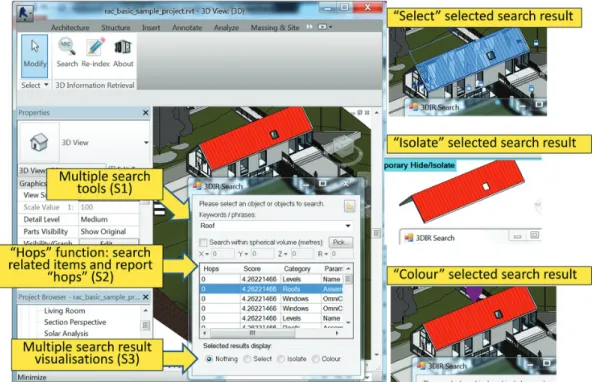
S1: Multiple search modes are needed:
a. Clicking on a single component or collection of components should display all the textual information (whether parameters or external documents) linked to that/those component(s). b. The system should allow the user to filter the search by keyword, by selecting desired 3D
components or by specifying a 3D volume.
S2: “Hops function”: with a single component or collection of components selected, the system should give the user the option of searching or “hopping” outside this selection to related 3D components up to a specified maximum number of hops away. Search results can be ranked by “hops”.
S3: Text search results listing is needed, together with as many visual representations of search results as the API allows:
a. Text listing
b. Retrieved 3D components are “selected”
c. Retrieved 3D components are isolated, i.e. all other components in the model are temporarily rendered invisible
d. Retrieved 3D components are highlighted by insetting a phantom coloured shape above them. The colour of the shape can be used to denote the type of information retrieved (i.e. format of file or type of parameter) and the size of the shape can be used to denote the relevance according to the text retrieval computation.
A prototype was developed under the Autodesk Revit platform. Revit is a common commercial BIM platform and, as noted in Section 3, upon reviewing common BIM platforms, was found to have a powerful API. The source code was writing in C#. The Apache Lucene open source library was used for the text indexing and search functions.
3DIR appears in the add-ins ribbon of the standard Revit interface. The first step when searching a building model using 3DIR for the first time is to “index” the model using that icon on the 3DIR toolbar. This will create an index of all text terms from the 3D object parameters or linked text documents. Once an index has been created, the “Search” tool can be used which brings up the dialogue box shown in Figure 1.
As the user enters keywords in the text box, search results are listed in real time in the dialogue box. In the example shown in Figure 1, the keyword “roof” is entered and search results listed related to the roof of the model. A relevance score is calculated for each search result using texct analysis. The search can be processed either on the whole building model if nothing is selected, or limited to the selected objects. As the object selection in the model changes, the search results are updated dynamically. The user is also able to limit the search to a spherical volume. Selecting a search hit from the list (e.g. the “Roof Assembly” item) will optionally “select” (or highlight) the Revit element containing that search term (i.e. the red roof graphic from the model), “isolate” it (i.e. temporarily hide all other items in the model) or identify the object by displaying a coloured balloon next to it in the model. The size and colour of the balloon can be used to denote various attributes, such as the relevance or type of information. Figure 1 shows an example search for “roof”. The three options for displaying the selected search result(s) appear on the right hand side of the figure.
Figure 1. The 3DIR interface. Left: Screenshots showing the software functions satisfying the specifications (S) which emerged from the user workshops. Right: Various presentations of search results.
4.3. Exploitation of Model Topology in 3DIR
From requirement R2 and corresponding specification S2, the exploitation of topological relationships between objects in a 3D model emerged as a promising avenue for improving information retrieval from BIMs. The 3DIR prototype was extended to exploit such relationships. In order to establish relationships between the 3D building elements in the model, a separate list of other objects
hosting, touching or intersecting (as noted in Section 3) each element in question is saved as a list of “Neighbours”. While indexing, these Neighbours lists are indexed with their respective objects along with the object’s own parameters. For each element, only one list of nearest neighbours is stored, i.e. one “hop” away. Subsequent neighbours, more than one hop away, are retrieved during the search, using a recursive function.
When searching a selected set of objects, the results are shown in the same way as when searching the whole building model. Selected objects containing the search keyword in any of their parameters are shown first in the results table with “Hops” value 0. Next, the list of Neighbours of each of the retrieved objects is also searched. Neighbouring objects containing the required keyword are listed in the results table with “Hops” value 1. The search is repeated recursively on the newly retrieved objects, each time incrementing the “Hops” value. This continues until the maximum number of Hops specified by the user. In this way, objects which are not in direct consideration but are related to the objects of the user’s interest can still be retrieved but with less relevance.
4.4. Results of 3DIR Evaluation
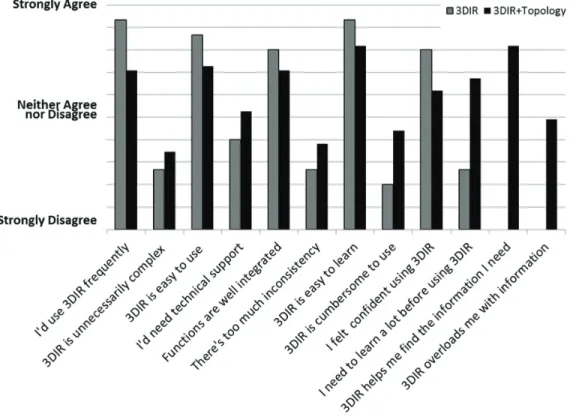
Both the original (3DIR) and modified (3DIR+Topology) versions of 3DIR were evaluated by demonstrating the software to users and recording their feedback using a questionnaire. The samples of test subjects were drawn from different populations. 3DIR was evaluated by professional architects from the 3DIR project industry partners “Architects”, each with over ten years of industrial experience. 3DIR+Topology was evaluated by a sample of postgraduate construction students from Loughborough University (11 students with an average of 1.95 years of industrial experience). The questionnaire was based on the System Usability Scale (SUS Brooke, 1996). Two additional questions were posed for 3DIR+Topology to gauge its recall and performance in averting information overload. The results are shown in Figure 2.
It can be seen from Figure 2 that although 3DIR+Topology was generally well received, without exception the new topology feature caused test subjects to agree less strongly with the positive statements and disagree less strongly with the negative statements. This is most pronounced in the last statement which was posed to users of both tools: “I would need to learn a lot before using 3DIR”. As discussed below, it appears that a major concern for the new functionality is the added complexity it entails.
5. DISCUSSIoN
The results from the 3DIR evaluation demonstrate the promise of this approach. The results from 3DIR+Topology are encouraging but suggest that the added complexity might be difficult for users to grasp. The stronger agreement with statements of the complexity, cumbersomeness and un-learnability may also be a symptom of the speed with which the demonstration was conducted. The software demonstration lasted about twenty minutes, followed by about ten minutes of questions and answers, after which the users were asked to complete the questionnaire. It is also possible that framing the new functionality within the theoretical concept of topology added unnecessary complexity. In the demonstration session, the users used terms such as “widening the search criteria” or “finding related items” when discussing the new functionality.
A possibility that was explored was that the lukewarm assessment of 3DIR+Topology was due to the relative inexperience of the cohort of test subjects. Perhaps more experienced professionals
would see the value of the functionality more clearly. This was investigated but the results showed that the support for the new functionality was roughly constant for all levels of experience.
Although the 3DIR results reaffirm the potential if exploiting 3D data and 3D visualisation, it must be acknowledged that the slightly lower scores of 3DIR+Topology indicate that some rethinking is required about the usefulness of this extra topology functionality. During the workshop following the demonstration, test participants verbally agreed that the functionality was useful, but the SUS (System Usability Scale) questionnaire scores do not strongly support this. This functionality might be a result of “function creep”, whereby the gradual widening use of a technology causes it to be unwieldy in its complexity or causes it eventually to shift away from the use for which it was originally intended. Even if this functionality is indeed useful, an improved interface design is needed to make the functionality more intuitive and facilitate the formation of more helpful mental models of the notion of topology. From discussion with test participants, the list of topological relationships exploited (touching, intersecting and hosting) needs to be expanded, and the interface design needs to convey those more clearly.
Figure 2. A comparison of the evaluation results from the original version of 3DIR and the modified version of 3DIR (3DIR+Topology). The questions are loosely based on the System Usability Scale (Brooke 1996) with three additional Likert questions for the modified version of 3DIR.
6. CoNCLUSIoN
The 3DIR prototype creates an index of all text data attached to a Building Information Model. The user is able to search for information by selecting specific 3D objects, specifying a spherical region of the model and/or entering search keywords. Search results are displayed by highlighting 3D objects in the 3D model, isolating them or indicating them using a coloured balloon shape. The 3DIR+Topology system exploits model topology. At the indexing stage, a separate list of other objects hosting, touching or intersecting each element in question is saved as a list of “neighbours”. When searching a selected set of objects, selected objects containing the search keyword in any of their parameters are shown first in the results. The list of Neighbours of each of the retrieved objects is then recursively searched until the maximum number of Hops specified by the user. In a comparative evaluation of 3DIR and 3DIR+Topology, users of the latter agree less strongly with positive statements and disagree less strongly with negative statements. This indicates that, although still useful, more careful interface design is needed to mitigate the added complexity of this functionality.
This work is distinct in its focus on retrieval of non-geometric information from BIMs, and how 3D computations can support information retrieval. It contrasts with, for example, the work of Daum & Borrmann (2014). They focus on spatial semantics, and particularly topological operators such as Touch, Within and Contains. They go on to propose a Query Language for Building Information Models (QL4BIM) and an efficient set of algorithms for implementing that query language. Aside from BIM, 3DIR is also aligned with some work in the domain of GIS: Ellul & Haklay 2007, Ellul & Haklay 2009, Schneider et al. 2012 The 3D computations employed in those efforts can also be pplied to 3DIR in future work.
The underlying hypothesis of the 3DIR project remains compelling, that a tighter coupling between the 3D model and textual information is helpful for information retrieval. Future research can attempt to evaluate search results from 3DIR and 3DIR+Topology in the more formal information retrieval sense, using formal measurements of recall and precision.
ACKNowLEDGMENT
Our colleague Dr Ann O’Brien was an original member of the 3DIR team and contributed to the original 3DIR work but unfortunately passed away before this paper was written. The 3DIR project was supported by a Brian Mercer Feasibility Award from the Royal Society, with further support from the Enterprise Office at Loughborough University and funding from University’s Higher Education Innovation Fund. Autodesk provided support through membership of the Autodesk Developer Network. 3DIR is available for free from the Autodesk App Store link at http://www.3dir.org/
REFERENCES
Austin, S., Baldwin, A., Li, B., & Waskett, P. (2000). Analytical design planning technique (ADePT): A dependency structure matrix tool to schedule the building design process. Construction Management and Economics, 18(2), 173–182. doi:10.1080/014461900370807
Bohn, R. E., & Short, J. E. (2009). How Much Information?: 2009 Report on American Consumers. University of California. San Diego: Global Information Industry Center.
Borrmann, A., & Rank, E. (2009a). Topological analysis of 3D building models using a spatial query language.
Advanced Engineering Informatics, 23(4), 370–385. doi:10.1016/j.aei.2009.06.001
Borrmann, A., & Rank, E. (2009b). Specification and implementation of directional operators in a 3D spatial query language for building information models. Advanced Engineering Informatics, 23(1), 32–44. doi:10.1016/j. aei.2008.06.005
Brilakis, I. K., & Soibelman, L. (2008). Shape-based retrieval of construction site photographs. Journal of Computing in Civil Engineering, 22(1), 14–20. doi:10.1061/(ASCE)0887-3801(2008)22:1(14)
Brooke, J. (1996). SUS-A quick and dirty usability scale. Usability evaluation in industry, 189(194), 4-7. Caldas, C. H., Soibelman, L., & Han, J. (2002). Automated classification of construction project documents.
Journal of Computing in Civil Engineering, 16(4), 234–243. doi:10.1061/(ASCE)0887-3801(2002)16:4(234) Card, S. K., Mackinlay, J. D., & Shneiderman, B. (Eds.). (1999). Readings in information visualization: using vision to think. Morgan Kaufmann.
Charalambous, G., Thorpe, T., Demian, P., Yeomans, S. G., Doughty, N., & Peters, C. (2013, October 9-12). Collaborative BIM in the Cloud and the Communication tools to support it.Proceedings of the 30th CIB W78 International Conference on Applications of IT in the AEC industry, Beijing, China (pp. 58 – 67).
Christmann, O., Carbonell, N., & Richir, S. (2010). Visual search in dynamic 3D visualisations of unstructured picture collections. Interacting with Computers, 22(5), 399–416. doi:10.1016/j.intcom.2010.02.005
Daum, S., & Borrmann, A. (2014). Processing of topological BIM queries using boundary representation based methods. Advanced Engineering Informatics, 28(4), 272–286. doi:10.1016/j.aei.2014.06.001
Demian, P., & Fruchter, R. (2005). Measuring relevance in support of design reuse from archives of building product models. Journal of Computing in Civil Engineering, 19(2), 119–136. doi:10.1061/(ASCE)0887-3801(2005)19:2(119)
Demian, P., & Walters, D. (2014). The advantages of information management through building information modelling. Construction Management and Economics, 32(12), 1153–1165. doi:10.1080/01446193.2013.777754 Dominich, S. (2008). The modern algebra of information retrieval. Heidelberg: Springer.
Eastman, C., Teicholz, P., Sacks, R., & Liston, K. (2011). BIM Handbook: A Guide to Building Information Modeling for Owners, Managers, Designers, Engineers, and Contractors (2nd ed.). John Wiley & Sons. Eastman, C. M. (1999). Building product models: computer environments, supporting design and construction. CRC press.
Ellul, C., & Haklay, M. (2007). Requirements for Topology in 3D GIS. Transactions in GIS, 10(2), 157–175. doi:10.1111/j.1467-9671.2006.00251.x
Ellul, C., & Haklay, M. M. (2009). Using a B-rep structure to query 9-intersection topological relationships in 3D GIS–reviewing the approach and improving performance. In 3D geo-information sciences (pp. 127–151). Springer Berlin Heidelberg.
Emmitt, S., & Ruikar, K. (2013). Collaborative design management. Routledge. Gemignani, M. C. (1972). Elementary Topology. Courier Corporation. Gray, C., & Hughes, W. (2001). Building design management. Routledge.
Hilbert, M. (2012). Info Capacity| Introduction—How to Measure “How Much Information”? International Journal of Communication, 6, 14.
Koo, B., & Fischer, M. (2000). Feasibility study of 4D CAD in commercial construction. Journal of Construction Engineering and Management, 126(4), 251–260. doi:10.1061/(ASCE)0733-9364(2000)126:4(251)
Kunz, J. C., Christiansen, T. R., Cohen, G. P., Jin, Y., & Levitt, R. E. (1998). The virtual design team.
Communications of the ACM, 41(11), 84–91. doi:10.1145/287831.287844
Lansdale, M., & Edmonds, E. (1992). Using memory for events in the design of personal filing systems.
International Journal of Man-Machine Studies, 36(1), 97–126. doi:10.1016/0020-7373(92)90054-O
Lansdale, M. W. (1988). The psychology of personal information management. Applied Ergonomics, 19(1), 55–66. doi:10.1016/0003-6870(88)90199-8 PMID:15676648
Lansdale, M. W., Scrivener, S. A., & Woodcock, A. (1996). Developing practice with theory in HCI: Applying models of spatial cognition for the design of pictorial databases. International Journal of Human-Computer Studies, 44(6), 777–799. doi:10.1006/ijhc.1996.0033
Leslie, H. G. (1996). Strategy for information in the AEC industry. Proceedings: Bridging the Gap INCIT 96 . Lin, C. J. (2013). Smart Spatial Ontology: Bridging Semantic Ontology to Spatial Topology. Computer-Aided Design and Applications, 10(3), 489–497. doi:10.3722/cadaps.2013.489-497
Lin, K. Y., & Soibelman, L. (2009). Incorporating domain knowledge and information retrieval techniques to develop an architectural/engineering/construction online product search engine. Journal of Computing in Civil Engineering, 23(4), 201–210. doi:10.1061/(ASCE)0887-3801(2009)23:4(201)
Lyman, P., & Varian, H. (2003). How much information 2003?
OED Online. (2016). Oxford University Press. Retrieved from http://www.oed.com/view/Entry/203426?redir ectedFrom=topology
Paul, N. (2009). Basic topological notions and their relation to BIM. In Handbook of Research on Building Information Modeling and Construction Informatics: Concepts and Technologies (pp. 451-472).
Pirolli, P., & Card, S. (1999). Information foraging. Psychological Review, 106(4), 643–675. doi:10.1037/0033-295X.106.4.643
Rezgui, Y. (2006). Ontology-centered knowledge management using information retrieval techniques. Journal of Computing in Civil Engineering, 20(4), 261–270. doi:10.1061/(ASCE)0887-3801(2006)20:4(261)
Robertson, G., Czerwinski, M., Larson, K., Robbins, D. C., Thiel, D., & Van Dantzich, M. (1998). Data mountain: using spatial memory for document management.Proceedings of the 11th annual ACM symposium on User interface software and technology (pp. 153-162). ACM. doi:10.1145/288392.288596
Rosson, M. B., & Carroll, J. M. (2001). Usability engineering: scenario-based development of human-computer interaction. Elsevier.
Schneider, M., Chen, T., Viswanathan, G., & Yuan, W. (2012). Cardinal directions between complex regions.
ACM Transactions on Database Systems, 37(2), 8. doi:10.1145/2188349.2188350
Shaaban, S., Lockley, S., & Elkadi, H. (2001). Information visualisation for the architectural practice. Proceedings of the Fifth International ConferenceInformation Visualisation ‘01 (pp. 43-50). IEEE.
Ugwu, O. O. (2005). A service-oriented framework for sustainability appraisal and knowledge management.
International Journal of IT-Construction ITCon, 10, 245–263.
Veeramani, D., & Russell, J. (2000). Preparing the AEC industry for the knowledge economy.In Berkeley-Stanford Construction Engineering and Management Workshop. Defining a Research Agenda for AEC Process/Product Development in 2000 and Beyond.
Wu, I. C., & Hsieh, S. H. (2012). A framework for facilitating multi-dimensional information integration, management and visualization in engineering projects. Automation in Construction, 23, 71–86. doi:10.1016/j. autcon.2011.12.010
Please recommend this Publication to your librarian For a convenient easy-to-use library recommendation form, please visit: http://www.igi-global.com/IJ3DIM
Volume 5 • Issue 1 • January-March 2016 • ISSN: 2156-1710 • eISSN: 2156-1702 An official publication of the Information Resources Management Association
all inquiries regarding iJ3dim should be directed to the attention of:
Umit Isikdag, Editor-in-Chief • [email protected]
all manuscriPt submissions to iJ3dim should be sent through the online submission system:
http://www.igi-global.com/authorseditors/titlesubmission/newproject.aspx
3D augmented and virtual reality • 3D data collection and reconstruction • 3D GIS standards • 3D interoperability • 3D spatial analysis • 3D spatial information infrastructures • 3D static and dynamic network models • 3D to nD spatial information modeling • 3D/4D visualization and visual analytics • BIM based 4/5/nD modeling and management • BIM based collaborative working • BIM based facilities/asset management • BIM based visualization/simulation/augmented reality • BIM in site automation • BIM maturity/readiness/adoption • BIM standards • Building Information Modeling and Management (BIM) • Disaster Management • Environmental Management • Geo-coding and 3D location based services • Integrated project delivery • Location based scheduling • Management of large 3D datasets • Multi-source and multi-domain 3D data integration • Ontology/ schema/service level integration • Serious Games • Spatial DBMS • Training and education on BIM • Urban planning, management and renewal • Web semantics and knowledge engineering
Coverage and major topiCs
The topics of interest in this journal include, but are not limited to:
The mission of the International Journal of 3-D Information Modeling (IJ3DIM) is to provide a comprehensive and collective body of knowledge in the domains of Building Information Modeling (BIM) and 3D Geographical/ Geospatial Information Models & Systems (3D GIS). The journal stimulates the sharing of knowledge, research approaches and practical experience in domains related to BIM, 3D GIS and Urban Information Fusion and combines the worlds of BIM and GIS toward integrated management and re-use of “3D semantically rich information”. IJ3DIM encourages developments in BIM, 3D GIS, City Modeling (including Indoor Modeling). IJ3DIM focuses on both advanced technologies and soft aspects, including human, process, organizational, industrial level problems, relating to BIM, 3D GIS and Urban Information Fusion. The journal also facilitates the sharing of scientific knowledge related to the development of indoor applications, such as indoor navigation, evacuation, facility management, intelligent buildings, and sustainable buildings.
mission
IDeas For specIal TheMe Issues May be subMITTeD To The eDITor(s)-In-chIeF