Potato Classification Using Deep Learning
Abeer A. Elsharif, Ibtesam M. Dheir, Alaa Soliman Abu Mettleq , Samy S. Abu-NaserDepartment Information Technology, Faculty of Engineering and Information Technology,
Al-Azhar University, Gaza, Palestine
Abstract: Potatoes are edible tubers, available worldwide and all year long. They are relatively cheap to grow, rich in nutrients, and they can make a delicious treat. The humble potato has fallen in popularity in recent years, due to the interest in low-carb foods. However, the fiber, vitamins, minerals, and phytochemicals it provides can help ward off disease and benefit human health. They are an important staple food in many countries around the world. There are an estimated 200 varieties of potatoes, which can be classified into a number of categories based on the cooked texture and ingredient functionality. Using a public dataset of 2400 images of potatoes, we trained a deep convolutional neural network to identify 4 types (Red, Red Washed, Sweet, and White).The trained model achieved an accuracy of 99.5% of test set, demonstrating the feasibility of this approach.
1. INTRODUCTION
Potato, annual plant in the nightshade family (Solanaceae), grown for its starchy edible tubers. The potato is native to the Peruvian-Bolivian Andes and is one of the world’s main food crops. Potatoes are frequently served whole or mashed as a cooked vegetable and are also ground into potato flour, used in baking and as a thickener for sauces. The tubers are highly digestible and supply vitamin C, protein, thiamin, and niacin. [1]
Benefits
A high intake of fruits and vegetables can benefit health and reduce the risk of many lifestyle-related health conditions. Potatoes contain important nutrients, even when cooked, which can benefit human health in various ways.
1) Bone health
The iron, phosphorous, calcium, magnesium, and zinc in potatoes all help the body to build and maintain bone structure and strength.
2) Blood pressure
A low sodium intake is essential for maintaining a healthy blood pressure, but increasing potassium intake may be just as important. Potassium encourages vasodilation, or the widening of the blood vessels.
3) Heart health
The potato's fiber, potassium, vitamin C, and vitamin B6 content, coupled with its lack of cholesterol, all support heart health. Potatoes contain significant amounts of fiber. Fiber helps lower the total amount of cholesterol in the blood, thereby decreasing the risk of heart disease.
4) Inflammation
Choline is an important and versatile nutrient that is present in potatoes. It helps with muscle movement, mood, learning, and memory.
Potatoes contain folate. Folate plays a role in DNA synthesis and repair, and so it prevents many types of cancer cells from forming due to mutations in the DNA.
6) Digestion and regularity
The fiber content in potatoes helps prevent constipation and promote regularity for a healthy digestive tract. 7) Weight management and satiety
Dietary fibers are commonly recognized as important factors in weight management and weight loss. 8) Metabolism
Potatoes are a great source of vitamin B6. This plays a vital role in energy metabolism, by breaking down carbohydrates and proteins into glucose and amino acids. These smaller compounds are more easily utilized for energy within the body.
9) Skin
Collagen is the skin's support system. Vitamin C works as an antioxidant to help prevent damage caused by the sun, pollution, and smoke. Vitamin C also helps collagen smooth wrinkles and improve overall skin texture. 10) Immunity
Research has found that vitamin C may help reduce trusted Source the severity and duration of a cold. Potatoes are a good source of vitamin C. [1]
There are more than 200 varieties of potatoes sold throughout the United States. Each of these varieties fit into one of thirteen potato type categories: Russet (Burbank), White Washed, Red/Pink Washed, Chat (Baby), Cocktail, Desiree, Yukon Gold, Purple, Medley, Fingerling, Kipfler, Japanese Sweet Potato, and Sweet Potato.[2]
1. Russet (Burbank)
Russet or Burbank potato is the classic ruddy-skinned potato. The flesh is very dry and the skin is thick, making it ideal for baking it up to be crisp on the outside and fluffy on the inside. The best potato for French fries, Russet has a very pleasantly bland flavour, which carries other flavours beautifully. [3]
2. White Washed
With its golden skin and creamy fluffy white flesh, white wash potato makes the perfect all-rounder, they are excellent steamed, fried, baked, boiled or roasted. Smooth and creamy, their delicate, thin skins add just the right amount of texture to any dish without the need for peeling. A classic salad potato with a good source of vitamin B6 and is fat and cholesterol free.
3. Red/Pink Washed
Red or pink washed potatoes are a salad variety, with a firm flesh and thin blush red skin. They have a firm, smooth, solid texture that stand up well to boiling, making them perfect for stews and sliced or diced in salads. Consume
them whole as many of the nutrients are found in the skin
4. Chat (Baby)
With a creamy skin and light yellow flesh, chat or baby potatoes are relatively small potatoes. They are light fresh flavored which tastes great either hot or cold. Soft and fluffy textured, they are ideal for steaming, boiling or whole roasted and are can be eaten hot or cold with their skins on. Chat potatoes are a good source of Vitamin C, potassium and dietary fiber.
5. Cocktail
Cocktail potatoes are not a variety but refer to the size. Generally a smaller sized Chat or white washed potato, they similarly have white flesh and yellowish skin. Extremely easy to use as they do not require peeling or cutting before use and cooks in half the time.
6. Desiree
Desiree potatoes have a firm, creamy tasting flesh making them ideal for smooth mash or being cooked in a sauce. They are easily recognizable by their lovely red skin and light yellow flesh. Desiree are normally larger, longer and oval shape.
Yukon Gold
Yukon Gold has an attractive smooth yellow skin with a very yellow flesh. It makes a great baking potato but also a lovely roast or chip potato recipe.
7. Purple
A specialist heritage potato variety with an indigo blue skin and purplish blue flesh. They have a delicate sweet flavor, a slightly fluffy flesh and work well in savory dishes. To retain the color, it is best to keep the skin on.
8. Medley
There are an estimated 200 varieties of USA grown potatoes which can be classified into a number of categories based on the cooked texture and ingredient functionality. The medley potato is a good mix of yellow, red or pink and purple skin varieties which allows for endless culinary
9. Fingerling
Fingerling potato has a firm texture and knobbly appearance with a slight nutty flavor. It can be enjoyed boiled, roasted or steamed, either hot or cold in salads but also tastes delicious roasted. It mixes well into vegetarian dishes and with green leafy vegetables.
10. Kipfler
Kipfler potatoes are small to medium in size with an elongated, narrow, finger-like shape. Fluffy almost creamy in texture with a nutty, creamy flavor, Kipflers are best suited for baking, roasting or boiling and not so ideal for frying or mashing. They make excellent wedges and as a salad potato as they hold their shape well when cooked.
11. Japanese Sweet Potato
Kanta-kun is a Japanese sweet potato variety from Oita prefecture. Similar in appearance to other Japanese sweet potatoes, it has a deep pinkish purple skin and is fairly firm inside. Its shape varies from rounder and fatter in the center to elongated. Its whitish flesh turns golden when baked and is 1.5 times sweeter than a normal sweet potato. Best steamed or baked whole with skin on and served piping
hot. Kanta-kun require no seasoning and is deliciously sweet and fibreless as is. Sweet Potato
Sweet potato also known as yam has two commercial varieties, Garnet and Jewel. A deep orange, almost copper interior encased in a light brown skin. When cooked, it has a mildly sweet taste and maintains its firm texture, but falls apart easily when taken apart.
2. RELATED WORK
Computer vision and machine learning techniques have been applied to different disease detection or classification of different types of vegetables and fruits such as tomatoes, grapes, potatoes, banana, and cotton. In Bolle et al. [4] authors proposed a system to classify fruits and vegetables in grocery and supermarkets stores. In Noordam et al. [5], a method for grading potatoes by size, shape and various defects was introduced. A banana segmentation method was proposed in (Hu et al., 2014). The segmentation of the banana from the background and the detection of damaged lesions were made by two k-means clustering algorithms [6]. Bouaziz et al. proposed a deep learning-based approach that automates the process of classifying banana leaves diseases. [7]
3. METHODOLOGY
Deep learning is a machine learning technique that teaches computers to do what comes naturally to humans: learn by example.
In deep learning, a computer model learns to perform classification tasks directly from images, text, or sound. Deep learning models can achieve state-of-the-art accuracy, sometimes exceeding human-level performance.
Models are trained by using a large set of labeled data and neural network architectures that contain many layers. [8]
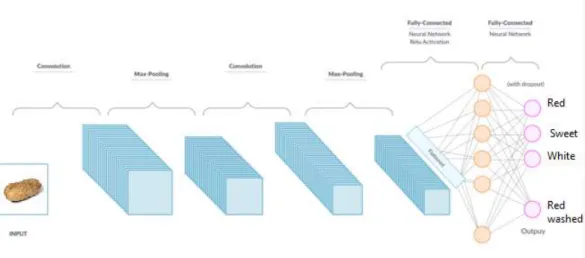
Fully connected layers are an essential component of Convolutional Neural Networks (CNNs), which have been proven very successful in recognizing and classifying images for computer vision. The CNN process begins with convolution and pooling, breaking down the image into features, and analyzing them independently. The result of this process feeds into a fully connected neural network structure that drives the final classification decision. [9]
CNN Architecture:
Types of Layers Convolutional Neural Networks:
Figure 1: CNN Architecture
Convolutional layer: a “filter” passes over the image, scanning a few pixels at a time and creating a feature map that predicts the class to which each feature belongs.
Pooling layer (downsampling): reduces the amount of information in each feature obtained in the convolutional layer while maintaining the most important information (there are usually several rounds of convolution and pooling).
Fully connected input layer (flatten): takes the output of the previous layers, “flattens” them and turns them into a single vector that can be an input for the next stage.
The first fully connected layer: takes the inputs from the feature analysis and applies weights to predict the correct label.
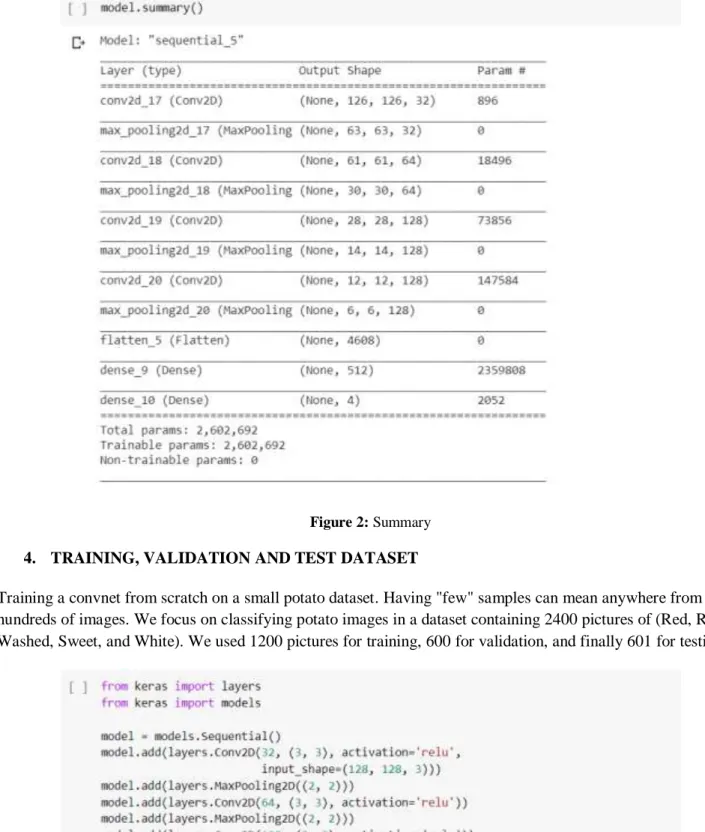
Figure 2: Summary
4. TRAINING, VALIDATION AND TEST DATASET
Training a convnet from scratch on a small potato dataset. Having "few" samples can mean anywhere from a few hundreds of images. We focus on classifying potato images in a dataset containing 2400 pictures of (Red, Red Washed, Sweet, and White). We used 1200 pictures for training, 600 for validation, and finally 601 for testing.
Figure 3: CNN model
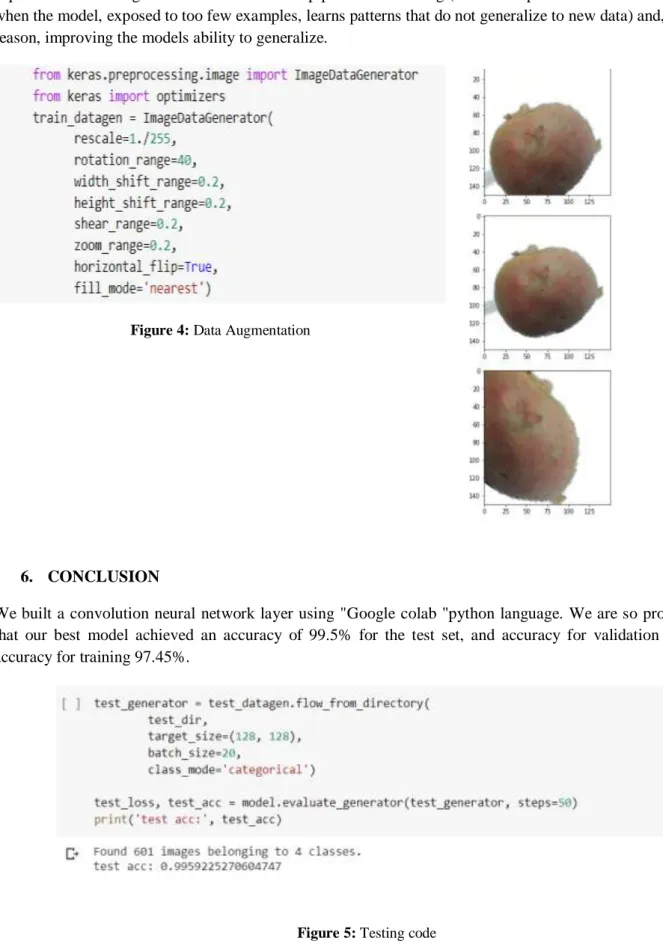
We augmented the data via a number of random transformations. The selected data augmentation techniques were: size re-scaling, rotations of 40, horizontal shift, image zooming, and horizontal flipping. Furthermore, it is expected that data augmentation should also help prevent overfitting (a common problem with small datasets, when the model, exposed to too few examples, learns patterns that do not generalize to new data) and, for this reason, improving the models ability to generalize.
Figure 4: Data Augmentation
6. CONCLUSION
We built a convolution neural network layer using "Google colab "python language. We are so proud to show that our best model achieved an accuracy of 99.5% for the test set, and accuracy for validation 100%, and accuracy for training 97.45%.
REFERENCES
1. https://www.britannica.com/plant/potato
2. https://www.potatogoodness.com/potato-types/
3. https://euro-atlantic.com.my/products/potatoes/
4. Bolle, R. M., Connell, J. H., Haas, N., Mohan, R., and Taubin, G. (1996). Veggievision: A produce recognition , system. In Applications of Computer Vision, 1996. WACV’96., Proceedings 3rd IEEE Workshop on, pages , 244– 251. IEEE.
5. Noordam, J. C., Otten, G. W., Timmermans, T. J., and van Zwol, B. H. (2000). High-speed potato grading and quality inspection based on a color vision system. In Machine Vision Applications in Industrial Inspection VIII, volume 3966, pages 206–218. International Society for Optics and Photonics.
6. Hu, M.-h., Dong, Q.-l., Liu, B.-l., and Malakar, P. K. (2014). The potential of double k-means clustering for banana image segmentation. Journal of Food Process Engineering, 37(1):10–18.
7. B. Mitschang et al. (Hrsg.): BTW 2017 – Workshopband, Lecture Notes in Informatics (LNI), Gesellschaft für Informatik, Bonn 2017 79 A Deep Learning-based Approach for Banana Leaf Diseases Classification Jihen Amara,1 Bassem Bouaziz,2 and Alsayed Algergawy
8. https://www.mathworks.com/discovery/deep-learning.html
9. https://missinglink.ai/guides/convolutional-neural-networks/fully-connected-layers-convolutional-neural-networks-complete-guide/