Durham Research Online
Deposited in DRO:
04 May 2017
Version of attached le:
Published Version
Peer-review status of attached le:
Peer-reviewed
Citation for published item:
Esperanca, P. M. and Aslett, L. J. M. and Holmes, C. C. (2017) 'Encrypted accelerated least squares regression.', in Proceedings of the 20th International Conference on Articial Intelligence and Statistics, PMLR 54. Fort Lauderdale, FL, USA: PMLR, pp. 334-343. Proceedings of machine learning research., 54
Further information on publisher's website:
http://proceedings.mlr.press/v54/esperanca17a/esperanca17a.pdfPublisher's copyright statement:
Copyright 2017 by the author(s).
Additional information:
Use policy
The full-text may be used and/or reproduced, and given to third parties in any format or medium, without prior permission or charge, for personal research or study, educational, or not-for-prot purposes provided that:
• a full bibliographic reference is made to the original source
• alinkis made to the metadata record in DRO
• the full-text is not changed in any way
The full-text must not be sold in any format or medium without the formal permission of the copyright holders. Please consult thefull DRO policyfor further details.
Durham University Library, Stockton Road, Durham DH1 3LY, United Kingdom Tel : +44 (0)191 334 3042 | Fax : +44 (0)191 334 2971
Encrypted accelerated least squares regression
Pedro M. Esperan¸ca Louis J. M. Aslett Chris C. Holmes
Department of Statistics University of Oxford Department of Statistics University of Oxford Department of Statistics University of Oxford
Abstract
Information that is stored in an encrypted format is, by definition, usually not amenable to statistical analysis or machine learning methods. In this paper we present detailed analysis of coordinate and accelerated gra-dient descent algorithms which are capable of fitting least squares and penalised ridge regression models, using data encrypted un-der a fully homomorphic encryption scheme. Gradient descent is shown to dominate in terms of encrypted computational speed, and theoretical results are proven to give param-eter bounds which ensure correctness of
de-cryption. The characteristics of encrypted
computation are empirically shown to favour a non-standard acceleration technique. This demonstrates the possibility of approximat-ing conventional statistical regression meth-ods using encrypted data without compro-mising privacy.
1
Introduction
Issues surrounding data security and privacy of per-sonal information are of growing concern to the pub-lic, governments and commercial sectors. Privacy con-cerns can erode confidence in the ability of organisa-tions to store data securely, with a consequence that individuals may be reticent to contribute their per-sonal information to scientific studies or to commercial organisations (Sanderson et al., 2015; Naveed et al., 2015; Gymrek et al., 2013).
In this paper we demonstrate that statistical regres-sion methods can be applied directly to encrypted
data without compromising privacy. Our work
in-Proceedings of the 20thInternational Conference on
Artifi-cial Intelligence and Statistics (AISTATS) 2017, Fort Laud-erdale, Florida, USA. JMLR: W&CP volume 54. Copy-right 2017 by the author(s).
volves adapting existing methodology for regression analysis in such a way as to enable full computa-tion within the mathematical and computacomputa-tional con-straints of recently developed fully homomorphic en-cryption schemes (Gentry, 2010; Fan and Vercauteren, 2012). We show empirically that traditional state-of-the-art convergence acceleration techniques can under-perform when such constraints are taken into account. Fully homomorphic encryption (FHE) differs from dif-ferential privacy (DP) in that it provides for exact computation with cryptographically strong privacy of all the data during the fitting process itself, at the ex-pense of much greater restrictions on the operations and computational cost (Gentry, 2010; Aslett et al., 2015a). However, it is complementary to DP (as op-posed to competing with it) in the sense that FHE
maintains privacyduringmodel fitting and prediction,
while DP can ensure privacy post-processing of the data if the model itself is to be made public. For an overview of DP see Dwork and Roth (2014).
FHE allows for secure operations to be performed on data, and statistical analysis and machine learning is the major reason why people want to perform mathe-matical operations on data. Thus, there is a real op-portunity for machine learning scientists to be involved in shaping the research agenda in FHE (United States EOP, 2014). The applications of encrypted statistics and machine learning include general purpose cloud computing when privacy concerns exist, and are espe-cially important in e-health and clinical decision sup-port (Basilakis et al., 2015; McLaren et al., 2016).
§2 is a brief accessible introduction to FHE and §3
recaps regression to fix notation and our method of representing data prior to encryption. A detailed ex-amination of coordinate and gradient descent
meth-ods in an encrypted context follows in §4, including
encrypted scaling for correctness, computational con-siderations, prediction, inference, regularisation and theoretical proofs for parameters in a popular FHE
scheme. §5 discusses acceleration methods optimal for
encrypted computation, with examples provided in§6
2
Homomorphic encryption
A common technique for ensuring the privacy of data is to encrypt it, but typically once one wishes to fit a model it is necessary to first decrypt and risk exposing the data. However, recent advances in cryptography enable a very limited amount of computation to be performed directly on the encrypted content, rendering the correct result upon decryption.
2.1 Standard cryptography
A public key encryption scheme is one which has two
algorithms, Enc(·,·) and Dec(·,·), to perform
encryp-tion and decrypencryp-tion respectively, together with two
keys: the public key,kp, can be widely distributed and
used by anyone to encrypt a message; the secret key,
ks, is required to decrypt any message encrypted using
kpand so is kept private. The fundamental identity is:
Dec(ks,Enc(kp, m)) =m ∀m.
The data to be encrypted,m, is referred to as the
mes-sage orplaintext and after encryption is referred to as theciphertext. In conventional encryption algorithms manipulation of the ciphertext does not typically lead to meaningful modification of the message.
2.2 Fully Homomorphic encryption
An encryption scheme is said to befully homomorphic
if it also possesses two operations, ⊕ and ⊗, which
satisfy the following identities:
Dec(ks,Enc(kp, m1)⊕Enc(kp, m2)) =m1+m2
Dec(ks,Enc(kp, m1)⊗Enc(kp, m2)) =m1×m2
for allm1, m2, which can be applied a theoretically
ar-bitrary number of times. In other words, a homomor-phic encryption scheme allows computation directly on ciphertexts which will correctly decrypt the result as if the corresponding operations had been applied to the original messages.
However there are many constraints in practical im-plementation, reviewed in Aslett et al. (2015a). For the purposes of this work they may be synopsised as:
• Typically m can only easily represent binary or
integers.
• Data size grows substantially after encryption.
• The computational cost of ⊕and ⊗is orders of
magnitude higher than standard + and×.
• Operations such as comparisons (==, <, >) and
division (÷) are not possible.
• Implementation of current schemes necessitate a
highly computationally expensive ‘bootstrap’ op-eration (unrelated to statistical bootstrap) which
must be applied frequently between⊗operations
to control the noise in the ciphertext.
Consequently, a crucial property of any FHE scheme
is the multiplicative depth1 which is possible before
a ‘bootstrap’ is required. Typically, one can select
the parameters of the FHE scheme to support a pre-specified multiplicative depth, but this is a trade-off because parameters supporting greater depth between ‘bootstraps’ also result in larger ciphertexts and slower
homomorphic operations (⊕,⊗). Therefore, it is
es-sential to consider theMaximum Multiplicative Depth
(MMD) required to evaluate an algorithm encrypted, since this dramatically affects speed and memory us-age. Indeed, cryptographic parameters are typically chosen to match the MMD of the target algorithm be-ing run so as to avoid ‘bootstrap’ altogether (which is simply deemed too computationally costly).
The above constraints often mean that standard sta-tistical methodology cannot be applied unmodified on encrypted content.
2.3 Privacy preserving statistics
There has been some work towards using FHE schemes
for statistics and machine learning. Often this has
involved identifying existing algorithms which can be run with minimal modifications (Wu and Haven, 2012; Graepel et al., 2013), or fitted on unencrypted data for later prediction on new encrypted data (Dowlin et al., 2016). However, some recent work has also begun on developing new methodology inspired by traditional techniques, specifically tailored to homomorphic com-putation so that the whole analysis — model fitting and prediction — can be computed encrypted (Aslett et al., 2015b).
In particular, the topic of linear regression in the con-text of FHE has not been covered systematically in
the literature thus far. Hall et al. (2011) propose
protocols for regression analysis which involve sub-stantial communication and intermediate decryption between multiple parties: it takes two days to
com-plete a problem of size N = 51,016 observations and
P = 23 predictors. In this work, we want to develop
methods capable of fitting and prediction without any intermediate communication or decryption. Wu and Haven (2012) were the first to tackle linear regression in the context of FHE by using Cramer’s rule for ma-trix inversion. Unfortunately, this approach calls for
the computation of the determinant of XTX, which
1Having only addition and multiplication operations
mean all computations form polynomials. Simply put, the multiplicative depth corresponds to the degree of the maximal degree term of the polynomial minus one. e.g.,
PP
j=1ajbj has depth 1 and
QP
Pedro M. Esperan¸ca, Louis J. M. Aslett, Chris C. Holmes
quickly becomes intractable for even low dimensional
problems (e.g.,P >4). Specifically, the multiplicative
depth is unbounded with growing dimension and, con-sequently, bootstrapping seems unavoidable. Graepel et al. (2013) mention that regression can be done by gradient descent, but do not implement the method or give further details.
The approach we present in this work enjoys several notable properties: (i) estimation and prediction can both be performed in the encrypted domain; (ii) boot-strapping can be avoided even for moderately large problems, (iii) scales linearly with the number of
pre-dictors; (iv) and admits the option ofL2(ridge)
regu-larisation.
3
The linear regression model
The standard linear regression model assumes
y=Xβ+ε, ε∼ N(0N, σ
2I
N N) (1)
whereyis a response vector of lengthN;Xis a design
matrix of sizeN×P;βis a parameter vector of length
P; and ε is a vector of length N of independent and
Normally distributed errors with zero mean and
con-stant variance σ2. Provided that XTX is invertible,
the ordinary least squares (OLS) solution to min
β ||y−Xβ||
2
2 (2)
is βˆols= (XTX)−1XTy. (3)
Regularisation techniques trade the unbiasedness of OLS for smaller parameter variance by adding a
con-straint of the formPP
j=1|βj|
γ ≤c, for someγ(Hastie
et al., 2009). Bounding the norm of the parameter vector imposes a penalty for complexity, resulting in shrinkage of the regression coefficients towards zero.
We focus onL2regularisation (ridge, henceforth RLS;
Hoerl and Kennard, 1970), where γ = 2. Other
op-tions are available, although no one method seems to dominate the others (Zou and Hastie, 2005; Tibshi-rani, 1996; Fu, 1998). The standard solution to the regularised problem min β ||y−Xβ||2 2+α||β|| 2 2 (4) is βˆrls(α) = (XTX+αIP P) −1XTy (5)
revealing that α is also key in converting
ill-conditioned problems into well-ill-conditioned ones (Ho-erl and Kennard, 1970).
3.1 Data representation and encoding
Because FHE schemes can only naturally encrypt rep-resentations of integers, dealing with non-integer data
requires a special encoding. We use the transformation ˙
z ≡ b10φze ∈Z, for z ∈Rand φ∈N. Here, φ
repre-sents the desired level of accuracy or, more precisely, the number of decimal places to be retained. By
con-struction, ˙z≈10φz, so that smooth relative distances
between elements encoded in this way are
approxi-mately preserved. The encoding can accommodate
both discrete (integer-valued) data and an approxima-tion to continuous (real-valued) data. Throughout, we assume that covariates are standardised and responses centred before integer encoding and encryption.
4
Least squares via descent methods
Conventional solutions to (3) and (5) can be found in closed form using standard matrix inversion techniques
with runtime complexity O(P3) for the matrix
inver-sion andO(N P2) for the matrix product. This direct
approach was the one advocated for encrypted regres-sion by Wu and Haven (2012), though dimenregres-sionality is constrained by school-book matrix inversion to en-able homomorphic computation.
4.1 Iterative methods
We analyse two variants of an iterative algorithm, one
which updates all parameters in β[k] simultaneously
at each iteration k, using the vectorβ[k−1] (
ELS-GD);
and another which updates these parameters
sequen-tially, using always the most current estimate for each
parameter (ELS-CD).
The sequential update mode is related to the Gauss– Seidel method (coordinate descent), while the simul-taneous update mode is related to the Jacobi method
(gradient descent). See Varga (2000, chapter 3);
Bj¨orck (1996, chapter 7).
As we will see below, there are two competing con-cerns here: optimisation efficiency and computational tractability within the cryptographic constraints, with these two types of updates having different properties. We demonstrate that the properties of these methods in the encrypted domain means some standard opti-mality results no longer apply.
4.1.1 Sequential updates via coordinate descent
Standard coordinate descent (see e.g. Wright, 2015) for linear regression has the update:
βj[k] k =β [k−1] jk + XT •jk(y−Xβ old) XT •jkX•jk (6)
where βold contains the components updated on the
being many variants for the schedule of coordinates
to update. However, this cannot be computed
en-crypted because the required data-dependent division is not feasible. In an alternative variant we can replace
this with a generic step-size δ and at each iteration
k choose one variable, say jk ∈N1:P, and update the
corresponding regression parameter:
βjk[k]=βjk[k−1]+δX•Tjk(y−Xβ
old) (7)
Two things are noteworthy: first, these equations re-quire only evaluation of polynomials; and second, a rescaling is necessary since only integer polynomial functions can be computed homomorphically, and the
parameterδis usually not an integer. We show how to
perform this type of rescaling in the context of§4.1.2.
Encrypted computation As each update uses the most recent estimate of every parameter, the MMD grows by 2 with each parameter update (due to the
term XT
•jkXβ
old). This implies that forK iterations
over P covariates the MMD is equal to 2KP. This
renders the algorithm very expensive computationally, as it requires bootstrapping of ciphertexts for problems
with even moderately largeP.
4.1.2 Simultaneous updates via gradient descent
In the case of gradient descent, for the objective
func-tion S(β) =||y−Xβ||2
2 with ∇S(β) = ∂S(β)/∂β=
−2XT(y−Xβ), the update equations are:
β[k]=β[k−1]−δ∇S(β[k−1]) (8)
=β[k−1]+δXT(y−Xβ[k−1]). (9)
As with coordinate descent, these updates can be com-puted homomorphically, although the update equa-tions must again be rescaled. This is strictly neces-sary to accommodate the transformed data, in order
to overcome the fact that we cannot divide (see §3.1).
Lettingδ≡1/ν forν∈N, the transformed equations
for the simultaneous updates are: ˜
β[k]≡10φ˜νβ˜[k−1]+ ˜XT(10kφν˜k−1y˜−X˜β˜[k−1])
= 10(2k+1)φνkβ[k] (10)
where now all transformed variables are represented
with tildes, e.g., ˜X= 10φXand similarly for the other
variables, except the coefficients{β[k]}
k∈N0:K as their
scaling is iteration dependent (see supplementary
ma-terials, §1). The rescaling factors are independent of
the data and known a priori, and so can be grouped
during computation, e.g., 10kφν˜k−1in (10) can be
en-crypted as a single value.
Retrieval of the coefficients can be done by
the secret key holder by computing β[K] ←
Dec(ks,β˜[K])/(10(2K+1)φνK). Note the important dif-ference between coordinate and gradient descent: for
K iterations, in CD each coefficient is updated K/P
times while in GD each coefficient is updatedKtimes.
Encrypted computation There is a crucial differ-ence between CD and GD in the encrypted domain:
GD reduces the multiplicative depth from 2KP to
2K, which is independent of P, enabling scalability
to higher dimensional models without bootstrapping or having to select parameters which support greater
MMD. As discussed in§2.2, bootstrapping in current
FHE schemes is to be avoided wherever possible
be-cause it is very computationally expensive. This is
an interesting and important result, because it means that in the specific setting of encrypted computation, Nesterov’s faster rates of convergence (Nesterov, 2012) compared to gradient descent in a randomised coordi-nate descent setting will not apply, as we will show. For these computational reasons we focus primarily on gradient descent hereinafter. For convergence in a regression setting recall:
Lemma 1 (Convergence of ELS-GD). Defineβ[k+1]≡
β[k] +δXT(y−Xβ[k]) and let β[0] ≡ 0
P. Then,
limk→∞β[k] = (XTX)−1XTy = βˆols for δ ∈
(0,2/S(XTX))whereS(XTX)is the spectral radius of XTX.
The optimal choice of step size, in the sense that it
minimises the spectral radius, isδ?= 2/(λmax+λmin),
implying an optimal spectral radius S? = (λmax −
λmin)/(λmax+λmin), whereλmaxandλmindenote the
largest and smallest eigenvalues ofXTX, respectively
(see Ryaben’kii and Tsynkov, 2006, Theorem 6.3 for all proofs).
Lemma 2 (Oscillatory nature ofELS-GD). The itera-tive process (8)can be written as an oscillating sum:
β[k] = k X n=1 (−1)n+1 k k−n δn(XTX)n−1XTy (11)
This lemma is proved in the supplementary materials
(§3). We show in§5.2 that it is possible to improve the
convergence rate by using acceleration methods that exploit the oscillatory nature of the GD algorithm to
accelerate the convergence of the series {β[k]}
k≥0.
4.2 Prediction
Note that the form of the GD equation (10) implies
a common scaling factor, 10(2k+1)φνK, for all
parame-ters. Performing encrypted prediction is then straight-forward as it requires only the computation of the
dot product ˜yi = ˜XiT•β˜
[K] = 10(2K+1)φνKyˆ
Pedro M. Esperan¸ca, Louis J. M. Aslett, Chris C. Holmes
ˆ
yi=XiT•β
[K]denotes the predicted values in the space
of the original data and ˜yi denotes the corresponding
transformed version. Upon decryption, rescaling can be done as before by the secret key holder. The pro-cedure increases the MMD of the algorithm by 1. The situation is more complex for coordinate descent since at the end of the final iteration each element of
β[K] will have different scaling. Therefore the scaling
must be unified before prediction, adding additional overhead.
4.3 Inference
Inference in the linear regression model (e.g., confi-dence intervals, hypothesis testing, variable selection) requires knowledge of the standard errors of the re-gression coefficients:
V[ ˆβols] = ˆσ2(XTX)−1, σˆ2=eTe/(N−P). (12)
However, the matrix inversion is intractable under
ho-momorphic computation except for very small P. An
alternative is to estimate the standard errors by boot-strapping the data and using the variability in the pa-rameter estimates obtained.
4.4 Regularisation
L2-regularised (ridge) least squares is easy to
imple-ment using the well known data augimple-mentation proce-dure (Allen, 1974): ˚ X= X √ αIP P and ˚y= y 0P . (13)
OLS estimates when using the augmented data,
( ˚X,˚y), are equivalent to RLS estimates when using
the original data, (X,y); that is,
ˆ
βrls(α) = ( ˚XTX˚)−1X˚T˚y= (XTX+αIP P)
−1XTy. (14)
Because the augmentation terms (√αIP P and 0P) are
independent of the data (Xandy), the iterative
meth-ods already developed for least squares (§4.1) can be
used with the augmented data. Also note that the
maximal eigenvalue is easily updated, ˚λmax=λmax+α
and so a new step size ˚δ can be chosen without
addi-tional computation.
4.5 Theoretical parameter requirements for the Fan and Vercauteren scheme
We provide results to guide the choice of crypto-graphic parameters for the encryption scheme of Fan and Vercauteren (2012) — hereinafter FV. This is
im-plemented in theHomomorphicEncryptionR package
(Aslett et al., 2015a) and used in the examples.
FV represents data as a polynomial of fixed degree
with coefficients in a finite integer ring.2 For
exam-ple, m is represented by ˚m(x) =Pa
ixi where ai are
the binary decomposition ofm, such that ˚m(2) =m.
Addition and multiplication operations on the cipher-text result in polynomial addition and multiplication on this representation.
The transformed regression coefficients grow substan-tially during computation, so that we must ensure (i) the maximal degree of the FV message polynomial is
large enough to decrypt ˜β[K]; and (ii) that the
coeffi-cient ring is large enough to accommodate the worst case growth in coefficients.
Lemma 3 (FV parameter requirements for GD). If data is represented in binary decomposed polynomial form, then after running theELS-GDalgorithm the de-gree and coefficient value of the encrypted regression coefficients is bound by:
deg( ˜β[k])≤max{4n+deg( ˜β[k−1]),(4k−1)n} where deg(β[1])≤3nandn≡(φ+ 1) log2(10);
and||β˜[k]||∞≤(4n+ (n+ 1)2)N P||β˜[k−1]||∞
+ (4k−3)n(n+ 1)N
where ||β˜[1]||∞≤n(n+ 1)N
This lemma is proved in the supplementary
materi-als (§2) and provides lower bounds on the choice of
parameters dandtin the FV scheme.
Recall the MMD for GD is 2K. Theoretical bounds
on security level (Lindner and Peikert, 2011) and mul-tiplicative depth (Lepoint and Naehrig, 2014) — to-gether with the polynomial bounds and algorithmic MMD proved here — then enable full selection of en-cryption parameters to guarantee security and compu-tational correctness of the encrypted GD algorithm.
5
Acceleration
AlthoughELS-GDis guaranteed to converge to the OLS
solution, the rate of convergence can be slow, for in-stance when predictors are highly correlated. Here we analyse some classic acceleration methods.
5.1 Preconditioning
A preconditioning matrixDis often used to accelerate
convergence of iterative methods (Bj¨orck, 1996,
chap-ter 7) by solving the preconditioned problem
D−1(XTXβ−XTy) = 0 (15)
2
The maximal degree and maximal ring element are tunable parameters, but even small increases make cipher-texts bigger and homomorphic operations slower.
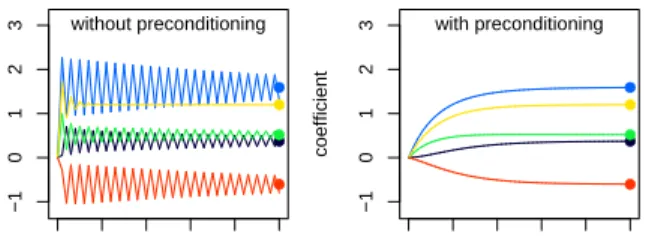
● 0 10 20 30 40 50 −1 0 1 2 3 iteration coefficient ● ● ● ● ● without preconditioning ● 0 10 20 30 40 50 −1 0 1 2 3 iteration coefficient ● ● ● ● ● with preconditioning
Figure 1: The effect of diagonal scaling
precondition-ing on the convergence paths of ELS-GD. Full circles
represent OLS estimates. [N = 100, P = 5, ρ= 0.1]
with the same solution as the original problem, but having more favourable spectral properties. A simple preconditioning is diagonal scaling of the columns of
X. Let D = diag(d1, . . . , dP) be a P ×P diagonal
matrix with diagonal entries {d1, . . . , dP} wheredj =
||X•j||22. Sincedj ≈N for all j ∈N1:P as a result of
standardisation (see §3.1) the preconditioning matrix
becomes D−1≈N−1I
P P. The preconditioned update
equation is then
β[k]=β[k−1]+ (δ/N)XT(y−Xβ[k−1]) (16) which differs from (8) only in the step size. Precondi-tioning smooths the convergence path, but the number of iterations required is still large (Figure 1).
5.2 van Wijngaarden transformation
The van Wijngaarden (1965) transformation (VWT) is a variant of the Euler transform for accelerating the convergence of an alternating series. Given the partial
sums of an alternating series, S1,k = P
k n=1(−1)
na n, we can compute averages of these partial sums,
Sz,k=
Sz−1,k+Sz−1,k+1
2 , z∈N2:K (17)
(and averages of the averages) to form a matrix of averaged partial sums. For a finite number of terms
(K), averages of partial sums are often closer to the
limiting value,S1,∞, than any single partial sum of the
original series,S1,k(k∈N1:K), so that the alternating
nature of the sequence is averaged out, damping its oscillatory behaviour and speeding-up convergence.
As shown in (11), the values {β[k]}
k∈N1:K computed
with ELS-GD form an alternating series, making the VWT a candidate for accelerating the convergence to the true regression coefficients.
The implementation of (17) has a simple, closed form
solution. For a stopping column k? =bK/3c+ 1 (as
van Wijngaarden suggests) we compute the average
partial sum S? = (2K−k ? )−1PK n=k? K−k? n−k? S1,n, and
take this as our best approximation to the value of the series at convergence. Notably, this can be imple-mented homomorphically with the exception of the di-vision, but since the factor is independent of the data,
we can compute instead ˜S? = 2K−k
?
S? and
incorpo-rate the appropriate correction upon decryption; i.e., onceELS-GDis completed, the final VWT estimate is:
˜ βvwt← K X k=k? K−k? k−k? ˜ β[k]. (18) The computational cost of the VWT is minimal,
in-volving approximately 2K/3 additions and
multiplica-tions, and increasing the MMD by only 1.
5.3 Nesterov’s accelerated gradient
Nesterov’s accelerated gradient (NAG) achieves a
con-vergence rate of O(1/K2) as opposed to the O(1/K)
achieved by regular GD (Nesterov, 1983). The NAG algorithm can be written as follows:
s[k]=β[k−1]+δXT(y−Xβ˜[k−1]) (19a)
β[k]=s[k]+ηk(s[k]−s[k−1]), ηk <0. (19b)
The first step in NAG, (19a), is the same as the stan-dard GD step in (8). The extra step, (19b), is
pro-portional to the momentum term s[k]−s[k−1], and is
responsible for the acceleration.
These equations must also be rescaled for
homomor-phic computation (similarly to GD in §4.1.2):
˜ s[k] ≡10φν˜β˜[k−1]+ ˜XT(10(2k−1)φν˜k−1y˜−X˜β˜[k−1]) ≡103kφνks[k] (20a) ˜ β[k] ≡(10φ+ ˜ηk)˜s[k]−102φν˜η˜ks˜[k−1] ≡10(3k+1)φνkβ[k] (20b)
where ˜y= 10φyis the transformed vector of responses,
according to§3.1, and similarly for the remaining
vari-ables, except{s˜[k],β˜[k]}k∈N0:Kwhich have iteration
de-pendent scaling factors.
All scaling constants are independent of the data and known a priori, and so can be incorporated into the scaling by the secret key holder to obtain the final
parameter estimates as: Dec(ks,β˜[K])/(10(3K+1)φνK).
Because of the extra acceleration step, ELS-NAG has
a MMD equal to 3K (see Table 1). This is
particu-larly interesting, because although Nesterov’s method is state-of-the-art for unencrypted GD, the increase in MMD makes it costly for encrypted analysis.
6
Results
In this section we empirically analyse the methods pro-posed for encrypted linear regression using simulated
Pedro M. Esperan¸ca, Louis J. M. Aslett, Chris C. Holmes
Table 1: Maximum Multiplicative Depth (MMD).
Algorithm MMD
Preconditioned gradient descent 2K
van Wijngaarden transformation 2K+1
Nesterov’s accelerated gradient 3K
and real data (see supplementary materials,§4, for
de-tails). We use the implementation of the Fan and Ver-cauteren (2012) cryptosystem provided by Aslett,
Es-peran¸ca, and Holmes (2015a). The runtimes reported
for encrypted analysis are on a 48-core server. All error norms are root mean squared deviations w.r.t. OLS,
and we useφ= 2 throughout.
6.1 Simulations
For simulations with independent data we generate
β∼ N(0P,IP P),X ∼ N(0P,Σ) andy∼ N(Xβ,IP P).
For simulations with correlated data we use Normal
copulas and generate predictors whose pairwise
corre-lations are all equal toρ.
Figure 2 (left) illustrates the computational properties of the coordinate and gradient descent methods for en-crypted regression for a fixed MMD. Since the MMD supported in the encryption scheme is a prime deter-minant of the computational cost of homomorphic op-erations, this serves as a proxy for the error as a
func-tion of encrypted computafunc-tional complexity. ELS-GD
clearly outperformsELS-CDfor a fixed encrypted
com-putational cost, as expected from §5. Furthermore,
Figure 2, (right) shows the VWT provides additional acceleration in convergence relative to GD.
In general, higher correlation among predictors implies
less favourable spectral properties forXTX, which in
turn makes convergence slower for both ELS-GD-VWT
andELS-NAG(Figure 3). A fair comparison must con-trol for the fact that the two algorithms have differ-ent encrypted computational complexities. Using the
MMD as a proxy again,ELS-GD-VWTtypically
outper-formsELS-NAGfor fixed level of complexity (Figure 4).
In very high correlation settings this relationship can be reversed, but only for large numbers of iterations, which it is desirable to avoid.
We stress that this choice is conditional on the en-crypted computational framework considered here. It is particularly interesting that when working unen-crypted, NAG is the state-of-the-art; but in the re-stricted framework of FHE, VWT empirically appears to be a better choice.
Convergence is affected by the number of predictors. In particular, the maximum number of iterations re-quired to reduce the norm of the initial error vector
by a factor e (reciprocal of the average convergence
5 10 15 20 25 0.0 0.4 0.8 multiplicative depth error nor m ●●●●●●●●●●●●●●●● ●●●●●●●●● ● ● ●● ● ●●●●●● ●●● ●●●●●●●●●●● ● ● CD, large P GD, large P CD, small P GD, small P 5 10 15 20 25 0.2 0.6 1.0 number of iterations error nor m r atio
Figure 2: Error norms with respect to the OLS
solu-tion. [left] ELS-CD vs. ELS-GD. Comparison for fixed
multiplicative depth [right] acceleration via VWT.
Ratios of error norm of ELS-GD-VWT toELS-GD. [N =
100, large P= 50, smallP = 5] ● 0 10 20 30 40 50 −1.0 0.0 1.0 2.0 iteration coefficient ● ● ● ● ●● ● ● ● ● ● ● ● ● ● ● ● ● ● ● ● ● ● ● ● ● ● ● ● ● ● ● ● ● ● ● ● ● ● ● ● ● ● ● ● ● ● ● ● ● ● ● ● ● ● ● ● ● ● ● ● ● ● ● ● ● ● ● ● ● ● ● ● ● ● ● ● ● ● ● ● ● ● ● ● ● ● ● ● ● ● ● ● ● ● ● ● ● ● ● ● ● ● ● ● ● ● ● ● ● ● ● ● ● ● ● ● ● ● ● ● ● ● ● ● ● ● ● ● ● ● ● ● ● ● ● ● ● ● ● ● ● ● ● ● ● ● ● ● ● ● ● ● ● ● ● ● ● ● ● ● ● ● ● ● ● ● ● ● ● ● ● ● ● ● ● ● ● ● ● ● ● ● ● ● ● ● ● ● ● ● ● ● ● ● ● ● ● ● ● ● ● ● ● ● ● ● ● ● ● ● ● ● ● ● ● ● ● ● ● ● ● ● ● ● ● ● ● ● ● ● ● ● ● ● ● ● ● ● ● ● ● ● ● ● ● ● ● ● ● ● ● ● ● ● ρ =0.3 ● ols ● vwt nag ● 0 10 20 30 40 50 −1.0 0.0 1.0 2.0 iteration coefficient ● ● ● ● ●● ● ● ● ●● ● ● ● ●● ● ● ● ●● ● ● ● ● ● ● ● ● ● ● ● ● ● ● ● ● ● ● ● ● ● ● ● ● ● ● ● ● ● ● ● ● ● ● ● ● ● ● ● ● ● ● ● ● ● ● ● ● ● ● ● ● ● ● ● ● ● ● ● ● ● ● ● ● ● ● ● ● ● ● ● ● ● ● ● ● ● ● ● ● ● ● ● ● ● ● ● ● ● ● ● ● ● ● ● ● ● ● ● ● ● ● ● ● ● ● ● ● ● ● ● ● ● ● ● ● ● ● ● ● ● ● ● ● ● ● ● ● ● ● ● ● ● ● ● ● ● ● ● ● ● ● ● ● ● ● ● ● ● ● ● ● ● ● ● ● ● ● ● ● ● ● ● ● ● ● ● ● ● ● ● ● ● ● ● ● ● ● ● ● ● ● ● ● ● ● ● ● ● ● ● ● ● ● ● ● ● ● ● ● ● ● ● ● ● ● ● ● ● ● ● ● ● ● ● ● ● ● ● ● ● ● ● ● ● ● ● ● ● ● ● ● ● ● ρ =0.7 ● ols ● vwt nag
Figure 3: Convergence of ELS-GD-VWT andELS-NAG
for different levels of correlation: [left]ρ= 0.3[right]
ρ= 0.7. [N = 100, P = 5] ● 5 10 15 20 25 30 0.0 0.2 0.4 0.6 multiplicative depth error nor m ● ● ● ● ● ● ● ● ● ● ● ● ● ● ● vwt nag ρ =0.3 ● 5 10 15 20 25 30 0.0 0.2 0.4 0.6 multiplicative depth error nor m ● ● ● ● ● ● ● ● ●● ● ● ● ● ● vwt nag ρ =0.7
Figure 4: Error norm of ELS-GD-VWTandELS-NAGas a function of multiplicative depth, for different levels
of correlation: [left] ρ = 0.3 [right] ρ = 0.7. [N =
100, P = 5]
rate; Varga, 2000, p.69) gives us an idea of the rela-tionship between number of predictors and speed of convergence. For any level of correlation, this measure
of complexity increases linearly with P (see Figure 1
in the supplementary materials).
Finally, the computational costs ofELS-GDare given in
Figure 5. Runtime grows quickly with the algorithm’s multiplicative depth, which increases with the num-ber of iterations. However, for a fixed multiplicative
depth the runtime is roughly linear in bothN andP.
P=5 P=25 time (mins) 0 20 40 60 80 1 2 3 K=4 1 2 3 K=4 P=5 P=25 data siz e (GBs) 0 2 4 6 8 10 1 2 3 K=4 1 2 3 K=4
Figure 5: Computational aspects of ELS-GD for
dif-ferent problem sizesP∈ {2,25}, per 100 observations:
[left] runtimes (in minutes) [right] encrypted data
size in memory, {X,y} (in gigabytes, excluding
com-putational overheads).
6.2 Applications
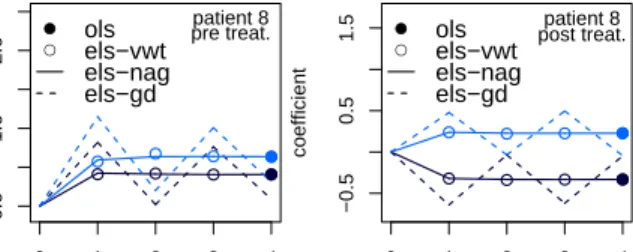
Mood stability data The first application is to mood stability in bipolar patients (Bonsall et al., 2012). Of interest in this application is the charac-terisation of the stochastic process governing the re-sulting time series, pre and post treatment, which we model as an autoregressive process of order two
(N = 28, P = 2). Convergence is achieved within 2
iterations (||β[2]||
∞≤0.04; Figure 6). The algorithm
runs encrypted in 12 seconds and requires under 15 MBs of memory, excluding overheads.
Prostate cancer data The second application is to prostate cancer (Stamey et al., 1989). The model
here is a standard linear regression (N = 97, P = 8).
Although not all parameters have completely
con-verged by iteration 4 with unregularised ELS-GD-VWT
(||β[4]||
∞ ≤0.26; Figure 7), the predictions are close
to those produced by RLS (Figure 8). The algorithm runs encrypted in 30 minutes and requires 3.5 GBs of
memory (K= 4).
For runtimes and memory requirements in these appli-cations see Figure 2 in the supplementary materials.
7
Discussion
We demonstrated that in the restricted framework of FHE, traditional state-of-the-art methods can perform
poorly. Statistical and computational methods
tai-lored for homomorphic computation are therefore re-quired, which may differ from the state-of-the-art in an unrestricted framework.
For optimal convergence speed, the step size δ can
be provided by the data holder, who can use the
inequality S(XTX) ≤ ||(XTX)m||1/m ≡ B(m) to
approximate S(XTX) to arbitrary precision, since
B(m)→ S(XTX) asm→ ∞. ● 0 1 2 3 4 0.0 1.0 2.0 iteration coefficient ● ● ● ● ● ● ● ● ● ● ● ● olsels−vwt els−nag els−gd patient 8 pre treat. ● 0 1 2 3 4 −0.5 0.5 1.5 iteration coefficient ● ● ● ● ● ● ● ● ● ● ● ● olsels−vwt els−nag els−gd patient 8 post treat.
Figure 6: Convergence of different algorithms in the
mood stability application (patient 8 shown): [left]
pre treatment [right]post treatment. Lines of
differ-ent colours represdiffer-ent differdiffer-ent regression coefficidiffer-ents.
● 0 1 2 3 4 0.0 0.5 1.0 iteration coefficient ●● ● ● ● ● ● ● ● ● ● ● ● ● ● ● ● ● ● ● ● ● ● ● ● ● ● ● ● ● ● ● ● ● ● ● ● ● ● ● α =0 ● ● ols els−vwt els−nag els−gd ● 0 1 2 3 4 0.0 0.5 1.0 iteration coefficient ● ● ● ● ● ● ● ● ● ● ● ● ● ● ● ● ● ● ● ● ● ● ● ● ● ● ● ● ● ● ● ● ● ● ● ● ● ● ● ● α =30 ● ● ols els−vwt els−nag els−gd
Figure 7: Convergence of different algorithms in the
prostate data application: [left] without
regularisa-tion (α= 0)[right]with regularisation (α= 30).
● ● ●● ● ● ●● ●●● ● ● ●● ● ● ● ● ●● ● ● ● ●●● ●● ● ● ● ● ● ● ● ● ● ● ●●●● ● ●● ● ● ● ●● ● ● ● ● ● ●●● ● ● ● ● ● ●● ●● ● ●● ● ● ●●● ●● ● ● ● ●●● ● ● ● ● ● ● ● ● ● ● ● ● ● R1[[i]][, 1] R2[[i]][, 1]/10^(phi) α =0 df=8.00 −2 0 1 2 −2 0 1 2 ● ● ● ● ● ● ●● ●●● ● ● ●● ● ● ● ● ●● ● ● ● ●●● ●● ● ● ● ● ● ● ● ● ● ● ●●●● ● ● ● ● ● ● ●● ● ● ● ● ● ●●● ● ● ● ● ● ●● ● ● ● ● ● ● ● ●●● ● ● ● ● ● ● ● ● ● ● ●● ● ● ● ●● ● ●● ● R1[[i]][, 1] R2[[i]][, 1]/10^(phi) α =15 df=6.34 −2 0 1 2 ● ● ● ● ● ● ●● ●●● ● ● ●● ● ● ● ● ●● ● ● ● ●●● ●● ● ● ● ● ● ● ● ● ● ● ●●●● ● ● ● ● ● ● ●● ● ● ● ● ● ●●● ● ● ● ● ● ●● ● ● ● ●● ● ● ●●● ● ● ● ● ● ●●● ● ● ●● ● ● ● ●● ● ●●● R1[[i]][, 1] R2[[i]][, 1]/10^(phi) α =30 df=5.63 −2 0 1 2 rls els−gd−vwt
Figure 8: Predictions for the prostate dataset
un-der different regularisation settings, α ∈ {0,15,30}.
df = trace(X(XTX+αI
P P)−
1XT), effective degrees
of freedom. [K= 4]
Choosing the penaltyαis less straightforward.
Tradi-tional methods involve cross-validation which is impos-sible under strict FHE. Alternatively, it is posimpos-sible to do rounds of communication and decryption between two parties to achieve this, in which case Differential Privacy can used as a way to guarantee security during the intermediate communication steps.
Acknowledgements
P.M. Esperan¸ca: LSI-DTC doctoral studentship
(EP-SRC grant EP/F500394/1). L.J.M. Aslett and C.C. Holmes: i-like project (EPSRC grant EP/K014463/1).
Pedro M. Esperan¸ca, Louis J. M. Aslett, Chris C. Holmes
References
D. Allen. The relationship between variable selection and data agumentation and a method for prediction.
Technometrics, 16(1):125–127, 1974.
L. J. M. Aslett, P. M. Esperan¸ca, and C. C. Holmes. A review of homomorphic encryption and soft-ware tools for encrypted statistical machine
learn-ing. arXiv:1508.06574: arxiv.org/abs/1508.06574,
2015a.
L. J. M. Aslett, P. M. Esperan¸ca, and C. C.
Holmes. Encrypted statistical machine learning:
new privacy preserving methods. arXiv:1508.06845: arxiv.org/abs/1508.06845, 2015b.
J. Basilakis, B. Javadi, and A. Maeder. The potential for machine learning analysis over encrypted data in cloud-based clinical decision support — background
and review. In Health Informatics and Knowledge
Management (HIKM’15), volume 164 of Confer-ences in Research and Practice in Information Tech-nology, pages 3–13. ACS, 2015.
A. Bj¨orck. Numerical methods for least squares
prob-lems. SIAM, 1996.
M. Bonsall, S. Wallace-Hadrill, J. Geddes, G.
Good-win, and E. Holmes. Nonlinear time-series
ap-proaches in characterizing mood stability and mood
instability in bipolar disorder. Proceedings of the
Royal Society B (Biological Sciences), 279(1730): 916–924, 2012.
N. Dowlin, R. Gilad-Bachrach, K. Laine, K. Lauter,
M. Naehrig, and J. Wernsing. Cryptonets:
Applying neural networks to encrypted data
with high throughput and accuracy. Technical
Report MSR-TR-2016-3.: www.microsoft.com/en- us/research/publication/cryptonets-applying- neural-networks-to-encrypted-data-with-high-throughput-and-accuracy/, 2016.
C. Dwork and A. Roth. The Algorithmic Foundations
of Differential Privacy. Foundations and Trends in Theoretical Computer Science. Now Publisher, 2014.
J. Fan and F. Vercauteren. Somewhat
prac-tical fully homomorphic encryption. IACR
Cryptology ePrint Archive, Report 2012/144:
eprint.iacr.org/2012/144, 2012.
W. Fu. Penalized regressions: The bridge versus
the lasso. Journal of Computational and Graphical
Statistics, 7(3):397–416, 1998.
C. Gentry. Computing arbitrary functions of
en-crypted data. Communications of the ACM, 53(3):
97–105, 2010.
T. Graepel, K. Lauter, and M. Naehrig. ML
Confiden-tial: Machine learning on encrypted data. In
Infor-mation Security and Cryptology (ICISC’12), volume
7839 of Lecture Notes in Computer Science, pages
1–21. Springer, 2013.
M. Gymrek, A. L. McGuire, D. Golan, E. Halperin, and Y. Erlich. Identifying personal genomes by
sur-name inference. Science, 339(6117):321–324, 2013.
R. Hall, S. E. Fienberg, and Y. Nardi. Secure multiple linear regression based on homomorphic encryption.
Journal of Official Statistics, 27(4):669–691, 2011.
T. Hastie, R. Tibshirani, and J. Friedman. The
ele-ments of statistical learning: data mining, inference and prediction. Springer, 2009.
A. Hoerl and R. Kennard. Ridge regression: Biased
estimation for nonorthogonal problems.TheJournal,
Technometrics(12):1, 1970.
T. Lepoint and M. Naehrig. A comparison of the ho-momorphic encryption schemes FV and YASHE. In
Progress in Cryptology (AFRICACRYPT’14),
vol-ume 8469 of Lecture Notes in Computer Science,
pages 318–335. Springer, 2014.
R. Lindner and C. Peikert. Better key sizes (and
attacks) for LWE-based encryption. In Topics
in Cryptology (CT-RSA’11), volume 6558 of Lec-ture Notes in Computer Science, pages 319–339. Springer, 2011.
P. J. McLaren, J. L. Raisaro, M. Aouri, M. Rot-ger, E. Ayday, I. Bartha, M. B. Delgado, Y.
Val-let, H. F. G¨unthard, M. Cavassini, H. Furrer,
T. Doco-Lecompte, C. Marzolini, P. Schmid, C. Di Benedetto, L. A. Decosterd, J. Fellay, J. Hubaux, A. Telenti, and the Swiss HIV Cohort Study. Privacy-preserving genomic testing in the clinic: a
model using HIV treatment. Genetics in Medicine,
2016. Advance online publication.
M. Naveed, E. Ayday, E. W. Clayton, J. Fellay, C. A. Gunter, J.-P. Hubaux, B. A. Malin, and X. Wang.
Privacy in the genomic era. ACM Computing
Sur-veys, 48(1):Article 6, 2015.
Y. Nesterov. A method for solving a convex
program-ming problem with convergence rateO(1/k2).Soviet
Mathematics Doklady, 27(2):372–376, 1983.
Y. Nesterov. Efficiency of coordinate descent methods
on huge-scale optimization problems.SIAM Journal
on Optimization, 22(2):341–362, 2012.
V. S. Ryaben’kii and S. V. Tsynkov. A Theoretical
Introduction to Numerical Analysis. Chapman and Hall/CRC, 2006.
S. C. Sanderson, M. D. Linderman, S. A. Suckiel, G. A. Diaz, R. E. Zinberg, K. Ferryman, M. Wasserstein,
A. Kasarskis, and E. E. Schadt. Motivations, con-cerns and preferences of personal genome sequenc-ing research participants: baseline findsequenc-ings from the
HealthSeq project.European Journal of Human
Ge-netics, 24:14–20, 2015.
T. Stamey, J. Kabalin, J. McNeal, I. Johnstone, F. Freiha, E. Redwine, and N. Yang. Prostate spe-cific antigen in the diagnosis and treatment of ade-nocarcinoma of the prostate. II. radical
prostatec-tomy treated patients. Journal of Urology, 141(5):
1076–1083, 1989.
R. Tibshirani. Regression shrinkage and selection via
the lasso. Journal of the Royal Statistical Society.
Series B (Methodological), 58(1):267–288, 1996. United States Executive Office of the President. Big
data: Seizing opportunities, preserving values, 2014.
A. van Wijngaarden. In Cursus: Wetenschappelijk
Rekenen B: Process Analyse, pages 51–60. Stichting Mathematisch Centrum, 1965.
R. S. Varga. Matrix iterative analysis, volume 27
of Springer Series in Computational Mathematics. Springer, 2nd edition, 2000.
S. Wright. Coordinate descent algorithms.
Mathemat-ical Programming, 151(1):3–34, 2015.
D. Wu and J. Haven. Using homomorphic encryption
for large scale statistical analysis. Technical
Re-port:
cs.stanford.edu/people/dwu4/papers/FHE-SI Report.pdf., 2012.
H. Zou and T. Hastie. Regularization and variable
selection via the elastic net. Journal of the Royal
Statistical Society. Series B (Methodological), 67(2): 301–320, 2005.
![Figure 3: Convergence of ELS-GD-VWT and ELS-NAG for different levels of correlation: [left] ρ = 0.3 [right]](https://thumb-us.123doks.com/thumbv2/123dok_us/9440473.2818264/8.918.509.841.632.780/figure-convergence-els-vwt-different-levels-correlation-right.webp)