DESIGN OF AN ADAPTIVE DISTANCE-LEARNING
HYPERMEDIA BASED ON LEARNER MODELING:
APPLICATION FOR A COURSE IN ELECTRICAL
ENGINEERING
1
AZIZ DEROUICH, 2KARIMMOHAMMED, 2DRISS MARJANE, 1FAYÇAL MESSAOUDI
1
Department of Electrical and Computer Engineering, the Higher School of Technology, Fez 2
Faculty of Science Dhar El Mahraz, Fez Sidi Mohamed Ben Abdellah University, Morocco
E-mail: {aziz.derouich, mohammed.karim,driss.marjane, fayçal.messaoudi}@usmba.ac.ma
ABSTRACT
The present article is concerned with the design, modeling and implementation of an adaptive hypermedia dedicated to distance learning. The architecture of this system is essentially based on three models: the learner model representing all data about the user, the domain model representing the pedagogical content to be taught, and the adaptation model allowing the generation and adaptation of pedagogical contents to the actual needs of the learner. Experiments in a real context, in a pilot class of thirty-two students majoring in electrical engineering, enabled us to assess our system and interpret the behavior of the learners with this mode of learning.
Keywords: Adaptive Hypermedia, Learner Model, Domain Model, Adaptation Model, UML
1. INTRODUCTION
The architecture of any adaptive system dedicated to distance learning is essentially made up of a learner model and a domain model [1, 2]. The first makes it possible to take into account the different features of the users: their personal data, needs, preferences, aims, skills, knowledge, etc. These various parameters can be obtained through questionnaires and a follow-up of the interaction of the learner with the computer system. The second model, also named “domain knowledge” or “knowledge model” has as its objective identifying the relevant concepts and their relationships and provides an overall structure of the learning domain (the course).
In this article, we will conceptually define the different elements of our system using UML (Unified Modeling Language). At the beginning, we will be interested in the two sub-models of the learner in the system: the knowledge model and the attitude model [3, 4]. Secondly, we will proceed to an analysis of the domain model with particular interest in examining the characteristics of the basic fragments of which it consists and which will allow the construction of courses that adapt to the models of the learners. A large part of the implementation of our system is dynamic in the form of computer code.
2. ARCHITECTURE OF OUR ADAPTIVE
HYPERMEDIA
The architecture of our system is inspired by that proposed by Benyon [5]. It essentially comprises three models: a user model, a domain model, and a model of generating and adapting the pedagogical contents as is illustrated in Figure 1 below.
Figure1: Architecture Of The Adaptive Hypermedia
Learner Model Domain
Model
Web
Interface Learner
Generation and Adaptation of
Pedagogical Contents Filtering
The domain model contains the knowledge to be taught [6]. This knowledge is represented using Artificial Intelligence techniques (production rules, semantic networks, frames, etc.). This model is implemented through a base of knowledge relative to the domain to be taught. In some systems, the pedagogical rules that make it possible to run a learning session are also represented in this model.
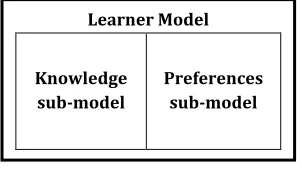
[image:2.612.309.528.289.520.2]The learner model is one that contains the information reflecting the cognitive state and the psycho-didactic features of the learner. It is a source of knowledge that contains acquisitions on all aspects of the learner that can be useful to the customization of learning. It thus allows the hypermedia to choose the concepts of the course tailored to the learner and to dynamically design the presentation and organization of the pedagogical content during a pedagogical sequence. In our implementation, the learner model consists of two sub-models: the knowledge sub-model and the preferences sub-model as is illustrated in Figure 2 below.
Figure 2: The Learner Sub-Models
The knowledge sub-model, or the learner’s knowledge sub-model, contains information on the level of knowledge of the learner with regard to each concept that is considered in the domain model. This level is calculated through a knowledge-MCQ at the beginning of the learner’s first access to a course. An update of this model is carried out after an assessment MCQ at the end of each course.
The preferences sub-model is primarily responsible for the generation of the course plan, its organization and the media to be used. This model is also responsible for the choice of the presentation model of the course and the definition of the order of appearance of the different media in the course [7].
The initialization of the preferences sub-model takes place during the learners’ enrollment phase on our system using a profiling process that is based on a measure of the learning style.
3. LEARNING STYLE MEASUREMENT:
INDEX OF LEARNING STYLES
This measure is based on the Index of Learning Styles (ILS) developed by Felder and Solomon [8]. The ILS considers that the styles of information reception and mental processing differ from one person to another. These styles may be classified according to four dimensions.
Felder’s questionnaire consists of 44 questions. For each question, the learner must choose one answer out of two alternatives a and b. The 44 questions fall into four sets of 11 questions each. Each set of questions defines one dimension of the learner’s cognitive model, which is thus made up of four dimensions according to Felder (see table 1 below).
Table 1: Learning Style Dimensions
Dimension Lower End
(a)
Upper End (b)
ILS sets of Questions
Reflection Active Reflective
Q1, Q5, Q9, Q13, Q17, Q21, Q25, Q29, Q33, Q37, Q41
Reasoning Inductive Deductive
Q2, Q6, Q10, Q14, Q18, Q22, Q26, Q30, Q34, Q38, Q42
Sensory Verbal Visual
Q3, Q7, Q11, Q15, Q19, Q23,
Q27, Q31, Q35, Q39, Q43
Progression Sequential Global
Q4, Q8, Q12, Q16, Q20, Q24,
Q28, Q32, Q36, Q40, Q44
3.1 First dimension: information processing The first dimension represents the dimension of reflection and information processing by the learner. It ranges from reflective to active. Active learners do better by engaging into an activity (collective or individual) or by discussing the concept to be learned. A computerized learning system should therefore give more importance to the practical aspect of learning and the implementation of collaborative activities. Reflective learners prefer learning by introspection (observing, listening, etc.). In order to be more efficient with a reflective learner, the pedagogical apparatus should mostly be based on theory, definitions and demonstrations.
Learner Model
Knowledge sub-model
[image:2.612.121.272.351.438.2]3.2 Second dimension: Reasoning
This second dimension represents reasoning. It varies from deductive to inductive. Deductive learners prefer starting from principles in order to deduce outcomes or applications. Inductive learners, on the other hand, prefer starting from facts and examples in order to identify principles. A pedagogical apparatus suitable to deductive learners should start from definitions and theories and progress towards practice.
3.3 Third dimension: perception of
information
The third dimension consists of representing the manner in which the learner prefers to receive information. It is a sensory dimension. It ranges from visual to verbal. A visual learner prefers instruction through the use of pictures, diagrams, graphs and animations. On the other hand, a verbal learner prefers verbal instruction through texts, words, readings and discussions.
3.4 Fourth dimension: progress towards
understanding
This dimension defines the way a learner prefers to progress in learning within a course. It varies from global to sequential. A sequential learner prefers to progress through successive steps; on the other hand, global learners prefer to choose their way freely in order to make big leaps according to context.
3.5 Dimension Measurement
To assign a dimension to a learner, using Felder’s questionnaire, it is enough to count the number of a-responses and the number of b -responses out of the 11 questions corresponding to the dimension as is indicated in Table 1 above, and calculating the difference between these two figures.
Let M and N respectively be these two figures. The difference M-N makes it possible to place the learning style of the learner. A negative number indicates that the learner is close the b-end and vice versa.
This measure ranges from 11 (all the responses of the learner are a) to -11 (all the responses are b).
4. Reducing Felder’s questionnaire
Reducing the number of questions makes it possible to raise the concentration level of the learners [10] during the profiling process in order to better respond to the questionnaire, which allows us
to define a cognitive model in a way that reflects the learner’s preferences more appropriately. Therefore, after having administered the paper questionnaire to a population of 201 learners in different classes of a technical high school, the results were collected and analyzed using SPHINX and SPSS software. The value of Cronbach’s coefficient enabled us to show the reliability index of the measurement instrument used in the experiment. Indeed, in [9], the authors state that the acceptance threshold of Cronbach depends on the type of questionnaire. In the case of a questionnaire that measures a knowledge level, the acceptance threshold is set at 0.75, and in the case of a preference or an attitude measure it is set at 0.50. On the SPSS software, our survey obtained a Cronbach coefficient equal to 0.538, which is a fair enough reliability index for a learning style measure.
In order to reduce the number of Felder’s questions, the study consisted of calculating the dimension value for each learner using all 11 eleven questions and then dropping two different questions each time the calculation is repeated. For each dimension, the number of cases is equal to , that is to say, 55 cases in addition to the one using all the 11 questions.
A comparison of the results is carried out using the coefficient of determination R², which gives an idea on the percentage of variability of the variable to be modeled, the value of the learning style dimension in our case. The closer R² is to 1, the higher the correlation, and the better the model. Table 2 below summarizes the obtained results:
Table 2: Coefficients of determination and pairs of dropped questions
Dimension
Minimum R² & Pairs of dropped
questions
Maximum R² & Pairs of dropped
questions
Reflection
0,45 1
Q1, Q9
Q9, Q13 Q17, Q33
Reasoning 0,27 1
Q22, Q42 Q18, Q26
Sensory
0,39 1
Q19, Q35
Q7, Q15 Q27, Q43 Q35, Q39
Progression
0,12 1
Q16, Q36
Following the results of the statistical analysis above, we reduced Felder’s questionnaire concerning the reflective dimension to 9 questions only that properly represent this dimension.
We used the same technique to study the other three dimensions of Felder’s cognitive model. The results obtained are summarized in the table 3 below:
Table 3: Felder’s Questionnaire reduced
We allowed our system administrator to manage Felder’s questionnaire and choose the questions to be dropped for other possible situations.
5. USE SCENARIO OF OUR SYSTEM BY
THEMAIN ACTORS
First, we will describe the use scenario from the learner’s point of view, the primary user of the system. This scenario consists of describing the actions and reactions between the system and the learner.
The system starts by identifying the learners. If they are first-time users, they will be given a questionnaire [11]. The questionnaire is a set of psychologically-oriented questions whose aim is to determine learners’ preferences, likes, habits, etc... [12]. All of their answers will enable the adaptive hypermedia to define the learning style dimensions of the learner that represent the main component of the learner preferences sub-model.
When a learner who is already enrolled chooses a course for the first time, the system takes care of issuing a questionnaire, but this time of a knowledge type. The result of this questionnaire will allow the system to initialize the learner’s knowledge sub-model by assigning a level (Beginner, Intermediate or Expert). Depending on the results of the latter two tests, the system proceeds to assembling the appropriate course by accessing all the fragments that constitute the course, and by determining which among these should be present in the adapted hyper-document.
The learner’s use-cases diagram illustrated in Figure 3 below summarizes the tasks that the learner can perform on our system.
Figure 3: Learner’s Use-Case Diagram
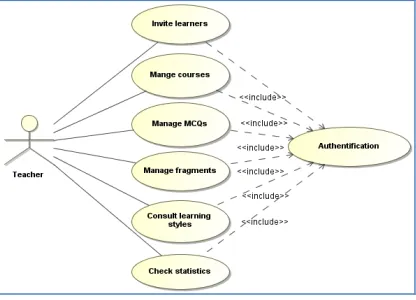
The interaction of the teacher with the system can be summarized as follows:
• Invite students to enroll on the system. • Create a course in a learning domain.
• Create an MCQ related to knowledge ("Knowledge MCQ" and "Assessment MCQ"). • Create plans for a course (default plan and
customized plans).
• Break the course into fragments (picture, video sequence, Java applet, flash animation, text, simulation, etc..)
• Complete each fragment by a pedagogical signature concerning the learning style dimension of the learner that can be attributed to this fragment (Sequential/Global, Inductive/Deductive, Active/Reflective, Visual/Verbal), the required level of knowledge for this fragment, and possibly the pre-requisites and post-requisites for this fragment, and finally, save the contents (fragment + pedagogical signature) in the system’s database.
[image:4.612.313.522.140.239.2]The use-case diagram for the teacher is shown in Figure 4 below:
[image:4.612.315.523.561.711.2]The tasks of the system’s administrator can be summarized in the following points:
• Inviting teachers.
• Managing domains: creating, modifying and deleting a learning domain.
• Activating or deactivating one of Felder’s questions for each of the four dimensions of the learning style in order to reduce the number of questions.
• Consulting learning styles.
Figure 5: Administrator’s Use-Case Diagram
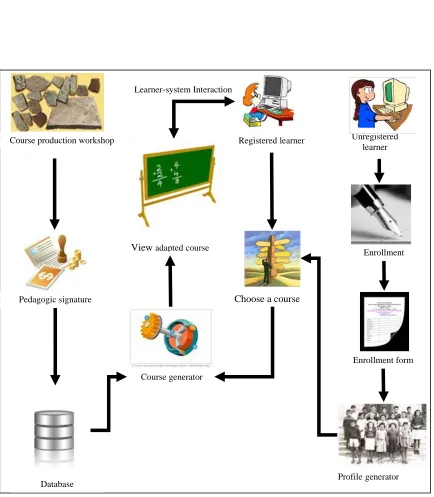
Figure 6 further below summarizes the interactions of the main actors (learners and teachers) with the system.
6. LEARNER MODEL
The learner model consists of two sub-models, namely the knowledge sub-model and the preferences sub-model. In this paragraph, we will be interested in class diagram in the UML modeling of these different components of this model.
6.1 Knowledge sub-model
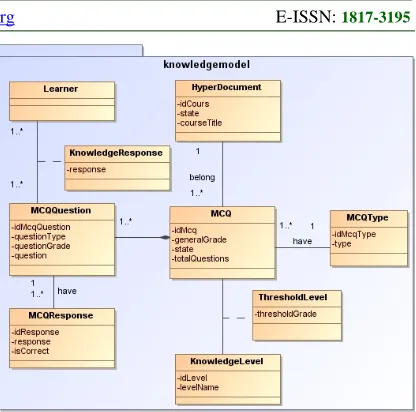
[image:5.612.316.524.73.279.2]We have put together the content of this sub-model in a package named “knowledgemodel”. This package is represented in Figure 7 below.
Figure 7: Knowledge Sub-Model Class Diagram
Before starting the session corresponding to learning the course, learner must take a knowledge-MCQ allowing the initialization of the knowledge sub-model of the learner by assigning him a level (Beginner, Intermediate or Expert).
6.2 Preferences Sub-Model
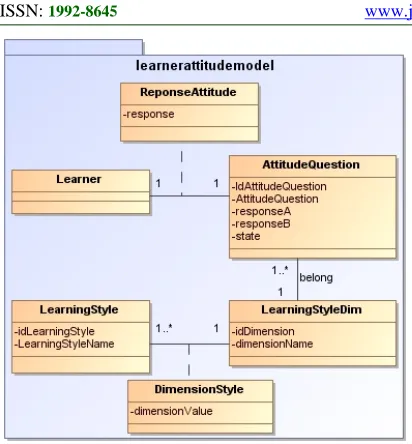
This second sub-model of the learner will allow the choice of the general structure of the course (the plan) adapted to the profile of the learner and will give shape to its content. This component will assign a cognitive style and a learning style to the learner.
Learners must, at the beginning of their first use of the hypermedia, the moment they enroll on the system, answer a questionnaire that enables them to be placed into a stereotype according to the value of the four dimensions of a learning style. This stereotype associated to the knowledge sub-model determines the plan of the course defined beforehand by the teacher that will be used. A major part of this process is processed dynamically by development.
The history of the activities of the learner will be saved for any possible use by the system. The latter always gives the learner the possibility to retake the MCQ in order to update of the preferences sub-model.
Fig.8: Preferences Sub-Model Class Diagram
7. DOMAIN MODEL
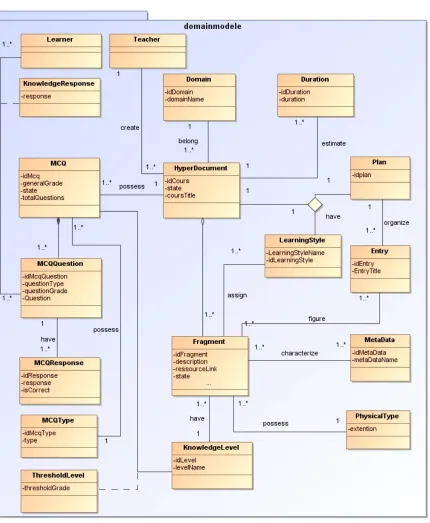
Figure 9 below provides details of the various components of our domain model. The hyperdocument (the course) consists of one or several fragments. The attributes of one hyperdocument are the identifier, the title of the document and the status of the course (activated or deactivated).
A customized plan is associated with each course and each learning style; otherwise a default plan is applied. The plan is made up of several entries that represent the titles of the paragraphs that make up the course. A fragment consists of one or more media. These media can be of various types: text, audio, video, animation, image, pdf file, simulation or other. The attributes of a fragment are the identifier, a description, the link of the resource, and the status (activated or deactivated). The teacher must assign a level (Beginner, Intermediate, or Expert) to each fragment and specify it through a set of metadata and choose, according to the predefined plans, in which entry it should appear.
The class diagram, in figure 9, clearly explains our approach to the design of the domain model of our adaptive hypermedia. The package of this model is referred to as “domainmodel”.
8. COURSE GENERATOR
The preferences sub-model is in charge of generating the course model; in other words, the plan of the course. This model represents the mechanism that, from the raw pedagogical content
stored in the multimedia database in the form of basic fragments, constructs a hyperdocument (course or learning activity) suitable for a learner with a particular profile.
The teacher is thus responsible for defining a course plan for each learning style. In total, he can customize the plan for 16 styles that are stored in a library of styles. In the general cases, the teacher establishes a default plan that applies to all the styles and then chooses the stereotypes for which he wishes to customize the plan, and this is done according to the pedagogical activity, the population of learners, and the number of basic fragments that will be stored in the database. The higher the number of fragments is, the more flexible the system is, enabling it in this way to adapt to several learning styles.
The presentation of the course on a webpage in the desired format is done thanks to a page of the CSS style.
The course generator takes care of constructing course pages dynamically starting from choices made by the learner, the domain model, the learner model and the fragments stored in the database. It is therefore able to restore, at any given moment, the concepts and the links of a page and to display them.
Therefore, and after applying a first filter on the fragments in order to select those corresponding to the course to be delivered, it will apply a second filter in order to select the fragments corresponding to the learning style of the learner, and a third one in order to retain the fragments that are suitable to the required level of knowledge (Beginner, Intermediate, Expert). The knowledge sub-model is automatically updated according to the assessment of the learner after each learning session.
Once the course generator has retrieved the plan associated with the course for a given learning style, it searches among the fragments for the one that is most appropriate for each part of the model and starts assembling the course.
9. CONCLUSION
and the knowledge sub-model, as well as the domain sub-model.
We have preferred a package modeling given the complexity of the studied system. The computer implementation of our system is based on an object-oriented programming with the JEE technology (Java Enterprise Edition).
We tested our system in a pilot class of 32 learners of a technical education major. We noticed that the majority of learners find working on the system efficient. They highly enjoyed using it.
We also noticed, during its first use, the necessity of enriching the base of basic fragments. Nevertheless, our hypermedia system reflects certain features of the user well in its learner model and applies this model in order to adapt learning to the user.
A second version of our adaptive hypermedia is underway in order to overcome the limitations of the first version with regard to security, speed, and adaptive techniques.
REFERENCES
[1] Brusilovsky P., “Methods and Techniques of
Adaptive Hypermedia, User Modeling and User-Adapted Interaction”, Kluwer academic publishers, Vol. 6, 1996, pp. 87–129.
[2] Brusilovsky P., Eklund J., Schwarz E., “ Web-based Education for All: A Tool for Development Adaptive Courseware”, Computer Networks and ISDN Systems, Proceedings of Seventh International World Wide Web Conference, 1998, pp. 291-300.
[3] Brusilovsky P., Adaptive Hypermedia, “User Modeling and User-Adapted Interaction”,
Kluwer Academic Publishers, Vol. 11, 2001, pp.
87-110.
[4] Brusilovsky P., Vassileva J., “Course sequencing techniques for large-scale web-based education”,
International Journal of Continuing Engineering
Education and Lifelong Learning, Vol.13,
Nos.1/2, 2003, pp. 75-94.
[5] Benyon D. R., Adaptive systems: “A solution to Usability Problems”, Journal of user modeling
and user adapted interaction, Kluwer, 3(1),
1993, pp. 1-22.
[6] Derouich A., Karim M., Hachem E-K.,
“Representation and analysis of learner’s knowledge in an adaptive hypermedia”,
Modelling, Measurement and Control, Series D: Production Engineering and Management,
Organization, Human and Social Problems, Vol.
31, Issue 1, 2010.
[7] Laroussi M., “Conception et réalisation d’un système didactique hypermédia adaptatif : CAMELEON”, Doctoral thesis, Manouba University, Tunisie, 2001.
[8] Felder R.M., “Reaching the Second Tier: Learning and Teaching Styles in College Science Education”, J. College Science Teaching, 23(5), 1993, pp. 286-290.
[9] Felder R.M., Spurlin J., “Applications, Reliability and Validity of the Index of Learning Styles”, International Journal of Engineering
Education, 21(1), 2005, pp. 103-112.
[10] Piombo C., “Modélisation probabiliste du style d’apprentissage et application à l’adaptation de contenus pédagogiques indexés par une ontologie”, Doctoral thesis, National Polytechnic Institute of Toulouse, Toulouse University,
France, 2007.
[11] Derouich A., “Conception et réalisation d’un hypermédia adaptatif dédié à l’enseignement à distance”, Doctoral thesis, Faculty of Science Dhar Mahraz, Sidi Mohamed Ben Abdellah University, Fez, Morocco, 2011.
Figure 6: Interactions Of The Main Actors (Teacher And Learner) With The System
Unregistered learner Course production workshop
Enrollment
Enrollment form Registeredlearner
Database
Course generator View adaptedcourse
Profilegenerator
Pedagogic signature Choose a course