IMPACT OF SHOPPER MARKETING ON PURCHASE
DECISIONS OF INFORMATION TECHNOLOGY DEVICES
FOR PERSONAL USE BY INDIAN CONSUMERS
1D.DAVID WINSTER PRAVEENRAJ, 2J.ASHOK
1
Assistant Professor (SG)., School of Management Studies, Bannari Amman Institute of Technology
2
Professor., School of Management Studies, Bannari Amman Institute of Technology
E-mail: [email protected] , [email protected]
ABSTRACT
The main objective of this study is to analyze the impact of shopper marketing elements on the purchase decisions of the Indian consumers in purchase of Information Technology Devices. The study focuses on the purchase behvaiour of Indian consumers in the purchase of domestic hardware devices like desktops, laptops, Smart phones and Tablets. This study has also taken into consideration about the purchase of peripherals like printers, modems etc Consumer behavior is an important consideration by any marketer when constructing a marketing plan. The important phase of purchase behavior exhibited by consumers about which every marketer would be eager to know and influence is the purchase decisions made by them. This article is discusses the impact of some of the elements of shopper marketing on purchase decisions made by Indian consumers in purchase of Information Technology Devices. 250 respondents which visited a retail outlet were interviewed about the role the elements like store atmospherics, in-store promotions and the sales persons played on influencing their purchases. Personal interview method was adopted using a structured questionnaire as a tool for data collection. A model was proposed and validated through Structural Equation Modeling. The result of the study shows a direct causal relationship of these shopper marketing elements on the purchase decisions of the consumers.
Keywords: Information Technology products, Sales persons, In-store Promotions, Atmospherics, Structural Equation Modeling.
1. INTRODUCTION
A broader definition states that Shopper Marketing is the use of insights –driven marketing and merchandising initiatives to satisfy targeted customer needs, enhance the shopping experience, and optimize business results for retailers and
suppliers. This sometimes derives in the
misperception that Shopper Marketing is a new hyped way to call in-store promotion and communication. It is rather a new function that crosses the traditional sales and marketing divide as it may indeed start before shoppers have entered the store. Shopper centered activations usually demand the cooperation of different participants, long-term objectives, coordination of diverse resources and new budget allocation. In the past, it also meant fewer methods to measure results but nowadays there are new tools, like Shopperception, that permit marketers and retailers to accurately track activity in front of the shelf.
Further, at the core of Shopper Marketing lies the intention for a better and deeper understanding of shopping behavior in order to engage shoppers more meaningfully in the point of purchase and thus lead to increased sales and loyalty. Most commonly, people think of stores and retailers as places where products are put on display and sold. Shopper marketing goes far beyond that belief making the shopping environment a vital part of the marketing toolkit. When considering that 76% of buying decisions are made inside stores, more attention should be paid to what happens in this context, what triggers certain shopper behavior, etc.
mechanisms at the point of sale – the ultimate consumer touch point that reflects the moment of truth in the purchasing process.
Shopper marketing continues to be one of the fastest growing and most promising areas for
marketing investment, accounting for
approximately 5 to 10 percent of total advertising and promotions spending. Shopper marketing’s potential is rooted in its focus on gathering insights
about consumers when they are in
shopping mode and applying these insights to influence their purchase decisions.
1.1 Drivers of Shopper Marketing
The opportunity to reach shoppers all along the path to purchase: The fact that manufacturers and retailers are extending their shopper marketing investments beyond the store to a broader set of touch points is a reflection of the growing recognition that in addition to deciding where to buy, shoppers very often decide what to buy at home and on the go. Companies are investing in programs both to gather shopper insights and to translate these insights into action. Many of these programs are increasingly interactive as more and more digital touch points spring up along the path to purchase. From online relationship marketing, to mobile applications designed to simplify shopping, to in-store video and high-tech shopping carts, shopper marketers are seeking to deliver targeted messages to consumers in shopping mode and to drive a measurable response.
The opportunity to create more collaborative trade relations: The rapid growth in shopper marketing has been fueled by the growing realization that it can be an effective platform for collaboration between manufacturers and retailers. Shopper marketing offers a means for deciding how much to invest in co-branded initiatives, creating more collaborative planning, and enhancing the returns on merchandising and promotional activities throughout the store.
The opportunity to better manage recession-driven price pressures: The recession, particularly its effect on consumer behavior, has created a greater sense of urgency to unleash shopper marketing’s full potential. The economy is driving an even greater consumer focus on price than in the past. It has also created a rise in competitive pressures among manufacturers within and across categories and from retailers, who are intent on driving traffic, volume, and margin through
promotions, as well as exerting greater control over the store environment. Shopper marketing offers a valuable opportunity for both manufacturers and retailers to get beyond price by activating brand equity along the path to purchase.
1.2 Beneficial fallouts
Effective in-store shopper marketing entails improving the shopping experience, choosing the equity messages that get beyond price, and targeting messages to shoppers for maximum impact. Once manufacturers have gathered shopper insights, manufacturers should craft activation strategies by brand. They can choose to reinforce strong brand preferences at the shelf and protect sales; drive competitive switching if their brands aren’t leaders; or create an environment in-store that encourages and captures the impulse buying of shoppers. The malleability of shopping lists once shoppers enter the store supports the idea that in-store must remain a major focus for marketers. Further, like the out-of store environment, the store remains an open frontier to some degree because manufacturers and retailers have just scratched the surface in terms of the insights that can be derived from shopper marketing. Although manufacturers and retailers have been working together for decades to use price, promotions, merchandizing, and store improvements to boost results, there is still plenty of room to convert insights into action in the store.
1.3 Challenges and Opportunities
The future of shopper marketing is heavily dependent on the actions of manufacturers and retailers today. Shopper marketing clearly has tremendous potential and considerable momentum, which has not been significantly slowed by a recession that accentuated the urgency of driving demand at the shelf. Looking forward, however, it is also clear that the stakes have risen: Shopper marketing must deliver more transparent ROI and be better integrated with other demand-generation activities or risk losing funding and management attention.
basis. Shopper marketing can thus play a critical role as part of a brand’s overall growth strategy.
Shopper marketers also need to optimize execution across product categories and the retail environment. However, they can’t approach this work in a monolithic way; one size does not fit all in shopper marketing. Rather, effectiveness of programs can vary by retail format, product category, and even the location of products within the store. To enhance shopper marketing’s results, manufacturers and retailers need to systematically build insights and apply a test-and-learn model across a broad set of activities to achieve continuous improvement.
Second, in order to unleash the full potential of shopper marketing, it must be integrated with other demand-generation activities all along the path to purchase. This requires that shopper marketing be developed as a strategic marketing capability. To transform shopper marketing into a more strategic capability, manufacturers and retailers need to undertake sustained, rigorous efforts aimed at developing four supporting pillars: analytics to collect and analyze the data needed to create insight and measure results; processes to ensure consistent action across the shopper marketing organization; technologies to enable sound decision making and support shopper marketers as they move through the process; and organization support to develop, support, and maintain the shopper marketing capability. All four pillars are necessary to create a strategic capability. Further, shopper marketing cannot exist in isolation. It intersects with every other activity along the path to purchase—from advertising to relationship marketing to promotions to merchandising. To fully unleash its value, shopper marketing must be coordinated with all of these other brand-building and sales-generating activities. Thus, all demand-generation activities can be optimized and all messaging can be aligned to influence shoppers.
Finally, shopper marketers must demonstrate measureable results in order to earn the financial commitment from their companies and/or trading partners. This requires the data and analytics necessary to gauge incremental benefit and weigh it against other demand-generation activities. Shopper marketers must develop and adopt models capable of quantifying the value of their activities. Otherwise, they will be unable to make the right choices, compare results across demand-generation activities, and sustain the flow of funding and
leadership commitment on which they depend. Further, the essential collaboration between manufacturers and retailers will be hampered. As shopper marketers successfully capitalize on these opportunities, they will deliver ever greater returns to their organizations in terms of brand equity and sales. In the process, they will raise their craft to the level of a strategic capability. GMA and its members can play an essential role in establishing industry-recognized metrics and model practices that are needed to ensure this opportunity is realized.
2. INDUSTRY PROFILE
2.1 Information Technology
Information technology (IT) is the application of computers and telecommunications equipment to store, retrieve, transmit and manipulate data, often in the context of a business or other enterprise. The term is commonly used as a synonym for computers and computer networks, but it also
encompasses other information distribution
technologies such as television and telephones. Several industries are associated with information
technology, including computer hardware,
software, electronics, semiconductors, internet, telecom equipment, e-commerce and computer services.
2.2 Information Technology Devices
The various information technology
equipments that are used to enhance
communication are Computer Systems, Routers, Modems etc. Smart phones and tables are also exhibiting an overwhelming sales and the usage of smart phones and tablets has risen drastically. That is why the purchase behaviour with regard to these products are also taken up in this study.
This growing market, which is currently sized at USD 13 billion, has been led by BFSI, Manufacturing and Government, which have the maximum share in hardware spend in India. Factors such as infrastructure requirement in public sector, capital-intensive nature of manufacturing firms and increasing need or modernization of banks has been driving the spending of these three verticals. While these three verticals lead the market in the current scenario, sectors such as Communications and Media, Financial Services and Healthcare are expected to ride the next wave of growth witnessing growth rates of 12 percent, 11.6 percent and 11.4 percent respectively.
Although the segment is promising and has immense potential, the increasing demand-supply gap remains to be a cause of concern. While the demand for hardware was estimated to be USD 13 billion in FY12, the production of goods stood merely at USD 6 billion.3 Growing demand for hardware fuelled by modernization across verticals, clubbed with the slow rate of increase in domestic production, is widening the demand-supply gap. While this is seen as a challenge, it is also unveils a
plethora of opportunities for hardware
manufacturers, be it global or India, who can gain significantly while bridging this chasm.
2.4 The Laptop and Smartphone Market in India
The computer market is tanking fast. The latest figures from Gartner show that sale of computers declined by 19.9% in the fourth quarter of 2013 compared to the same quarter last year. The Gartner report said a total of 1.96 million computers were sold in the quarter. "Indian PC market performed dismally," noted the report.
This is in stark contrast to tablet and smartphone market. In India, 2.66 million tablets were sold in 2012 and while the final figures for 2013 are still not out, IDC is expecting it to be around 6 million. Also, in Q3 2013, around 12.8 million smartphone -- including those with large screens -- were sold in India, registering a year-on-year growth of 229%.
The Gartner figures showed the notebook market declined by 27%, while the white boxes (assembled computers) -- which accounted for 44% of the total market -- declined by 10%.
HCL and Wipro too are reportedly pulling out of the laptop market. While HCL has announced
that it would phase out its PC manufacturing business as part of a three-year restructuring plan, Wipro has reportedly stopped manufacturing new laptops.
Samsung is changing focus. The word from the market is that it has stopped selling lower-priced laptops and only wants to sell premium notebooks. "We have only one Samsung laptop left in stock. New stock is not coming because Samsung wants to sell only premium notebooks and I don't get customers who buy Rs 1 lakh machine," said a retailer in a south Delhi market.
Dell, HP and Lenovo, are, meanwhile, looking at tablets in a bid to offset revenue loss in computer market. HP will start selling two tablets in India in the coming days. Last month Dell launched several tablets in the Indian market.
A report released by research firm Canalys this June forecasts that tablets will account for 37 per cent of the entire PC market at 182.5 million units and be responsible for most of its 7 per cent growth in 2013. But more starting is the forecast, that of the 713.8 million PCs that will ship worldwide in 2017, 64 per cent will be tablets with notebooks accounting for just 25 per cent.
Thanks to the advent of cheap tablets, this form factor has found many takers in India. According to a report released by the Manufacturers' Association of Information Technology this week, tablet PC sales grew a staggering 424 per cent from 0.36 million in 2011-12 to 1.90 million in 2012-2013. If the present trends and the popularity of the seven-inch tablets is any indication, the sales figures for the current year will be much more than this.
In fact, the "value conscious" Indian buyer has been pushing the demand for the seven-inch tablet - or phablet - with the added facility of calling. Globally, tablet sizes are consolidating around the seven-inch mark with the larger sizes now becoming a niche rather than the standard. But Indian customers seem to think that this size is good enough to be used as a phone, despite the awkward grip. No wonder then that most tablets manufacturers now have a phone version of their seven-inch tablet available in this market.
3. RESEARCH GAP ADDRESSED
that there are now many players competing for the market share and there is stiff competition. That is why this study is taken to assess how the point-of-purchase factors influence the point-of-purchase decisions.
Moreover, much attention was given on the study of the impact of the external environmental factors on the impact of the purchase decisions of the consumers. Studies which focus on the impact of shopper marketing elements have taken only some of the elements of them and have studied the impact of those specific factors on store choice and purchase decisions. Much of studies are not available to measure the impact of all the shopper marketing elements on the purchase decisions of consumers. Most of the studies on in-store marketing elements pertain to the purchase of grocery, apparels. Focus is not given on impact of the store-marketing elements on purchase of Information Technology devices. That is why this study is taken up to close these research gaps. All the elements of shopper marketing like store atmospherics, in-store promotions and the sales persons were considered and their impact on the purchase decisions of the consumers regarding Information Technology devices were studied.
4. LITERATURE REVIEW
The study by Wendy L. Billings [1] (1990)
reveals that the extent of respondents' approach-avoidance responses may be predicted from their reported emotional states while in the various retail environments. The sex of the subject and the
perceived pleasantness of the within-store
environment are the major predictors accounting for a substantial 65 percent of the variation in intended approach-avoidance behaviors in the retail stores.
Katelijn Quartier, Henri Christiaans, and
Koenraad Van Cleempoel [2] (2008) have stated that
retail atmosphere has been proven to have an influence on consumer’s behavior from a marketing point of view. They have discussed the notion of ‘atmosphere’ and its relationship to lighting. The concentration of their study lies on the influence of lighting on the physiology of the human being operating on mood and consumer behavior through the perceptual system, beyond the conscious level.
A research paper by Maria Pereira, Susana Azevedo, Vera Bernardo, Fernando Moreira Da
Silva, Rui Miguel and José Lucas [3] (2010)
represents a contribution to a deeper understanding
about the impact of visual merchandising on consumer buying behavior in shopping centre fashion stores. The main objective of their paper is to study the influence of visual merchandising, especially the one related to the shop-windows, on consumer buying behavior according to sex, and to store attributes most valued by consumers.
W.M.C.B. Wanninayake and Pradeep
Randiwela [4] (2007) have studied the impact of
visual merchandising on consumer store choice decisions. They have found out that the influence emerged from Product Display and Cleanliness on consumer store choice decisions is very significant.
Kim-Shyan Fam, Bill Merrilees, James E. Richard, Laszlo Jozsa, Yongqiang Li and Jayne
Krisjanous [5] (2011) have examined the two key
dimensions of in-store marketing, namely
in-store promotions and price markdowns. They have stated that these seem to be the two most important aspects of in-store marketing, though other dimensions such as retail personal service are also important.
A study by Vasanth Kiran, Mousumi
Majumdar, Krishna Kishore [6] (2012) states that
innovative retail set up can create a truly
differentiated in-store experience with fun,
interactive tools that put a wealth of information at customers’ fingertips during the right time of purchase decision.
Research by Gillian Naylor and Kimberly E.
Frank [7] (2000) suggests that salespeople can
significantly impact consumers’ outcome
perceptions. The study examines the importance of initial contact with salespeople on consumers’ perceptions of value and the impact of salesperson service failure on perceptions of value among non-purchasers.
Ruoh-Nan Yan, Jennifer Yurchisin and
Kittichai Watchravesringkan [8](2011) had
conducted a study aimed to understand whether and how sales employee clothing style would influence consumers' perceptions of store image through their expectations of service quality and to uncover how
fashion orientation would influence the
5. RESEARCH OBJECTIVES
The study was taken up with the following research objectives
• To study the intensity of the influence of
in-store marketing efforts in purchase decisions of Information Technology Devices.
• To find whether these in store marketing
elements change the purchase decisions made by consumers based on the marketer controlled promotional elements
• To find out which one among the various
in store elements acts as the significant influencing factor.
6. RESEARCH METHODOLOGY
6.1 Sample Design
Data were collected from 250 respondents. The study is conducted among the buyers who visited 5 leading home Computer and Peripherals retailers in various districts of TamilNadu (South India). The retailers were shortlisted based on their sales
volume form the database of classifieds.
Judgmental Sampling method is used to select the samples from the population.
6.2 Research Instrument
The indicators of the constructs were identified based on the literature review. The measurement indicators were scaled on a 5 point rating scale. The responses of the respondents are brought out using a structured questionnaire. Personal Interview method is adopted to collect the data from the respondents.
6.3 Tools for Analysis
A model stating about the impact of in-store marketing elements was proposed and the same was tested and validated through Structural Equation Modeling using AMOS software package.
7. PROPOSED MODEL ON THE IMPACT
OF SHOPPER MARKETING
ELEMENTS ON PURCHASE
[image:6.595.275.502.82.301.2]DECISIONS
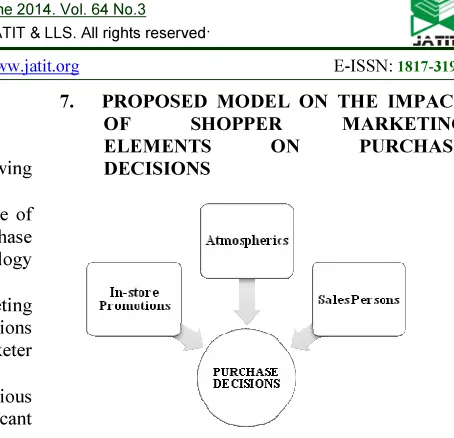
Figure 1 - Impact of Shopper Marketing Elements on Purchase Decisions
The main intent with which the study is taken is to find out the impact shopper marketing efforts have on the purchase decisions of the consumers in purchase Information Technology Devices. The study has taken up three major shopper marketing elements Atmospherics, In-store promotions and Sales persons as independent variables and attempted to find the impact these elements have on the purchase decisions which is taken as the dependent variable.
In the construct atmospherics the five indicators that constitute store atmospherics like Layout, Lighting, Temperature, Shelf Management and Cleanliness were taken. In the construct in-store promotions indicators taken were Loyalty Card Discounts, Price offs, Gifts, End-aisle displays and Banners. For determining the construct sales persons some of the significant attributes of them like Physical appearance, Product demonstration capability, Response to queries and their Attitude were taken as indicators.
The below listed hypotheses were framed for this study.
H1 Store atmospherics has got a direct causal relationship on purchase decisions of the consumers H2 In-store promotional efforts by the retailer has got a direct causal relationship on the purchase decisions of the consumers
8. RESULTS AND INTERPRETATIONS
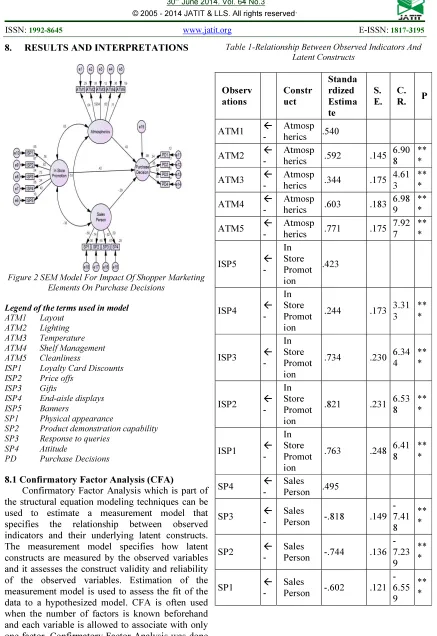
Figure 2 SEM Model For Impact Of Shopper Marketing Elements On Purchase Decisions
Legend of the terms used in model
ATM1 Layout ATM2 Lighting ATM3 Temperature ATM4 Shelf Management ATM5 Cleanliness
ISP1 Loyalty Card Discounts ISP2 Price offs
ISP3 Gifts
ISP4 End-aisle displays ISP5 Banners
SP1 Physical appearance
SP2 Product demonstration capability SP3 Response to queries
SP4 Attitude
PD Purchase Decisions
8.1 Confirmatory Factor Analysis (CFA)
[image:7.595.83.520.85.721.2]Confirmatory Factor Analysis which is part of the structural equation modeling techniques can be used to estimate a measurement model that specifies the relationship between observed indicators and their underlying latent constructs. The measurement model specifies how latent constructs are measured by the observed variables and it assesses the construct validity and reliability of the observed variables. Estimation of the measurement model is used to assess the fit of the data to a hypothesized model. CFA is often used when the number of factors is known beforehand and each variable is allowed to associate with only one factor. Confirmatory Factor Analysis was done on the final data to confirm that all the indicators that constitute the independent variable.
Table 1-Relationship Between Observed Indicators And Latent Constructs Observ ations Constr uct Standa rdized Estima te S. E. C. R. P
ATM1
-
Atmosp
herics .540
ATM2
-
Atmosp
herics .592 .145
6.90 8 ** * ATM3 - Atmosp
herics .344 .175
4.61 3 ** * ATM4 - Atmosp
herics .603 .183
6.98 9 ** * ATM5 - Atmosp
herics .771 .175
7.92 7 ** * ISP5 - In Store Promot ion .423 ISP4 - In Store Promot ion
.244 .173 3.31
3 ** * ISP3 - In Store Promot ion
.734 .230 6.34
4 ** * ISP2 - In Store Promot ion
.821 .231 6.53
8 ** * ISP1 - In Store Promot ion
.763 .248 6.41
8 ** * SP4 - Sales
Person .495
SP3
-
Sales
Person -.818 .149
-7.41 8 ** * SP2 - Sales
Person -.744 .136
-7.23 9 ** * SP1 - Sales
Person -.602 .121
-6.55 9
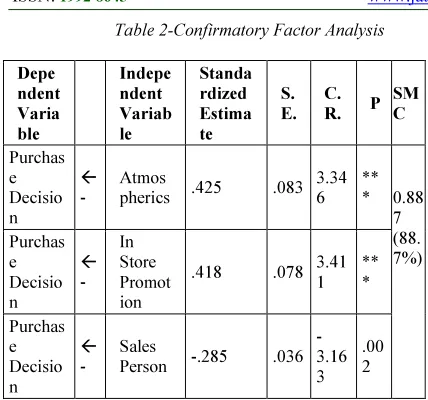
Table 2-Confirmatory Factor Analysis
Depe ndent Varia ble
Indepe ndent Variab le
Standa rdized Estima te
S. E.
C. R. P
SM C
Purchas e Decisio n
-
Atmos
pherics .425 .083 3.34 6
** *
0.88 7 (88. 7%) Purchas
e Decisio n
-
In Store Promot ion
.418 .078 3.41 1
** *
Purchas e Decisio n
-
Sales
Person -.285 .036 -3.16 3
.00 2
Confirmatory Factor Analysis confirms that all the independent variables as stated in the proposed model have got a direct causal relationship on the dependent variable. This can be inferred from Table 2. The Critical Ratio for all the independent variables is above 1.96. The Probability value is less than 0.05 for all the independent variables which mean that all the independent variables are independent impact on the dependent variable. Hence the shopper marketing elements have got an impact on the purchase decisions of the consumers.
8.2 Path Model
8.2.1 The Goodness-of-Fit Index (GFI)
The GFI is a non-statistical measure that ranges in value from 0 (poor fit) to 1 (perfect fit). The higher the GFI, the better the model fit is considered to be. There is no definite value that indicates “good” model fit (Chin and Todd, 1995), although values above 0.90 are usually considered to be favorable to conclude that there is a good fit between the proposed model and the observed data.
8.2.2 Adjusted Goodness-of-Fit Index (AGFI) The AGFI is similar to the GFI, but it is adjusted by the ratio of the degrees of freedom for the proposed model to the degrees of freedom for the null. Again, there is no set standard for an acceptable AGFI. In some instances, values of 0.80 or greater are often considered an indication of good fit model (Taylor and Todd, 1995), although values as low as 0.70 have been considered acceptable.
8.2.3 The Comparative Fit Index (CFI)
This is another measure of overall goodness of fit that uses a Chi-square distribution. The CFI
produces a value between 0 and 1, with 1 indicating a perfect fit. As a rule of thumb for this statistic, values of 0.90 or above are considered to indicate a good fit. This is one of the most used measures of unidimensionality of the scale.
8.2.4 Bentler-Bonett Fit Index (NFI or TLI) NFI or TLI is a good indicator of the convergent validity of the questionnaire. The scale with TLI values of 0.90 or above is an indication of strong convergent validity (Bentler and Bonett, 1980).
8.2.5 Root Mean Square Error of Approximation (RMSEA)
[image:8.595.82.296.117.317.2]This is a popular measure of fit which is also called discrepancy per degree of freedom. By convention, there is good model fit if RMSEA is less than or equal to 0.05. There is adequate fit if RMSEA is less than or equal to 0.08. More recently, Hu and Bentler (1999) have suggested RMSEA<=0.05 as the cutoff for a good model fit.
Table 3 Results of Goodness of Fit Indices for the Proposed Model
Fit Measure Default
Model
Fit
GFI 0.909 Very
Good
Adjusted GFI 0.880 Good
Normed fit index 0.839 Good
Comparative fit index 0.914 Very
Good
RMSEA 0.059 Very
Good
The Fit Measures in Table 3 validates the proposed model depicted in Figure 1. Hence it can be inferred that the shopper marketing elements and the efforts by the retailer has got a significant impact on the purchase decisions of the consumers in purchasing televisions. It is also inferred from the Table 2 that amongst the in-store marketing
elements the independent variable in-store
promotion has got a significant influence on the purchase decisions compared to the other elements taken for the study.
9. CONCLUSION
consumers in their purchase of Information Technology Devices. The proposed model states the fact that shopper marketing efforts have got a significant impact on the purchase decisions of consumers. So the marketers should ensure that along with their controlled promotions to induce consumers they should also try to understand and control what happens in the black box of the consumers at the point of purchase. The retailers should not have a mindset that the outlet is just a point of sale but is a place that should provide a conducive environment to give the visitors a wholesome shopping experience because the retail store environment factors have got a significant impact on the purchase decisions of the consumers.
REFERENCES:
[1] Billings '90, Wendy L., "Effects of Store
Atmosphere on Shopping Behavior" (1990).
Honors Projects. Paper 16.
http://digitalcommons.iwu.edu/busadmin_honp roj/16
[2] Quartier Katelijn, Christiaans Henri and Van
Cleempoel, Koenraad (2008). Retail design: lighting as an atmospheric tool, creating experiences which influence consumers’ mood and behaviour in commercial spaces. In:
Undisciplined! Design Research Society
Conference 2008, Sheffield Hallam University, Sheffield, UK, 16-19 July 2008.
[3] Maria Pereira, Susana Azevedo, Vera
Bernardo, Fernando Moreira Da Silva, Rui Miguel and José Lucas (2010) - The effect of visual merchandising on fashion stores in shopping centres - 5th International Textile, Clothing & Design Conference – Magic World of Textiles October 03rd to 06th 2010, Dubrovnik, Croatia
[4] W.M.C.B. Wanninayake and Pradeep
Randiwela (2007)- The impact of visual merchandising on consumer store choice decisions in Sri Lankan supermarkets - 7th Global Conference on Business & Economics October 13-14, 2007 Rome, Italy. ISBN : 978-0-9742114-9-4
[5] Kim-Shyan Fam, Bill Merrilees, James E.
Richard, Laszlo Jozsa, Yongqiang Li and Jayne Krisjanous (2011) – “In-store marketing: a strategic perspective” Asia Pacific Journal of Marketing and Logistics Vol. 23 No. 2, 2011 pp. 165-176
[6] Vasanth Kiran, Mousumi Majumdar, Krishna
Kishore (2012), “Innovation in In-Store Promotions: Effects on Consumer Purchase Decision”, European Journal of Business and Management, Vol 4, No.9, 2012
[7] Gillian Naylor and Kimberly E. Frank, (2000)
"The impact of retail sales force responsiveness on consumers’ perceptions of value", Journal of Services Marketing, Vol. 14 Iss: 4, pp.310 – 322
[8] Ruoh-Nan Yan, Jennifer Yurchisin and