Copyright © 2018, Scholarly Research Journal for Interdisciplinary Studies
CONSTRUCTION AND VALIDATION OF ACHIEVEMENT TEST IN CHEMISTRY (ATC)
R. Babu1, Ph. D. & R. Gandhiji2 1
Prof. Dean, Faculty of Education, Annamalai University, Annamalai Nagar, Tamilnadu, India.
2
Research Scholar, Department of Education, Annamalai University, Annamalai Nagar.
In learning situation, the most important centre of attention of teaching is to make easy the learners to learn absolutely the subject qualified to them. To know the importance of achievement of the students, many conventional and contemporary methods of evaluation, techniques and tools are used. The means and methods of evaluation differ from oral tests to online tests. However, Achievement test in Chemistry is considered the majority popular dependable and possible one. Therefore, in the present study, the researcher has planned to construct and validate an Achievement test in Chemistry to determine the achievement level of Higher Secondary students in chemistry.According to the validation procedure the framed 100 questions were finalized to 50 questions constituting the Achievement test in Chemistry.
Keywords: Achievement in Chemistry, Higher secondary school student.
INRODUCTION
The knowledge attained or skills developed in the school subjects, usually resolute by
test scores or by marks assigned by teachers. In the present study, Achievement in Chemistry
is measured as the total score obtained by a student as measured in the Achievement Test
constructed by the researcher, in Chemistry, covering the cognitive domain of the behaviours.
NEED AND IMPORTANCE
Life in universal and for a student in exacting, has become highly ready for action.
The two years of higher secondary course has become very critical in view of the fact that
these two years shape the entire future of a student. Educationists, teachers and parents are all
equally afraid about problems of achievement. The increasing number of low achievers has
made them really anxious and research in their direction has made it clear that a student
shortage or lack of achievement is not due to single factor but due to contribution of factors.
Most of the low achievers have no regularity of habits, they show withdrawing tendencies,
Copyright © 2018, Scholarly Research Journal for Interdisciplinary Studies OBJECTIVE
To construct and to validate an Achievement test in Chemistry (ATC).
SAMPLE
100 Higher secondary school students were selected by using Random sampling technique.
METHOD OF THE STUDY
Normative survey method has been used in the present study.
TOOL
The tool namely, Achievement test in Chemistry (ATC) was developed by the
researcher in order to measure the Achievement in Chemistry of the students. The
Achievement test in Chemistry (ATC) was constructed based on the following three main
phases.
a) Pre- pilot phase
b) P i l o t phase and
c) Finalization phase
Pre- Pilot Phase
Pre- pilot phase is concerned with item pooling. It consists of
a) Source of items
b) Laying down / criteria for item collection
a) Sources of Items
The preliminary item pool was made by drawing items from the following sources
Review of thematic and research work
Discussion with the school Headmasters
Discussion with the experienced educational psychologists
Discussion with the learners
Discussion with educational experts
By careful analysis of the above sources, statements were collected and tabulated. Thus a
total of 100 statements were gathered during this stage.
b) Criteria for selection of items
The collected statements were not directly administered, but they were subjected to
screening. The following criteria were considered while screening and thereby some
statements were added or excluded.
The language of the statements should be simple, clear and unambiguous
Copyright © 2018, Scholarly Research Journal for Interdisciplinary Studies
The statements that are likely to be enclosed by almost every one or no one
should be avoided.
The compound and complex statements should be avoided.
Pilot Study Phase
Once the statements are collected, the next step is pilot study. The pilot study is concerned
with refining the items collected during the pre- pilot state. The refinement of the items has
been conducted at two levels
a) Judgment analysis,
b) Item analysis
a) Judgment Analysis: Judgment analysis implies eliciting the opinion of the experts in the area of study regarding the suitability and objectivity of the items pooled. All the
100 items gathered during the pre-pilot stage were sent to a jury opinion regarding their
suitability and clarity, in which the jury council consisting of three school Headmasters
belonging to the higher secondary schools in Cuddalore District. On the basis of the jury
council’s judgment, some of the items were restructured and retained.
b) Item Analysis: Having refined and reworded the items, it was decided to put all the 100 items under item analysis procedure. The main objective of the item analysis is to obtain
objective information concerning the items pooled. This information is valuable to eliminate
subjective judgment in selecting the items. Further, it enables the investigator to know how
the respondents react to the items in the Achievement test in Chemistry (ATC).
The researcher has developed Objective type of Question, which consists of 100
questions. This 100 questions intended for the pilot study was administered to the sample of
as many as 100 school students studying in the first year higher secondary schools situated in
the Cuddalore district of Tamilnadu, India. The next step in the construction and validation of
Achievement test in Chemistry (ATC) after pilot study is to find out Index of Discrimination
value of each statement which forms the basis for item selection in order to build up the final
test
Difficulty index of an item:
The difficulty of an item is represented by the percentage of students who responded
to it correctly. It was calculated by using the formula,
D.I. =𝑈 + 𝐿
2𝑁
Copyright © 2018, Scholarly Research Journal for Interdisciplinary Studies L = Number of correct responses in the lower group
N = Number of students in both groups
Discriminating power of an item:
Discriminating power of an item indicates the measure of the extent to which a test
item discriminates or differentiates between the students who do well on the overall test and
those who do not do well on the overall test.
In an educational achievement test, the principal function is to distinguish different
levels of achievement as much clear as possible. Hence, the discriminating power of the item
was calculated by the formula,
D.P. =𝑈 − 𝐿
2𝑁
where, U = Number of correct responses in the upper group
L = Number of correct responses in the lower group
N = Number of students in both groups
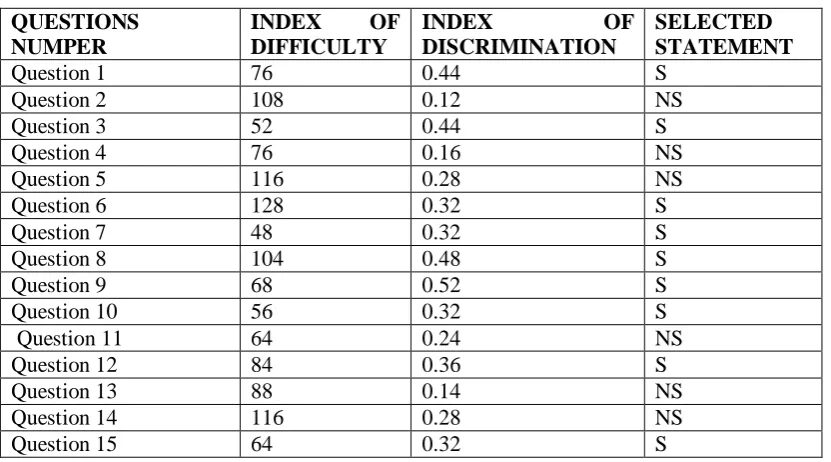
Any item, whose discriminating power is above 0.30, should be considered as
reasonably good item. In the present study, only such of those items whose difficulty indices
ranged from 0.30 to 0.90 and whose discriminating power falls between 0.30 to 0.90 were
selected. The item selected for the final study is indicated by the symbol ‘S’ and the not
selected items by the symbol ‘NS’. The difficulty index and discrimination power values are
[image:4.595.92.508.530.761.2]given in the table.1.
Table 1: The Index Of Difficulty And Index Of Discrimination Values For The Achievement Test In Chemistry
QUESTIONS NUMPER
INDEX OF
DIFFICULTY
INDEX OF
DISCRIMINATION
SELECTED STATEMENT
Question 1 76 0.44 S
Question 2 108 0.12 NS
Question 3 52 0.44 S
Question 4 76 0.16 NS
Question 5 116 0.28 NS
Question 6 128 0.32 S
Question 7 48 0.32 S
Question 8 104 0.48 S
Question 9 68 0.52 S
Question 10 56 0.32 S
Question 11 64 0.24 NS
Question 12 84 0.36 S
Question 13 88 0.14 NS
Question 14 116 0.28 NS
Copyright © 2018, Scholarly Research Journal for Interdisciplinary Studies
Question 16 84 0.44 S
Question 17 80 0.32 S
Question 18 68 0.2 NS
Question 19 108 0.28 NS
Question 20 120 0.16 NS
Question 21 96 0.32 S
Question 22 68 0.28 NS
Question 23 40 0.00 NS
Question 24 88 0.32 S
Question 25 60 0.04 NS
Question 26 56 0.16 NS
Question 27 12 0.04 NS
Question 28 68 0.36 S
Question 29 36 -0.2 NS
Question 30 40 0.00 NS
Question 31 36 0.36 S
Question 32 84 0.44 S
Question 33 36 -0.00 NS
Question 34 60 0.28 NS
Question 35 48 0.24 NS
Question 36 80 0.32 S
Question 37 52 0.2 NS
Question 38 68 0.2 NS
Question 39 64 0.32 S
Question 40 80 0.16 NS
Question 41 84 0.28 NS
Question 42 44 0.36 S
Question 43 28 0.12 NS
Question 44 76 0.36 S
Question 45 76 0.28 NS
Question 46 64 0.16 NS
Question 47 36 0.12 NS
Question 48 76 0.44 S
Question 49 88 0.08 NS
Question 50 76 0.44 S
Question 51 76 0.36 S
Question 52 68 0.36 S
Question 53 48 0.32 S
Question 54 120 0.16 NS
Question 55 60 0.28 NS
Question 56 96 0.32 S
Question 57 92 0.36 S
Question 58 104 0.24 NS
Question 59 98 0.52 S
Question 60 72 0.24 NS
Question 61 64 0.24 NS
Question 62 84 0.36 S
Question 63 92 0.36 S
Question 64 116 0.28 NS
Question 65 64 0.32 S
Copyright © 2018, Scholarly Research Journal for Interdisciplinary Studies
Question 67 80 0.32 S
Question 68 80 0.08 NS
Question 69 92 0.28 NS
Question 70 120 0.16 NS
Question 71 80 0.16 NS
Question 72 68 0.28 NS
Question 73 88 0.48 S
Question 74 88 0.32 S
Question 75 84 0.28 NS
Question 76 76 0.44 S
Question 77 92 0.36 S
Question 78 68 0.36 S
Question 79 80 0.16 NS
Question 80 92 0.28 NS
Question 81 76 0.76 S
Question 82 84 0.44 S
Question 83 76 0.36 S
Question 84 60 0.28 NS
Question 85 88 0.64 S
Question 86 80 0.32 S
Question 87 80 0.16 NS
Question 88 76 0.12 NS
Question 89 64 0.32 S
Question 90 80 0.16 NS
Question 91 84 0.28 NS
Question 92 44 0.36 S
Question 93 68 0.52 S
Question 94 76 0.36 S
Question 95 76 0.28 NS
Question 96 64 0.16 NS
Question 97 76 0.52 S
Question 98 76 0.44 S
Question 99 88 0.08 NS
Question 100 76 0.44 S
S – Significance and NS – Not Significance
The investigator classified marks and the Achievement level as below
Low level of achievement :Upto 12
Average level of achievement :Above 13 upto 32
High level of achievement :Above 32
VALIDITY AND RELIABILITY OF ACHIEVEMENT TEST IN CHEMISTRY (ATC) Achievement test in Chemistry (ATC) for the school students constructed by the
investigator has content validity as the test contains items from the content areas prescribed
before and the same was ratified by a panel of experts it has construct validity as the items
were selected following rigid item analysis procedure described above its intrinsic validity
Copyright © 2018, Scholarly Research Journal for Interdisciplinary Studies
The coefficient of stability has also been determined by the test retest method and it is
found to be 0.80.
Thus the Achievement test in Chemistry (ATC) has validity and reliability.
CONCLUSION
The tool namely Achievement test in Chemistry (ATC) was hence constructed and
also validated.
REFERENCES
C. R. Kothari (2007) Research methodology methods and techniques, New age international (p) limited, Publishers, New Delhi.
Hasan, M & Khan, S. (2015). Achievement Test in English and Mathematics of Secondary School Students in relation to Gender Differences. The International Journal of Indian Psychology, Volume 2, Issue 3.
Jayanthi, J (2014). Development and Validation of an Achievement Test in Mathematics. International Journal of Mathematics and Statistics Invention (IJMSI), Volume 2, Issue 4, pp.-40-46.
Singh, B. K & Patel, H. A. (2013). Construction and Standardization of an Achievement Test for the Students of Std. VIII in the Subject of Hindi. Indian Journal of Applied Research, Volume: 3, Issue 2.