5607
FLIPPED CLASSROOM INSTRUCTIONAL MODEL WITH
MOBILE LEARNING BASED ON CONSTRUCTIVIST
LEARNING THEORY TO ENHANCE CRITICAL THINKING
(FCMOC MODEL)
1THADA JANTAKOON, 2PALLOP PIRIYASURAWONG
1Department of Computer Science, Faculty of Science and Technology
Rajabhat Maha Sarakham University, Thailand
2Department of Information and Communication Technology for Education,
Faculty of Technical Education King Mongkut’s University of Technology North Bangkok, Thailand
E-mail: 1[email protected], 2[email protected]
ABSTRACT
This study was a report on the findings of a Research and Development (R&D) aiming to develop the model of the flipped classroom with mobile learning based on constructivist learning theory to enhance critical thinking (FCMOC model). The sample consisted of 10 experts in computer education field during the FCMOC model developing stage. The research procedures included 2 phases: (1) Develop FCMOC model and (2) Evaluation of the FCMOC model. The research results was found that the FCMOC model consists of three components were (1) Flipped classroom learning activities on mobile learning technology, (2) The major methods constructivist theory, and (3) 5-Step model to move students toward critical thinking. The experts also evaluated which step of the FCMOC model was most suitable for the development of the respective aspects of critical thinking skill.
Keywords: Flipped Classroom, Mobile Learning, Constructivist, Critical Thinking, FCMOC Model
1. INTRODUCTION
Nowadays, modern technologies are integrated
with the flipped classroom instructional
development models which aim to promote and facilitate learning for people of all ages that can solve the problems regarding place and time limitation for studying in order to become learning societies in 21st century and to learn by focusing on giving an opportunity for all students to create their knowledge, meaningful learning and critical thinking as consistent with the recommendations of learning skills development in 21st century which said that the learning skills development of 21st century is to learn for enhancing knowledge proficiencies, critical thinking skills to achieve the efficiency of learning in current globalization. [1] In the framework of learning in 21st century is also concerned with critical thinking skills, problem solving skills, skills of information and technology which students will be given to question an important issue that lead them to be the best for
solving problem in different situations
appropriately, also can analyze, synthesize and link data orderly. Moreover, the students can interpret and summarize based on reliable analysis as well as reasonable feedback on the basis of experiences and learning to process. [2] Developing learners is needed to use mobile learning as a tool to do research, organize, evaluate and communicate
information. The use of technology in
communication and networking includes access to social media appropriately. [3]
5608 the critical thinking requires knowledge arising from the experiences of the learners. Thus, learning activities by using a problem-based learning which links the experiences of learning contributes the learners to develop their critical thinking skills. An ability to think critically is highly valued in higher education generally.
The important characteristic of the flipped learning is focusing on student-centered of active learning in small group classes and comes from knowledge searching to use for learning objectives that have been assigned. The process of learning will run systemically step by step, acquiring up-to-date knowledge and it can be applied for the student in the real life which is effective for teaching and also it is unlimited to disseminate the knowledge into others sciences. Flipped learning usage is a strategy that constructivist to develop critical thinking skills and the student is able to apply knowledge to critical thinking effectively. Therefore, it is very necessary to develop learning model for making the critical thinking skills of students.
2. LITERATURE REVIEW
2.1 Flipped Classroom
The flipped classroom strategy is considered potential to promote the comprehensive development of critical thinking skills among students under a learner-centered paradigm, as the learning tasks in flipped classrooms depend heavily on learner-driven preparation outside of formal class time. In flipped classrooms, learning tasks typically done as homework are undertaken in class with guidance from teachers, especially those collaborative learning tasks such as whole-class brainstorming, group-based hands-on assignments and peer reviews, feedback exchange and remedial help, etc. [4, 5, 5]. Teachers in flipped classrooms are enabled to free up class time to make meaningful contact with students for observing, guiding, commenting, and helping. Students in this regard can take more control of the pace, progress and responsibility in their own learning process according to individual needs [7, 8].
In the digital age, the idea of flipped classrooms has gained prominence due to advancement in digital technology which enables students to ubiquitously access resources and connect with peers [5, 7]. For flipped classrooms in the digital age—the digital classrooms, students use personal computing devices, especially mobile devices that are wirelessly interconnected, on their own or with a small group of peers for learning proposes [9, 10]. Such flipped classroom strategy
moves passive learning tasks of knowledge delivery beyond formal class time; and uses classroom
learning activities to prompt knowledge
construction through the access to additional learning information from sources other than textbooks, and the extensive interactions with peers and teachers within formal class time [4, 11].
These learning tasks in flipped classrooms often require students to properly process and then critically assimilate information from different sources for knowledge construction [9, 12, 13]. Students are therefore enabled to progressively develop a deep understanding of domain knowledge through the convenient access to appropriate and sufficient resources and the extensive sharing of useful information [6]. This study attempted to investigate the outcome of critical thinking achievement of learners when its development is infused into subject teaching which deploys the flipped classroom strategy and pedagogical ways to enhance students' awareness of the need and process of developing critical thinking skills in classroom learning.
2.2 Mobile learning
An examination of the current state of
mobile learning will make obvious how facilitators, in concert with mobile devices, create the opportunity for increased learner access to the critical thinking intervention, and facilitator access to learner. MoLeNET [14] defines mobile learning as “the exploitation of ubiquitous handheld technologies, together with wireless and mobile phone networks, to facilitate, support, increase and continue the reach of teaching and learning.” One can distinguish mobile devices from other forms of technology by their portability, ability to link, and ability to reach learner and learner’s needs [15].
The device, to be considered mobile,
5609
2.3 Constructivist learning theory
Constructivism is an education perspective
in which students build their understanding of concepts through a combination of their existing knowledge and new experiences [16]. Students who actively participate in their learning are one of the main focuses of science education, according to teachers who held a constructivist belief. Teachers guide the learning in a constructivist setting rather than just imparting knowledge to the students [17]. The flipped classroom model embodies this type of learning by eliminating the traditional lecture from the classroom and provides students with increased opportunities for active participation. In this way, students can build on their understanding of concepts and apply this knowledge in a supportive setting overseen by their instructor.
2.4 Critical thinking skill
Developing this type of thinking helps
individuals learn about themselves and the other, acquiescence the workplace to reap the rewards of variety. Research shows that workplace variety directly impacts institutional innovation [18]. Critical thinking authorizes people to apply minding to move beyond the friction and barriers that impede collaboration required for innovation. Service members can also advantage from innovation stemming from critical thinking and variedness when integrating with foreign military units. They may employ empathy at the tactical level within the battlespace to assess intent appropriately, and at the strategic tier where creator require a deeper understanding of the people and context to win the hearts and minds [19].
A supporting factor to the unsparing use of
the term and lack of its application may derive from the complexity that arises while trying to determine it. In an attempt to determine concept, one must first understand that 5 intellectual traditions significantly influenced the term and created distinct brands of critical thinking skill. Critical theory, analytic logic and philosophy, natural science, psychoanalysis, and pragmatism [20] utilize explicit criteria to shape the idea of critical thinking in each of their fields. The following section will briefly highlight their similarities, shared ideas, and usage of the concept the interfiled commonalities. Brookfield’s [20] definition of critical thinking asserts that assumptions frame thinking and determine actions. The criticality of the thinking emerges through a presumption of the validity of existing assumptions, and the utilization of multiple perspectives prior to taking action [20]. This condensed critical theory based view of
critical thinking requires an application of self-criticality and an ability to recognize what the field establishes as legitimate knowledge.
3. METHODOLOGY
This research was divided into 2 phases
which are (1) Develop FCMOC model, and (2) Evaluation on the FCMOC model.
3.1.1 Phase 1: Develop FCMOC model
The study in this phase included the study
of theories and research on flipped classroom, mobile learning, constructivist learning theory, and critical thinking skill to be used as guidelines in determining learning processes and components of the FCMOC model. The FCMOC model will be development after documentation review, and then the interview will be conducted to get an opinion towards the model from 10 experts.
3.1.2 Phase 2: Evaluation on the FCMOC
model
After gathering all of information and
5610
4. RESULT
[image:4.612.97.519.134.516.2]Phases 1: The FCMOC model is composed of 3 key components which are:
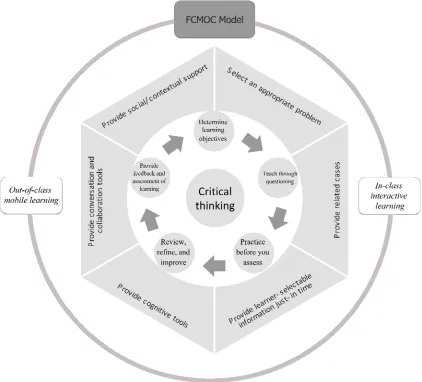
Figure 1. Flipped Classroom Instructional Model With Mobile Learning Based On Constructivist Learning Theory To Enhance Critical Thinking (FCMOC Model)
4.1 Flipped classroom learning activities on
mobile learning technology
A typical flipped classroom involves two
major components: (1) out-of-class mobile learning, and (2) in-class interactive learning. Fig. 1 provides a depiction of the FCMOC model.
4.1.1 Out-of-class mobile learning
Out-of-class mobile learning activities
should provide students with sufficient preparation for in-class learning, without overwhelming the learners. Following a literature review, there are two essential instructional activities in the out-of-class learning component. FCMOC model can be
applied to guide the design for these out-of-class instructional activities.
4.1.1.1 Pre-class video lecture. One of the most
common strategies for delivering course materials prior to class is the use of instructional videos [21, 22]. An action research project by Grypp and Luebeck [23] indicated that watching instructional videos was more effective in helping students to prepare for class than reading text-based materials. Pre-class instructional videos have been used for flipping various secondary school subjects.
4.1.1.2 Online follow-up exercise. After watching
5611 questions concerning the video contents [24, 22, 25]. The use of online follow-up exercises allows the students to apply their new knowledge and promote their learning (i.e., application principle). Empirical support for this approach can be found in a study by Szpunar, Khan, and Schacter [26].
4.1.2 In-class interactive learning
In-class learning experiences are also
essential to the success of the flipped classroom approach [24, 27, 28]. Teachers should fully utilize the in-class time that is freed up by shifting direct lecturing to outside the classroom. Three core instructional activities have been identified, namely brief reviews of out-of-class learning, mini-didactic lectures, and critical thinking activities.
4.1.2.1 Brief review on out-of-class learning. At
the beginning of class meetings, some teachers [23, 29, 30] start their lessons with a brief review of the out-of-class learning (i.e., activation principle). A Q&A session could provide an opportunity for teachers to clarify the students’ misunderstandings about video contents [23].
4.1.2.2 Mini-didactic lecture. Some teachers have
encountered problems when flipping their entire courses [22, 31]. These difficulties suggested that in-class short didactic lectures were still necessary to deliver some of the more complicated concepts. Although the flipped classroom approach emphasizes the moving of direct lectures to outside the classroom.
4.1.2.3 Critical thinking activities. By shifting
parts of the course materials to outside the classroom, more in-class time can be spent on critical thinking activities [32].
4.2 The major methods constructivist theory
The major methods constructivist theory
offer [32] involves six major activities: (1) Select
an appropriate problem, (2) Provide related cases,
(3) Provide learner-selectable information just-in time, (4) Provide cognitive tools, (5) Provide conversation and collaboration tools, and (6) Provide social/contextual support for the learning environment. Fig. 1 provides a depiction of the FCMOC model.
4.2.1 Select an appropriate problem. (or question,
case, project) for the learning to focus on.
The problem should be interesting, relevant and
engaging, to foster learner ownership.
The problem should be defined or
ill-structured.
The problem should be authentic (what
practitioners do).
The problem design should address its context,
representation, and manipulation space.
4.2.2 Provide related cases or worked examples to
enable case-based reasoning and enhance cognitive flexibility.
4.2.3 Provide learner-selectable information just-in time
Available information should be relevant
and easily accessible.
4.2.4 Provide cognitive tools that scaffold required
skills, including problem-representation tools, knowledge-modeling tools, performance-support tools, and information-gathering tools.
4.2.5 Provide conversation and collaboration
tools to support discourse communities,
knowledge-building communities, and/or
communities of learners.
4.2.6 Provide social/contextual support for the
learning environment. This theory also offers the
following instructional activities to support learning:
Model the performance and the covert cognitive
processes.
Coach the learner by providing motivational
prompts, monitoring and regulating the leamer's
performance, provoking reflection, and/or
perturbing learners' models.
Scaffold the learner by adjusting task difficulty,
restructuring the task, and/or providing alternative assessments.
4.3 5-Step Model to Move Students toward
Critical Thinking
5-Step Model to Move Students toward
Critical Thinking [33] involves five major steps: (1) Determine learning objectives (2) Teach through questioning (3) Practice before you assess (4) Review, refine, and improve and (5) Provide feedback and assessment of learning. Fig. 1 provides a depiction of the FCMOC model.
4.3.1 Step 1: Determine learning objectives.
5612 providing a base of learning to be built upon by another syllabus, a teacher should first analyze the key learning objectives that set what deportment students should show when they exit the class. To make critical thinking increase, these learning objectives, as well as the obligation and assessments, must include those tied to the higher class of Bloom's (1956) taxonomy.
4.3.2 Step 2: Teach through questioning.
Questioning is a necessary part of the learning process and teaching. It allows the teacher to create what is already known and then to expand above that to develop new ideas and understandings. Questions can be used to stimulate interaction between learner and teacher and to challenge the learner to defend his or her position, (i.e., to think critically).
4.3.3 Step 3: Practice before you assess. In the
past decade, a major transfer has taken place in education; that transfer is an active learning. Teachers that have used this approach usually find that the students learn rather and that the courses are rather enjoyable.
4.3.4 Step 4: Review, refine, and improve.
Teachers should plan to continually refine their courses to ensure that their instructional procedure is in fact helping the learner develop critical thinking skills. To achieve this, teachers should observe the classroom activities very closely.
4.3.5 Step 5: Provide feedback and assessment of
learning. Teacher feedback, like evaluation,
compares criteria and standards to student performance in an effort to assess the quality of the result. However, the purpose of feedback is to increase the quality of performance and, student learning rather than to grade the performance and, importantly, it has the potential to help students learn how to evaluate their own performance in the future. Feedback allows the student(s) and teacher to take in dialogue about what distinguishes
successful performance from unsuccessful
performance as they discuss criteria and standards.
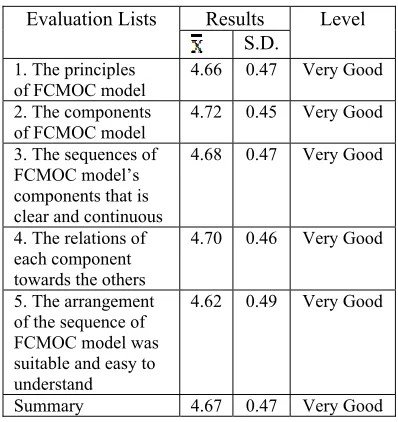
[image:6.612.318.517.140.351.2]Phases 2: The result of appropriateness measurement of the FCMOC model.
Table 1: Experts’ evaluation of the FCMOC model.
Evaluation Lists Results Level
S.D. 1. The principles
of FCMOC model
4.66 0.47 Very Good
2. The components of FCMOC model
4.72 0.45 Very Good
3. The sequences of FCMOC model’s components that is clear and continuous
4.68 0.47 Very Good
4. The relations of each component towards the others
4.70 0.46 Very Good
5. The arrangement of the sequence of FCMOC model was suitable and easy to understand
4.62 0.49 Very Good
Summary 4.67 0.47 Very Good
Evaluation of the appropriateness of the
FCMOC model In Table 1 shows that the ten expert agree with the principles of FCMOC model that had very good results (mean = 4.66, S.D. = 0.47). The components of FCMOC model ranked as very good (mean = 4.72, S.D. = 0.45). The sequences of FCMOC model’s components that is clear and continuous were ranked as very good (mean = 4.68, S.D. = 0.47). The relations of each component towards the others was ranked as very good (mean = 4.70, S.D. = 0.46), and the arrangement of the sequence of FCMOC model was suitable and easy to understand was ranked as very good (mean = 4.62, S.D. = 0.49).
5. CONCLUSIONS
According to the document analysis that is
associated with the flipped classroom and constructivist, together with mobile learning for critical thinking, it was found that the FCMOC model consists of three components: (1) Flipped classroom learning activities on mobile learning technology, (2) The major methods constructivist theory, and (3) 5-Step Model to Move Students toward Critical Thinking. The experts also evaluated which step of the FCMOC model was most suitable for the development of the respective aspects of critical thinking skill. The knowledge review was based on constructivist in the learning support activities for students on mobile learning, being
5613
6. ACKNOWLEDGEMENT
This research was supported by the
Research and Development Institute and Faculty of Science and Technology, Rajabhat Maha Sarakham University, Thailand.
REFRENCES:
[1] Kongrugsa, N., Nilsook, P., & Wannapiroon, P. (2016). Designing a Knowledge Review, Based on Connectivism of Cloud Computing for Developing Critical Thinking. International Journal of Information and Education Technology, Vol. 6, Pages 492-495. Retrieved from:http://www.ijiet.org/vol6/738-JM051.pdf [2] Jantakoon, T., & Jantakun, T. (2017).
Development of Flipped Classroom
Instructional Model by using Webquest Base on Constructivism Theory for Creating Critical Thinking and Problem-Solving Skill, The Turkish Online Journal of Educational Technology, Special Issue for INTE 2017 (October), ISSN 1303 – 6521. 870-874.
[3] Lee, H., Parsonsl, D., Kwon, G., Kim, J., Petrova, K., Jeong, E., & Ryu, H. (2016). Cooperation begins: Encouraging critical thinking skills through cooperative reciprocity using a mobile learning game, Computers & Education, Volume 97, Pages 97-115, ISSN 0360-1315, https://doi.org/10.1016/j.compedu.2016.03.006. [4] Bergmann, J., & Sams, A. (2012). Why you
should flip your classroom. Flip your classroom reach every student in every class every day. Eugene, OR: International Society for Technology in Education
[5] Davies, R., Dean, D., & Ball, N. (2013). Flipping the classroom and instructional technology integration in a college-level information systems spreadsheet course. Educational Technology Research and Development, 61(4), 563-580.
[6] Kong, S. C. (2014). Developing information literacy and critical thinking skills through domain knowledge learning in digital classrooms: an experience of practicing flipped classroom strategy. Computers and Education, 78, 160-173.
[7] Flumerfelt, S., & Green, G. (2013). Using lean in the flipped classroom for at risk students. Educational Technology and Society, 16(1), 356-366.
[8] Fulton, K. P. (2012). 10 reasons to flip. Phi Delta Kappan, 94(2), 20-24.
[9] Chan, T. W. (2010). How East Asian classrooms may change over the next 20 years. Journal of Computer Assisted Learning, 26(1), 28-52. [10] Wong, L. H., & Looi, C. K. (2011). What
seams do we remove in mobile assisted seamless learning? A critical review of the literature. Computers and Education, 57(4), 2364-2381.
[11] Missildine, K., Fountain, R., Summers, L., & Gosselin, K. (2013). Flipping the classroom to improve student performance and satisfaction. Journal of Nursing Education, 52(10), 597-599. [12] Kang, M., Heo, H., Jo, I. H., Shin, J., & Seo, J.
(2010). Developing an educational performance indicator for new millennium learners. Journal of Research on Technology in Education, 43(2), 157-170.
[13] Kong, S. C. (2011). An evaluation study of the use of a cognitive tool in a one-to-one classroom for promoting classroom-based dialogic interaction. Computers and Education, 57(3), 1851-1864.
[14] MoLeNET (2011) http://www.molenet.org.uk accessed 14 December 2014.
[15] Shippee, M. & Keengwe, J. (2014). mLearning: Anytime, anywhere learning transcending the boundaries of the educational box.
[16] Parrotta, P., Pozzoli, D., & Pytlikova, M. (2014). The nexus between labor diversity and firm’s innovation. Journal of Population
Economics, 27(2), 303-364. Chicago.
[17] Feyzioglu, E. (2012). Science teachers’ beliefs as barriers to implementation of constructivist-based education reform. Journal of Baltic Science Education, 11(4), 302-317.
[18] Parrotta, P., Pozzoli, D., & Pytlikova, M. (2014). The nexus between labor diversity and firm’s innovation. Journal of Population Economics, 27(2), 303-364. Chicago.
[19] Cutright, K. R. (2013). Empathy for Carnivores. Army Command and General Staff Coll Fort Leavenworth KS School of Advanced Military Studies.
[20] Brookfield, S. D. (2011). Teaching for critical thinking: Tools and techniques to help students question their assumptions. John Wiley & Sons. [21] Abeysekera, L., & Dawson, P. (2015).
Motivation and cognitive load in the flipped classroom: Definition, rationale and a call for research. Higher Education Research and Development, 34(1), 1–14.
5614
education: Possible solutions and
recommendations for future research. Research and Practice in Technology Enhanced Learning, 12(1), 4.
[23] Grypp, L., & Luebeck, J. (2015). Rotating solids and flipping instruction. Mathematics Teacher, 109(3), 186–193.
[24] Bishop, J. L., & Verleger, M. A. (2013). The flipped classroom: A survey of the research.
120th ASEE national conference and
exposition, Atlanta, GA (Paper ID 6219). Washington, DC: American Society for Engineering Education.
[25] Hew, K. F., Huang, B., Chu, K. W. S., & Chiu, D. K. (2016). Engaging Asian students through game mechanics: Findings from two experiment studies. Computers & Education, 92, 221–236. [26] Szpunar, K. K., Jing, H. G., & Schacter, D. L.
(2014). Overcoming overconfidence in learning from video-recorded lectures: Implications of interpolated testing for online education. Journal of Applied Research in Memory and Cognition, 3(3), 161–164.
[27] Eisenhut, L. A., & Taylor, C. E. (2015). In-class purposes of flipped mathematics educators. Journal of Mathematics Education at Teachers College, 6(2), 17–25.
[28] Giannakos, M. N., Krogstie, J., & Chrisochoides, N. (2014). Reviewing the flipped classroom research: Reflections for computer science education. Proceedings of the computer science education research conference (pp. 23–29). New York, NY: ACM..
[29] Chao, C. Y., Chen, Y. T., & Chuang, K. Y. (2015). Exploring students' learning attitude and achievement in flipped learning supported computer aided design curriculum: A study in high school engineering education. Computer Applications in Engineering Education, 23(4), 514–526.
[30] Lai, C. L., & Hwang, G. J. (2016). A self-regulated flipped classroom approach to improving students' learning performance in a mathematics course. Computers & Education, 100, 126–140..
[31] Anderson, L., & Brennan, J. P. (2015). An experiment in “flipped” teaching in freshman calculus. Primus, 25(9–10), 861–875.
[32] Jonassen, D. H. (1999). Designing constructivist learning environments. In C. M. Reigeluth (Ed.), Instructional-design theories and models: A new paradigm of instructional theory (Vol. II, pp. 215-39). Mahwah, NJ: Lawrence Erlbaum Associates.