ORIGINAL RESEARCH ARTICLE
GENDER-RESPONSIVE OF MICRO ENTERPRISE DEVELOPMENT STRATEGY USING SAST
(STRATEGIC ASSUMPTION SURFACING AND TESTING) AND ISM
(INTERPRETATIVE STRUCTURAL MODELING)
1*
Kholil,
2Kohar Sulistyadi and
3Dini Agusdini, S.
1,2
Lecturer in Post Graduate Sahid University, Jakarta, Indonesia
3Lecturer in Food Technology, Sahid University University
ARTICLE INFO ABSTRACT
Women's business activities have different characteristics from men. the instinct of the housewife always influences in regulating her business. This study aim to design the most appropiate strategy to develop the business scale of gender responsive micro enterprise. Some aspects to be considered and how business institutions can ensure their sustainability will be assessed using SAST (Strategic Assumption Surfacing and Testing) and ISM (Interpretative Structural Modeling). SAST analysis is chosen to identify important and certain aspects which determines the success of gender responsive business; while ISM anlysis to design the institutional that ensure sustainability of business. The gender responsive of Micro enterprise studied is a food and beverage business based on a superior natural resources.
Copyright ©2017 Kholil et al. This is an open access article distributed under the Creative Commons Attribution License, which permits unrestricted use, distribution, and reproduction in any medium, provided the original work is properly cited.
INTRODUCTION
Home industries (HI) have major role in economic and welfare development of the people. One of the most important roles is as a social safety net, because it can absorb a very large workforce, and reducing the number of unployment. The number of home industries currently around 40 million, with total of workforce 110 million (Anonimous, 2014). Almost home industries are managed by women especially for beginner. This mean that wowen have great potential to develop family economics. Home industries is an industries that employ fewer than six people, limited capital , and integrates with households activities, and all of workers are
family (Sujatmiko, 2014). Although women have a very big
role in their families, and even national development, but policies and their implementations don’t provide any space for women to live as they should. Access, participation, and control on economic resources are limited.
*Corresponding author: Kholil,
Lecturer in Post Graduate Sahid University, Jakarta, Indonesia.
The role and participation of women in micro enterprises are still often overlooked with their obligation as a housewife, even their activities in home industries always fused with her role as a housewife, no separation in managing finances, labor and spending. There are some characteristics of Home industries : (a) limited capital, (b) run by women as subcontracting workersorhomeworkersand family labor, but their participation rarely recognized, (c) low wage, (Sunarso,2010), additionally anonymous (2013) stated that home industries are characterized by four aspects (a) integrated withhouseholds, (b) unskilled labor, (c)low technology and (d) unbankable. Didia, P.Freeman, J.C. Assad, and J.Yuan (2015) stated that labour force of wowen has a positive correlation with economic growth. While Nobari, K. Mohamadkhani, A. M, Davoudi (2014) stated that women behaviourhave a significant enfluence on the productivity of home industries, while Smith (2014) stated that wive, partner is the most important aspects for developing home industries inte term ofbusiness scale.
ISSN: 2230-9926
International Journal of Development Research
Vol. 07, Issue, 12, pp.17830-17834, December,2017Article History:
Received 26th September, 2017
Received in revised form 22nd October, 2017
Accepted 28th November, 2017
Published online 30th December, 2017
Key Words: Women’s Business, Responf Gender,
Superior Natural Resources, AHP, SAST, ISM
Citation: Kholil, Kohar Sulistyadi and Dini Agusdini, S. 2017. “Gender-responsive of micro enterprise development strategy using sast (strategic
assumption surfacing and testing) and ism (interpretative structural modeling)”, International Journal of Development Research, 7, (12), 17830-17834.
Widiastuti, R; Awang, S.A; Prayitno, T.A. Warsito, Sofyan P. (2011) stated that the technologies used in home industries is very simple and all of production process is manual (handmade), moreover, they rely on their own capitals not on the bank’s capital. Husain, Li Xiao Xiao (2016) stated that women leader in Small Medium Enterprise (SME) have a stronger motivation and spirit of the men, and women are more patient and resilient than men in dealing with business constraint. There are three type of home industries by level of business continuity, capital, production process technology, number of workforce, and sales system (Minister of Women and Child Protection, 2013). They are: (1) Startup home industries which is characterized by 1-2 workers whom all members are family, non-continuous production and average income/month 1-5 million. (2) Developing home industries which is characterized by continuous production and fixed sales system, capital is around 25 - 50 million rupiah of personal assets and microfinance credit, 2-5 workers, and (3) Developed home industries characterized by 5-10 workers including the owner, bank credit, production process using technology, business and finance are managed professionally.
The proportion of home industry is currently dominated by the beginner (60-70%) beginner, developing 20-30% and developed 5-10% (PSP3 IPB, 2011). This mean that majority of home industries are not competitive and weak, and only small proportion are well managed. Due to the role of home industry in improving the welfare of families, especially poor families; the government wants to increase business scale of home industry.Thereforesince 2012Kendal Regency has been appointed to be the pilot project of national home industry development. As a pilot project of national home industry development, local government wants to choose the most appropriatestrategyto develop home industry business scalein accordance with the level (beginner/start up, developing and developed). The purpose of this study is to select the most appropriate strategy to develop business scale of home industry which can be replicated nationally.
MATERIALS AND MOTHODS
Data was collected by experts discussion and question are which involved local government, academics of local Universities, and business of home industries, and field visit to see directly the activities of home industry. Data analysis by SAST (Strategic Assumption Surfacing and Testing) method which was developed by Mason and Mitroff (1981), and AHP (Analytical Hierarchy Process) developed by Saaty (1983). SAST was selected to determine basic assumptions which must be considered in home industry development. This analysis is based on respone to question are from experts, while AHP to determine the appropriate strategy based on experts discussion. Based on experts discussion generally AHP structure as follow:
Picture 1. AHP structure of home industry development
RESULT AND DISCUSSION
Public perception on women’s occupation always places it in the context of household activities. Most of women’s work, especially in villages, is revolved around household, so it’s not easy to clearly separate the types or characteristics in market or non-market, economic or non-economic, production or reproduction groups. The difficulty leads to simplification of definition of women’s occupations because a lot of work activities take place at home. Based on a study of 54 examples of home industry in the Kendal Regency showed only 5.7 % were categorized as developed, while most of the others (82.3%) beginner and 12 % as a developing groups. The workers mostly women, working without separation with household chores, and with out health insurance. Most beginner group come from non bank capital owners, with a profit-sharing system agreed by both parties. While in developing and developed groups already using the bank's capital. Women more involved at beginner groups, otherwise at developed groups men a bigger role. In the developing groups of home industries men and womenhave an equal role in business management.
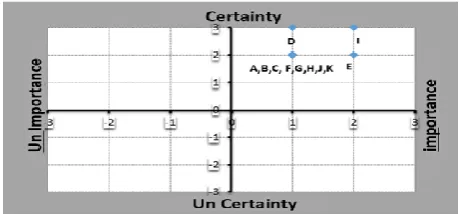
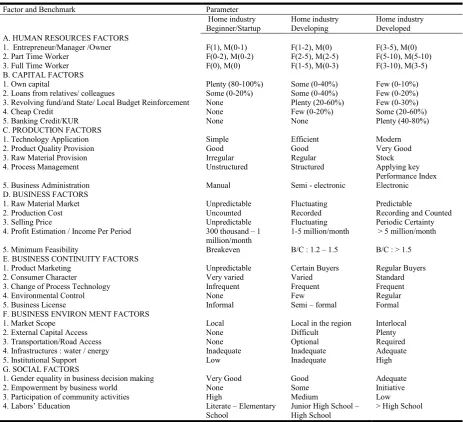
[image:2.595.319.549.667.774.2]There are 8 indicators related to home industry development in Kendal Regency, which are shown in table 1 below: Based on table 8 above shows that there are differences in the characteristics of the three-level home industry (start-up, developing and developed) especially in terms of capital , production, business factors, continuity and business environment factors. Therefore, the development strategy should be different according to their characteristics. Strategic assumptions were formulated from the results of meetings and discussions between experts from various fields. The assumptions were (A) Initiative and creativity of female entrepreneurs in producing potentials of Startup home industry, (B) Market capability and opportunities identified, (C) Innovation and implementation of technologies owned by female entrepreneurs, (D) Coordinated and planned participation of Local Government, (E)The function of Women Empowerment Agency, (F) NGOs’ participation in improving gender equality in local economic activities, (G) The function of business consultation agencies in reinforcing the business continuity of home industry, (H) The function of financial institutions in reinforcing the capital of Startup home industry, (I) Local Government Leaders policies, who motivated and guided home industry development, (J) home industry partnership with large enterprises/large traders in marketing and improving product quality and (K) Relation between poverty alleviation program and home industry reinforcement and progress. Analysis results showed that all of assumptions in quadrant 1, which mean importance and certainty for home industy development, as shown in figure 2.
Of 11 variable assumptions Coordinated and planned participation of Local Government (D) and Local Government Leaders policies, who motivated and guided home industry development (I). This means that the development of home industries is highly dependent on the willingness and policy of
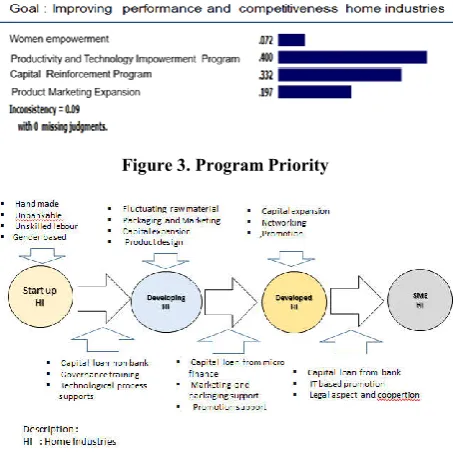
local government leaders.The result of AHP analysis showed
that Productivity and Technology Improvement Program (0.400) is the highest priority program, then followed
[image:3.595.65.529.80.502.2]by rcement Program (0.332), Product Marketing Expansion (0.197) and finally Women Empowerment (0.072). While the main criterion is sustainability, as shown in figure 3. As described above, that most of home industry is a beginner groups, who are still using very simple technology in producing goods (hand made) with limited capital, so priority strategies to improve the performance of home industry is providing technological support and capital loan.
Table 1. Identification of Characters of Home Industry
Factor and Benchmark Parameter
Home industry Beginner/Startup
Home industry Developing
Home industry Developed
A. HUMAN RESOURCES FACTORS
1. Entrepreneur/Manager /Owner F(1), M(0-1) F(1-2), M(0) F(3-5), M(0) 2. Part Time Worker F(0-2), M(0-2) F(2-5), M(2-5) F(5-10), M(5-10)
3. Full Time Worker F(0), M(0) F(1-5), M(0-3) F(3-10), M(3-5)
B. CAPITAL FACTORS
1. Own capital Plenty (80-100%) Some (0-40%) Few (0-10%)
2. Loans from relatives/ colleagues Some (0-20%) Some (0-40%) Few (0-20%) 3. Revolving fund/and State/ Local Budget Reinforcement None Plenty (20-60%) Few (0-30%)
4. Cheap Credit None Few (0-20%) Some (20-60%)
5. Banking Credit/KUR None None Plenty (40-80%)
C. PRODUCTION FACTORS
1. Technology Application Simple Efficient Modern
2. Product Quality Provision Good Good Very Good
3. Raw Material Provision Irregular Regular Stock
4. Process Management Unstructured Structured Applying key
Performance Index 5. Business Administration Manual Semi - electronic Electronic
D. BUSINESS FACTORS
1. Raw Material Market Unpredictable Fluctuating Predictable
2. Production Cost Uncounted Recorded Recording and Counted
3. Selling Price Unpredictable Fluctuating Periodic Certainty
4. Profit Estimation / Income Per Period 300 thousand – 1 million/month
1-5 million/month > 5 million/month
5. Minimum Feasibility Breakeven B/C : 1.2 – 1.5 B/C : > 1.5
E. BUSINESS CONTINUITY FACTORS
1. Product Marketing Unpredictable Certain Buyers Regular Buyers
2. Consumer Character Very varied Varied Standard
3. Change of Process Technology Infrequent Frequent Frequent
4. Environmental Control None Few Regular
5. Business License Informal Semi – formal Formal
F. BUSINESS ENVIRON MENT FACTORS
1. Market Scope Local Local in the region Interlocal
2. External Capital Access None Difficult Plenty
3. Transportation/Road Access None Optional Required
4. Infrastructures : water / energy Inadequate Inadequate Adequate
5. Institutional Support Low Inadequate High
G. SOCIAL FACTORS
1. Gender equality in business decision making Very Good Good Adequate
2. Empowerment by business world None Some Initiative
3. Participation of community activities High Medium Low
4. Labors’ Education Literate – Elementary
School
Junior High School – High School
> High School
Table 2. The Support Required for IR Transformation
Note Transformation of Startup HI Developing HI
Transformation of Developing HI Developed HI
Transformation of Developed HI SME Required Support 1. Non-bank capital loan
2. Process technology fits products 3. Training /consultation from Local
Government/ Regional Work Units (Management, business, TTG, Character development, Entrepreneurship)
4. Sanitation and cleanliness of business environment 5. Business grouping (KUBE)
1. Product packaging (Technique, design, material)
2. Marketing expansion (E-commerce, Online)
3. The role of local governments in promotion
4. Process technology (Improving quality and added values)
5. Institutional status, the role of local governments (Pre cooperative) 6. Expansion of production location to
increase capacity
7. Capital from micro financial institutions (LKM/KSP)
1. Soft Loan Capital from Banks
2. Product packaging (design)
3. Production diversification 4. The role of local
governments in promotion outside of the regions
[image:3.595.54.537.540.694.2]Figure 3. Program Priority
Figure 4. Transformation Process of Home Industry
Home Industry is a private business unit where performance and competitiveness is the indicator of success. Perform mace is measured by how it obtains income, control budget and comply with regulations in effect. Home industries is a business which a legal practice to obtain monetary income by adding profit or reducing cost. Therefore, home industry development requires flexible mechanism and cross-sectoral support from central and local government agencies. The start-up stage/beginner is started by entrepreneurial ideas to capture market opportunities. After startup home industry is established, despite the high bankruptcy rate, it should be maintained to become Developing home industry. The next stage is expanding the business into Developed home industry which is formalized by development process into Cooperatives or Limited Liability Company SME. The following table shows medium-term plan in home industry transformation process. Similar to other enterprises, home industry is also expected to grow the business to a larger scale to create family welfare. The requirements of the transformation of home industry are shown in table 2, while the transformation of home industry (HI) is shown in figure 4.
Conclusion and Suggestion
Conclusion
Women have a major role to improve the welfare of the family through home industries, whether in terms of economic, health or education aspects, and more harmonious relations between family members. No value chain in the production system of home industries, produsen directly as a marketer. There are three models strategy to develop home industries : (a) from start up to developing: technological process support, capital loan non banks (micro finance), governance training; and marketing (b) from developing to developed : packaging; marketing, capital loan from micro finance ; (c) from developed to SME : soft loan capital from banks, promotion and business legality.
Suggestion
To improve the role of home industry in family economics, government’s policy support and cooperation among them are the most important aspecs. The government also should
facilitate acsess to micro finance, network marketing and training to improve their skill.
REFERENCES
Anonimous, 2014. Home Industries prospect and challenges in Indonesia. Ministry of Women Empowerment and Child Protection Republic of Indonesia. Jakarta.
Anonimous, 2013. Obstacles and constraints of gender based
home industries development in Indonesia. Ministry of
Women Empowerment and Child Protection Republic of Indonesia. Jakarta.
Anonimous, 2011. Annual Repport Ministry of Women empowerment and Child Protection, Republic of Indonesia, Jakarta.
Abdulmanap, N.M., S. Fahmi, A. Sidique and N.W. Ismail. 2015. International Journal of Economics and Management 9 (S): P : 181 – 191.
Ahimsa, P.H. Sumintarsih, Sarmini, and Raharjana, D.T. 2003. Economic Moral, Rational, and Politics of Small Industries in Center Java. Kepel Press. Yogyakarta.
Allen, T and Thomas, A. 2000. Poverty and Development into The 21st Century.
Bradshaw, J. Castellino and Bineta Diop. 2015. Women’s role in economic development :Overcoming the constranits. Paper for the High-Level Panel of Eminent Persons on the Post-2015 Development Agenda. Sustainable Development Solution Network. Global Initiative for The United Nation. Benneth, N. 2010. Sustainable Livelihoods from Theory to
Conservation Practice: An Extended Annotated Bibliography for Prospective Application of Livelihoods Thinking in Protected Area Community Research. Protected Area and Poverty Reduction Alliance Working Paper No. 1. Victoria, Canada.
Carney, D. 2002. Sustainbale Livehood Approaches. Department for Internasional Development. Toronto, Canada.
Dal, Didia, P. Freeman, J.C. Assad, and Jing Yuan.2015. Foreign Capital, Domestic Policy, and Economic Growth: The Case of Nigeria. Journal of Applied Economics and Business Research: JAEBR, 5(4): 233-244.
Eriyatno dan Larasati L. 2013. Ilmu Sistem: Meningkatkan Integrasi dan Koordinasi Manajemen. Jilid 2. Guna Widya. Surabaya.
Nobari, E., Mohamadkhani, K., Mohammad Davoudi. A. 2014. The Relationship between Servant Leadership and Organizational Citizenship Behavior of Employees at Valiasr Academic Complex, Islamic Azad University-Central Tehran Branch. International Journal of Management and Business Research, 4 (4),pp : 247-254. Gregorian,H. 2007. Impact of Gender Mainstreaming in Rural
Development and Milenium Development Goal (MGD). UNDP Gender Mainstreaming Annual Conference, January 2007. Islamabad, Pakistan.
Husain, Li Xiao Xiao. 2016. The Antecedents of Women Leadership in SMEs: The Malaysian Senior Female Managerial Perspective. International Journal of Business and Management. Vol 5 (11), 2016, pp : 179-2010.
Kholil, S. L. Susanty dan Soecahyadi, 2016. Potential Leading Resources in Padang Panjang City, West Sumatra : The Development of Regional Economic Based on Soft System Methodology (SSM). Journal Science Research and Repport . Vol 9 Issue 7 No, pp. 1-9
Montez, et al. 2009. The Sustainable Livelihoods Approach and the Community Capitals Framework: The Importance of System-Level Approaches to Community Change Efforts. Journal of the Community Development Society, volume 40 (2).
Marlow and Mcadam. 2013. Gender and Entrepreneurship: Advancing Debate and Challenging Myths; Exploring the Mystery of the Under-Performing Female Entrepreneur. International Journal of Entrepreneurial Behaviour and Research 19(1) · January 2013.
Marimin. 2008. Technique and application of multi cretireum decesion making Grasindo. Jakarta.
Marimin dan Maghfiroh N. 2010. Application of decesion making in value chain management. IPB Press. Bogor.
Kanungo, S. and Bhatnagar, V.K. 2002. Beyond generic models for information system quality, the use of Interpretive Structural Modelling (ISM). System Research 19:531- 549.
Smith , 2014. Assessing the contribution of the ‘theory of matriarchy’ to the entrepreneurship and family business literatures. International Journal of Gender and Entrepreneurship, Vol. 6 Iss: 3, pp.255 – 275.
Sukiman; E.T.Sule; Sucherly; and D. Sari. 2016. The Affect of value creation and business strategy to business performance of Indonesian green tea product. International Journal of Economics Commerce and Management. Vol iv , Issues v. P : 398-413.
Sujatmiko, 2014. Indonesian Dictionary. First edition. Aksara Sinergi, Surakarta
Sunarso, 2010, Micro, and Small Enterprises as a motivator
and stabilizer of the Indonesian Economy, Journal of
Economics and Entrepreneurship Vol . 7 , No. 1.