2184
SYSTEM OF DECISION SUPPORT IN
WEAKLY-FORMALIZED PROBLEMS OF TRANSPORT
CYBERSECURITY ENSURING
1AKHMETOV B., 2 LAKHNO V.
1Yessenov Caspian state university of technologies and engineering, Kazakhstan 1Department of Cyber Security, European University, Ukraine
E-mail: 2[email protected], 1[email protected]
ABSTRACT
This paper resolves the actual task of the development of mathematical software decision support systems (DSS) cyber security mission-critical information systems of transport (CRIST) in poorly structured and difficult tasks of formalizing the information security and information risk assessment. The paper presents developed system for decision support in weakly formalized problems of CRIST and the cyber security of objects of Informatization of the industry. The system is based on models of information security tasks description, risk assessment and cyber defense of transport in conceptual and functional aspects. Also the article presents the description of the process of forming the DSS knowledge base for circumstances related to the identification of hard-to-explain signs of anomalies and attacks.
Keywords: system of support of decision-making, cyber security, poorly formalized tasks, the interpretation of the situation.
1.INTRODUCTION
In connection with the increased number of complex targeted cyber-attacks (C–A) on critical information systems for transport (CRIST) [1–4], one of the most pressing problems of public and private transportation companies became cyber security (CS). The most serious security issues CS CRIST is to protect it from unauthorized access (UAA). The magnitude of the problem says at least the fact that even one person who has access to the data CRIST, in a short time can completely paralyze the work of any strategic railway hub, seaport, gas or oil transport enterprises, logistics center, etc. For this purpose it is enough to enter only several tens of code lines of the virus program into the software (SW) CRIST. During targeted attacks, cybercriminals often use unique malicious programs and methods of penetration into the CRIST (cyber defense facilities – CDF) [5, 6]. To withstand the constant growth of complexity of illegitimate influences on OBCS is possible, in particular using the system for the intelligent recognition of C–A (SIRCA), equipped with modules of decision support (DS) for complicated structured and formalized problems of information security (IS). Even the initial problem of designing integrated systems for the protection of information (ISPI) for CRIST can be attributed to poorly
formalized tasks with incomplete information. Such tasks include situations associated with the recognition of long target of C–A on OPKS, not accompanied by obvious signs. Therefore, the scope of the research devoted to the development of models of DS systems (DSS) in poorly structured and difficult to be formalized to ensure information security CRIST, seems relevant.
2.ANALYSIS OF LITERARY DATA AND PROBLEM STATEMENT
The increase in the number of C–A on CRIST in recent years sparked interest in the development of effective systems of intellectual recognition of C–A (SIRCA) and anomalies [7, 8]. A separate direction of research in this area began work on the development of methods, models and software (SW) for DSS [9, 10] and expert systems (ES) [11, 12] region IS CR [13, 14], in particular, transport, energy, industry etc.
In [15, 16] analyzed the methodology of intelligent simulation for analysis and decision-making in poorly structured situations, the IP. Research has not brought to the hardware or software implementation.
2185 analyze and support decision-making concerning IS
CRIST (or CDF) are [17]. In this case, the status parameter IS CDF, can be represented by quality indicators [18], which is not always appropriate.
As the authors [19, 20], analysis of the security of CRIST and the development of countermeasures to counter targeted C–A, should be preceded by a stage of identifying the major threats and vulnerabilities. At the same time, as pointed out by the researchers themselves, it is problematic to describe not regular formalized relationships between threats and vulnerabilities in the conceptual and functional aspects IS OBCS without appropriate DSS.
A significant drawback of the works [21, 22] is the lack of an architectural implementation of a DSS for the difficult formalized tasks IS OBCS. As the authors acknowledge [22], most of these DSS and ES are currently in the testing phase.
The works [23, 24] show that the disadvantages of many DSS and ES in the field of IS are: the need for experts of high qualification in the formation of the knowledge base (KB); inability to assess the effectiveness of specific DSS, etc.
Thus, taking into account the debate in the reviewed works, there is obviously a need to continue research on viable solutions for DSS in the field IS CDF. Such studies, in particular, should be aimed at the decision of difficult formalized tasks atypical of IP, for example, in the process of implementation of the multi-stage targeted attacks.
3.STATEMENT OF THE PROBLEM
The aim of this work is the development of models for the DSS for the information security management and information risk assessment in difficult formalized atypical situations, in implementing of multi-stage targeted attacks on CRIST. The article examines the decision based on the development of models describing the transformation of the situation when assessing IS CRIST in the conceptual and functional aspects. The problem solution of information risks reducing
countermeasures selection includes the
minimization of costs of measures for the protection of information (IP) in CRIST, while ensuring acceptable level of risk, presented as:
min
C for ARARr, where C , A,ARr –
accordingly, allocations to CSIP (countermeasures), and allowable total risk value of IS.
The motivation for our study was the desire to improve the security of information systems in various fields. Also there were taken into account the situations where cyber security experts and
analysts have to deal with poorly formalized problems with incomplete information about the signs of anomalies, cyberattacks and threats to critical computer systems.
4.MATERIALS AND METHODS
The procedure of structuring a situation associated with the task of supporting the building IS CRIST (or OBCS) considered in functional and structural contexts of the concept – the field of knowledge (FN) cyber security.
We introduce the following notation (in the form of concepts – concepts of cyber security) threats IS for CRIST in FN: destabilizing factors (DF); target (targeted) factors (TF); intermediate factors (INF).
The structural approach version enables the decomposition of the situation. It enables to perform structural-functional relationships of its constituent component
se
i . The component selection
se
i , implemented in the course of interaction DSS and SIRCA [8, 11, 14, 23]. The result of such interaction is represented by ahierarchical component of the "Part –
Whole", PA,WH , where PA
pai – integer (the set or alphabet
se
i ),WH
– the relation "Part – Whole" in the alphabetPA
,
i
1
,...,
n
.For the variant of the functional approach to the definition of the situation defines a baseline assessment of illegitimate interference in the work of CRIST. Made for all the components of the situation SIi
siij, j1,...,m – many peaks,AM
i– the adjacency matrix (MS) directed graph (DG), which specifies for each component
se
i situation
pa
i its functional structure. Using experts,construct cognitive maps (COGM)
SIi,AMi
, which reflect the subjective interpretation of the laws of functioning of the element of the EOQ. Then received COGM grouped
SI,AM
, wherei SI
SI – a set of attributes ("P") describing the change in the situation.
The developed DSS uses a model of representation of knowledge in the form of the iconic OG, as well as fields of knowledge (FN) [25, 26]. FN is defined and the input data (factors X) of tasks for DSS; conclusions (output – Y); module (MO), used to transform the original data in the
output. The model described by the
2186 the structure of the situation and the regularities of
the implementation of PB OBCS.
COGM
SI
,
AM
described in the functional system (FS) FN for concepts (DF), (TF) (INF). In the process descriptions, COGM applied scale of informativeness "P" [27, 28]. To describe COGM also used methods to identify the preferences of the expert (or decision makers – decision makers),analyzing the transformation scenarios
situations
pa
i .Using the method of [23] obtained ordered set
ijzij
ml
ML
linguistic knowledge (LK)j
th«P»
i
th judgment forz
th number LM whoseelements are displayed in the range [0,1]. For each "P" judgments there determined the scale
X
ij. Thescale division has a linguistic
interpretation
ml
ijz
ML
ij.The indirect effect from the influence of the DF concept (concepts) INF – concept can be described as follows:
kl
l k j TF i DF
n CO CO COM
EF
.
min
, (1)
where CODF,COTF – concepts (concepts) and the task of destabilizing factors IS CRIST, respectively,
COMkl
– many links in the transformation of the situation from destabilizing threats to the target.The direct effect of the influence of the DF
concept for INF – concept can be described as follows:
k N
j TF i DF
EF
EF
EF
EF
CO
CO
EF
,...,
,...,
,
max
1 2
, (2)
where
k
1
,
2
,...,
N
, N – indirect effects of the concepts DF on INF.The resulting risk of impact TF for all threats KRIST CS can be described as follows:
,
,
ji j j
j TF i DF
IM
CI
CO
CO
EF
R
(3)where CIj,IMj– the cost and value of
j
–thinformation asset in CDF.
For situations where there needed to script the transformation of the original data is the situation: many factors
SI
si
i ; scale(s) of factorsX
ij; the initial state of the CDF prior to the occurrenceof the situation being
evaluated
X
(
t
0)
(
x
11,...,
x
nm)
;CMAM amijsl , where
i
,
s
– number of a notion (concept),j
,
l
– the number "P" judgments, with the numbersi
s
, respectively.Generally it is required to define the vector of addition "P" (VA)
V
t
,
V
t
1
,...,
V
t
n
and track the state change of the CDF for the input parameters X
t ,X t1,...,X
tn
in moments oft
,...,
t
n
.To solve the problem using the method of successive iterations in which VA was determined from the expression
V
t
1
V
t
AM
.The state of CDF at the moment
t
1
, ischaracterized by the ratio of
t
1
X
t
V
(
t
1
).
X
Each CMn n sl ij
am
AM
for positive and negativecomponent was converted under the following conditions: sl ij l s j i sl ij l s j i sl ij sl ij l s j i sl ij l s j i sl ij
am
m
a
am
m
a
then
am
if
am
m
a
am
m
a
then
am
if
) 2 ( ) 2 ( ) 1 2 ( ) 1 2 ( ) 2 ( ) 2 ( ) 1 2 ( ) 1 2 (,
0
;
,
0
(4)to double positive definite CM
n n sl ij m a M A 2 2 .
Therefore, AV
V
(
t
)
and predictive values of the indication(s)V
(
t
1
)
, also have dimension 2n. There are rules of synthesis of primary AVV
(
t
)
with the dimension 2n:.
0
)
(
),
(
)
(
0
)
(
&
0
)
(
),
(
)
(
0
)
(
) 1 2 ( ) 2 ( ) 2 ( ) 1 2 (
t
v
t
v
t
v
then
t
v
if
t
v
t
v
t
v
then
t
v
if
j i ij j i ij j i ij j i ij (5)In vector
V
(
t
)
(
v
11,
v
11,...,
v
nm,
v
nm)
the significance of "P"si
ij is determined by twocomponents with the index
2
j
, characterizingv
ij,2187 AV V
t1 for positive definite CMA
M
represented as –
V
t
1
V
t
A
M
.In the result of the transposition of components of the AV for the moments of time
t
V
t
n
V
1
,...,
the block matrix (BM) is received. In BM of a line – addition "P" at the moments t, columns – addition "P" in timepointwhich corresponds to a column:
1
T,...,
(
)
T.
t
V
t
P
t
n
V
BM
V
t was used in DSS in a subsystem of forecasting of transformation of a situation with IS CRIST.The degree of mismatch of elements fields of knowledge (FK) –
dis
ij(
t
)
, taking into account theworks [23, 27, 28], is defined by expression:
,
1
)
(
0
,
)
(
)
(
)
(
)
(
)
(
t
v
t
v
t
v
t
v
t
v
t
dis
ij ij ij ij ij ij (6)where
v
ij(
t
),
v
ij(
t
)
– adding positive and negative "P" in the points
t
, respectively.Parameter
dis
ij(
t
)
characterizes the confidenceof ADP in the process of adding
v
ij(
t
)
forsi
ij.For
dis
ij(
t
)
1
(case, whenv
ij(
t
)
v
ij(
t
)
or
v
ij(
t
)
v
ij(
t
)
) trust of ADP in value of sign.
max
)
(
t
v
ij Fordis
ij(
t
)
0
(case,when
v
ij(
t
)
v
ij(
t
)
) valuev
ij(
t
)
min
.
Tracking the dynamics of transformation of the situation during the implementation of illegitimateactions by an attacker in the
moments
X
(
t
),...,
X
(
t
n
)
, in the DSS are displayed in the process of transformation of the term:,
)
1
(
),
1
(
t
dis
t
v
ijk ij (7)where
(
1
),
(
1
)
max
1
1
sgn
)
1
(
t
v
t
v
t
v
t
v
t
v
ij ij ij ij ij .It is accepted that if it is true inequality
)
1
(
)
1
(
t
v
t
v
ij ij that signv
ij(
t
1
)
ispositive. If it is true
inequality
v
ij(
t
1
)
v
ij(
t
1
)
, is negative. Consequently, the transformation of the situation in the course of prediction, to determine a tuple:
t
1
,
DIS
(
t
1
)
,
X
(8)where
X
t
1
X
(
t
)
V
(
t
1
)
or) 1 ( ) ( ) 1
(t x t v t
xij ij ij ;
).
1
(
)
1
(
t
DIS
t
dis
ijIn the developed DSS, the transformation of the
situation represented by the
matrix
X
t
X
(
t
1
)
T,...,
X
(
t
n
)
T . The matrixt
X
is used for visual representation of results generated in the search for solutions.The solution of the inverse problem (INPR) forms for ADP recommendations, allowing to transform the current situation in the target state CDF. While in subsystem of search of conclusions (SSC) there was used transitive closure
AM
* double adjacency matrixA
M
a
m
ij
sl.
In SSC, in particular, when there are set
AM
* and the target vectorP
p
1,...,
p
n
, sets ofvectors of entrance influences are defined –
D
. It is accepted that for allD
thereimplemented the expression
D
AM
*
P
.The versions of the decision of INPR for
D
max andD
min are presented in works [27, 28]. Control actionsD
i, on "P"si
ij are established byparameters
v
ij anddis
ij, i.e.
v
dis
v
nmdis
nm
D
11,
11,...,
,
. Parameters ofij
dis
andv
ij in DSS are determined by using relations (6) and (7), respectively.The current status FS FN is defined by the tuple:
.
),
0
(
,
,
X
X
AM
SI
The conceptual system (CONS) of FK in the part of the DSS allows you to perform structural and
functional decomposition of the situation
WH
PA
,
. It is also used in the processes of interpretation of findings related to the scenarios of the transformation of the status of CDF, for example, in the course of the implementation of targeted C–A.Components of the situation are defined by the
2188
)
(
),
(
,
i ii
SI
pa
CV
pa
pa
, wherepa
i – theidentifier of the notion (concept);
SI
(
pa
i)
– theintension of the concept
(
SI
i
si
ij,
SI
(
pa
i)
(
x
11,...,
x
nm)
);) (pai
CV – the scope of the concept (a component
of the situation described in the model).
The concept
pa
i in DSS displayed in the space coordinates of the values "P". The feature space of concepts formed by the Cartesian product of the scales of all “P” –U
(
pa
i)
.In the model of CONS the identifier of the concepts
pa
i
PA
are presented in meaningful (semantic [29]) spaceU
(
pa
i)
. CONS allows todefine a set of semantic spaces
(
),...,
(
)
)
(
PA
U
pa
1U
pa
nU
, and hierarchicalcomponent WH(« Part–Whole »). So, a couple of
the concepts
U
(
pa
i)
andU
(
pa
q)
are connected by the relationWH
i.e.U
(
pa
i)
WH
U
(
pa
q)
.In the field of CS for the developed DSS there carried out the structuring of the semantic space for key concepts
pa
i in a format of representativeclusters i
CL [30]. Clusters and concepts are interfaced by the relations "Classes – Subclasses".
In DSS it is accepted that
pa
1i represents a class2
i
pa
, if conditions are satisfied
1 2
i i
SI
pa
pa
SI
and
1 2
i i
CV
pa
pa
CV
.Conceptual clusters (CCL) in semantic space of IS are defined in interpretation of basic concepts
B i
pa
(BC). BC defines a class of the objects analyzed by means of SIRCA and DSS (for example, an attack class), and category of a situation to which the element is carriedpa
.The interval of values is established by an expert way
X
ijB
x
ijb,
x
ijc
,
x
ij
X
ijB,
j
, which sets the bounds of object classes under consideration SIRCA and DSS for CRIST.Within the meaningful (semantic) concepts IS belonging to the space of terms (ST), i.e.
)
(
)
(
pa
U
cv
0U
o
, there are areas of theallowed semantic values
U
(
pa
o)
for «P»si
ij,for example, vulnerabilities are found, partially found, not found, etc.
BC is defined by parameters:
B
i B
i B
i
SI
pa
CV
pa
pa
,
,
, wherepa
iB– theidentifier of BC;
SI
pa
iB – the intension of BC;
Bi
pa
CV
– the scope of BC. The scope of BC can be presented as a set of objects of ST for which values "P" belong to acceptable. Acceptable values from the point of view of the analyst of information security (ISA or the employee of department of cyber security) belong to area of the allowed BCparameters ( B).
i pa AC
The procedure of generalization of BC is realized by removal of the repeating "P" or their combinations.
It is accepted that BC for IS have for m number of abstractions –
A
2
m
1
. The universalizedBC are classified by
parameters
pa
iBa,
SI
pa
iBa
,
CV
pa
iBa
, where Aa1,..., .
It is accepted that in admissible values of the generalized concepts of the alphabet of IS BC
values are implemented. Thus,
Ba
i B
i
AC
pa
pa
AC
and
CV
pa
iB
CV
pa
iBa
.The intension of BC and its abstractions form a
partially ordered set
BA
i B
i B
i
SI
pa
SI
pa
pa
SI
,
1,...,
. The formedset represents a conceptual cluster of BC –
PA
i. Formed CCL allow to structure the semantic space of CS. The transitions from BC are determined in clusterspa
iB to generalizedpa
iBa. At CONS the navigation is set to a tuple of vectors:)
(
),
(
),
(
t
CC
t
SV
t
CN
, (9)where
CN
(
t
)
pa
1Ba,...,
pa
nBa
– identifiers of concepts within the description of situations;
Ba
n Ba
SI
pa
pa
SI
t
CC
(
)
1,...,
– theintention of CONS
pa
BaCN
(
t
)
i
;
Ba
n Ba
CV
pa
pa
CV
t
SV
(
)
1,...,
– the scopes of the conceptspa
iBa
CN
(
t
),
i
.
2189 BC, formed a new concept; 2) new concepts
summarize the primary BC for the characteristics whose values deviate from the permissible.
Formally rules are submitted as display of a condition of FS
X
(
T
)
in a condition of CONS, i.e.
(
),
(
),
(
)
:
,
)
(
),
(
),
(
t
SV
t
CC
t
CN
t
X
UM
t
SV
t
CC
t
CN
, (10)
where
UM
UM
i
– vector transformationrules BC
pa
iB in commonpa
iBa,
i
.
The expression (10) gives ADP the ability to
interpret and generalize the concept IS
characterized by a set of "P".
Thus, taking into account (10), a model for the representation of PZN is determined by the tuple:
UM
FS
SC
pa,
si,
, (11) whereSC
pa – CONS FK,FS
si – FS FK, i.e.
PA
WH
PA
CN
t
CC
t
SV
t
U
,
,
i,
,
,
.The problem of search of a conclusion and obtaining the decision is reduced to development of strategy of transformation of a situation from current state of IS in target. Thus, INPR decides.
During the decision are defined
0 0
11
,...,
0
x
x
nmX
andX
P
x
11p,...,
x
nmp
FK. Further the target vector of additions is
defined
P
v
1j,...,
v
nm
, where0 12 12 12 0 11 11
11
x
x
,
v
x
x
v
p
p
, etc. The targetvector specifies the direction and size of the changes the "P" attack from an initial state
X
(
0
)
CDF in targetX
P. The operating SIP resources for CRIST are defined so:V
R
v
11r,...,
v
nmr
.Set of conclusions D
D1,...Dcv
formed in the process of solving INPR i.e. the situation that arose during the implementation of the C–A from its current state to the target.In some situations, there are precedents, when there is no solution. However, changing the structure of the cognitive model situation, you can find a solution, using a heuristic approach, in particular, attracting experts IS.
Finding solutions involves the following stages: generation of insights; structuring insights for
functional mapping; outlining the findings in a conceptual format.
Generating insights is performed in the process of solving INPR to the respective control circuits IS. The result is a set of solutions
D
1,...,
D
cv
, forming a vector of control actions (VCA). VCA corresponds to VAS, taking into account cognitiveconsonance (c) [27, 31-33], i.e.
v
11,
c
11,...,
v
nm,
c
nm
. Thus, to eachconclusion
D
cv
D
, is to be put in compliance a condition of CDF after change of a situation in thefunctional FK display
nj nj
cc
x
v
x
v
X
0
11 0
11
,...,
.For structurization of conclusions of functional display the following criteria were used: feasibility of the decision within, the available SIP; conflictness of the decision.
In DSS the decision is made
nm nm
cc
v
c
v
c
D
11,
11,...,
,
realizable, ifcc
ij D
v
and
v
ij
v
ijr,
v
ijkr
V
R
v
1rj,...,
v
njr
.Criterion feasibility, in relation to
D , has allowed to divide conclusions to subsets of realizedR
D
and unrealizableD
N decisions.Decision component
D
cv is set by parametersij
v
andс
ij. In [27, 28, 31], the level of consonance in problems of decision-making IS specified in the rangec
ij
0
,
5
0
,
65
. Values below cij 0,5 for decision-makingD
cv relyconflict [27, 31].
Structurization of conclusions in a conceptual format is realized by model of representation of knowledge (expression (11)). We will believe that to each conclusion
D
cv
D
there corresponds dynamics of transformation of a situationX
cv. It isdisplayed by structure of CONS, i.e.
cv cv cv
cv CN CC SV
X
UM: , , . Therefore, to a
set of decisions D in FS there corresponds the set of conclusions of CONS, i.e.
Dpa1,...,Dpacv
, whereD
pacv
CN
cv,
CC
cv,
SV
cv
– state CONS DSS.2190 same time combination of various decisions is
possible
D
cv
D
. Therefore, in CONS DSSclasses are formed
D
qpa. Class solution ischaracterized by the tuple
q q q e
pa
CN
CC
SV
D
,
,
, where Q – quantity ofclasses in CONS. The content of classes
СС
1,...,
СС
Q
forms the conceptual graph of decisions (DG), fig. 1. The root vertex of DG (0, Y0) contains insightsD
v
D
, in which any of the signs ("P") doesn't go beyond, limited BC for IS CDF. On U1 solutions are foundD
v, in which outside the area ST came out no more than one "P". On U2 are solutionsD
v, in which outside the area ST came out no more than two "P". Conclusions summarize the conclusions U2 U1 "P", etc. For thesituation when the values of "P" beyond the limits set ST, defined new feature class with non-basic ST structure and actions [10, 12, 23].
Search for structural solutions includes the steps of: evaluation of alternative solutions; evaluation of prospects; the formation of solutions. The conclusion about the prospects of the course of action starts from the root node of the DG gas. ADP should imagine a situation, abstracting from the "P" that it is a generalization.
The formation of output is based on the assessment of alternatives to individual decisions. Evaluation is performed during the introduction of the structural transformation in the situational
model SI,X X(0) AM and the subsequent
decision INPR for structure
SI
*,
X
*X
(
0
)
AM
* .Figure 1: Conceptual graph of solutions
As a result after synthesis of a conclusion we
will receive a subset
* *
1
* ,...,
a D D
D . The
conclusion is made if there is at least one decision *
* R
a D
D preferable, than
D
a
D
R, which havebeen received during the solution of INPR for an initial configuration of a situation with IS CDF.
The efficiency of the counter-measures offered DSS for protection of CRIST is defined so:
'
100%, R R R
EF (12)
where
R
,
R
'
– initial and final (afterimplementation of countermeasures) risk value for the IS CDF, respectively.
2191 DSS is implemented on the algorithmic
high-level language. User interfaces include modules that implement the operation of the subsystems, which are described in works [23, 28, 30, 32].
Interface to generate baseline information to define "P", showing the situation and corresponding rating scale "P". Visualization of the transformation
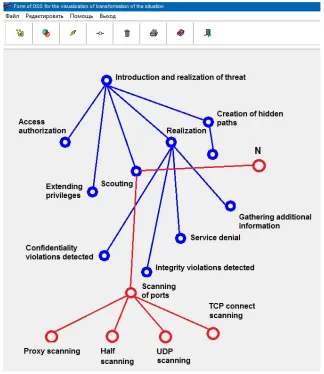
of the situation presented in the iconic DG
[image:8.612.144.468.172.546.2]
SI
,
AM
,Fig. 2. Blue color indicates fragments of a situation "Part–Whole", and red "Class– Subclass".Figure 2: DSS form to visualize the transformation of the situation when assessing CS CRIST
If there selected the direct assessment, the degree of influence of the P cyber-attacks on the indices IS
computed so: r
,
sl с ij sl
ij
v
v
am
wherev
ijс,v
rsl –addition of the characteristics "P" of the reason ("R") and consequence ("C"), respectively; i,s – number of the concept, j,l – number «P».
The preferences subsystem of the ADP provides an opportunity to identify the degree of influence of each of the "P" anomalies or C–A on other factors IS. As basic data the scale of informational content of "P" was used
ML
ij [23, 30]. Besides, DSS areanalyzed the current values accepted on the basis DG
SI
,
AM
.2192
5.EXPERIMENT
To verify the practical applicability of the proposed model the program complex (PRCOM) was developed – a system of decision support "Decision Support System of Management Cyber security – DSSMCS" [12, 21, 27]. In the process of experimental verification DSSMCS and simulation in Matlab variants generation and analysis of countermeasures recommended by the DSS for different classes of C–A were investigated. During the experimental verification DSSMCS for CRIST four kinds of countermeasures (or combinations thereof) was tested: 1) notice ISA (ADP); 2) reconfiguration of services IS (for example, router); 3) limiting attempts to connect to the network; 4) connection and sending the alert to the subscriber. Additionally consider blocking access to the modules CRIST, which recorded incidents IS.
If the ISA considers it appropriate to perform a paired comparison of the informativeness of the signs of a C–A, for example, in a situation requiring specification of signs-reasons for
si
tl,
si
sd and their impact on a bunch of sign–consequence ("S– C"), use the ranking scale [11, 14, 30]. The degree of influence of the "P" of attack on the performance IS CDF was determined as:,
sd tl sd ij tl
ij
am
am
where
– the parameter describing a level of influence of a linking of "S-C" on "R–C".At the same time minimization of costs of IP is provided in CRIST in case of support of the
allowed level of risk, i.e. C minfor
r
AR
AR
.6. RESULTS
The Fig. 3 shows examples of the results of testing the DSS for the decision of problems of cyber security CRIST in poorly structured and difficult to be formalized situations.
a) decision support by detecting the virus infection CRIST
b)
c) decision support in detecting attacks on SCADA transport company
c) decision support in detecting attacks class network intelligence in CRIST
N – the number of analyzed bundles of sign–consequence («S–C»), k – the number of consecutive iterations during which
the vector of addition of signs (VAS) is formed
1 – DSS DSSMCS; 2 – methods of forecasting of states; 3 – consecutive search of signs
Figure: 3 Comparative efficiency of the offered model
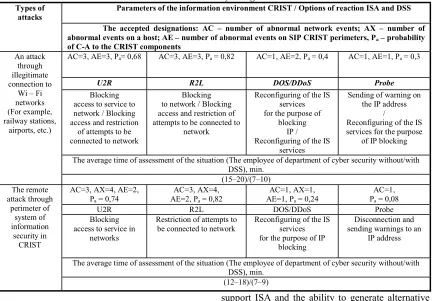
2193 supporting the decisions regarding the probabilities
of realization of actions of the malefactor that implements the C–A on CRIST, table 1. It is established that application of DSS has allowed to reduce the predicted value of risk of overcoming contours of IS by 5.5–6%.
Approbation of the decision support system (DSS) "DSSMCS" has been performed for real cyber security situation centers for transport
information systems in Ukraine and Kazakhstan [5, 24, 34, 35].
[image:10.612.92.525.216.517.2]In comparison with the methods of sequential search signs and statistical algorithms conditions [7, 12], the proposed model allowed to reduce the amount of required rules for making effective decisions on cyber defense CRIST.
Table 1: Results of testing the DSS
Types of attacks
Parameters of the information environment CRIST / Options of reaction ISA and DSS The accepted designations: AC – number of abnormal network events; АХ – number of abnormal events on a host; AE – number of abnormal events on SIP CRIST perimeters, Ра – probability
of C-A to the CRIST components
An attack through illegitimate connection to
Wi – Fi networks (For example, railway stations,
airports, etc.)
АС=3, AE=3, Ра= 0,68 АС=3, AE=3, Ра = 0,82 АС=1, AE=2, Ра = 0,4 АС=1, AE=1, Ра = 0,3
U2R R2L DOS/DDoS Probe
Blocking access to service to network / Blocking access and restriction
of attempts to be connected to network
Blocking to network / Blocking access and restriction of attempts to be connected to
network
Reconfiguring of the IS services for the purpose of
blocking IP / Reconfiguring of the IS
services
Sending of warning on the IP address
/
Reconfiguring of the IS services for the purpose
of IP blocking
The average time of assessment of the situation (The employee of department of cyber security without/with DSS), min.
(15–20)/(7–10) The remote
attack through perimeter of
system of information
security in CRIST
АС=3, АХ=4, AE=2,
Ра = 0,74
АС=3, АХ=4,
AE=2, Ра = 0,82
АС=1, АХ=1,
AE=1, Ра = 0,24
АС=1,
Ра = 0,08
U2R R2L DOS/DDoS Probe
Blocking access to service in
networks
Restriction of attempts to be connected to network
Reconfiguring of the IS services for the purpose of IP
blocking
Disconnection and sending warnings to an
IP address
The average time of assessment of the situation (The employee of department of cyber security without/with DSS), min.
(12–18)/(7–9)
In the process of testing, it was determined that the implementation of the DSS "DSSMCS" allows to provide increase of level of automation and centralization of monitoring of security of the CDF, and also to reduce the time of information about incidents responsible for information security individuals at 6.75–7.15 times
7. DISCUSSION
DSS "DSSMCS" has the following advantages compared to similar systems previously used for problems of decision support ISA analyze the transport companies.
First, DSS ADP provides a convenient display
format changes IS CRIST during the
implementation of the various classes of attacks. Second, the DSS provides intelligent decision
support ISA and the ability to generate alternative solutions to counter the attacks.
Eliminate the drawback of DSS is that at the initial stage of operation for each CRIST must be in manual mode to set initial rules descriptions of conceptual clusters IS.
Further development of research could be improving the interaction of the traditional mechanisms IS that, in particular, treated with primary information, and units of DSS for decision-making in weakly-formalized problems of cyber security CRIST.
Overall, studies have confirmed the effectiveness of the proposed models and software complex DSS to improve security of the considered companies.
2194 AP05132723 "Development of adaptive expert
systems in the field of cyber security of critical information objects".
A temporary shortcoming of the software implementation of the decision support system (DSS) "DSSMCS", which was identified as a result of testing, has become quite a long time to update the knowledge base on the signs of cyberattacks. This applies only to situations with incomplete information. Now work is under way to optimize the developed software (DSS) "DSSMCS", which will eliminate this drawback.
This work continues the research of authors whose results were previously partially published in international publications [5, 23, 34, 35].
8.CONCLUSIONS
This paper resolves the relevant task of
mathematical software DSS CS CRIST
development in poorly structured and difficult formalization of the information security task.
The developed model descriptions in the conceptual and functional aspect of the process of formation and use of a KB DSS for the circumstances associated with detection of certain inexplicable signs of anomalies and attacks, which improves the understanding of the analyzed processes of cyber defense CRIST.
The software complex DSS "DSSMCS" that implements the structurally difficult situation IS for CRIST Developed and tested. DSS "DSSMCS" allows to visualize and interpret the results of the current evaluation revealed signs of difficult to explain the anomalies and C–A, but also to describe the current situation in the implementation of the multi-stage targeted attacks, on the basis of the cognitive model. The use of DSS "DSSMCS" in interaction with other systems for the intelligent recognition of illegitimate interference in the work of CRIST, allows to improve the quality of solutions in the field of cyber security.
The article presents improved model for describing situations related to the terminology of information and cybersecurity in the conceptual and functional aspects of the problem under consideration. This problem consists in the formation of adequate knowledge bases for decision support systems in situations of detection of anomalies and cyber attacks on the basis of insufficient descriptive characteristics. The proposed approach has made it possible to increase the understanding of the analyzed cyberprotection processes in computer systems for situations where signs of anomalies, attacks and threats are poorly formatted.
REFERENCES:
[1] U. S. Department of Transportation, Research and Innovative Technology Administration, "Intelligent Transportation Systems (ITS) Strategic Plan: Background and Processes"
(2010). Available at:
http://www.its.dot.gov/strategic_plan2010_20 14/ppt/strategic_backgroundv2.ppt
[2] A. W. Sadek, B. Park, B., & M.Cetin. Special Issue on Cyber Transportation Systems and
Connected Vehicle Research. Journal of
Intelligent Transportation Systems, Vol. 20, no. 1, 2014, pp. 1–3.
[3] Transportation & Logistics 2030. Vol. 4: Securing the supply, pp. 254–286.
[4] V. P. Kharchenko, Ju. B.Chebotarenko, O. Gh. Korchenko, V Je, S. Pacira, O. Ghnatjuk, (2009). Kyberterroryzm na avyacyonnom
transporte, Problemy informatyzaciji ta
upravlinnja, Vol. 4, no. 28, 2009, pp. 131– 140.
[5] V. Lakhno, A. Hrabariev. Improving the transport cyber security under destructive impacts on information and communication
systems, Eastern–European Journal of
Enterprise Technologies, Vol. 1 No 3(79), 2016, pp. 4–11.
[6] V. A. Lakhno, A. S. Petrov, A.V. Hrabariev, Y.V. Ivanchenko, G.S.Beketova. Improving of information transport security under the conditions of destructive influence on the
information-communication, Journal of
theoretical and applied information technology, Vol. 89, Iss.2, 2016, pp. 352–361. [7] J. Petit, S.E. Shladover. Potential Cyberattacks
on Automated Vehicles, IEEE Transactions on Intelligent Transportation Systems, Vol. 16, Iss. 2, 2015, pp. 546 – 556.
[8] F. Miao, Q. Zhu, M. Pajic, G.J. Pappas. Coding
Schemes for Securing Cyber-Physical
Systems Against Stealthy Data Injection Attacks, IEEE Transactions on Control of Network Systems, Vol. PP, Iss. 99, 2016, pp. 1.
2195 [10] A. Fielder, E. Panaousis, P. Malacaria, C.
Hankin, F. Smeraldi. Decision support approaches for cyber security investment, Decision Support Systems, Vol. 86, 2016, pp. 13–23.
[11] L. Atymtayeva, K. Kozhakhmet, G.Bortsova. Building a Knowledge Base for Expert System in Information Security, Chapter Soft
Computing in Artificial Intelligence of the series Advances in Intelligent Systems and Computing, Vol. 270, 2014, pp. 57–76. [12] M. M. Gamal, B. Hasan, A.F. Hegazy. A
Security Analysis Framework Powered by an
Expert System, International Journal of
Computer Science and Security (IJCSS), Vol. 4, No. 6, 2011, pp. 505–527.
[13] S. Dua, X. Du. Data Mining and Machine Learning in Cybersecurity, CRC press, 2016, p. 225.
[14] A. L. Buczak, E. Guven. (2016). A Survey of Data Mining and Machine Learning Methods for Cyber Security Intrusion Detection, IEEE Communications Surveys & Tutorials, Vol. 18, Iss. 2, 2016. pp. 1153 – 1176.
[15] I. P. Larionov, P. B. Khorev. Problemy sozdaniya i osnovnye zadachi ekspertnoy
sistemy podderzhki proektirovaniya
kompleksnoy sistemy zashchity informatsii,
Internet-zhurnal «NAUKOVYEDYENIYE»,
2016, Vol. 8, no. 2. available at: http://naukovedenie.ru/PDF/117TVN216.pdf. [16] N. Ben–Asher, C. Gonzalez. Effects of cyber
security knowledge on attack detection,
Computers in Human Behavior, Vol. 48, 2015, pp. 51–61.
[17] K. Goztepe. Designing Fuzzy Rule Based
Expert System for Cyber Security,
International Journal of Information Security Science, Vol. 1, No 1, 2012, pp.13–19. [18] M.M. Gamal, B. Hasan, A.F. Hegazy. A
Security Analysis Framework Powered by an
Expert System, International Journal of
Computer Science and Security (IJCSS), Vol. 4, No. 6, 2011, pp. 505–527.
[19] Chang Li-Yun, Lee Zne-Jung. Applying fuzzy expert system to information security risk Assessment – A case study on an attendance system, International Conference on Fuzzy Theory and Its Applications (iFUZZY), 2013, pp. 346 – 351.
[20] M. Kanatov, L. Atymtayeva, B.Yagaliyeva. (2014). Expert systems for information
security management and audit,
Implementation phase issues, Soft Computing and Intelligent Systems (SCIS), Joint 7th
International Conference on and Advanced Intelligent Systems (ISIS), 2014, pp. 896 – 900.
[21] K.C. Lee, C.H. Hsieh, L.J.Wei, C.H. Mao, J.H. Dai, Y.T. Kuang. Sec-Buzzer: cyber security emerging topic mining with open threat intelligence retrieval and timeline event annotation, Soft Computing, 2016, pp. 1–14. [22] S. Pan, T. Morris, U. Adhikari. (2015).
Developing a Hybrid Intrusion Detection System Using Data Mining for Power Systems, IEEE Transactions on Smart Grid, Vol. 6, Iss. 6, 2015, pp. 3104 – 3113.
[23] V. Lakhno, S. Kazmirchuk, Y. Kovalenko, L. Myrutenko, T. Zhmurko. Design of adaptive system of detection of cyber-attacks, based on the model of logical procedures and the coverage matrices of features, Eastern-European Journal of Enterprise Technologies, No 3/9 (81), 2016, pp. 30–38.
[24] P. Louvieris, N. Clewley, X. Liu. Effects-based feature identification for network intrusion detection. Neurocomputing, Vol. 121, Iss. 9, 2013, pp. 265–273.
[25] Z. Wang, X. Zhou, Z. Yu, Y. He, D. Zhang. Inferring User Search Intention Based on Situation Analysis of the Physical World,
Chapter Ubiquitous Intelligence and Computing of the series Lecture Notes in Computer Science, Vol. 6406, 2010, pp. 35– 51.
[26] A. P.Yeremeev, P. R.Varshavskiy, I. Ye.
Kurilenko. Modelirovanie vremennykh
zavisimostey v intellektualnykh sistemakh podderzhki prinyatiya resheniy na osnove
pretsedentov, International Journal
«Information technologies and knowledge», Vol. 6, № 3, 2012, pp. 227–239.
[27] A.A. Kulinich. Kontseptualnye «karkasy» plokho opredelennykh predmetnykh oblastey.
Otkrytye semanticheskie tekhnologii
proektirovaniya intellektualnykh sistem:
materialy III Mezhdunarodnoy nauchno-tekhnicheskoy konferentsii (Minsk, 21–23 fevralya 2013) / Pod red. Golenkova V.V. – Minsk: BGUIR, 2013, pp. 135–142.
[28] C. Puri, C. Dukatz. Analyzing and Predicting Security Event Anomalies: Lessons Learned from a Large Enterprise Big Data Streaming Analytics Deployment, 26th International Workshop on Database and Expert Systems Applications (DEXA), September 1–4, Valencia, Spain, 2015, pp. 152–158.
2196 Data Analytics Knowledge for Cybersecurity
Professionals and Students, IEEE Security & Privacy, Vol. 13, Iss. 6, 2015, pp. 60 – 65. DOI: 10.1109/MSP.2015.121
[30] A. Razaq, H.Tianfield, P. Barrie. A big data analytics based approach to anomaly detection, BDCAT '16 Proceedings of the 3rd IEEE/ACM International Conference on Big
Data Computing, Applications and
Technologies, 2016, pp. 187–193.
[31] L. Perlovsky, O. Shevchenko. (2014). Dynamic Logic Machine Learning for Cybersecurity, Chapter Cybersecurity Systems for Human Cognition Augmentation of the series Advances in Information Security, Vol. 61, 2014, pp. 85–98.
[32] V. A. Lakhno, Y. N. Tkach, T.A. Petrenko, S.V. Zaitsev, V. M. Bazylevych. Development of adaptive expert system of information security using a procedure of clustering the attributes of anomalies and cyber attacks, Eastern-European Journal of Enterprise Technologies, No 6/9 (84), 2016, p. 32–44.
[33] M. Seijo Simó, G. López López & J. I. Moreno Novella. Cybersecurity Vulnerability Analysis of the PLC PRIME Standard. Security and Communication Networks, 2017.
[34] G. Beketova, B. Akhmetov, A. Korchenko, V, Lakhno, A. Tereshuk. Cyber intelligence systems based on adaptive regression splines and logical procedures of attack recognition.
Computer modelling and new technologies, Vol. 21, No. 2, 2017, pp. 7–16.
[35] Lakhno V., Petrov Al., Petrov Ant. Development of a Support System for Managing the Cyber Security of Information
and Communication Environment of
Transport, Information Systems Architecture and Technology : 38th International Conference on Information Systems Architecture and Technology (ISAT 2017),
Wroclaw, 17–19 September 2017 :