Munich Personal RePEc Archive
Interactions between competition and
consumer policy
Armstrong, Mark
Department of Economics - University College London
February 2008
Online at
https://mpra.ub.uni-muenchen.de/7258/
Interactions Between Competition and Consumer Policy
∗∗∗∗Mark Armstrong
February 2008
Abstract
This paper discusses complementarities and tensions between competition policies and consumer
protection policies. The paper argues that markets will often supply adequate customer protection
without the need for extra public intervention. Special areas where intervention might be needed are
discussed, including the need to combat deceptive marketing and the need to provide additional
market transparency (about both headline prices and shrouded product attributes). A few instances
are presented of how more intense competition can worsen the outcomes for (some) consumers.
Situations in which poorly designed consumer policies can harm consumers are discussed,
including how they can be used to protect incumbent suppliers, how they can relax competition
between oligopolists, how they can reduce consumer choice, how they can focus on one aspect of
market performance at the expense of others, and how they can lead consumers to take insufficient
care in the market.
Keywords: Competition policy, consumer protection, fraud, market transparency, add-on pricing
JEL codes: D18, D83, L15, L40, K12, M3
∗ Department of Economics, University College London, UK. I am very grateful for discussion, information and
1. INTRODUCTION
The objective of both consumer and competition policy is to deliver well-functioning
markets, something which requires both a strong supply side (competition) and a strong demand
side (consumers). For many products, vigorous competition is the single best protection for
consumers, and only minimal consumer protection (general contract law, forbidding deceptive
marketing, the ability to return faulty goods, and so on) is needed. As a former Chairman of the
Federal Trade Commission (FTC) writes:1 “robust competition is the best single means for
protecting consumer interests.” However, in some markets some consumers do not always obtain a
good deal, even when substantial competition is present, and in such cases additional policies to aid
consumers have a role to play.
What prevents markets delivering good outcomes to consumers? Familiar reasons include
abuse of dominance and collusion between suppliers, and these fall broadly within the domain of
competition policy. However, there are several other reasons why competition need not work well,
including: imperfect information about product attributes, imperfect information about market
prices, consumer costs of obtaining market information, supplier costs of advertising, consumers
possessing imperfect information about their own needs, and so on. These features, which are
explored in section 3 below, fall broadly under the heading of consumer policy.
It seems hard to define precisely what is a “competition policy” and what is a “consumer
policy”. One could say that competition policy comprises “the set of policies and laws which ensure
that competition in the marketplace is not restricted in such a way as to reduce economic welfare”.2
Whereas consumer policy “consists of preventing sellers from increasing sales by lying about their
products or by engaging in unfair practices such as unilateral breach of contract or unauthorized
billing”.3 Alternatively, one can define consumer policy in terms of the fundamental problems it
seeks to prevent, cure or remedy, which are (i) duress and undue sales pressure; (ii) information
problems pre-purchase, and (iii) undue surprises post-purchase.4 Nevertheless, many policies (such
as policies which act to reduce consumer search costs or switching costs, or which reduce industry
advertising costs) could be said to fall under both headings.
In the past, consumer policy and competition policy ran along quite separate lines, with little
interaction between the two. For better or worse, there was a lot more economics informing
competition policy than consumer policy. However, in recent years economists have shown a
1
TIMOTHY MURIS, The Interface of Competition and Consumer Protection, paper presented at Fordham Corporate Law Institute’s 29th Annual Conference on International Antitrust Law and Policy, New York (31 October 2002).
2
MASSIMO MOTTA, COMPETITION POLICY: THEORYAND PRACTICE, page 30 (2004).
3
MURIS, supra note 1.
4
greater interest in consumer policy. This stems from at least two, probably related, causes: first, the
modern consumer arguably faces more difficult decisions, involving more choices, than in the past;
second, the economics profession has recently been captivated by “behavioral economics”, a branch
of the discipline which takes more account of imperfect consumer decision making – consumers can
be less “rational”, more prone to various “biases” – than in earlier analysis. As leading behavioral
economists recently put it5: “Recent research in behavioral economics has identified a variety of
decision-making errors that may expand the scope of paternalistic regulation.”
Over recent decades, competition policy has tended to be implemented in a more similar
fashion across countries than in the past. As the internet enables more products to be marketed
globally, this same trend of convergence is now starting to affect consumer policy too. As Muris
puts it:6 “If different arbiters apply different standards in these areas, then marketers who wish to
apply identical techniques across borders may have to design a strategy that complies with the
standards of the most restrictive jurisdiction in most countries, a result that might not maximize
consumer welfare.” This is another reason why there is currently more interest in consumer policy
than previously.7
In this paper I describe some of the interactions between competition and consumer policies:
when are they substitutes or complements, and when does one approach actively interfere in the
implementation of the other? In section 2, I give a very brief outline of how competitive markets
offer sufficient protection to consumers without the need for extra publicly-provided protection. In
section 3, I point out some ways in which competitive markets may fail (some) consumers, and how
consumer policy might then be needed. Some scenarios in which more competition might actually
make (some) consumers worse off are outlined in section 4, while situations in which poorly
designed consumer policies could harm consumers are presented in section 5. Section 6 concludes
and offers some suggestions for where future research might most usefully be targeted.
2. COMPETITION ON ITS OWN CAN OFTEN PROTECT CONSUMERS
The aim of this section is not to present the various benefits of competitive markets in
general. Rather, I wish to discuss the ways in which markets can provide consumer protection
measures without additional government intervention. In well-functioning markets, supported by
5
C. Camerer, S. Issacharoff, G. Loewenstein, T. O’Donoghue & M. Rabin, Regulation for Conservatives: Behavioral Economics and the Case for “Asymmetric Paternalism”, 151(3) University of Pennsylvania Law Review page 1211 (2003).
6
See MURISsupra note 1. Muris provides a detailed discussion of recent convergence in the area of consumer fraud.
7
general contract law, competitive pressure means that only those firms which give consumers what
they want can prosper. There is little role for consumer policy when all product attributes and prices
are easily observed and evaluated at the time of sale, when search costs are not significant when
consumers sample offers from multiple suppliers, and when most consumers are capable of making
reasonably “good” decisions concerning the product in question. These stringent conditions
probably apply when someone buys a new diary for the start of the year, for instance.
But many, perhaps most, products do not satisfy these restrictive requirements. In particular,
it is rare that all product attributes and prices are known when choice is made. The more important
insight is that even in markets for experience goods the competitive mechanism can often still work
well unaided.8 Consider novels for instance, which are a clear-cut experience good since consumers
do not know how much they will enjoy a particular book until they read it.9 Here, many signals of a
book’s likely quality are available: (i) the consumer enjoyed previous books by the same author (a
“brand” effect), (ii) there are useful blurbs on the back (which most readers know are not always to
be trusted), (iii) the bookseller provides informative comments, (iv) word-of-mouth from friends
may be valuable, and (v) electronic versions of word-of-mouth, such as “reader comments” on
retailer websites such as Amazon.com, provide useful information.10 There is no obvious “consumer protection” policy which could improve on the laissez-faire outcome in this market.
Even credence goods, the most challenging type of good, can sometimes be supplied
effectively in a laissez-faire competitive market. Consider repairing a particular kind of machine
(which could be the human body). The consumer does not know the cause, which may trivial or
may require a major repair. An expert can repair the fault to the satisfaction of the consumer, but the
consumer might never know if the expert exaggerated what was needed in order to increase the bill.
But if the search/diagnosis cost is relatively small, many consumers will shop around for several
quotes for repair, and competitive pressure may force the cost of repair close to the minimum cost.11
Nevertheless, consumer search costs for credence goods may be extremely high (as is plausible for
car repair, for instance), and experts may presume that most consumers are captive and the severity
8
It is conventional to divide products into three classes, depending on the extent of the information problem. Search
goods are products whose attributes are fully observable at the time of purchase; experience goods have attributes which are only revealed after purchase, while credence goods have attributes which are not fully revealed even after purchase.
9
See Vickers supra note 4 at 297.
10
On this last point, see J. Chevalier & D. Mayzlin, The Effect of Word of Mouth on Sales: Online Book Reviews, 43(3) Journal of Marketing Research 345-354 (2006).
11
of the fault can safely be exaggerated.12 Moreover, if consumers cannot even tell if the repair has
been successful ex post (say, the medical treatment only cures the patient some of the time, even
when the treatment is appropriate), then under-treatment as well as over-treatment presents a
danger, and the market may break down altogether without intervention.13
A seller’s concern with its reputation is another means by which opaque markets can work
relatively well. Reputation can be established through two main channels: via repeat purchases from
the same consumer, or via publicity, including word-of-mouth from one consumer to another. The
reputation literature is concerned with how and when an appropriate level of product quality is
supplied in the market. “Quality”, here, can be interpreted very broadly, and encompasses hidden
charges in the small print, unexpected exclusions in insurance contracts, and so on. For instance, it
is quite unrealistic to suppose that consumers are aware of the prices of all products inside a
supermarket before they visit, and so many of the store’s prices are only observed at the point of
sale. The store could set high prices in order to exploit the fact that the consumers are “locked in”
once they enter the store. If this were the end of the story, this market would perform very badly,
and there would be scope for beneficial consumer policies, such as publicizing price indices for
supermarkets. (See the later discussion of the “Diamond paradox” in section 3C.) But supermarkets
are a leading example of repeated purchase, and this hold-up strategy is unlikely to be profitable for
a store since many consumers will experiment with a rival store if they are exploited by their
current choice.
A more serious information problem is that many consumers may not be aware even of the
prices of those products they put into their baskets. Therefore, if a supermarket puts up its price for,
say, butter by 500%, many of its customers will mistakenly buy it, yielding the store a short run
profit. But at least some people will notice the trick, either in the store or once they get home, and
there will quickly be substantial negative publicity which will wipe out any short-run gains to the
shop. (Note that reputational effects are greatly enhanced when there is a vigorous free media
operating in the jurisdiction.) Here, a supermarket’s concern to maintain its reputation is a more
powerful constraint than any externally-imposed informational remedy could be. Similar issues
arise with financial products, where the product often requires signing a lengthy contract involving
many clauses and potential hidden charges. Indeed, when a consumer does not realize the
importance of a small-print clause or price until after the product is purchased, the effect is very
12
Illustrative anecdotes are provided in W. Emons, Credence Goods and Fraudulent Experts, 28(1) Rand Journal of Economics 107-119 (1997). For instance, in a region in Switzerland the general population had significantly more medical operations than medical doctors and their families, consistent with a degree of “over-treatment” among the uninformed.
13
much like an experience good. For instance, a firm concerned with its reputation selling a life
insurance policy would not put in exploitative clauses (such as “We will not pay out if death occurs
on Tuesday”), even if they were legal, since the negative publicity would be enormous.
Modern technology provides new ways in which the reputation mechanism can be
harnessed. For instance, one situation which on the surface seems problematic is buying objects on
an internet platform such as eBay, where a consumer hands over money while having to trust that the seller will actually send the object. Since there is little chance that a buyer and seller will
interact repeatedly, or even that a friend of the buyer will interact with the seller, there seems to be
little scope for direct reputational concerns to play a role. But the use of “seller ratings”, a kind of
collective reputation mechanism, apparently provides a powerful constraint on a seller’s ability to
exploit consumer vulnerability (unless the seller has only one item to sell).14
All of this suggests that reputation (generally conceived) is a powerful force to constrain
firms to behave well, even when they supply highly complicated. However, in some markets
reputation cannot play a strongly disciplining role, for instance if the product is not purchased
repeatedly and if word-of-mouth or other publicity is ineffective.15 (The textbook example is a
restaurant in a tourist area, although in reality tourist guidebooks or star rating systems can provide
large incentives to provide good food.)
Advertising is a prime means by which to get information – price and non-price – to
consumers with search costs. Consumers do not always have to visit a retailer physically to find out
its prices and other product characteristics. In addition, advertising can provide important
information about product characteristics which consumers would otherwise find hard to discover
even at the point of sale, thus ameliorating experience/credence good problems. Suppliers of
breakfast cereals, for instance, may advertise useful information about the healthiness of their
products.16 While advertisers can be trusted to point out the good aspects of their products, they will
not voluntarily advertise the less good product characteristics. However, comparative advertising
(when permitted) may step in here, and rivals will often be willing to point out defects in a product
14
P. Bajari & A. Hortacsu, Economic Insights from Internet Auctions, 42(2) Journal of Economic Literature, section 5 (2004) surveys the empirical work on the effectiveness of the reputation mechanism in online auctions, which is mixed in its conclusions.
15
G. Lin & P. Leslie, Reputational Incentives for Restaurant Hygiene, American Economic Journal: Microeconomics (forthcoming) provides evidence showing that restaurant hygiene tends to be higher in local markets which have a greater proportion of repeat buyers.
16
to the benefit of all consumers. Even advertising messages which do not contain useful information
to consumers may indirectly act as a signal of the price or quality of the product. If consumers follow the rule of thumb that a more heavily advertised product will likely be better or cheaper than
its rivals, it may often be in the interests of the better (or lower cost) supplier to advertise most
intensively.17 Finally, advertising – including direct marketing methods – may be the only way to
reach those consumers who do not wish to research the market actively themselves.
To aid those consumers who do wish to undertake market research, there is a flourishing
market for market information, which can help overcome consumer search costs as well as provide
information about shrouded product attributes. This market includes commercial magazines and
websites offering consumer reports on various items, as well as price comparison websites. Other
commercial websites offer detailed “consumer protection” advice.18 The market for market
information has several special features which can limit its efficient operation, some of which are
discussed later in section 3B, but it undoubtedly is important in helping active consumers to make
better decisions.
In markets with switching costs, it is likely that rivals will choose to make it as easy to
switch as possible. For instance, an energy company might offer to do all the work involved in
switching supplier. More controversially, a firm may offer new customers a better deal than its
existing customers, in order to overcome its new customers’ cost of switching.19 The result then is
that there could be too much switching in the market, not too little, which could provide a novel role for policy. Finally, several price comparison websites (for energy, insurance, and so on) provide a
“one-stop” switching service too.
A contentious issue when discussing the competition/consumer policy interface is whether
more competition acts to simplify the deals offered to consumers (to the appropriate extent), or
whether firms in competitive markets resort to trying to “confuse” consumers in order to relax
competition. The evidence on this question is very mixed, and often anecdotal. But it is clear that at
least sometimes firms compete by offering simpler deals than their rivals, in order to attract those
consumers who find consideration of complex tariffs or products psychologically costly. For
instance, a mobile phone entrant might try to differentiate itself from incumbents by offering a tariff
Information, Advertising and Health Choices: A Study of the Cereal Market, 21(3) Rand Journal of Economics 459-480 (1990).
17
See Kyle Bagwell, The Economic Analysis of Advertising, in THE HANDBOOK OF INDUSTRIAL ORGANIZATION
(Volume 3) 1701-1844 (Mark Armstrong & Robert Porter ed., 2007). Likewise, if users of a search engine tend to click on suggested links in the order they appear on the page, websites which are most likely to fit the user’s need will often pay the most to be listed first. (And in this case, consumers indeed should click on the links in the suggested order.) See S. Athey & G. Ellison, Position Auctions with Consumer Search, mimeo Harvard and MIT (2007).
18
See for instance the UK website http://www.moneysavingexpert.com (visited on Jan. 17, 2008).
19
with a uniform call charge regardless of the network being called or the time of day. Or a firm
might “unshroud” a rival’s tariff, for instance by pointing out that the price for its car, say, is “all
inclusive” while a rival’s advertised price excludes some core features. We return to this issue in
section 3.
Markets can deliver products which help consumers deal with their own imperfect decision
making. For instance, many consumers have problems of self-control to do with impatience –
spending too much on a credit card now, and not thinking enough about high interest charges later,
say – and many of these consumers are aware of their weakness of will (e.g., they have learnt this over time). These sophisticated, but weak-willed, consumers have a demand for commitment
devices to constrain their subsequent choices20, which the market will often supply. The most
obvious of these are illiquid savings products (e.g., where someone automatically pays in a certain
amount of money each month, and it is hard to extract the savings at short notice).21 Other examples
include addiction treatment clinics, where consumers sign up for a period of time and are kept apart
from their vice, season tickets to “high-brow” cultural events (where consumers may be tempted to
stay in and watch TV if they had to buy a ticket for each performance), and exercise gyms offering
lump-sum membership contracts so that consumers are not discouraged from exercise by a per-visit
fee.22 Thus, the presence of time-inconsistent, or otherwise boundedly rational, consumers is not a
sufficient reason to intervene in a market.
Finally, many retailers compete by voluntarily offering their own comprehensive “consumer
protection”. Retailers may offer warranties or “no quibble” return policies which are substantially
more protective of their consumers than is required by consumer law. In sum, consumer protection
in its various forms is undoubtedly a vital service, but it is usually provided without the need for
government intervention. The next section considers those situations in which intervention might
still be needed.
3. HOW CONSUMER POLICY CAN SOMETIMES AID CONSUMERS
A. Deceptive Marketing
An implicit assumption in the discussion in the previous section was that firms could not
engage in deceptive marketing. For instance, a firm could make false claims for its products, or it
20
For evidence that consumers have demand for commitment devices, see N. Ashraf, D. Karlan & W. Yin, Tying Odysseus to the Mast: Evidence from a Commitment Savings Product in the Philippines, 121(2) Quarterly Journal of Economics 635-672 (2006).
21
D. Laibson, Golden Eggs and Hyperbolic Discounting, 112(2) Quarterly Journal of Economics 443-477 (1997).
22
could advertise one price while consumers find they must pay a higher price once they arrive at the
store (or the advertised product is not available in the store, and only the more expensive versions
are – the so-called bait-and-switch technique). If firms could do such things, some of them would
do so when the practice enhanced profit. Consequently, consumer faith in the reliability of the
advertising mechanism would be eroded, to the detriment of consumers and honest firms. However,
it is important to recognize that many firms would not take advantage of the ability to make
deceptive claims, since their reputation would quickly be harmed.
Similarly, if firms could freely denigrate their rivals’ products, many would choose to do so,
and consumers may eventually view advertising as meaningless babble, shutting down this crucial
channel of information. (Reputational considerations may have somewhat less force for misleading
comparative advertising, since, if the advertising campaign were successful, consumers might not
try the rival product and so might not discover that the claims made were deceptive.) Naturally,
though, there is a fine line to be drawn between outright deception and adverts which mislead many
consumers but which are technically accurate. To cope with this issue, it is common to use “copy
tests” to determine how many people are misled by a particular advert. The consumer body still
needs to decide the vexed question of how many consumers need to be misled in order for the
advert to be withdrawn.23 (In section 5 it is argued that past policy in the U.S. set the barrier too
low, requiring only a few people to be misled before an advert was withdrawn.) Such policy can
never be perfect, since adverts which are useful for sophisticated consumers may mislead others.
Likewise, if a firm has built up a reputation for high-quality products, a rival firm may wish
to pretend to be that firm by choosing a similar brand name or packaging (the phenomenon known
as “passing off”) in order to charge the brand price but offer a product of a lower quality, thus
harming both consumers and the original brand. Here, trademark laws and their enforcement will be
useful for consumers.
Of course, misleading marketing practices can go beyond advertising false prices, and
suppliers can make false claims about their products. Common scams include claims that a
particular “natural health cure” is effective, that “Professor X can predict the next winning lottery
Economic Studies 689-714. An alternative and less benign reason why gyms might set low per-visit charges, to do with exploiting over-optimism on the part of consumers, is discussed in section 3E.
23
numbers”, or that a stranger genuinely needs to deposit money in my bank account.24 Sometimes
policy towards scams and “scam-like” products can be hard to formulate. Since people (even
policy-makers) differ in their beliefs about the efficacy of some products, and objective data can be
unavailable, it can be hard to determine whether a product is fulfilling a genuine need or is really a
scam. We might agree that Professor X cannot really foresee the winning lottery numbers,25 but
there are many grey areas, including: services which predict the outcome of horse races26,
clairvoyants, astrology, some beauty products, some alternative health remedies, or the health
benefits of organic food. The consumer body could publicize “warnings” about those products it felt
confident were indeed scams (see footnote 24), but it is perhaps unlikely that those consumers taken
in by outlandish claims will be the kind of consumer who browses consumer protection websites.
The use of misleading marketing regulations is probably the most effective and proportionate
method of controlling exploitative conduct here, and sellers should be prevented from making
claims which are false or which cannot be verified. In addition, if there is objective information
available about the efficacy or otherwise of these products, that could usefully be brought to
consumers’ attention. (See the discussion of “quacks” in section 3C below.)
Generally, policy to combat fraud and misleading marketing is the least contentious area of
consumer policy. (In this regard it is similar to cartel and horizontal merger policy in competition
policy.) However, some commentators are skeptical of the need for public intervention even in this
area. For instance, Richard Posner has written:27
“In the political arena we posit a marketplace of ideas in which good ideas can be expected
to prevail in open competition with bad, and one can take the same approach to
advertising. Individuals know more about household products than they do about political
questions, so if we trust them to evaluate competing and often fraudulent claims by
political candidates, we should also trust them to evaluate competing product claims. Since
other sellers, like rival candidates, have every incentive to counter the misleading
representations of a competitor, false claims should eventually be unmasked.”
24
See http://www.docep.wa.gov.au/ConsumerProtection/ScamNet/content/pages/full_list.html (visited 25 Jan. 2008) for a long list of the scams being used in Australia at the time of writing.
25
“Claiming that products are able to facilitate winning in games of chance” is one of the 31 practices which are in all circumstances considered unfair in the UCPD supra note 7.
26
For details of recent intervention against a racing tipster, see http://www.oft.gov.uk/news/press/2008/12-08
(visited Feb. 12, 2008). In return for a membership fee of £590, members received tips on likely winners in horse races. Some 3000 consumers signed up to the service. The marketing materials for the service were judged to be misleading, and falsely claimed for instance that the tipster owned a team of race horses and had ridden regularly for some of the most successful horse trainers. In addition, members were told they would make a “minimum of £47,000 in 30 days”.
27
A situation in which even Posner admits may require public intervention is when no seller has an incentive to provide accurate information and no rival has an incentive to unmask a rival’s
misleading claims. He suggests that cigarettes are an example of such a market, where no supplier
has an incentive to advertise that smoking is unhealthy.28 Here, there may be a role for carefully
designed health warnings on cigarette packets, for instance, as well as other education campaigns.
B. The Market for Market Information
Internet-based price-comparison websites and other information intermediaries have
recently emerged which mitigate problems of costly consumer search.29 For instance, The Economist (Nov. 20, 1999, page 112) suggested that:
“The explosive growth of the Internet promises a new age of perfectly competitive
markets. With perfect information about prices and products at their fingertips, consumers
can quickly and easily find the best deals. In this brave new world, retailers’ profit margins
will be competed away, as they are all forced to price at cost.”
However, information intermediaries are not a panacea for several reasons. First, while the market
may provide market information, it cannot force consumers to undertake market research. For
instance, in 2003 only 10 to 12 percent of consumers in a survey who had made price comparisons
for energy suppliers that year had used the internet as their source of market information.30
(Doorstep selling was a much more significant source of information, which at times is indeed a
way of forcing consumers to investigate market options.) Of course, though, this does not imply that
government intervention to make markets transparent can do any better in this regard.
Second, there is still a good deal of price dispersion on price-comparison websites,
notwithstanding the previous quotation. A detailed study of one such website over a long period
28
Posner supra note 27 at 68.
29
J. Brown & A. Goolsbee, Does the Internet Make Markets more Competitive? Evidence from the Life Insurance Industry, 110(3) Journal of Political Economy 481-507 (2002) provide evidence that the growth of price-comparison websites for life insurance drove down prices for this product. An interesting study in the pre-internet era had related findings. Two districts in Canada in 1974 were chosen for a market transparency experiment in supermarket pricing. In one district prices were collected but not publicized, while in the other district average price indices for individual supermarkets in that area were publicized in local newspapers. The result was that price dispersion and price levels fell in the second district relative to the first. See G. Devine and B. Marion, The Influence of Consumer Price Information on Retail Pricing and Consumer Behavior, 61(2) American Journal of Agricultural Economics 228-237 (1979).
30
suggests that price dispersion is significant and non-transient: the gap between the lowest and the
second-lowest listed prices averaged 23% when just two firms listed prices for the product,
although this fell to 3.5% when 17 suppliers listed prices.31 Suppliers also change their listed prices
frequently over time, so that consumers (and rivals) need to keep on their toes. As discussed in the
next section, it is the search cost of the marginal searching consumer which is likely to determine the degree of price dispersion in market, and it could be that the number of consumers who use
price-comparison websites is not yet large enough to have a major impact of price dispersion in
many markets.
Third, if consumers visit just one such information broker (e.g., because of search costs for
using more than one price-comparison website), then a broker will hold a monopoly over providing
access by sellers to its exclusive consumers. This will often mean that consumers are treated well by
the broker (e.g., they obtain the service for free, as is often observed) while sellers may have to pay
inefficiently high charges to list their prices. Moreover, as the broker makes its revenue mainly
from the supplier side, it may have an incentive to restrict competition between sellers so that they
have a better ability to pay high fees for being listed.32 The result of this skewed pricing could be
that too few suppliers choose to be listed on the broker’s website and/or suppliers may choose to
bypass the broker and try to market their services directly to consumers. (For instance, we now see
the increased use by airlines of their own websites to sell tickets directly to travelers, and some
prominent insurers have forbidden their products to be sold on price-comparison websites.) If such
bypass goes too far, many consumers will have to search supplier-by-supplier once more, and the
search efficiency introduced by the brokers in the first place will be eroded.
Fourth, the intermediaries are commercial operations, and must be funded from some
source.33 The funding may come from non-discriminatory listing fees (as above), but alternatively it
may come from just one or a few suppliers rather. In such cases, the broker may be biased and give
undue prominence to its funders’ products. In extreme cases, a “price-comparison website” might
just be a marketing front for one supplier. As such, a consumer body needs to be open to consumer
31
M. Baye, J. Morgan & P. Scholten, Price Dispersion in the Small and the Large: Evidence from an Internet Price Comparison Site, 52(4) Journal of Industrial Economics 463-496 (2004). (The quote from The Economist came from this paper.)
32
The recent literature on “two-sided markets” is relevant here, one example of which is M. Armstrong, Competition in Two-Sided Markets, 37(3) Rand Journal of Economics, section 5 (2006). Similar issues arise with the (typically non-price) market information found in Yellow Pages directories, where most consumers consult just one directory. See M. Rysman, Competition Between Networks: A Study of the Market for Yellow Pages, 71(2) Review of Economic Studies 483-512 (2004).
33
complaints about the accuracy of price comparisons, as well as ensuring that the funding basis for
the website is transparent. (These issues are already familiar in the market for financial advice.)
Fifth, many price comparison websites attempt to rank their various products by price (or
give consumers the option to rank in this way), and for this they may be forced to use a
single-dimensional measure of “price”. This gives suppliers an obvious incentive to publicize a low
“headline price” in order to be placed near the top of the list, and to load hidden charges onto the
item insofar as this is possible. (For instance, a seller could set high postage and handling charges.
Even worse, the seller’s postage and handling charges may not even be observable to the consumer
until the consumer has gone to the “checkout” page.) Similar issues arise in, say, insurance markets.
If price-comparison websites focus consumer attention on the headline premium, many consumers
may buy the cheapest product, and this could well turn out to be a low-quality product with many
small-print exclusions or excesses. The net result of all this subterfuge might be that suppliers at the
top of list may not be the cheapest or best value when the total deal is taken into account.34
Generally, inefficiency ensues if consumers are misled about the total charge for the product or its
quality, or if they have to spend undue effort to understand exactly what is included in the service.
Finally, and related to the previous point, for complicated products, price comparison
websites are often opaque and hard to use for many consumers. When consumers differ in their
demand for, say, electricity, and suppliers use nonlinear tariffs, to obtain a relevant comparison a
consumer must know and key in her typical demand volume.35 One supplier may well be cheaper
for low-demand consumers but more expensive for higher-demand consumers. In markets with
complex products where a consumer’s demand volume and/or tastes are needed to determine the
relevant price comparisons, price comparison websites are not always effective since there is no
single price or price index to use in rankings. With complex products, making the market
transparent is difficult both for commercial intermediaries and for public policy.
In sum the “market for market information” is one with several special features which imply
that it does not always work well unaided. As such, with the important caveat that policy cannot
34
Recent papers present evidence that obfuscation strategies, such as presenting a low headline price together with high small-print charges for postage, can confuse consumers and reduce firm-level demand elasticities. See G. Ellison & S. Fisher Ellison, Search, Obfuscation and Price Elasticities on the Internet, mimeo Harvard University (2004) and T. Hossain & J. Morgan, Plus Shipping and Handling: Revenue (Non)equivalence in Field Experiments on eBay, 6(2) Advances in Economic Analysis and Policy (2006). OFFICE OF FAIR TRADING supra note 30 at pages 125-127 documents a survey which revealed that the majority of listed prices do not make clear whether delivery is included, and in a sample of airline ticket bookings the final price was above the original listed price in 47% of cases (and in these the median price increase was 19%).
35
force inactive consumers to undertake market research, there may be a role for public policy to
provide additional market information.36 We discuss the impact of these policies in the next two
sections. In section 3C we discuss the impact of market transparency policies about headline prices
and product attributes, while in section 3D we discuss further the problems caused by “hidden”
charges and how transparency policies may be helpful in overcoming these problems.
C. The Impact of Market Transparency Policies
There are a number of plausible situations in which consumers differ in how well-informed
they are about products in the market. In part, this may reflect how much effort they have put into
market research. Here, situations fall into three broad types: (A) where uninformed consumers exert
a negative externality on the informed consumers; (B) where informed consumers benefit from the
presence of the uninformed, and (C) where there is no cross-subsidy between the consumer groups.
Much consumer policy aims to improve “market transparency” in a general sense in order to
increase the number of informed consumers. Such a policy is relatively uncontroversial in (A) and
(C) situations, but in (B) situations it could harm the informed consumers and can be more
contentious. In this section we consider some examples of (A) situations, where increasing the
number of informed consumers benefits all consumers. (The next section provides some examples
of (B) situations, while section 3E discusses (C) situations.)
A classic model by Varian is instructive.37 Here, a number of symmetric firms offer an
identical product to a population of consumers who each wish to consume a single unit of the
product. The unit cost of the product is c, and each consumer is willing to pay up to v > c for the product. The only way in which consumers differ is that a fraction, say , of them know all prices in
the market, and the remaining consumers know no prices.38 The informed consumers will buy their
item from the lowest-price supplier, while the uninformed consumers will buy from a random
36
In the UK several regulators have “accredited” price-comparison websites listed on their own websites, and one regulator, the Financial Services Authority, has its own comparison website http://www.moneymadeclear.fsa.gov.uk
(visited on 28 Jan. 2008). In addition, the introduction of an approved price-comparison website was one of the remedies to market failure in COMPETITION COMMISSION, Home Credit Market Investigation page 10 (2006).
37
H. Varian, A Model of Sales, 70(4) American Economic Review 651-569 (1980). A closely related model is S. Salop & J. Stiglitz, Bargains and Ripoffs: A Model of Monopolistically Competitive Price Dispersion, 44(3) Review of Economic Studies 493-510 (1977).
38
supplier (so long as that firm’s price turns out to be no higher than v). In this framework, firms have to trade off the benefit of setting a low price which may attract the informed consumer against the
benefit of setting a high price which exploits the “vulnerable” uninformed consumers. A firm
chooses its price randomly, so that rivals cannot predict its price. One can show that both the
average price paid by informed consumers and the (higher) average price paid by the uninformed
consumers decreases as the fraction of informed consumers, , rises. In particular, informed
consumers are harmed by the presence of the uninformed consumers, while uninformed consumers
benefit from (or free-ride on) the presence of the informed. Consumer policy which increases
market transparency, in the sense of raising , will improve the welfare of both groups of
consumers. However, price dispersion varies non-monotonically with the fraction of informed
consumers: when is close to zero, almost all prices are close to the monopoly level, and when is
close to 1, almost all prices are close to the competitive level. In either case, there is little price
dispersion, and so price dispersion is maximized at some intermediate level of . In particular,
starting from a low level of consumer price awareness ( small), a market transparency policy
which increases may also increase price dispersion.39
Likewise, consumer policy which acts to reduce consumer search costs will tend to benefit
all consumers.40 When consumers have low search costs, both the average level of prices and their
dispersion tend to be low. To illustrate, consider this variant of Varian’s model.41 Instead of
supposing that consumers fall exogenously into two groups, the informed and the uninformed,
suppose a consumer has the option to learn all market prices for a cost s, say. (This “all or nothing” search process simplifies the discussion, but does not alter the qualitative conclusions.) This search
cost may vary across consumers. There is a subtle two-way interaction between consumer and firm
the fraction of informed consumers is good for aggregate consumer welfare, but it has no impact on those consumers who remain uninformed.
39
Brown & Goolsbee supra note 29 find support for this effect in the early part of their data when the fraction of consumers who used price-comparison websites was small.
40
Markets differ greatly in their consumer search costs. For instance, petrol has a rather low search cost since many consumers are already in their car when buying the product. As a result, prices are reasonably competitive and exhibit little dispersion within a local area. Funerals and condoms, by contrast, are often purchased by consumers with little appetite for market research. Car tyres are frequently purchased by consumers who are not very mobile. In one study, 71% of consumers wanting to buy tyres contact no other outlet apart from the one at which they buy. See M. Waterson,
The Role of Consumers in Competition and Competition Policy, 21(2) International Journal of Industrial Organization, 129-150 (2003) for details and further discussion. However, the case of petrol presents an interesting danger: given that the market is understood by consumers to be reasonably competitive, consumers may not even bother checking the prices when they fill up, and this leaves a profit opportunity for unscrupulous (but legal) suppliers. For instance, in 1996 a Mr. Mole in Lancashire (UK) operated a number of petrol stations where petrol was nearly twice as expensive as his competitors. See the Lancashire Telegraph, 27 Jan. 2006.
41
behavior in such a market. The fraction of consumers who choose to become informed affects the
level and dispersion of prices, which in turn determines the incentives for consumers to become
informed in the first place. As just discussed, price dispersion is a non-monotonic function of the
number of informed consumers. Since the incentive to become informed depends on the dispersion
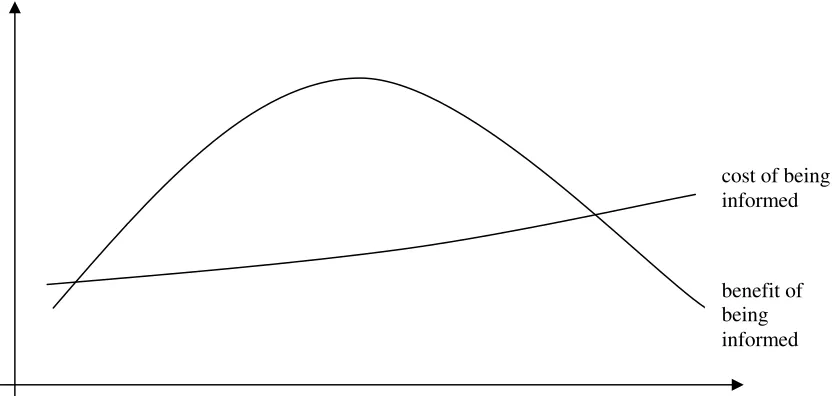
(rather than the level)of prices, we expect that the benefit of becoming informed will depend
[image:17.595.78.495.234.432.2]non-monotonically on the number of other informed consumers, as illustrated on this diagram.
Figure 1: The Cost and Benefit of Being Informed
A consumer will choose to become informed if the private benefit to her exceeds her cost s, and an equilibrium degree of search is when the cost of the search for the marginal searching
consumer equals the benefit from searching, as depicted on the diagram. From the diagram, it is
clear that there will probably be two (interior) equilibria, one with relatively few informed
consumers and the other with relatively many. On the assumption that it is the latter equilibrium
which is observed (this is the stable equilibrium of the two), a reduction in all search costs (in the
sense that the search cost schedule is shifted downwards) will lead to more consumers choosing to
become informed, which in turn leads to a more competitive market and lower average prices.
However, it is the search cost of the marginal searching consumer who determines price levels and dispersion. If a large number of infra-marginal consumers (whose search cost is anyway below the
marginal searcher’s cost) experience a fall in their search cost, this may have little impact on market
prices. Thus, if the use of price-comparison web-sites has not yet reached the marginal searching
cost of being informed
benefit of being informed
consumer (see section 3B), such websites may not have a major impact on price levels or
dispersion.
A consumer policy which acts directly to limit price dispersion in such a market could have
somewhat perverse effects. (In some jurisdictions, for instance, usury laws operate so that an
interest rate which is more than a specified distance above the market average for the relevant loan
cannot be legally enforced. It is plausible that such a policy will reduce interest rate dispersion.) If
price dispersion is reduced, this reduces the incentive for a consumer to become informed, and so is
likely to reduce the number of informed consumers. The net result of reduced consumer search
could well be that average prices in the market rise, thus harming consumers.
Notice that, provided that all consumers have positive search costs, in this theoretical
framework there is also always a third equilibrium and this involves (i) all firms setting monopoly
prices and (ii) no consumers choosing to become informed. The reason is that if all firms set the
same price (in this case, the monopoly price), no consumer finds it worthwhile to incur the search
cost s to find the best deal; and if no consumer is informed, each firm will set the monopoly price to exploit those consumers who randomly come to it. This is the famous “Diamond paradox”.42 It
provides a stark example of how naive competition policy, interpreted as a policy to increase the
number of suppliers but without decreasing search costs, may have no beneficial impact on
consumer welfare.
As well as reducing search costs, another powerful form of consumer protection is to
remove restrictions on advertising, as advertising typically intensifies competition between firms.
Consider the classical model of informative advertising by Butters.43 Here, many firms compete to
sell a homogeneous product. The only way consumers can find out about the product is by seeing an
advert from one or more firms. Firms send out (non-misleading) adverts to consumers at random
with information about the product’s existence and its price, with an advertising cost c per person. One can show that (i) total quantity sold (i.e., the number of consumers who observe at least one
advert) decreases with c, and (ii) the average price paid for the product increases with c. Thus, policy which acts to lower c (e.g., a policy which removes restrictions on non-misleading price advertising in the specified market) will intensify competition and benefit consumers.44 However,
42
P. Diamond, A Model of Price Adjustment, 3(2) Journal of Economic Theory 156-158 (1971).
43
G. Butters, Equilibrium Distributions of Sales and Advertising Prices, 44(3) Review of Economic Studies 465-491 (1977).
44
sometimes policy towards advertising needs to balance two conflicting kinds of “consumer
protection”. Since many consumers do not like being on the receiving end of direct marketing, one
consumer protection policy is to allow consumers to opt out of direct marketing campaigns (as in
the U.S. “Do Not Call” policy launched in 2003, to which some 100 million people have signed up).
But if a significant number of consumers choose to opt out of advertising, it is possible that
competition between firms is thereby lessened to the detriment of consumers as a whole.45
Further insights into the benefits of market transparency are obtained from a pair of models
by Ran Spiegler. Consider first Spiegler’s model of credence goods.46 Here, word-of-mouth does
not necessarily work well when consumers are not sophisticated. There are a number of suppliers of
treatment for a given medical condition, say, and each supplier has an associated probability of
successful treatment. If no treatment is given, there is also a chance that a consumer gets better
anyway. Without policy intervention, consumers do not observe a supplier’s probability of success,
but instead hear from friends whether they have had success or suffered failure with each supplier
(with, for simplicity, one “anecdote” for each supplier, including the no-treatment default). Instead
of understanding that treatment success is probabilistic, consumers behave as though each anecdote
predicts what will happen to them for sure. In particular, each consumer will choose the supplier
who offers the lowest price (or no treatment, which has a zero price) from among the successful
treatments he hears about. Spiegler shows that that, even when all suppliers offer “treatment” which
does not involve higher probability of success than getting no treatment at all (i.e., the suppliers are
“quacks”), the market for quacks is active and all consumers are worse off relative to the case where
quacks were not present. In fact, when the disease is unlikely to be cured (so the no-treatment
default and quack success probabilities are both small), the quacks charge a higher price, for the
reason that a consumer is unlikely to hear of more than one success story, which weakens
competitive pressure. In addition, when suppliers differ in their treatment success rates and have the
ability to reveal their success probability to consumers, none of them, including the best one,
unilaterally wishes to do so. (Given the anecdotal basis of consumer decision making, they prefer to
set high prices to those consumers who hear about their successful treatments than to get a moderate
165-186 (1986). See also the review of related studies on the impact of advertising on prices in Bagwell supra note 17 at 1745-1746.
45
More generally, while new technologies often facilitate information flows to consumers, they can sometimes also help consumers avoid adverts. For instance, personal video recorders in broadcasting and “pop-up blockers” on the internet allow consumer to avoid adverts. Since many consumers dislike viewing adverts, but there is a competitive benefit to consumers as a whole when more consumers receive adverts, it is possible that the increased use of ad-avoidance devices may harm aggregate consumer welfare. A simple model of broadcasting in which the ability to opt out of advertising harms viewers can be found in M. Armstrong, Public Service Broadcasting, 26(3) Fiscal Studies, page 295 (2005).
46
price from consumers who know the real success probability.) Thus, there is a role for consumer
policy to publicize the treatment success rates for the various suppliers. Such a policy will induce
those consumers who see the publicity to choose the best value treatment.
Second, consider Spiegler’s model of “confusing prices”.47 Here, a number of identical
firms compete to sell a homogeneous product to identical consumers. However, instead of
publicizing their true price, each firm publicizes an unbiased noisy signal of the true price. Each
consumer sees a price signal from each supplier, and buys from the supplier with the lowest signal.
(This could be because consumers mistakenly take the signal they see to be the price they will
actually pay, or consumers might be more sophisticated and, in the absence of other information,
assume that the firm with the lowest signal is most likely to be the firm with the lowest true price.)
Spiegler shows that firms do not want to set transparent prices.48 Instead, firms choose to offer
noisy prices in equilibrium, where the amount of noise depends on the number of suppliers.
Remarkably, in this model the equilibrium true price does not depend on the number of suppliers,
while the noise becomes more pronounced as the number of suppliers increases. Thus, firms
respond to “more competition” (in the naive sense of having more suppliers) with “more
obfuscation”. Firms make positive profits as a result of their obfuscation strategy, even though
products are homogeneous. Consumer welfare would be improved if policy either forces firms to
publicize their true prices or ensures that some other platform publicizes the true prices. When all
consumers base their decision on the true prices, Bertrand competition and zero profits ensue.
Finally, a very different kind of market transparency policy involves the accurate labeling of
experience and credence goods. History does not make one confident that the market will, on its
own, ensure that firms will always adequately label their products. For instance, a future Chairman
of the FTC wrote:49
“Until the government intervened and required or induced disclosure, accurate information
was not available in the market concerning the durability of light bulbs, octane ratings for
47
R. Spiegler, Competition Over Agents with Boundedly Rational Expectations, 1(2) Theoretical Economics, 207-231 (2006). Spiegler interprets his model in terms of a product with many pricing attributes, where a consumer’s inability to process many pieces of information implies that she just looks at a small number of price attributes for the product, while the expected price eventually paid depends on all pricing attributes.
48
Suppose the unit production cost is c. If all firms offer transparent prices, there is Bertrand competition and price is equal to c. Suppose instead that one firm sets a noisy price, where its true price is 2c and its (unbiased) signal is either zero or 4c with equal probability. This seller will have the lowest signal in the market half the time, and in these cases it will make the sale and make a positive profit while doing so.
49
gasoline, tar and nicotine content of cigarettes, mileage per gallon for automobiles, or care
labeling of textile wearing apparel.”
As already mentioned, credence goods are a particularly challenging type of product, since repeat
purchases or word-of-mouth may not adequately discipline the market. For instance, it could be
valuable for policy to publicize and verify suppliers’ professional qualifications. For a novice
consumer, the ability and/or effort of a lawyer is hard to determine. In such cases, one thing which
may help to some extent is to mitigate information asymmetries about an expert’s ability (even if
the effort problem remains), which can be done by publicizing a recognized system of professional
qualifications. Thus, if a consumer consults a qualified solicitor, she may be reasonably confident
that the expert at least knows how to do the task, even if the under- or over-treatment problems
remain. In practice, this transparency policy often goes alongside a policy which sets a minimum
qualification barrier to entry, although the two policies are distinct and need not go together. I
discuss this second, more interventionist policy later in section 4B.
A second labeling issue involves the accurate listing of ingredients in a product. To
illustrate, consider the salt content of a particular kind of snack food. Without access to a chemical
laboratory, a consumer cannot determine salt content, even after consumption. Suppose a supplier
can make its product tasty in two ways: an expensive way involving high-quality ingredients, or a
cheap way which just involves adding salt. Consumers know the tastiness of a snack, but they do
not know whether it is due to high-quality ingredients or to too much salt. Suppose that excessive
salt consumption in the long term has adverse health effects, and many consumers would prefer to
avoid this if possible (despite the higher cost of the alternative). In this situation, a competitive
market may not, on its own, deliver a good outcome. Firms cannot attract customers by using the
more costly, high-quality method of production, and so they make greater profit by putting too
much salt in the snack. This is true even if consumers are smart enough to work out a firm’s
incentives, and foresee that salt is used. If consumer policy somehow ensures accurate labeling of
ingredients, then it is much more likely that consumers will at least have the option to consume a
healthier snack. Note that consumer policy might work most effectively through the “deceptive
marketing” route: firms have the ability to publicize the salt content of the snack and market the
product accordingly, while the consumer body makes periodic laboratory checks on the accuracy of
the claims. Similar issues arise with the provenance of a product (“free range”, “organic”,
Powerful evidence of the impact of mandatory labeling of credence goods comes from a
study of hygiene ratings cards for restaurants in Los Angeles.50 In 1998, restaurants in parts of Los
Angeles were forced to make prominent the results of recent hygiene inspections. The result was
that (i) average hygiene scores increased, (ii) consumer demand became sensitive to changes in
hygiene, and (iii) hospitalizations due to food poisoning in the local area declined. Moreover, the
policy intervention was superior to the laissez-faire situation in which reputational concerns were
the main incentive to have clean kitchens, suggesting a significant role for policy in this market.51
D. Add-On Pricing, Hidden Charges, and the Small Print
A possible limitation of Spiegler’s model of confusing pricing just discussed is that firms
were somehow forced to advertise an unbiased signal of their true price: some consumers get the
impression that the price is higher than it really is; some consumers think it is lower. However, in a
wide range of plausible situations, firms systematically give the impression that the price is lower than it will in fact turn out to be. A common reason for this is that part of the service which many
consumers will want is not included in the “headline” price used in marketing, as discussed in
section 3B. Although many of these situations are similar to the “bait-and-switch” method of
deceptive marketing discussed at the start of section 3, and their impact on consumer behavior can
be similar, they do not fall foul of consumer law if the various charges are included in the advert’s
small print. In this section I discuss this issue of add-on pricing and hidden charges.
Consumers often seem to pay a lot for “add-on” products, such as extended warranties on
electrical goods, payment protection insurance on loans, house insurance linked to a new mortgage,
hotel phone and minibar charges in the hotel room, printer ink cartridges for a computer printer, or
treats at the supermarket check-out line after the main shopping is done. They may be willing to do
this in order to eliminate the hassle of buying complementary items from several different suppliers.
However, if this was the only story, we would expect to see suppliers compete in terms of the total
charge for all items, and consumer choice would not be distorted. But very often the price of the
add-on is not voluntarily publicized when the main item is marketed (electrical retailers do not tend
to post prices for extended warranties on their shop windows, for example), which suggests other
factors are also at work.
50
G. Jin & P. Leslie, The Effect of Information on Product Quality: Evidence From Restaurant Hygiene Grade Cards, 118(2) Quarterly Journal of Economics 409-451 (2006).
51
Suppose, for whatever reason, the market operates so that the price of the main item is
transparent to all consumers but the price for a secondary product, the add-on, is not revealed until
after a consumer has decided to purchase the main item. One example of this might be
supermarkets, where a retailer can advertise its prices for a few selected prominent items, but the
prices for other items can only be discovered once in the store. In a static context, it is plausible that
a retailer will advertise very low prices for the prominent items (perhaps below cost), since that is
the only way it can attract shoppers into the store, but the remaining items have something like
monopoly prices.52 Formally, the situation is much like the “bargains then rip-offs” prices seen in
markets with switching costs.53 As such, there will be an undesirable pattern of prices, which could
harm consumer welfare whenever the demand for the add-on is not completely inelastic.
Another version of this kind of problem is the following.54 A contract drawn up between a
seller and a consumer includes a clause which comes into effect only in a relatively unlikely event.
For instance, this could be the payout from an insurance contract in a particular scenario. The
efficient negotiation of this clause would lead to a pay-off to the consumer of v and a pay-off to the seller of , say. However, if the seller knows that the consumer doesn’t, for whatever reason, read
this clause, it could draft the clause so that it obtains payoff * > while the consumer then obtains just v* < v. If the consumer has a “reading cost” k to read and understand this clause in the contract, she will not bother to read it when k > r(v – v*). (Here, r is the small probability that the clause is implemented. The supplier might be able to inflate the reading cost k by writing the clause using dense or unfamiliar jargon.) That is to say, if the reading cost is large, or the perceived probability
that the clause is relevant is small, the consumer will not bother to check that the clause has been
efficiently drafted. In this case, sellers will draft the clause in their own interests, and inefficiency
will result. This is true even if consumers are sophisticated and foresee that they will be exploited in
the small print. Notice that, although the probability r might be almost negligible for an individual consumer, the fact that a firm deals with many consumers means that the profits it obtains from
exploiting consumers in the small print could be significant.
In the situations described in the previous paragraphs, even if consumers had a very small,
but positive, cost of investigating the small print or the add-on prices, it remains anequilibrium for
all sellers to set monopoly terms for unobserved prices or clauses: if sellers are predicted to do this,
52
R. Lal & C. Matutes, Retail Pricing and Advertising Strategies, 67(3) Journal of Business 345-370 (1994).
53
For a survey, see Joseph Farrell & Paul Klemperer, Coordination andLock-In: Competitionwith Switching Costs and Network Effects, in THE HANDBOOKOF INDUSTRIAL ORGANIZATION (Volume 3) 1967-2072 (Mark Armstrong & Robert Porter ed., 2007).
54