© 2019, IRJET | Impact Factor value: 7.211 | ISO 9001:2008 Certified Journal
| Page 1915
“ANALYSING THE EFFECTIVENESS OF THE HEAT EXCHANGER BY
INCREASING OVERALL HEAT TRANSFER COEFFICIENT”
Mazhar Mumbaiwala
1,
Rahul Panjwani
2, Rishikesh Shulav
3, Shashwat Budholia
4, Anshu Kumar
51,2,3,4
UG Student, Mechanical Engineering Department, SVITS Indore (M.P)
5Assistant Professor, Mechanical Engineering Department, SVITS Indore (M.P)
---***---Abstract - There are various methods to increase the effectiveness of heat exchanger but mainly two methods are used to enhance the performance of heat exchanger namely active and passive. In this study the wire coil inserts having circular cross section, with different pitches i.e. 12, 24and 33 mm with 3mm wire diameter were used. The performance is investigated under constant heat flux condition and in laminar regime in the Reynolds number ranging from 2000 to 4000, here water is used as working fluid.
It will increase heat exchanger tube performance. So it will be designed for counter flow and LMTD method will be adopted. Arrangement is done in such a way that in one set we can achieve counter flow by simply changing the flow pattern in the pipe shown in the process of whole set up. The spring of different pitches increases heat exchanger tube performance. Results shows that the spring coil having pitch 12 mm shows better performance in the spring coil.
Key Words: Heat exchanger, Effectiveness, LMTD, Reynolds number.
1. INTRODUCTION
A heat exchanger is heat transfer device that is used to transfer the internal heat energy between two or more fluids available at different temperatures. In many existing heat exchangers, fluids are separated by a heat transfer surface, and ideally they do not mix with each other. Heat exchangers are primarily employed in the process, power, petroleum, transportation, air-conditioning, refrigeration, heat recovery and many other related domains. Familiar examples of heat exchanger falling under some day to day use are automobiles radiators, condenser, evaporator, air pre-heater and oil coolers.
It is design and constructed a spring wire inserted concentric- tube heat exchanger in which two tubes are concentrically arranged and either of the fluids (hot or cold) flows through the tube and the other through the annulus. It also made an ordinary tube in tube heat exchanger for which temperature readings for hot water and cold water for parallel and counter flow had taken. Also, it calculate the different parameters like the LMTD, overall heat transfer coefficient, capacity ratio and effectiveness for counter flow. From the results, it is observed that the overall heat transfer coefficient and effectiveness is increased for counter flow as compared to heat exchanger without springs because when
spring is inserted it act as turbulent which increase heat transfer capacity. For the future scope, the wire inserted concentric tube heat exchanger technique will be used to carry the test on parallel as well as counter flow.
1.1. CLASSIFICATION OF HEAT EXCHANGERS
There are two approaches that are normally taken for classification. The first considers the flow configuration within the heat exchanger, while the second is based on the classification of equipment type primarily by construction. Both are considered here.
BY FLOW CONFIGURATION
There are four basic flow configurations:
1. Counter Flow 2. Co-current Flow 3. Cross flow
4. Hybrids such as Cross Counter flow and Multi Pass Flow
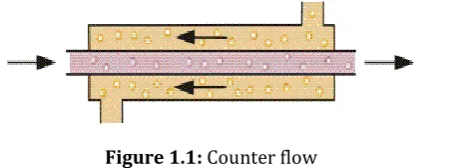
Counter flow: Counter flow exchanger in which the two fluids flow parallel to each other but in opposite directions. This type of flow arrangement allows the largest change in temperature of both fluids and is therefore most efficient.
Figure 1.1: Counter flow
[image:1.595.328.554.532.616.2]Co-current flow: In co-current flow heat exchangers, the streams flow parallel to each other and in the same direction as shown in fig. 1.2. This is less efficient than counter current flow but does provide more uniform wall temperatures.
© 2019, IRJET | Impact Factor value: 7.211 | ISO 9001:2008 Certified Journal
| Page 1916
[image:2.595.105.219.148.272.2]Cross flow: Cross flow heat exchangers are intermediate in efficiency between counter current flow and parallel flow exchangers. In these units, the streams flow at right angles to each other as shown in fig. 1.3.
Figure 1.3: Cross flow
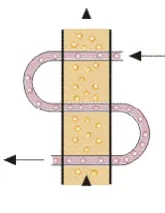
[image:2.595.118.201.336.443.2]Cross Counter flow and Multi Pass Flow: In industrial heat exchangers, hybrids of the above flow types are often found. Examples of these are combined cross flow/counter flow heat exchangers and multi pass flow heat exchangers.
Figure 1.4: Cross Counter flow and Multi Pass Flow
CLASSIFICATION OF HEAT EXCHANGERS BY CONSTRUCTION
Figure 1.5: Heat exchanger classifications
In this section heat exchangers are classified mainly by their construction. The first level of classification is to divide heat exchanger types into recuperative or regenerative. A Recuperative Heat Exchanger has separate flow paths for each fluid and fluids flow simultaneously through the exchanger exchanging heat across the wall separating the
flow paths. A Regenerative Heat Exchanger has a single flow path, which the hot and cold fluids alternately pass through.
Regenerative heat exchangers
In a regenerative heat exchanger, the flow path normally consists of a matrix, which is heated when the hot fluid passes through it (this is known as the "hot blow"). This heat is then released to the cold fluid when this flows through the matrix (the "cold blow"). Regenerative Heat Exchangers are sometimes known as Capacitive Heat Exchangers. Regenerators are mainly used in gas/gas heat recovery applications in power stations and other energy intensive industries.
Recuperative heat exchangers
There are many types of recuperative exchangers, which can broadly be grouped into indirect contact, direct contact and specials. Indirect contact heat exchangers keep the fluids exchanging heat separate by the use of tubes or plates etc.. Direct contact exchangers do not separate the fluids exchanging heat and in fact rely on the fluids being in close contact.
Shell and tube heat exchanger
A Shell and Tube Exchanger consists of a number of tubes mounted inside a cylindrical shell. Figure 1.8 illustrates a typical unit that may be found in a petrochemical plant. Two fluids can exchange heat, one fluid flows over the outside of the tubes while the second fluid flows through the tubes. The fluids can be single or two phase and can flow in a parallel or a cross/counter flow arrangement. The shell and tube exchanger consists of four major parts:
Front end–this is where the fluid enters the tube side of the exchanger.
Rear end–this is where the tube side fluid leaves the exchanger or where it is returned to the front header in exchangers with multiple tube side passes.
Tube bundle–this comprises of the tubes, tube sheets, baffles and tie rods etc. to hold the bundle together. Shell—this contains the tube bundle.
Figure 1.6: Shell and tube heat exchanger
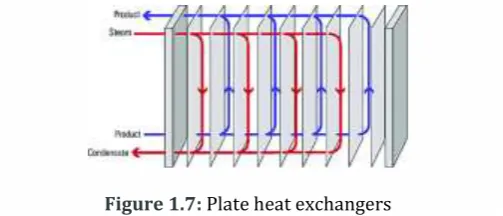
Plate heat exchangers
[image:2.595.37.295.487.660.2] [image:2.595.321.553.613.695.2]© 2019, IRJET | Impact Factor value: 7.211 | ISO 9001:2008 Certified Journal
| Page 1917
pressure and or temperatures as circular tubs, they are generally used for small and low to moderate pressure/temperatures. Their compactness factor is also low compared to other types of heat exchangers. The plates can be arranged in such a way that there is cross-flow i.e. the hot and cold fluids flowing in directions perpendicular to each other to enhance the heat transfer characteristic.
Figure 1.7: Plate heat exchangers
1.3. METHODS OF ENHANCEMENT OF HEAT EXCHANGER
Active Technique: The active method involves external power input for the enhancement in heat transfer; for examples it includes mechanical aids and the use of a magnetic field to disturb the light seeded particles in a flowing stream, etc.
Passive Technique: The Passive heat transfer methods does not need any external power input. In the convective heat transfer one of the ways to enhance heat transfer rate is to increase the effective surface area and residence time of the heat transfer fluids. By Using this technique causes the swirl in the bulk of the fluids and disturbs the actual boundary layers which increase effective surface area, residence time and simultaneously heat transfer coefficient increases in an existing system. Methods generally used are, extended surface, displaced enhancements devices, rough surfaces surface tension devices, Inserts.
Inserts requires additional arrangements to make to fluid flow which enhance the heat transfer. The types of inserts are: twisted tape, wire coils, ribs, baffles, plates, helical screw insert, mesh inserts, convergent – divergent conical rings, conical rings etc.
Coiled wire inserts is one of the passive heat transfer enhancement technique used in various heat transfer application such as air conditioning, cooling device, pre-heater, refrigeration system heat recovery processes, good and dairy process etc.
The advantages of wire coil inserts in comparison to other heat exchanger performance enhancement techniques are-
1. Easy installation & removal
2. Simple manufacturing process with lowest cost. 3. Possibility of easy installation in an existing smooth
tube heat exchanger.
4. they do not change mechanical strength of original plain tube
2. LITERATURE REVIEW
As per the research by Hiroshi et al. (2006), [1] they worked on the Performance of Wire Springs as Extended Heat Transfer Surface for Compact Heat Exchangers. Use of thin metal wire structures as a new type of extended heat transfer surface is proposed. As one of the most basic shapes of such wire structures, heat transfer performance of spring shaped fins is experimentally investigated under relatively low Reynolds number conditions. The averaged heat transfer coefficient is evaluated by a single-blow method while the pressure drop is measured at a steady state flow condition. The effects of the geometric parameters such as the wire diameter, the spring pitch and the pitch ratio were systematically examined and the obtained data were compared with that of a conventional offset fin, which is commercially available. It was found that the geometric parameters of the spring fins and the arrangement of spring fins in the test section affect their heat transfer performance.
Folaranmi Joshua (2009), in his research, design and construction of a concentric tube heat exchanger. The concentric tube heat exchanger was purposeful in order to study the process of heat move between two fluids through a solid divider. It was planned for a counter-flow deal and the logarithmic mean temperature difference (LMTD) method of analysis was adopted. Water was used as fluid for the experiment. The temperatures of the hot and cold water complete to the equipment were 87ᵒC and 27ᵒC, respectively and the outlet temperature of the water after the experiment was 73ᵒC for hot and 37ᵒC for cold water. The outcome of the experiment was tabulate and a graph of the mean temperatures was drawn. The heat exchanger was 73.4% efficient and has an overall coefficient of heat transfer of 711W/m2K and 48ᵒC Log Mean Temperature Difference. The
research takes into account different types of heat exchangers [2].
Jung-Yang San et. al. (2015), has performed experiment on heat transfer and fluid friction correlations for circular tubes with coiled-wire inserts. The wire diameter-to-tube inner diameter ratio (e/d) and coil pitch-to-tube inner diameter ratio (p/d) are in the ranges of 0.0725 to 0.134 and 1.304 to 2.319 respectively. It is found that the Nusselt number (Nu) increases with the e/d value, where as it increases with a decrease of the p/d value [3].
[image:3.595.37.289.183.291.2]© 2019, IRJET | Impact Factor value: 7.211 | ISO 9001:2008 Certified Journal
| Page 1918
Jaypal Mali (2016) experimentally investigated the centrally hollow twisted tape in laminar flow regimeReynolds number ranging from 600 to 1600. According to his study the heat transfer enhancement for centrally hollowed twisted tape near about 22.4 % than that of the conventional twisted tape. The results shows that centrally hollowed twisted tape are good high performance tube inserts and also friction factor increment is less as compared with the heat transfer enhancement [5].
3. EXPERIMENT
The experimental set up is as shown in the following figure. It consists of a copper tube and CPVC pipe heater is mounted. Pump by pass valve is used to pump the water in the tube and digital thermometer is used to measure the temperature at the outlet of pipe as shown in figure. The springs are of steel material and extrusion process is used to manufacture the spring. The sketch of the wire coil is as shown in the figure and the dimensions of springs are given in the following table 3.1.
Figure 3.1: Spring in pipe
Table 3.1: Dimension of spring coil
Sr. no. Parameters Geometry of
wire coil Pitch (P) (in mm) Diameter of wire (d) mm Ratio (p/d) 1 Circular cross section
12 3 4 2 24 3 8 3 33 3 11
All values are taken from experiments performed by us:
Mass flow rate of hot water = 0.01 L/sec
Mass flow rate of cold water = 0.033 L/sec
Temperature drop in hot water = 20°C
Temperature rise in cold water = 6°C
Temperature at inlet of hot water T1 = 68.1°C
Temperature at outlet of hot water T2 = 48.0°C
Temperature at inlet of hot water T3 = 28.0°C
Temperature at outlet of cold water T4 = 34.2°C
Diameter of Hot water tube = 22 mm
Diameter of cold water tube = 48 mm
Pipe length of cold water tube = 1.22 m
Pipe length of hot water tube = 1.52 m
3.1. EXPERIMENTAL PROCEDURE
The pump is turn on and the flow rate is adjusted by the valve mounted on pipe copper as well as cpvc pipe and its value is measured by rotameter. Then heater is turned on, the water while flowing through the copper tube transfers the heat and then comes out from the pipe opening valve into the tank where it loses its heat and gets cooled. The inlet, outlet and surface temperatures are measured by means of thermocouple and the experiment is carried out till the steady state is achieved.
3.3 CALCULATION
1). LMTD
T1= temperature of hot water at inlet
T2= temperature of hot water at outlet
T3= temperature of cold water at inlet
T4= temperature of cold water at outlet
For counter flow:
)
(
)
(
ln
)
(
)
(
)
(
3 2 4 1 3 2 4T
T
T
T
T
T
T
T
counter m
2). Heat transfer coefficient
For Counter flow
)
(
)
(
)
(
)
(
mC
T
1T
2mC
T
3T
4Q
counter
p hot
p cold
,
m
UA
Q
Where,
m= Mass of hot water.
© 2019, IRJET | Impact Factor value: 7.211 | ISO 9001:2008 Certified Journal
| Page 1919
Q= Total heat required
U= Heat transfer coefficient
3). Determination of heat exchanger effectiveness
)
(
)
(
/
)
(
4
1
T
T
mC
cold
hot
T
mC
ess
Effectiven
small p p
[image:5.595.64.558.34.605.2]4. RESULSTS AND DISCUSSION
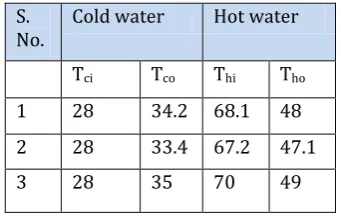
Table 4.1: Temperature of Hot and Cold Water
S.
No. Cold water Hot water Tci Tco Thi Tho
1 28 34.2 68.1 48
2 28 33.4 67.2 47.1
3 28 35 70 49
We had design and construct a spring coil inserted in concentric- tube heat exchanger in which two tubes are concentrically arranged and either of the fluids (hot or cold) flows through the tube and the other through the annulus.
Table 4.2: Overall heat transfer coefficient
Sr.
No. LMTD (°C)
Overall Heat Transfer Coefficient
(U)
1 26.34 173.07
2 26.01 296.36
[image:5.595.76.247.239.347.2]3 27.4 328.21
Table 4.3: Mass flow rate of hot and cold water and their effectiveness
Sr. No.
Mass flow rate hot water (L/s)
Mass flow rate cold water (L/s)
Effectiveness
1 0.01 0.033 0.514
2 0.015 0.062 0.563
[image:5.595.43.280.434.552.2]3 0.02 0.058 0.465
[image:5.595.309.562.461.611.2]Figure 4.1: Overall heat transfer coefficient
Figure 4.2: Effectiveness and mass of cold water
Figure 4.3: Effectiveness and mass of hot water
[image:5.595.39.287.595.728.2]© 2019, IRJET | Impact Factor value: 7.211 | ISO 9001:2008 Certified Journal
| Page 1920
When all of these values are compared with standard data of heat exchanger without using spring, the designed heat exchanger is more effective.
5. CONCLUSION
For the laminar flow in circular tube having turbulent promoters of three different pitch to diameter is used. The overall heat transfer coefficient, effectiveness and heat transfer capability is being experimentally calculated for the above inserts of spring coil in tube. Results show that the cross section circular gives the highest values of overall heat transfer coefficient, efectiveness and heat transfer capability as compared to conventional heat exchanger. The circular cross section having p/d 4 gives the maximum values. So from the result circular cross section is the best when it is compared with concentric heat exchanger as compared in the performance and its overall heat transfer coefficient is also more than concentric tube heat exchanger.
REFERENCES
[1]. Hiroshi IWAI, Soushi KAWAKAMI, Kenjiro SUZUKI, Junichi TSUJII, Tetsuo ABIKO, (2006), “Performance of Wire Springs as Extended Heat Transfer Surface for Compact Heat Exchangers”, Journal of Thermal Science and Technology, Vol.1, pp.78-89.
[2]. Folaranmi Joshua, (2009), “Design and Construction of a Concentric Tube Heat Exchanger”, Department of Mechanical Engineering, Federal University of Technology Minna, Niger State, Nigeria vol.2, pp. 128-133.
[3]. Jung-Yang San,Wen-Chieh Huang, Chang-An Chen.,(2015),“Experimental investigation on heat transfer and fluid friction correlations for circular tubes with coiled-wire inserts”, International Communications in Heat and Mass Transfer, Vol. 65, pp. 8–14.
[4]. A. E. Zohir and M.A. Habib, (2012), “Heat transfer characteristics in a double pipe heat exchanger equipped with coiled circular wires” Journal of Engineering Sciences, Assiut University, Vol. 40, No. 3, pp.731 -744.
[5]. Jaypal Mali, Girisg Patil, A.R.Acharya, A.T.Pise, (2016), “Heat Transfer Enhancement With Centrally Hollow Twisted tape and Al2O3 Water Based Nanofluid in Tubular Heat