
Lane Detection Techniques: A Review
Gurveen Kaur
Student of C.S.E Department DAVIET College, Jalandhar (Pb.) India, 144001.
Dinesh Kumar
Head of I.T. Department.DAVIET College, Jalandhar (Pb.) India, 144001.
ABSTRACT
Many people die each year in roadway departure crashes caused by driver inattention. Lane detection systems are useful in avoiding these accidents as safety is the main purpose of these systems. Such systems have the goal to detect the lane marks and to warn the driver in case the vehicle has a tendency to depart from the lane. A lane detection system is an important element of many intelligent transport systems. Lane detection is a challenging task because of the varying road conditions that one can come across while driving. In the past few years, numerous approaches for lane detection were proposed and successfully demonstrated. In this paper, a comprehensive review of the literature in lane detection techniques is presented. The main objective of this paper is to discover the limitations of the existing lane detection methods.
Keywords
Lane detection, Lane Colorization.
1.
INTRODUCTION
With the rapid raise of urban traffic, the traffic safety becomes more and more significant. Leaving the lane causes about 30% of all accidents in the highway, and most of these are resulted from the distraction and fatigue of the driver. Therefore, a system that could provide a warning to drivers of a danger has a great potential to save a large number of lives. Systems that are designed to help the driver in its driving process are known as advanced driver assistance systems (ADAS). Many systems like adaptive cruise control, collision avoidance system, night vision, blind spot detection and traffic sign detection are a part of ADAS [1]. Lane departure system is also a part of this category. This system has a goal to detect the lane marks and to advise the driver in case the vehicle has a tendency to leave the lane.
Lane detection is the process to locate lane markers on the road and then present these locations to an intelligent system. In intelligent transportation systems [2], intelligent vehicles cooperate with smart infrastructure to achieve a safer environment and better traffic conditions. The applications of a lane detecting system could be as simple as pointing out lane locations to the driver on an external display, to more complex tasks such as predicting a lane change in the instant future in order to avoid collisions with other vehicles. Some of the interfaces used to detect lanes include cameras, laser range images, LIDAR and GPS devices [3].
In many proposed systems [4], the lane detection consists of the localization of specific primitives such as road markings of the surface of the painted roads. Various challenges like parked and moving vehicles, bad quality lines, shadows of trees, buildings and other vehicles, sharper curves, irregular lane shapes, merging lanes, writings and other markings on the road, unusual pavement materials and dissimilar slopes causes problems in lane detection. There have been active research on lane detection and a wide variety of algorithms of various representations, detection and tracking techniques, and modalities have been proposed [5].
[image:1.595.317.549.169.383.2]
Figure 1: Challenges of Lane Detection [6]
Many approaches have been applied to lane detection, which can be classified as either feature-based or model-based [7-8]. Feature-based methods detect lanes by low-level features like lane-mark edges [9-11]. The feature-based methods are highly dependent on clear marks, and suffer from weak lane-marks, noise and occlusions. Model-based methods represent lanes as a kind of curve model which can be determined by a few critical geometric parameters [12-16]. The model-based methods are less sensitive to weak lane appearance features and noise as compared to feature-based methods. But the model constructed for one scene may not work in another scene, which makes the method less adaptive. Additionally, for best estimation of model parameters, an iterative error minimization algorithm should be applied, which is comparatively time-consuming [17].
2.
LANE DETECTION MODEL
5
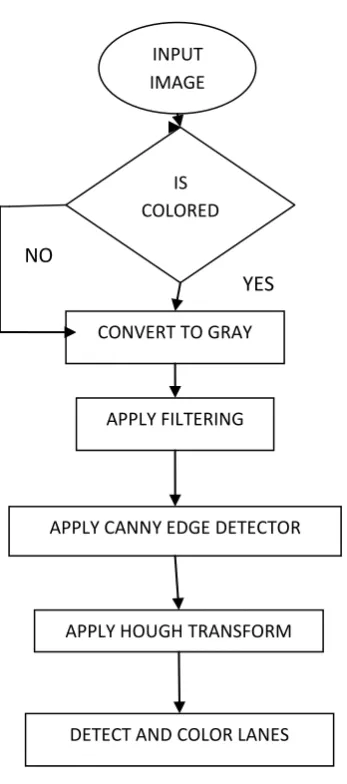
Figure 2: Algorithm of Lane Detection
The algorithm undergoes various changes and detection of patterns in the images of roads for detecting the lanes. Some of the images are shown in Figure 3-6. Figure 3a , shows the input image. Figure 3b represents the filtered image of fig 3a. In Figure 4a, the filtered image is converted to grayscale image for reducing the processing time. Then this image is segmented to binary image 4b. It is done to locate the lanes in captured image.
[image:2.595.319.563.73.209.2]Figure 3: a) Input Image b) Filtered Image [20]
Figure 4: a) Grayscale Image b) Binary Image [20]
Figure 5a) represents the smoothed image and Figure 5b) shows the detected edges in the image with the help of canny edge detector.
Figure 5: a) Smoothed Image b) Edge Detected Image[20]
Figure 6a) shows the smoothed image and finally the output image is represented in Figure 6b.
Figure 6: a) Smoothed Image b) Output Image[20]
3.
LANE DETECTION TECHNIQUES
3.1 Results using Hough Transform [1]
Mariut et. al [1]proposed a simple algorithm that detected the lane marks, lane mark’s characteristics and had the ability to determine the travelling direction. It used the well known Hough transform to detect the potential lines in the images. To ensure the right detection of the lane mark, they had developed a technique that extracts the inner margin of the lane. The margins are highlighted by generating the magnitude image.CONVERT TO GRAY
APPLY FILTERING
APPLY CANNY EDGE DETECTOR
APPLY HOUGH TRANSFORM
DETECT AND COLOR LANES INPUT
IMAGE
IS COLORED
NO
[image:2.595.319.562.263.387.2] [image:2.595.317.564.437.601.2] [image:2.595.57.297.580.705.2]Figure 7: a) Input Image b) Detected Lanes[1]
3.2 Results using Hough Transformation
and Filters [2]
T.T Tran et al.[20] proposed an adaptive method based on HSI color model to detect lane marking. First, they converted RGB-based image to its HSI-based image. However, HSI color model was improved by the change in the way to calculate the intensity (I) component from RGB color images. From observing the color images of the road scene in HIS color space, they utilized the limited range of color. Hence, H, S and I component were used in this method. The proposed method can label the location of lane marking accurately.
Figure 8: a)Input Image b) Detected Lanes [2]
3.3 Results using H-Maxima and Improved
Hough Transformation [19]
K. Ghazali et al. [19] proposed a fast and improved algorithm with the ability to detect unexpected lane changes. Based on the characteristics of physical road lane, they presented a lane detection technique based on H-MAXIMA transformation and improved Hough Transform algorithm which first defines the region of interest from input image for reducing searching space; divided the image into near field of view and far field of view. In near field of view, Hough transform has been applied to detect lane markers after image noise filtering.
Figure 9: a) Detection in shadows b) Detection in vehicles [19]
3.4 Results of Lane Detection based on
HSI model [20]
S. Srivastava et. al [2] proposed an efficient ways of noise reduction in the images by using different filtering techniques in this paper. The main objective was to design, develop, implement and subsequently simulate an efficient lane detection algorithm which will provide high quality results in the case when noise is present in the signal. Various filters used for comparison were median, wiener, and hybrid median filters.
Figure 10: a) Input Image b) Filtered Image c) Image without Filter d) Output Image [20]
4.
LITERATURE REVIEW
The objective of the literature review is to find and explore the benefits of lane detection algorithms and also what are the different problems in existing algorithms and techniques. The main goal of this literature review is to find the gaps in existing research and methods and also what will be the possible solutions to overcome these holes.
[image:3.595.55.292.70.191.2] [image:3.595.56.289.325.456.2] [image:3.595.55.292.603.729.2]7 However, when the system detected the shadow of a tree
trunk or a shadow of telegraph pole which has a uniform orientation, an unpredictable result occurred. M. Chen et al.(2004) [25] developed another system called AURORA which tracks the lane markers present on structured road using a color camera mounted on the side of a car pointed downwards toward the road. A single scan line is applied in each image to detect the lane markers. C. R. Jung et al.(2005) [26] used the edge detection, squares angular estimation, Hough transform to estimate lanes on a road. The results were obtained in his paper using his algorithm. The algorithm mostly runs good except when it comes to shadow or other interference on the road. M. Aly (2008) [6] proposed an efficient, real time, and robust algorithm for detecting lanes in urban streets. The algorithm was based on taking a top view of the road image, filtering with Gaussian kernels, and then using line detection and a new RANSAC spline fitting technique to detect lanes in the street. This algorithm was able to detect all lanes in still images of urban streets under various conditions. This method has problems due to stop lines at cross streets, at cross walks, passing cars and confused writings. Z. Kim(2008) [5] presented a robust lane-detection-and-tracking algorithm to deal with challenging scenarios such as a lane curvature, worn out lane markings, lane changes, and emerging, ending, merging, and splitting lanes. The algorithm was based on random sample consensus and particle filtering. The algorithm was proposed to produce a large number of hypotheses in real time as compared to other algorithms. O. O. Khalifa et al. (2009) [18] proposed a real time lane detection algorithm based on video sequences taken from a vehicle driving on highway. This algorithm showed a robust behaviour to lighting change and shadows. The lanes were detected using Hough transformation with restricted search area. It could be applied in both painted and unpainted road, as well as slightly curved and straight road in different weather conditions. This algorithm proved to be robust and fast enough for real time requirements as compared to other algorithms. Vehicles are assumed to move on flat and straight roads or with slow curvature. This algorithm does not work well on sharp curves and in presence of shadows. M. Meuter et al. (2009) [27] proposed a new robust approach for camera based lane recognition for lane detection and tracking system. This detection algorithm was combined with a tracking algorithm which combined two Extended Kalman filter using the Interacting Multiple Models (IMM) algorithm. The algorithm was linear in time and robust in the presence of noise and weak markers. The algorithm could be used to detect the position and the slope of the lane segments. S. Zhou et al. (2010) [28] proposed a road detection algorithm
m on the marked roads based on Geometrical model and Gabor filter. This algorithm can be used for Lane Departure Warning System or other auxiliary driving system. The lane geometrical model contained four parameters which were starting position, lane original orientation, and lane width and lane curvature. Gabor filter is adopted to estimate orientation in each pixel and to filter the image along the line of lane model. This algorithm can overcome the universal lane detection problems due to inaccuracies in edge detection such as shadow of tree and passengers on the road. As compared to other methods, the algorithm achieved high accuracy and was robust to the noise and other interferences such as shadow. Q. Lin et al. (2010) [17] proposed a real time vision-based lane detection system to find the position and type of lanes in each video frame. In this method, lane hypothesis was generated and verified based on an effective combination of lane-mark edge-link features. During the searching process of lane mark
candidates, an extended edge linking algorithm with directional edge gap closing is used to produce more complete edge links. The continuity of lane is estimated using a Bayesian probability model. In this algorithm, there were no special requirements for camera parameters, background models, or any other road surface models. Therefore, the algorithm was more adaptive to various road environments.
Z. Teng et al. (2010) [29] proposed an algorithm which integrated multiple cues, including bar filter which has been efficient to detect bar-shape objects like road lane, color cue, and Hough Transform. To guarantee the robust and real-time lane detection, particle filtering technique has been utilized. This algorithm improved the accuracy of the lane detection in both straight and curved roads. It has been effective on a wide variety of challenging road environments. This method fails for the lane tracking wh en it is to be applied to particle filter in the dashed lane situation.
F. Mariut et.al (2012) [1] proposed an algorithm that automatically emphasizes the lane marks and recognizes them from digital images, by the use of Hough transform. This method also detects lane mark’s characteristics and has the ability to determine the travelling direction. A technique that extracts the inner margin of the lane is used to ensure the right detection of the lane mark. The algorithm works very efficiently for straight roads but fails in some cases of curved roads. N. Phaneendra et al. (2013) [30] proposed a vision-based lane departure warning system. The main goal of this model was to implement an image processing algorithm for detecting lanes on the road and give a textual warning on departure from the lane. The lane departure decision making is based on distance between lanes and the center of the bottom in captured image coordinate, which needed less parameters. The lane detection performance has been improved by making use of Kalman filter, compared to the usual method of using Hough transform. The model proved to be efficient and feasible as compared to other systems. This system failed to detect the lanes correctly when the situations on the road are more complex.
5.
GAPS IN EXISTING LITERATURE
By conducting the literature survey it has been found that the most of the existing literature has neglected one of the following:-
1) The survey has shown that the existing methods provides good accuracy for high quality images but sometimes provide poor results for poor environmental conditions like fog, haze, noise, dust etc.
2) Most of the existing techniques are best for straight lanes, but they provide poor results for curved roads.
3) Most of the lane detection techniques are based on standard Hough transform, so it can be modified for improving the accuracy further.
6.
CONCLUSION AND FUTURE WORK
7.
REFERENCES
[1] F. Mariut, C. Fosalau and D. Petrisor, “Lane Mark Detection Using Hough Transform", In IEEE International Conference and Exposition on Electrical and Power Engineering, pp. 871 - 875, 2012.
[2] S. Srivastava, R. Singal and M. Lumb, “ Efficient Lane Detection Algorithm using Different Filtering Techniques”, International Journal of Computer Applications, vol. 88, no.3, pp. 975-8887, 2014.
[3] A. Borkar, M. Hayes, M.T. Smith and S. Pankanti , “A Layered Approach To Robust Lane Detection At Night” , In IEEE International Conference and Exposition on Electrical and Power Engineering, Iasi, Romania, pp. 735 - 739, 2011.
[4] K. Ghazali, R. Xiao and J. Ma, “Road Lane Detection Using H-Maxima and Improved Hough Transform”, Fourth International Conference on Computational Intelligence, Modelling and Simulation, pp: 2166-8531, 2011.
[5] Z. Kim, “Robust Lane Detection and Tracking in Challenging Scenarios”, In IEEE Transactions on Intelligent Transportation Systems, vol. 9, no. 1, pp. 16 - 26, 2008.
[6] M. Aly, “Real time Detection of Lane Markers in Urban Streets”, In IEEE Intelligent Vehicles Symposium, pp. 7 - 12, 2008.
[7] J.C. McCall and M.M. Trivedi, “Video-based Lane Estimation and Tracking for Driver Assistance: Survey, System, and Evaluation”, IEEE Transactions on Intelligent Transportation Systems, vol.7, pp.20-37, 2006.
[8] Y.Wang, E. K.Teoh and D. Shen, “Lane Detection and Tracking Using B-snake,” Image and Vision Computing, vol. 22, pp. 269-280, 2004.
[9] A. Broggi and S. Berte, “Vision-based Road Detection in Automotive Systems: a Real-time Expectation-driven Approach”, Journal of Artificial Intelligence Research, vol.3, pp. 325-348, 1995.
[10] M. Bertozzi and A. Broggi, “GOLD: A Parallel Real-time Stereo Vision System for Generic Obstacle and Lane Detection”, IEEE Transactions of Image Processing, pp. 62-81, 1998.
[11] S.G. Jeong, C.S. Kim, K.S. Yoon, J.N. Lee, J.I. Bae, and M.H. Lee, “Real-time Lane Detection for Autonomous Navigation”,IEEE Proc. Intelligent Transportation Systems, pp. 508–513, 2001.
[12] Y.Wang, E.K. Teoh and D. Shen, “Improved Lane Detection and Tracking Using B-snake,” Image and Vision Computing, vol. 20, pp. 259-272, 2005.
[13] C. R. Jung and C. R. Kelber, “A Lane Departure Warning System Using Lateral Offset with Uncalibrated Camera,” Proc. IEEE Conf. on Intelligent Transportation Systems, pp.102-107, 2005.
[14] D.J. Kang, J. W. Choi and I.S. Kweon, “Finding and Tracking Road Lanes Using Line-snakes”, Proceedings of Conference on Intelligent Vehicle, pp. 189-194, 1996.
[15] Z. Kim, “Real-time lane tracking of curved local road”, Proc. IEEE Conf. on Intelligent Transportation System, pp. 1149-1155, 2006.
[16] Y. Wang, D. Shen and E.K. Teoh, “Lane Detection Using Spline Model”, Pattern Recognition Letters vol.21, pp. 677-689, 2000.
[17] Q. Lin, Y. Han and H. Hahn, “Real-time lane departure detection based on extended edge-linking algorithm”, In IEEE 2nd International Conference on Computer Research and Development, pp. 725-730, 2010.
[18] O.O. Khalifa and A.H.A Hashim, “Vision-Based Lane Detection for Autonomous Artificial Intelligent Vehicles”, In IEEE International Conference on Semantic Computing, pp. 636 - 641, 2009.
[19] K. Ghazali, R. Xiao and J. Ma, “Road Lane Detection Using H-Maxima and Improved Hough Transform”, Fourth International Conference on Computational Intelligence, Modelling and Simulation, pp: 2166-8531, 2012.
[20] T. T Tran, C. S Bae, Y. N. Kim, H.M. Cho, and S.B. Cho, “An Adaptive Method for Lane Marking Detection Based on HSI Color Model”, ICIC, CCIS 93, pp. 304– 311, 2010.
[21] D. Pomerleau and Jochem, “Rapidly Adapting Machine Vision for Automated Vehicle Steering, IEEE, 1996.
[22] B. M, Broggi, “GOLD: A parallel real-time stereo Vision system for generic obstacle and lane detection”, IEEE Transactions on Image Processing, pp. 4-6, 1998.
[23] C. Kreucher and S. K. Lakshmanan, A Driver warning System based on the LOIS Lane detection Algorithm, Proceeding of IEEE International Conference On Intelligent Vehicles. pp. 17 -22, 1998.
[24] Y. Wang, E. K. Teoha, D. Shen. Lane detection and tracking using B-Snake”, In: Image and Vision Computing 22, pp: 269-28, 2004.
[25] M. Chen., T. Jochem and D. T. Pomerleau, “AURORA: A Vision-Based Roadway Departure Warning System”, In Proceeding of IEEE Conference on Intelligent Robots and Systems, 2004.
[26] C. R. Jung and C. R. Kelber, “Lane following and lane departure using a linear-parabolic model” In: Image and Vision Computing, pp. 1192–1202, 2005.
[27] M. Meuter, S. Muller, A. Mika, S. Hold, C. Nunn and A. Kummert, “A Novel Approach to Lane Detection and Tracking”, In IEEE 12th International Conference on Intelligent Transportation Systems, pp. 1-6, 2009.
[28] S. Zhou, Y. Ziang, J. Xi, J. Gong, G. Xiong and H. Chen, “A novel lane detection based on geometrical model and gabor filter”, in IEEE Intelligent Vehicles Symposium, pp. 59-64, 2010.
[29] Z. Teng, J.H. Kin and D.J. Kang, “Real-time Lane detection by using multiple cues”, In IEEE International Conference on Control Automation and Systems, , pp. 2334 - 2337, 2010.
![Figure 1: Challenges of Lane Detection [6]](https://thumb-us.123doks.com/thumbv2/123dok_us/8022840.766596/1.595.317.549.169.383/figure-challenges-of-lane-detection.webp)
![Figure 8: a)Input Image b) Detected Lanes [2]](https://thumb-us.123doks.com/thumbv2/123dok_us/8022840.766596/3.595.56.289.325.456/figure-a-input-image-b-detected-lanes.webp)
