
JAIST: Combining multiple features for Answer Selection in Community
Question Answering
Quan Hung Tran1, Vu Duc Tran1, Tu Thanh Vu2, Minh Le Nguyen1, Son Bao Pham2 1Japan Advanced Institute of Science and Technology
2University of Engineering and Technology, Vietnam National University, Hanoi
1{quanth,vu.tran,nguyenml}@jaist.ac.jp
2{tuvt,sonpb}@vnu.edu.vn
Abstract
In this paper, we describe our system for SemEval-2015 Task 3: Answer Selection in Community Question Answering. In this task, the systems are required to identify the good or potentially good answers from the answer thread in Community Question Answering collections. Our system combines 16 features belong to 5 groups to predict answer quality. Our final model achieves the best result in sub-task A for English, both in accuracy and F1-score.
1 Introduction
Nowadays, community question answering (cQA) websites like Yahoo! Answers play a crucial role in supporting people to seek desired information. Users can post their questions on these sites for find-ing help as well as personal advice. However, the quality of these answers varies greatly. Typically, only a few of the answers in an answer thread are useful to the users and it may take a lot of efforts to identify them manually. Thus, a system that auto-matically identifies answer quality is much needed.
The task of identifying answer quality has been studied by many researchers in the field of Question Answering. Many methods have been proposed: web redundancy information (Magnini et al., 2002), non-textual features (Jeon et al., 2006), textual en-tailment (Wang and Neumann, 2007), syntactic fea-tures (Grundstr¨om and Nugues, 2014). However, most of these works used independent dataset and evaluation metrics; thus it is difficult to compare the results of these methods. The SEMEVAL task
3 (M`arquez et al., 2015) addresses this problem by providing a common framework to compare differ-ent methods in multiple languages.
Our system incorporates a range of features: word-matching features, special component fea-tures, topic-modeling-based feafea-tures, translation-based features and non-textual features to achieve the best performance in subtask A (M`arquez et al., 2015). In the remainder of the paper, we will de-scribe our system with the focus on the features.
2 System Description
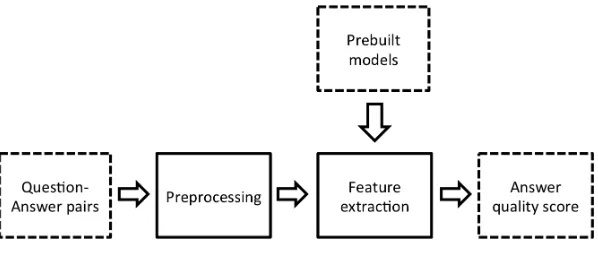
For extracting the features, we first preprocess the questions and the answers then build a number of models based on training data or other sources (Fig-ure 1).
2.1 Preprocessing
All the questions and the answers are preprocessed through the following steps: Tokenization, POS-tagging, Syntactic parsing, Dependency parsing, Lemmatization, Stopword removal, Name-Entity recognition. These preprocessing steps are com-pleted using The Stanford CoreNLP Natural Lan-guage Processing Toolkit (Manning et al., 2014). Because of the noisy nature of community data, the syntactic parsing, dependency parsing and Name-Entity recognition steps do not produce highly ac-curate results. Thus, we rely mainly on the bag-of-word representation of text. Removing stopbag-of-words or lemmatization can alter the meaning of the text, so in the system, we keep both the original version and the processed version of the text. The choice between using the two versions is made using experiments in
Figure 1:System components
development set.
2.2 Building models from data
In this section, we describe the resources we use, or build for extracting features, these resources are: Translation models, LDA models, Word vector rep-resentation models, Word Lists. The translation models are built to bridge the lexical chasm be-tween the questions and the answers (Surdeanu et al., 2008). In previous works (Jeon et al., 2005; Zhou et al., 2011), monolingual translation mod-els between questions have been successfully used in finding similar questions in Question Answering archive. We adapt the idea and build translation models between the questions and their answers us-ing the trainus-ing data and the Qatar Livus-ing forum data. We treat the question-answer pairs similar to dual language sentence pairs in machine translation. First, each question-answer pair is tokenized and all special characters are removed. In the process, if any answer has too few tokens (less than two tokens), it is removed from the training data. Then the trans-lation probabilities are calculated by IBM Model 1 (Brown et al., 1993) and Hidden Markov Model. Each model is trained with 200 iterations. The cal-culated translation probabilities help us to calculate the probability that an answer is the translation of the question. The translation feature will be detailed in Section 2.3.
We build two topic models, the first one is trained in the training data, the second one is trained in Wikipedia data1using Gensim toolkit ( ˇReh˚uˇrek and
Sojka, 2010) and Mallet toolkit (McCallum, 2002).
1The compressed version of all article from Wikipedia
downloaded at http://dumps.wikimedia.org/enwiki/
These LDA models have 100 topics. The choice be-tween which model will be used is based on experi-ments in the development set.
We experiment with two word vector represen-tation models built using Word2Vec tool (Mikolov et al., 2013), the first one is pre-trained word2vec model provided by the authors, and the second one is trained from the Qatar Living forum data. Our Word2Vec model was built with word vector size of 300, window size of 3 (n-skip-gram, n=3) and mini-mum word frequency of 1. In Section 2.3, we detail how to extract feature using these models.
We also build several word lists from the training set to extract features:
• The words that usually appear on each type of answers (Good, Bad, Potential).
• The words pairs (one from the question, one from the good answers) that have high fre-quency in the training set. We aim to extract the information about word collocations through this list.
2.3 Features
Word-matching feature group: This feature group exploits the surface word-based similarity between the Question and the Answer to assign score:
• Cosine similarity:
cosine sim=
n
P
i=1ui×vi
rPn
i=1(ui) 2×
rPn
i=1(vi) 2
(1)
Withu andv are binary bag of words vectors (with stopwords are removed),ui is the i-th
feature returns the cosine similarity between question vector and answer vector.
• Dependency cosine similarity: We represent the questions and the answers as bag of word-dependency, with words are associated with their dependency label in the dependency tree. For example: a dependency arc in the depen-dency tree: prep(buy-4, for-7) will generate the following word-dependency: prep-by-for. We consider the sentence to be the collection of these word-dependencies. The cosine similar-ity score is calculated similar to bag-of-word cosine similarity.
• Word alignment: We also use the Meteor toolkit (Denkowski and Lavie, 2014) to align the words from the question and the answers, and use the alignment score returned as a fea-ture in the feafea-ture space
• Noun match: This feature is similar to Cosine similarity feature, however; only nouns are re-tained in the bag-of-word.
Special-component feature group: This feature group identifies the special characteristics of the an-swers that show the answer quality:
• Special words feature: This feature identifies if an answer contains some of the special tokens (question marks, laugh symbols). Typically, the posts that contains this type of tokens are not a serious answer (laugh symbols), or a further question (question marks). The laugh symbols are identified using a regular expression.
• Typical words feature: This feature identifies if an answer contains some specific words that are typical for an answer quality class (good, bad, potential). The typical word lists are built using training data and described in the previous sec-tion. After the experiment step, however, only the typical word list for bad answers was found to be effective and was used in the final version of the system.
Non-textual feature group: This feature group exploits some non-textual information of the posts in the answer thread to assign answer quality:
• Question author feature: This feature identifies if an answer in the answer thread belongs to the author of the question. If a post belongs to the author of the question, it is very unlikely to be an answer.
• Question category: We also include the ques-tion category (27 categories) in the feature space because we found out that the quality dis-tribution of different types of question are very different.
• The number of posts from the same user: We include the number of posts from the same user as a feature because we observe that if a user has a large number of posts, most of them will be non-informative, irrelevant to the original question.
Topic model based feature: We use the previ-ously mentioned LDA models to transform ques-tions and answers to topic vectors and calculate the cosine similarity between the topic vectors of the question and its answers. We use this feature be-cause a question and its correct answer should be about similar topics. After experimenting on the de-velopment set, only the LDA model built from train-ing data is effective and thus, it is used in the final system.
Word Vector representation based feature: We use the word vector representation to model the relevance between the question and the answer. All the questions and answers are tokenized and the words are transformed to vector using the pre-trained word2vec model. Each word in the ques-tion will then be aligned to the word in the answer that has the highest vector cosine similarity. The re-turned value will be the sum of the scores of these alignments normalized by the question’s length:
align(wi) = max0<j≤m(cosine(wi, wj0)) (2)
word2vec sim=
Pn
i=1align(wi)
n (3)
Withcosine(wi, w0j)is the cosine similarity of two
Translation based feature: We use the previ-ously mentioned translation models to find the word to word alignments between the question and the an-swer. This feature is calculated similar to the Word Vector representation based feature. Each word in the question will be aligned with the word in the an-swer with the highest translation score. The feature value will be the sum of translation scores normal-ized by question’ length.
2.4 System run configuration
The straightforward way to identify the quality classes for answers is using a classification model. However, the classification model has problem in identifying the Potential class. In our experiments, the classification model ignores the Potential class entirely. This problem may be caused by our feature design as the features actually aim to identify either good or bad answers.
To solve this problem, we use another approach. As we observe the data, most of the Potential an-swers can be considered “Not good enough” and “Not bad enough”. An answer which is not quite good nor quite bad can be considered “Potential”, thus using a regression model2 to score the quality
of the answer would probably be better. In our ex-periment with the development data, the regression model outperforms the classification model by 3.4 F-measure score.
Features are extracted from the answers (with their questions treated as the context), and then the feature values are passed through a regression model. However, the provided data only has qual-ity classes but not regression value, thus we need to assign the regression value for each answer quality class: 1.0 for Good answers, 0.5 for Potential an-swers, and 0.0 for Bad answers.
Our system runs are different in the feature space. Our best run (JAIST-contrastive1) uses all the fea-tures described above. Our main run (JAIST-primary) excludes the topic-modeling based feature while the third run (JAIST-contrastive2) includes several other experimental features that did not have contribution when tested on the development set.
2We use SVM-regression model in WEKA toolkit (Hall et
[image:4.612.312.535.69.286.2]al., 2009)
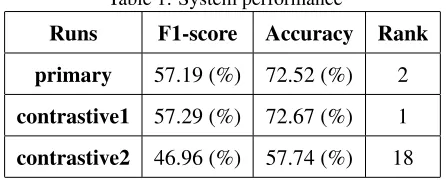
Table 1: System performance
Runs F1-score Accuracy Rank
primary 57.19 (%) 72.52 (%) 2
contrastive1 57.29 (%) 72.67 (%) 1
contrastive2 46.96 (%) 57.74 (%) 18
Table 2: Detail Class F1-score
Runs F1-score
Good 78.96 (%)
Bad 78.24 (%)
Potential 14.36 (%)
3 Result and Discussion
We only take part in subtask A for English. Our system has the best accuracy and F1-score in sub-task A (primary runs) shown in Table 1. Classifying the Potential class is quite difficult (M`arquez et al., 2015) and our system only achieve 14.36 % F1 score on this class. Although the use of regression model partly solves this problem, our feature space is not adequate for identifying this class reliably (Table 2)
4 Conclusion
In this paper, we present our approach for the sub-task A - English of the SEMEVAL 2015 sub-task 3 - An-swer Selection in Community Question AnAn-swering. We propose an Answer quality scoring based ap-proach for classifying answers in Community Ques-tion Answering. Our system achieves high results in the task, however, does not handle the Potential class well. A possible explanation is that we still rely heavily on the bag-of-word representation of text. In the future, other semantically rich representations of text would be employed to improve performance.
References
[image:4.612.314.537.75.165.2]Jakob Grundstr¨om and Pierre Nugues. Using Syntactic Features in Answer Reranking. InAAAI 2014 Work-shop on Cognitive Computing for Augmented Human Intelligence, pages 13–19, 2014.
Mark Hall, Eibe Frank, Geoffrey Holmes, Bernhard Pfahringer, Peter Reutemann, and Ian H. Witten. The WEKA Data Mining Software: An Update. SIGKDD Explor. Newsl., 11(1):10–18, November 2009. Jiwoon Jeon, W. Bruce Croft, and Joon Ho Lee.
Find-ing Similar Questions in Large Question and Answer Archives. In Proceedings of the 14th ACM Inter-national Conference on Information and Knowledge Management, CIKM ’05, pages 84–90, New York, NY, USA, 2005.
Jiwoon Jeon, W. Bruce Croft, Joon Ho Lee, and Soyeon Park. A Framework to Predict the Quality of Answers with Non-textual Features. InProceedings of the 29th Annual International ACM SIGIR Conference on Re-search and Development in Information Retrieval, SI-GIR ’06, pages 228–235, New York, NY, USA, 2006. Michael Denkowski Alon Lavie. Meteor Universal:
Lan-guage Specific Translation Evaluation for Any Target Language.ACL 2014, page 376, 2014.
Bernardo Magnini, Matteo Negri, Roberto Prevete, and Hristo Tanev. Is it the right answer?: exploiting web redundancy for Answer Validation. InProceedings of the 40th Annual Meeting on Association for Computa-tional Linguistics, pages 425–432, 2002.
Christopher D Manning, Mihai Surdeanu, John Bauer, Jenny Finkel, Steven J Bethard, and David McClosky. The Stanford CoreNLP natural language processing toolkit. In Proceedings of 52nd Annual Meeting of the Association for Computational Linguistics: System Demonstrations, pages 55–60, 2014.
Andrew Kachites McCallum. MALLET: A Machine Learning for Language Toolkit. http://mallet.cs.umass.edu, 2002.
Tomas Mikolov, Kai Chen, Greg Corrado, and Jeffrey Dean. Efficient Estimation of Word Representations in Vector Space.CoRR, abs/1301.3781, 2013. Llu´ıs M`arquez, James Glass, Walid Magdy,
Alessan-dro Moschitti, Preslav Nakov, and Bilal Randeree. SemEval-2015 Task 3: Answer Selection in Commu-nity Question Answering. InProceedings of the 9th International Workshop on Semantic Evaluation (Se-mEval 2015).
Radim ˇReh˚uˇrek and Petr Sojka. Software Framework for Topic Modelling with Large Corpora. InProceedings of the LREC 2010 Workshop on New Challenges for NLP Frameworks, pages 45–50, Valletta, Malta, May 2010.
Mihai Surdeanu, Massimiliano Ciaramita, and Hugo Zaragoza. Learning to rank answers on large online
QA collections. In In Proceedings of the 46th An-nual Meeting for the Association for Computational Linguistics: Human Language Technologies (ACL-08: HLT, pages 719–727, 2008.
Rui Wang and G¨unter Neumann. DFKILT at AVE 2007: Using Recognizing Textual Entailment for Answer Validation. In In online proceedings of CLEF 2007 Working Notes, ISBN, pages 2–912335, 2007.
![The Community's development policy: the view from inside. Notes prepared by Corrado Pirzio-Biroli [Delegation of the European Commission] for a Conference of Europeanists. Washington DC, 25 October, 1980](data:image/gif;base64,R0lGODlhAQABAIAAAP///wAAACH5BAEAAAAALAAAAAABAAEAAAICRAEAOw==)