Munich Personal RePEc Archive
Risk management in Takaful
Akhter, Waheed
COMSATS Institude of Information Technology, Lahore, Pakistan
2010
RISK MANAGEMENT IN
TAKĀFUL
Dr. Waheed Akhter
ABSTRACT
Risk management is of vital importance in Islam and Takāful provides a way to manage risks in business according to Sharī‟ah principles. This research paper attempts to
identify various types of risks involved in Takāful business that affect operational and investment functions of Takāful operators across the globe. It lays down criteria for Takāful operator to manage those risks effectively. However, Takāful operators often face difficulty in managing market and credit risks as Sharī‟ah compliant nature of Takāful contract does not allow Takāful companies to deal with interest rate and financial derivatives that have been unanimously considered repugnant to Sharī‟ah by
Islamic jurists. This research identifies Islamic financial instruments like cooperative
hedging and bi-lateral mutual adjustment that aim at providing mutual gains to both
parties by the way of risk sharing and can be used as an alternative to conventional
derivatives. The research paper attempts to provide a framework to enhance risk management culture among Takāful operators. It also discusses the challenges that need to be encountered to enhance risk management practices among Takāful operators.
Key Words: Risk management, Underwriting Risk, Operational Risk, Credit Risk, Market Risk, Liquidity Risk, Takāful, Re-takāful, Sharī‟ah, Financial derivatives, Interest rate.
The author is working as an Assistant Professor at Management Sciences Department, Comsats Institute of Information Technology (CIIT), Lahore. This article was presented at International Conference held at Iqra University, Islamabad on 23-24 January 2010.
INTRODUCTION
“Many Muslims misunderstand the concept of fate. For some Muslims believe that the future is in the hand of Allah, where they are facing with fatalistic mentality by
putting themselves in the doctrine, whether one is rich or poor, happy or sad, it is fated
by Allah. It is a good dealing with luck. In fact, efforts and prayers should precede this
kind of belief” (Iqtisad Al-islamy, 2003). For a long time, same misconceptions have been associated with insurance. Muslim scholars and Islamic jurists have treated insurance illegal, haram and repugnant to Sharī‟ah without providing an alternative solution to Muslim Ummah. As a result of these prevalent misconceptions, any effort or risk management strategy to insure the assets or life has been considered against the fate and will of Allah.
In Islamic financial planning, Takāful is a way to reduce the financial risk of loss due to accident and misfortunes (Iqtisad Al-islamy, 2003). As a matter of fact, Takāful plan is an alternative to the insurance in the conventional financial planning. In Takāful plan, the participant would pay particular amount of money as contribution (known as the premium) partly to risk fund (the participants' special account) using the concept of
tabbaru' (donation) and partly to another party (known as Takāful company) with a mutual agreement that, the kafiil (Takāful company) is under a legal responsibility to provide for the participant a financial protection against unexpected loss, should it happen within the agreed period.
The focus of this research paper is to identify various types of risks associated with Takāful business and devise criteria for managing risks and enhancing risk
RISK MANAGEMENT
“Risk is the chance of happening of something that will have an impact upon our objectives. It is measured in terms of likelihood and consequences” (GOWA, 2002).
Traditionally, concept of risk has been associated with uncertainty of events in future. Higher the uncertainty of events, higher is the risk. In insurance, risk is the amount of loss associated with property or life. Risk to property can be a loss or damage to car, building, house, etc. Risk to life can be described as poor health, premature death, bodily injuries as a result of accident etc. (Rejda, 2006; p.23).
Risk management is a process that identifies loss exposures faced by an organization and selects the most appropriate techniques for treating such exposures
(Rejda, 2006; p. 63). According to New Zealand standard of Risk Management, “It is the
culture, processes and structures that are directed towards the effective management of potential opportunities and adverse effects”. In fact, risk management is an ongoing process that encompasses all aspects of our life.
RISK MANAGEMENT UNDER SHARI’AH
Risk traditionally means possibility of meeting danger or suffering, harm or loss (Iqtisad Al-islamy, 2003). Risk is an element of life in this world for being ignorant of the future. It is also factor of investing that one should take time to understand prior to selecting any specific investment instruments or any new adventures. Muslims are asked to work hard in order to be able to change their conditions as obvious in the verse of Holy Quran, "… Verily never will Allah change the condition of a people until they change it themselves (with their own souls)…" (Qur'an 3:11). However, it is true that only Allah
Prophet Muhammad peace be upon him once asked a Bedouin who had left his camel untied, "Why do not tie your camel?" the Bedouin answered, " I put my trust in
Allah" the prophet then said, "tie up your camel first then put your trust in Allah"( Sunan al -Tirmizi, vol.4, No. 2517, p. 668). This conversation depicts not only how should Muslims accept their fate but it also indicates how do Muslims reduce the risk of loss and calamities.
Qur'an has presented stories of the previous prophets so that Muslims can take the lessons from their experiences. The story of the prophet Joseph, for instance, tells us about financial planning. The story of Prophet Ya'qub, Joseph's father, tells us about the management of risks as Ya'qub commanded his sons to enter Egypt from different gates.
Qur'an states, "Further he said: "O my sons! Enter not all by one gate: enter ye by different gates. Not that I can profit you aught against Allah (with my advice): None can
command except Allah: On Him do I put my trust: and let all that trust put their trust on
Him" (Qur'an 12:67).
The history of the prophet's migration to Madinah gives us other lessons on how the Prophet (SAW) managed the risk. The Prophet reduced the risk of getting killed by asking Hazrat Ali (R.A.) to sleep in his bed during the night of emigration. It was reported that as night advanced, the Quraish posted assassins around the Prophet's house. Thus they kept vigil all night long, waiting to kill him the moment he left his house early in the morning, peeping now and then through a hole in the door to make sure that he was still lying in his bed.
All these above examples depict that risk management is in the roots of Islam. We, as a Muslims, should put our trust onto Allah only after meticulous planning and best utilization of all the available resources.
NORMS OF ETHICS
Obaidullah (2002, pp.2-4) has identified norms of efficiency and ethics for
Sharī‟ah based risk management in a business contract. These norms are also applicable
to Takāful contract and are briefly described as follow:
ii. Takāful contract should be free from element of „riba‟ (interest) that is prohibited by Shari‟ah. One of the major objections on the contract of conventional insurance by Sharī‟ah scholars is element of „riba‟ in its investments for which it is considered illegal and unIslamic.
iii. There should be no uncertainty or ambiguity about the nature of contract. Excessive uncertainty is not permissible in Shari‟ah. For example, Sharī‟ah
scholars disallow conventional insurance contract where no party clearly knows how and from where the insured amount is to going to be paid in case a loss or catastrophe occurs to the insured.
iv. There should not be any element of gambling in Takāful contract. It means that Takāful contract should not be aimed at getting a huge advantage at the cost of others. Rather, participants should have sincere intention of helping each other in case of loss or catastrophe from a joint fund.
v. Contribution amount for participants should be adequate and fair and should be determined by actuaries and approved by Sharī‟ahscholars.
vi. Takāful customers (participants) should have equal access to adequate, accurate and timely market information related to Takāful products and
company’s performance where they want to contribute their money.
vii.Rights of any third party should not be adversely affected by Takāful contract between two parties. It means Takāful contract should not be detrimental to any third party.
viii. There should be unrestricted public interest in Takāful products and its business contract which should work for the benefit of people at large.
TYPES OF RISKS IN TAKĀFUL BUSINESS
Business industry is prone to a number of risks. Five types of risks in business (Basel, 2006; IAIS, 2004) have been identified that are relevant to Takāful business. First two types of risks (underwriting and operational risks) are directly related to operations
i. Underwriting Risk:
Underwriting risk is pertinent to insurance and Takāful. It occurs due to adverse selection of applicants or due to re-Takāful risk as a result of inability of re-Takāful operator to meet the obligation towards ceded company under re-Takāful agreement (IAIS, 2003; pp.32-33). Adverse selection refers to the tendency of selecting applicants that result in higher than average chance of loss (Rejda, 2006; p. 45). The risk of adverse selection arises when applicants with higher than average chance of loss succeed in obtaining Takāful coverage at standard rates e.g. high risk drivers or persons with serious health problems. It results in higher claim ratio and put the firm on high liquidity constraints. Re-Takāful risk occurs as the ceded company remains liable for a portion of
outstanding claim to the extent re-Takāful operator fails to provide financial protection to
Takāful operator in accordance with agreed terms. Both adverse selection and re-Takāful
risk hamper the firm’s underwriting capacity; disturb the cash flow pattern and hence affect the stability of the profits of the company.
ii. Operational Risk:
Operational risk is not a well defined concept , yet Basel Report (2006, p.144) defines it as a loss that occurs as a result of inadequate or failed internal processes, people, technology or from external events.
Internal processes failure occurs (Ahmed & Khan, 2001; pp.29-30) as a result of inaccurate processing of transactions, inefficient record keeping, violating operational control limits, non-compliance of regulations etc. people risk may occur due to incompetence of employees, fraud and failure to perform the duties. Technology risk may arise as a result of telecommunication system or computer network breakdown. Risks from external events include unenforceability of regulatory policies, legislation and regulations that affect the fulfillment of contracts and transactions in the organizations. These risks are also called legal risks and are considered a part of operational risks.
iii. Credit Risk:
In case of insurance, credit risk may be treated as default risk, migration risk, spread risk or concentration risk. Default risk occurs when Takāful operator does not receive or partially receive cash flows or assets to which it is entitled because the other party fails to meet the obligations of the contract. Migration risk occurs when probability of a future default of an obligator adversely affect the contract today. Spread risk occurs due to market perception of increased risk on either macro or micro basis. Concentration risk is the result of increased exposure to losses due to concentration of investments in a particular geographical area or economic or industrial sector. Takāful industry is also exposed to these risks.
iv. Liquidity Risk:
Liquidity risk is the risk resulting from Takāful company’s inability to meet its obligations (i.e. claims payments and maturity price of policy) when they fall due. This risk occurs because the company has insufficient liquid assets or high level of liabilities (IAIS, 2004; p.18). Liquidity risk includes liquidation risk, affiliation investment risk and capital funding risk.
Liquidation value risk is the risk under circumstance when assets are liquidated below their real (market) value. Affiliated investment risk is the risk that investment in an affiliated or member company might result in drain of financial or operating resources. Capital fund risk is the risk that insurance company will not be able to outsource funds in case of large claims. Takāful industry, just like conventional insurance company, faces similar types of liquidity risks.
v. Market Risk:
Market risk is the volatility of prices in instruments and assets of Takāful company in the market. It can be classified as equity price risk, interest rate risk, currency risk and commodity price risk (IAIS, 2004, p.12). Equity price risk is the risk of loss resulting from changes in market price of equities or other assets. Interest rate risk is the
For a Takāful company, it does not include interest rate risk, however Takāful operators are exposed to mark up price risk as avoidance of interest based transactions is distinctive feature of Sharī‟ahcompliance.
MANAGING RISKS
All types of risks in Takāful require specific risk management strategy and need to be managed on individual basis.
i. Underwriting Risk Management:
Underwriting risk can be managed by establishing standard selection procedure
consistent with the company’s objectives. Most of the Takāful operators require physical inspection or medical reports of the applicants that have serious health problems or prone to higher than average risk. Some have introduced computerized underwriting system to standardized underwriting procedure and minimizing the chance of adverse selection. For example, Takāful Ikhlas Sdn. Bhd. of Malaysia uses computerized underwriting procedure for motor Takāful where applicants who meet standard requirements are automatically selected for Takāful. Others are rejected or alternatively are offered higher contribution rates for the extra risk. To minimize re-Takāful risk, Takāful operator can evaluate the financial strength of re-Takāful operators in the region and diversify the risk geographically by making arrangements with more than one re-Takāful operator.
ii. Operational Risk Management:
Management of this risk is more complex as it arises from failure of internal processes, people, information system breakdown and non-compliance with regulatory standards (Ahmed & Khan, 2001; pp. 38-39). Senior management and board of directors of Takāful company should devise policies and develop strategies to manage and reduce operational risks. Sources of operational risk (i.e. people, processes and technology) should be handled carefully. This raises the importance of corporate governance culture in the organization. Given the newness of Takāful industry, computer software available
auditors can also play an important role in mitigating operational risk as they point out flaws in internal processes of the organization. This calls for proper disclosure of activities and independent and secure reporting system.
iii. Credit Risk Management:
Under conventional insurance system, credit exposure limits are established within company’s investment policies to mitigate and manage default risk, migration risk, spread risk and concentration risk as discussed under credit risk. Usually, following credit exposure limits can be established for insurance company investment and credit activities (IAIS, 2004; pp.16-18).
Internal and external rating of counterparties
Limit on maturity of credit facility (prefer short term credit over long term credit)
Limit on maximum investment amount or a certain percentage of investment
exposure to a single issuer, industry, geographical region or some other risk classification.
Prohibition of interest does not allow Takāful companies to investment in interest-based instruments (Chapra and Khan, 2000). Moreover, Takāful companies do not have access to credit derivatives that are considered effective instruments for credit risk mitigation. Yet Al-Suwailem (2006; pp.67-68) argues that futures and Option contracts result in losses for more than 70% of the time and hence such instruments are considered as factors of loss, not of gain. The non-availability of Islamic derivatives raises the importance of internal control mechanism for Takāful operators which ensures that credit risk exposures are maintained within limits of prudential standards defined by internal controls.
iv. Liquidity Risk Management:
IAIS Report (2004, p.20) identifies two approaches in order to hedge liquidity risk that are also applicable to Takāful industry. These are:
Cash flow modeling is done in order to assess the amount of deficit, surpluses or liquidation value risk in order to meet the needs of Takāful industry. Takāful operator should make sure that it has sufficient liquid assets in order to meet liquidity risk and unexpected liquidity requirements.
Use of liquidity ratios will help Takāful operator to set the amount of liquid assets required to meet demands of liability portfolio, desired level of liquidity ratio will also help in determining Takāfuloperator’s investment policies.
Capital funding risk could be mitigated by setting contingency plans and drawing cash from re-Takāful policies. This form of liquidity hedging could be recognized by knowing current level of liquid assets in hand to meet Takāful operator’s investment
policies. In order to identify and evaluate liquidity risks, Ahmed and Khan (2001, p.38) emphasize the need of adequate internal control and proper disclosure of information in the organization. Towards this end, it is essential to have regular independent reports and internal audit function should periodically review the liquidity risk management process.
v. Market Risk Management:
In conventional insurance, management of market risk includes devising strategies to manage interest rate risk, exchange rate, and commodity price risk as well as equity price fluctuations. Takāful operators are not involved in interest based transactions so they do not face this risk. However, KIBOR (Karachi Inter Bank Offered Rate) can be used as bench mark for markup in Islamic financial institutions in their financing activities.
Conventional institutions manage the market risk using financial derivatives such as futures, forward, option or swap contracts (Chapra & Khan, 2000; p.55). Takāful operators face difficulty in managing market risk as these financial derivatives are not compatible with Sharī‟ah in the eyes of Islamic scholars. However, according to Al-Suwailem (2006; pp.118-126), cooperative hedging and bi-lateral mutual adjustment are acceptable instruments under Sharī‟ah to mitigate currency risk and interest rate risk
portfolios to abnormal shocks and market conditions. Value at Risk is the probability of portfolio losses exceeding some specified proportion.1
ENHANCING RISK MANAGEMENT CULTURE
Cultivation of risk management culture is extremely important to form a robust and resilient Takāful industry in Pakistan. This objective, however, could not be achieved without active participation and collaboration of regulatory authorities, senior management of Takāful companies and members of Sharī‟ah Supervisory Board (SSB). Towards this end, regularities authorities should make sure that stress testing and Value at Risk (VaR) reports as identified above are regularly produced and obtained from senior
management of Takāful operators in addition to reports of Takāful risks. Regular review of these reports will greatly facilitate the regulatory authorities as well as Takāful operators to enhance risk management practices in Takāful industry.2
Moreover, effective implementation of internal control and corporate governance system could prove to be of vital importance to Takāful operator as well as to concerned regulatory authority. It will help the authorities in effective monitoring of Takāful activities and managing different types of risks hence enhancing the functioning of
Takāful operators in the industry.
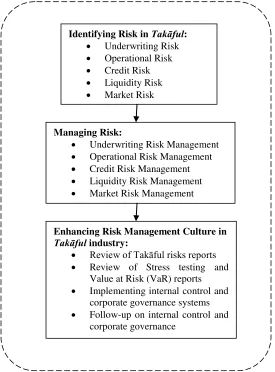
Figure 1 shows the steps for effectively manage the risks in Takāful business. In the first step, possible risks in the way of Takāful business are identified. In the second step, strategies are developed to cope with and manage the risks effectively. In the third step, process of identification and strategy formulation and implementation related to each type of risk is examined through review reports and effective measures are taken to counter any flaw or discrepancy in the previous process.
1
For details of stress tests and Value at Risk (VAR) techniques, see BIS (2000). “Stress testing by large financial institutions: Current practice and aggregation issues” and Blaschke et al. (2001). “Stress testing
for financial systems: An overview of issues, methodologies and FSAP experiences” 2
FIGURE 1: FLOW CHART OF RISK MANAGEMENT IN TAKĀFUL
Identifying Risk in Takāful:
Underwriting Risk
Operational Risk
Credit Risk
Liquidity Risk
Market Risk
Managing Risk:
Underwriting Risk Management
Operational Risk Management
Credit Risk Management
Liquidity Risk Management
Market Risk Management
Enhancing Risk Management Culture in Takāful industry:
Review of Takāful risks reports
Review of Stress testing and Value at Risk (VaR) reports
Implementing internal control and corporate governance systems
CHALLENGES TO RISK MANAGEMENT
In spite of effective risk management techniques discussed above, there are
certain challenges in the way of risk management for Takāful.
i. Internal Controls:
Internal controls are indispensable for recognizing and assessing risks faced by financial institutions including Takāful companies. Basel Committee (2005) and IAIS (2006a) reports have focused on the importance of internal controls for banking institutions as well as for conventional insurance companies respectively. Chapra and Ahmad (2002) found that existence of effective internal control have prevented the financial institutions from systemic crisis and enabled them to have early detection of problems and associated risks they might face in future. These experiences highlight the importance and need of internal controls for Takāful companies. Unique nature of these companies from conventional insurance demands the fulfillment of Sharī‟ah aspects. IFSB and IAIS joint working group (2006) maintains that to have effective internal control mechanism, Takāful companies must ensure Sharī‟ah controls in addition to all statutory regulations. It urges the need of a regular Sharī‟ah audit as a part of an on-going internal control system.
ii. Corporate Governance:
The corporate governance structure specifies the distribution of rights and responsibilities of the Board, manager, shareholders and other stakeholders (OECD
challenge related to corporate governance of Sharī‟ah Supervisory Board (SSB). Grais and Pellegrini (2006b) identify corporate governance issues that affect their role and functioning in the organizations. It calls for a greater need to incorporate corporate governance culture to overcome related issues of Takāful industry.
iii. Sharī’ah Based Challenges:
According to Ahmed & Khan (2001), most of the risk management techniques are not applicable to Islamic financial institutions due to the requirements of Sharī‟ah
compliance. It creates Sharī‟ah based challenges to risk management for Takāful companies as well. These challenges arise as Sharī‟ah restricts the use certain
instruments that are considered useful in conventional risk management e.g. derivatives (futures, options, swaps etc.) and sale of debts. Al-Suwailem (2006, pp.89-90) argues that
Sharī‟ah constraints to human behavior do not hinder creativity, rather these constraints are the major driving force behind the creation of innovative financial instruments. He suggests several Islamic financial instruments for risk management and concludes that
Sharī‟ah is abundant with real solutions to the present problems of gambling and speculation. It provides directions to Sharī‟ah scholars and experts of Islamic finance to explore the dimensions of Sharī‟ahin order to integrate risk management practices with value creation.
iv. Financial Engineering:
Financial engineering aims at designing new and innovative Sharī‟ah compliant Islamic financial instruments for IFIs including Takāful companies. Chapra and Ahmad (2002) maintain that financial engineering has emerged as the greatest challenge faced by
Sharī‟ah scholars of present time as it poses major threat to IFIs to become competitive in the contemporary business environment. Process of giving fatwās by Sharī‟ahscholars regarding the permissibility of a financial instrument is quite slow and over-conservative (Iqbal et al, 1998; pp.47-48) as Sharī‟ah scholars and experts of modern finance have
scholars with Sharī‟ah background that also have working knowledge of modern finance to meet the acute challenge of financial engineering.
v. Islamic Financial Market:
Islamic financial market provides a secondary market for trading of Islamic financial instruments. In the absence of this market, it will be extremely difficult for
Takāful companies to maintain its liquidity position to make prompt claim payments when they become due. Retaining a large portion of Takāful fund to maintain high liquidity ratio will affect the efficiency of the firm and its competitiveness as compared to conventional insurance companies that have ready access to liquid bonds and t-bills. Islamic Financial Market will greatly facilitate the Takāful companies to invest large
portion of their fund in Islamic financial instruments and increasing their efficiency and competitiveness while maintaining low liquidity ratio. It will also help Takāful companies in hedging market risk by providing alternative instruments to financial derivatives that are not acceptable under Shari‟ah.
vi. Need of Private Credit Rating Agencies:
CONCLUSION AND RECOMMENDATIONS
Risk management is of vital importance in Islam and Takāful provides a way to manage risks in business according to Sharī‟ah principles. Five types of risks have been identified in Takāful business that affect operational and investment functions of Takāful operator. Operational risk can be managed by enhancing corporate governance culture in the organizations. Cash flow modeling and use of liquidity ratios is quite helpful to identify liquidity constraints. Takāful operators might face difficulty in managing market and credit risks as Sharī‟ah compliant nature of Takāful contract does not allow Takāful
companies to deal with interest rate and financial derivatives due to their speculative nature by which they tend to benefit one party at the loss of other. On the other hand, Islamic financial instruments like cooperative hedging and bi-lateral mutual adjustment aim at providing mutual gains to both parties by the way of risk sharing.
Risks associated to Takāful have raised several challenges that need to be encountered to enhance risk management practices. Regular Sharī‟ah audit is found to be an integral part of effective internal controls that prevent the companies from systemic
crisis. Corporate governance calls for independence of BOD to devise policies for effective risk management, make unbiased decisions and resolve issues related to functioning of SSB. Sharī‟ah based challenges call for devising innovative Islamic financial instruments as Sharī‟ah is abundant with real solutions to present business dilemma and does not hinder creativity. Exploring those solutions will help to meet the challenge of financial engineering. Islamic financial market will greatly facilitate the task of Takāful companies to invest large portion of their fund in Islamic financial instruments and increase their efficiency and competitiveness. There is need to establish private credit rating agencies that could assist IIRA to rate thousands of counterparties for the benefit of
REFERENCES
Al-Suwailem, Sami (2006). “Hedging in Islamic Finance”, Occasional Paper No.10, King Fahad National Library Cataloging-in-Publication Data, Islamic
Development Bank (IDB), Jeddah.
Ahmed, H. & Khan, T. (2001). “Risk Management: An analysis of issues in Islamic
Financial Industry”, Occasional paper No. 5, Islamic Research Training Institute, Islamic Development Bank, Jeddah.
Basel (2005), “International Convergence of Capital Measurement and Capital Standards”, Basel Committee on Banking Supervision, Switzerland. Basel (2006), “International Convergence of Capital Measurement and Capital
Standards”, Basel Committee on Banking Supervision, Switzerland. BIS (2000). “Stress testing by large financial institutions: Current practice and
aggregation issues”, Bank for International Settlements, Basel, Switzerland.
Blaschke, W.; Jones, T. M.; Manoni, G. & Peria, M. S. (2001). “Stress testing for
financial systems: An overview of issues, methodologies and FSAP experiences”,
IMF Working paper wp/01/88, International Monetary Fund, USA.
Chapra, U. & Khan, T. (2000). “Regulation and Supervision of Islamic Banks”,
Occasional paper No. 3, Islamic Research Training Institute, Islamic Development Bank, Jeddah.
Chapra, M. and Ahmed, H. (2002) “Corporate Governance in Islamic Financial
Institutions” Occasional Paper No. 6, Islamic Research and Training Institute:
Islamic Development Bank, Jeddah.
Grais, W. & Pellegrini, M. (2006b). “Corporate Governance and Shari'ah Compliance in
Institutions Offering Islamic Financial Services”, World Bank Policy Research Working Paper 4054, November
GOWA (2002). “Risk Management, Department of Sport and Recreation”, Govt. of Western Australia, as retrieved from http://www.uksport.gov.uk/assets/File/ on Tuesday, 26th December, 2006.
IAIS (2004). “Guidance paper on investment risk management”, guidance paper no. 9, International Association of Insurance Supervisors, Switzerland.
IAIS, (2006a). “Analysis of self-assessment exercise 2004-2005”, Report on Insurance
Core Principles, International Association of Insurance Supervisors, Switzerland. Iqbal, M.; Ahmad, A and Khan, T. (1998). “Challenges facing Islamic Banking”,
Occasional paper No. 1, Islamic Research Training Institute, Islamic Development Bank, Jeddah.
Iqtisad Al-islamy (Islamic Economics), (2003). “Risk Management in Islam –Takaful”, as retrieved from www.islamic-world.net/economics/tafakul.htm on Thursday, 26th October, 2006.
Obaidullah, Muhammad, (2002). “Islamic Risk Management: Towards greater ethics and efficiency”, International Journal of Islamic Financial Services, Volume 3, Number 4, as retrieved from www.islamic-finanace.net on Monday, 05th February, 2007.
OECD, (1999). “OECD Principles of Corporate Governance 1999”, Organization for Economic Co-operation and Development, OECD publications service, Paris. Psaros, J. and Seamer, M. (2002).“Horwath 2002 Coporate Governance Report”,
Horwath (NSW) Pty Limited, Sydney, Australia.