Munich Personal RePEc Archive
Inequality and development: Evidence
from semiparametric estimation with
panel data
Zhou, X. and Li, Kui-Wai
City University of Hong Kong
December 2011
Online at
https://mpra.ub.uni-muenchen.de/36418/
Our reference: ECOLET 4915
P-authorquery-v8
AUTHOR QUERY FORM
Journal:
Economics Letters
Article Number:
4915
Please e-mail or fax your responses and any corrections to:
E-mail: [email protected]
Fax: +44 1392 285879
Dear Author,
Please check your proof carefully and mark all corrections at the appropriate place in the proof (e.g., by using on-screen annotation in
the PDF file) or compile them in a separate list.
For correction or revision of any artwork, please consult
http://www.elsevier.com/artworkinstructions
.
Any queries or remarks that have arisen during the processing of your manuscript are listed below and highlighted by flags in the
proof. Click on the
‘Q’
link to go to the location in the proof.
Location
in article
Query / remark
click on the Q link to go
Please insert your reply or correction at the corresponding line in the proof
Q1
Uncited references: This section comprises references that occur in the reference list but not in the body of the
text. Please cite each reference in the text or, alternatively, delete it. Any reference not dealt with will be retained
in this section.
Thank you for your assistance.
Highlights
◮Nonparametric and semiparametric models on Kuznet’s equality-development relationship.◮Sample of 75 countries for the period 1962–2003.◮
∧
Economics Letters xx (xxxx) xxx–xxx
Contents lists available atScienceDirect
Economics Letters
journal homepage:www.elsevier.com/locate/ecolet
Inequality and development: Evidence from semiparametric estimation with
panel data
Xianbo Zhou
a, Kui-Wai Li
b,∗aLingnan College, Sun Yat-sen University, China bCity University of Hong Kong, Hong Kong
a r t i c l e i n f o
Article history:
Received 17 August 2010 Received in revised form 12 July 2011
Accepted 14 July 2011 Available online xxxx
JEL classification:
C14 O1
Keywords:
Kuznet’s inverted-U Semiparametric model Unbalanced panel data
a b s t r a c t
Evidences from nonparametric and semiparametric unbalanced panel data models with fixed effects show that Kuznet’s inverted-U relationship is confirmed when economic development reaches a threshold. The model tests justify semiparametric specification. The integrated net contribution of control variables to inequality reduction is significant.
©2011 Elsevier B.V. All rights reserved.
1. Introduction 1
The mixed empirical results on Kuznet’s inverted-U
relation-2
ship between inequality and economic development using
para-3
metric quadratic models have been improved by nonparametric
4
studies using cross-section data with nonparametric functional
5
forms or higher-than-second-order nonlinearity (Li et al.,1998;
6
Barro,2000;Bulí˘r,2001;Iradian,2005;Mushinski,2001;Huang,
7
2004;Lin et al.,2006). This paper conducts a nonparametric and
8
semiparametric investigation on the inverted-Urelationship with
9
unbalanced panel data. The analysis incorporates heterogeneity
10
across economies. The following sections discuss the data and
11
model specification, present the methodology with unbalanced
12
panel data, conduct estimations and tests and conclude the paper.
13
2. Data and model specification 14
The Gini coefficient data
∧
andthe inequality proxy
∧
are obtained
15
from the World Bank ‘‘Project on Inequality’’.1 The unbalanced 16
∗Tel.: +852 34428805; fax: +852 34420195.
E-mail addresses:[email protected](X. Zhou),[email protected]
(K.-W. Li).
1 The ‘‘Inequality around the World’’ and ‘‘All the Ginis’’ dataset are compiled from Deininger–Squire (1960–1996), WIDER (1950–1998) and World Income
panel Gini coefficient data contains 75 countries (with at least 17
two years’ data) with 704 observations for the period 1962–2003. 18
Real GDP per capita (in 2005 constant price) is the proxy for 19
development. Such economic and policy variables obtained from 20
the Penn World Table and WDI as openness (openk, percentage 21
share of trade in GDP in 2005 constant price), urbanization 22
(urbanize, urban population as percentage of total population), 23
investment (ki, share of investment in real GDP per capita), growth, 24
and inflation (annual percentage of GDP deflator), are taken as 25
control variables.Table 1shows the basic statistics. 26
The nonparametric panel data model with fixed effects is 27
giniit
=
g(
lgdppcit)
+
ui+
v
it,
28t
=
1,
2, . . . ,
mi;
i=
1,
2, . . . ,
n,
(1) 29where the functional form of g
(
·
)
is unspecified, lgdppcit is 30the logarithm of real GDP per capita. Each country i has mi 31
observations. Individual effects ui are fixed effects which are 32
correlated withlgdppcit with an unknown correlation structure. 33
The error term
v
itis assumed to be i.i.d. with finite variance and 34mean-independent oflgdppcit, namely,E
(v
it|
lgdppcit)
=
0. 35Distribution (1985–2000) datasets. ‘‘Giniall’’ gives the Gini coefficients from household survey for 1067 country/years. The coefficients with ‘‘Di=1’’ are chosen. The December 2006 version and recent years’ data are used. SeeMilanovic(2005). 0165-1765/$ – see front matter©2011 Elsevier B.V. All rights reserved.
2 X. Zhou, K.-W. Li / Economics Letters xx (xxxx) xxx–xxx
Table 1
The basic statistics.
Gini gdppc Openk Urbanize Ki Growth Deflator
Minimum 17.800 561.519 5.293 0.000 2.110 −21.603 −8.000
Maximum 63.660 63419.400 399.217 94.940 56.141 16.469 4107.000
Mean 38.689 13712.587 57.848 36.457 25.099 2.187 41.129
Std-deviation 10.285 9109.813 49.738 19.816 8.032 4.651 249.507
The semiparametric counterpart of Model (1) with control
1
variables is:
2
giniit
=
g(
lgdppcit)
+
x′itβ
+
ui+
v
it,
3t
=
1,
2,
· · ·
,
mi;
i=
1,
2, . . . ,
n,
(2)4
where
v
itis also assumed to be mean-independent ofxit. Since the 5regressor ‘‘growth’’ may be endogenous (Huang et al., 2009), its
6
lagged form is used in the model.
7
When g
(
·
)
is parametric quadratic, cubic or fourth-degree8
polynomial functions oflgdppcit,(1) and(2)become parametric 9
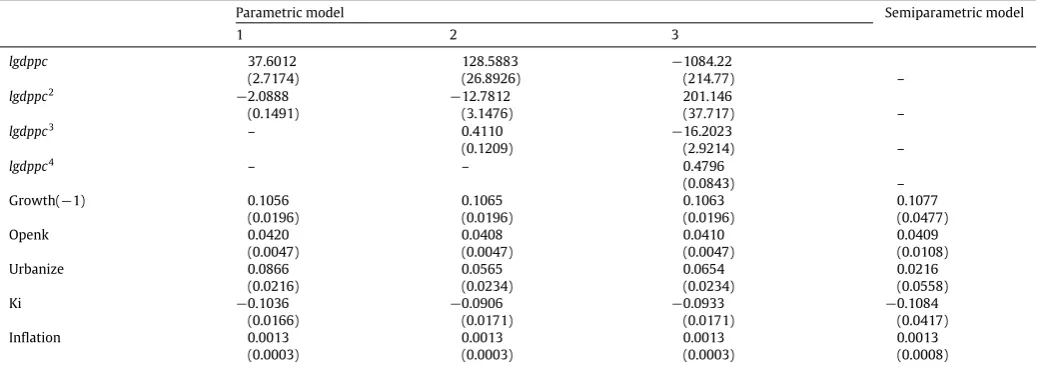
unbalanced panel data models with fixed effects. Columns 1–3
10
of Table 2 report the parametric estimation results. Note that
11
a fourth-degree polynomial function is still significant although
12
the coefficient estimates in quadratic and cubic forms are also
13
significant. This casts doubts on the conventional quadratic
14
specification for the relationship.
15
3. Nonparametric estimation and testing method 16
Lety
=
giniandz=
lgdppc. Models(1)and(2)are estimated by17
the iterative procedure modified fromHenderson et al.(2008) for
18
unbalanced panel data. Model(1)is used to illustrate the specific
19
modification. To remove the fixed effects, we write
20
˜
yit
≡
yit−
y1t=
g(
zit)
−
g(
zi1)
+
v
it−
v
i1≡
g(
zit)
−
g(
zi1)
+ ˜
v
it.
21Denotey
˜
i=
(
y˜
i2, . . . ,
y˜
imi)
′,
v
˜
i
=
(
v
˜
i2, . . . ,
v
˜
imi)
′,
∧
gi
=
(
gi2, . . . ,
22 gimi
)
′. The variance–covariance matrix of
v
˜
i and its inverse are 23
calculated asΣi
=
σ
v2(
Imi−1+
emi−1emi−1)
andΣ−1
i
=
σ
v−2(
Imi−1−
24
emi−1emi−1
/
mi)
, where Imi−1 is an identity matrix of dimension25
mi
−
1 andemi−1is a(
mi−
1)
×
1 vector of ones. The criterion26
function is given by
27
Ξi
(
gi,
gi1)
= −
12
(
y˜
i−
gi+
gi1emi−1)
′
Σi−1
(
y˜
i−
gi+
gi1emi−1),
28
i
=
1,
2, . . . ,
n.
29
Denote the first derivatives ofΞi
(
gi,
gi1)
with respect togit as 30Ξi,tg
(
gi,
gi1)
,t=
1,
2, . . . ,
mi. Then 31Ξi,1g
(
gi,
gi1)
= −
e′mi−1Σ−1
i
(
y˜
i−
gi+
gi1emi−1),
32
Ξi,tg
(
gi,
gi1)
=
ci′,t−1Σ −1i
(
y˜
i−
gi+
gi1emi−1),
t≥
2,
33
whereci,t−1is a
(
mi−
1)
×
1 matrix with(
t−
1)
th element/other 34elements being 1
/
0. Denote(α
0, α
1)
′≡
(
g(
z),
dg(
z)/
dz)
′. It can 35be estimated by solving the first order conditions of the above
36
criterion function iteratively:
37 n
i=1 1 mi mi
t=1Kh
(
zit−
z)
GitΞi,tg 38×
ˆ
g[l−1]
(
zi1), . . . ,
Git(α
0, α
1)
′, . . . ,
g[l−1]ˆ
(
zimi)
=
0,
39
where the argumentΞi,tgisg[l−1]
ˆ
(
zis)
fors̸=
t andGit(α
0, α
1)
′ 40whens
=
t, andgˆ
[l−1](
zis)
is the(
l−
1)
th iterative estimates of 41(α
0, α
1)
′. HereGit≡
(
1, (
zit−
z)/
h)
′andkh(v)
=
h−1k(v/
h)
,k(
·
)
42is the kernel function. The next iterative estimator of
(α
0, α
1)
′is 43equal to
ˆ
g[l]
(
z),
gˆ
[l](
z)
′=
D−11(
D2+
D3)
, where 44D1
=
n
i=1 1 mi
e ′ mi−1Σ−1
i emi−1Kh
(
zi1−
z)
Gi1G′ i1 45
+
mi
t=2ci′,t−1Σi−1ci,t−1Kh
(
zit−
z)
GitG′it
,
46D2
=
n
i=1 1 mi
e′m i−1Σ−1
i emi−1Kh
(
zi1−
z)
Gi1gˆ
[l−1](
zi1)
47+
mi
t=2
ci′,t−1Σi−1ci,t−1Kh
(
zit−
z)
Gitgˆ
[l−1](
zit)
,
48D3
=
n
i=1 1 mi
−
Kh(
zi1−
z)
Gi1e′mi−1Σ−1
i Hi,[l−1] 49
+
mi
t=2
Kh
(
zit−
z)
Gitc′i,t−1Σ −1 i Hi,[l−1]
,
50andHi,[l−1]is an
(
mi−
1)
×
1 vector with elements 51
˜
yit
−
(
g[l−1]ˆ
(
zit)
− ˆ
g[l−1](
zi1))
,
t=
2, . . . ,
mi.
52The series method is used to obtain an initial estimator forg
(
·
)
. The 53convergence criterion for the iteration is set to be 54
n
i=1 1 mi mi
t=2
ˆ
g[l]
(
zit)
− ˆ
g[l−1](
zit)
2/
n
i=1 1 mi mi
t=2ˆ
g[l−1]2
(
zit) <
0.
01.
55Further, the variance
σ
2v is estimated by 56
ˆ
σ
v2=
12n n
i=1 1 mi
−
1mi
t=2
(
yit−
yi1−
(
gˆ
(
zit)
− ˆ
g(
zi1)))
2.
57The variance of the iterative estimator g
ˆ
(
z)
is calculated as 58κ(
nhΩˆ
(
z))
−1, whereκ
=
k2
(v)
dv
, andΩˆ
(
z)
=
1n
n i=1mi−1
mi 59
mit=2Kh
(
zit−
z)/
σ
ˆ
v2. 60For the model selection to be data-driven, we modify the 61
specification tests to suit for unbalanced panel data models. We 62
have three specification tests: 63
First, test parametric against nonparametric model in Model(1). 64
The null hypothesisH0is parametric model withg
(
z)
=
θ
0(
z, γ )
. 65For example,
θ
0(
z, γ )
=
γ
0+
γ
1z+
γ
2z2. The alternativeH1 66is thatg
(
z)
is nonparametric. The statistic for testing this null is 67 In(1)=
1n
ni=1 1 mi
mit=1
(θ
0(
zit,
γ )
ˆ
− ˆ
g(
zit))
2, whereγ
ˆ
is a consistent 68estimator of the parametric model with fixed effects;g
ˆ
(
·
)
is the 69iterative consistent estimator of Model(1). 70
Second, test parametric against semiparametric model with 71
control variables in Model(2). The nullH0is parametric model with 72 g
(
z)
=
θ
0(
z, γ )
. The alternative is thatg(
z)
is nonparametric. The 73statistic for testing this null isIn(2)
=
1n
ni=1 1 mi
mit=1
(θ
0(
zit,
γ )
˜
+
74 x′it
β
˜
− ˆ
g(
zit)
−
xit′β)
ˆ
2, whereγ
˜
andβ
˜
are consistent estimators in 75the parametric panel data model with fixed effects;g
ˆ
(
·
)
andβ
ˆ
are 76X. Zhou, K.-W. Li / Economics Letters xx (xxxx) xxx–xxx 3
Table 2
Parametric estimation results.
Parametric model Semiparametric model
1 2 3
lgdppc 37.6012 128.5883 −1084.22
(2.7174) (26.8926) (214.77) –
lgdppc2 −2.0888 −12.7812 201.146
(0.1491) (3.1476) (37.717) –
lgdppc3 – 0.4110 −16.2023
(0.1209) (2.9214) –
lgdppc4 – – 0.4796
(0.0843) –
Growth(−1) 0.1056 0.1065 0.1063 0.1077
(0.0196) (0.0196) (0.0196) (0.0477)
Openk 0.0420 0.0408 0.0410 0.0409
(0.0047) (0.0047) (0.0047) (0.0108)
Urbanize 0.0866 0.0565 0.0654 0.0216
(0.0216) (0.0234) (0.0234) (0.0558)
Ki −0.1036 −0.0906 −0.0933 −0.1084
(0.0166) (0.0171) (0.0171) (0.0417)
Inflation 0.0013 0.0013 0.0013 0.0013
(0.0003) (0.0003) (0.0003) (0.0008)
The dependent variable is Gini. The numbers in the parentheses are standard errors of the coefficient estimates. Intercept estimates in parametric models are not reported.
Table 3
Nonparametric estimation ofg(·)at different points of ln(gdppc). Quantile of
z=ln(gdppc)
Nonparametric model(1) Semiparametric model(2)
% z g(z) Std. err. g(z) Std. err. 2.5 7.2014 34.1085 2.9719 32.7535 2.8225 25.0 8.7307 43.3724 1.4581 42.4299 1.3848 50.0 9.4323 38.9278 1.2869 38.7704 1.2222 75.0 9.9073 36.0767 1.0948 35.5236 1.0398 95.0 10.2808 36.1586 1.4052 34.3298 1.3346 97.5 10.3490 36.1649 1.5553 34.0305 1.4771
Third, test the null nonparametric model (1) against the
1
semiparametric model(2). The statistic for testing this null isIn(3)
=
21 n
n i=1m1i
mit=1
(
g˜
(
zit)
− ˆ
g(
zit)
−
x′itβ)
ˆ
2, whereg
˜
(
·
)
is the iterative 3consistent estimator in Model(1)whileg
ˆ
(
·
)
andβ
ˆ
are the iterative4
consistent estimator of Model(2).
5
We apply bootstrap procedures to approximate the finite
6
sample null distributions of test statistics and obtain the bootstrap
7
probability values for the three tests.
8
4. Results 9
In the estimation, the kernel is the Gaussian function and the
10
bandwidth is chosen according to rule of thumb. All bootstrap
11
replications are set to be 400. The last column inTable 2reports the
12
coefficient estimation for the control variables in the parametric
13
part of Model (2). Except ‘‘urbanize’’, the coefficient estimates
14
of all other control variables are close to those in parametric
15
models, showing that growth, openness and inflation (investment)
16
significantly increase (reduces) inequality.
17
InTable 3, the nonparametric functiong
(
·
)
is estimated at some18
quantile points of ln
(
gdppc)
by using nonparametric Model(1)and19
semiparametric Model(2). In all these cases, the nonparametric
es-20
timates are slightly larger than their semiparametric counterparts,
21
implying that the overall effect of control variables on inequality is
22
negative. These policy and economic characteristics variables
in-23
deed can affect inequality.
24
Figs. 1and2illustrate the nonparametric estimation ofg
(
·
)
in25
Models(1)and(2), respectively, where lower and upper bounds
26
of 95% confidence intervals are also drafted. The estimates are
27
acceptable though the estimation has boundary effects. The two
28
curves ofg
(
·
)
in Figs. 1 and 2 look similar, implying that the29
control variables, though having an overall impact, play little role
30 10 20 30 40 50 60 70
6 7 8 9 10 11
ln(gdppc)
[image:6.595.327.541.289.598.2]Gini
Fig. 1. g(·)from nonparametric model(1).
10 20 30 40 50 60 70
6 7 8 9 10 11
ln(gdppc)
Gini
Fig. 2. g(·)from semiparametric model(2).
in the estimation of nonlinear shape ofg
(
·
)
.Huang (2004) also 31reported such findings. The estimation is robust to the control 32
variables. However, the inverted-Uhypothesis is confirmed only 33
when ln
(
gdppc)
arrives at 7.2, about $1340 of GDP per capita 34(about 2.5% quantile, seeTable 3). For the case less than this level, 35
inequality decreases with development, though insignificantly, 36
with a very wide confidence interval. This implies that the 37
inverted-Uhypothesis does not significantly hold at low stage of 38
development. 39
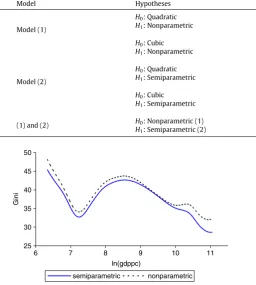
Fig. 3compares the two curves ofg
(
·
)
estimated by nonpara- 40metric and semiparametric models. The vertical difference be- 41
tween the two curves shows the contribution of control variables 42
4 X. Zhou, K.-W. Li / Economics Letters xx (xxxx) xxx–xxx
Table 4
Model specification tests.
Model Hypotheses Instatistic (p-value) Model selected
Model (1)
H0: Quadratic
9.256 (0.000) Nonparametric
H1: Nonparametric
H0: Cubic 7.375 (0.003) Nonparametric
H1: Nonparametric
Model (2)
H0: Quadratic 11.467 (0.003) Semiparametric
H1: Semiparametric
H0: Cubic 11.401 (0.003) Semiparametric
H1: Semiparametric
(1) and (2) H0: Nonparametric (1) 5.211 (0.000) Semiparametric
H1: Semiparametric (2)
25 30 35 40 45 50
6 7 8 9 10 11
ln(gdppc)
Gini
[image:7.595.38.295.91.377.2]semiparametric nonparametric
Fig. 3. Comparingg(·)from estimating(1)and(2).
variables is positive in reducing inequality. When the development
1
level is below exp
(
9)
≈
$8100, the net integrated effect has nosig-2
nificant difference across different development levels. However,
3
when the development level is above exp
(
10)
≈
$22,
000, thecon-4
trol variables have a larger integrated effect on inequality, implying
5
that policy instruments and economic performance play a larger
6
role in reducing inequality in the more developed than in less
de-7
veloped economies. For an economy with development between
8
$8100 and $22
,
000, the integrated effect of control variables on9
inequality is economically insignificant.
10
Table 4presents three kinds of tests in Models(1)and(2). All the
11
nulls are rejected at 1% significant level, showing that parametric
12
form in(1)is inappropriate, but semiparametric specification in
13
(2)is more appropriate for our sample. This justifies our analysis
14
on the estimation of semiparametric model(1).
15
5. Conclusion 16
This paper uses nonparametric and semiparametric unbalanced
17
panel data models with fixed effects to study the validity of
18
the inequality and development relationship. Specification tests
19
justify the flexible semiparametric model. The results show that
20
Kuznet’s inverted-U relationship is confirmed only when the
21
development level arrives at a threshold. The inverted-Udoes not
22
significantly hold when development is less than the threshold.
23
This result is robust whether or not the control variables are
24
included in the model. The integrated contribution of control
25
variables to reduction of inequality is positive. Policy instruments
26
and economic performance play a larger role in reducing inequality
27
in more developed than in less developed economies.
28
Uncited references 29
Q1
Chen, 2003.
30
Acknowledgments 31
Zhou/Li’s research funding was provided by the National 32
Natural Science Foundation of China Grant number 70971143/the 33
City University of Hong Kong Strategic Research Grant number 34
7002433. 35
Appendix. The sample in the study 75 countries and years: 36
Argentina, 1989, 92, 98, 2001. Armenia, 1994–97. Australia, 37
1967–69, 76, 78–79, 81–82, 85–86, 89–90, 94–96, 2002. Austria, 38
1987, 91, 95, 2000. Bahamas, 1970, 73, 75, 77, 79, 86, 88, 91–93. 39
Bangladesh, 1963, 66, 67, 69, 73, 77, 78, 81, 83, 86. Barbados, 1979, 40
96. Belarus, 1995–97, 2002. Belgium, 1979, 85, 88, 92, 96, 2000. 41
Brazil, 1970, 72, 76, 78–91, 93, 96, 98, 2002. Bulgaria, 1981–97, 42
2003. Canada, 1965, 67, 69, 71, 73–75, 77, 79, 81–88, 91, 94, 97, 43
2000. Chile, 1968, 71, 80–94, 98, 2000. China, 1970, 75, 78, 80, 44
82–99, 2001. Colombia 1964, 70, 71, 74, 78, 88, 91, 94, 98, 2003. 45
Costa Rica, 1961, 69, 71, 77, 79, 81, 83, 86, 89, 93, 98, 2001. 46
Cyprus, 1990, 96. Czech Republic, 1991–97, 2002. Denmark, 1963, 47
76, 78–95, 97, 2000. Dominican Republic, 1976, 84, 89, 92, 96, 97, 48
2003. Ecuador, 1968, 88, 93, 94, 95, 98, 2003. El Salvador, 1965, 77, 49
89, 94, 95, 97, 2002. Estonia, 1990–94. Finland, 1962, 77–84, 87, 50
91, 95, 2000. France, 1962, 65, 70, 75, 79, 81, 84, 89, 95. Gabon, 51
1975, 77. Germany, 1973, 75, 78, 80, 81, 83–85, 89, 94, 97, 98, 52
2000. Guatemala, 1986, 87, 89, 98, 2002. Honduras, 1968, 89–94, 53
98, 2003. Hong Kong, 1971, 73, 76, 80, 81, 86, 91, 96, 98. Hungary, 54
1972, 77, 82, 87, 89, 91, 93–97, 99. Ireland, 1973, 80, 87, 94, 99, 55
2000. Israel, 1986, 92, 97. Italy, 1967–69, 71–84, 86, 87, 89, 91, 56
93, 95, 98, 2000. Jamaica, 1958, 2003. Japan, 1962–65, 67–82, 85, 57
88–90, 93, 98, 2002. Kazakhstan, 1993, 96, 2002. South Korea, 1965, 58
66, 70, 71, 76, 80, 82, 85, 88, 93, 98, 2003. Latvia, 1995, 96, 98, 59
2002. Luxembourg, 1985, 91, 94, 98, 2000. Malaysia, 1967, 70, 73, 60
76, 79, 84, 89, 95, 97. Mexico, 1963, 68, 69, 75, 77, 84, 89, 92, 94, 61
98, 2002. Nepal, 1976, 77, 84. Netherlands, 1962, 75, 77, 79, 81–83, 62
1985–99. New Zealand, 1973, 75, 77, 78, 80, 82, 83, 85–87, 89–91. 63
Nicaragua, 1998, 2001. Nigeria, 1959, 81, 82. Norway, 1962, 63, 67, 64
73, 76, 79, 82, 84–91, 95, 96, 2000. Pakistan, 1963, 64, 66, 67, 69, 70. 65
Panama, 1969, 70, 79, 80, 89, 95, 97, 2002. Paraguay, 1990, 95, 98, 66
2001. Peru, 1961, 71, 81, 96, 2002. Philippines, 1961, 65, 71, 75, 85, 67
88, 91, 94, 97. Poland, 1991–97. Portugal, 1973, 80, 89–91, 94, 97. 68
Puerto Rico, 1963, 69, 79, 89. Romania, 1989–92, 94, 98. Russian 69
Federation, 1990, 93–96, 98. Senegal, 1960, 95. Singapore, 1973, 70
78, 80, 89, 92, 97, 2003. Slovak Republic, 1988–97, 2005. Slovenia, 71
1991–93, 97, 2002. South Africa, 1990, 93, 95. Spain, 1965, 73, 75, 72
94, 2000. Sri Lanka, 1963, 69, 73, 79, 80, 81, 86, 87. Sweden, 1963, 73
67, 75, 76, 80–96, 2000. Switzerland, 1982, 92, 2002. Thailand, 74
1962, 68, 69, 71, 75, 81, 86, 88, 90, 92. Trinidad & Tobago, 1971, 75
76, 81, 88, 94. Turkey, 1968, 73, 87, 94, 2003. United Kingdom, 76
1964–76, 79, 85, 86, 91, 95, 2002. United States, 1960–91, 94, 97, 77
2000. Uruguay, 1989, 92, 98. Uzbekistan, 1990, 2002. Venezuela, 78
X. Zhou, K.-W. Li / Economics Letters xx (xxxx) xxx–xxx 5 References
1
Barro, R.J., 2000. Inequality and growth in a panel of countries. Journal of Economic 2
Growth 5, 5–32. 3
Bulí˘r, A., 2001. Income inequality: does inflation matter? IMF Staff Papers 48, 4
139–159. 5
Chen, B.-L., 2003. An inverted-Urelationship between inequality and long-run 6
growth. Economics Letters 78, 205–212. 7
Henderson, D.J., Carroll, R.J., Li, Q., 2008. Nonparametric estimation and testing of 8
fixed effects panel data models. Journal of Econometrics 144, 257–275. 9
Huang, H.-C.R., 2004. A flexible nonlinear inference to the Kuznets hypothesis. 10
Economics Letters 84, 289–296. 11
Huang, H.-C.R., Lin, Y.-C., Yeh, C.-C., 2009. Joint determinations of inequality and 12
growth. Economics Letters 103, 163–166. 13
Iradian, G., 2005 Inequality, poverty, and growth: cross-country evidence. IMF 14
Working Paper No. 05/28. 15
Li, H., Squire, L., Zou, H.-F., 1998. Explaining international and intertemporal 16 variations in income inequality. Economic Journal 108, 26–43. 17 Lin, S.-C., Huang, H.-C., Weng, H.-W., 2006. A semiparametric partially linear 18 investigation of the Kuznets’ hypothesis. Journal of Comparative Economics 34, 19
634–647. 20
Milanovic, B., 2005. Worlds Apart: Measuring International and Global Inequality. 21
Princeton University Press. 22