ScholarWorks @ Georgia State University
ScholarWorks @ Georgia State University
Educational Policy Studies Dissertations Department of Educational Policy Studies
Spring 5-11-2012
Exploring College Readiness: Self-Perceptions of Early College
Exploring College Readiness: Self-Perceptions of Early College
Students
Students
Kim Renee Ramsey-White Georgia State University
Follow this and additional works at: https://scholarworks.gsu.edu/eps_diss
Recommended Citation Recommended Citation
Ramsey-White, Kim Renee, "Exploring College Readiness: Self-Perceptions of Early College Students." Dissertation, Georgia State University, 2012.
https://scholarworks.gsu.edu/eps_diss/96
This dissertation, EXPLORING COLLEGE READINESS: SELF-PERCEPTIONS OF EARLY COLLEGE STUDENTS, by KIM R. RAMSEY-WHITE, was prepared under the direction of the candidate’s Dissertation Advisory Committee. It is accepted by the committee members in partial fulfillment of the requirements for the degree Doctor of Philosophy in the College of Education, Georgia State University.
The Dissertation Advisory Committee and the student’s Department Chair, as representatives of the faculty, certify that this dissertation has met all standards of excellence and scholarship as determined by the faculty. The Dean of the College of Education concurs.
Jennifer Esposito, Ph.D. Committee Chair
Janice G. Fournillier, Ph.D. Committee Member
Gwendolyn T. Benson, Ph.D. Committee Member
Brian A. Williams, Ph.D. Committee Member
Phillip E. Gagne, Ph.D. Committee Member
Date
William L. Curlette, Ph.D.
Chair, Department of Educational Policy Studies
R. W. Kamphaus, Ph.D.
By presenting this dissertation as a partial fulfillment of the requirements for the
advanced degree from Georgia State University, I agree that the library of Georgia State University shall make it available for inspection and circulation in accordance with its regulations governing materials of this type. I agree that permission to quote, to copy from, or to publish this dissertation may be granted by the professor under whose direction it was written, by the College of Education’s director of graduate studies and research, or by me. Such quoting, copying, or publishing must be solely for scholarly purposes and will not involve potential financial gain. It is understood that any copying from or publication of this dissertation which involves potential financial gain will not be allowed without my written permission.
All dissertations deposited in the Georgia State University Library must be used in accordance with the stipulations prescribed by the author in the preceding statement. The author of this dissertation is:
Kim R Ramsey-White 80 Trelawney Circle Covington, GA 30016
The Director of this dissertation is:
Dr. Jennifer Esposito
Department of Educational Policy Studies College of Education
Kim R. Ramsey-White
ADDRESS: 80 Trelawney Circle Covington, GA 30016 EDUCATION:
Ph.D. 2012 Urban Public Research University Educational Policy Studies
M.P.H. 1997 University of Alabama-Birmingham Maternal and Child Health
B.S. 1983 Hampton University Marketing
PROFESSIONAL EXPERIENCE:
2009-present Evaluation and Research Consultant White and Associates, Covington, GA
2008-2011 Director of Diversity Assessment and Research Management Rochester Institute of Technology, Rochester, NY
2005-present University Liaison
Urban Public Research University, Atlanta 1996-2005 Data Manager/Youth Services Director
Project Healthy Grandparents, Atlanta, GA
PROFESSIONAL SOCIETIES AND ORGANIZATIONS
2007-present National Association of Multi-Cultural Education (NAME) 2006-2008 Atlanta Area Evaluation Association (AAEA)
2005-present American Education Research Association (AERA)
PRESENTATIONS AND PUBLICATIONS:
White, K.,&Sanchez, V. (2010, November). An introduction to inclusive excellence: In
the context of institutional transformation. Rochester Institute of Technology,
Rochester, NY.
White, K., Harris, T., & Henry, K. (2010 February). How College Partners Can
Effectively Support an Early College. State Early College Winter Institute,
Peachtree City, GA.
White, K.,Sheppard, B. Cote, J., & Lara, P.(2007, February). Youth Culture: Are You in
the Know? Kiwanis International-Key Leader Facilitation Training, Hampton,
GA.
Benson, G., Thornton, M. McCloud, J., & White, K. (2007, February). One Year After Reinventing An Urban High School and An Urban University Partnership:
Lessons Learned at Early College High School. American Association for
Association for Colleges of Teacher Education. San Diego, CA .
Sipe, T. A., White, K. (2004, October). Project Healthy Grandparents: Youth Leadership
Program. Children and Youth Coordinating Council Conference- Kennesaw State
University. Kennesaw, GA.
White, K. (2003, November). Abstinence Education and At-Risk Youth. Annual Parents and Youth Convocation. Inter-Denominational Theological Center, Atlanta, GA. Whitley, D. M., Kelley, S. J., & White, K. (2002, October). Saturday Youth Academy: A
Mental Health Support Group for Grandchildren Living with Grandparents.
National Association of Social Workers-Georgia Chapter, 14th Annual Conference, Atlanta, GA.
Whitley, D., & White, K.(2001, October). Saturday Youth Academy: An Innovation for
Grandparents Raising Grandchildren. American Public Health Association.
Atlanta, GA.
Kelley, S., Whitley, D., & White, K. (2001, July). Saturday Youth Academy: Mental
Health Support for Grandchildren Being Raised by Grandparents. Child Welfare
League of America. Chicago.
Kelly, S., White, K. (2001, June). Grandparents Raising Grandchildren: An
Inter-Disciplinary Approach. American Professional Society Against the Abuse of
Children. Washington, DC.
White, K.(2001, March). Effective Communication with Grandparents Raising
Grandchildren. National SIDS Alliance. Chicago.
White, K. (1999, November). Strengths Based Case Management. American Public Health Association. Chicago.
EXPLORING COLLEGE READINESS: SELF-PERCEPTIONS OF EARLY COLLEGE STUDENTS
by
Kim R. Ramsey-White
Research shows that too many students are graduating from high school
ill-prepared to be successful in the postsecondary environment. This study examined the
high school experiences of dual-enrollment students who participated in an Early College
High School, and how the students perceived their high school experiences in preparing
them for college. Additionally the study sought to understand the role that social capital played in the students’ preparation for college. In-depth interviews with 13 African
American students, some of whom were first-generation college attendees, were used to
illuminate the student voice in an effort to learn how early college practices and strategies
were beneficial and/or detrimental to their preparation for college. Data from the study
were analyzed using a college readiness framework developed by David Conley (2007)
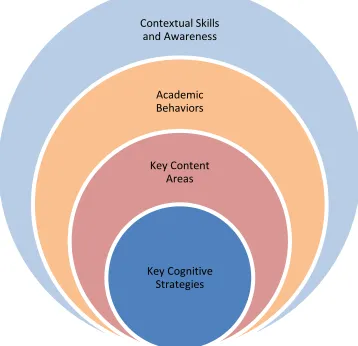
which focuses on four dimensions of college readiness: (1) Key cognitive strategies, (2)
academic content, (3) academic skills and behavior, and (4) contextual skills and
awareness. Findings from the study indicate that the students’ Early College High School
experiences increased their confidence as college students (key cognitive strategies),
taught them the benefits of time management and working in study groups (academic
skills and behavior), and provided meaningful relationships and social networks that
allowed them to navigate the college application and financial aid processes (contextual
skills and awareness). The students also expressed concern that there was very limited
by
Kim R. Ramsey-White
A Dissertation
Presented in Partial Fulfillment of Requirements for the Degree of
Doctor of Philosophy in
Research, Measurement and Statistics in
the Department of Educational Policy Studies in
the College of Education Georgia State University
Copyright by Kim R. Ramsey-White
ii
ACKNOWLEDGMENTS
1 Corinthians 13 (NIV)
1If I speak in the tongues of men or of angels, but do not have love, I am only a
resounding gong or a clanging cymbal.2If I have the gift of prophecy and can fathom all
mysteries and all knowledge, and if I have a faith that can move mountains, but do not
have love, I am nothing.3If I give all I possess to the poor and give over my body to
hardship that I may boast, but do not have love, I gain nothing.4Love is patient, love is
kind. It does not envy, it does not boast, it is not proud.5It does not dishonor others, it is
not self-seeking, it is not easily angered, it keeps no record of wrongs.6Love does not
delight in evil but rejoices with the truth.7It always protects, always trusts, always
hopes, always perseveres.8Love never fails. But where there are prophecies, they will
cease; where there are tongues, they will be stilled; where there is knowledge, it will pass
away.9For we know in part and we prophesy in part,10but when completeness comes,
what is in part disappears.
This dissertation would not be complete were it not for faith, hope and love. Not just my faith, hope and love but more importantly those of my family and friends. So many times this journey seemed insurmountable, but there was a village behind me that WOULD not let me give up.
DivineLove - The greatest love of all. The love from the creator that reminded me that he was with me every step of the way. Let me share a little secret with you, GOD writes papers and dissertations. Thank you Lord for your AGAPE love that sustained me physically, emotionally and spiritually throughout this process. There is none like you!!!!
Family Love – Roosevelt and Evangelyn Ramsey gave me life, and gave me a foundation upon which I have tried to build a legacy that honors who they are. My parents always believed in me. Beginning in October 2010 they sent me a card of encouragement every week until I submitted my last chapter to my chair in December. When my mom didn’t think the cards were enough she fasted daily until noon, she did that for more than 18 months. My parents taught me the power of faith and family. My children reminded me that we were not a family of quitters. I can so clearly hear my son Kofi tell me, “Mom remember when I wanted to quit and you wouldn’t let me. Well YOU can’t quit either.” How humbling was it to hear my own words used back to me. My daughter Nicole has been through so much with me and this process, moving across the country with me letting me cry and crying with me. She is truly wise beyond her 17 years. My two oldest children Theresa and Clayton, while not living with me through this process were always supporting and encouraging along with my four grandchildren.
My RIDE OR DIE, TIL DEATH DO US PART partner, friend and spouse Frank. Against all odds honey we got it done. I thank you from the bottom of my heart for your constant encouragement, love and support.
iii
McKinsey-Mabry, Dr. Jeannie Dingus-Eason; Dr. Jodi Kaufman; Dr. Carol Thurman; Dr. Kelly McMurry; Dr. Helen Stiff-Williams; Dr. Deborah Whitley; Ms. Kristin Skarie; Dr. John Rowland; All of the administrators and staff at Urban Early College High School; Dr. Dee Taylor; Mrs. Sandra Whitmore-Woodruff; All my Key Leader facilitators and early college colleagues. I am sure I left someone out. Charge it to my head and not to my heart.
iv
TABLE OF CONTENTS
Page
List of Tables ... vi
List of Figures ... vii
Abbreviations ... viii
Chapter 1 INTRODUCTION ...1
Background ...2
Statement of the Problem ...4
Purpose of the Study ...7
Significance...8
Definitions of Terms ...10
Theoretical Framework ...12
Social Capital Theory ...13
“To Be the Lab Rat”: How This Study Got Started ...17
Summary ...19
2 REVIEW OF THE LITERATURE ...21
Early College Schools ...21
Social Capital and Educational Research ...34
College Readiness ...37
Early College Strategies, Social Capital, and College Readiness ...51
Summary ...55
3 METHODOLOGY ...56
Research Questions ...57
Methodological Framework ...57
The Research Setting ...62
Participants ...66
Researcher Role ...69
Positionality ...71
Negotiating Access ...74
Data Collection ...76
Data Management ...79
Data Analysis ...80
Confidentiality and Ethics...84
Trustworthiness ...86
Strengths and Limitations ...88
Summary ...89
4 FINDINGS ...90
v
College Readiness in the Traditional Postsecondary Experience ...120
Summary ...136
5 DISCUSSION AND RECOMMENDATIONS ...138
Overview ...139
Review of the Findings ...140
Significance of the Study ...145
Implications for Educational Policy...146
Contribution to Educational Research ...147
Limitations of the Study...149
Recommendations for Future Research ...150
Contribution to Educational Research Methodology ... 153
Conclusion ...154
Personal Reflections on Completing This Degree: “Profiting from Trials” ...155
References ...159
vi
LIST OF TABLES
Table Page
vii
LIST OF FIGURES
Figure Page
viii
ABBREVIATIONS
AIR American Institutes for Research ECHSI Early College High School Initiative FLC Freshman Learning Community GRAD Graduation Really Achieves Dreams IB International Baccalaureate
IHEP Institute for Higher Education Policy JFF Jobs for the Future
CHAPTER 1
INTRODUCTION
The goal of this dissertation research was to understand how Early College
students experienced the transition years between high school and college and how they
perceived their preparedness for college. Despite a plethora of interventions that focus on
improving college readiness in secondary schools, scholarly research has been slow to
examine the key factors that contribute to college readiness from the perspective of the
student. Often education policymakers and funders create interventions and programming
that incorporate research-based strategies tested through quantitatively derived measures,
but seldom are qualitative measures used to query the students upon whom these actions
are intended to support. In this dissertation, I examine college readiness from the
perspective of students who were the first in their state to pioneer an innovative high
school reform effort, the Early College High School.
“Mrs. White, give me a break, I know we were your lab rats.” These were the
words of one of the Early College students that served as the impetus for my desire to
ensure that the experiences of the legacy class were properly documented. This work is
an attempt to document their experiences in a way that reveals the perspectives of these
pioneers as standard bearers of this new high school reform effort. I wanted to honor their
courage and tenacity in a way that moves beyond examining their achievement. The
student referenced above had been chosen as one of the top 20 students, known at the high school as the “Trailblazing Twenty,” to lead the charge and enroll in their first
college course during their sophomore year in high school. We recognized that their
early college high schools would fare in the rigor of a postsecondary environment as
dual-enrollment high school students. What a daunting responsibility for 15- and
16-year-olds! It has been my privilege to create an opportunity for them to share their experiences
and contribute to the scholarly literature on college readiness for early college students.
Background
For over three decades, the United States of America has consistently
implemented reforms in an attempt to improve high schools. While progress has been
made towards combating achievement gaps, ameliorating high school drop-out rates, and
creating access to postsecondary education, educational inequities and unacceptable
graduation rates still persist in public education. These inequalities continue to exist for
students who are first generation college attenders, members of ethnic minority groups,
members of low-income families, and English language-learners (Martinez & Klopott,
2005; Noeth & Wimberly, 2002). These characteristics are also associated with students
who have been traditionally underrepresented in the postsecondary environment and are
highly correlated with students who reside in urban settings (Land & Letgers, 2002;
Noeth & Wimberly). While the term “urban” has become synonymous with negative
implications such as low educational achievement, poverty, oppression and racism
(Shealey, 2006; Haberman & Post, 1998), that is not the intent of the use of the word in
referring to students in this study. The American Heritage College dictionary (1997)
simply defines the term urban as an adjective meaning “of or located in a city; or
characteristic of the city or city life” (p.1484). In the context of this study, the term urban
student represents the wide range of human experiences and diverse academic, financial
Over the past decade, a number of school reform initiatives, such as Career
Academies, Communities in Schools, and Project GRAD (Graduation Really Achieves
Dreams), were instituted in a national effort to improve high school graduation rates and
access to postsecondary education (Martinez & Klopott, 2008). Another promising
intervention is the Early College High School Initiative (ECHSI), which offers students
who have traditionally been underrepresented in postsecondary institutions the
opportunity to earn college credit in high school. In 2002, the Bill and Melinda Gates
Foundation, in collaboration with the Carnegie Foundation of New York, The Ford
Foundation, the W. K. Kellogg Foundation, and other local foundations, awarded over
$28 million to Jobs for the Future (JFF) and seven partner organizations to initiate
implementation of the ECHSI. The ECHSI reinvented high schools in an effort to create
culturally relevant and meaningful experiences to engage students in the learning process.
The ECHSI seeks to address two goals simultaneously: (a) increase the number of
minority, low-income and English language-learners entering postsecondary education
and (b) combat the abysmal high school graduation rates prevalent in urban school
systems (Berger, Adelman, & Cole, 2010).
The early college model is a comprehensive reform model that leverages the
shared responsibility and resources of a state K-12 system and a partner institution of
higher learning to provide young people from underrepresented groups with the academic
preparation and social support that is needed to succeed in postsecondary education (JFF,
2008; Lieberman, 2004; Edmunds, Bernstein, Glennie, Willse, Arshavsky, Unlu, Bartz,
Silberman, Scales, & Dallas, 2010). Incorporating a strategy that uses academic challenge
High School initiative has shown positive results in improving high school graduation
and college access rates for traditionally underrepresented students (Webb & Mayka,
2011). For example, in a 2011 publication examining academic outcomes for early
college graduates, Webb and Mayka reported that 73% of Early College High School
graduates between 2007-2009 enrolled in college following high school, compared to a
nationwide enrollment rate of 69%. A detailed description of the history and current
research on the early college school model is provided in Chapter 2.
Statement of the Problem
A decade ago, the United States led the world in college completion rates; today
our country is outranked by at least 10 other countries in the number of college degrees
attained (Kelly, 2010). To achieve the assertion put forth by President Obama in his February 2009 address to Congress that “by 2020 America will once again have the
highest proportion of college graduates in the world,” greater strides must be made to
increase the college-going rates among all young Americans and specifically among
students from minority and low income populations.
Despite the marked increases in the number of traditionally underrepresented
students who have enrolled in college and earned degrees (Weldon, 2009), there are still
significant gaps in degree attainment along racial and socioeconomic lines. Goldberg
(2007) reported that 65% of low-income students do not graduate from high school, only
22% of low-income students graduate from high school academically prepared for the
postsecondary environment, and only 42% of those who are academically prepared for
college actually go on to earn a degree. These statistics indicate that too many students
college only to withdraw shortly after beginning their postsecondary endeavors
(Hoffman, Vargas, & Santos, 2008).
Multiple studies (Reid & Moore, 2008; Chen, 2005; Warburton et al. 2001; Choy,
2001) examining college access, enrollment, and success patterns of first generation
college attenders, many of whom are minority and low-income, conclude that first
generation students are more likely than students whose parents did attend postsecondary
education to delay enrollment in college, enroll in a two-year school, and or need
remedial courses in college. These are all factors that contribute to a reduced likelihood that first generation college students would obtain a bachelor’s degree. The early college
initiative, seeks to positively impact first generation college attenders, minority and low-income student’s college access and degree attainment rates by providing academic,
financial and social supports (JFF, 2003). While financial and educational supports are
important to overcoming the obstacles of postsecondary access, it is equally as important
to ensure that students have adequate social support and the information required to assist
them with navigating the physical and cultural transition from high school to college
(Hoffman, Vargas & Santos, 2008; JFF). Access to that social support and information is
often embedded within the social networks to which students have access (Coleman,
1988; Farmer-Hinton & Adams, 2004; Israel & Beaulieu, 2004; Stanton-Salazar, 1997).
These social networks or social relations are the foundation of social capital theory. This
theory states that students with social networks are afforded the opportunity to improve
their life outcomes academically, socially, and financially (Farmer-Hinton & Adams,
2006). Within the research on social capital and educational attainment is a growing body
underrepresented students (Farmer-Hinton & Adams, 2006; Reid & Moore, 2008; Kao,
2004; Israel and Beaulieu, 2004; Kim & Schneider, 2005) Researchers who have
conducted studies in this area (e.g., Farmer-Hinton & Adams; Reid & Moore) used the
framework of social capital as put forth by Coleman, which purports that social capital is
a form of capital that exists in the relationships between people. An individual can use
these relationships to access resources and information that otherwise may not have been
available to them, in their pursuit of the postsecondary environment and beyond.
Researchers Farmer-Hinton & Adams (2006), Israel & Beaulieu (2004), Reid &
Moore (2008), Kao (2004) and Stanton-Salazar (1997) have conducted research on the
role of social capital as an important variable in understanding student success and
academic achievement in both the high school and postsecondary environments.
However, there is still paucity in the literature related to the role of social capital in
college-preparedness for students participating in early college schools. Social capital
stands to serve as an important contributor to how underrepresented students acquire
information and knowledge that will contribute to their ability to gain access to the
postsecondary environment and then persist to graduation (Gonzalez, Stone, & Jovel,
2003). Improving opportunities for underrepresented students to overcome enrollment
and retention barriers in postsecondary institutions has been a priority for quite some
time, yet the gaps in academic achievement, enrollment and retention remain (Martinez &
Kloppott, 2005; Noeth & Wimberly, 2002; Somers, Owens & Pilasky, 2008). A detailed
discussion of the origins and applications of social capital in educational research is
Purpose of Study
The purpose of this study was to investigate how Early College High School
students describe their high school experiences as well as how those experiences
contributed to their college readiness and transition to college. When policymakers and
school administrators routinely neglect to solicit the voice of students during reform
planning and implementation, their direction can be underminded, particularly if their
plans conflict with the concerns of the students (Cushman, Cervone & Rowley, 2003;
Lee, 1999; Miron & Lauria, 1998). Schools that purposefully demonstrate an effort to
incorporate student interest in curricular and topics; actively involve students in school
wide councils and teams; and diligently work to create greater academic and social
supports are schools that foster a culture of empowerment for students (Lee). Empowered
students make for powerful allies in the realm of reform. Their lived experiences, when
solicited and valued, can serve to best inform and develop successful strategies for
increasing student achievement and positive educational outcomes.
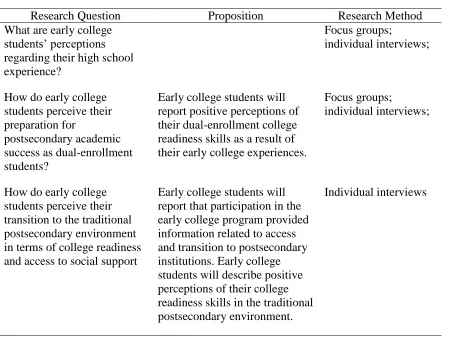
The research questions for the study were as follows:
1. What were early college students’ perceptions, as dual enrollment
students, regarding their high school experiences?
2. How do early college students perceive their preparation for
postsecondary academic success?
3. How do early college students perceive their transition to the traditional
postsecondary environment in terms of their college readiness skills and
Significance
Numerous studies have examined the effect of early admittance to college for
younger students (e.g., Cornell, Callahan, & Lloyd, 1991; Janos, Robinson & Lunneborg,
1989; Lupkowski, Whitmore & Ramsay, 1992). Most of these studies, however, focused
on students who were above-average academic achievers. Additionally, a number of
studies have documented the experiences of first-year college students (Higbee, 2007;
Reid & Moore, 2008). However, little research exists that examines the effects of early
entrance to college on average or low-achieving high school students or documents their
experience attending college after matriculating as a dually enrolled high school-college
student.
Given the current emphasis on education reform efforts which encourage early
entrance to college for middle and high school students, empirical research is needed to
help direct implementation efforts and inform policy. Hoffman et al. (2008) discussed
three accelerated learning outcomes related to early college entrance for students:
traditional dual enrollment, dual enrollment pathways and early college schools.
Traditional dual enrollment programs offer high achieving high school students
the opportunity to take college courses that will count for both high school and college
credit. The traditional dual enrollment program has been available for several decades as an “escape from high school” for high achieving juniors and seniors; however, the
program has more recently been restructured to serve as a mechanism to engage a wider
range of students on the path to college and technical educations (Hoffman, Vargas &
Santos, 2008; Martinez & Kloppott, 2005).
Dual enrollment pathways are structured for students who might require more
enrollment pathways option typically have two to four preselected college courses, one of which is usually a “college 101” course.
The early college school model, which is targeted towards underrepresented
students, is also built on the tradition of dual enrollment, promoting a student’s ability to
earn a high school diploma while simultaneously earning an associate’s (2-year) degree,
all tuition free. These approaches provide the opportunity for middle and high school
students to earn college credit prior to graduation from high school. While the traditional
dual enrollment option is offered only to high school students, both the dual enrollment
pathways option and the early college school model can engage students in college
courses as early as the 6th grade.
There is a significant body of literature (Adelman, 2006; Bailey & Karp, 2003;
Hoffman, Vargas & Santos, 2008; Kleiner & Lewis, 2005; Martinez & Kloppott, 2005)
on traditional dual enrollment programs that substantiate the benefits of dual enrollment
on college completion rates for all students, including those who have traditionally been
underrepresented in the postsecondary environment. However, additional research is
required to thoroughly examine the benefits associated with dual enrollment pathways
and early college school models (Hoffman et al., 2008). This study seeks to add to the
body of literature on the success of the students participating in the early college program
and to garner a better understanding of the factors that influence and promote successful
outcomes for students participating in the early college school program. It is imperative
that scholars continue research in this area, as many of the students who take part in early
education and/or students who are at high-risk for dropping out of high school (JFF,
2008).
Unique opportunities are available for an exploration of the relationships that
exist between high schools and universities, and their potential for building social capital
among early college students. The research on school-based social capital asserts and
reinforces the importance of institutional agents such as teachers and counselors in
assisting students with negotiating the structural barriers associated with access to
information and norms that ease the transition to postsecondary education
(Farmer-Hinton & Adams, 2006; Israel & Beaulieu, 2004; Lee & Croninger, 1999;
Stanton-Salazar, 1997).
This study contributes unique insight into the early college model, as it examines
the experiences of students at one Early College High School. Additionally, it contributes
to the literature on college access and retention for underrepresented youth. The results of
the study will provide valuable insight for early college high school administrators,
university partners, and early college intermediaries on the relationship between social support and college readiness from the students’ perspective. In addition, the results of
this study will contribute to the limited literature on early college high schools and the
ways in which school and university partnerships can most effectively impact improved
access and retention in early college students.
Definitions of Terms
A number of terms are used throughout this study that warrant definitions. These
terms have been used in the literature with slight variations of meaning depending upon
list of terms and how they are defined for this study. The terms early college high school,
early college, and early college school are used interchangeably in this study. When the
initiative began in 2002, the premise was that all schools would start with students in the
ninth or tenth grade; however as the initiative developed new models included schools
that began in the middle grades. To account for those differences, the term early college
school was incorporated in the model descriptions (Berger, Adelman & Cole, 2010).
Postsecondary education refers to all education and training beyond high school. This
includes four-year colleges, community colleges, and training programs. One of the
cornerstones of the early college model is school and university partnerships. These
partnershipsare collaborations between K-12 schools and institutions of higher
education. Most notably in this study the K-12 segment consisted of high schools and
middle schools and institutions of higher education were two-year colleges, community
colleges, or four-year colleges (Laguardia, 1998). Underrepresented students are defined
as students who are first-generation college attendees, low-income, minority, and/or
English language learners. These students are traditionally underrepresented in
postsecondary institutions of higher education. In addition, based on population trends,
these students are also typically concentrated in urban areas and are also be referred to as
urban students in the context of this study (JFF, 2008). Finally, college readiness as
described in this studyis based on David Conley’s (2007) research, which asserts that a
student is college ready when the student has the knowledge, skills, and behaviors
necessaryto complete a college course of study successfully, without remediation. The
strategies, academic content, academic skills and behaviors, and college knowledge.
These dimensions are discussed in greater detail in Chapter 2 of this study.
Theoretical Framework
The theoretical framework that undergirds this study derives strength from social
capital theory. However, it is important to define the period of adolescence, as this is the
period that the students are being interviewed.The age of adolescence is the time when
young people transition from childhood to adulthood. Adolescence, as described by Born
(2006), is marked with experimentation and development across many personal,
intellectual, sexual, and political domains. This time of development and experimentation
typically does not occur in isolation. Rather, this happens with others in their peer group.
While adolescence may be seen as a time when young people achieve independence,
Christie and Viner (2005) argue that perhaps it is more accurate to discuss the ways in
which adolescents change the balance between independence and dependence with others
who are a part of their social networks (parents, peers, community members). The effect
of this balance will depend upon the social and cultural expectations expressed by
members of those networks (Christie & Viner). By gaining insight into the ways in which
adolescents develop, engage and understand the social relationships and social norms in
their lives, I am better positioned as a researcher to understand how to support them
academically and socially.
The use of social capital theory provides a framework that affords me an
understanding of what social networks and elements of social support impact college
readiness and the transition to the postsecondary environment for early college students.
Stanton-Salazar, 1997) suggests strongly that social capital plays an influential role in promoting
educational achievement and consequently leads to increased social mobility and life
outcomes.
In this study, I investigate if social capital theory, especially those attributes
related to information channels, is related to college readiness within the framework of
the early college high school model. This study differs from other research on social
capital in that it did not measuring variables of social capital related to college readiness.
Instead, I sought to understand how students perceive their sources of social capital and
how those networks affect their college preparedness from the perspective of the early
college.
Social Capital Theory
The concept of social capital has had prominence in the literature for well over
four decades. Social capital theory’s roots are found in the discipline of sociology, but it
has been extended to explain phenomena in many of the social sciences, including
education. The theory is bound in economic terms and is constructed as a resource that
individuals are able to build up, trade and exhaust. French sociologist Pierre Bourdieu
(1986) introduced social capital as a concept that could describe resources inhered in the
institutionalized relationships of social networks. Bourdieu stressed the importance of social capital’s role in increasing access to economic and cultural capital, thereby
affecting the ways in which an individual can maneuver through life choices. Bourdieu
(1986) and American sociologist James Coleman (1988) are often credited as the scholars
who formulated the original theoretical development of the social capital concept. Both
their social relationships with others, and the ways in which social capital facilitates
increased access to other forms of capital such as material, physical and cultural. In Coleman’s most cited work Social Capital in the Creation of HumanCapital (1988), he
argued that social capital is an intangible resource that is similar to physical and human
capital in that it is productive and makes possible certain outcomes that in the absence of
said capital would not be probable. However, Coleman also asserted that social capital
differs from physical and human capital in that it is not completely fungible, meaning that
it may or may not be freely traded or replaced for something else just like it. Coleman
also posited that social capital is not a single entity, but a variety of entities with two
things in common: They are contrived of social structures, and they facilitate certain
actions of actors. Social capital is an asset which is rooted in social relations
(Farmer-Hinton &Adams, 2006; Lee & Croninger, 1999; Coleman, 1988; Bordieu, 1985), and
which has the potential to increase and or improve life outcomes for individuals.
Elements of Social Capital
Coleman (1988) asserted that there are three properties inherent within social
capital that results in resources for individuals. The first, consisting of obligations,
trustworthiness, and expectations, is defined by the belief that relationships are
trustworthy and that there are certain obligations created by the interactions of individuals
in the relationships. These obligations can be seen as credit slips that when enough have
been acquired, become accumulated capital for future services and or information.
Information channels are the second element, representing the potential for the
acquisition of information that resides in social relations. Social ties have the potential of
may otherwise have not been available (Lin, 2001). Finally, norms and effective
sanctions are the third element and represent the rules that govern or shape the behavior
of a group or community, guiding people to behave in a specific way. Each property has
the potential to cultivate social capital for individuals. This study examines all three of
these elements relevant to understanding how the early college model affects the college
readiness of students in the program.
Social Capital versus Social Support
Social support, much like social capital, has been examined very closely in the
research literature; however, seldom in the literature would one find any clear delineation
or explanation of the difference between the two. This may be a function of the notion of
social support as embedded within the concept of social capital in the form of social
networks.
Malecki and Demaray (2006) define social support as “one’s perception of
supportive behaviors from individuals in his or her social network (e.g., parents, teachers,
classmates close friends, school), that enhance functioning and/or may buffer him or her
from adverse outcomes” (p. 376). Tardy (1985) and others have defined social support as
deriving from multiple sources as well (e.g., parents, teachers) but further conceptualized
that there are specific types of social support, including emotional, appraisal,
instrumental, and informational (House & Kahn, 1985). Often in the literature, social
support is examined only from the emotional aspect; seldom do researchers explore the
other elements. A holistic examination of social support in the context of both the types
improving the support that students receive from the individuals in their lives (Malecki &
Demaray).
The terms “social support” and “social networks” are sometimes used
interchangeably in the social support literature (Hutchinson, 1999). It is important to
distinguish between the two, as it is quite possible for social networks to be sources of
both stress and support (Wellman, 1981). To understand how these concepts may differ,
it is necessary to separate the structure of a relationship or network from the function or
action of the relationship or network (Hutchinson). For example, families (structural)
serve as social networks to students; their supportive or nonsupportive behaviors
(functions) are imparted upon the student in terms of emotional, instrumental,
informational or appraisal support.
While in this study I examined the perceptions of college readiness and not
academic achievement, the two constructs are very closely related. Therefore, the
inference here is that if social support can be a significant contributor to improved
academic achievement, it would also reproduce positive outcomes in preparing students
for their postsecondary experience. The literature on the relationship between social
support and academic achievement in minority students is extensive. Malecki and Elliot (1999) reported a small but significant relationship between students’ perceived social
support and GPA, as well as a small but significant relationship between teacher support
and GPA. In their investigation of social factors related to African American student’s
school performance, Somers, Owens, and Piliawsky (2008) found that social support
In a study of social support and its relevance to minority populations, Kao (2004)
examined how the various types of social support interrelate to govern the behavior of
groups and group members. Kao noted the importance of families and schools in
trans-ferring social capital to students and relayed the fact that social capital can also work
against positive educational outcomes. She argued that it is not unimaginable that there
could be social norms within families and peer groups that support unconstructive
behaviors, which in turn lead to negative educational outcomes. This proposition is
germane to the tenets of this study in that many early college students, who are
first-generation college attendees, could have had parents not familiar with college culture or
who had negative secondary education experiences that could impact the way in which
their student constructs knowledge about finishing high school or attending college.
“To Be the Lab Rat”: How This Study Got Started
I was employed as the college liaison at the early college high school where the
study took place. As the liaison I was responsible for ensuring a smooth transition for the
students between the secondary and postsecondary environments. As is the case with any
new undertaking, there were unexpected obstacles and miscommunications between the
high school and the college; however, as the liaison between the two environments, I
worked diligently to maneuver around obstacles and assist in the formalization of the
relationships between both entities. As the students approached the semester in which
they would enroll in both high school and college, everyone’s level of anxiety increased.
This program was poised to make an invaluable impact not only on increasing the high
school graduation rates, but also increasing access to postsecondary education for
During the spring semester of the students’ second year in high school, 20
pioneers who came to be known as the Trailblazing Twenty, enrolled at the
post-secondary institution. I rode the bus with them that day; they were remarkably calm, quite
contrary to what I expected from them. As they disembarked from the yellow school bus affectionately known as the “Cheese,” there was an education correspondent from the
local television station, waiting with microphone and camera crew to interview this
courageous group of young people and myself. The students were impressive, calm,
poised, and very articulate. The cameras followed them from the time they left the bus
until they sat down in their seats in the classroom—so much for anonymity about being
in high school and college at the same time. As the reporter interviewed me, I shared my
enthusiasm and hope for these students, and I was humbled that I was involved in such a
momentous opportunity. All of the 20 students were first-generation college attenders,
which meant that they all represented a change in the educational lineage of their
families. The hope represented in these students would affect generations of students to
come; so much was riding on the success and failure of these students. Many people told
the students how important it was for them to do their best, outperform the traditional
students, and pave the way for their peers in the fall semester. At the end of the semester
when grades were released, about half of the students passed their class with a “C” or above and the other half received a “D” or “F.” Accolades were extended to all the
students for completing the semester and trying their best. Individual debriefings were
conducted by teachers, the high school administrator, an associate dean from the college,
and myself with each of the students to determine from their perspective what things
one of the students who had failed his course, I asked him what had happened and, why
he failed the class. He responded to me “C’mon Mrs. White give me a break, I know I was your lab rat.” I could not argue with him. They were the first group of students in the
state to test this model. They allowed us to learn from their mistakes.
The statement, “I know I was your lab rat” left such an impression on me that I
decided to dig deeper. From my perspective, a lab rat has no connectedness to the
researcher, there is no personal relationship with the lab rat, and the researcher willingly
accepts that the lab rat is expendable and capable of being sacrificed. I did not like how
that made me feel, and it forced me to consider just what was at stake for these 20
students and the contingent of students that would follow in their footsteps. I realized that
the students were sacrificing a significant period of their lives to be a part of this new
initiative. It was at this point that I realized my desire to provide a platform for the
students to share their stories about what it was like being an early college student. I saw
the opportunity to use my doctoral research as a venue to convey their stories and
contribute to the scholarly literature on early college students and college readiness.
Summary
Chapter 1 introduced the topic and research problem. Despite a 20+ year focus on
high school reform and improved access to postsecondary education for minority,
low-income and English language learners, there are still significant gaps in access and
retention which warrant investigation. The purpose of this study was to investigate how
early college high school students describe their high school experiences and how those
postsecondary environment are conspicuously missing from the literature. This chapter
also included the definition of terms relevant to the study, introduced the theoretical
perspective and identified the research questions that guided the inquiry. Social capital theory was discussed as the conceptual framework for understanding how students’
networks and relationships contributed to their experiences as early college students. In
Chapter 2, I examine the relevant literature related to the early college model, social
CHAPTER 2
REVIEW OF THE LITERATURE
The focus of this study was to examine early college high school students’
perceptions of their college readiness and the role in which social capital played in regard
to their access and persistence in postsecondary institutions. In an effort to garner a better
understanding of how social capital and social support impact college readiness in early
college high school students, this review will examine three areas of scholarship: early
college schools, social capital theory, and college readiness. The literature on early
college schools reviews the theory behind the model and how that theory and the
strategies of the initiative align with the tenets of social capital theory. The review of the
literature on social capital theory includes a discussion on the ways in which social
capital has been conceptualized and applied in educational research with regards to
college readiness. Finally, the literature review on college readiness examines the
discourse related to salient best practices and strategies focusing on improving college
readiness in secondary education.
Early College Schools
America’s high schools are obsolete. By obsolete, I don’t just mean that our high schools are broken, flawed, and under-funded—though a case could be made for every one of those points. By obsolete, I mean that our high schools—even when they’re working exactly as designed—cannot teach our kids what they need to know today. (Bill Gates, 2005)
The national agenda on education in the United States has made it clear that every
American needs an education through 2 years of college or vocational training
(Department of Education, 2010). The challenge here is how do we ensure that students
are adequately prepared in high school and able to be successful in their postsecondary
which illustrate the disparities in educational outcomes for students across income and
racial/ethnic lines and prove that these still hover in an unacceptable range. The research
tells us that only 11% of the low-income eighth grade students in the class of 2001 are
expected to earn a college degree by 2014 and that students from the middle and upper
income classes are five times more likely to earn a 2- or 4-year degree then low-income
students, and the scope of work that still needs to be done is very clear (Goldberg, 2007).
These disparaging data support the need for radical and innovative approaches that will
address the gaps in the K-12 system that impede low-income and other traditionally
underrepresented students from engaging in the postsecondary environment. There is a
robust field of high school reform efforts engaged in the work of reversing the negative
trends related to postsecondary access for underrepresented students. The initiatives vary
across approach and design but are focused on increasing college readiness for all
students, giving particular attention to students who are minority, low-income, English
language learners, and first generation college attenders.
One such initiative is the early college school model. It is a reform model that
seeks to provide underserved students with the opportunity to take college classes while
in high school. The initiative is a network of small autonomous schools that seek to
integrate the high school and college experience for students who have traditionally been
underrepresented and underserved in postsecondary education. Early college schools are
small schools–schools of 450 or less across all grade levels–that provide opportunities for
their students to have a structured college experience while simultaneously earning high
school and college credit. The philosophy of the program is captured in the idea that
disenfranchised in traditional school settings. The incentive of earning college credit
while in high school may motivate students to see themselves as active participants in the
postsecondary experience (Berger, Adelman, & Cole, 2010). Early College High Schools
are designed so that within 4-5 years of entering high school, students have the
opportunity to earn up to 2 years of college credit (JFF, 2002).
Background of the Early College Movement
Early College High Schools are an extension of another innovative high school
reform model, the Middle College High School. The first middle college high school was
established in 1974 by Dr. Janet Lieberman on the campus of LaGuardia Community College in New York City. Dr. Lieberman’s goal was to creatively meet the academic,
vocational and affective needs of underserved youth and to encourage them to believe
that a college education was attainable. Dr. Lieberman established the middle college
program believing that establishing a small, nurturing, innovative high school with
creative pedagogical inputs on a college campus would capitalize on the “power of place”
and stimulate and inspire underserved students to believe that a college education was
within their reach.
In 2000, Dr. Lieberman and Dr. Cecilia Cunningham, co-directors of the Middle
College National Consortium, advanced the Middle College High School model by
conceptualizing and creating the Early College High School model. Funded by the Ford
Foundation, the early college model pilot program created an opportunity for students
who were previously underachieving in high school to take college courses in their 11th
and 12th grade years of high school. This acceleration in college course work provided an
time (Lieberman, 2004). The early college model while fundamentally based on the
experience and lessons of the middle college high school, would add new structural
elements, such as stronger collaboration between secondary and higher education and a
more formal opportunity for accelerated learning options (Lieberman, 2004). The early
college model as set forth by Lieberman and Cunningham would seek to accomplish the
following objectives:
Reach out to students who are underserved by the regular schools;
Demand a cooperative relationship between the district high school administration
and the college president;
Offer a different sequence of courses from the tenth grade and an accelerated
program from the ninth grade to the associate’s degree, which can be achieved in
five years or less, instead of six;
Combine the resources of a high school on the college campus with the college
facilities (gym, library, cafeteria), making them all available to the early college
high school student;
Require active college campus collaboration from the college administrative
structure: faculty interchange, support from the college divisions of finance,
admissions, scheduling, and counseling under a college-appointed administrator;
Enhance the role of high school faculty; and
Integrate high school and college study in an articulated program.
In conjunction with these objectives the theoretical rationale that drove the model
emanated from the developmental psychology literature (Lieberman, 2004) highlighting
Intellectual maturation is a continuous process: there is little or no difference
between a student at the conclusion of the twelfth grade and the beginning of
college enrollment. Therefore, learning should be a continuous process; the
transitions should be smooth; and the curriculum between high school and college
should be coordinated.
Challenge, both academic and personal, is a strong motivator for achievement.
Positive role models improve behavior.
Flexible use of time advances opportunities for mastery.
Teachers involved in reform have increased motivation for success; caring
teachers improve students’ success.
Lieberman was adamant in her belief that the structural and theoretical
components of the model were inextricably tied to each other. She proposed that the
pieces worked together in much the same way a jigsaw puzzle works and that to omit or
alter any element would only reduce the efficacy of the model.
Early College High School Initiative
In 2002, the Gates Foundation invested in Lieberman’s work by committing $350
million to the Early College High School Initiative. Along with the support of the
Carnegie Foundation of New York, The Ford Foundation, The W.K. Kellogg Foundation
and other local philanthropic organizations, the Gates Foundation inaugurated the reform
effort with the opening of three early college high schools during the 2002-2003 school
year.
The initiative sought to address two goals: (1) improve the secondary experience
traditionally underrepresented in the postsecondary environment, and (2) increase the
college readiness and subsequent college experience for these students (Berger, Adelman,
& Cole, 2010). To achieve those goals, the ECHSI maintained the integrity of the Middle
College concept by ensuring that participating schools incorporated the small school
approach, provided meaningful college exposure to its students, offered structured
academic supports, and ensured a student-centered learning environment where close,
high-quality relationships with adults were maintained (Nodine, 2009).
Although the Early College model drew heavily from the Middle College
concepts, Early College differed in significant ways. First and foremost, Early College
schools offer all of their students the opportunity to earn a significant number of
transferable college credits while still in high school. While it is true that some Middle
College students earned college credit in high school, it was not emphasized that this
option was expected for all students. Not all Early Colleges were located on college
campuses as were middle college schools.
In addition to the Gates Foundation, another key player in the implementation of
this initiative was Jobs for the Future, an action/research and policy organization that
promotes innovative reform in education and workforce development As the overarching
intermediary for the ECHSI, JFF was charged with the responsibility to coordinate,
manage and be a policy advocate for the Early College Initiative (JFF, 2002). JFF took on
the critical role of developing relationships with organizations that were interested in and
had the capabilities to start new early college schools. They also provided opportunities
for these organizations to build professional development learning communities and to
together. Gates had initially invested in seven partner organizations, including JFF, to
launch the first 100 schools of the initiative; however, that group quickly expanded to 13
partner organizations, or intermediaries, as they later became known (see Appendix E for
a list of these organizations). These organizations represented a variety of players in the
educational reform effort, including state education systems, constituency-based
organizations, community foundations and national school reform models and have been
responsible for the opening of over 200 early college schools since 2002. These 13
intermediary organizations have formed the foundation of the ECHSI and have
committed to the work of blending the secondary and postsecondary experiences of
students who probably would not have seen themselves as college material (Berger et al.,
2010). In 2002 the initiative began, guided by a set of core principles. These principles
were discussed and debated over the first 5 years of program and in 2008, were revised
and ratified to reflect a set of core principles that better represented the vision of the
initiative (see Table 1).
What sets the Early College initiative apart from other reform efforts is the
expectation that most students, not just those considered to be advanced academically,
would enroll in some college courses and with the support of the school have successful
progression onto college. Nodine (2009) asserted that prior to the initiation of the early
college initiative, were it not for the advanced placement program, there would be no meaningful “curricular coherence and sequencing between the senior year of high school
and postsecondary education” (p. 6). Early college schools have the potential to be the
conduit that promotes a viable seamless system between the secondary and postsecondary
Table 1
Original Core Principles and Revised Core Principles
Original Principles (2002-2008) Revised Principles (2008-present)
ECHSs serve students from populations typically underrepresented in postsecondary institutions.
ECHS are committed to serving students underrepresented in higher education
Students earn an associate’s degree or 2 years of college credit toward the baccalaureate while in high school.
ECHS are created and sustained by a local education agency, a higher education
institution, and the community, all of whom are jointly accountable for student success;
The years to a postsecondary degree are compressed.
ECHS jointly develop an integrated academic program with their higher education partners so all students earn one to two years of
transferable college credit leading to college completion;
The middle grades are included or there is outreach to middle-grade students to promote academic preparation and awareness of the ECHS.
ECHS engage all students in a comprehensive support system that develops academic and social skills as well as the behaviors and conditions necessary for college completion; and
The ECHSs demonstrate the attributes of highly effective high schools.
ECHS work with initiative partners to create conditions and advocate for supportive policies that advance the early college movement.
Early College and Dual Enrollment
The goals and rationale of the initiative sought to change a paradigm of
hopelessness and low expectations for the most marginalized students in the education
system (Lieberman, 2004). By focusing on the students who had historically been
under-served as a result of the divide between the K-12 and postsecondary institution, the
doing in high school (Webb & Mayka, 2011). Earning college credit in high school
through the dual enrollment program was not commonplace for low-income, minority
and first-generation college students. While dual enrollment has been available for
several decades, it has historically been available only to those high school students who
were in the academic top tier of their classes. Many believed less advanced students
would not be able to withstand the rigor of college courses, that they would be
academically unprepared for the opportunity. It was also thought that giving them “easy
access” to college would inhibit their motivation to strive for high achievement in their
high school courses (Bailey, Hughes, & Karp, 2002). The notion of relaxing the
requirements of the dual enrollment program to enable access to a wider variety of
students was novel to say the least.
Dual enrollment has also been called dual credit, concurrent enrollment, college
in high school, and joint enrollment (Hoffman, Vargas, & Santos, 2010; Kleiner & Lewis,
2005). The program typically allows juniors and seniors in high school to take college
courses that will count for credit at both the high school and the college. The college
course usually is taken in place of a class that is required in high school and is offered for
free or at discounted tuition. This financing caveat helps to eliminate or reduce the
financial barriers that some low-income families may encounter in being able to send
their children to college.
Easing the psychological transition between high school and college is another
benefit of dual enrollment programs (Bailey, Hughes & Karp, 2002; Kleiner & Lewis,
2005; Karp, Calcagno, Hughes, Jeong, & Bailey, 2007). Many dual enrollment courses
college culture, both the academic and extracurricular sides, first hand while having the
support and guidance of their support system at the high school.
Recent research on dual enrollment also supports that there are very positive
outcomes for students that participate in the program (Kleiner & Lewis, 2005; Bailey,
Hughes, & Karp, 2002; Bailey & Karp, 2003). Berger et al. (2010) reported that students
who had taken college courses in high school were more likely to enroll in college and
more likely to enroll in a four-year college, as well as have higher college GPAs and earn
more credits in their first three years of college than students with no college experience
in high school. Additionally, research (Abell, 2007; Adelman, 2006) has shown that
students who accumulate at least 20 college credits by the end of their first year of
college are much more likely to persist to graduation. Therefore, if underrepresented
students who participate in the early college program capitalize on an intensive program
of study, it would be reasonable to assume that they would increase the likelihood of their
persistence in the college environment (Hoffman, Vargas & Santos, 2010)
Early College Outcomes
Using the first four early college principles as a guide, this section explores the
most recent outcome data on access and persistence rates available for the initiative. No
data are available to date regarding college completion rates for those students seeking a
four year college degree, as the first cohort to graduate from an early college program,
would have just done so this past spring. However, the data that are available regarding
access and persistence for early college students shows favorable outcomes. Additionally,
no progress will be reported on core principle five as there has been little to no research
Core Principle1: Early Colleges are committed to serving students
under-represented in higher education. The data support the claim that early college schools
are diligently working to enroll high percentages of minority and low-income students
(AIR/SRI, 2008). Drawing on data from the early college student information system
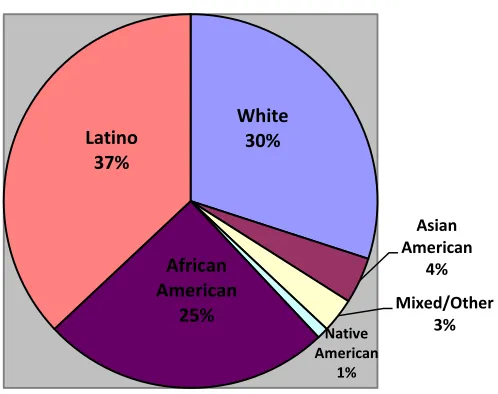
Berger et al. (2010) reported that 70% of early college students are students of color (see
Figure 1) and that at least 59% are eligible for free or reduced-price lunch.
Core Principle 2: Early college schools are created and sustained by a local
education agency, a higher education institution, and the community, all of whom
are jointly accountable for student success. Partnering with an institution of higher
education (IHE) has always been a defining feature of the initiative (Berger et al., 2010). The model’s success is predicated on a commitment from both the K-12 system and their
higher education partner to work collaboratively to provide early college students with
both the academic and social supports that they will need to be successful in the
postsecondary environment (Hooker & Brand, 2009). Most (65%) early colleges partner
with a 2-year IHE, which is not surprising given the community college’s mission to
serve a diverse student population and their admissions policies, which favor
under-represented students. Approximately 24% of the schools partner with 4-year institutions,
and 11% partner with both 2-year and 4-year institutions (Webb & Mayka, 2011).
The type of IHE that a school partners with is important, especially as considera-tion is given to capitalizing on the “power of place” (Cunningham & Matthews, 2007;
Lieberman, 2004; Nodine, 2009). Fifty percent of the early colleges are located on a
college campus, while 47% are in freestanding or traditional buildings and 3% are on a