93
Study on the Performance of a Pilot-Scale Vertical Aerated Steel Slag
Filter for Phosphorus Removal
Syahrul Nizam Bin Maarup1*, Rafidah Binti Hamdan2 and Norzila Binti Othman3
1,3
Department of Water and Environmental Engineering, Universiti Tun Hussein Onn Malaysia, Parit Raja, 86400 Batu Pahat, Johor, Malaysia, 2Department of Civil Engineering Technology, Universiti Tun Hussein Onn Malaysia, Parit Raja, 86400 Batu Pahat, Johor, Malaysia
*Email: [email protected]
Abstract
Phosphorus in river can be classified to three major sources such as industry, agriculture and wastewater treatment plant. Conventionally, to treat phosphorus it requires a complex treatment process with additional chemical cost. Thus, this present study has been design with an aim to develop a low-cost rock filter system to remove phosphorus from domestic wastewater. A pilot-scale rock filter with steel slag a filter medium has been constructed and the objective was to study the performance of a pilot-scale vertical aerated steel slag filter (VASSF) for phosphorus removal from domestic wastewater. Steel slag has been selected for filter medium due to its content which highly contained Al, Ca, Mg for enhanced phosphorus adsorption and also their readily locally available. The pilot-scale vertical aerated steel slag filter has been operated in laboratory for treating domestic wastewater from Universiti Tun Hussein Onn Malaysia (UTHM) wastewater treatment plant located at Tun Fatimah Residential College. The influent and effluent samples of VASSF were collected and analysed for Total Phosphorus, Biochemical Oxygen Demand5, Chemical Oxygen Demand,
turbidity, Total Suspended Solid, pH and Dissolved Oxygen once a week to monitor the filter performance at different filter depths. Results from this study show that at the depth of 0.75m the vertical aerated steel slag filter has efficiently remove 89%, 76%, 64% and 94% of Total Phosphorus, Biochemical Oxygen Demand5, Chemical Oxygen Demand and Total
Suspended Solid, respectively. For Dissolved Oxygen and pH profiles, the vertical aerated steel slag filter effluent values have increased after the treatment. The Dissolved Oxygen is increase at the depth of 0.75m and above about ranged from 7.85 - 8.12 mg/L to 7.72 - 8.46 mg/L, whilst pH increases from ranged 6.64 - 6.79 to 8.37 - 8.99. In conclusion, the filter provides an effective removal performance by using low cost media in removing phosphorus. By complying with Malaysian Environment Quality (sewage) Regulation 2009, the sample treated for all parameters are within permissible limit of standard B.
Introduction
Phosphorus is known as non renewable resource and it has been used for essential to plant growth, animal feed and soil flexibility (Ghani & Mahmood, 2011). It is also can be attributed many major sources such as from industry, agriculture and also from improper wastewater treatment plant. However, the large excessive output have been recognized as a major causes of water pollution problem especially eutrouphication in river. By controlling phosphorus discharged from municipal and industrial wastewater treatment plant is a good factor in preventing eutrophication of surface water. Its presence causes many water quality problems including increased purification costs and lethal effect of algal toxin on drinking water.
94
fundamentally occurs through chemical adsorption or precipitation and much of the phosphorus can be irreversibly bound. Based upon these studies, promising substrates include water treatment residual (WTR), blast furnace slag, steel furnace slag, OPC, calcite, marble, Utelite and other light weight aggregate (LWA), zeolite and shale is the media needed in removal the nutrients (Revision & Bachand, 2003)
Material and Methods
Vertical Aerated Steel Slag Filter (VASSF)
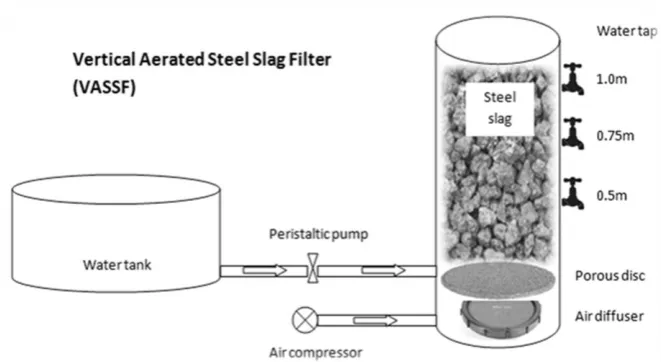
[image:2.595.123.454.369.550.2]A pilot scale of vertical aerated steel slag filter (VASSF) has been designed and constructed in Environmental Laboratory, FKAAS, UTHM. The schematic of the pilot-scale VASSF is shown in Figure 1. Total height of the filter is 1.0 m with three sampling taps located at 0.5m, 0.75m and 1.0m. The VASSF was fed with domestic wastewater collected from UTHM wastewater treatment plant at the base of the filter in order to operate an up-flow system by a variable-speed peristaltic pump (model). In this study, steel slag with grain sizes of 25-30 mm has been used as the filter medium. Prior to this experiment, fresh steel slag sample has been analysed for X-ray Fluorescent to examine their chemical compositions. In addition, the VASSF has been aerated using an air compressor (Rocker air compressor) through a fine bubble air diffuser.
Figure 1: VASSF Schematic Diagram
Wastewater sampling and analysis
Table 1: Method and sampling frequency
Parameter Standard Method Examination for Water and Wastewater (APHA)
Test conducted
BOD BOD Incubator Model 205 device (Hach, USA)
Twice a week
COD DR4000 Spectrophotometer
SS DR4000 Spectrophotometer
Total Phosphorus DR4000 Spectrophotometer
DO DO meter
95
Results and Discussion
Biochemical Oxygen Demand Removal
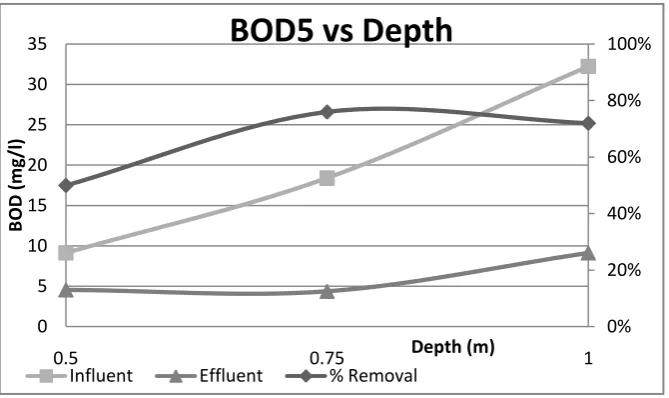
From the experiment, the results show that the removal efficiency of BOD5 has been
influenced by the filter depth. As the filter depth higher than 0.75m, the removal of BOD5
[image:3.595.123.458.253.452.2]was found to be better. It can be seen as provided in Figure 2 that the removal efficiency achieved more than 70% as the water passes through the filter vertically. From this observation, it is indicate that the longer contact time of wastewater flow through the filter, the better removal of organic matters were achieved. Therefore, to achieve higher removal efficiency the filter height must be higher than 1.0.
Figure 2: BOD5 Removal
Chemical Oxygen Demand Removal
As for COD removal, similar pattern of removal was found as previously removal mentioned above. The removal of COD was influenced by the filter depth. Figure 3 shows the removal of COD versus the filter depth as well as influent and effluent concentration. The removal of COD was found to be the highest at the filter depth of 1.0m which was 64%. The result from this study shows that for removing organic matter the filter height should be higher than 1.0m as previously mentioned in BOD5 removal.
0% 20% 40% 60% 80% 100%
0 5 10 15 20 25 30 35
0.5 0.75 1
B
OD
(m
g/
l)
Depth (m)
BOD5 vs Depth
96
Figure 3: COD Removal
pH Profile
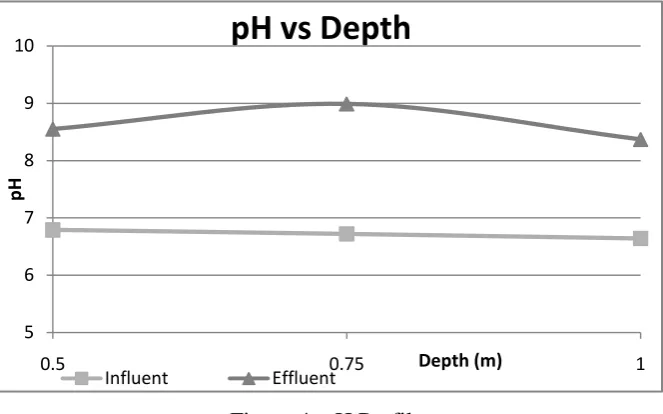
Effluent pH from the VASSF is in the range from 8.37 to 8.99. From figure 4, we can see that the influent of wastewater is in the range 6.64 to 6.79. After been treated in VARF, the pH is increase up to 8.99. It shows that the VASSF effluent pH is stable and has capabilities to treat the wastewater and increase the pH value. Although the pH values were increased, the recorded values are within the pH range the permissible limit of Malaysian Effluent Standard as the pH range is 5-9.
Figure 4: pH Profile
Dissolved Oxygen Profile
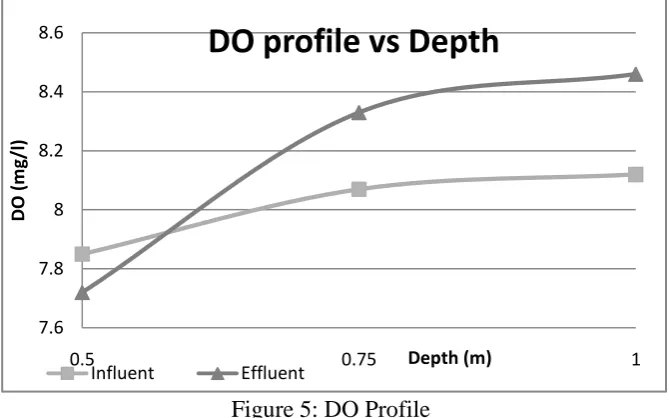
The DO level for influent over the depth of the filter in the VASSF filter ranged from 7.85 to 8.12 whilst the effluent ranged from 7.72 to 8.46 as illustrated in Figure 5. The results show that the greater depth of the filter, the system was found to be more aerobic. This is due the
0% 10% 20% 30% 40% 50% 60% 70%
40 60 80 100 120 140 160 180
0.5 0.75 1
COD
(
m
g/
l)
Depth (m)
COD vs Depth
Influent effluent % removal
5 6 7 8 9 10
0.5 0.75 1
pH
Depth (m)
pH vs Depth
[image:4.595.134.466.448.655.2]97
[image:5.595.132.467.109.318.2]condition where the longer the air bubbles contact time in the system, the higher oxygen transfer efficiency will be achieved (Al-Ahmady, 2006).
Figure 5: DO Profile
The SS was removed through VASSF system and elimination through biological process in the treatment system. From figure 6, the average removal efficiency in the VASSF system was 67% at 0.5m depth and increased to an average 94% at 0.75m depth. The SS concentration entering the VASSF system in ranged 52 to 78 mg/l and after treated, the final effluent was in case lower than influent value about ranged 5 to 17 mg/l. Hence, the VASSF was consistently effective in removing TSS from the effluent. For the solid removal, filter height of 0.75m is also adequate.
Figure 6: TSS with Different Depth
Total Phosphorus Removal
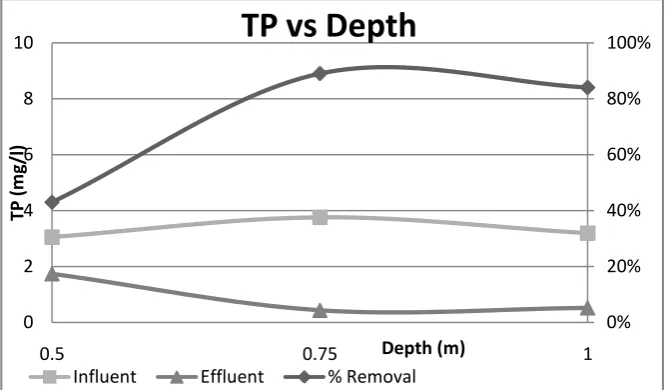
From the experiment, the result shows that the removal of total phosphorus is consistently achieved throughout the present study. The influent TP average ranged from 3.05 to 3.76 mg/l and after through the filter, the effluent ranged about 0.43 to 1.74 mg/l respectively.
7.6 7.8 8 8.2 8.4 8.6
0.5 0.75 1
D
O (m
g/
l)
Depth (m)
DO profile vs Depth
Influent Effluent
0% 20% 40% 60% 80% 100%
0 20 40 60 80
0.5 0.75 1
SS
(m
g/
l)
Depth (m)
TSS vs Depth (m)
[image:5.595.138.474.451.649.2]98
[image:6.595.144.478.118.313.2]From the figure 7, it indicates that the highest removal of TP is on 0.75m depth. The result demonstrated that the VASSF appears to be a promising system for the wastewater treatment system.
Figure 7: Total Phosphorus Removal
Conclusion
Based on the experimental result analyses, the conclusion is VASSF has a great potential in removing the total phosphorus due to steel slag properties which is the substrates is high in Calcium, Aluminium and Ferrum. Furthermore, the steel slag is a waste material, readily available and low cost media product from steel industry. It has been proven more effectively in phosphorus removal in wastewater. Hence, the VASSF appears as a low cost technology in removing nutrient for the wastewater treatment process and the final effluent is lower than the Malaysian Environmental Quality (sewage) Regulation 2009 as low than 10mg/l in standard B.
Acknowledgements
I expressed sincere appreciation to my supervisor Dr Rafidah Bt Hamdan for her encouragement, guidance, trust, critics and also ideas in finishing this paper.
References
Al-Ahmady, K. K. (2006). Analysis of oxygen transfer performance on sub-surface aeration systems. International journal of environmental research and public health, 3(3), 301–8.
Ghani, L. A., & Mahmood, N. Z. (2011). Balance Sheet for Phosphorus in Malaysia by SFA, 5(12), 3069–3079.
Revision, F., & Bachand, B. P. A. M. (2003). Literature Review Potential Application of Adsorptive Media to Enhance Phosphorus Uptake in Stormwater Basins and Wetlands at Lake Tahoe, (02).
0% 20% 40% 60% 80% 100%
0 2 4 6 8 10
0.5 0.75 1
TP
(m
g/
l)
Depth (m)