Journal of Chemical and Pharmaceutical Research, 2013, 5(12):928-932
Research Article
CODEN(USA) : JCPRC5
ISSN : 0975-7384
The reactivity of the diethyl
α
-acylphosphonates with the various
α
-aminoesters: Synthesis and DFT (density functional theory) study
Ilyas Mellah*
1, Serge Turcaud
2and Sameh Ayadi
31
Laboratory of Natural and Bioactive Substances, Department of Chemistry, Faculty of Science,
University of Abou Bakr Bel Kaid, Tlemcen, Algeria
2
Laboratory of Medicinal Chemistry, Faculty of Biological and Pharmaceutical Science, University of
René Descartes, France
3
Unity of Research in Physical Chemistry, 2070 la Marsa, Tunisia
_____________________________________________________________________________________________
ABSTRACT
The condensation of diethyl 1-oxomethylphosphonates with α-aminoglycinemethylester, α-aminoalaninemethylester,
α-aminovalinemethylester, α-aminophenylalaninemethylester at room temperature in the presence of the ceaves
gives the corresponding acetamides, and not the α-iminophosphonates. This study of reactivity have also explored by the theoretical study using the program GAUSSIAN 98 and hybrid B3LYP functional density with 6-31G*. Moreover, the electronic properties such as highest occupied molecular orbital (HOMO) and lowest unoccupied orbital (LUMO) energy have been investigated. Theoretical results have confirmed that the formation of the α -iminophosphonates is not favored thermodynamically, and have indicated that B3LYP/6-31g (d) model is a suitable and precise method for studying molecular structure of α-iminophosphonates.
Keywords: Acylphosphonates, Aminoesters, Reactivity, DFT (density functional theory) method.
_____________________________________________________________________________________________
INTRODUCTION
The knowledge of phosphorus compounds has expanded so rapidly that it constitute now a major branch of chemistry, organic molecules containing phosphorus offer fascinating possibilities for structural, synthetic and mechanistic study [1]. Phosphonates are a key functional group in both organic synthesis and biological chemistry [2]. In synthesis, they are a direct precursor of olefins through the Horner-Wadsworth-Emmons reaction [3]. In biological chemistry, their unique structure and charge distribution give them an important role in pharmaceuticals [4] and phosphoester mimicry [5]. Good general synthetic routes to dialkyl 1-oxoalkylphosphonates have been available for many years [2]. Dialkyl acylphosphonates were obtained for the first time by Kabachnik and Rossiiskaya in 1945 by the reaction of acyl chlorides with trialkyl phosphites [2]. The reaction proceeds readily at room temperature and even on cooling by slowly adding trialkyl phosphite to acyl chlorides. A great amount of investigations dealt the reactivity of dialkyl 1-oxoalkylphosphonates. The main and usual type of such reactions was the reductive amination [6] and the reductive deoxygenation [7].
EXPERIMENTAL SECTION
Material
IR spectra were recorded as a KBr pellets on Perkin‐Elmer FT IR 240‐c spectrometer. 1HNMR, 13CRMN, 31PRMN spectra on a Bruker Avance DPX400 MHz spectrometer with CDCl3 as a solvent and TMS internal standard. The
chemical shift values are expressed in part per million (ppm) downfield from the internal standard and signals are quoted as s (singlet), d (doublet), t (triplet) and m (multiplate).
General procedure for the synthesis of diethyl 1-oxomethylphosphonates(1)
To the acyl chloride (66 mmoles), triethylphosphite (55 mmoles) was added dropwise maintaining the temperature at 0˚C. The mixture was then left overnight at room temperature and the volatile components of the reaction mixture were removed under reduced pressure. The crude products, obtained in 90-100% yield, were of satisfactory purity.
(1): IR spectra: (KBr) cm-1: 1698 (C=O), 1241 (P=O), 1033 (P-O-C); 1H NMR (CDCl3) ppm: δ= 4.16-4.26 (m,
4H), 2.47 (d, 3JP-H= 3Hz, 3H), 1.35 (t, J= 6Hz, 6H); 13C NMR (CDCl3) ppm: δ= 208.8 (d, JP,C= 170 Hz), 63.7 (d, 2J
P,C= 6.8 Hz, 2C), 30.6 (d, 2JP,C= 58.9 Hz), 16.4 (d, 3JP-C= 5.3Hz, 2C); 31P (CDCl3): δ= -2.9 (s).
General procedure for the synthesis of compound 3(R=CH2Ph)
To 4,9 mmoles of diethyl 1-oxomethylphosphonates diluted in the 10 ml of toluene 4,9 mmoles of α -aminophenylalaninemethylester were added at room temperature in the presence of 3,2g of 3A˚ molecular sieve. The mixture was left overnight and filtrated. The volatile components of the reaction were removed by rotary evaporation. The crude product was washed by pentane to obtain the acetamides with 28 % yield. (3): IR spectra:
(KBr) cm-1 : 3276 (N-H), 1745 (C=O, ester), 1657 (C=O, acetamide); 1H NMR (CDCl3) ppm: δ= 7-7.2 (m, 5H), 5.9
(br s, 1H), 4.8 (d, J= 4.5Hz, 1H), 3.7 (s, 3H), 3 (m, 2H), 1.9 (s, 3H); 13C NMR (CDCl3) ppm: δ= 172.29, 169.80,
136.01, 129.41, 128.76, 127.31, 53.29, 52.51, 38.00, 23.31.
Calculation Method
This study was performed using the program GAUSSIAN 03 [8]. The calculations are done at DFT level with the basis standard 6-31G*, We used the B3LYP functional in which the exchange energy is calculated by the Becke method and the correlation by the Lee, Yang et Paar method [9-10].
RESULTS AND DISCUSSION
Synthesis
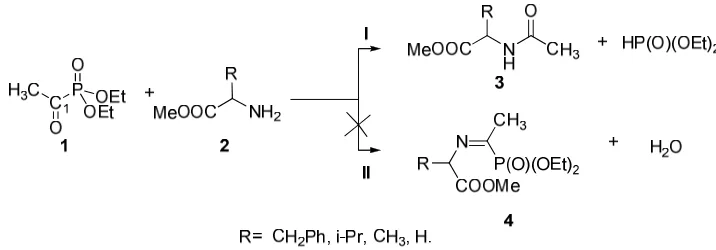
Experimentally, the condensation of diethyl 1-oxomethylphosphonates with α-aminophenylalanine- methylester 3 (R=CH2Ph) in the toluene in the presence of sieve at room temperature gives after washing with pentane the
corresponding acetamides which were isolated exclusively with moderate yield, and not the α-iminophosphonates (Figure. 1). All the attempts to direct the reaction towards the formation of the imines were failed; it is practically non-dependent on the solvent used. The attempt to add acetic acid (standardly used to promote the formation of α -iminophosphonates [11]) was also failed, the spectroscopic analyzes always show the formation of the acetamides and diethylphosphites which have been revealed by the 31P RMN spectroscopy at 7.3 ppm. The use of other aminoesters like α-aminoalaninemethylesters, α- aminovalinemethylesters, and α-aminoglycinemethylesters was totally unsuccessful. The infra-red spectra of crude products always show the band NH and the strong band C=O of acetamide around 3200 cm-1-3300cm-1, and 1650cm-1-1690 cm-1 respectively. The structural assignment of compounds 3 (R= CH2Ph) was confirmed additionally from NMR (
13
C, 1H) spectral data, The 13C NMR spectra showed characteristic signals of CO-NH around 170 ppm, and C=O of ester around 172 ppm. Other evidence for the structure of compounds 3 (R= CH2Ph) was provided by 1H NMR spectroscopy. Indeed, we confirmed the
presence of all the protons, particularly those corresponding to the NH which resonates as a broad singulet around 6 ppm. The CH-NH and CH3CO protons appeared at 4,8 ppm and 2,9 ppm respectively. Mechanistically, there is a
Figure 1
Thermodynamic study
Theoretically, we studied thermodynamically the possibility of the reaction between 1 and 2 possessing various substituents, using the calculation method DFT/B3LYP with the basis standard 6-31 G *, we determined under the standard conditions of temperature and pressure (298 k, et 1 atm (1 atm=101,325 Kpa)) changes in free energy ∆rG,
energy ∆rE, and enthalpy ∆rH. Table 1 presents their values obtained by the DFT/B3LYP method with the 6-31G* standard basis set. As shown in table 1, changes in free energy ∆rG for reaction I are all negative, therefore, we have clearly shown that the reaction is possible and promotes thermodynamically. On the other hand, for reaction II, we observe that changes in free energy ∆rG are all positive; this allowed us to say that the reaction II is not favored
thermodynamically. We have also observed that the values of changes energy ∆rE corresponding to a reaction I are more important than those of changes energy ∆rE corresponding to a reaction II. This further confirms that the product 3 is the most stable and most majority. Moreover, Table 1 shows that reaction I with the values of change enthalpy ∆rH negative is exothermic.
Table1. Thermodynamic data (∆rG, ∆rE, and ∆rH (kcal mol-1)) on some reactions calculated at the DFT/B3LYP 6-31G(d)level of theory
Reaction Products R ∆rH ∆rE ∆rG
I
II
3a H -17.348 -17.348 -15.023
3b CH3 -16.599 -16.599 -15.597
3c i-Pr -15.934 -15.934 -16.142
3d CH2Ph -14.382 -14.382 -15.945
4a H 8.607 8.607 10.863
4b CH3 8.348 8.349 10.615
4c i-Pr 8.425 8.425 10.244
4d CH2Ph 9.367 9.367 12.414
Frontiers orbitals study
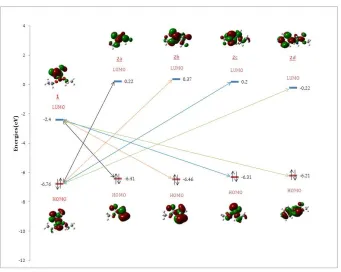
The mechanism of this reaction has been explored by the calculation of the energies of LUMO (Lowst unoccupied molecular orbital) and HOMO (highest occupied molecular) of α-acylphosphonate 1 and of various α-aminoesters 2. The energy of HOMO is often associated with the electron-donating ability of a molecule; high values of EHOMO are
likely to indicate a tendency of the molecule to donate electrons to appropriate acceptor molecules with low energy and empty molecular orbital. Therefore, the energy of LUMO indicates the ability of the molecule to accept electrons [12-13]. We have also calculated the energy difference between the possible HOMO/LUMO combinations for these reactants (Table 3). According to the theory of frontier orbitals, during the interaction between two molecules, the frontier orbitals considered are the HOMO of the one and the LUMO of the other, chosen so that the energy gap ∆E which separates them is the lowest possible [14]. It turns out from the results in table 3 that the gaps E1LUMO -E
R
HOMO are less in energy than the gaps E R
LUMO -E 1
HOMO in all cases. Consequently, the α
-acylphosphonates act as electrophiles whereas the α-aminoesters act as nucleophiles.
Table2 : Energies difference between the to possible HOMO/LUMO combinations for the acylphosphonates and aminoesters(values in eV)
Reactants HOMO LUMO E1
LUMO -ERHOMO ERLUMO -E1HOMO
B3LYP/6-31G(d)
1 -6.76 -2.40
2a(R=H) -6.41 0.22 4.01 6.98
2b(R=CH3) -6.46 0.37 4.06 7.13
2c(R=i-Pr) -6.31 0.20 3.91 6.96
As shown in Figure 2, orbital diagram gives a good qualitative indication as to the reactivity of our system. We noted that the main interaction is between the energy of the LUMO of α-acylphosphonates and the energy of the
HOMO of various α-aminoesters, as we observed a favorable collection between the orbitals of the LUMO of 1 and the orbitals of the HOMO of 2. We also observed that the gap ERLUMO -E1HOMO in the case of 2c is lower compared
[image:4.595.137.478.165.437.2]to the others. Consequently, we have found that the reaction I in the same case is the most favored thermodynamically (∆rG=-16,142Kj/mol). Thus, with our very great satisfaction, our results are complementary.
Figure 2. Orbital diagram of the studied compounds
Figure 3. Optimized structures of the studied α-iminophosphonates
CONCLUSION
In this paper, we have explored the reactivity of the diethyl α-oxophosphonates with the various α-aminoesters,
which seems particularly interesting from a synthetic view point. The present experimental and theoretical study shows that the condensation of α-acylphosphonates with the α-glycinemethylester, α-alaninemethylesters, α -valinemethylesters, α-phenylalaninemethylesters gives the corresponding acetamides, and not the α -iminophosphonates. The formation of the α-iminophosphonates is not favored thermodynamically. In addition, the
B3LYP/6-31G(d) level of theory is a suitable and precise method for studying molecular structure of α -iminophosphonates.
Acknowledgment
[image:4.595.101.510.476.621.2]REFERENCES
[1] (a) Hartly, R. In The Chemistry of Organophosphorus Compounds 1996, John wiley & sons, New York, USA. (b) Corbridg, D. In Phosphorus 1990, Fourth Edition, Elsevier, New York, USA.
[2] (a)Engel, R.; Cohen, J. I. Synthesis of carbon-phosphorus bonds, 2nd ed.; CRC Press: Boca Raton, FL, 2004. (b) Savignac, P.; Iorga, B. Modern phosphonate chemistry, CRC Press: Boca Raton, FL, 2003.
[3] (a) Boutagy, J.; Thomas, R. Chem. Rev. 1974, 74, 87. (b) Horner, L.; Hoffmann, H.; Wippel, H. G. Chem. Ber.-Recl. 1959, 92, 2499. (d) Wadsworth, W., Emmons, W. D. J. Am. Chem. Soc. 1961, 83, 1733.
[4] (a) De Clercq, E. Nat. Rev. Drug Discovery 2002, 1, 13. (b) De Clercq, E.; Holy, A. Nat. Rev. Drug Discovery
2005, 4, 928. (c) Metcalf, W. W.; van dar Donk, W. A. Annu. Rev. Biochem. 2009, 78, 65. (d) M.; Okuhara, M.;
Goto, T. Drugs Exp. Clin. Res. 1981, 7, 559. (e) Okuhara, M.; Kuroda, Y.; Goto, T.; Okamoto, M.; Terano, H.; Kohsaka, M.; Aoki, H.; Imanaka, H. J. Antibiot. 1980, 33, 13. (f) White, A. K.; Metcalf, W. W. Annu. Rev. Microbiol. 2007, 61, 379.
[5] (a) Brandt, G. S. Ph.D. Dissertation,California Institute of Technology, Pasadena, CA, 2003. (b) Chen, L.; Wu, L.; Otaka, A.; Smyth, M. S.; Roller, P. P.; Burke, T. R.; Denhertog, J.; Zhang, Z. Y. Biochem. Biophys. Res.
Commun. 1995, 216, 976. (c) Engel, R. Chem. Rev. 1977, 77, 349. (e) Oleksyszyn, J.; Powers, J. C. In Proteolytic
Enzymes: Serine and Cysteine Peptidases; Academic Press Inc.: Maeng, J. H.; Shen, Q. R.; Berkowitz, D. B. Chem. Biol. 2009, 16, 928. (g) Pettersson, E. J. Ph.D. Dissertation, California Institute of Technology, Pasadena, CA, 2005. (h) Rothman, D. M.; Petersson, E. J.; Vasquez, M. E.; Brandt, G. S.; Dougherty, D. A.; Imperiali, B. J. Am. Chem. Soc. 2005, 127, 846. (i) Zheng, W. P.; Schwarzer, D.; LeBeau, A.; Weller, J. L.; Klein, D. C.; Cole, P. A. J. Biol.
Chem. 2005, 280, 10462. (j) Zheng, W. P.; Zhang, Z. S.; Ganguly, S.; Weller, J. L.; Klein, D. C.; Cole, P. A. Nat. Struct. Biol. 2003, 10, 1054.
[6] Ryglowsky, A.; Kafarski, P. Tetrahedron. 1996, 52, 10685.
[7] Kedrowski, S. M. A.; Dougherty, D. A. Organic letters. 2010, 12, 3990.
[8] Frisch, M. J.; Trucks, G.W.; Schlegel, H.B.; Scuseria, G.E.; Robb, M.A.; M.A. Cheeseman, M.A.; Zakrzewski, V.G.; Montgomery, J.A.; Stratmann, Jr., R.E.; Burant, J.C.; Dapprich, S.; J.M.Millam, A.D.; Daniels, K.N.; Kudin, O.; Farkas, J.; Tomasi, V.; Barone, M.; Cossi, R.; Cammi, B.; Mennucci, C.; Pomelli, C.; Adamo, S.; Clifford, J.; Ochterski, G.A.; Petersson, P.Y.; Ayala, Q.; Cui, K.; Morokuma, P.; Salvador, J.J.; Dannenberg, D.K.; Malick, A.D.; Rabuck, K.; Raghavachari, J.B.; Foresman, J.; Cioslowski, J.V.; Ortiz, A.G.; Baboul, B.B.; Stefanov, G.; Liu, A.; Liashenko, P.; Piskorz, I.; Komaromi, R.; Gomperts, R.L.; Martin, D.J.; Fox, T.; Keith, M.A.; Al-Laham, C.Y.; Peng, A.; Nanayakkara, M.; Challacombe, P.M.W.; Gill, B.; Johnson, W.; Chen, M.W.; Wong, J.L.; Andres, C.; Gonzalez, M.; Head-Gordon, E.S.; Replogle, J.A. Pople, Gaussian 98, Revision A.11, Gaussian, Inc., Pittsburgh PA,
2001.
[9] Lee, C.; Yang, W.; Parr, R.G. Phys. Rev. B. 1988, 37, 785. [10] Becke, A.D. Phys. Rev. A. 1988, 38, 3098.
[11] Jelaiel, N.; Said, N.; Touil, S.; Efrit, M. L. Phosphorus. Sulfur, and Silicon. 2010, 185, 2383. [12] Larabi, L.; Harek, Y.; Benali, O.; Ghalem, S. Prog. Org. Coat. 2005, 54, 256.
[13] Lukovits, I.; Bako, I.; Shaban, A.; Kalman, E. Electrochim. Acta. 1998, 43, 131.