051
SOLUTIONS ON STUDENTS’ DISSATISFACTION TOWARDS PBL
IMPLEMENTATION IN ENGINEERING EDUCATION
Nur Sofurah Mohd Faiz1, Norsuhaila Mamat2, Maziana Mohamed3, Mohd Faiz Burhannuddin4 1, 2, 3
Faculty of Technical Education, Universiti Tun Hussein Onn Malaysia, 86400 Batu Pahat, Johor. 4
Academy of Linguistic, Universiti Teknologi MARA Cawangan Dungun, 23000 Dungun, Terengganu Email: [email protected]
ABSTRACT
Problem-based learning (PBL) is widely regarded as a successful and innovative learning method in technical and vocational education. The main reason of the implementation of PBL in Faculty of Technical Education, Universiti Tun Hussein Onn Malaysia (UTHM) is to enhance self-directed learning among students. It is undeniable that PBL gives remarkable advantages to those who implemented the approach, especially when the outcomes covered both hard skills and soft skills. In spite of the benefits of PBL, recent study revealed that 108 UTHM technical and vocational education final year matriculation intake students that have been the respondents show dissatisfaction towards the implementation of PBL in their learning process. This paper will discuss the possible causes of the problems and will highlight alternative solutions to overcome the major dissatisfaction that occurred.
Keywords: Technical and Vocational Education, PBL, dissatisfaction, alternative solutions
INTRODUCTION
PBL is part of Self Directed Learning (SDL) which due to Robert et.al [1] is a way to enhance students’ problem solving skills. Problem solving needs students to apply critical and creative thinking in decision making simultaneously implementing several critical soft skills are needed in working life situation such as leadership, communication skills, teamwork and so on. Through SDL, students’ knowledge is developed through numbers of generic skills including research finding skills and independent working. This statement is supported by Piskurich [2] who agreed SDL is an ideal approach in generating students’ performance towards independent working. Through implementation of PBL approach, in the end students should conquer not only knowledge but also the major soft skills needed in problem solving that could be applied to survive in their real life situation. Due to that, the advantages of implementing PBL are undeniable.
Previous study revealed students were shocked with the sudden transformation from conventional learning to PBL [3]. Students in Rong Huang’s [4] study met the first difficulty at the very first step in implementing PBL. According to Rong Huang [4] this is due to lack of understanding towards the problems and to highlight important facts that could be a clue in solving the problems given.
UTHM STUDY SCENARIO
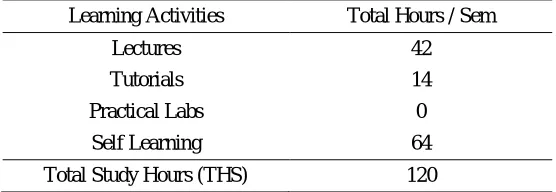
In UTHM, students will take 15 to 18 credits subject per semester and that is equivalent to five to six subjects [5]. Each subject has different credits which depend on the type of the subject and also the learning activities for each subject. The learning activities consist of lecture class, tutorials, lab experiments and self learning. One credit subject is equivalent to 14 hours class per semester [5]. Therefore, for three credits subject without practical labs, it is equivalent to 42 hours lecture class, 14 hours tutorials and 64 hours for self learning per semester as shown in Table 1 [5]. Hence, maximum TSH per semester will be around 720 hours for 6 subjects.
Table 1: Student’s Study Hours for Three Credits Subject per Semester
Learning Activities Total Hours / Sem
Lectures 42
Tutorials 14
Practical Labs 0
Self Learning 64
Total Study Hours (THS) 120
Generally, each subjects will be assessed by such criteria; quizzes, tutorials, assignments, tests, projects, lab reports and final examination. Each criteria has its own weight depending on particular subjects. Usually, for assignments, the weight will be between 15-20% also depending on specific module [6]. For this task, examples of assignments given to students are normally case studies, problem solving, topic covered exercises and etc. Students will be instructed to submit these assignments individually or in group and normally duration given to complete an assignment is around 2 to 4 weeks.
Since PBL is implemented widely in UTHM, assignments are usually done using this approach. However, the implementation of PBL will go through critical steps before reaching the outcome. These steps, namelyproblem identification, information exploration, making hypothesis, hypothesis testing and evaluation need full commitments and focus from each group member [8]. Due to that, additional time is needed by each person and group for them to fulfil all the requirements needed to complete a PBL task.
RESULTS AND DISCUSSIONS
[image:2.595.159.437.195.291.2]Instrument used in this study was 48 items using five Likert Scale questionnaires. According to Majid [9], questionnaire is an instrument commonly used to interpret a phenomenon currently happening and is commonly used in educational researches. The questionnaire was distributed in a 20 minutes session during class to 108 final year TVET students who had experienced PBL. The questionnaire was divided into three sections where section (A) is to look at the demographic pattern of these respondents. Section (B) is to identify the problems occurred in implementing PBL in their studies. In addition, they were also required to list down technical subjects learned using PBL approach and duration given to complete a PBL task at the first part of the questionnaire. Analysis was done using the Statistical Packages for Social Science (SPSS) version 15.0 to determine the average mean score as shown in Table 2 interpreted from Landell in Suriani [10] for each section.
Table 2: Average Score Mean Interpretation
Group Code Average Level
1 1.00 – 2.40 Low
2 2.41 – 3.80 Moderate
3 3.81 -5.00 High
implemented in almost all subjects they took. Some of the facilitator even never explains on how PBL works. The PBL process itself is quite a load, lack of understanding in tackling PBL is another burden. These problems lead to decrease their motivation and due to this, PBL assignments have become a stress for them.
Rather than that, students also feel stressed facing language problems. It is understood that most technical references would be in English. Due to that, understanding English language had become a challenge for them. It was added in the comment that knowing assignments in English could low down their motivation to even start the PBL process. As in their comments, if the study will be approached using PBL, they should be given extra time in order to give some space searching meanings and tackling English. As said earlier by Rong Huang [4] and Larsen [10], this problem could lead a failure in achieving the objectives of a lesson.
Although stress had become a problem, the worse they had to face is to manage their time. Since PBL is used in many subjects and that they have to deal with all the steps during the process, it has been such a burden in time management. Furthermore, with maximum six subjects per semester, problem occurs in time management become worse.
Previous study did reveal time management could be the basis cause of stress problem. Stresses students faced may be caused by their improper time management. Fatah [10], Sherina [11] and Fadzli [12] agreed that students should create an appropriate and effective self time-management schedule that can assist them however it has to be complied with high discipline and motivation. Due to stress is closely related with time management, two alternatives solutions are discussed.
Table 3 shows a framework proposed to encounter improper time management in handling PBL assignments. This framework is called the ‘Jauhari Window’ and is adapted from the framework developed by Fadzli [13]. It is divided into urgent, less urgent, important and less important parts. Students should give priority on any assignment given based due date or marking weight and note in which part does the assignment should be. The urgent and important assignments should be the priority and should be completed first. However, the less important and less urgent assignments should not be neglected. As the priority ones have been completed half ways by ticking at the blocks, the other assignments should be started.
Table 3: First Proposed Framework for Time Management
URGENT
LESS URGENT
Urgent but not important Urgent and important
Less urgent and less important Less urgent but important
Date : Due date : Lecturer :
Weight : ________________________ __________________________________ __________________________________
Identify problems and do hypothesis
Search and gather information
Brainstorm & make decision
Assignment draft
Meet lecturer
Accomplish the assignment
Lecturer assess the assignment
Editing and correction
Submit and evaluation
Date : Due date : Lecturer :
Weight : ________________________ __________________________________ __________________________________
Identify problems and do hypothesis
Search and gather information
Brainstorm & make decision
Assignment draft
Meet lecturer
Accomplish the assignment
Lecturer assess the assignment
Editing and correction
Submit and evaluation
Date : Due date : Lecturer :
Weight : ________________________ __________________________________ __________________________________
Identify problems and do hypothesis
Search and gather information
Brainstorm & make decision
Assignment draft
Meet lecturer
Accomplish the assignment
Lecturer assess the assignment
Editing and correction
Submit and evaluation
Date : Due date : Lecturer :
Weight : ________________________ __________________________________ __________________________________
Identify problems and do hypothesis
Search and gather information
Brainstorm & make decision
Assignment draft
Meet lecturer
Accomplish the assignment
Lecturer assess the assignment
Editing and correction
Table 4: Second Proposed Framework for Time Management
ASSIGNMENT TITLE : _________________________________________________________________________________
SUBJECT : ___________________________ CODE : ____________________ DATE : ____________________ DUE DATE : ______________________
GROUP FORMING
EXTRACT THE FACTS AND PROBLEMS BRAINSTORMING IDEA
NEXT MEETING: MEMBER :
NEXT MEETING: NOTES:
NEXT MEETING: NOTES:
NEXT MEETING: NOTES:
NEXT MEETING: NOTES:
NEXT MEETING: NOTES:
NEXT MEETING: NOTES:
PENCARIAN MAKLUMAT
NEXT MEETING: NOTES:
NEXT MEETING: NOTES:
NEXT MEETING: NOTES:
NEXT MEETING: NOTES:
NEXT MEETING: NOTES:
NEXT MEETING: NOTES:
NEXT MEETING: NOTES:
ASSIGNMENT DRAFT LECTURER AGREEMENT ASSIGNMENT ACCOMPLISHMENT
PROCESS
NOTES: NOTES: NEXT MEETING:
NOTES: NEXT MEETING:
NOTES: NEXT MEETING:
NOTES:
NEXT MEETING: NOTES:
NOTES:
ASSIGNMENT ACCOMPLISHMENT PROCESS
ASSIGNMENT EDITING AND CORRECTION LECTURER
EVALUATION
INSPECTION
NOTES: NEXT MEETING:
NOTES:
NEXT MEETING: NOTES:
NOTES:
28 27 26 25 24 23 22
16 17
18 19
20 21
8 9
10 11
12 13
14
15
NOTES: NEXT MEETING:
NOTES:
NOTES:
7 6 5 4 3 2 1
KUMPUL FAKTA & MAKLUMAT
CONCLUSIONS
As a whole, PBL is undeniable a good approach to enhance various hard and soft skills. These skills however, will not be achieved if PBL is not completed using proper steps and methods. Since time management has become the major problem of tackling PBL, two alternative solutions are highlighted in this study. The suggestions of solutions should become a good assist for students coping PBL tasks. Further consideration however, is needed in order to evaluate the effectiveness of using these solutions suggested.
ACKNOWLEDGEMENT
The author would like thank to Universiti Tun Hussein Onn Malaysia for the Short Grant support Vot No. 0471.
REFERENCES
[1] Robert W. Sanson Fisher and Marita C. Lynagh (2005) PBL: A Dissemination Success Story. Medical Australia Journal, pp. 183.
[2] Piskurich, G.M. (1993) Self Directed Learning: A Practical Guide to Design, Development and Implementation, San Francisco, Josey Bass.
[3] Khairiyah Mohd Yusof, Zaidatun Tasir, Jamalludin Harun and Syed Ahmad Helmi (2005) Promoting PBL in Engineering Courses at UTM, Global Journal of Engineering Education, pp. 175-184.
[4] Rong Huang (2005) Chinese International Students’ Perceptions of the PBL Experience. Journal of Hospitality, Leisure, Sport and Tourism Education, pp. 36-43.
[5] UTHM Academic Management Office (2001) UTHM Academic Rules and Regulations. Publication Office, UTHM, Johor.
[6] Nur Sofurah Mohd Faiz (2008) Lesson Plan. Unpublished paper, Department of Engineering Education, UTHM, Johor.
[7] Sinevitratne, R. De A., Samarasekera, D.D., Karunathilake, I.M. and Ponnamperuma, G.G. (2001) Students’ Perseption of PBL in The Medical Curriculum of the Faculty of Medicine, University of Colombo, Ann Acad Medical, Singapore.
[8] Shahabuddin Hashim, Mahani Razali and Ramlah Jantan (2003) Psikologi Pendidikan, PTS Publications and Distributor Sdn. Bhd.
[9] Mohd Majid Konting (2004) Kaedah Penyelidikan Pendidikan, 1st Edition, Kuala Lumpur.
[10]Lars Bo Larsen and Flemming K. Fink (2000) Issues on Globalisation of Engineering Educations. The Many Facets of International Education of Engineers.
[11]Abdul Fatah Hasan (2001) Penggunaan Minda Secara Optimum dalam Pembelajaran. PTS Publication & Distributor Sdn. Bhd., Pahang.
[12]Sherina (2001) Merancang Kehidupan Seharian Anda. Golden Book Centre Sdn. Bhd., Kuala Lumpur.