
How learners respond to CBL material based on modality learning style?
12
0
0
Full text
(2) Journal of Technical Education and Training. INTRODUCTION Digital technology has changed on how students learn in their lifelong learning. Teachers are increasingly using information and communications technology (ICT) to improve their own skills for their teaching. In addition, technology is making many administrative and assessment tasks easier. Higher education institutions (HEIs) face big changes with the improvement of ICT facilities. Internet channels for educators and learners have been developed and will encourage institutions to offer every learner their own learning space. Lecturers will have access to richer computer based materials. Learners can access flexible or ‘blended’ courses, with opportunities to learn at home, in work, in college or in other community settings. E-learning resources and support will contribute to a skills strategy to improve basic and higher level skills across the workforce and throughout life. E-Learning E-Learning is the use of technology to design, deliver, select, administer, support, and extend learning (Becta, 2005). The power of the Internet as an E-learning delivery system lies in its ability to provide personalised, individualised learning to meet the learner's interests, skills, and needs. In E-learning (Rosernberg, 2001), the learner is, arguably, given the opportunity to actively construct his/her learning in a way that meets his/her needs and learning styles. Elearning focuses on learning solutions that go beyond traditional paradigms of training. However, E-learning is not a new idea and has roots in Computer Based Learning (CBL) approaches. Computer Based Learning Computer-Based Learning (CBL) is using the computer for training and instruction. CBL programs are called "courseware" and provide interactive learning sessions for all disciplines. Multimedia CBL has been introduced, first on Laser Discs, then on CD-ROMs and recently in online format. CBL courseware is typically developed to create interactive question and answer sessions. Rist and Hewers (2005) defined CBL as drill and practice packages, which offer structured reinforcement of previously learned concepts. Question and answer interactions and should give the student appropriate feedback. CBL also includes tutorials which are used to teach new concepts and processes with, again, material presented to students in a structured format. A key factor in assessing the value of CBL concerns student attitudes to technology and their comfort with working at the machine, factors which largely lie outside the control of the designer. LEARNING STYLES Learning styles are often discussed in relation to how individuals differ in learning approaches and strategies. Coffield [6] identified 71 out of hundreds of learning styles models related to education and the learning environment. His research team focused on 13 models of the most widely used models including Allinson and Hayes’ (CSI), Apter’s (MSP), Dunn 22.
(3) Journal of Technical Education and Training. and Dunn model (ASSIST), Gregorc’s (GSD), Herrmann’s (HBDI), Honey and Mumford’s (LSQ) , Jackson’s (LSP), Kolb’s (LSI), Myers-Briggs (MBTI), Riding’s (CSA), Sternberg’s (TSI) and Vermunt’s (ILS). They concluded that none of the most popular learning style inventories had been adequately validated through independent research. This led to the conclusion, that the consistency of visual, auditory and kinaesthetic preferences and the value of matching teaching and learning styles were both questionable. Curry’s model (1983) categorised four basic characteristics of the learner: personality, information-processing models, social interaction and instructional preference. This model put forward the analogy of an `onion’ to represent the layered understanding of learning styles (see also Coffield et al. 2004). According to Fleming (2001) learning style refers to individuals’ characteristic and preferred ways of gathering, organizing, and thinking about information. This research uses the VARK model which focuses on sensory modalities as a framework verifying learner’s response to particular learning material which has been developed to suit their learning preferences. Visual, Aural, Reading, Kinaesthetic Model (VARK) Fleming (2001) developed a VARK model and linked it with other models. This included earlier work on cognitive styles; Kolb’s Learning Cycle; Honey and Mumford activist, pragmatist, reflector and theorist styles and learning dimensions. VARK sees sensory preferences (modality preferences) influencing the ways learners learn. Fleming was influenced by Multiple Intelligence Theory but saw it as too complex and lacking a theoretical basis. However, four out of seven intelligences have been linked with the VARK model put forward by Fleming. VARK is based on a person’s preference for particular types of external events to stimulate their senses to help them learn. It offers a guide for learners on how to pick up information suited to their learning strategy. Fleming developed and made available an instrument to measure learners’ preferences. It classified learners by their preferred mode of interaction with others based on input motivation and output performance. This model recognizes multimodal-learning styles for those learners with more than one preference. Fleming suggested strategies for each learning style and for multimodal combinations. A possible difficulty is that categories mix sensory input (visual, aural, kinaesthetic) with the nature of input (reading) • Visual – pictures, diagrams, video, animation, flowcharts, colors, symbols, lecturers’ gestures and graphs. • Aural – lecturers voices, discussions, verbal explanations, tape recordings, stories and jokes, recall to other people. • Read/Write – lists, headings, dictionaries, glossaries, textbooks, and lecture notes. • Kinesthetic – real experiences, concrete examples, case studies, field trips, physical, active movement, laboratory experiments. Fleming argued that learners will learn better if using their preferred learning styles. Sternberg (1999) later observed that people with different styles would like to use their ability 23.
(4) Journal of Technical Education and Training. and their thinking styles in different ways, and to respond differentially to the kinds of thinking required in different settings. However, he argued that:1) students will learn better when using the preferences in which they are successful 2) students will be better learners when they can expand their preferences 3) when teaching accommodates various preferences, more students will be successful. 4) teachers can construct activities that include specific (and multiple) learning preferences and this can be done by adding alternatives or completing learning cycles that incorporate all styles or, by utilizing holistic, complex tasks. There has certainly been some interesting and stimulating work which has originated from work on VARK learning styles. Zhang (2002) used VARK to investigate students’ perception of multimedia and to identify learner’s preference in using instructional media in the classroom. Byrne (2002) further found support for the idea that students prefer learning with some types of online multimedia better than others, depending on their learning styles. Drago and Wagner (2004) applied VARK to suggest that learning styles do play a part in the decision to take online or traditional courses. Learning style is independent of intelligence. Cashdan and Victor [4] argued that people have preferred learning styles but may switch styles depending on the problem. Pritchard (2005) drew attention to VARK learning styles. He argued that learners may not only have preferred learning styles but expectations concerning the nature of the learning material. Problems may arise if the learner is expecting visual material and is presented with a kinaesthetic approach without explanation. CBL Design Berger (2000) argued that instructional technology was the systemic application of strategies and techniques derived from behavioural, cognitive, and constructivist theories to the solution of instructional problems. Malachowski (2002) put forward the ADDIE model (Analysis, Design, Development, Implementation, and Evaluation) as one of the first design models, giving rise to much discussion about its effectiveness and suitability. As a model it is simple, relatively easy to apply, and cyclical. Kruse (2004) argued that the ADDIE Model was an iterative instructional design process, where the results of the formative evaluation of each phase would lead the instructional designer back to any previous phase. The end product of one phase was the starting product for the next phase. PURPOSE OF THE STUDY This research investigated a new approach to E-learning through content and multimedia customized according to a user’s preferred modalities. It is based around a learning product called MINDs to help students learn according to their preferred learning styles. Minds Courseware A sample courseware product was designed by authors to explore how learners respond to the learning material which suit with them. It demonstrated basic and more advanced features of 24.
(5) Journal of Technical Education and Training. PowerPoint presentations. It included an inventory which identified the learner as having a preferred learning style or styles. The VARK model was chosen because it had been applied in other multimedia learning material and seemed particularly appropriate for this context. For example, Kelly and Tangney (2003) used VARK in their intelligent tutoring system project and Byrne (2002) applied VARK to investigate the relationship between multimedia learning material and learning styles. While material will necessarily use a combination of sensory input in this product different modes were accentuated. The visual mode used graphics more heavily; the aural mode included sound and verbal, rather than written, explanation; the reading mode included pop up text; and the kinaesthetic mode encouraged the learner to interact with the on screen environment. The courseware was developed over time using an ADDIE model.. Diagram 1: Four different route of MINDs Courseware Once a preferred learning style had been identified the learner tackled the tasks using the route designed for this particular preference. The research set out to: 1) develop and test a prototype for “Intelligent Courseware” based on learning styles and intelligences suitable to ‘anyone, anyhow’ approach in E-learning environment. 2) probe relationships between learning styles, types of learning activity, and learning outcomes 3) make a contribution to educational research, especially in the design of learning material adapted to multiple intelligences. 4) make a contribution to the field of Educational Technology by developing a prototype of learning material based on learning preferences modality adaptive learning materials.. 25.
(6) Journal of Technical Education and Training. RATIONALE OF CHOICE OF AREA The interest in carrying out this study began through experience of the difficulties of addressing differentiation in the classroom. ICT seemed an appropriate means to provide personalised learning for students if it could offer differentiation in some way to match preferred learning style. RESEARCH QUESTIONS The key research question was ‘how do learners respond to Computer Based Learning material which allows them to follow specially designed routes suited to their learning style, in particular visual, aural, reading and kinaesthetic modes’. This larger question posed subquestions: 1) do learners respond positively to learning material which is suited to their learning styles? 2) do learners respond negatively to learning material which does not suited their learning styles? 3) are learning style preferences affected by the particular context of CBL and acquisition of computer skills? METHOD OF THE STUDY This was an exploratory empirical study which showed some similarity to a study by Ford and Chen (2001), Bryne (2002) which explored the relationship between matching and mismatching instructional presentation style with students’ cognitive style in a computerbased learning environment. A further study by Ford et al. (2001) carried out an empirical investigation of the role of individual differences in Internet searching. Methods The primary purpose of the research was to analyse the reaction of learners to CBL material which has been designed for VARK learning styles. This required production of learning material, identification of a sample, a procedure and methods of data collection. In order to maintain reliability of the research instrument, data has been collected using a triangulated approach. This has included learning styles inventory, questionnaire, observation form and semi structured interview. Research Sample It was important to get a balance, or at least a variety, of learning styles. This meant that a fairly large sample of students was invited to participate. However, it was not necessary to have a representative sample in terms of age, gender, subject specialisation. Students from a teacher training programme at the University Tun Hussein Onn Malaysia were invited to take part in the study. There were 164 students on this programme. They first took a pen and paper VARK inventory and it was found that 71 had a combination of one or more preferred styles and that 83 had a clearly defined preference: 20 for kin aesthetic; 36 for reading; 8 26.
(7) Journal of Technical Education and Training. visual; 19 for aural. These 83 students were then invited to take part in the courseware trials. Thirty two agreed to do so. Six of them expressed a kinesthetic preference, 12 reading and 2 visual and 12 were aural. They were then, divided into two groups. In group 1, 16 learners followed a route through the learning material matched to their learning preference whereas in group 2, 16 learners followed a route through the learning material mismatched to their learning preference. ICT was very important to these students because they were going to apply it in their future teaching. Preparing learning material for presentations was one of the most important tasks in teaching and they were motivated to tackle the courseware. Courseware development is one of the topics included in their Educational Technology courses. OBSERVATION Cohen, Manion & Keith (2003) argued that observation enables the researcher to understand the context of teaching and learning and to see what might otherwise be unconsciously missed, to discover things that participant might not freely talk about in interview situation, to move beyond perception-based data and to access personal knowledge. In this research learners were observed using the observation form which used to record their reactions. This focused on signs of engagement and disengagement with the material and it was found that there were twice as many positive reactions to the material including smiling, focused concentration and cheers than negative response including signs of disinterest or uncertainty. There was some variation in between the matched and mismatched group with group 2 showing high hesitation signs compared to those in matched group. Pre and post-test Learners took a pre-test which consisted of 5 different topics. After completing the MINDS courseware learners were asked to answer the achievement test based on what they have learnt. Results were compared to pre-test results and were broken down by learning style. Interview. Interviews were conducted after learners used MINDs courseware. A semi-structured interview covered five major themes which included ICT background, learners’ learning styles, type of learning styles, about MINDs product and perception of CBL. Each interview was recorded and transcribed with responses to each theme aggregated and described. RESULTS All the collected data have been coded and aggregated. Findings and expected results are indicated in the following sections:-. Match and mismatch in VARK LS inventory and Learners’ preferences. 27.
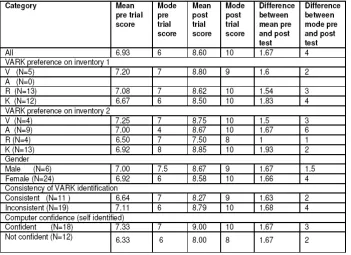
(8) Journal of Technical Education and Training. VARK questionnaires identified 5 visual learners, 13 reading and 12 kinaesthetic. However, these results did not match learners’ preferences when asked by the researcher which was their preferred route before using the courseware. Type of learning Group. Individual Result from VARK Preference pre Inventory trial V A R K V A R K 2 4 6 4 5 2 3 6. Group A Matched group 0 8 6 2 12 0 0 4 Group B Mismatched Group Total 2 12 12 6 17 2 3 10 Table 1: Differences between VARK inventory and learners preferred route. Results show that the learning style inventory is not a predictor on preference in the context of CBL, for example only 2 out of 32 learners were identified as visual learners through the inventory but 17 out of 32 expressed a preference for a visual route through the courseware. Pre and post test Comparison was made between pre and post test scores and these were broken down by learning styles and matched and mismatched groups. There is not the space to include all the results in this paper but there was not found to be a significant relationship between test outcome and either learning styles or matched and unmatched groups (Table 2). However, the unmatched group tended to spend longer on the material than the matched group.. Table 2: Learners pre and post test on MINDs courseware. 28.
(9) Journal of Technical Education and Training. Interview data. Data was categorised into ten themes. These were learners’ confidence in using ICT, approach to software, attitude to using computers, experience of CBL, experience of self study, experience of PowerPoint, using PowerPoint in future, approach to own teaching, learning styles and respond about MINDs learning system some keys findings were: 1) Learners seemed to be aware of the idea of learning styles, found them a useful concept but felt they were context dependent and different styles suited different purposes. 2) Learners had a very positive attitude towards ICT in general and towards the CBL material. 3) there was no clear sense that learning style preference was an indicator of attitude to ICT, to CBL or to the courseware in particular 4) Learners responded positively to the idea of choosing a route through the programme. 5) Learners found that learning styles may help them to learn but not necessary to follow. DISCUSSION AND CONCLUSION This study has thrown more light on the concept of learning styles and the values of CBL. It offers a tentative conclusion based on concrete data, rather than a solid conclusion based on little evidence. As such it offers a valuable contribution to the field. In a field in which match of VARK and learning styles in general are polarised this offers a balanced approach. Learning styles has been founded as important and interesting. This considering that learning style will help teachers focus and realise about an individual difference. However, learning styles are not reliable or stable; too much emphasis on learning styles with single preferences is unlikely to be helpful. Learners should be exposing to various modality. Future Research Future research work on learning styles might consider: 1) Consideration of different learning styles inventories, e.g. serialist and holistic models. 2) More research could be carried out into the context in which CBL is used e.g. what the impact of context is; having tutor direction; having on hand support. 3) The use of mixed modality in CBL - are users aware of the different modalities, do they consider this modality useful, and are they aware of changing modal preferences during the activity. 4) The identification of learners’ entry points and provision of entry points. 5) Different contexts – this study has considered relatively straightforward procedures learning. How do learners’ response to different modalities in higher order contexts? What are the features of modality which assist or inhibit learning? For example, text differs from speech as it is more easily scanned, can be accessed at the user’s own 29.
(10) Journal of Technical Education and Training. pace, while pictures can show events or objects much more clearly than text but do not provide a narrative to explain what went on. REFERENCES Becta, (2005) Learning styles – an introduction to the research literature Version 1.1, September 2005 retrieved from http://www.becta.org.uk pp. 2-9 Brown, E., Cristea, A., Stewart, C., & Brailsford, T. (2005). Patterns in Authoring of Adaptive Educational Hypermedia: Taxonomy of Learning Styles. Educational Technology & Society, 8 (3), 77-90. Byrne, D. (2002) A Study Of Individual Learning Styles And Educational Multimedia Preferences An Experiment using Self-Directed Online Learning Resources, School of Computer Applications, Dublin City University, Ireland Cashdan, A. & Victor, L. (1971) Learning Styles. Portsmouth London: The Open University Press. Coall, D. (2001) Use of an Interactive CD-ROM as a Learning Resource and its Effect on Student Outcome in First Year, retrieved from http://www.ecu.edu.au/conferences/herdsa/main/papers/ ref/pdf/Coall.pdf. Coffield, F. Moseley, D. Hall, E. And Ecclestone, K. (2004) Should we be using Learning Styles? What research has to say to practice London; Learning and Skills Development Agency. Cohen, L. Manion, L. & Keith, M. (2003) Research Methods in Education, 5th Edition, London, Routledge. Curry, L. (1983). An organization of learning style theory and constructs. ERIC Document, 235, 185. Drago, W.A. and Wagner, R.J. (2004) “Vark Preferred Learning Styles and Online Education”, Management Research News, Volume 27 Number 7, pp. 1-13 E-Strategy Document, (2005) Harnessing Technology Transforming Learning and Children’s Services, retrieved from http://www.dfes.gov.uk/publications/e-strategy/docs/e-strategy.pdf Flemming. N. D. (2001) Teaching and Learning Styles: VARK Strategies. Published by the author, Christchurch, New Zealand, 5th edition, 2001. Fleming, N., Dunn, J., and Bonwell, C. (2001) VARK a Guide to Learning Styles, retrieved from http://www.vark-learn.com/english/index.asp Ford, N and Chen, SY. (2001) Matching/Mismatching Revisited: An Empirical Study Of Learning And Teaching Styles, British Journal of Educational Technology, 32, 1, pp. 5-22. Ford, N., Miller, D. and Moss, N. (2001) The role of individual differences in Internet searching: An empirical study, Journal of the American Society for Information Science and Technology, 52, 12, pp 1049-1066. Gardner, H. (1983) Frames of Mind. The Theory of Multiple Intelligences, New York: Basic Books.. 30.
(11) Journal of Technical Education and Training. Kelly, D and Tangney, B. (2003) A Framework for using Multiple Intelligences in an ITS, Proceedings of EDMedia, retrieved from https://www.cs.tcd.ie/crite/publications/sources/ EDMEDIA03Paper4.pdf. Kruse, K. (2004) Introduction to Instructional Design and the ADDIE Model, retrieved from http://www.elearningguru.com/articles/art2_1.htm. Malachowski, M.J. (2002) ADDIE Based Five-Step Method Towards Instructional Design, retrieved from http://fog.ccsf.cc.ca.us/~mmalacho/OnLine/ADDIE.html#TOC Pritchard, A. (2005) Ways of Learning, Learning Theories and Learning Styles in the Classroom, London: Fulton Publishers. Rist, R., and Hewers, S. (1999) Implementing Learning Technology, retrieved from http://www.icbl.hw.ac.uk/ltdi/implementing-it/what-def.htm Rosenberg, M.J. (2001) E-learning: strategies for delivering knowledge in the digital age, New York; London: McGraw-Hill Sternberg, R.J. (1999) Thinking Styles, Cambridge United Kingdom, Cambridge University Press Zhang, S. (2002) Students’ Perceptions of Multimedia Classrooms at East Tennessee State University, Ed. D. Dissertation.. 31.
(12) Journal of Technical Education and Training. 32.
(13)
Figure
Related documents
Based on the number of galloyl and hydroxyl groups, the bioactive compounds could be arranged in the following order; geraniin > chebulagic acid > corilagin
Contact your local Child Care Resource and Referral agency for training(s) and resources for training staff in appropriate curricular practice with young children.. GOING FURTHER
Dependent variable, in this study, was tax morale where the variables of religiosity, national pride, and importance of religion, importance of politics,
The uptake of monosodium urate (MSU) crystals by macrophages can lead to activation of NOD-like receptors containing a PYD 3 (NLRP3) inflammasome, thus accelerating interleukin (IL)-1
These concepts constitute incremental work from our previous work [1], and form the basis of our 3D mapping system. The key contributions of the research reported in this paper
Comparison of Remote Sensing Data at Different Spatial Resolutions (Landsat 8 OLI, Sentinel 2 MSI, and NEON Phase
Majority class prediction and naïve Bayes prediction at the leaves is used for Hoeffding trees and they are evaluated using the framework and the results are noted
The Royal Conservatory of Music is pleased to present Ceiebrdtioh Seies Perspe(tives@, the iourth edition of this renowned piano series.. 'fhe celebrution Sen?so was
