Identification of Deleterious Single Amino Acid
Polymorphism Using Sequence Information Based on
Feature Selection and Parameter Optimization
Xiao Chen, Qinke Peng, Jia Lv
Systems Engineering Institute of Electronic and Information Engineering School, Xi’an Jiaotong University, Xi’an, China Email: [email protected], [email protected], [email protected]
Received 2013
Abstract
Most of the human genetic variations are single nucleotide polymorphisms (SNPs), and among them, non-synonymous SNPs, also known as SAPs, attract extensive interest. SAPs can be neural or disease associated. Many studies have been done to distinguish deleterious SAPs from neutral ones. Since many previous studies were based on both structural and sequence features of the SAP, these methods are not applicable when protein structures are not available. In the current paper, we developed a method based on UMDA and SVM using protein sequence information to predict SAP’s disease association. We extracted a set of features that are independent of protein structure for each SAP. Then a SVM-based machine-learning classifier that used grid search to tune parameters was applied to predict the possible disease associa- tion of SAPs. The SVM method reaches good prediction accuracy. Since the input data of SVM contain irrelevant and noisy features and parameters of SVM also affect the prediction performance, we introduced UMDA-based wrapper approach to search for the ‘best’ solution. The UMDA-based method greatly improved prediction performance. Com- pared with current method, our method achieved better performance.
Keywords: Single Amino Acid Polymorphisms; Support Vector Machine; Univariate Marginal Distribution Algorithm
1. Introduction
With the completion of the human genome project, more and more single nucleotide polymorphisms (SNPs) are collected. It’s estimated that around 90% of human ge- netic variations are SNPs [1], among them, the single amino acid polymorphisms (SAPs), also known as non- synonymous SNPs or nsSNPs, cause amino acid substi- tutions in the protein product, and they have the potential to affect protein structure and function. Some of the SAPs won’t make any change in phenotype, so we con- sider them neutral, while others account for many human genetic diseases, so we consider them deleterious [2]. It’s important to discriminate deleterious nsSNPs from neu- tral ones for the study of human disease.
So far, many methods have been developed to predict possible disease association of SAPs. For example, em- pirical rules [3,4], probabilistic models [5], and machine learning techniques [6-12] are used to classify SAPs. These studies use various features to distinguish delete- rious nsSNPs from neutral ones. Some of the methods
use features derived from protein sequences [4,6-8] while others use both sequential and structural features [9-12]. An up-to-date study predicted deleterious SAPs by add- ing network features based on sequential features and structural features [13]. However, a limitation of the me- thods using structural features is that they are applicable only when protein structures are known, while the major- ity of proteins don’t have available structural information. Therefore, it’s significant to predict deleterious SAPs with high accuracy only using sequential information. Some previous methods can predict the disease associa- tion of SAPs using only sequence information. Maybe because some sequence information hasn’t been explored or the features haven’t been optimized by the previous studies, their prediction accuracy is not high enough to omit further research.
In this study, we extracted a set of 130 features, and these features are independent of protein structure. Each SAP was encoded by 130 features, and then a SVM- based machine-learning classifier is applied to predict the possible disease association of SAPs. It’s not clear which features are relevant with the prediction, so feature selec- tion is often used to improve the prediction accuracy. On the other hand, the parameters of the classifier have an *This work was jointly supported by National Natural Science Founda-
important effect on the classification performance. Thus, we applied a UMDA-based method which can select features and optimize parameters simultaneously. Using the selected features and parameters, SVM classifier achieves better prediction performance.
2. Methods
2.1. Feature Construction 2.1.1. Conservation Attributes
The degree to which a residue is conserved is very im- portant for the classification of SAPs. We measured the residue conservation by using PSI-BLAST [14]. PSI- BLAST can output Position Specific Scoring Matrix (PSSM), which is an L*20 matrix and L in this study is the length of input sequence. First, we derived three attributes from PSSM, that is, the observed frequencies of original residue and substitution residue in SAP, and their difference. Then we also obtained conservation score of the SAP’s neighbors, from the output of PSI- BLAST directly. Saunders’ study showed that the num- ber of homologous sequence in alignment can reflect the reliability of PSSM, so we added this value as an attri- bute.
2.1.2. Motif Attributes
Motifs are some conservative segments in the protein sequence, and they contain lots of biological information. In this study, we used MEME [15] to extract motifs from database. Finally, we got 27 motifs from deleterious SAP dataset and 20 motifs from neural SAP dataset by setting different parameters. Then for each SAP’s neighbor se- quence, if one motif appeared in it, we set the attribute to1. Otherwise, set the attribute to 0. In this way, we ob- tained 47 attributes.
2.1.3. Physicochemical Properties of Amino Acid
If the difference between the physicochemical properties of the original amino acid and the variation amino acid is big, the SAP is likely to cause changes of protein’s func- tion. If the difference is small, the SAP may be compati-ble by the body and won’t be deleterious. We considered four kinds of properties of amino acid that were molecu- lar weight, pI value, hydrophobicity value, and conserva- tive value. For each SAP, property values of the original amino acid and the variation amino acid as well as their differences of corresponding property value between the two amino acids were calculated.
2.1.4. Amino Acid Submission Rates
Matthew’s report pointed that amino acid submission rates in the deleterious SAP dataset and in the neural SAP dataset are different. For the deleterious SAP data- set, submission rates between physicochemically similar
amino acids are lower, and that between highly physico- chemically different amino acids are higher. However, amino acid submission rates for the neural SAP dataset come to the contrary. Thus, for each SAP, the difference between the logarithms of submission rates in the delete- rious set and the neural set was calculated as an attribute:
2 2
= log ijn log ijd
SubDif p − p (1)
where pijn and d ij
p are the submission rates of amino acid i and j in the deleterious SAP dataset and the neural SAP dataset respectively.
2.1.5. Position Attributes
We supposed that the position where SAP is in the pro- tein sequence has an effect on the disease association of the SAP. Based on the above guess, we divided the pro- tein sequence into five same areas according to the posi- tion. These five areas were named by Area ii
(
=1, 2,5)
. Here a 5-dimension vector, pos pos1, 2,,pos5 , was used as features. If the SAP is located in the Areai,i
pos was set to 1. Otherwise, set posi to -1:
SAP 1,
SAP 1,
i i
i Area pos
Area
∈
= − ∉
(2)
2.1.6. Stability of Protein
The physicochemical properties stability of a protein sequence may be associated with the function change [16]. Thus, we calculated the average property values of SAP’s neighbor sites, including four amino acids in the downstream and four in the upstream. The difference between the property value of original amino acid and the average value, as well as the difference between the property value of variation amino acid and the average value were also calculated.
4 1
1 4
( ) 8
prop i i i i
Avg =
∑
= prop +∑
−=− prop (3)prop prop
Odiff =Avg −O (4)
prop prop
Vdiff =Avg −V 5)
where
{
}
prop molecular weight, pI value,
hydrophobicity value, conservative value
∈
,
prop
O represents the property value of original amino acid and Vprop is that of variation amino acid. propi is
the property of the ith site around the SAP. Avgprop is
the average property value of SAP’s neighbor sites.
2.1.7. Sequence Features Used in Previous Study
indicates whether the protein in which the SAP located belongs to the HLA family, METAL and MOD_RES shows whether the SAP is close to functional sites, nor_diff_freq is the normalized frequency difference be- tween original residue and substitution residue, and the other features are defined based on entries from AAindex that is a public database of amino acid properties.
2.2. SVM Classifier and Performance Measure The classifier we used in our study is Support Vector Machine (SVM), which separates transformed data with a hyper plane in a high-dimensional space. SVM has been widely used in classification in bioinformatics. We adopted the LIBSVM that used the radial basis function (RBF) as the kernel function[17].
We used grid-search method to search the best values of the penalty coefficient C and the kernel parameter γ . C was set to 2 , 2 ,−7 −6, 28, and so does γ. We tried all the combinations of C and γ, then selected the pair that got the best 5-fold cross-validation accuracy.
Let “Disease” be the positive class and “Polymor-phism” be the negative class. The overall accuracy is de- fined as below.
TP TN ACC
TP TN FP FN
+ =
+ + + (6)
where TP is the number of true positive; TN is the num- ber of true negative; FP is the number of false positive and FN is the number of false negative. We also calcu- lated the Matthew’s correlation coefficient (MCC), which is more realistic than ACC on an unbalanced da- taset [18].
(
)(
)(
)(
)
MCC
TP TN FP FN
TP FN TP FP TN FN TN FP
× − ×
=
+ + + +
(7)
The higher the ACC and MCC are, the better the clas- sifier’s performance is.
2.3. UMDA Method
Estimation Distribution Algorithms (EDAs) [19] are evo- lutionary searching strategies without crossing and muta- tion operators. In EDAs, the new population is sampled from a probability distribution which is estimated from the fittest individuals. Univariate marginal distribution algorithm (UMDA) is a type of EDAs, and UMDA as- sumes that the variables in the problem were independent. In our study, UMDA was used to search for the “best” solution, including a feature subset and a set of SVM parameters. In the UMDA-based method, the binary coding chromosome representation is shown as Figure 1.
In Figure 1, v1f~
f
n f
v denotes the feature mask, the
1
f
v i
f v
nf
f v 1 C v j C v
nC
C
v 1
vσ k vσ
n
vγ
[image:3.595.310.537.83.119.2]σ
Figure 1. The binary coding chromosome.
bit with value “1” indicates the feature is selected and “0” indicates not. v1c~
c
n c v , v1γ~
n
vγγ denote the value of pa- rameter C and γ , respectively. nf , nc and nγ are
the number of bits indicating the features, parameters C and γ. nc and nγ are chosen according to the calcu-
lation precision required. In our study, nf =130 , 15
c
n = and nγ =15.
The procedure of UMDA-based method is given as follows:
S1: Generate M individuals randomly.
S2: Evaluate the fitness value (ACC) of each individu- al.
S3: Sort the individuals according to their fitness val- ues from high to low.
S4: Select N (N≤M ) individuals with higher fit- ness value from population.
S5: Estimate the probability distribution of the tthite- ration p xt( ) by the selected individuals.
( )
(
1)
1 1 1 1 | ( | ) = n Sel i t i N Sel n
j i i t
i t
j
p x p x pop
X x pop
N δ − = − = = = =
∏
∑
∏
(8)where n is the number of variables, and
(
1)
1 |
0
i i Sel
j i i l
X x
X x pop
others
δ −
=
= =
(9)
S6: Retain N fittest individuals and sample M−N in- dividuals from p xt( ) to form the next generation.
S7: If the termination criterion is satisfied, stop. Oth- erwise, go to S2. The maximum number of iterations is the termination criterion.
3. Experiment and Result
SAPs and 3167 neutral SAPs. Hu’s study [8] and Ye’s study [11] used the data selected from Swiss-Prot, the structural information of which was available. By con- trast, we use the data selected randomly from the data- base were more objective and more reliable.
We compared our method with Hu’s method that pre- dicted SAP’s disease association using sequence-derived information. Hu et al. used a greedy approach to select features useful for the classification of SAPs and 10 fea- tures were selected. Using the 10 features, a decision tree method can achieve a high accuracy.
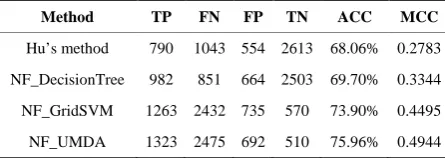
First, we applied Hu’s method on our dataset using the 10 features and decision tree method. In the recent study, we added 120 features to the previous 10 features, so the new feature set was obtained. Next, we used a decision tree which was used in Hu’s method to identify delete- rious SAPs with the new feature set, and this method was called NF_DecisionTree. Then the decision tree was re- placed with SVM that used grid search to tune parame- ters, and this method was called NF_GridSVM. At last, we applied the UMDA based method to optimize the prediction performance, and this method was called NF_UMDA. Table 1 compared the results of above me- thods.
On the same dataset, Hu’s method achieved 68.06% accuracy and 0.2783MCC, while NF_DecisionTree achieve 73.9% accuracy and 0.4495 MCC. So we can see that using the same classifier, the added features in the recent study contributed to the improvement in prediction performance.
As was shown in Table 1, NF_GridSVM achieved much higher accuracy and MCC than NF_DecisionTree. The reason may be that, compared with decision tree, RBF kernel SVM can achieve good generalization and thus is suitable for the data which may contain irrelevant features.
Moreover, it’s observed that NF_UMDA can achieve considerably better prediction performance than NF_ GridSVM. This can be explained by the fact that the UMDA-based method is able to select features that are more relevant and classifier parameters that are more ap- propriate, and then obtain a better classification.
[image:4.595.60.283.653.732.2]Hu et al. also compared their method with SIFT [4] that was a popular sequence-based method to predict whether a SAP is deleterious or neutral. SIFT achieved
Table 1. Prediction performance of various methods.
Method TP FN FP TN ACC MCC
Hu’s method 790 1043 554 2613 68.06% 0.2783
NF_DecisionTree 982 851 664 2503 69.70% 0.3344
NF_GridSVM 1263 2432 735 570 73.90% 0.4495
NF_UMDA 1323 2475 692 510 75.96% 0.4944
only 0.33 MCC using all SAPs from the Swiss-Prot da- tabase, while our method achieved an increase of 0.164 in MCC over SIFT.
4. Conclusion
We explored sequence features deeply and introduced UMDA into the current study to search the solution that includes a feature subset and a set of SVM parameters maximizing the prediction performance on our dataset. The experimental result showed that the UMDA-based search strategy considerably improved the prediction per- formance. Our method used only information derived from protein sequence, so the method can be applied to predict all the SAPs. The performance of the proposed method is higher than Hu’s method and SIFT. Further research will introduce more features and try other evo- lutionary algorithms to improve the prediction accuracy of SAP’s disease association.
References
[1] F. S. Collins, L. D. Brooks and A. Chakravarti, “A DNA Polymorphism Discovery Resource for Research on Hu- man Genetic Variation,” Genome Research, Vol. 8, 1998, pp. 1229-1231.
[2] P. C. Ng and S. Henikoff, “Accounting for Human Poly- morphisms Predicted to Affect Protein Function,” Ge- nome Research, Vol. 12, 2002, pp. 436-446.
[3] S. Herrgard, S. A. Cammer, B. T. Hoffman, S. Knutson, M. Gallina, J. A. Speir, J. S. Fetrow and S. M. Baxter, “Prediction of Deleterious Functional Effects of Amino Acid Mutations Using a Library of Structure-Based Func- tion Descriptors,” Proteins-Structure Function and Ge-netics, Vol. 53, 2003, pp. 806-816.
[4] P. C. Ng and S. Henikoff, “Predicting Deleterious Amino Acid Substitutions,” Genome Research, Vol. 11, 2001, pp.
863-
[5] D. Chasman and R. M. Adams, “Predicting the Function-al Consequences of Non-Synonymous Single Nucleotide Polymorphisms: Structure-Based Assessment of Amino Acid Variation,” Journal of Molecular Biology, Vol. 307, 2001, pp. 683-706.
[6] Y. Bromberg and B. Rost, “SNAP: Predict Effect of Non- Synonymous Polymorphisms on Function,” Nucleic Ac- ids Research, Vol. 35, 2007, pp. 3823-3835.
[7] E. Capriotti, R. Calabrese and R. Casadio, “Predicting the Insurgence of Human Genetic Diseases Associated to Single Point Protein Mutations with Support Vector Ma- chines and Evolutionary Information,” Bioinformatics, Vol. 22, 2006, pp. 2729-2734.
Synonymous Single Nucleotide Polymorphisms Using Sequence-Derived Information,” BMC Bioinformatics,
Vol. 9, 2008
[9] L. Bao and Y. Cui, “Prediction of the Phenotypic Effects of Non-Synonymous Single Nucleotide Polymorphisms Using Structural and Evolutionary Information,” Bioin- formatics, Vol. 21, 2005, pp. 2185-2190.
[10] V. G. Krishnan and D. R. Westhead, “A Comparative Study of Machine-Learning Methods to Predict the Ef-fects of Single Nucleotide Polymorphisms on Protein Function,” Bioinformatics, Vol. 19, 2003, pp. 2199-2209.
[11] Z.-Q. Ye, S.-Q. Zhao, G. Gao, X.-Q. Liu, R. E. Langlois, H. Lu and L. Wei, “Finding New Structural and Sequence Attributes to Predict Possible Disease Association of Sin- gle Amino Acid Lpolymorphism (SAP),” Bioinformatics, Vol. 23, 2007, pp. 1444-1450.
[12] P. Yue, Z. L. Li and J. Moult, “Loss of Protein Structure Stability as a Major Causative Factor in Monogenic Dis- ease,” Journal of Molecular Biology, Vol. 353, 2005, pp. 459-473.
[13] T. Huang, P. Wang, Z.-Q. Ye, H. Xu, Z. He, K.-Y. Feng, L. Hu, W. Cui, K. Wang, X. Dong, L. Xie, X. Kong, Y.-D. Cai and Y. Li, “Prediction of Deleterious Non-Syno- nymous SNPs Based on Protein Interaction Network and Hybrid Properties,” PloS One, Vol. 5, 2010.
[14] S. F. Altschul, T. L. Madden, A. A. Schäffer, J. Zhang, Z.
Zhang, W. Miller and D. J. Lipman, “Gapped BLAST and PSI-BLAST: A New Generation of Protein Database Search Programs,” Nucleic Acids Research, Vol. 25, 1997, pp. 3389-3402.
[15] T. L. Bailey, C. Elkan, S. D. D. o. C. S. University of California, and Engineering, Fitting a Mixture Model by Expectation Maximization to Discover Motifs in Bipoly- mers, Citeseer, 1994.
[16] J. Cheng, A. Randall and P. Baldi, “Prediction of Protein Stability Changes for Single-Site Mutations Using Sup-port Vector Machines,” Proteins: Structure, Function,
and Bioinformatics, Vol. 62, 2006, pp. 1125-1132.
[17] C.-C. Chang and C.-J. Lin, “LIBSVM: A Library for Sup- port Vector Machines,” ACM Transactions on Intelligent Systems and Technology, Vol. 2, 2011, pp. 1-27.
[18] P. Baldi, S. Brunak, Y. Chauvin, C. A. F. Andersen and H. Nielsen, “Assessing the Accuracy of Prediction Algo- rithms for Classification: An Overview,” Bioinformatics, Vol. 16, 2000, pp. 412-424.
[19] P. Larranaga and J. A. Lozano, “Estimation of Distribu- tion Algorithms: A New Tool for Evolutionary Computa-tion,” Vol. 2, Springer, The Netherlands, 2002.