© 2017, IRJET | Impact Factor value: 5.181 | ISO 9001:2008 Certified Journal | Page 152
A new method for a nonlinear acoustic echo cancellation system
Tuan Van Huynh
Department of Physics and Computer Science, Faculty of Physics and Engineering Physics,
University of Science, Vietnam National University Ho Chi Minh City, Vietnam
---***---Abstract -
Acoustic echo cancellation (AEC) is a fundamental requirement of signal processing to increase the quality of teleconferences. AEC has been concerned since the 1950s in telecommunications and efficient solutions for linear echo cancellation had been devised. Teleconferencing systems employ FIR adaptive filter to echo cancellation. However, in this case the problem is difficult to solve because of nonlinear echo path. In this paper, we propose a new method for acoustic echo cancellation system which uses neural network combined with Laguerre filter model to reduce echo signal in nonlinear system. The results of simulations on Simulink will demonstrate the efficiency of the solution.Key Words: acoustic echo cancellation, AEC, neural network.
1. INTRODUCTION
Sound is the object enriched, beautifully added to our lives. But people are harassed, etc., such as echoes. Echo cancellation is a matter of practical research today. There are two echo cancellation methods: echo cancellation using adaptive filtering and echo cancellation using neural networks. Within this paper, the author will introduce the advantages of echo cancellation using the neural network combined with the Laguerre model.
The rapid development of technology has changed the whole way in which people communicate. Today, people like to talk to each other over the phone without having to hold the phone in their hands. In those situations, you need to use a speaker and a microphone in place to receive calls. This will allow more people to be able to join the conversation at the same time as at a telephone conference [2, 5, 8, 15]. However, the sound coming from the speaker will reflect on the surface of the room, echoed and picked up by the microphone. As a result, the other line will hear its own sound, which is called echo.
An acoustic echo is a repetition of the same waveform or by reflection at perfect impedance coordinates. The echoes are born in places where the transmission medium is suddenly changed or because of the sound feedback between the loudspeaker and the microphone of a telecommunication system [4, 7, 10 12]. Elimination of sound echoes is a matter of practical importance, such as echo cancellation in conference rooms or handheld users, live video meetings, etc. There are two types of echoes in telecommunication networks: electromagnetic echoes and
acoustic echoes. Electromagnetic echoes are caused by impedance mismatch at different points along the transmission channel. Echoes are generated at two-wire to four-wire connections in telecommunications systems [1, 3, 4, 7, 14]. Acoustic echoes are caused by reflections of sound waves (between speakers and microphones) in telephones and telecommunications systems [4, 6, 13, 18]. There are two groups of solutions to this problem, Echo Suppression and Echo Cancellation. This paper will focus on the study of adaptive filtering algorithms, Laguerre filter and neural network for echo cancellation to improve the quality of the conversation.
This paper presents an AEC system by using neural network structure. A new method for a nonlinear acoustic echo cancellation system using artificial neural network combined with Laguerre filter model is proposed, where the model of neural network is simplified to meet the characteristic of an AEC system. The remainder of the paper is organized as follows. Section 2 describes the AEC system and proposes a new method for AEC system. In section 3, the results of the proposed AEC system are presented. The conclusions of the work as well as suggestions for further research are given in section 4.
2. METHODOLOGY
[image:1.595.309.558.534.651.2]Adaptive filter
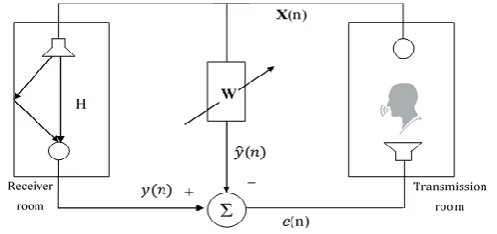
Figure 1. Diagram of AEC system
The common method for echo cancellation is using an adaptive filter. The adaptive filter algorithm adjusts the parameters of the filter to minimize the error between y(n)
and
y
ˆ
(
n
)
echo signals. Figure 1 shows a block diagram of a© 2017, IRJET | Impact Factor value: 5.181 | ISO 9001:2008 Certified Journal | Page 153 echo signal
y
ˆ
(
n
)
equal to the primary echo y(n). At eachloop, the error signal e(n) is feedback on the filter so that the filter has the information and adjusts the output [6, 7, 11].
As shown in figure 1, the estimated echo signal is
̂( ) ∑ ( ) ( )
( ) ( ) ( )
and error signal
( ) ( ) ( ) ( ) (2)
where
( ) ( ) ( ) ( ) (3)
( ) ( ) ( ) ( ) (4)
where L is order filter.
Laguerre filter
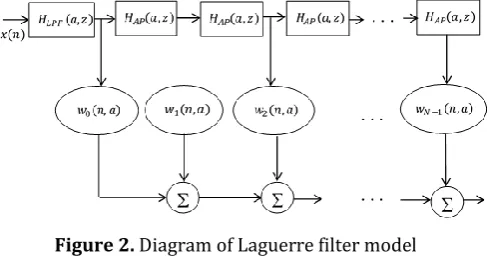
[image:2.595.312.553.367.472.2]The Laguerre filter algorithm can be created by replacing the delay time in the FIR filter with phase filters (figure 2) with the HAP(a, z) transfer function and add the low pass filter HLPF(a, z) at the input [16, 18, 19].
Figure 2. Diagram of Laguerre filter model
( )
(5)
( )
√
(6)
For each value of a, the coefficient of the filter is calculated so that
y
ˆ
(
n
)
is the best. The Laguerre filter isstable when and only when
|
a
|
< 1
. If a = 0, the Laguerre filter degenerates into a familiar horizontal filter. Based on the steepest-descent method, to minimize the output instantaneous error of a filter, we have a retrieval equation for calculating the filter coefficients:( ) ( ) ( ) ( ) (7) The output signal of the filter is calculated using the coefficient vector from the previous loop and the current input vector
̂ ( ) ( ) ( ) (8)
The estimated error value e (n) is the difference between the echo value y (n) and the estimate echo y (n):
( ) ( ) ̂( ) (9) This method has some complex drawbacks and it is difficult to perform with a nonlinear environment.
Artificial Neural Network (ANN)
[image:2.595.38.282.414.554.2]Artificial neural network is the simplest reproduction of biological neurons. Each artificial neuron is created that will synthesize the input information and convert it to output. The general structure of an ANN consists of three components: the input layer, the hidden layer, and the output layer. Each artificial neuron produces an output value, and the output value depends on the transfer function. The hidden layer consists of neurons that receive input data from neurons in the previous layer. In an ANN there can be many hidden classes.
Figure 3. Multi-layered neural network model
Figure 4. TheANN with sigmoid nonlinear function
[image:2.595.308.557.511.661.2]© 2017, IRJET | Impact Factor value: 5.181 | ISO 9001:2008 Certified Journal | Page 154 This procedure is repeated which causes the MSE to
continuously decrease and the weight vector approaches an optimal value.
( ) (10)
where μ is the control parameter for stability and convergence rate, and is the value of the gradient at a point on the MSE surface corresponding to W = Wk. These
rules are then generalized to apply to neural networks. Figure 4 shows the ANN associated with the sigmoid nonlinear function. The input and output relations of the sigmoid function are represented by ̂ ( ). The sigmoid function is hyperbolic tangent:
̂ ( ) (11) The weights of ANN are adjusted to minimize the mean error ̅ , which is defined as:
̅ ̂ ( ) (12)
This goal is achieved by selecting the appropriate weight vector. Then we will set up the back propagation algorithm for ANN. Instantaneous gradients are obtained with each input vector, and use the steepest descent method to minimize error.
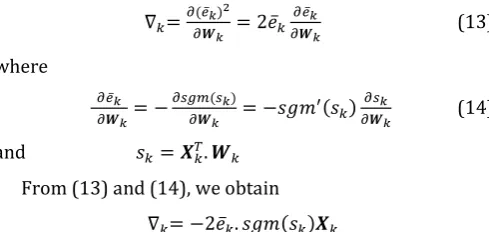
In figure 4, the estimated instantaneous gradient value obtained from the input vector Xk is given by:
( ̅ )
̅
̅
(13)
where
̅
( )
( )
(14)
and From (13) and (14), we obtain
̅ ( )
Based on the steepest descent method to minimize error after the sum of sk through the nonlinear sigmoid function. The algorithm is as follows:
( ) ̅ ( ) (15)
If the sigmoid function is chosen as a hyperbolic tangent function (11), the derivative ( ) is given by:
( ) ( ( ))
( ( )) (16)
Accordingly, equation (15) becomes:
̅ ( ) (17)
Artificial Neural Network using nonlinear function In this section, we propose an acoustic echo cancellation system using ANN combined with Laguerre filter for echo cancellation in nonlinear acoustic environment. To
[image:3.595.309.556.138.284.2]simulate a nonlinear acoustic environment, we use the function: ( ) and it is designed as figure 5.
Figure 5. The proposed AEC system using ANN combined with Laguerre filter
3. EXPERIMENTAL RESULTS
In this section, we present the results of AEC systems in a linear and nonlinear acoustic environment. Based on RLS (Recursive least squares) algorithm to update the coefficients or weights of adaptive filter, Laguerre filter and neural network combined with Laguerre filter algorithms. In this experiment, noise sources include music signals (eg any song) were applied to excite the receiver room. Sampling frequency of 8000 Hz was used throughout the experiment, the learning rate for W is chosen as = 1. Results of AEC systems are implemented on Simulink.
To evaluate the effectiveness of the AEC systems we use mean square error (MSE) and echo return loss enhancement (ERLE) which respectively are defined as follows
∑ ( ) (18)
∑ ( )
∑ ( ) (19)
where y(n) is acoustic echo signal, e(n) is error signal, N is number of steps interaction.
Linear acoustic environment
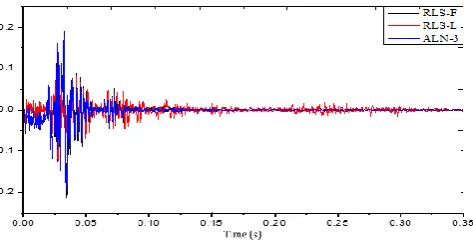
The error signal corresponding to the AEC systems using the adaptive filter (RLS-F), Laguerre filter (RLS-L) and the three-layer ANN combined with the Laguerre filter (ALN-3) filters is shown in figure 6 and figure 7. When the AEC system is activated, mean square error of the residual echoes (error signal) is attenuated very fast respectively. This demonstrates that the AEC systems work effectively.
[image:3.595.39.284.430.546.2]© 2017, IRJET | Impact Factor value: 5.181 | ISO 9001:2008 Certified Journal | Page 155 Figure 6. The error signal of the linear AEC systems
[image:4.595.46.282.416.548.2]Figure 7. The MSE value of the linear AEC systems
Figure 8. The MSE value varies with order filter of the linear AEC systems
Figure 9. The ERLE value varies with order filter of the linear AEC systems
Based on the results of figure 8, we find that the MSE value decreases with order filter and the ALN-3 algorithm has a smaller MSE value than the RLS-L and the RLS-F
algorithm. And figure 9 shows that the ERLE value increases corresponding with order filter and the ALN-3
algorithm has a larger ERLE value than the RLS-F and the
RLS-L algorithm. The results show that the proposed AEC system using neural network combined with Laguerre filter worked effectively and stability in linear acoustic environment.
Nonlinear acoustic environment
To evaluate the proposed AEC system, we also implemented it in a nonlinear acoustic environment (figure 5). We make a comparison of the results of the adaptive filter, the Laguerre filter and the neural network combined with Laguerre filter algorithms. The results of figures 10 and 11 show that the proposed AEC system (ALN-3) algorithm also works very well in nonlinear acoustic environment.
[image:4.595.310.555.509.620.2]Figure 10. The error signal of the nonlinear AEC systems
Figure 11. The MSE value of the nonlinear AEC systems
[image:4.595.41.288.600.738.2]© 2017, IRJET | Impact Factor value: 5.181 | ISO 9001:2008 Certified Journal | Page 156 proposed AEC system will perform better in real
[image:5.595.38.283.121.270.2]situations.
[image:5.595.40.282.324.467.2]Figure 12. The MSE value varies with order filter of the nonlinear AEC systems
Figure 13. The ERLE value varies with order filter of the nonlinear AEC systems
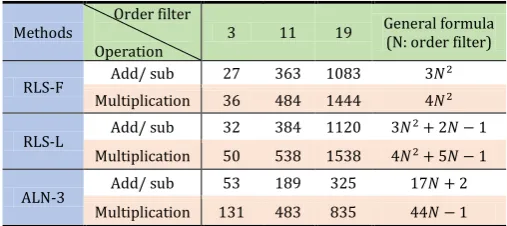
Table 1. Comparing the complexity of algorithms
Methods Order filter
Operation 3 11 19
General formula (N: order filter)
RLS-F Add/ sub 27 363 1083
Multiplication 36 484 1444
RLS-L Add/ sub 32 384 1120
Multiplication 50 538 1538
ALN-3 Add/ sub 53 189 325
Multiplication 131 483 835
4. CONCLUSIONS
Based on the neural network technique and Laguerre filter algorithm, we develop a new ANC system with saturation compensation. The learning algorithm is carried out using the gradient steepest descent method. The results are provided to illustrate the performance of the proposed AEC system in both the linear acoustic
environment and the nonlinear acoustic environment cases.
The simulation results system show that the proposed AEC system operated effectively. We will continue to study other algorithms more optimally to improve the efficiency of acoustic echo cancellation algorithms.
REFERENCES
[1] J. Benesty, D. R. Morgan, M. M. Sondhi, “A Better Understanding and an Improved Solution to the Specific Problems of Stereophonic Acoustic Echo Cancellation”, IEEE Transactions on Speech and Audio Processing, vol. 6, no. 2, 1998.
[2] V. V. Sudhir, A. S. N. Murthy, D. E. Rani, “Acoustic Echo Cancellation using Adaptive Algorithms”, International Journal of Advances in Computer Science and Technology, vol. 3, no. 4, 2014.
[3] H. Buchner, W. Herbordt, and W. Kellermann, “An efficient combination of multi-channel acoustic echo cancellation with a beamforming microphone array”, University of Erlangen Nuremberg, Germany.
[4] Y. W. Liu, J. O. Smith, “Perceptually similar orthogonal sounds and applications to multichannel acoustic echo canceling”, Center for Computer Research in Music and Acoustics, Stanford University, USA.
[5] T. G. Nsler, J. Benesty, ”Stereophonic acoustic echo cancellation and two-channel adaptive filtering: an overview”, International Journal of adaptive control and Signal Processing, 2000.
[6] K. Mayyas, “Fast implementation of a subband adaptive algorithm for Acoustic Echo Cancellation”, Journal of Electrical Engineering, vol. 55, no. 5-6, 2004, pp. 113-121.
[7] M. Moonen, T. Waterschoot, H. Jensen, “Adaptive filtering algorithms for Acoustic Echo Cancellation and Acoustic Feedback Control in speech communication applications”, Group Science & Technology, KU LEUVEN, 2013.
[8] J. C. M. Bermudez, “Adaptive Filtering - Theory and Applications”, Electrical Engineering Federal University of Santa Catarina Florian´opolis – SC Brazil, IRIT - INP-ENSEEIHT, 2011.
[9] S. A. Minami, “Stereophonic echo canceler using single adaptive filter", Proceedings of IEEE ICASSP, 1995. [10] A. Schwarz, C. Hofmann, W. Kellermann, “Combined
Nonlinear Echo Cancellation and Residual Echo Suppression”, Multimedia Communications and Signal Processing, Friedrich-Alexander-Universität Erlangen-Nürnberg, 2014.
[11] C. Boukis, D. P. Mandic, A. G. Constantinides, and L. C. Polymenakos, “A Novel Algorithm for the Adaptation of the Pole of Laguerre Filters”, IEEE Signal Processing Letters, vol. 13, no. 7, 2006.
[12] A. Dankers, D. T. Westwick, “A Convex Method for Selecting Optimal Laguerre Filter Banks in System Modelling and Identification”, American Control Conference Marriott Waterfront, USA, 2010.
[image:5.595.34.288.548.661.2]© 2017, IRJET | Impact Factor value: 5.181 | ISO 9001:2008 Certified Journal | Page 157 [14] J. Yuan, “Adaptive Laguerre filters for active noise
control”, Mechanical Engineering, The Hong Kong Polytechnic University, 2006.
[15] L. Knockaert,” On Orthonormal Müntz–Laguerre Filters”, IEEE Transactions on Signal Processing, vol. 49, no. 4, 2001.
[16] B. Krose, P. V. D. Smagt, “An introduction to Neural Networks”, University of Amsterdam, 1996.
[17] R. J. Schallkoff, “Artificial Neural Networks”, The McGraw – Hill Companies, 1997.
[18] A. Uncini, “Audio Signal Processing by Neural Networks”, University of Rome “La Sapienza” Via Eudossiana 18, Italy.
[19] Schiffmann, W. Joost, M. and Werner, ”Optimization of the backpropagation Algorithm for Training Multilayer Perceptrons”, University of Koblenz, 1994. [20] B. Widrow and Michael a. Lehr,” 30 Years of Adaptive