Voice and e-quality:
the state of electronic democracy in Britain
by Wainer Lusoli
Thesis submitted for the degree o f PhD
Department o f Media and Communication
UMI Number: U21B447
All rights reserved
INFORMATION TO ALL USERS
The quality of this reproduction is dependent upon the quality of the copy submitted.
In the unlikely event that the author did not send a complete manuscript and there are missing pages, these will be noted. Also, if material had to be removed,
a note will indicate the deletion.
Dissertation Publishing
UMI U213447
Published by ProQuest LLC 2014. Copyright in the Dissertation held by the Author. Microform Edition © ProQuest LLC.
All rights reserved. This work is protected against unauthorized copying under Title 17, United States Code.
ProQuest LLC
789 East Eisenhower Parkway P.O. Box 1346
<Jwgbj*M*oaw*
Abstract
This dissertation is broadly concerned with the issue of electronic democracy, i.e. whether,
under what conditions and how does the Internet strengthen democracy in advanced
industrial polities. Specifically, this work applies the theory of participation to recent British
data on online political engagement in order to understand:
• whether and how the Internet modifies the existing structure of political inequality;
• whether and how the Internet alters the context of traditional political action;
• whether the Internet holds a democratising potential and what is its nature.
Data collected and analysed include a survey of British citizens’ online political behaviour,
and three smaller, in-depth surveys of citizens’ online political activities within limited
settings: a national online consultation forum, routine politics by young party activists and
charity work by an elderly activist network. More generally, the dissertation contributes
towards clarifying the ongoing debate on electronic democracy, by examining the discourse
surrounding the evolution of the issue. It reviews a large portion of the existing literature on
online political engagement, organised in three main approaches. It presents and analyses
seminal data on British online political engagement to assess the state of electronic
democracy in Britain. Importantly, it advances a theoretical framework for the understanding
of the ‘real’ digital divide, drawing on the theory of participation. The theory is an ideal
explanatory base from which to depart in order to find the factors shaping the structure of
online political opportunities and the way in which preferences are voiced, and heard,
through the Internet. This dissertation speaks directly to the electronic democracy debate by
setting the agenda on the notion of democratic equality and by focusing on the structure of
Acknowledgments
But I kept rhymin’ and stepwritin’ the next cypher Best believe somebody’s payin’ the pied piper All the pain inside amplified by the fact That I can’t get by with my 9 to 5
Marshall Bruce Mathers
Halfway through this journey I felt I should start thanking people for their help, support,
inspiration, approval. The thought hit me on the train from Manchester to London, on my
way back to Italy, homebound. Reading a journal article, thinking of book proposals, SPSS
files, the next APSA conference and a seaside weekend, all of which seemed to go together
well, three years in the PhD. I tried at first to dismiss the thought, as the journey was still
long, the dissertation half-through. Yet it was then that I first realised that the journey was
safe, mainly due to the people I wished so strongly to thank. Thus it was, in the end.
Thanks to Maggie, for all her help, advice, understanding and respect; she has seen this
work through difficult times. So is life. Thanks to Steve and Rachel for providing the
material means of my subsistence, and for the time and freedom to pursue a distinct
intellectual project from my terms of engagement with two exciting projects. They have
shaped my thinking in countless ways. Thanks to the EMTEL bunch, the old hands and the
young, who helped relieve my academic pains with good times and inspiring discussion.
Thanks to Roger, a humanist, intellectual, and hombre vertical. Thanks to all of the above,
and many others, for putting up with me at good and at bad times. These ‘many others’
include the members of my upgrade committee, Sonia Livingstone and Shani Orgad,
Stephen Coleman and other people at the Hansard Society, the commissioning editor of
Hampton Press, Nick Jankowski, and all others who went out of their way to read and listen.
Obviously, I am very grateful to the University of Bologna, to the European Commission
and to the ESRC for the financial support they have provided throughout my doctoral
studies.
Two things I will never forget that I heard at the beginning of this work. The first is
about ‘writing a thousand words before breakfast’, which haunted me all through the PhD. I
would have to get up at 4am to stand a reasonable chance, let alone the quality of the results.
The second is about the PhD being ‘three years when all you have to do is read and write’.
As it happens, the longest period I was able to sit down and think through things was three
months. Yet these phrases encapsulate the challenges and rewards of a long intellectual
journey, one that rests on the right and duty to think, incessantly, and on the duty and right to
share one’s thinking with others. This I have done, I hope, during the last few years; this
thesis is the result of such thinking and sharing. Needless to say, I do not see why anyone
Lastly, and most importantly. Thanks to Gisella and Sesto, Cristina and Barbara, my
family, who would look at me, not quite understand, and love me all the more for that.
Thanks to Anusca, my family, who would look at me, understand all too well, and expect me
to finish.
Table of contents
ABSTRACT ... 2
ACKNOWLEDGMENTS...3
TABLE OF CONTENTS...5
LIST OF TABLES...8
LIST OF FIGURES...8
INTRODUCTION - THE QUEST FOR DEMOCRACY IN CYBERSPACE... 9
1.1 The prevalence of the In ter n et...9
1.2 Approaches to electronic d e m o c r a c y... 10
1.3 Resea rch qu estion s...11
1.4 Da ta and m eth o do lo gy...13
1.5 Ch apter s y n o p s is... 15
CHAPTER 1 - THE E-DEMOCRACY DISCOURSE... 18
1.1 Intro d u ctio n... 18
1.2 Online politics and electronic d em o cra cy...18
1.3 E-dem o cracy and political m o m e n t u m... 20
1.3.1 The cold war and the discourse in the US...22
1.4 THE E-DEMOCRACY DISCOURSE IN BRITAIN... 24
1.4.1 Bipartisan support fo r e-democracy...26
1.4.2 Local and global dimensions o f the discourse...27
1.5 Th e role of the n e w m ed ia industry in the construction of the d isc o u r se 28 1.6 R e s ilie n c e o f t h e e - d e m o c r a c y d i s c o u r s e ... 30
1.7 Co n c l u sio n s...32
CHAPTER 2 - MACRO AND MESO APPROACHES TO E-DEMOCRACY... 34
2.1 In tro d u ctio n... 34
2.2 T h r e e a p p r o a c h e s t o e l e c t r o n i c d e m o c r a c y ...35
2.3 The democratic In t e r n e t... 36
2.4 Political characteristics of the In t e r n e t... 38
2.5 Archetypes of e-d em o c r a c y... 40
2.5.1 Teledemocracy...41
2.5.2 Virtual community...43
2.5.3 Online deliberation...46
2.6 MACRO OBSTACLES TO E-DEMOCRACY...50
2.7 The norm alisation critiq u e... 53
2.8 The theoretical com m on grou nd of n o rm a lisa tio n... 55
2.9 The em pirical core of n o r m a l isa t io n... 57
2.9.1 Electoral campaigns online...57
2.9.2 Political p a r tie s...61
2.10 C o n c l u s i o n s ... 63
CHAPTER 3 - MICRO APPROACHES TO E-DEMOCRACY...65
3.1 In t r o d u ctio n... 65
3.2 Why study the u s e r...65
3.3 Existing surveys of o nline political en g a g e m e n t... 67
3.4 Reso u rces, uses and effects of th e political In t e r n e t... 69
3.5 The resources of online pa r tic ipa t io n...71
3.5.1 Dynamics o f resource generation...73
3.5.2 Social capital and resource generation...75
3.6 Uses studies: the com plexity o f the online political ex perien ce... 77
3.6.1 Why people use the electoral Internet... 77
3.6.2 The motives o f online discussion, information seeking and contacting...78
3.6.3 Length o f use, Internet skills and online engagement....80
3.7 The search fo r effects a t individual lev el... 83
3.7.1 Internet effects on voting behaviour...83
3.7.2 Internet effects on non-voting activities...84
3.8 Conclusions from the m icro r e v ie w...86
3.9 Con clusions: tow ard the em pirical definition of e-d em o cra cy... 89
CHAPTER 4 - POLITICAL PARTICIPATION... 93
4.1 In tro d u ctio n... 93
4.2 The theory of pa r tic ipa t io n... 93
4.2.1 The definition o f participation...95
4.2.2 Nomological vs. empirical approaches to participation...96
4.3 The theory of pa rticipa tio n: m a in e l e m e n t s ...100
4.3.1 Participation and democracy...100
4.3.2 Instrumental participation...105
4.3.3 The socio-economic model...108
4.3.4 The modes o f participation...110
4.3.5 The dimensions o f participation...112
4.4 Participation and the study of electronic d e m o c r a c y...115
4.4.1 The autonomous citizen and self-representation: voice and (inequality...117
4.4.2 Modes and dimensions o f electronic democracy...120
4.5 Co n c l u sio n s...122
CHAPTER 5 - A METHODOLOGY FOR ONLINE PARTICIPATION... 124
5.1 In tro d u ctio n...124
5.2 Th e survey c o m po n e n t...125
5.2.1 Survey design and questions...126
5.3 Dimensional analysis and case c o m po n en t... 128
5.3.1 Merits and limits o f case research...133
5.4 Case study and electronic d em o cra cy... 135
5.5 Cases and their selectio n... 136
5.6 The DF co n su lt a tio n...138
5.6.1 H S content analysis...138
5.6.2 Units o f analysis...139
5.6.3 Coding fram e...139
5.6.4 Piloting and inter-coder reliability...141
5.6.5 Post-consultation questionnaire...142
5.7 Liberal Dem ocrat you ng activists and Age Concern e-activists n e tw o r k 142 5.8 Co n c l u sio n s...144
CHAPTER 6 - RESULTS: THE STRUCTURE OF ONLINE POLITICAL INEQUALITY.. 147
6.1 In tro d u ctio n... 147
6.2 Th e British In ternet a u d ien ce: tech nica l, social a nd po litica l pr o file s...147
6.2.1 Social and digital divide...148
6.2.2 The political Internet...150
6.3 Online participation a nd co n ta ctin g... 152
6.4 The online structure of political in e q u a l it y... 156
6.4.1 Towards proper modelling o f online inequality...158
6.4.2 Online participation in perspective: a glance at the future...162
6.5 Co n c l u sio n s... 166
CHAPTER 7 - RESULTS: THE MODES AND DIMENSIONS OF E-DEMOCRACY... 169
7.1 In tro d u ctio n... 169
7.2 The morphology of the online po litical spa c e... 169
7.3 Th e offline predictors of online m odes of e n g a g e m e n t... 171
7.4 Dimensions of participation: survey pe r spe c t iv e...173
7.4.1 Dimensional poles o f online engagement...178
7.4.2 Dimensions ofparticipation and radical potential....179
7.5 Co n c l u sio n s... 182
8.1 In tro d u ctio n...184
8.2 Ex ped ien cy: initiative, speed and d u r a t io n... 185
8.3 Synergy: a ccess, interaction, co-o pe r a t io n... 190
8.3.1 Access to the DF....190
8.3.2 Interaction in the DF...193
8.3.3 Co-operation in DF...197
8.4 Effica cy: a genda setting and effectiv en ess...200
8.5 Co n c l u sio n s... 205
CHAPTER 9 - CONCLUSIONS... 208
9.1 Contribution of the thesis to the e-dem ocracy d e b a t e...208
9.1.1 Ql: The structure o f online political inequality...209
9.1.2 Q2: The institutional contexts o f online action...210
9.1.3 Q3: The political value o f the Internet...211
9.2 The individual a n d the political In t e r n e t... 212
9.3 ‘No rm a lisa tio n’ and the meso a g en d a... 214
9.4 Th e internet and the w id er p o l it y...216
9.5 The theory of participation and online e n g a g em en t... 217
9.6 E-dem ocra cy: w hat should be d one? ... 220
APPENDICES 223 Appendix 1 - Su rvey q u estio n n a ire... 223
Appendix 2 - Hansard Society content analysis coding f r a m e... 227
Appendix 3 - Ha nsard Society questionnaire... 230
Append ix 4 - Liberal Dem ocrats online survey q u estio n n a ir e... 231
Appenddc 5 - Age Concern England online survey q u estio n n a ire...236
Appendix 6 - Declaration of originality and involvem ent in jo in t research w o r k 240 Appendix 7 - Data sources of m icro st u d ie s... 242
ACRONYMS, SHORTHAND AND GLOSSARY... 246
List of tables
Table 4-1. Typology of political participation...98
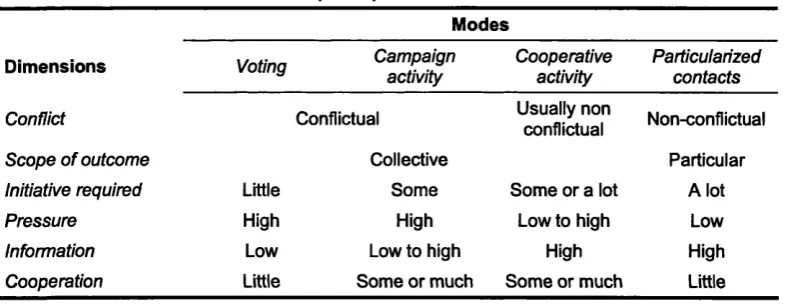
Table 4-2. Modes and dimensions of participation...114
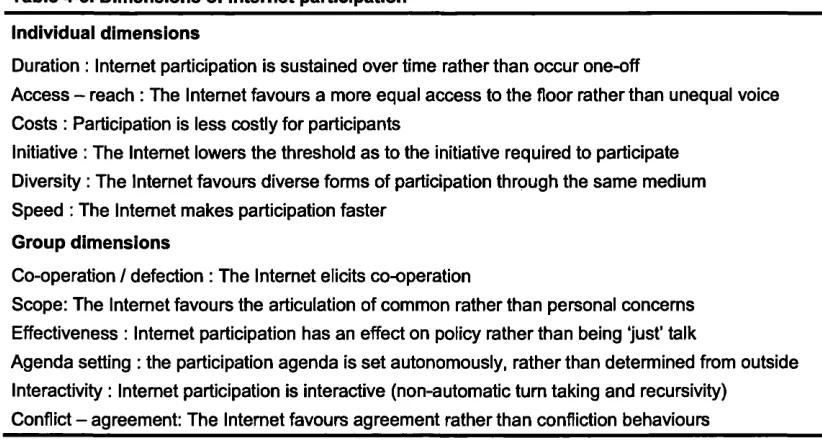
Table 4-3. Dimensions of Internet participation...121
Table 5-1. Dimensionality of online participation activities...130
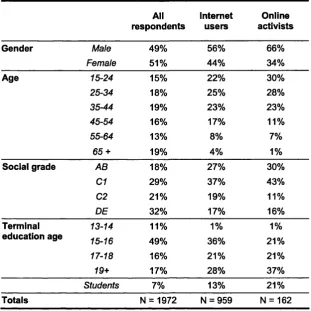
Table 6-1. Internet use by age, gender, social grade and education...149
Table 6-2. Political activity by Internet u se... 150
Table 6-3. Predictors of offline political participation...151
Table 6-4. Levels of engagement in online participation...152
Table 6-5. Involvement with political organisations after online contact...155
Table 6-6. Awareness of political campaigns online...156
Table 6-7. Socio demographic profile of different Internet groups... 157
Table 6-8. Predictors of offline participation... 159
Table 6-9. Predictors of online participation and contacting... 160
Table 6-10. Four scenarios of Internet political effects... 163
Table 6-11. Major reason of disengagement from online political activity...164
Table 6-12. Predicted participation probability of non-users... 165
Table 7-1. Factor analysis of online political engagement... 170
Table 7-2. Predictors of the modes of online participation... 172
Table 7-3. Descriptive statistics of dimensional scales... 174
Table 7-4 Dimensional poles of online political engagement... 178
Table 7-5. Dimensionality of Internet radical potential... 180
Table 8-1. Access to and usefulness of features on LD party website...185
Table 8-2. Effects of LD party e-mails and website... 186
Table 8-3. Predictors of online e-mail activation of LD members... 187
Table 8-4. Online engagement of ACE activists... 188
Table 8-5. Readership predictors... 195
Table 8-6. Replied to predictors... 196
Table 8-7. Predictors of policy advice...202
List of figures
Figure 7-1. Boxplot distributions of dimensions of online engagement...175Figure 8-1. Concentration of message distribution... 192
Introduction - The quest for democracy in cyberspace
This dissertation is broadly concerned with the issue of electronic democracy, i.e.
whether, under what conditions and how does the Internet strengthen democracy in advanced
industrial polities. Specifically, this work applies Verba’s theory of participation to recent
British data on online political engagement in order to understand:
• whether and how the Internet modifies the existing structure of political inequality;
• whether and how the Internet alters the context of traditional political action;
• whether the Internet holds a democratising potential and what is its nature.
Data collected and analysed include a public opinion survey of British citizens’ online
political behaviour, and three smaller, in-depth surveys of online political activity within
limited settings: a national online consultation forum, routine party politics by young
activists and charity work by an elderly activist network. More generally, the dissertation
contributes towards clarifying the ongoing debate on electronic democracy, by examining
the discourse surrounding the evolution of the issue. It reviews a large portion of the
literature on online political engagement, organised in three main approaches. It presents and
analyses original data on online political engagement to test the state of electronic
democracy in Britain. Finally, it advances a theoretical framework for the understanding of
the ‘real’ digital divide, drawing on the theory of political participation.
1.1 The prevalence of the Internet
The Internet, also referred to as new information and communication technologies
(ICTs), the Net, new media and cyberspace, was assembled in 1969 as a research / military
communication infrastructure in the United States. Since the early days, the network has
evolved through a number of functional and architectural structures, yet preserving the
original distributed morphology (Abbate, 1999). The latest phase of Internet evolution,
starting in the mid 1990s, was driven by privatisation and marketisation logics. This caused a
rapid increase in the Internet audience, from a minority of researchers and military users in
the United States to the world public. Possibly, the first head of state to send an e-mail was
Queen Elizabeth II, on 26 March 1976, from the Royal Signals and Radar Establishment in
Malvern (Zacon, 2003). Three decades later more than half of the British population access
the Internet daily from home, the workplace, public places and mobile devices (OH, 2003).
From the early days, much was written about the economic, social and political
consequences of the medium. As regards specifically the political, a powerful discourse
unfolded around the concept of electronic democracy (or e-democracy). E-democracy
media inherently democratic? The Internet - the discourse goes - is a powerful driver of
modernisation and democratisation in both advanced industrial democracies and developing
nations, as it provides the material and symbolic incentives for a ‘leap across’ inter-personal,
social, global and ultimately democratic divides. This discourse matured over three decades,
following rather than driving technological change, which was dictated mainly by
endogenous dynamics (Castells, 2000).
1.2 Approaches to electronic democracy
In contrast with the unifying simplicity of the electronic democracy discourse, research
brought to bear on electronic democracy is multifaceted. I argue here that the discussion of
online politics qua electronic democracy has been conducted within four main approaches -
articulated at three different analytical levels - over the three-decade evolution of the
Internet:1
1. Macro / polity level of analysis
• Systemic - theoretical approaches
• Archetypal approaches
2. Meso / arenas level of analysis
• Agency - middle-range approaches
3. Micro / citizen level of analysis
• Individual - inductive approaches
Early views of the Internet and politics tended to consider systemic aspects of the
technology. According to macro theorists, the political value of ICTs descends from their
very novelty (Enzensberger, 1970; Hiltz & Turoff, 1993; Pool, 1983). The social processes
of a new democratic polity are predicated upon new media’s technical characteristics -
interactivity, flexibility, multiple connectivity, high speed, low marginal cost, diffused media
ownership and access, and control of the medium. Overall, it was argued, the Internet
incarnated the myth of democratic decentralisation (Mosco, 1998). Simply put, political
power is decentralised along with political communication qua new media. With the
increasing prevalence of ICTs in different nodes of the polity, however, democratic
decentralisation was modelled more precisely around definite technical characteristics,
creating archetypes of electronic democracy. According to this set of views, new media
would allow citizens to bypass traditional authorities to directly decide (teledemocracy),
deliberate(online deliberation), and sharewith fellow citizens (virtual community). Macro
level theorisation on e-democracy is grounded in a competent understanding of ICTs, their
technical characteristics and historical development in the framework of western polities.
A ‘normalisation backlash’ followed - circa 1997 - stemming from sceptic assumptions
as to the political value of the Net, with an increased focus on meso-level political players,
on the content rather than the structure of the Internet. Meso theorists limit the democratic
potential on four important accounts (Resnick, 1997). Firstly, the prominence of politics over
technology is stated. Secondly, ‘so what’: the radical potential of the medium is contested.
Thirdly, ‘intra-net politics’ and ‘Internet policy’ are disregarded, as only ‘real life’ political
phenomena are counted in the e-democracy equation. Finally, a meso-level of analysis
unveils the complexity of online politics. The analysis of a narrower political space -
generally limited to the electoral circuit - generated more sober conclusions on electronic
democracy. Normalisation works benefit from specific knowledge about politics in advanced
industrial democracies, and the increasing ‘tactical’ use of the media by specialist political
brokers - political parties, electoral campaigns, pressure groups and government agencies.
With the expansion of Internet content and user base (circa 1999, see Lyman & Varian,
2000), research appeared that assessed the importance of the Internet for democracy qua the
citizen. As the Internet has become a ‘general purpose technology’ fit for a multiplicity of
economic and social uses (Lovelock & Ure, 2002), increasingly more citizens gained access
to the Net. In 2005, more than half of the British population could access the Internet and
used it on a relatively regular basis (OH, 2003). A proportion of this population engaged in
online political activities such as political information seeking, discussing politics on mailing
lists and weblogs, donating online to political cause and engaging in online party activity
(Gibson, Lusoli, & Ward, 2002a; Norris & Curtice, 2004). A set of questions has being
asked about the political value of the Internet for individuals and mediating organisations;
the extent to which and how citizens use the Internet to participate in political life; the
marginal importance of new media for individual political participation (Bimber, 2003). The
growing micro literature can be organised in three main streams, concerned with different
aspects of Internet, participation and democracy. Resources studies examine users’ socio
demographic profiles, and other predictors of Internet political use. Uses studies are
concerned with different types of online political engagement and the motivations of
specialised online activities. Effects studies are concerned with the outcomes of Internet
adoption access and use for offline participation and the externalities of the Internet for
citizen engagement.
1.3 Research questions
The literature suggests that the democratic implications of new media are more complex
than the e-democracy discourse may suggest. They are composed of three main interrelated
elements: the democratic potential of new media and the implications of new media for the
democratic transactions of the polity; the implications of new media for the institutions
political opportunities. These three elements operationalise the ‘electronic democracy’
question into manageable analytical units, which this work addresses:
1. The structure of online political equality. Does the Internet increase or reduce
citizens’ access to political information and to the decision-making circuit?
2. The institutional contexts of online action. What are the actors and factors, if
any, which mediate citizens’ online engagement?
3. The political nature of the Internet, at the interface between institutions and
citizens. What, if any, is the political quality of the technology?
To illuminate online engagement in a way conducive to conclusion on electronic
democracy, I draw on the theory of political participation. The theory of participation was
formalised by Verba and Nie in the 1970s and subsequently developed in different directions
by numerous scholars (Barnes & Kaase, 1979b; Parry, Moyser, & Day, 1992; Pattie, Seyd, &
Whiteley, 2003; Verba, Nie, & Kim, 1978; Verba, Schlozman, & Brady, 1995). The theory
maintains that it is possible to determine the degree and nature of democracy in a polity or
across polities according to the differential analysis of individual levels, modes and styles of
political engagement. The theory of participation is useful for the study of electronic
democracy in a number of ways. Firstly, it provides the necessary bridge between democratic
theory and the empirical study of actual political behaviour. Secondly, it helps the
articulation and analysis of the concept of political action both quantitatively (modes) and
qualitatively (dimensions). Thirdly, it offers a malleable explanatory model based on a socio
economic baseline (SES), which is consistent with soft-technological determinism and
social-shaping approaches to the techno-political. Finally, the underlying assumption of
Verba and Nie’s work is that democracy resides at the interface between individuals,
institutions and political organisations. The initial model, based on the explanatory power of
individual socio-economics to predict participation (Verba & Nie, 1972), lays the
foundations for subsequent work on the importance of group political consciousness, the role
of mobilisation agencies and political voluntarism (Schlozman, Verba, & Brady, 1995;
Verba, Nie, & Kim, 1978). In fact, the standard socio-economic model is an explanatory
base from which to depart in order to find the ‘additional factors’ that shape participation
and, as applied to ICTs, online participation. With them, ‘we are interested in these
additional social circumstances, attitudes, and social and political structures because they
modify the working of the socio-economic model’ (Verba & Nie, 1972: 14).
The participation approach helps evaluate the role of the citizen as a political user of
new media, and the political importance of technology at citizen level. ICTs influence the
re-equilibrate, further skew or have spurious effects on the structure of political equality, and
ultimately democracy. Following the participation tradition, and responding to a challenge
posed in the existing literature, the focus of the research is explicitly on individuals, and the
way, intended as modes and dimensions, in which they adapt and adopt the Internet to
participate in the political process, in specific techno-institutional contexts. In short, this
research examines the structure, modes and dimensions of online political engagement.
Firstly, it makes inferences from the micro-empirical to the theoretical layer regarding the
role of the Internet in shaping the structure of political equality. What are the consequences
of the Internet for the existing structures of political inequality in advanced industrial
democracies? Secondly, this work examines new media political agency, and the interaction
of the Internet with offline political dynamics. What is politically new about new media, and
why, if at all, does it matter for democracy?
1.4 Data and methodology
Britain was selected as the unit of reference for the study of e-democracy through the
lens of participation. This choice was natural, as it descended from reasons of relevance and
opportunity. The review of macro, meso and micro literature attested the clear predominance
of the United States as a context for the study of e-democracy. The fact that the US is the
largest and most developed online political market accounts for this predominance.
Furthermore, the electronic democracy discourse, it is argued in Chapter 1, is anchored to a
‘democratic deficit’ discourse generated in the United States. Although this is no impediment
to theorisation, it is necessary to consider electronic democracy in other political settings,
where this ‘deficit’ is arguably less apparent. In many European countries voter turnout is
relatively high, parties are weaker than in the past but still enjoy considerable popular
support, and citizens are satisfied with the quality of democracy and are not entirely
disengaged from the political process. This is clearly the case in Britain. Secondly, one might
expect citizens in different countries to differ in terms of their uses of the political Internet.
While US users are more likely to be engaged in politics than non-users (e.g. Bimber, 1999),
European users, for instance, tend to have lower participatory profiles, as offline generations
constitute the participation core of the country (Gibson & Ward, 1999b). In Britain, there is a
lack of systematic evidence on citizen engagement with new media for political purposes;
the available evidence, however, suggests a relatively ambivalent citizenry (Gibson, Lusoli,
& Ward, 2002a; Norris & Curtice, 2004; Ward, Gibson, & Lusoli, 2003). Finally, the
electronic democracy discourse is well rehearsed in Britain, a country at the forefront of e-
democracy developments in Europe. This makes Britain a theoretically suitable unit of
context. Regarding opportunity, being based in Britain gave this author easier access to
country-related evidence. Specifically, the author was able to collect and analyse data in the
participation in Britain.2 Although similar data was available for the US and other OECD
countries,3 the author enjoyed a much higher degree of control over the British data. Of
course, the ideal study of electronic democracy according to the theory of participation
would entail a multi-country research design, with an over-sample of theoretically significant
groups, and a nested longitudinal (panel) component. However, this goes beyond the limited
resources available for this dissertation, and for most other individual efforts that purport to
examine e-democracy systematically.
The research design consists of a two-level, nested analytical framework (Chapter 6). At
the micro level, citizens’ online engagement is surveyed and analysed; at the meso level, the
role of context to co-shape the dimensions of participation is assessed. The design includes a
nationally representative survey of the British population (N = 1972, stratified sample, face-
to-face, May 2002). The survey provides information on the extent of citizens’ participation
online, and their awareness of the political web-sphere (Foot & Schneider, 2002).
Furthermore, questions are asked about citizens’ modes of involvement in offline and online
politics, how they interact online with other citizens and political organisations, and about
the role of political organisations in shaping participatory opportunities online (Chapter 7).
Nonetheless, although the survey yields necessary insights into the online structure of
political equality in Britain, closer inspection of the data confirms the limits of large-scale
surveys with respect to the assessment of the dimensionality of political participation. Partly,
this is due to the limited extent of online political activity, which does not allow for in-depth
probing;4 partly, it depends on the very nature of survey research, as neither the temporal nor
the contextual effects of ICTs can be considered.
Under these conditions, case study research usefully integrates the research design
(Collier, 1993; Yin, 1994). Three cases were selected to investigate in depth the dimensions
of online participation, whether and how the enabling characteristics of the Internet - high
speed, inter-connectivity, interactivity, low cost - interact with the SES model in limited
contexts of online political engagement (Chapter 8). The first case considers the earliest
example of online deliberation in Britain, a forum of experts run by the Hansard Society
(HS) on behalf of the UK Parliament Public Administration Select Committee. The
unfolding of discussion in the forum is structure and content analysed over the duration of
the experiment (64 participants, November 1999), and a follow-up survey of participants
2 ‘Internet, participation and political organisations’ (http://www.ipop.org.uk) funded under the ESRC Democracy and Participation Programme (Grant L215252036). The project, running between August 2001 and December 2003, was directed by the principal applicants Rachel K. Gibson and Stephen Ward. A full, auditable account of this author’s involvement is provided in Appendix 6.
3 Respectively through the General Social Survey 2000 computer supplement and the World Internet Project.
administered at its conclusion. The second case considers young Liberal Democrat party
members (LD), and the way they use the Internet to keep in touch with the party and engage
in political activities such as letter writing, attending party meetings and public
demonstrations. The case features an online survey of membership subscribed to the party e-
mail list (N = 288, March 2002). The third case examines the e-activists network of the
charity Age Concern England (ACE), a mailing list of supporters engaged in online political
activity on behalf of the organisation (N = 208). The selection of the cases follows criteria of
relevance and accessibility; these are fully detailed in the methodology (section Cases and
their selection, p. 140). The cases selected reflect the modes of participation returned by
dimensional analysis of survey data, while the collection of case evidence - design and
administration - was undertaken in co-operation with the organisations involved, within the
framework of two research projects that the author was involved with.5
1.5 Chapter synopsis
Chapter 1 comprises an introduction to the study of online politics and the exploration
of the electronic democracy discourse. I argue that the discourse hinders the full
development of critical, evidence-based theories of electronic democracy, and therefore
needs checking. The discourse of electronic democracy is first defined and then discussed in
relation with its historical emergence, its current shape and its implications for empirical
research. Special attention is paid to the e-democracy discourse in Britain.
Chapters 2 and 3 constitute the main literature review, where the claims of different
approaches to electronic democracy are critiqued. Chapter 2 reviews the macro and meso
literature on electronic democracy, assessing the claims of theorisation unfolding across
system, archetype and model approaches. Particular attention is paid to the idea of
democratic decentralisation and to the new techno-political centres underpinning e-
democracy archetypes. The chapter then examines the assumptions of the normalisation
camp and its analytical building blocks. Finally, the chapter reviews the claims on electronic
democracy that arise from empirical studies of new media impact specifically on the
electoral process and party competition. Chapter 3 examines the existing micro evidence on
e-democracy nexus, as organised in three main streams: resources, uses and effects. While
resources studies build on the ‘digital divide’ debate to examine the democratic nature of
access, direct-modelling studies regress Internet engagement on a range of explanatory
factors (uses modelling), or regress offline politics, mainly voting, on Internet access and use
(effects modelling).
Chapter 4 formalises the research questions set for this work. It then critiques the theory
of political participation in order to assess its value as interpretive framework for the study of
electronic democracy. I trace the early evolution of the theory and devote more attention to
the five analytical components of the theory. Firstly, a multivariate relation between
individual participation and democracy. Secondly, the assumption of instrumentality of
political action. Thirdly, the introduction of sophisticated SES modelling, which is used to
disentangle the structure of political inequality. Fourthly, the introduction of aggregate
‘modes’ of political participation. Finally, the definition of ‘dimensions’, or styles of
political participation. These components, I argue, make the theory of participation a suitable
tool for the assessment of electronic democracy claims.
Chapter 5 presents the dissertation’s research design, which comprises a representative
survey of online engagement in Britain and a case-study component. The survey allows for
the collection of data from a wide, representative sample of respondents in Britain. Statistical
modelling is based on the theoretical assumptions and analytical routines of the theory of
participation. Survey analysis directly leads to conclusions with respect to the Internet and
the structure of political equality in Britain. The case study component draws on in-depth
case analysis, survey analysis and content analysis. Case analysis refines survey results and
provides a deeper understanding of the dimensions of participation, aimed at providing
supplementary testing of question two and three, about the political nature of the Internet.
Chapter 6 reports results concerning the structure of online participation in Britain. The
chapter comprises three main themes. Firstly, the socio-demographic and political correlates
of the British Internet audience are examined. Particular attention is devoted to the British
online political domain and to the ‘funnel’ of access to the Internet and to political
opportunities online. Secondly, I examine directly the amount and nature of online
participation and online contacting in Britain, and the importance of stimuli and
intermediaries for individual engagement. Thirdly, online participation is modelled on SES,
technical factors and pre-existing political behaviour, in order to discern the structure of
online political inequality into two inter-related components: the digital funnel, discussed
previously, and ‘accelerating’ factors that further explain the uptake of new media for
political action.
Chapters 7 and 8 report the results of dimensional analysis. Chapter 7 uses cross-
tabulation, factor analysis and dimensional analysis to illuminate the stratified morphology
of online political engagement. It examines how and why political activity is engaged in
online and identifies the political characteristics of the technology that explain and motivate
Internet use for political purposes. Three dimensional poles of political engagement are
identified: expediency, synergy and efficacy. The three subsequent sections examine the
dimensions underlying the poles, discuss dimensionality in relation to offline engagement
and trace the dimensional contours of non-engagement. In Chapter 8, evidence is marshalled
online political communication are enhanced - or otherwise - by electronic means. First, I
discuss the significance of each case as concerns dimensionality. Then I deal with each
dimensional pole and the underlying dimensions. Conclusions are drawn based on the cases
regarding the importance of immediacy, synergy and efficacy in the economy of this work,
and the meaning of Internet political dimensionality for e-democracy in Britain.
Finally, the conclusions review the results with respect to the three research questions
proposed, and more broadly, to the two general concerns guiding this work: what is the
democratic nature of new media, and does it match the prevailing, positive discourse on
electronic democracy? Overall, the conclusion will speak to the discourse of electronic
democracy in Britain, and stress the need to align discourse to practice if the democratic
Chapter 1 - The e-democracy discourse
Science must begin with myths, and with the criticism of myths.
Karl Popper, 1957
One cannot understand the place of computer communication technology without taking account of some of the central myths about the rise of global computer communication systems, particularly those identified by Internet, cyberspace, or the so- called Information Highway ... Myths are important both for what they reveal, in this case a genuine desire for community and democracy, and for what they conceal, here the growing concentration of communication power in a handful of transnational media businesses.
Vincent Mosco, 1998
1.1 Introduction
This chapter frames the political consequences of new media in relation to the electronic
democracy theme. In the first two sections (1.2 and 1.3), I discuss the emergence of
‘electronic democracy’ as a primary lens for the understanding of the political effects of new
media, and the political conditions that favoured its emergence. In the next two sections, I
document the historical origins of an e-democracy discourse during the cold-war period in
the United States (section 1.3.1). In section 1.4,1 describe the surfacing of the e-democracy
discourse in Britain during the 1990s and assess the role of different players in its
construction. I then discuss the local and global nature of the discourse (section 1.4.2), with
specific reference to the role of the new media industry (section 1.5). The concluding section
evaluates the capacity of the academia to shape the discourse by means of critical counter
discourses and discusses the semantic resilience of the concept to critical understanding
(1.6).
1.2 Online politics and electronic democracy
The socio-political consequences of each ‘new’ means of communication have received
extensive academic attention (Ankey, 2003). There is wide consensus that radio and
television changed the way politics was interpreted, by enabling the broadcast diffusion of
political information and the amplification of ongoing political debate. The political import
of radio before and during the second World War has been widely recognised (Craig
Douglas, 2000; Ryfe, 1999).The Kennedy-Nixon televised duel had profound consequences
for the practices of production and consumption of political communication, hence for the
wider polity (Druckman, 2003; Schudson, 1995: 116-119). Today, new ICTs present new
challenges to researchers and policymakers. Not only has Internet access almost equalled
Norris, 2001a), thus engendering familiar debates on content, distribution and ownership of
political communication channels (McChesney, 1999; McChesney, Wood, & Foster, 1998).
ICTs offer new participatory opportunities directly to citizens, groups and institutions.
Internet demographics crossed with participation data show that users actively participate in
political life and vice versa, political participators consistently use ICTs (Bimber 1999).
Citizens and political groups use ICTs to obtain political information, to discuss political
issues, to vote in binding elections (Solop, 2001), participate to community life (Bryan,
Tsagarousianou, & Tambini, 1998) and to engage in direct political action (Walch, 1999).
Due to the global diffusion of ICTs, online participation transcends national and institutional
borders; it sometimes engenders novel practices of social and political action (McCaughey &
Ayers, 2002; Meikle, 2002). Bruce Bimber argued that new media are an accelerator of
pluralist politics, as a variety of interests are organised by electronic means that would not
otherwise coalesce. More generally, ICTs prime change in the way politics is organised,
discussed and lived: it amplifies ongoing change in the political process (Agre, 2002),
creates virtual sounding boards for citizens’ voice (Wilhelm, 1999) and nurtures cultural
pluralism (Papacharissi, 2002). Online politics encapsulate the growing complexity of
contemporary politics. Indeed, new media are intertwined with recent trends of socio
political development in advanced industrial democracies regarding growing
individualisation and the rise of non-traditional forms of engagement, and the ways in which
these are conceptualised in political science (Bennett, 2003b; Norris, 2002b). Therefore, due
to the increasing prevalence of online politics and to the fecund implications it bears for
political theory, the study of online processes presents serious challenges to political
analysts.
In a seminal review of research on ICTs and politics over two decades, Bill Dutton
noted that ‘teledemocracy is a general concept covering a variety o f visions of how electronic
media could be used to facilitate more direct and equitable participation in politics’ (Dutton,
1992: 505, italics mine). Since, the expression ‘electronic democracy’ has gained momentum
to define these broad visions (Hagen, 1997a: 13-20). Political change qua ICTs has seldom
been identified as a change in the practice of governance, hence information politics or
information polity (Bellamy & Taylor, 1998). Much more often, it has been framed as a
change of perspective in democratic theory, hence ‘electronic democracy’. Since the
inception in the 70s of political studies of ‘new new media’, democratic theory and visions
have become the stepping stone for different explanations of online politics and, circularly,
most often its conclusion. The theory and (best) practice of e-democracy has become the
Holy Grail of the enquiry on the political Internet.6 This is a ‘story about how ever smaller,
faster, cheaper, and better computers and communication technologies help to realize, with
little effort, those seemingly impossible dreams of democracy and community with
practically no pressure on the natural environment’ (Mosco, 1998: 59). E-democracy entails
an overarching vision of popular empowerment that conceals as much as it discloses the true
promises of the technology. The ‘information superhighway’, Kubicek and Dutton argued
(1997), is a metaphor at the time simple and ambiguous.7 New media help people make
sense of the complexity of modem life, reconcile individuality with longing for community
and transform the ‘messy complexities of history into the pristine gloss of nature’ (Mosco,
1998: 59), thus meeting people’s needs and expectations of control over their own life,
power and a longing for community. Finally, the myth transcends history, being the product
of an incontrovertible rupture with the past - the coming of the Information Age. The ‘end of
history’, predicted by Francis Fukuyama with the end of ideology (1989), rather comes along
as the end of geography.
1.3 E-democracy and political momentum
Electronic democracy originates in the context of a convergence between supply and
demand of democratic potential in a specific marketplace of ideas. On the one hand, there are
new technological developments, and their vast communicative power. According to leading
scholars of technology, three laws govern Internet evolution regarding information
processing, connectivity and data transfer. Moore’s law, predicting that computing power
(the number of circuits on a computer chip) will double every 18 months has proved
remarkably accurate over the last 40 years. According to Metcalfe’s law the value of a
computer network is proportional to the square of the numbers using it. Hence, each new
user contributes geometrically the value of the network. Gilder’s law predicts a threefold
increase in data bandwidth every year for the next 25 years, thus ensuring that more Moore’s
and Metcalfe’s laws, implying a huge increase in the circulation of data on the network, do
not strain a limited physical infrastructure (Lovelock & Ure, 2002: 351-352). As a result,
new media users are today at the centre of an unprecedented flow of information,
increasingly acting as producers rather than consumers of an increasing knowledge base
(Lyman & Varian, 2000). Information stored on a range of supports - digital, optical,
analogue, magnetic - is distributed and communicated primarily through the Internet
(Lyman & Varian, 2003). Although the growth of user base follows more traditional rules, as
there are Malthusian limits to the numbers who can access the network, audience growth has
followed the S-shaped path of technology diffusion typical of traditional media (Bimber,
2003; J. E. Katz & Rice, 2002; Norris, 2001a). However, the curve of Internet diffusion is
steeper, as it has moved faster than previous technology including radio and television form
ideation to popular fruition (Stowers, 1999). The concurrence of digitalisation, compression
and miniaturisation, boosted by impressive growth rates of consumer markets, and
NASDAQ market performance led industry experts to talk about a ‘new economic paradigm
and the burgeoning of a knowledge society founded on the new technology and mode of
production’.8 The ‘new economy’ is based on four macroeconomic pillars: high rates of
sustainable growth, low levels of inflation, the prevalence of ecologic sources of growth, and
ceteris paribus stable employment rates (OECD, 2000). As extraordinary as it might sound,
this implies that the Internet-enabled economy might have prevented the failure of post-war
social democracy to implement sustainable re-distributive policies.
Concurrently, many observers have stressed the urgent need for new modes of citizens’
participation in politics. There are different aspects of this ‘democratic deficit’. Decreasing
rates of voting turnout, declining confidence in political institutions (Dalton, 1988), decline
in the membership of voluntary associations (Putnam, 2000) and other worrying symptoms
of citizen disengagement with representative institutions - parties, pressure groups and trade
unions (R. Katz & Mair, 1994) - have turned the attention to the causes and die possible
solutions to this civic debacle (Bennett, 1998; Putnam, 2000). More worryingly, the ‘crisis of
democracy’ is not limited to the nation state, but affects the health of transnational civil
society and institutions (cf. Offe, 1996). One of the culprits is broadcast media (Norris,
2000a), especially television, which is seen to obstruct the articulation of increased political
information into increased political knowledge, a process Russell Neuman has defined the
‘paradox of mass democracy’ (1986).
The Internet has met the rhetorical needs o f the ‘democratic deficit’ debate from its very
inception. Kees Brants has defined this convergence as ‘a distinctive coincidentality and
interdependence between socio-political developments leading to up what has been dubbed
by many ‘politics in crisis’ and the different generations of ICT’ (1996). A dominant
discourse has thus started to unfold, which is based on the convergence of a ‘paradigmatic
shift in society, due to the introduction of the new technologies, and a urgent need for
democratic restructuration’ (Hague & Loader, 1999). An agenda of claims and concerns
regarding electronic democracy is set and pursued by governments, political oppositions and
corporate interests. With governments, ‘oppositions and lobbies [are] adopting both the
rhetoric and the policy prescriptions which seem to them to be appropriate’ (Bellamy &
Taylor, 1998: 4). The resulting discourse is function of and reflexively functional to ICTs
policy agendas of Western polities and supra-national entities - the EU, various UN
agencies, the WTO and the World Bank.
8 Carlo De Benedetti, Olivetti CEO, lecture given at the London School of Economics on 15 February
1.3.1 The cold war and the discourse in the US
Arguably, the techno-political encounter between democratic crisis and the new media
saviour has been in the making for a long time. From its very inception, both the media and
scientific research have framed the Internet as a hyper-political technology. The founding
myth of the Internet dates back to the cold war, in 1969, when the distributed structure and
redundant transmission protocols of the seminal Internet were designed in the United States
by the military for the military to resist a nuclear attack.
Of all the technologies built to fight the Cold War, digital computers have become its most ubiquitous, and perhaps its most important, legacy. Yet few have realized the degree to which computers created the technological possibility of Cold War and shaped its political atmosphere, and virtually no one has recognized how profoundly the Cold War shaped computer technology. Its politics became embedded in the machines — even, at times, in their technical design — while the machines helped make possible its politics. (P. N. Edwards, 1996: II)
The Internet, the discourse goes, would have allowed the transmission of information
and the preservation of the military chain of command-and-control under conditions not
viable for traditional Information, Communication, Command and Control systems (ICCC).
While US political leaders bear most of the responsibility for the public expression of the
idea, the making of the discourse, Edwards argues, is largely the product of cold-war popular
discourse.
Cold War popular culture grasped the intimate connection between the closed world and the cyborg. Closed-world drama, in film and fiction, repeatedly dramatized them together, articulating the simultaneous construction of the material realm of technology, the abstract realm of strategy and theory, and the subjective realm of experience’ (P. N. Edwards, 1996: VII)
Thus Ronald Reagan rode the (radio) waves to proclaim that
Technology will make it increasingly difficult for the state to control the information its people receive. ... The Goliath of totalitarianism will be brought down by the David of the microchip. (Ronald Reagan, speech at London’s Guildhall, 14 June 1989)9
That it was economic crisis, industrial and labour market rigidities and a crisis of
political legitimacy rather than information technology relapse and loss of political control
that lost the USSR the cold war is an unimportant detail.
The denial of history is central to understanding myth as depoliticized speech because to deny history is to remove from discussion active human agency, the constraints of social structure, and the real world of politics. According to the myth, the Information Age transcends politics because it makes power available to everyone and in great abundance. The defining characteristics of politics, the struggle over the scarce resource of power, is eliminated. (Mosco, 1998)
Although recent research has corrected this founding myth (Abbate, 1999), the rhetoric
of ‘democratic decentralisation’ has persisted unabated. Later leaders were no less
enthusiastic about the democratic potential of new media. President Clinton was asked about
the ‘creative destruction of the Internet’, whether it was ‘about to hit government’, and if
next decade was ‘going to be as revolutionary and creative a period in American politics as
was the period between the Declaration of Independence in 1776 and the Constitutional
Convention in 1787’. Reportedly:
President Clinton: I strongly agree that the Internet and information technology has the potential to strengthen our democracy and to make government more open, efficient, and user friendly .... I think that the potential payoffs are enormous, and will only increase as many Americans gain access to the Internet, and as Internet technology becomes more versatile and powerful .... The Internet of the 21st century will not only be a global electronic marketplace - it may also become the town square. (William J. Clinton, Q&A with Stateline.org 26 January 2000)10
Vice President Gore was one of the drivers of the National Information Infrastructure
(Nil), soon to become the Global Information Infrastructure. ‘Gore’s long held conviction
that new technology would be critical to securing the USA’s role as a leading nation in the
global economy has been consistently augmented by the belief that ICTs also provide the
means for enhancing democratic and civic life’ (Bellamy & Taylor, 1998: 65). Gore
expressed Reagan’s ‘the microchip is power’ discourse in a more sophisticated, forceful
way:
In the past, all computers were huge mainframes with a single processing unit, solving problems in sequence, one by one, each bit of information sent back and forth between the CPU and the vast field of memory surrounding it. Now, we have massively parallel computers with hundreds - or thousands - of tiny self-contained processors distributed throughout the memory field, all interconnected, and together far more powerful and more versatile than even the most sophisticated single processor, because they each solve a tiny piece of the problem simultaneously and when all the pieces are assembled, the problem is solved.
Similarly, the GII will be an assemblage of local, national, and regional networks, that are not only like parallel computers but in their most advanced state will in fact be a distributed, parallel computer.
In a sense, the GII will be a metaphor for democracy itself. Representative democracy does not work with an all-powerful central government, arrogating all decisions to itself. That is why communism collapsed. (Gore, 1994)11
The discourse instead survived the end of the cold war, and thrived. Presidential candidate
Ross Perot, the former Speaker of the House Newt Gingrich and, to a lesser extent, President
Bill Clinton during the 1992 electoral campaign (Hacker, Howl, Scott, & Steiner, 1996).
According to Clinton’s adviser Dick Morris,
The Internet offers a potential for direct democracy so profound that it may well transform not only our system of politics but also our very form of government... The
10 Also see the remarks of Dick Morris, Clinton’s communication adviser, on the democratic power of ICTs (Morris, 2001).
result will be a system of governance that pays closer heed to public views and that tethers more closely to the opinions of the people. Whether this greater public participation in decisions of government is desirable or not, it is inevitable as the Internet over-comes the logistical barriers that required delegation of decision-making to elected representatives in far-off Washington, D.C. (Morris, 2001: 1033-1034)
1.4 The e-democracy discourse in Britain
Britons followed suit. In 1995, the Labour party officially set their policies for the
Information age in ‘Communicating Britain’s future’, a white paper on new information
technologies. The paper - the British response to the Nil and to the EU Bangemann report
(Bangemann, 1994) - was overtly optimistic as to the importance of ICTs for the future of
the nation.
We stand on the threshold of a revolution as profound as that brought about by the invention of the printing press. New technologies, which enable rapid communication to take place in a myriad of different ways across the globe ... will bring fundamental changes to all our lives.
The information society can create enormous opportunities for economic, social and democratic regeneration. It can help to make our society more open and accessible. It can empower people in a world where, increasingly, knowledge is a source of power... Labour will ensure that the information society is liberating, not alienating. (Labour Party, 1995: 4,17)
The priority attributed to ICTs by Labour, second only to the welfare state in 1995, was
not hard to explain. In a leader of the Financial Times, Kevin Brown noted that ‘Information
fits neatly into the modem political image being crafted by Mr Blair. And it is an area in
which Labour can meld its growing enthusiasm for free markets with a clear role for
government planning’ (K. Brown, 1995). The values associated with ‘New Public
Management’ characterised Labour’s vision of the Information Age Government, in ways
that ‘at the rhetorical level, at least - avoided ‘going back’ to the old ‘public service’ values
that had characterised the British state during the last period when Labour had been in office’
(Chadwick & May, 2003: 288). Reinvention of the party, reinvention of government and
reinvention of democracy appear to go hand-in-hand.
Just a few months later, the media featured the Labour party conference as the first
online party conference. On the occasion, Graham Allen MP, then shadow minister for
media and broadcasting, argued that ‘more people will have access to a political party
conference than ever before, and an opportunity to participate in an online debate about the
potential of digital democracy to revitalise British politics’ (NA, 1995). Geoff Mulgan,
former director of Demos, a prominent Labour Party think-tank, is a keen techno-enthusiast.
In various speeches and writings he extolled the virtues of new media to radically change the
Although Tony Blair is personally a techno-phobe,12 he advanced the discourse in many
occasions.
Information is the key to the modem age. The new age of information offers possibilities for the future limited only by the boundaries of our imaginations. The potential of the new electronic networks is breathtaking - the prospect of change as widespread and fundamental as the agricultural and industrial revolutions of earlier eras. (Blair, 16 April 1998, quoted in Akdeniz, 2000)
My point is this: this technology is revolutionising the way we work, the way we do business - the way we live our lives. Our job is to make sure it is not the preserve of an elite - but an Internet for the people. We have to democratise the new economy. We must ensure that it is open to all. (Blair, 2000)
... globalisation is a fact and, by and large, it is driven by people. Not just in finance, but in communication, in technology, increasingly in culture, in recreation. In the world of the Internet, information technology and TV, there will be globalisation. (Blair, 2001b)
Tony Blair’s speechwriting is closely informed by Labour’s policy position since the
early 90s, as the themes and tone of the two scripts, five years apart, are remarkably similar:
‘revolution’ and its ‘taming’, and the importance of the ‘people’ feature prominently in both
the speech and the 1995 white paper. These aims consolidated in September 1999 with the
creation of the first e-Envoy, operating within the Cabinet Office, with the specific (and
daunting) remit to provide universal access to ICTs to all UK citizens who want it by 2005
(UK Online, 2001). Within the remits of the e-Envoy, participation looms large via e-
democracy, again framed as ‘power to the people’. Asked about his plans to further e-
democracy, Tony Blair reportedly responded:
I have asked my right hon. Friend the President of the Council and Leader of the House of Commons to chair a new Cabinet Committee on e-democracy ... "To consider ways of strengthening the democratic process by engaging the public and their elected representatives through the use of the internet and other electronic means." (Blair, 2001a: Column 1056W)
Although ministerial speech is more cautiously balanced on the democratic potential of
new media (Chadwick & May, 2003), the same elements of the discourse - empowering
technology and importance of the people - can be traced again. Comparing old and new
media control in authoritarian states, Alex Allan (first E-commerce minister), remarked
I remember how effective it was when the military leadership in Poland cut all telephone access to prevent internal or external opposition knowing what was going on. That has become much harder now, thanks to advances in technology. We now have a position where journalists can file stories direct using a solar-powered personal computer and satellite phone. And the internet has enabled many people access to information that their Governments would wish to suppress. (Allan, 2000)
As to the new media,