ROAR, the University of East London Institutional Repository:
This paper is made available online in accordance with publisher policies. Please scroll down to view the document itself. Please refer to the repository record for this item and our policy information available from the repository home page for further information.
To see the final version of this paper please visit the publisher’s website. Access to the published version may require a subscription.
Author(s): Maryam Yarandi, Abdel-Rahman Tawil, Hossein Jahankhani
Article Title: Ontologies for personalised adaptive learning
Year of publication:2012
Citation: Yarandi, M., Tawil, A.R., Jahankhani, H. (2008) ‘Ontologies for personalised
adaptive learning',, London: University of East
London.
Publisher statement:
Information on how to cite items within roar@uel:
Ontologies for Personalised Adaptive Learning
M. Yarandi, A. R. Tawil, H. Jahankhani
School of Computing Information Technology and Engineering University of East London
[email protected], [email protected],
Abstract: In recent years there has been an increasing interest in individual education. Consequently, one of the hot research topics is to adapt learning content to learner’s learning needs. Furthermore, recent developments in the field of semantic web have led to a renewed attention with focus in ontology-based e-learning system. This paper proposes an innovative ontological approach to design a personalised e-learning system which creates tailored contents for individual learners. The learning content associated with sequencing logic provides a clear separation between the domain and content models to increase the reusability and flexibility of the system. Additionally, in the proposed approach learner’s profiles are modelled to describe learner’s characteristics.
Keywords: personalised learning, e-learning, Ontology, adaptive learning, Semantic web
1. Introduction:
Personalised services are nowadays an important research issue in the field of e-learning because no fixed e-learning paths are appropriate for all learners (Chen 2008). Typically, traditional learning systems ignore personalisation features such as differences in learning styles, abilities, knowledge levels and backgrounds. With the lack of this background knowledge about individual learners, the learning process is not adapted to their specific needs, which results in delivering the same learning material to all learners. In order to design an adaptive learning system, we need to enable delivery of learning content according to particular learner’s needs.
Additionally, recent developments of semantic web technologies have shown a trend of using ontology to promote adaptive learning which allows us to create specific user profiles and content model. Ontology
has a vital role in every application of the semantic web as it is extremely effective. Ontology is a formal, explicit specification of a conceptualisation (Gruber 1993). This description has led to the emphasis that ontology represents conceptual explanation of the specific content as they help to identify appropriate items and relationships in a given set of knowledge domain.
In this paper, a new model for adaptive e-learning is presented based on technologies borrowed from knowledge engineering. In our approach the ontological models are separately built to support adaptive learning. The proposed system monitor learner at different stages of leaning process to ensure that specific targets have been made prior to the next level of learning.
section 4. Finally, section 5 contains a brief summary of paper.
2. Related Work:
Nowadays, there is growing demand for personalised, efficient and flexible systems for supporting learning in various settings. Personalised eLearning courses are developed within the fields of intelligent tutoring systems and Adaptive Hypermedia (AH) systems. These two fields are considered as two different approaches to providing personalised learning course that are tailored to various learning preferences and characteristics of learner. The aim of Intelligent Tutoring Systems (ITS) is to adaptively deliver content to the learner, but this system sets boundaries for the learner and delimitates the opportunities for the learner to support free exploration. However, AH supply the most relevant content and navigation paths by adapting to the user needs. Adaptive Intelligent Web-based Educational System is ITS with AH and consists of adaptive techniques which have opportunity to be personalised according to the student needs. AHA (De-Bra and Calvi 1998) is an adaptive systems but ELM-ART (Brusilovsky, Schwarz and Weber 1996), and InterBook (Brusilovsky, Eklund and Schwarz 1998) are examples of tutoring systems which take an integrated approach to adaptivity. However, those three systems can not represent adaptive elements of learning content, learner’s profile and learning strategies discretely (Conlan 2006). Furthermore, APeLS (Conlan, Wade, Bruen and Gargan1 2002)was developed as a service to deliver personalised educational courses based on a multi-model, metadata driven approach. It is an adaptive
hypermedia system which makes use of some e-learning standards as well as some of the Semantic Web technologies. Moreover, Chen et al (Chen and Duh 2008b) reveal another approach to develop an adaptive learning. They presented a personalised e-learning system using item response theory which provides personalised learning according to difficulty parameters of course materials and learners’ responses (Chen, Lee and Chen 2005). They proposed some personalised learning systems namely personalised curriculum sequencing during learning processes(Chen 2008), a personalised intelligent mobile learning system (PIMS) to promote the reading ability of English news for individual learners (Chen and Hsu 2008c).
approach we use ontology models that are specific to model an adaptive user profile for specific learning domains.
Against this background, the focus of this paper is to propose a novel approach for developing personalised e-learning system. Personalization and adaptation are achieved by designing the domain model, user model and content model separately to increase flexibility and reusability of system.
3. Personalisation Features
We see a problem arising when teachers assume similar learning styles, levels of knowledge and abilities for learners. This is because learners that are less able will feel that it is too difficult for them to follow and those that are more capable will feel as though the learning method is too easy. Teachers can adjust the standards; however, there may be conflicts between learners with varied learning styles, levels of knowledge and abilities. Introducing personalised learning concepts in the context of conventional learning will therefore not solve the problem. According to
Brusilovsky (Brusilovsky 2001) a learning process has many significant features in which some are the learner’s characteristics and activity. Learning style, level of knowledge, preferences and ability of learner are part of learner’s characteristics which have significant influence on the activity of learners in the learning process. Therefore, these features are considered in this paper to adaptively deliver content to the learner.
3.1. Learning style
In this paper, the learner’s learning style is considered based on Felder and Silverman’s learning style(Felder and Silverman 1988) model which is one of the most widely used models of learning styles. This model provides a questionnaire to establish the dominant learning style of each learner (Soloman and Folder 2006) and its results can be linked easily to e-learning systems. According to this model (which Felder revised in 2002) four dimensions of learning styles is descripted in Table 1.
Question Dimension Description
How does the student prefer to process information?
Active Understand information best by doing activities - Prefer group work
reflective Need to think about information individually before approach it - Prefer to work alone
What type of
information does the student preferentially perceive?
Sensing
Prefer learning facts - Solve problems by Concrete, practical, and procedural methods - Dislike
complications
intuitive
Prefer conceptual, innovative, theoretical information, to learn meanings and to discover possibilities and
relationships - Dislike repetition What type of sensory
information is most effectively perceived?
Visual Remember best what they see; pictures, diagrams, flow charts, timelines, films, and demonstrations
Verbal Get more out of words; written and spoken explanations How does the student
characteristically progress toward
Sequential Gain understanding in linear steps - Follow logical stepwise paths in finding solutions
understanding? once they have grasped the big picture
Table 1: Felder and Silverman learning style model In this system, learner should perform
registration process in the first session of learning. During this registration system presents a questionnaire to learner to realise the learner’s learning style. The small part of this questionnaire is shown in figure 1.
Figure 1: The part of questionnaire for determining learner’s learning style
3.2. Learner’s ability
Beside the learning style, learner’s ability is determined to personalise learning content. Chen et al (Chen, et al. 2008b) states that the difficulty level of the recommended content is highly relevant with the learner’s ability. Furthermore, an inappropriate content can result in learner’s cognitive overhead and disorientation during a learning process. Therefore, we propose a personalised e- learning system which delivers appropriate learning content for individual learners. In the first step, learner’s ability initiates in moderate level. At different stages of learning, regular tests will be given from individual learner and the learner’s
responses will be analysed according to Item Response Theory(Baker 2001) to estimate and update dynamically learner’s ability. In the next stage, appropriate content will be recommended based on updated ability (Yarandi, Jahankhani, Dastbaz and Tawil 2011). To obtain more precise estimation of the learner’s ability, the maximum likelihood estimation (MLE) is applied to estimate learner ability based on testing responses.
To estimate learner’s ability, the item response theory propose different characteristic functions (Baker 2001, Wang 2006). In this paper, the item characteristic function with three parameters is used to model each item in the test. In this model, each item is characterised by difficulty parameter. The equation for this model is given by the following formula:
(1)
Where:
bi is the difficulty parameter of item i θ is the ability level of the learner
ai is the discrimination degree of item i is a constant 1.702
ci is the guess degree of item i
P(θi) is the probability that learner with ability θ can response correctly to the item i.
In the formula, the P(θi) is equal to 0.5 when a learner’s ability equals the difficulty parameter. Obviously, if the difficulty level of items is increased, the learner should have a higher ability to have 50% chance for doing this item correctly.
means that, the learner gets one for the correct answers and zero for the incorrect answer. Hence, we will have a response pattern (U1,U2,U3,....,Uj,....,Un) which is called test response vector, where Uj=1 represents a correct answer given by the learner for the jth item in the test. On the contrary, Uj=0 represents an incorrect answer given by the learner for the jth item in the test. After that, the Maximum Likelihood Estimator (MLE) is applied to effectively estimate tests parameter and learner’s abilities (Hambleton et al 1991). Bock and Mislevy derived the quadrature form to estimate the learner’s ability (Baker 1992). This formula is as follow:
(2)
Where θ is the estimation of the ability of
the learner, is the value of likelihood function and A(θ) represents the quadrature weight at a level below the learner’s ability.
The likelihood function has been calculated as follows:
(3)
Where Pi(θ) denotes the probability that the learner responds correctly to the ith item at a level below ability level θ, Qi(θ)= 1- Pi(θ) represents the probability that the learner responds incorrectly to the ith item at a level below the ability level θ, ui=1 if the answer of ith is correct and ui=0 if the answer of ith is incorrect (Chen and Chung 2008a).
3.3. Level of Knowledge
Having an idea about the level of learner’s knowledge plays a significant role in the field of personalised learning. In this system, regular tests are given from the learner at different stages of the learning process to identify the level of his knowledge. In other words, by assessing the knowledge of the learners, we can identify the level of them. Based on the result of these tests, the system decides on the next stage of learning process. Therefore, considering the level of learner’s knowledge can promote personalised learning performance.
3.4. Preferences
One of the characteristic of learner which is important in adaptive e-learning is learner’s preferences. In this system, learners register their certain preferences regarding language, colour and domain topics during the registration process. Eventually, the learning content is adapted to learner’s preferences.
4. Domain Ontology
Ontology is a branch of philosophy which has been widely used in recent years in the field of Artificial Intelligence and computer and information science, especially in domains such as intelligent information integration, cooperative information systems, knowledge representation, information retrieval and extraction, work flow and database management systems (Snae and Brueckner 2007). Our system designs three innovative ontological models namely learner’s model, domain model and content model (Yarandi, Tawil and Jahankhani 2011). In this section we briefly describe each of these ontologies.
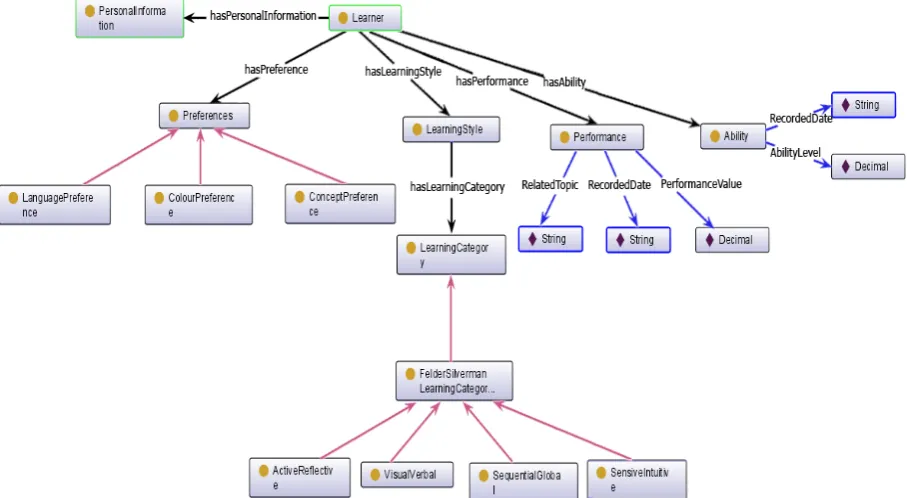
Figure 2: Graphical representation of user model ontology The Learner class is a central concept as it
includes all the properties of a learner. For each learner, the system needs information about personal identification such as names, passwords and emails as identifiers for learners. This information is kept in the PersonalInformation class. The other classes and properties of this ontology are aimed to represent learner’s learning profiles. Each learner is attached a set of performance related data which is presented in Performance class via hasPeformance
property. This class has some data properties for recording the learner’s performance namely relatedTopic,
performanceValue and recordedDate. The
Ability class represents the ability of learners which is calculated according to item response theory during the learning process. Moreover, each learner has a certain preferences regarding to language, colour and domain which is represented in Preferences class and pointed by
hasPereference property. Additionally, the
Figure 3: A fragment of domain model ontology
This ontology contains two properties
isTaughtAfter and isTaughtBefore to define
the topics sequencing in terms of the order in which the topics are to be presented to the learners.
The properties hasPrerequisite and
isPrerequisiteFor are defined to describe
prerequisite relations on the level of domain topics. The isRelatedTo property represents the relation between two topics which is semantically related to each other.
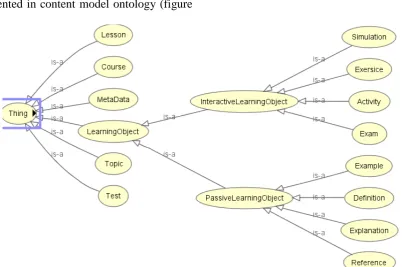
The structure of learning content is presented in content model ontology (figure
4). This structure includes three level of hierarchy namely course, lesson and learning object. Course class is the first level of hierarchy which is defined to describe the different feature of a course. These features are represented through some data properties which are attached to Metadata class. Course class is aggregated of several Lesson class via hasPart property and Lesson class is an aggregation of LearningObject class through hasLO property. In this ontology, learning objects are considered from the perspective of instructional roles. Therefore, the classes such as Example, Definition, Exercise, References are defined as a subclass of the LearningObject class. In this ontology, a Metadata class is defined to represent a set of metadata is attached to a course, lesson or learning object. This class is used to describe a course, lesson or learning object class via some data properties like name, keyword,
difficultyLevel and description.
[image:8.595.95.498.445.712.2]The learning content should be annotated in order to be searchable and reusable. In this system these three ontologies are used to annotate learning contents. The learning objects is annotated semi-automatically when the content author insert the LO to the repository. However, the annotation of a lesson and a course is performed fully automatic during the learning process.
5. Conclusion
This paper presents a personalised e-learning system which creates adaptive content for learner based on learner’s ability, learning style, level of knowledge and preferences. In addition, Ontology-based approach is used to design learner, content and domain model. The learner model describes learner’s characteristics to deliver the tailor content. The domain model consists of some classes and properties to define the topics of a domain and semantic relation between them. The content model describes the structure of courses and their component. This modelling is used to annotate learning objects and generate adaptive content based on individual learner’s needs. The response of the learner to some regular test during the learning process is analysed by the item response theory and the ability of learner is evaluated. After that, the progress from one stage of learning process to the next stage is determined based on the updated learner’s profile.
The prototype system is still being constructed. The learner will be tested by this system, which can provide a personalised e-learning system.
6. References
Baker, F. B. (1992), Item Response Theory:
Parameter Estimation Techniques, New
York: Marcel Dekker.
Baker, F. B. (2001), The Basics of Item
Response Theory (second ed.), Washington:
ERIC clearing house on assessment and evaluation.
Brusilovsky, P. (2001), "Adaptive Hypermedia," User Modeling and User
Adapted Interaction, 11, 87-110.
Brusilovsky, P., Eklund, J., and Schwarz, E. (1998), "Web-Based Education for All: A Tool for Developing Adaptive Courseware "
in Proceedings of the Seventh International
World Wide Web Conference pp. 291-300.
Brusilovsky, P., Schwarz, E., and Weber, G. (1996), "Elm-Art: An Intelligent Tutoring System on the World Wide Web," in In Proceedings of the Third International
Conference, ITS.
Brusilovsky, P., Sosnovsky, S., and Yudelson, M. (2005), "Ontology-Based Framework for User Model Interoperability in Distributed Learning Environments " in
Proceedings of World Conference on
ELearning ( E-Learn 2005), Vancouver,
Canada, pp. 2851-2855.
Chen, C.-M. (2008), "Intelligent Web-Based Learning System with Personalized
Learning Path Guidance," Computers &
Education, 51, 787-814.
Chen, C.-M., and Chung, C.-J. (2008a), "Personalized Mobile English Vocabulary Learning System Based on Item Response Theory and Learning Memory Cycle,"
Computers & Education, 51, 624-647.
Chen, C.-M., and Duh, L.-J. (2008b), "Personalized Web-Based Tutoring System Based on Fuzzy Item Response Theory,"
Expert Systems with Applications, 34,
2298-2315.
Learning," Educational Technology &
Society, 11, 153-180.
Chen, C.-M., Lee, H.-M., and Chen, Y.-H. (2005), "Personalised E-Learning System Using Item Response Theory," Computers
& Education, 44, 237 - 255.
Conlan, O. (2006), "The Multi-Model, Metadata Driven Approach to Personalised
Elearning Services," University of
Dublin,Trinity College, Department of Computer Science.
Conlan, O., Wade, V., Bruen, C., and Gargan1, M. (2002), "Multi-Model, Metadata Driven Approach to Adaptive Hypermedia Services for Personalized Elearning," in Proceedings of The Second International Conference on Adaptive Hypermedia and Adaptive Web-Based
Systems :, London, UK: Springer-Verlag,
pp. 100-111.
De-Bra, P., and Calvi, L. (1998), "Aha: A Generic Adaptive Hypermedia System " in
Proceedings of the 2nd Workshop on
Adaptive Hypertext and Hypermedia,
Pittsburgh, pp. 5-22.
Felder, R. M., and Silverman, L. K. (1988), "Learning and Teaching Styles in
Engineering Education," Engineering
Education, 78, 674-681.
Gemmis, M. d., Semeraro, G., Lops, P., and Basile, P. (2008), "A Retrieval Model for Personalized Searching Relying on Content-Based User Profiles," Association for the
Advancement of Artificial Intelligence.
Golemati, M., Katifori, A., Vassilakis, C., Lepouras, G., and Halatsis, C. (2007), "Creating an Ontology for the User Profile: Method and Applications," in In
Proceedings of the First IEEE International Conference on Research Challenges in
Information Science (RCIS), Morocco.
Gruber, T. R. (1993), "A Translation Approach to Portable Ontology
Specification " Knowledge Acquisition, 5, 199-220.
Henze, N., Dolog, P., and Nejdl, W. (2004), "Reasoning and Ontologies for Personalized E-Learning in the Semantic Web,"
Educational Technology & Society, 7,
82-97.
Jovanović, J., et al. (2006), "Ontologies to Support Learning Design Context," in
PROCEEDINGS OF EUROPEAN CONFERENCE ON TECHNOLOGY
ENHANCED LEARNING.
Pan, J., Zhang, B., Wang, S., and Wu, G. (2007), "A Personalized Semantic Search Method for Intelligent E-Learning,"
International Conference on Intelligent
Pervasive Computing, 11-14
Sangineto, E. (2008), "An Adaptive E-Learning Platform for Personalized Course Generation," in Architecture Solutions for
E-Learning Systems, Hershey, USA: Idea
Group Inc, pp. 262-281.
Snae, C., and Brueckner, M. (2007),
"Ontology-Driven E-Learning System Based on Roles and Activities for Thai Learning Environment " Interdisciplinary Journal of
E-Learning and Learning Objects, 3, 1-17.
Soloman, B. A., and Folder, R. M. (2006), "Index of Learning Styles Questionnaire." Wang, F.-H. (2006), "Application of
Componential Irt Model for Diagnostic Test in a Standard Conformant Elearning
System," Sixth IEEE International Conference on Advanced Learning
Technologies, 237- 241.
Yarandi, M., Jahankhani, H., Dastbaz, M., and Tawil, A. R. (2011), "Personalised Mobile Learning System Based on Item Response Theory," 6th Annual Conference
on Advances in Computing and Technology,
108-115.
Yarandi, M., Tawil, A. R., and Jahankhani, H. (2011), "Adaptive E-Learning System Using Ontology," the Workshop