Comparative Analysis for Least Mean Square
and Normalized LMS for Speech Enhancement
Application
Mrinal Bachute1, R D Kharadkar2, S.S.Dorle3 1
Research Scholar, G.H. Raisoni Collage of Engineering, Nagpur, 2G.H Raisoni Institute of Engineering &Technology, Pune, Maharashtra, India
Abstract— Adaptive Signal Processing (ASP) is an active research area. Adaptive Filter based speech enhancement technique is now a day’s getting very popular due to wide range of applications like mobile communication, hearing aids and speech recognition systems. Although this problem has attracted significant research efforts for several decades, many aspects remain open and require further research. The steady state levels of error, SNR and convergence performance of the widely-used adaptive algorithms haven’t been fully explored. This paper aims to investigate performance analysis and enhancements for the normalized least mean square adaptive algorithms and its application in speech enhancement. Objective of Implementing and analyzing the algorithms is to modify the algorithm to improve convergence behaviour, reduce computational requirements and decrease steady state mean square error. Experimental results revel that refined algorithms perform better than the existing algorithms.
Keywords— Speech Enhancement, LMS, NLMS and Modified NLMS, MSE
I. INTRODUCTION
The speech signal may get corrupted due to various sources of noise. It becomes a challenge to maintain its high speech quality [2]. Noise Cancellation is a technique used for reducing undesired noise signal. Communication has become an integral part of our life. Improvements in Network bandwidth, computing speed, digital storage capacities, and techniques of noise reductions are changing our lives. In recent years, with the development of data communication in Internet and Wireless networks, more and more information is frequently transmitted as digital forms including text, image, audio, video and other media. Adaptive filters finds variety of applications in communication which includes noise control, echo cancellation and online machine learning. Adaptive filters are suitable for the systems in which the statistical characteristics of the signals to be filtered are either unknown prior or time variant (non-stationary signal) [3]. Speech enhancement is the area which deals with the improvement of quality and intelligibility of voice [4]. Speech enhancement finds the application in mobile phones, car communication, Teleconferencing, hearing aids, voice coders and Automatic speech recognition system. The speech cleaning aims in improvements in the intelligibility of speech to human listeners and improvement in quality of speech that makes it more acceptable to human listener. The evaluation methods for speech enhancement system can be classified as subjective methods and objective methods. Subjective methods use tests where human listeners are involved and objective method uses signal analysis test like SNR, PSEQ [6].
II. ADAPTIVEFILTERFORSPEECHENHANCEMENT
Over the last decades there is a significant research done for development of adaptive algorithms. Basic algorithms are categorized as, the Least - Mean – Square (LMS) algorithm, based on a gradient optimization for determining the coefficients and the class of Recursive Least-Squares algorithms (RLS)[2]. LMS algorithm is the most commonly used algorithms in adaptive filter. The filter finds coefficients to produce least mean squares of error signal (difference between actual signal and expected signal). It is a stochastic gradient descent method based on error at current time, invented by Bernard Widrow. The basic idea is to approach optimum filter weights by updating filter weights to converge to optimum filter weight. Steepest descent approach is used to find filter weights to minimize cost function. The algorithm does not use exact values of expectations hence weights would never reach optimal weights, but convergence is possible in mean. Due to this convergence LMS algorithm is sensitive to scaling of its input. LMS algorithm is simple in implementation. It is stable and robust against different signals.
filter should be changed in minimal manner. Normalization make this algorithm converges faster than LMS. The estimated error value between desired signal and filter output is less than LMS. Limitation of NLMS algorithm is due to normalization the complexity of the algorithm increases.
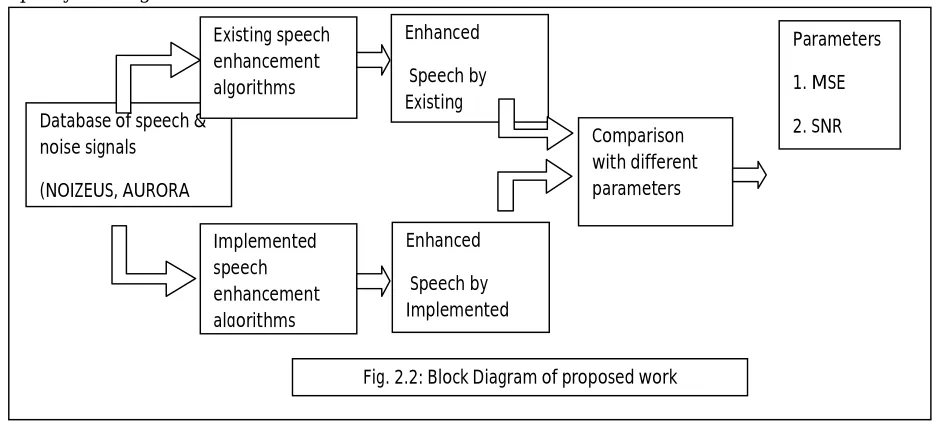
[image:3.612.70.538.106.318.2]Database of speech & noise signals (NOIZEUS, AURORA Existing speech enhancement algorithms Implemented speech enhancement algorithms Enhanced Speech by Existing Enhanced Speech by Implemented algorithms Parameters 1. MSE 2. SNR Comparison with different parameters
Fig. 2.2: Block Diagram of proposed work
A. LMS Algorithm
If the adaptive filter has a tapped delay line FIR structure, then the LMS update algorithm is simple. Typically, after each sample, the coefficients of the FIR filter are adjusted with respect to weight update equation. This algorithm does not require that the input values have any particular relationship; therefore it can be used to adapt a linear FIR filter. In this case the update formula is written as:
) ( ) ( ) ( ) 1
(n wn e n wn
w
) ( ) ( ) ( )
(n dn wTnxn
e
Where
is the convergence parameter (i.e. step-size),
e(n) is the output error, d (n) is the desired signal and x (n) is the input signal.
The effect of the LMS algorithm is at each time n, to make a small change in each weight. The direction of the change is such
that it would decrease the error if it had been applied at time n. The magnitude of the change in each weight depends on μ, the
associated input value and the error at time n. The weights making the largest contribution to the output are changed the most. If the error is zero, then there should be no change in the weights. If the associated value of inputs is zero, then changing the weight makes no difference, so it is not changed.
Convergence factor μ controls how fast and how well the algorithm converges to the optimum filter coefficients. If μ is too large, the algorithm will not converge. If μ is too small the algorithm converges slowly and may not be able to track changing
conditions. If μ is large but not too large to prevent convergence, the algorithm reaches steady state rapidly but continuously
overshoots the optimum weight vector. Sometimes, μ is made large at first for rapid convergence and then smaller value of step
size is used.
B. Normalized LMS algorithm
For the adaptive NLMS algorithm normalization is done to the next sample weight update equation. In case of LMS algorithm if error signal gets reduced to zero then next samples will be zero for avoiding this, normalization is used. Thus for that purpose constant factor is used so as to introduce non zero term at the base. The following weight update equation has been used:
) ( ) ( ) ( 2 ) ( ) 1
( e n x n
n x n w n
2( ) ) ( ) ( ) 1 ( ) ( n dx p n de n dx n w n w (5.8)
Where constant & p is used for normalization purpose Modified Normalized LMS algorithm
Where,
III.PERFORMANCEEVALUATIONPARAMETERS
The quality of the enhanced speech is evaluated on the basis of the following parameters. Mean Square Error:
In statistics, the mean squared error (MSE) of an signal is one of many ways to quantify the difference between values implied by an estimator and the true values of the quantity being estimated.
MSE is given by,
' 2 , , 1 1
1
(
)
M Nj k j k j K
MSE
x
x
MN
Signal to Noise Ratio
The signal to noise ratio is used as measure of quality of corrupted speech with respect to enhanced speech. SNR can mathematically be defined as
log10 10 ) 1 2 0 2 0 2 ( f f f SNR
IV.EXPERIMENTATIONANDVALIDATION
All we have used speech signal with different combinations of noise signal. For that purpose we have used NOIZEUS AURORA DATABASE. For studying these algorithms, we have used different speech signals corrupted with 0dB, 5dB and 10dB noise. These signals are collected from NOIZEUS database. The speech signal that we use was “We find joy in the simplest thing.” Different noise signals include Airport noise, Babble noise, Car Noise, Exhibition Noise, Restaurant Noise, Station Noise, Street Noise and Train Noise with 0dB, 5dB and 10dB values.
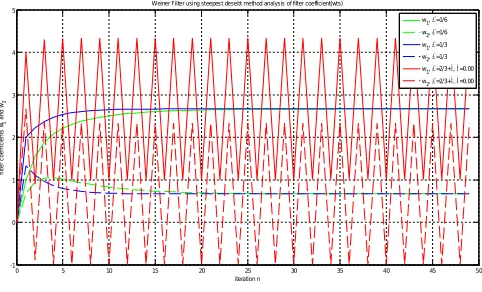
0 5 10 15 20 25 30 35 40 45 50
-1 0 1 2 3 4 5 iteration n fi lt e r c o e ff ic ie n ts w1 a n d w2
Weiner Filter using steepest desebt method analysis of filter coefficient(wts)
w
1, =1/6
w
2, =1/6
w1, =1/3 w2, =1/3 w1, =2/3+, =0.00 w
[image:4.612.192.433.526.672.2]2, =2/3+, =0.00
Figure 1:Filter coefficient Analysis )] ( 2 [ 1 )
( x n
xT n
0 5 10 15 20 25 30 35 40 45 50 -8 -6 -4 -2 0 2 4 6 8 10 iteration n fi lt e r c o e ff ic ie n ts w1 a n d w2
Weiner Filter using steepest desebt method analysis of filter coefficient(wts)
w1, =1/6 w
2, =1/6
w
1, =1/3
w2, =1/3 w
1, =2/3+, =0.01
w
[image:5.612.180.448.81.259.2] [image:5.612.179.449.301.452.2]2, =2/3+, =0.01
Figure 2:convergence parameter and the effect on filter coefficient
0 5 10 15 20 25 30 35 40 45 50
-1 0 1 2 3 4 5
it eration n
fi lt e r c o e ff ic ie n ts w1 a n d w2
Weiner Filter using steepest desebt method analysis of filter coefficient(wts)
w1, = 1/6 w
2, = 1/6 w1, = 1/3 w2, = 1/3 w
[image:5.612.85.528.503.688.2]1, = 2/3+, =-0.01 w2, = 2/3+, =-0.01
Figure 2:convergence parameter and the effect on filter coefficient
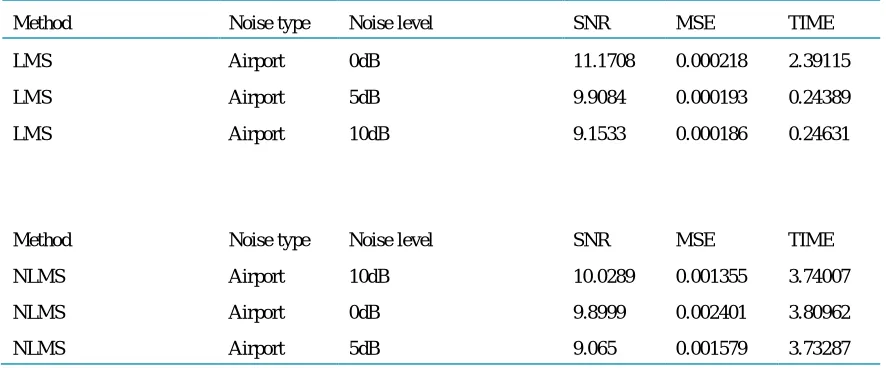
Table 1: Performance of LMS and NLMS in presence of airport noise
Method Noise type Noise level SNR MSE TIME
LMS Airport 0dB 11.1708 0.000218 2.39115
LMS Airport 5dB 9.9084 0.000193 0.24389
LMS Airport 10dB 9.1533 0.000186 0.24631
Method Noise type Noise level SNR MSE TIME
NLMS Airport 10dB 10.0289 0.001355 3.74007
NLMS Airport 0dB 9.8999 0.002401 3.80962
V. CONCLUSIONS
The step size is varied and its effect on filter coefficients are analyzed .Initially step size µ=1/6, 1/3and 2/3 are considered. It is observed that when µ=1/6 filter smoothly converges as seen in the plot. When µ=1/3 filter converges as shown in the plot. But when the value of µ is again increased further µ =2/3 the filter weights change abruptly as seen in the plot. Choice of µ is very important, a small µ value gives slow convergence and a large µ value constitutes a risk for divergence. The performance of NLMS is better than LMS considering SNR and MSE. Experimental results revel that NLMS algorithms perform better than the existing algorithms.
REFERENCES
[1] Jie, Yang, and Wang Zhenli. "On the application of variable-step adaptive noise cancelling for improving the robustness of speech recognition." In Computing, Communication, Control, and Management, 2009. CCCM 2009. ISECS International Colloquium on, vol. 2, pp. 419-422. IEEE, 2009. [2] Pandey, Alkon, L. D. Malviya, and Vineet Sharma. "Comparative study of LMS and NLMS algorithms in adaptive equalizer." International Journal of
Engineering Research and Applications (IJERA) 2, no. 3 (2012): 1584-1587.
[3] Douglas, Scott C., and Weimin Pan. "Exact expectation analysis of the LMS adaptive filter." Signal Processing, IEEE Transactions on 43, no. 12 (1995): 2863-2871.
[4] Chu, Hyung Suk, and Chong Koo An. "Design of the adaptive noise canceler using neural network with backpropagation algorithm." In Science and Technology, 1999. KORUS'99. Proceedings. The Third Russian-Korean International Symposium on, vol. 2, pp. 762-764. IEEE, 1999.
[5] Yi Hu, Philipos C. Loizou,” Subjective comparison and evaluation of speech enhancement algorithms”, Speech Communication ELSEVIER Journal,SPCOM Science Direct,pp-588 – 601, 2006
[8] Kailath, “Lectures on Wiener and Kalman filtering”, Springer link 2001, New York [8] Scott C. Douglas, ZEEE and Weimin Pan” Exact Expectation Analysis of the LMS Adaptive Filter’. IEEE Transactions on Signal Processing, vol. 43, no. 12, Dec 2001.
[9] Christian Feldbauer, Franz Pernkopf, and Erhard Rank Signal Processing and Speech Communication Laboratory Tutorial on Adaptive Filters. http://www.dsprelated.com
[10] S.C. Douglas. “Exact Expectation Analysis without the independence assumption of the LMS Adaptive Filter” IEEE Transactions on Signal Processing, vol. 43, no. 12, Dec 2000.
[11] F. Yang, M. Wu, P. Ji, and J. Yang, “An Improved Multiband-Structured Subband Adaptive Filter Algorithm,” vol. 19, no. 10, pp. 647–650, 2012.
Mrs. M. R. Bachute is research scholar of G. H. Raisoni College of Engineering, Nagpur, Maharashtra, India. She has completed her ME (Digital Electronics) from College of Engineering, Badnera, Amravati Maharashtra.
Currently she pursuing her PhD from RTM University Nagpur, Maharashtra and working as a Assistant Professor at G. H. Raisoni Institute of Engineering and Technology, Pune, Maharashtra. She has teaching experience of 15 years. She has guides UG and PG students for the projects. Her area of working is Digital Signal Processing and Adaptive Signal Processing. She has attended National & International workshops and conferences.
Mrs. M. R. Bachute is life member of ISTE, IE (India) and IEEE
Dr. R. D. Kharadkar is Professor in Electronics and Telecommunication Engineering at University of Pune, Pune Maharashtra. He completed his ME (Electronics) and PhD from Shivaji University, Kolhapur, Maharashtra. His field of working is in Digital Signal Processing and Networking. He is Principal at G. H. Raisoni Institute of Engineering and Technology, Pune, Maharashtra. He is senior member of IEEE.
He has teaching and industrial experience of 32 years. He has also worked with Tata Motors, Pune, Maharashtra. He has published papers in National, International journals and conferences. He guides the ME and PhD students. He chaired National and International conference sessions.
Dr. R. D. Kharadkar is currently working as a member of Board of Studies and Faculty of Technology at University of Pune, Maharashtra. He is a life member of ISTE, IETE, IE and ISIO.
Dr. S. S. Dorleis Professor and Head in Electronics Engineering Department at G. H. Raisoni College of
Engineering, Nagpur, Maharashtra. He completed his M.Tech (EDT) and Ph.D from VNIT, Nagpur, Maharashtra. His field of working is Adhoc Networks.
He has 17 years of teaching experience. He has published papers in National, International journals and conferences. He guides the ME and PhD students. He worked as resource person for various STTP, seminars and workshops. He worked as reviewer for various International Journals.